mirror of
https://github.com/gitleaks/gitleaks.git
synced 2026-11-27 11:44:23 +01:00
Compare commits
| Author | SHA1 | Date | |
|---|---|---|---|
 Zachary Rice |
923dcf0311 | ||
 Cristhian Amaya |
8896cf66cd | ||
 zach rice |
df133ccaf8 | ||
|
Zachary Rice
|
23cd693d71 | ||
|
zach rice
|
524d81fde9 | ||
|
zach rice
|
d387f528c4 | ||
|
zach rice
|
dcda26578b | ||
|
Zachary Rice
|
28639d3a49 | ||
|
zach rice
|
19e23c9cbe | ||
|
Zachary Rice
|
160015b872 | ||
|
zach rice
|
abdf2c47f0 | ||
|
zach rice
|
8536f16ceb | ||
|
Zachary Rice
|
6862c13bf7 | ||
|
zach rice
|
9939c638ec | ||
|
zach rice
|
ed3a512b4b | ||
|
Zachary Rice
|
7c988c927d | ||
|
zach rice
|
bde9af44ea | ||
|
Zachary Rice
|
eee4d05642 | ||
|
Cristhian Amaya
|
9144594d77 | ||
|
Cristhian Amaya
|
1cb15242fd | ||
|
Zachary Rice
|
08498600d1 | ||
|
zach rice
|
88c0c7779b | ||
|
Zachary Rice
|
67454d109e | ||
|
zach rice
|
ce603c73b4 | ||
|
zach rice
|
55218fc8f8 | ||
|
Zachary Rice
|
5d81c650e8 | ||
|
zach rice
|
0726209172 | ||
|
zach rice
|
bfec8aca51 | ||
|
Zachary Rice
|
a9b30edb06 | ||
|
Zachary Rice
|
cc6d698e63 | ||
|
Zachary Rice
|
2ba97d0fa3 | ||
|
Zachary Rice
|
d299b5aa7f | ||
|
Zachary Rice
|
0a209b60a5 | ||
|
Zachary Rice
|
fe8c6271f2 | ||
|
zach rice
|
42fb085684 | ||
|
Zachary Rice
|
3faec00bf9 | ||
|
Zachary Rice
|
93669f1ee8 | ||
|
Zachary Rice
|
fad98cbde2 | ||
|
Zachary Rice
|
8eb28cbb4c | ||
|
zach rice
|
9dc9a8e62a | ||
|
zach rice
|
e6caef0d94 | ||
|
Zachary Rice
|
5e289ed0cc | ||
 Fabian Helfert |
d99588fe19 | ||
|
Fabian Helfert
|
a7ccb7a9d1 | ||
|
Zachary Rice
|
f32abb921d | ||
 Nenad Stojanovikj |
e8851c1f99 | ||
|
Zachary Rice
|
f3a8359ac0 | ||
|
zach rice
|
829e8fed8c | ||
|
zach rice
|
c7e3605bff | ||
|
zach rice
|
c1774b1596 | ||
|
Zachary Rice
|
35710a7428 | ||
 Eric Ripa |
c7ba4d8bbf | ||
|
Eric Ripa
|
5585e10933 | ||
|
Eric Ripa
|
23d5bf0b51 | ||
|
Eric Ripa
|
b1c7a84fae | ||
|
Zachary Rice
|
60801b336a | ||
|
Zachary Rice
|
851ea3df3c | ||
|
Zachary Rice
|
d482577e47 | ||
|
zricethezav
|
94e7a25b5b | ||
|
zricethezav
|
45d94fa013 | ||
|
zricethezav
|
b4e69ecd37 | ||
|
zricethezav
|
1c2820b4f1 | ||
|
zricethezav
|
215c3f6623 | ||
|
Zachary Rice
|
39b162cadf | ||
|
zricethezav
|
e0c717c3a3 | ||
|
zricethezav
|
ebb9be999f | ||
|
Zachary Rice
|
5fbb15be62 | ||
|
Zachary Rice
|
8922546a00 | ||
 arjunyel |
38b7fc3cfb | ||
|
arjunyel
|
8a76e0af27 | ||
|
Zachary Rice
|
1f80d14f3f | ||
|
zricethezav
|
91eb014f17 | ||
|
Zachary Rice
|
6122092224 | ||
|
zricethezav
|
55102bd461 | ||
|
Zachary Rice
|
9927c0bd4b | ||
|
zricethezav
|
ba6f0c4d88 | ||
|
Zachary Rice
|
a52abe0b31 | ||
|
zricethezav
|
b1ae2a02fe | ||
|
Zachary Rice
|
f7fca41beb | ||
 zricethezav |
a257e9ed2e | ||
|
zricethezav
|
c51944c4d2 | ||
|
zricethezav
|
8e59bf766a | ||
|
zricethezav
|
fa498287b9 | ||
|
zricethezav
|
c77421d077 |
No files matched your search
+17
-5
@@ -1,7 +1,19 @@
|
||||
sudo: required
|
||||
language: go
|
||||
go:
|
||||
- 1.9
|
||||
|
||||
go:
|
||||
- 1.9
|
||||
services:
|
||||
- docker
|
||||
script:
|
||||
- go test -v
|
||||
|
||||
- make test
|
||||
after_success:
|
||||
- export REPO=zricethezav/gitleaks
|
||||
- export TAG=`if [ "$TRAVIS_BRANCH" == "master" ]; then echo "latest"; else echo $TRAVIS_BRANCH;
|
||||
fi`
|
||||
- if [ "$TRAVIS_PULL_REQUEST" = "false" ]; then make deploy; fi
|
||||
env:
|
||||
global:
|
||||
- secure: kUjq6Jgnm57V+ikDoYJ4IrFu4bLMHkaBb9uLtbQj0A545zZt4Dbooarnwqbfz2efqqMDZ9TXP6kN6677yWm0DyvFOCYx/Xq2innnVbBJczQciEUb5PI/9fcmLOfTe/QgGNi0GZOCdIOGlki2sbKxob6tTOUsm52ugRSJU92cXkX8w+Gzc6pC6fAb4moLE2QpwK1xWDHm2sHiZYExpBOH8eidSH5VPGVdNE9QmUA/FwwJ9NFGsZ8BgWCJPy7IJreyixsv2nNpiZNHoj0UgKe4wylzceu4sG/yQDIYk3fLVWBXSm/nSA17QYIjVMzQFjSAVC5dRqzq8HzFYiAYLKzkoOtrbBqEGtXzYZMN6yC8zEedk9gX6P6mvGpWYBy280uumcpGl6eoKYj5ke2H6kfcCUhMNTGZP17nmnTa1KFLAz1nxB1jfJwwO6v1l+xdytju5yAhm049Af7VyDM5GmE2x5ha48uKvK7wHtv+IKiZbbcR9ExsXvm21+7NVjQvRPzAw4/Sor9SG/yjoA/Sf7e4evy1w3fALv4WlaSisj5Yalmv7mzeeFZaIB7EIq6OryeRld2Rr1MZwwhZgIs7+SWwpjKfwhkfLVEUvSWCdnS2tnTydK6R6OFxfG5TGfR/WHooXLHEv5gMuKhUu/CqnbLyvI+8IOH2ybz2AtZWjf5n7oY=
|
||||
- secure: cIxKSkBNkPFAn243eHtwHJb8z6Uty1cZ43ZK/UABjwJoSrhu/roK4soqdZLwdVRA/0QswAlp6AC25Zs3ngLKGxxFHoeB8Tx6VLanE1zoi8OT0I2KbT92FdrLV4HlcRshKZtTFoTCfgVKPnWNKC+hil97CQzQPGRpZLBSfNefk5uCMnQiAzaJ5lyWPx+sjLHzpVlGA6aQx9ZeBQqngQJoDHKc0K3hKwug4h9mkkhyaYE3kgxtsdOYlHvOtQgVk+Zih5uW7ABOQCyAOaQVipXBC+uiuNf2DeAuGDaX69DTRKqPzuIasbhwyGqlfsr2JeofEWgZGmTaWGKMi03hnIY+U9+lHjygBW1qqVglODboouUrV3LwER9kqrT+ZFTM5Ca8VB+Gx5khkknbjWd06jpzRQxNXdukYN89kEaAHkBH844G99pMDqcZ32lHK7lpCu8n1H/Liz3ygoV6ScJXnYAP6y9rrd3bb9KEmnKhmFacVLRIAUw1vN/cgspJpl/Mk6s5rvGwsbQih1OxGyooOLxGjEGWqVDFgHFtyiwX9s9kT+hNTwKgbhp7Ragk/QuDYUPZ3Vum7HoiNPS9KpQNstLvDckdtd8h13JIw6nX+xdWbNKjjdYbAZRstJHUROQtNq3XdWNQ9YjqbCoybaxCOwOUTwOiTSWNKXjTFbFI5mR/ZO0=
|
||||
- COMMIT=${TRAVIS_COMMIT::8}
|
||||
- secure: o6uPX071qGRKgOQmitxiDr1j+KRW8W6ru0wmKNBFuUlZvQudwCUZMnVfk6OeofT1IgLCHmLS8ST81cTyeXqOQhYVZrlxTmEUpDHHRTu6dOj3eqRzdJow1LIWNpw5xfOaqXUdQ8+SQ47ZeSFapsmaY9oeRDvSJ8zLS4qUdgUylvZFJWjSrjzi2xemJa1l3MDdZRhEaNkfMliDGCv2vuUFp7tYz0QtyqBkBMORQl53dzgrcQcsRjDSE274WJl9CUg1l0pNMFsAbVCUGwUqCmKace9LXZ9JV00TRdg4EpryDsUCi23q0THnwstvRffwyJrw+xbhY/X3GKC4zOKqiCLJ4MTPQEIKlpVJQ9e9lWJ8FYhpUrl3QaHfEPINJ0taUfGhCyNzi5QBkSWbTcWVmRMmu+QIy7moW9crcz2xmVEUey7AaGwZT2Kk6JGw26w5q9IUy1Z9mwaljmHrUTqZrOX4Hj3UblpkHN+mGkoia/ipta5KhN5lTTIs4N3V+El7O2R2GggBrVHNiSualfydo+RX8k/S6PM1/C88IQO3Y2utoJrr415CznncvhF9Sc6tncZcShcNQj1iEOSsGxY2noW265eHzTMKJ/xuN6Bp9OXVK+8iOcUsz1T7F0UqwY3xnD8F7fBZ7IGG41DsXBDIcPmb+SIYbhv0uJjm3BEuv4TzIU0=
|
||||
+124
-17
@@ -1,26 +1,133 @@
|
||||
CHANGELOG
|
||||
=========
|
||||
1.12.1
|
||||
----
|
||||
- Show program usage when no arguments are provided
|
||||
- Exit program after the -h or --help options are used
|
||||
1.12.0
|
||||
----
|
||||
- removing --csv option
|
||||
- --report option now requires .json or .csv in filename
|
||||
- adding total time to audit in logs
|
||||
|
||||
1.11.1
|
||||
----
|
||||
- fix commit whitelist logic
|
||||
|
||||
1.11.0
|
||||
-----
|
||||
- Commit depth option
|
||||
- Commit stats output
|
||||
|
||||
1.10.0
|
||||
-----
|
||||
- Add entropy option
|
||||
|
||||
1.9.0
|
||||
-----
|
||||
- exclude fork option
|
||||
|
||||
1.8.0
|
||||
-----
|
||||
- whitelist repos
|
||||
- sample config option
|
||||
|
||||
1.7.3
|
||||
-----
|
||||
- style points
|
||||
|
||||
1.7.2
|
||||
-----
|
||||
- Fixing dangling goroutines, removing channel messaging
|
||||
|
||||
1.7.1
|
||||
-----
|
||||
- Fixing bug where single repos were not being audited
|
||||
|
||||
1.7.0
|
||||
-----
|
||||
- Exit code == 2 on error
|
||||
- Cleaning up some logs
|
||||
- Removing some unreachable code
|
||||
|
||||
1.6.1
|
||||
-----
|
||||
- Recover from panic when diffing
|
||||
|
||||
1.6.0
|
||||
-----
|
||||
- Default maximum goroutines spawned is number of cores your cpu run with. See benchmarks in wiki.
|
||||
- Cleanup after each repo audit for organizations rather than waiting for the entire organization to complete. Eliminates risk of running out of disk space.
|
||||
|
||||
|
||||
1.5.0
|
||||
-----
|
||||
- Support for CSV reporting
|
||||
- Refactoring github user/owner audits
|
||||
|
||||
1.4.0
|
||||
-----
|
||||
- Support for single commit repos
|
||||
- Bumped go-git version from 4.5.0 to 4.7.0
|
||||
|
||||
1.3.0
|
||||
-----
|
||||
- Target specific branch
|
||||
|
||||
1.2.1
|
||||
-----
|
||||
- Check errors when generating commit patch
|
||||
|
||||
1.2.0
|
||||
-----
|
||||
- Added support for providing an alternate GitHub URL to support scanning GitHub Enteprise repositories
|
||||
|
||||
1.1.2
|
||||
-----
|
||||
- Added version option
|
||||
- Introduced changelog
|
||||
|
||||
1.1.1
|
||||
-----
|
||||
- Fixed commit patch order
|
||||
- Updated Readme
|
||||
|
||||
1.1.0
|
||||
-----
|
||||
- Fixed Twitter typo
|
||||
- Fixed sample docker command
|
||||
- Default clone option to "in-memory"
|
||||
- Added clone option for "disk"
|
||||
- Updated Makefile
|
||||
|
||||
1.0.0
|
||||
-----
|
||||
- Rewrite, see Readme.md: https://github.com/zricethezav/gitleaks/releases/tag/v1.0.0
|
||||
|
||||
0.4.0
|
||||
-----
|
||||
- Added support for external regexes
|
||||
|
||||
0.3.0
|
||||
-----
|
||||
- Added local scan
|
||||
- Meaningful exit codes
|
||||
- Timestamped logs
|
||||
- Refactored for some maintainability
|
||||
|
||||
0.2.0
|
||||
-----
|
||||
Version 0.2.0 of Gitleaks is the first version update since this got relatively popular. Based on the issues raised it seems that folks want better support for integration into their pipelines. I hear ya. This is what this update tries to provide. So... what are the changes?
|
||||
|
||||
* Additionally regex checking
|
||||
* $HOME/.gitleaks/ directory for clones and reports
|
||||
* Clone into temp dir option
|
||||
* Persistent repos for Orgs and Users (no more re-cloning)
|
||||
* Pagination for Org/User list... no more partial repo lists
|
||||
* Since commit option
|
||||
* Updated README
|
||||
* Multi-staged Docker build
|
||||
* Travis CI
|
||||
|
||||
- Additionally regex checking
|
||||
- $HOME/.gitleaks/ directory for clones and reports
|
||||
- Pagination for Org/User list... no more partial repo lists
|
||||
- Persistent repos for Orgs and Users (no more re-cloning)
|
||||
- Updated README
|
||||
- Multi-staged Docker build
|
||||
- Travis CI
|
||||
|
||||
0.1.0
|
||||
-----
|
||||
- full git history search
|
||||
- regex/entropy checks
|
||||
- report generation
|
||||
|
||||
Version 0.1.0 of Gitleaks demonstrates:
|
||||
|
||||
* full git history search
|
||||
* regex/entropy checks
|
||||
* report generation
|
||||
@@ -0,0 +1,20 @@
|
||||
# Contributing Guidelines
|
||||
|
||||
The gitleaks project is under [GNU General Public License v3.0](LICENSE.md) and accepts
|
||||
contributions via GitHub pull requests.
|
||||
|
||||
## How to Contribute
|
||||
|
||||
Open a PR. Give the PR a descriptive title. Add some comments describing whats the purpose of the PR.
|
||||
|
||||
__BUT before you do that!__
|
||||
|
||||
Make sure you pass this list of requirements.
|
||||
|
||||
- You've ran `go fmt`.
|
||||
- You've ran `golint`.
|
||||
- Your Go changes are confined to `gitleaks_test.go` and `main.go`. This is subject to change as the project evolves. Stylistically, I like having a single go file considering the size of this project (its tiny).
|
||||
- You've added test cases for your changes.
|
||||
- You've updated [the changelog](CHANGELOG.md).
|
||||
- Your tests pass.
|
||||
|
||||
+1
-1
@@ -1,4 +1,4 @@
|
||||
FROM golang:1.10.0 AS build
|
||||
FROM golang:1.10.3 AS build
|
||||
WORKDIR /go/src/github.com/zricethezav/gitleaks
|
||||
COPY . .
|
||||
RUN CGO_ENABLED=0 go build -o bin/gitleaks *.go
|
||||
|
||||
Generated
+203
-14
@@ -2,16 +2,35 @@
|
||||
|
||||
|
||||
[[projects]]
|
||||
name = "github.com/boltdb/bolt"
|
||||
name = "github.com/BurntSushi/toml"
|
||||
packages = ["."]
|
||||
revision = "2f1ce7a837dcb8da3ec595b1dac9d0632f0f99e8"
|
||||
version = "v1.3.1"
|
||||
revision = "3012a1dbe2e4bd1391d42b32f0577cb7bbc7f005"
|
||||
version = "v0.3.1"
|
||||
|
||||
[[projects]]
|
||||
name = "github.com/emirpasic/gods"
|
||||
packages = [
|
||||
"containers",
|
||||
"lists",
|
||||
"lists/arraylist",
|
||||
"trees",
|
||||
"trees/binaryheap",
|
||||
"utils"
|
||||
]
|
||||
revision = "1615341f118ae12f353cc8a983f35b584342c9b3"
|
||||
version = "v1.12.0"
|
||||
|
||||
[[projects]]
|
||||
name = "github.com/franela/goblin"
|
||||
packages = ["."]
|
||||
revision = "cd5d08fb4ede9eaac1812fdb513552e7404eae2e"
|
||||
version = "0.0.2"
|
||||
|
||||
[[projects]]
|
||||
name = "github.com/golang/protobuf"
|
||||
packages = ["proto"]
|
||||
revision = "925541529c1fa6821df4e44ce2723319eb2be768"
|
||||
version = "v1.0.0"
|
||||
revision = "aa810b61a9c79d51363740d207bb46cf8e620ed5"
|
||||
version = "v1.2.0"
|
||||
|
||||
[[projects]]
|
||||
name = "github.com/google/go-github"
|
||||
@@ -20,10 +39,99 @@
|
||||
version = "v15.0.0"
|
||||
|
||||
[[projects]]
|
||||
branch = "master"
|
||||
name = "github.com/google/go-querystring"
|
||||
packages = ["query"]
|
||||
revision = "53e6ce116135b80d037921a7fdd5138cf32d7a8a"
|
||||
revision = "44c6ddd0a2342c386950e880b658017258da92fc"
|
||||
version = "v1.0.0"
|
||||
|
||||
[[projects]]
|
||||
name = "github.com/hako/durafmt"
|
||||
packages = ["."]
|
||||
revision = "7b7ae1e72eade09dbc9c2cfba3e6c4bae7b8bcac"
|
||||
version = "1.0.0"
|
||||
|
||||
[[projects]]
|
||||
branch = "master"
|
||||
name = "github.com/jbenet/go-context"
|
||||
packages = ["io"]
|
||||
revision = "d14ea06fba99483203c19d92cfcd13ebe73135f4"
|
||||
|
||||
[[projects]]
|
||||
name = "github.com/jessevdk/go-flags"
|
||||
packages = ["."]
|
||||
revision = "c6ca198ec95c841fdb89fc0de7496fed11ab854e"
|
||||
version = "v1.4.0"
|
||||
|
||||
[[projects]]
|
||||
name = "github.com/kevinburke/ssh_config"
|
||||
packages = ["."]
|
||||
revision = "81db2a75821ed34e682567d48be488a1c3121088"
|
||||
version = "0.5"
|
||||
|
||||
[[projects]]
|
||||
name = "github.com/mitchellh/go-homedir"
|
||||
packages = ["."]
|
||||
revision = "ae18d6b8b3205b561c79e8e5f69bff09736185f4"
|
||||
version = "v1.0.0"
|
||||
|
||||
[[projects]]
|
||||
name = "github.com/pelletier/go-buffruneio"
|
||||
packages = ["."]
|
||||
revision = "c37440a7cf42ac63b919c752ca73a85067e05992"
|
||||
version = "v0.2.0"
|
||||
|
||||
[[projects]]
|
||||
name = "github.com/sergi/go-diff"
|
||||
packages = ["diffmatchpatch"]
|
||||
revision = "1744e2970ca51c86172c8190fadad617561ed6e7"
|
||||
version = "v1.0.0"
|
||||
|
||||
[[projects]]
|
||||
name = "github.com/sirupsen/logrus"
|
||||
packages = ["."]
|
||||
revision = "3e01752db0189b9157070a0e1668a620f9a85da2"
|
||||
version = "v1.0.6"
|
||||
|
||||
[[projects]]
|
||||
name = "github.com/src-d/gcfg"
|
||||
packages = [
|
||||
".",
|
||||
"scanner",
|
||||
"token",
|
||||
"types"
|
||||
]
|
||||
revision = "f187355171c936ac84a82793659ebb4936bc1c23"
|
||||
version = "v1.3.0"
|
||||
|
||||
[[projects]]
|
||||
name = "github.com/xanzy/ssh-agent"
|
||||
packages = ["."]
|
||||
revision = "640f0ab560aeb89d523bb6ac322b1244d5c3796c"
|
||||
version = "v0.2.0"
|
||||
|
||||
[[projects]]
|
||||
branch = "master"
|
||||
name = "golang.org/x/crypto"
|
||||
packages = [
|
||||
"cast5",
|
||||
"curve25519",
|
||||
"ed25519",
|
||||
"ed25519/internal/edwards25519",
|
||||
"internal/chacha20",
|
||||
"internal/subtle",
|
||||
"openpgp",
|
||||
"openpgp/armor",
|
||||
"openpgp/elgamal",
|
||||
"openpgp/errors",
|
||||
"openpgp/packet",
|
||||
"openpgp/s2k",
|
||||
"poly1305",
|
||||
"ssh",
|
||||
"ssh/agent",
|
||||
"ssh/knownhosts",
|
||||
"ssh/terminal"
|
||||
]
|
||||
revision = "0e37d006457bf46f9e6692014ba72ef82c33022c"
|
||||
|
||||
[[projects]]
|
||||
branch = "master"
|
||||
@@ -32,7 +140,7 @@
|
||||
"context",
|
||||
"context/ctxhttp"
|
||||
]
|
||||
revision = "22ae77b79946ea320088417e4d50825671d82d57"
|
||||
revision = "f04abc6bdfa7a0171a8a0c9fd2ada9391044d056"
|
||||
|
||||
[[projects]]
|
||||
branch = "master"
|
||||
@@ -41,13 +149,29 @@
|
||||
".",
|
||||
"internal"
|
||||
]
|
||||
revision = "2f32c3ac0fa4fb807a0fcefb0b6f2468a0d99bd0"
|
||||
revision = "d2e6202438beef2727060aa7cabdd924d92ebfd9"
|
||||
|
||||
[[projects]]
|
||||
branch = "master"
|
||||
name = "golang.org/x/sys"
|
||||
packages = ["unix"]
|
||||
revision = "dd2ff4accc098aceecb86b36eaa7829b2a17b1c9"
|
||||
packages = [
|
||||
"unix",
|
||||
"windows"
|
||||
]
|
||||
revision = "b09afc3d579e346c4a7e4705953acaf6f9e551bd"
|
||||
|
||||
[[projects]]
|
||||
name = "golang.org/x/text"
|
||||
packages = [
|
||||
"internal/gen",
|
||||
"internal/triegen",
|
||||
"internal/ucd",
|
||||
"transform",
|
||||
"unicode/cldr",
|
||||
"unicode/norm"
|
||||
]
|
||||
revision = "f21a4dfb5e38f5895301dc265a8def02365cc3d0"
|
||||
version = "v0.3.0"
|
||||
|
||||
[[projects]]
|
||||
name = "google.golang.org/appengine"
|
||||
@@ -60,12 +184,77 @@
|
||||
"internal/urlfetch",
|
||||
"urlfetch"
|
||||
]
|
||||
revision = "150dc57a1b433e64154302bdc40b6bb8aefa313a"
|
||||
version = "v1.0.0"
|
||||
revision = "ae0ab99deb4dc413a2b4bd6c8bdd0eb67f1e4d06"
|
||||
version = "v1.2.0"
|
||||
|
||||
[[projects]]
|
||||
name = "gopkg.in/src-d/go-billy.v4"
|
||||
packages = [
|
||||
".",
|
||||
"helper/chroot",
|
||||
"helper/polyfill",
|
||||
"osfs",
|
||||
"util"
|
||||
]
|
||||
revision = "982626487c60a5252e7d0b695ca23fb0fa2fd670"
|
||||
version = "v4.3.0"
|
||||
|
||||
[[projects]]
|
||||
name = "gopkg.in/src-d/go-git.v4"
|
||||
packages = [
|
||||
".",
|
||||
"config",
|
||||
"internal/revision",
|
||||
"plumbing",
|
||||
"plumbing/cache",
|
||||
"plumbing/filemode",
|
||||
"plumbing/format/config",
|
||||
"plumbing/format/diff",
|
||||
"plumbing/format/gitignore",
|
||||
"plumbing/format/idxfile",
|
||||
"plumbing/format/index",
|
||||
"plumbing/format/objfile",
|
||||
"plumbing/format/packfile",
|
||||
"plumbing/format/pktline",
|
||||
"plumbing/object",
|
||||
"plumbing/protocol/packp",
|
||||
"plumbing/protocol/packp/capability",
|
||||
"plumbing/protocol/packp/sideband",
|
||||
"plumbing/revlist",
|
||||
"plumbing/storer",
|
||||
"plumbing/transport",
|
||||
"plumbing/transport/client",
|
||||
"plumbing/transport/file",
|
||||
"plumbing/transport/git",
|
||||
"plumbing/transport/http",
|
||||
"plumbing/transport/internal/common",
|
||||
"plumbing/transport/server",
|
||||
"plumbing/transport/ssh",
|
||||
"storage",
|
||||
"storage/filesystem",
|
||||
"storage/filesystem/dotgit",
|
||||
"storage/memory",
|
||||
"utils/binary",
|
||||
"utils/diff",
|
||||
"utils/ioutil",
|
||||
"utils/merkletrie",
|
||||
"utils/merkletrie/filesystem",
|
||||
"utils/merkletrie/index",
|
||||
"utils/merkletrie/internal/frame",
|
||||
"utils/merkletrie/noder"
|
||||
]
|
||||
revision = "d3cec13ac0b195bfb897ed038a08b5130ab9969e"
|
||||
version = "v4.7.0"
|
||||
|
||||
[[projects]]
|
||||
name = "gopkg.in/warnings.v0"
|
||||
packages = ["."]
|
||||
revision = "ec4a0fea49c7b46c2aeb0b51aac55779c607e52b"
|
||||
version = "v0.1.2"
|
||||
|
||||
[solve-meta]
|
||||
analyzer-name = "dep"
|
||||
analyzer-version = 1
|
||||
inputs-digest = "e5b5a811998b279fc744a64b18e7064d8030bc82a290d2f10bd571b48272a358"
|
||||
inputs-digest = "ad1b6855b3c8b3e1303f29123160cde693d39d6724682ce1cd246cd1a2343c7c"
|
||||
solver-name = "gps-cdcl"
|
||||
solver-version = 1
|
||||
+18
-2
@@ -26,17 +26,33 @@
|
||||
|
||||
|
||||
[[constraint]]
|
||||
name = "github.com/boltdb/bolt"
|
||||
version = "1.3.1"
|
||||
name = "github.com/BurntSushi/toml"
|
||||
version = "0.3.0"
|
||||
|
||||
[[constraint]]
|
||||
name = "github.com/franela/goblin"
|
||||
version = "0.0.2"
|
||||
|
||||
[[constraint]]
|
||||
name = "github.com/google/go-github"
|
||||
version = "15.0.0"
|
||||
|
||||
[[constraint]]
|
||||
name = "github.com/jessevdk/go-flags"
|
||||
version = "1.4.0"
|
||||
|
||||
[[constraint]]
|
||||
name = "github.com/sirupsen/logrus"
|
||||
version = "1.0.5"
|
||||
|
||||
[[constraint]]
|
||||
branch = "master"
|
||||
name = "golang.org/x/oauth2"
|
||||
|
||||
[[constraint]]
|
||||
name = "gopkg.in/src-d/go-git.v4"
|
||||
version = "4.7.0"
|
||||
|
||||
[prune]
|
||||
go-tests = true
|
||||
unused-packages = true
|
||||
File renamed without changes.
@@ -0,0 +1,27 @@
|
||||
.PHONY: test build-all deploy
|
||||
|
||||
test:
|
||||
go get golang.org/x/lint/golint
|
||||
go fmt
|
||||
golint
|
||||
go test --race --cover -run=Test$
|
||||
deploy:
|
||||
@echo "$(DOCKER_PASSWORD)" | docker login -u "$(DOCKER_USERNAME)" --password-stdin
|
||||
docker build -f Dockerfile -t $(REPO):$(TAG) .
|
||||
echo "Pushing $(REPO):$(COMMIT) $(REPO):$(TAG)"
|
||||
docker push $(REPO)
|
||||
build-all:
|
||||
rm -rf build
|
||||
mkdir build
|
||||
env GOOS="windows" GOARCH="amd64" go build -o "build/gitleaks-windows-amd64.exe"
|
||||
env GOOS="windows" GOARCH="386" go build -o "build/gitleaks-windows-386.exe"
|
||||
env GOOS="linux" GOARCH="amd64" go build -o "build/gitleaks-linux-amd64"
|
||||
env GOOS="linux" GOARCH="arm" go build -o "build/gitleaks-linux-arm"
|
||||
env GOOS="linux" GOARCH="mips" go build -o "build/gitleaks-linux-mips"
|
||||
env GOOS="linux" GOARCH="mips" go build -o "build/gitleaks-linux-mips"
|
||||
env GOOS="darwin" GOARCH="amd64" go build -o "build/gitleaks-darwin-amd64"
|
||||
benchmark:
|
||||
go test -run=Benchmark -bench=. -benchtime=5s
|
||||
benchmark-fast:
|
||||
go test -bench=BenchmarkAuditLeakRepo -run=BenchmarkAuditLeakRepo$
|
||||
|
||||
@@ -1,109 +1,70 @@
|
||||
<p align="center">
|
||||
<img alt="gitleaks" src="https://raw.githubusercontent.com/zricethezav/gifs/master/gitleaks4.png" height="140" />
|
||||
<img alt="gitleaks" src="https://raw.githubusercontent.com/zricethezav/gifs/master/gitleaks5.png" height="140" />
|
||||
<p align="center">
|
||||
<a href="https://travis-ci.org/zricethezav/gitleaks"><img alt="Travis" src="https://img.shields.io/travis/zricethezav/gitleaks/master.svg?style=flat-square"></a>
|
||||
</p>
|
||||
</p>
|
||||
|
||||
## Audit git repos for secrets and keys
|
||||
## Audit git repos for secrets
|
||||
### Powered by src-d's [go-git](https://github.com/src-d/go-git)
|
||||
<p align="center">
|
||||
<img src="https://cdn.rawgit.com/zricethezav/5bf8259b7fea0170becffc06b8588edb/raw/f762769fe20ef3669bff34612b1bede6457631e6/termtosvg_je8bp82s.svg">
|
||||
</p>
|
||||
|
||||
#### Installing
|
||||
|
||||
```bash
|
||||
go get -u github.com/zricethezav/gitleaks
|
||||
```
|
||||
Or download from release binaries [here](https://github.com/zricethezav/gitleaks/releases)
|
||||
|
||||
#### Usage and Explanation
|
||||
|
||||

|
||||
#### Usage and Options
|
||||
```
|
||||
Usage:
|
||||
gitleaks [OPTIONS]
|
||||
|
||||
```bash
|
||||
./gitleaks [options] <url/path>
|
||||
Application Options:
|
||||
-r, --repo= Repo url to audit
|
||||
--github-user= Github user to audit
|
||||
--github-org= Github organization to audit
|
||||
--github-url= GitHub API Base URL, use for GitHub Enterprise. Example: https://github.example.com/api/v3/ (default: https://api.github.com/)
|
||||
-p, --private Include private repos in audit
|
||||
-b, --branch= branch name to audit (defaults to HEAD)
|
||||
-c, --commit= sha of commit to stop at
|
||||
--depth= maximum commit depth
|
||||
--repo-path= Path to repo
|
||||
--owner-path= Path to owner directory (repos discovered)
|
||||
--max-go= Maximum number of concurrent go-routines gitleaks spawns
|
||||
--disk Clones repo(s) to disk
|
||||
--all-refs run audit on all refs
|
||||
--single-search= single regular expression to search for
|
||||
--config= path to gitleaks config
|
||||
--ssh-key= path to ssh key
|
||||
--exclude-forks exclude forks for organization/user audits
|
||||
-e, --entropy= Include entropy checks during audit. Entropy scale: 0.0(no entropy) - 8.0(max entropy)
|
||||
-l, --log= log level
|
||||
-v, --verbose Show verbose output from gitleaks audit
|
||||
--report= path to write report file
|
||||
--redact redact secrets from log messages and report
|
||||
--version version number
|
||||
--sample-config prints a sample config file
|
||||
|
||||
Help Options:
|
||||
-h, --help Show this help message
|
||||
```
|
||||
#### Exit Codes
|
||||
```
|
||||
0: no leaks
|
||||
1: leaks present
|
||||
2: error encountered
|
||||
```
|
||||
|
||||
Gitleaks audits local and remote repos by running regex checks against all commits.
|
||||
|
||||
#### Options
|
||||
```
|
||||
usage: gitleaks [options] <URL>/<path_to_repo>
|
||||
|
||||
Options:
|
||||
-u --user Git user mode
|
||||
-r --repo Git repo mode
|
||||
-o --org Git organization mode
|
||||
-l --local Local mode, gitleaks will look for local repo in <path>
|
||||
-t --temp Clone to temporary directory
|
||||
-v --verbose Verbose mode, will output leaks as gitleaks finds them
|
||||
--report-path=<STR> Save report to path, gitleaks default behavior is to save report to pwd
|
||||
--clone-path=<STR> Gitleaks will clone repos here, default pwd
|
||||
--concurrency=<INT> Upper bound on concurrent diffs
|
||||
--regex-file=<STR> Path to regex file for external regex matching
|
||||
--since=<STR> Commit to stop at
|
||||
--b64Entropy=<INT> Base64 entropy cutoff (default is 70)
|
||||
--hexEntropy=<INT> Hex entropy cutoff (default is 40)
|
||||
-e --entropy Enable entropy
|
||||
-h --help Display this message
|
||||
--token=<STR> Github API token
|
||||
--stopwords Enables stopwords
|
||||
```
|
||||
|
||||
#### Exit Codes
|
||||
code | explanation
|
||||
-------------|-------------
|
||||
0 | Gitleaks succeeded with no leaks
|
||||
1 | Gitleaks failed or wasn't attempted due to execution failure
|
||||
2 | Gitleaks succeeded and leaks were present during the audit
|
||||
|
||||
Use these codes to hook gitleaks into whatever pipeline you're running
|
||||
|
||||
#### Examples
|
||||
```bash
|
||||
gitleaks
|
||||
```
|
||||
Run audit on current working directory if `.git` is present
|
||||
|
||||
```bash
|
||||
gitleaks --local $HOME/audits/some/repo
|
||||
```
|
||||
Run audit on repo located in `HOME/audits/some/repo` if `.git` is present
|
||||
|
||||
```bash
|
||||
gitleaks https://github.com/some/repo
|
||||
```
|
||||
Run audit on `github.com/some/repo.git` and clone repo to
|
||||
|
||||
```bash
|
||||
gitleaks --clone-path=$HOME/Desktop/audits https://github.com/some/repo
|
||||
```
|
||||
Run audit on `github.com/some/repo.git` and clone repo to $HOME/Desktop/audits
|
||||
|
||||
```bash
|
||||
gitleaks --temp https://github.com/some/repo
|
||||
```
|
||||
Run audit on `github.com/some/repo.git` and clone repo to $TMPDIR (this will remove repos after audit is complete)
|
||||
|
||||
```bash
|
||||
gitleaks --temp -u https://github.com/some-user
|
||||
```
|
||||
Run audit on all of `some-user`'s repos. Again, `--temp` flag will clone all repos into $TMPDIR after be removed after audit
|
||||
|
||||
|
||||
|
||||
#### Additional Examples and Explanations
|
||||
Check the wiki [here](https://github.com/zricethezav/gitleaks/wiki)
|
||||
|
||||
### If you find a valid leak in a repo
|
||||
Please read the [Github article on removing sensitive data from a repository](https://help.github.com/articles/removing-sensitive-data-from-a-repository/) to remove the sensitive information from your history.
|
||||
Please read this [Github article on removing sensitive data from a repository](https://help.github.com/articles/removing-sensitive-data-from-a-repository/) to remove the sensitive information from your history.
|
||||
|
||||
### Run me with docker
|
||||
|
||||
Simply run `docker run --rm --name=gitleaks zricethezav/gitleaks https://github.com/zricethezav/gitleaks`
|
||||
|
||||
Or build the image yourself to get the latest version :
|
||||
|
||||
```
|
||||
docker build -t gitleaks .
|
||||
docker run --rm --name=gitleaks gitleaks https://github.com/zricethezav/gitleaks
|
||||
```
|
||||
|
||||
##### Support
|
||||
BTC: 1H2rSXDJZxWcTk2Ugr5P9r9m93m2NhL4xj
|
||||
|
||||
Simply run `docker run --rm --name=gitleaks zricethezav/gitleaks --help`
|
||||
@@ -1,140 +0,0 @@
|
||||
package main
|
||||
|
||||
import (
|
||||
"math"
|
||||
"strings"
|
||||
)
|
||||
|
||||
// checks Regex and if enabled, entropy and stopwords
|
||||
func doChecks(diff string, commit Commit, repo *Repo) []Leak {
|
||||
var (
|
||||
match string
|
||||
leaks []Leak
|
||||
leak Leak
|
||||
)
|
||||
|
||||
lines := strings.Split(diff, "\n")
|
||||
file := "unable to determine file"
|
||||
for _, line := range lines {
|
||||
if strings.Contains(line, "diff --git a") {
|
||||
idx := fileDiffRegex.FindStringIndex(line)
|
||||
if len(idx) == 2 {
|
||||
file = line[idx[1]:]
|
||||
}
|
||||
}
|
||||
for leakType, re := range regexes {
|
||||
match = re.FindString(line)
|
||||
if len(match) == 0 ||
|
||||
(opts.Strict && containsStopWords(line)) ||
|
||||
(opts.Entropy && !checkShannonEntropy(line, opts)) {
|
||||
continue
|
||||
}
|
||||
|
||||
leak = Leak{
|
||||
Line: line,
|
||||
Commit: commit.Hash,
|
||||
Offender: match,
|
||||
Reason: leakType,
|
||||
Msg: commit.Msg,
|
||||
Time: commit.Time,
|
||||
Author: commit.Author,
|
||||
File: file,
|
||||
RepoURL: repo.url,
|
||||
}
|
||||
leaks = append(leaks, leak)
|
||||
}
|
||||
|
||||
// Check for external regex matches
|
||||
if externalRegex != nil {
|
||||
for _, re := range externalRegex {
|
||||
match = re.FindString(line)
|
||||
if len(match) == 0 ||
|
||||
(opts.Strict && containsStopWords(line)) ||
|
||||
(opts.Entropy && !checkShannonEntropy(line, opts)) {
|
||||
continue
|
||||
}
|
||||
|
||||
leak = Leak{
|
||||
Line: line,
|
||||
Commit: commit.Hash,
|
||||
Offender: match,
|
||||
Reason: "match: " + re.String(),
|
||||
Msg: commit.Msg,
|
||||
Time: commit.Time,
|
||||
Author: commit.Author,
|
||||
File: file,
|
||||
RepoURL: repo.url,
|
||||
}
|
||||
leaks = append(leaks, leak)
|
||||
}
|
||||
}
|
||||
}
|
||||
return leaks
|
||||
|
||||
}
|
||||
|
||||
// checkShannonEntropy checks entropy of target
|
||||
func checkShannonEntropy(target string, opts *Options) bool {
|
||||
var (
|
||||
sum float64
|
||||
targetBase64Len int
|
||||
targetHexLen int
|
||||
base64Freq = make(map[rune]float64)
|
||||
hexFreq = make(map[rune]float64)
|
||||
bits int
|
||||
)
|
||||
|
||||
index := assignRegex.FindStringIndex(target)
|
||||
if len(index) == 0 {
|
||||
return false
|
||||
}
|
||||
target = strings.Trim(target[index[1]:], " ")
|
||||
if len(target) > 100 {
|
||||
return false
|
||||
}
|
||||
|
||||
// base64Shannon
|
||||
for _, i := range target {
|
||||
if strings.Contains(base64Chars, string(i)) {
|
||||
base64Freq[i]++
|
||||
targetBase64Len++
|
||||
}
|
||||
}
|
||||
for _, v := range base64Freq {
|
||||
f := v / float64(targetBase64Len)
|
||||
sum += f * math.Log2(f)
|
||||
}
|
||||
|
||||
bits = int(math.Ceil(sum*-1)) * targetBase64Len
|
||||
if bits > opts.B64EntropyCutoff {
|
||||
return true
|
||||
}
|
||||
|
||||
// hexShannon
|
||||
sum = 0
|
||||
for _, i := range target {
|
||||
if strings.Contains(hexChars, string(i)) {
|
||||
hexFreq[i]++
|
||||
targetHexLen++
|
||||
}
|
||||
}
|
||||
for _, v := range hexFreq {
|
||||
f := v / float64(targetHexLen)
|
||||
sum += f * math.Log2(f)
|
||||
}
|
||||
bits = int(math.Ceil(sum*-1)) * targetHexLen
|
||||
return bits > opts.HexEntropyCutoff
|
||||
}
|
||||
|
||||
// containsStopWords checks if there are any stop words in target
|
||||
func containsStopWords(target string) bool {
|
||||
// Convert to lowercase to reduce the number of loops needed.
|
||||
target = strings.ToLower(target)
|
||||
|
||||
for _, stopWord := range stopWords {
|
||||
if strings.Contains(target, stopWord) {
|
||||
return true
|
||||
}
|
||||
}
|
||||
return false
|
||||
}
|
||||
@@ -1,88 +0,0 @@
|
||||
package main
|
||||
|
||||
import (
|
||||
"testing"
|
||||
"os"
|
||||
"bufio"
|
||||
"fmt"
|
||||
)
|
||||
|
||||
func TestCheckRegex(t *testing.T) {
|
||||
var results []Leak
|
||||
opts = &Options{
|
||||
Concurrency: 10,
|
||||
B64EntropyCutoff: 70,
|
||||
HexEntropyCutoff: 40,
|
||||
Entropy: false,
|
||||
}
|
||||
repo := Repo{
|
||||
url: "someurl",
|
||||
}
|
||||
commit := Commit{}
|
||||
checks := map[string]int{
|
||||
"aws=\"AKIALALEMEL33243OLIAE": 1,
|
||||
"aws\"afewafewafewafewaf\"": 0,
|
||||
}
|
||||
|
||||
for k, v := range checks {
|
||||
results = doChecks(k, commit, &repo)
|
||||
if v != len(results) {
|
||||
t.Errorf("regexCheck failed on string %s", k)
|
||||
}
|
||||
}
|
||||
}
|
||||
|
||||
func TestExternalRegex(t *testing.T) {
|
||||
opts, err := defaultOptions()
|
||||
if err != nil {
|
||||
t.Error()
|
||||
}
|
||||
file, err := os.Create("testregex.txt")
|
||||
if err != nil {
|
||||
t.Error()
|
||||
}
|
||||
defer file.Close()
|
||||
|
||||
w := bufio.NewWriter(file)
|
||||
fmt.Fprintln(w, "AKIA[0-9A-Z]{16}")
|
||||
w.Flush()
|
||||
|
||||
opts.RegexFile = "testregex.txt"
|
||||
opts.loadExternalRegex()
|
||||
leaks := doChecks("aws=\"AKIALALEMEL33243OLIAE",
|
||||
Commit{}, &Repo{url:"someurl"})
|
||||
if len(leaks) != 2 {
|
||||
// leak from default regex, leak from external
|
||||
t.Error()
|
||||
}
|
||||
os.Remove("testregex.txt")
|
||||
}
|
||||
|
||||
func TestEntropy(t *testing.T) {
|
||||
var enoughEntropy bool
|
||||
opts := &Options{
|
||||
Concurrency: 10,
|
||||
B64EntropyCutoff: 70,
|
||||
HexEntropyCutoff: 40,
|
||||
Entropy: false,
|
||||
}
|
||||
checks := map[string]bool{
|
||||
"reddit_api_secret = settings./.http}": false,
|
||||
"heroku_client_secret = simple": false,
|
||||
"reddit_api_secret = \"4ok1WFf57-EMswEfAFGewa\"": true,
|
||||
"aws_secret= \"AKIAIMNOJVGFDXXFE4OA\"": true,
|
||||
}
|
||||
for k, v := range checks {
|
||||
enoughEntropy = checkShannonEntropy(k, opts)
|
||||
if v != enoughEntropy {
|
||||
t.Errorf("checkEntropy failed for %s. Expected %t, got %t", k, v, enoughEntropy)
|
||||
}
|
||||
}
|
||||
|
||||
}
|
||||
|
||||
func TestStopWords(t *testing.T) {
|
||||
if containsStopWords("aws_secret=settings.AWS_SECRET") != true {
|
||||
t.Errorf("checkStopWords Failed")
|
||||
}
|
||||
}
|
||||
@@ -0,0 +1,30 @@
|
||||
title = "gitleaks config"
|
||||
[[regexes]]
|
||||
description = "AWS"
|
||||
regex = '''AKIA[0-9A-Z]{16}'''
|
||||
[[regexes]]
|
||||
description = "RKCS8"
|
||||
regex = '''-----BEGIN PRIVATE KEY-----'''
|
||||
[[regexes]]
|
||||
description = "RSA"
|
||||
regex = '''-----BEGIN RSA PRIVATE KEY-----'''
|
||||
[[regexes]]
|
||||
description = "Github"
|
||||
regex = '''(?i)github.*['\"][0-9a-zA-Z]{35,40}['\"]'''
|
||||
[[regexes]]
|
||||
description = "SSH"
|
||||
regex = '''-----BEGIN OPENSSH PRIVATE KEY-----'''
|
||||
[[regexes]]
|
||||
description = "Facebook"
|
||||
regex = '''(?i)facebook.*['\"][0-9a-f]{32}['\"]'''
|
||||
[[regexes]]
|
||||
description = "Twitter"
|
||||
regex = '''(?i)twitter.*['\"][0-9a-zA-Z]{35,44}['\"]'''
|
||||
|
||||
[whitelist]
|
||||
regexes = [
|
||||
# "AKIA.*EXAMPLE",
|
||||
]
|
||||
files = [
|
||||
"(.*?)(jpg|gif|doc|pdf|bin|go)$"
|
||||
]
|
||||
@@ -0,0 +1,975 @@
|
||||
package main
|
||||
|
||||
import (
|
||||
"fmt"
|
||||
"io/ioutil"
|
||||
"os"
|
||||
"path"
|
||||
"regexp"
|
||||
"strings"
|
||||
"testing"
|
||||
|
||||
"github.com/franela/goblin"
|
||||
git "gopkg.in/src-d/go-git.v4"
|
||||
"gopkg.in/src-d/go-git.v4/storage/memory"
|
||||
)
|
||||
|
||||
const testWhitelistCommit = `
|
||||
[[regexes]]
|
||||
description = "AWS"
|
||||
regex = '''AKIA[0-9A-Z]{16}'''
|
||||
|
||||
[whitelist]
|
||||
commits = [
|
||||
"eaeffdc65b4c73ccb67e75d96bd8743be2c85973",
|
||||
]
|
||||
`
|
||||
const testWhitelistFile = `
|
||||
[[regexes]]
|
||||
description = "AWS"
|
||||
regex = '''AKIA[0-9A-Z]{16}'''
|
||||
|
||||
[whitelist]
|
||||
files = [
|
||||
".go",
|
||||
]
|
||||
`
|
||||
const testWhitelistBranch = `
|
||||
[[regexes]]
|
||||
description = "AWS"
|
||||
regex = '''AKIA[0-9A-Z]{16}'''
|
||||
|
||||
[whitelist]
|
||||
branches = [
|
||||
"origin/master",
|
||||
]
|
||||
`
|
||||
|
||||
const testWhitelistRegex = `
|
||||
[[regexes]]
|
||||
description = "AWS"
|
||||
regex = '''AKIA[0-9A-Z]{16}'''
|
||||
|
||||
[whitelist]
|
||||
regexes= [
|
||||
"AKIA",
|
||||
]
|
||||
`
|
||||
|
||||
const testWhitelistRepo = `
|
||||
[[regexes]]
|
||||
description = "AWS"
|
||||
regex = '''AKIA[0-9A-Z]{16}'''
|
||||
|
||||
[whitelist]
|
||||
repos = [
|
||||
"gronit",
|
||||
]
|
||||
`
|
||||
|
||||
var benchmarkRepo *RepoDescriptor
|
||||
var benchmarkLeaksRepo *RepoDescriptor
|
||||
|
||||
func getBenchmarkLeaksRepo() *RepoDescriptor {
|
||||
if benchmarkLeaksRepo != nil {
|
||||
return benchmarkLeaksRepo
|
||||
}
|
||||
leaksR, _ := git.Clone(memory.NewStorage(), nil, &git.CloneOptions{
|
||||
URL: "https://github.com/gitleakstest/gronit.git",
|
||||
})
|
||||
benchmarkLeaksRepo = &RepoDescriptor{
|
||||
repository: leaksR,
|
||||
}
|
||||
return benchmarkLeaksRepo
|
||||
}
|
||||
|
||||
func getBenchmarkRepo() *RepoDescriptor {
|
||||
if benchmarkRepo != nil {
|
||||
return benchmarkRepo
|
||||
}
|
||||
bmRepo, _ := git.Clone(memory.NewStorage(), nil, &git.CloneOptions{
|
||||
URL: "https://github.com/apple/swift-package-manager.git",
|
||||
})
|
||||
benchmarkRepo = &RepoDescriptor{
|
||||
repository: bmRepo,
|
||||
}
|
||||
return benchmarkRepo
|
||||
}
|
||||
|
||||
func TestGetRepo(t *testing.T) {
|
||||
var err error
|
||||
dir, err = ioutil.TempDir("", "gitleaksTestRepo")
|
||||
defer os.RemoveAll(dir)
|
||||
if err != nil {
|
||||
panic(err)
|
||||
}
|
||||
_, err = git.PlainClone(dir, false, &git.CloneOptions{
|
||||
URL: "https://github.com/gitleakstest/gronit",
|
||||
})
|
||||
|
||||
if err != nil {
|
||||
panic(err)
|
||||
}
|
||||
|
||||
var tests = []struct {
|
||||
testOpts Options
|
||||
description string
|
||||
expectedErrMsg string
|
||||
}{
|
||||
{
|
||||
testOpts: Options{
|
||||
Repo: "https://github.com/gitleakstest/gronit",
|
||||
},
|
||||
description: "test plain clone remote repo",
|
||||
expectedErrMsg: "",
|
||||
},
|
||||
{
|
||||
testOpts: Options{
|
||||
Repo: "https://github.com/gitleakstest/gronit",
|
||||
Disk: true,
|
||||
},
|
||||
description: "test on disk clone remote repo",
|
||||
expectedErrMsg: "",
|
||||
},
|
||||
{
|
||||
testOpts: Options{
|
||||
RepoPath: dir,
|
||||
},
|
||||
description: "test local clone repo",
|
||||
expectedErrMsg: "",
|
||||
},
|
||||
{
|
||||
testOpts: Options{
|
||||
Repo: "https://github.com/gitleakstest/nope",
|
||||
},
|
||||
description: "test no repo",
|
||||
expectedErrMsg: "authentication required",
|
||||
},
|
||||
{
|
||||
testOpts: Options{
|
||||
Repo: "https://github.com/gitleakstest/private",
|
||||
IncludePrivate: true,
|
||||
},
|
||||
description: "test private repo",
|
||||
expectedErrMsg: "invalid auth method",
|
||||
},
|
||||
{
|
||||
testOpts: Options{
|
||||
Repo: "https://github.com/gitleakstest/private",
|
||||
IncludePrivate: true,
|
||||
Disk: true,
|
||||
},
|
||||
description: "test private repo",
|
||||
expectedErrMsg: "invalid auth method",
|
||||
},
|
||||
}
|
||||
g := goblin.Goblin(t)
|
||||
for _, test := range tests {
|
||||
g.Describe("TestGetRepo", func() {
|
||||
g.It(test.description, func() {
|
||||
opts = test.testOpts
|
||||
_, err := cloneRepo()
|
||||
if err != nil {
|
||||
g.Assert(err.Error()).Equal(test.expectedErrMsg)
|
||||
}
|
||||
})
|
||||
})
|
||||
}
|
||||
}
|
||||
func TestRun(t *testing.T) {
|
||||
var err error
|
||||
configsDir := testTomlLoader()
|
||||
|
||||
dir, err = ioutil.TempDir("", "gitleaksTestOwner")
|
||||
defer os.RemoveAll(dir)
|
||||
if err != nil {
|
||||
panic(err)
|
||||
}
|
||||
git.PlainClone(dir+"/gronit", false, &git.CloneOptions{
|
||||
URL: "https://github.com/gitleakstest/gronit",
|
||||
})
|
||||
git.PlainClone(dir+"/h1domains", false, &git.CloneOptions{
|
||||
URL: "https://github.com/gitleakstest/h1domains",
|
||||
})
|
||||
var tests = []struct {
|
||||
testOpts Options
|
||||
description string
|
||||
expectedErrMsg string
|
||||
whiteListRepos []string
|
||||
numLeaks int
|
||||
configPath string
|
||||
}{
|
||||
{
|
||||
testOpts: Options{
|
||||
GithubUser: "gitleakstest",
|
||||
},
|
||||
description: "test github user",
|
||||
numLeaks: 2,
|
||||
expectedErrMsg: "",
|
||||
},
|
||||
{
|
||||
testOpts: Options{
|
||||
GithubUser: "gitleakstest",
|
||||
Disk: true,
|
||||
},
|
||||
description: "test github user on disk ",
|
||||
numLeaks: 2,
|
||||
expectedErrMsg: "",
|
||||
},
|
||||
{
|
||||
testOpts: Options{
|
||||
GithubOrg: "gitleakstestorg",
|
||||
},
|
||||
description: "test github org",
|
||||
numLeaks: 2,
|
||||
expectedErrMsg: "",
|
||||
},
|
||||
{
|
||||
testOpts: Options{
|
||||
GithubOrg: "gitleakstestorg",
|
||||
Disk: true,
|
||||
},
|
||||
description: "test org on disk",
|
||||
numLeaks: 2,
|
||||
expectedErrMsg: "",
|
||||
},
|
||||
{
|
||||
testOpts: Options{
|
||||
OwnerPath: dir,
|
||||
},
|
||||
description: "test owner path",
|
||||
numLeaks: 2,
|
||||
expectedErrMsg: "",
|
||||
},
|
||||
{
|
||||
testOpts: Options{
|
||||
GithubOrg: "gitleakstestorg",
|
||||
IncludePrivate: true,
|
||||
SSHKey: "reallyreallyreallyreallywrongpath",
|
||||
},
|
||||
description: "test private org no ssh",
|
||||
numLeaks: 0,
|
||||
expectedErrMsg: "unable to generate ssh key: open reallyreallyreallyreallywrongpath: no such file or directory",
|
||||
},
|
||||
{
|
||||
testOpts: Options{
|
||||
Repo: "https://github.com/gitleakstest/gronit.git",
|
||||
},
|
||||
description: "test leak",
|
||||
numLeaks: 2,
|
||||
expectedErrMsg: "",
|
||||
},
|
||||
{
|
||||
testOpts: Options{
|
||||
Repo: "https://github.com/gitleakstest/h1domains.git",
|
||||
},
|
||||
description: "test clean",
|
||||
numLeaks: 0,
|
||||
expectedErrMsg: "",
|
||||
},
|
||||
{
|
||||
testOpts: Options{
|
||||
Repo: "https://github.com/gitleakstest/empty.git",
|
||||
},
|
||||
description: "test empty",
|
||||
numLeaks: 0,
|
||||
expectedErrMsg: "reference not found",
|
||||
},
|
||||
{
|
||||
testOpts: Options{
|
||||
GithubOrg: "gitleakstestorg",
|
||||
},
|
||||
description: "test github org, whitelist repo",
|
||||
numLeaks: 0,
|
||||
expectedErrMsg: "",
|
||||
configPath: path.Join(configsDir, "repo"),
|
||||
},
|
||||
{
|
||||
testOpts: Options{
|
||||
GithubOrg: "gitleakstestorg",
|
||||
ExcludeForks: true,
|
||||
},
|
||||
description: "test github org, exclude forks",
|
||||
numLeaks: 0,
|
||||
expectedErrMsg: "",
|
||||
},
|
||||
}
|
||||
g := goblin.Goblin(t)
|
||||
for _, test := range tests {
|
||||
g.Describe("TestRun", func() {
|
||||
g.It(test.description, func() {
|
||||
if test.configPath != "" {
|
||||
os.Setenv("GITLEAKS_CONFIG", test.configPath)
|
||||
}
|
||||
opts = test.testOpts
|
||||
leaks, err := run()
|
||||
if err != nil {
|
||||
g.Assert(err.Error()).Equal(test.expectedErrMsg)
|
||||
}
|
||||
g.Assert(len(leaks)).Equal(test.numLeaks)
|
||||
})
|
||||
})
|
||||
}
|
||||
}
|
||||
|
||||
func TestWriteReport(t *testing.T) {
|
||||
tmpDir, _ := ioutil.TempDir("", "reportDir")
|
||||
reportJSON := path.Join(tmpDir, "report.json")
|
||||
reportJASON := path.Join(tmpDir, "report.jason")
|
||||
reportVOID := path.Join("thereIsNoWay", "thisReportWillGetWritten.json")
|
||||
reportCSV := path.Join(tmpDir, "report.csv")
|
||||
defer os.RemoveAll(tmpDir)
|
||||
leaks := []Leak{
|
||||
{
|
||||
Line: "eat",
|
||||
Commit: "your",
|
||||
Offender: "veggies",
|
||||
Type: "and",
|
||||
Message: "get",
|
||||
Author: "some",
|
||||
File: "sleep",
|
||||
Branch: "thxu",
|
||||
},
|
||||
}
|
||||
|
||||
var tests = []struct {
|
||||
leaks []Leak
|
||||
reportFile string
|
||||
fileName string
|
||||
description string
|
||||
testOpts Options
|
||||
expectedErrMsg string
|
||||
}{
|
||||
{
|
||||
leaks: leaks,
|
||||
reportFile: reportJSON,
|
||||
fileName: "report.json",
|
||||
description: "can we write a json file",
|
||||
testOpts: Options{
|
||||
Report: reportJSON,
|
||||
},
|
||||
},
|
||||
{
|
||||
leaks: leaks,
|
||||
reportFile: reportCSV,
|
||||
fileName: "report.csv",
|
||||
description: "can we write a csv file",
|
||||
testOpts: Options{
|
||||
Report: reportCSV,
|
||||
},
|
||||
},
|
||||
{
|
||||
leaks: leaks,
|
||||
reportFile: reportJASON,
|
||||
fileName: "report.jason",
|
||||
description: "bad file",
|
||||
expectedErrMsg: "Report should be a .json or .csv file",
|
||||
testOpts: Options{
|
||||
Report: reportJASON,
|
||||
},
|
||||
},
|
||||
{
|
||||
leaks: leaks,
|
||||
reportFile: reportVOID,
|
||||
fileName: "report.jason",
|
||||
description: "bad dir",
|
||||
expectedErrMsg: "thereIsNoWay does not exist",
|
||||
testOpts: Options{
|
||||
Report: reportVOID,
|
||||
},
|
||||
},
|
||||
}
|
||||
g := goblin.Goblin(t)
|
||||
for _, test := range tests {
|
||||
g.Describe("TestWriteReport", func() {
|
||||
g.It(test.description, func() {
|
||||
opts = test.testOpts
|
||||
err := optsGuard()
|
||||
if err != nil {
|
||||
g.Assert(err.Error()).Equal(test.expectedErrMsg)
|
||||
} else {
|
||||
writeReport(test.leaks)
|
||||
f, _ := os.Stat(test.reportFile)
|
||||
g.Assert(f.Name()).Equal(test.fileName)
|
||||
}
|
||||
})
|
||||
})
|
||||
}
|
||||
|
||||
}
|
||||
|
||||
func testTomlLoader() string {
|
||||
tmpDir, _ := ioutil.TempDir("", "whiteListConfigs")
|
||||
ioutil.WriteFile(path.Join(tmpDir, "regex"), []byte(testWhitelistRegex), 0644)
|
||||
ioutil.WriteFile(path.Join(tmpDir, "branch"), []byte(testWhitelistBranch), 0644)
|
||||
ioutil.WriteFile(path.Join(tmpDir, "commit"), []byte(testWhitelistCommit), 0644)
|
||||
ioutil.WriteFile(path.Join(tmpDir, "file"), []byte(testWhitelistFile), 0644)
|
||||
ioutil.WriteFile(path.Join(tmpDir, "repo"), []byte(testWhitelistRepo), 0644)
|
||||
return tmpDir
|
||||
}
|
||||
|
||||
func TestAuditRepo(t *testing.T) {
|
||||
var leaks []Leak
|
||||
err := loadToml()
|
||||
configsDir := testTomlLoader()
|
||||
defer os.RemoveAll(configsDir)
|
||||
|
||||
if err != nil {
|
||||
panic(err)
|
||||
}
|
||||
leaksR, err := git.Clone(memory.NewStorage(), nil, &git.CloneOptions{
|
||||
URL: "https://github.com/gitleakstest/gronit.git",
|
||||
})
|
||||
if err != nil {
|
||||
panic(err)
|
||||
}
|
||||
leaksRepo := &RepoDescriptor{
|
||||
repository: leaksR,
|
||||
name: "gronit",
|
||||
}
|
||||
|
||||
cleanR, err := git.Clone(memory.NewStorage(), nil, &git.CloneOptions{
|
||||
URL: "https://github.com/gitleakstest/h1domains.git",
|
||||
})
|
||||
if err != nil {
|
||||
panic(err)
|
||||
}
|
||||
cleanRepo := &RepoDescriptor{
|
||||
repository: cleanR,
|
||||
name: "h1domains",
|
||||
}
|
||||
|
||||
var tests = []struct {
|
||||
testOpts Options
|
||||
description string
|
||||
expectedErrMsg string
|
||||
numLeaks int
|
||||
repo *RepoDescriptor
|
||||
whiteListFiles []*regexp.Regexp
|
||||
whiteListCommits map[string]bool
|
||||
whiteListBranches []string
|
||||
whiteListRepos []string
|
||||
whiteListRegexes []*regexp.Regexp
|
||||
configPath string
|
||||
}{
|
||||
{
|
||||
repo: leaksRepo,
|
||||
description: "two leaks present",
|
||||
numLeaks: 2,
|
||||
},
|
||||
{
|
||||
repo: leaksRepo,
|
||||
description: "two leaks present limit goroutines",
|
||||
numLeaks: 2,
|
||||
testOpts: Options{
|
||||
MaxGoRoutines: 4,
|
||||
},
|
||||
},
|
||||
{
|
||||
repo: leaksRepo,
|
||||
description: "audit specific bad branch",
|
||||
numLeaks: 2,
|
||||
testOpts: Options{
|
||||
Branch: "master",
|
||||
},
|
||||
},
|
||||
{
|
||||
repo: leaksRepo,
|
||||
description: "audit specific good branch",
|
||||
numLeaks: 0,
|
||||
testOpts: Options{
|
||||
Branch: "dev",
|
||||
},
|
||||
},
|
||||
{
|
||||
repo: leaksRepo,
|
||||
description: "audit all branch",
|
||||
numLeaks: 6,
|
||||
testOpts: Options{
|
||||
AuditAllRefs: true,
|
||||
},
|
||||
},
|
||||
{
|
||||
repo: leaksRepo,
|
||||
description: "audit all branch whitelist 1",
|
||||
numLeaks: 4,
|
||||
testOpts: Options{
|
||||
AuditAllRefs: true,
|
||||
},
|
||||
whiteListBranches: []string{
|
||||
"origin/master",
|
||||
},
|
||||
},
|
||||
{
|
||||
repo: leaksRepo,
|
||||
description: "two leaks present whitelist AWS.. no leaks",
|
||||
whiteListRegexes: []*regexp.Regexp{
|
||||
regexp.MustCompile("AKIA"),
|
||||
},
|
||||
numLeaks: 0,
|
||||
},
|
||||
{
|
||||
repo: leaksRepo,
|
||||
description: "two leaks present limit goroutines",
|
||||
numLeaks: 2,
|
||||
},
|
||||
{
|
||||
repo: cleanRepo,
|
||||
description: "no leaks present",
|
||||
numLeaks: 0,
|
||||
},
|
||||
{
|
||||
repo: leaksRepo,
|
||||
description: "two leaks present whitelist go files",
|
||||
whiteListFiles: []*regexp.Regexp{
|
||||
regexp.MustCompile(".go"),
|
||||
},
|
||||
numLeaks: 0,
|
||||
},
|
||||
{
|
||||
repo: leaksRepo,
|
||||
description: "two leaks present whitelist bad commit",
|
||||
whiteListCommits: map[string]bool{
|
||||
"eaeffdc65b4c73ccb67e75d96bd8743be2c85973": true,
|
||||
},
|
||||
numLeaks: 1,
|
||||
},
|
||||
{
|
||||
repo: leaksRepo,
|
||||
description: "redact",
|
||||
testOpts: Options{
|
||||
Redact: true,
|
||||
},
|
||||
numLeaks: 2,
|
||||
},
|
||||
{
|
||||
repo: leaksRepo,
|
||||
description: "toml whitelist regex",
|
||||
configPath: path.Join(configsDir, "regex"),
|
||||
numLeaks: 0,
|
||||
},
|
||||
{
|
||||
repo: leaksRepo,
|
||||
description: "toml whitelist branch",
|
||||
configPath: path.Join(configsDir, "branch"),
|
||||
testOpts: Options{
|
||||
AuditAllRefs: true,
|
||||
},
|
||||
numLeaks: 4,
|
||||
},
|
||||
{
|
||||
repo: leaksRepo,
|
||||
description: "toml whitelist file",
|
||||
configPath: path.Join(configsDir, "file"),
|
||||
numLeaks: 0,
|
||||
},
|
||||
{
|
||||
repo: leaksRepo,
|
||||
description: "toml whitelist commit",
|
||||
configPath: path.Join(configsDir, "commit"),
|
||||
numLeaks: 1,
|
||||
},
|
||||
{
|
||||
repo: leaksRepo,
|
||||
description: "audit whitelist repo",
|
||||
numLeaks: 0,
|
||||
whiteListRepos: []string{
|
||||
"gronit",
|
||||
},
|
||||
},
|
||||
{
|
||||
repo: leaksRepo,
|
||||
description: "toml whitelist repo",
|
||||
numLeaks: 0,
|
||||
configPath: path.Join(configsDir, "repo"),
|
||||
},
|
||||
{
|
||||
repo: leaksRepo,
|
||||
description: "leaks present with entropy",
|
||||
testOpts: Options{
|
||||
Entropy: 4.7,
|
||||
},
|
||||
numLeaks: 7,
|
||||
},
|
||||
{
|
||||
repo: leaksRepo,
|
||||
description: "Audit until specific commit",
|
||||
numLeaks: 1,
|
||||
testOpts: Options{
|
||||
Commit: "f6839959b7bbdcd23008f1fb16f797f35bcd3a0c",
|
||||
},
|
||||
},
|
||||
{
|
||||
repo: leaksRepo,
|
||||
description: "commit depth = 1, no leaks",
|
||||
numLeaks: 0,
|
||||
testOpts: Options{
|
||||
Depth: 1,
|
||||
},
|
||||
},
|
||||
{
|
||||
repo: leaksRepo,
|
||||
description: "commit depth = 2, one leak",
|
||||
numLeaks: 1,
|
||||
testOpts: Options{
|
||||
Depth: 2,
|
||||
},
|
||||
},
|
||||
}
|
||||
|
||||
whiteListCommits = make(map[string]bool)
|
||||
g := goblin.Goblin(t)
|
||||
for _, test := range tests {
|
||||
g.Describe("TestAuditRepo", func() {
|
||||
g.It(test.description, func() {
|
||||
opts = test.testOpts
|
||||
// settin da globs
|
||||
if test.whiteListFiles != nil {
|
||||
whiteListFiles = test.whiteListFiles
|
||||
} else {
|
||||
whiteListFiles = nil
|
||||
}
|
||||
if test.whiteListCommits != nil {
|
||||
whiteListCommits = test.whiteListCommits
|
||||
} else {
|
||||
whiteListCommits = nil
|
||||
}
|
||||
if test.whiteListBranches != nil {
|
||||
whiteListBranches = test.whiteListBranches
|
||||
} else {
|
||||
whiteListBranches = nil
|
||||
}
|
||||
if test.whiteListRegexes != nil {
|
||||
whiteListRegexes = test.whiteListRegexes
|
||||
} else {
|
||||
whiteListRegexes = nil
|
||||
}
|
||||
if test.whiteListRepos != nil {
|
||||
whiteListRepos = test.whiteListRepos
|
||||
} else {
|
||||
whiteListRepos = nil
|
||||
}
|
||||
|
||||
// config paths
|
||||
if test.configPath != "" {
|
||||
os.Setenv("GITLEAKS_CONFIG", test.configPath)
|
||||
loadToml()
|
||||
}
|
||||
|
||||
leaks, err = auditGitRepo(test.repo)
|
||||
|
||||
if opts.Redact {
|
||||
g.Assert(leaks[0].Offender).Equal("REDACTED")
|
||||
}
|
||||
g.Assert(len(leaks)).Equal(test.numLeaks)
|
||||
})
|
||||
})
|
||||
}
|
||||
}
|
||||
|
||||
func TestOptionGuard(t *testing.T) {
|
||||
var tests = []struct {
|
||||
testOpts Options
|
||||
githubToken bool
|
||||
description string
|
||||
expectedErrMsg string
|
||||
expectedErrMsgFuzzy string
|
||||
}{
|
||||
{
|
||||
testOpts: Options{},
|
||||
description: "default no opts",
|
||||
expectedErrMsg: "",
|
||||
},
|
||||
{
|
||||
testOpts: Options{
|
||||
IncludePrivate: true,
|
||||
GithubOrg: "fakeOrg",
|
||||
},
|
||||
description: "private org no githubtoken",
|
||||
expectedErrMsg: "user/organization private repos require env var GITHUB_TOKEN to be set",
|
||||
githubToken: false,
|
||||
},
|
||||
{
|
||||
testOpts: Options{
|
||||
IncludePrivate: true,
|
||||
GithubUser: "fakeUser",
|
||||
},
|
||||
description: "private user no githubtoken",
|
||||
expectedErrMsg: "user/organization private repos require env var GITHUB_TOKEN to be set",
|
||||
githubToken: false,
|
||||
},
|
||||
{
|
||||
testOpts: Options{
|
||||
IncludePrivate: true,
|
||||
GithubUser: "fakeUser",
|
||||
GithubOrg: "fakeOrg",
|
||||
},
|
||||
description: "double owner",
|
||||
expectedErrMsg: "github user and organization set",
|
||||
},
|
||||
{
|
||||
testOpts: Options{
|
||||
IncludePrivate: true,
|
||||
GithubOrg: "fakeOrg",
|
||||
OwnerPath: "/dev/null",
|
||||
},
|
||||
description: "local and remote target",
|
||||
expectedErrMsg: "github organization set and local owner path",
|
||||
},
|
||||
{
|
||||
testOpts: Options{
|
||||
IncludePrivate: true,
|
||||
GithubUser: "fakeUser",
|
||||
OwnerPath: "/dev/null",
|
||||
},
|
||||
description: "local and remote target",
|
||||
expectedErrMsg: "github user set and local owner path",
|
||||
},
|
||||
{
|
||||
testOpts: Options{
|
||||
GithubUser: "fakeUser",
|
||||
SingleSearch: "*/./....",
|
||||
},
|
||||
description: "single search invalid regex gaurd",
|
||||
expectedErrMsgFuzzy: "unable to compile regex: */./...., ",
|
||||
},
|
||||
{
|
||||
testOpts: Options{
|
||||
GithubUser: "fakeUser",
|
||||
SingleSearch: "mystring",
|
||||
},
|
||||
description: "single search regex gaurd",
|
||||
expectedErrMsg: "",
|
||||
},
|
||||
{
|
||||
testOpts: Options{
|
||||
GithubOrg: "fakeOrg",
|
||||
Entropy: 9,
|
||||
},
|
||||
description: "Invalid entropy level guard",
|
||||
expectedErrMsg: "The maximum level of entropy is 8",
|
||||
},
|
||||
}
|
||||
g := goblin.Goblin(t)
|
||||
for _, test := range tests {
|
||||
g.Describe("Test Option Gaurd", func() {
|
||||
g.It(test.description, func() {
|
||||
os.Clearenv()
|
||||
opts = test.testOpts
|
||||
if test.githubToken {
|
||||
os.Setenv("GITHUB_TOKEN", "fakeToken")
|
||||
}
|
||||
err := optsGuard()
|
||||
if err != nil {
|
||||
if test.expectedErrMsgFuzzy != "" {
|
||||
g.Assert(strings.Contains(err.Error(), test.expectedErrMsgFuzzy)).Equal(true)
|
||||
} else {
|
||||
g.Assert(err.Error()).Equal(test.expectedErrMsg)
|
||||
}
|
||||
} else {
|
||||
g.Assert("").Equal(test.expectedErrMsg)
|
||||
}
|
||||
|
||||
})
|
||||
})
|
||||
}
|
||||
}
|
||||
|
||||
func TestLoadToml(t *testing.T) {
|
||||
tmpDir, _ := ioutil.TempDir("", "gitleaksTestConfigDir")
|
||||
defer os.RemoveAll(tmpDir)
|
||||
err := ioutil.WriteFile(path.Join(tmpDir, "gitleaksConfig"), []byte(defaultConfig), 0644)
|
||||
if err != nil {
|
||||
panic(err)
|
||||
}
|
||||
|
||||
configPath := path.Join(tmpDir, "gitleaksConfig")
|
||||
noConfigPath := path.Join(tmpDir, "gitleaksConfigNope")
|
||||
|
||||
var tests = []struct {
|
||||
testOpts Options
|
||||
description string
|
||||
configPath string
|
||||
expectedErrMsg string
|
||||
singleSearch bool
|
||||
}{
|
||||
{
|
||||
testOpts: Options{
|
||||
ConfigPath: configPath,
|
||||
},
|
||||
description: "path to config",
|
||||
},
|
||||
{
|
||||
testOpts: Options{},
|
||||
description: "env var path to no config",
|
||||
singleSearch: true,
|
||||
},
|
||||
{
|
||||
testOpts: Options{
|
||||
ConfigPath: noConfigPath,
|
||||
},
|
||||
description: "no path to config",
|
||||
expectedErrMsg: fmt.Sprintf("no gitleaks config at %s", noConfigPath),
|
||||
},
|
||||
{
|
||||
testOpts: Options{},
|
||||
description: "env var path to config",
|
||||
configPath: configPath,
|
||||
expectedErrMsg: "",
|
||||
},
|
||||
{
|
||||
testOpts: Options{},
|
||||
description: "env var path to no config",
|
||||
configPath: noConfigPath,
|
||||
expectedErrMsg: fmt.Sprintf("problem loading config: open %s: no such file or directory", noConfigPath),
|
||||
},
|
||||
}
|
||||
|
||||
g := goblin.Goblin(t)
|
||||
for _, test := range tests {
|
||||
g.Describe("TestLoadToml", func() {
|
||||
g.It(test.description, func() {
|
||||
opts = test.testOpts
|
||||
if test.singleSearch {
|
||||
singleSearchRegex = regexp.MustCompile("test")
|
||||
} else {
|
||||
singleSearchRegex = nil
|
||||
}
|
||||
if test.configPath != "" {
|
||||
os.Setenv("GITLEAKS_CONFIG", test.configPath)
|
||||
} else {
|
||||
os.Clearenv()
|
||||
}
|
||||
err := loadToml()
|
||||
if err != nil {
|
||||
g.Assert(err.Error()).Equal(test.expectedErrMsg)
|
||||
} else {
|
||||
g.Assert("").Equal(test.expectedErrMsg)
|
||||
}
|
||||
})
|
||||
})
|
||||
}
|
||||
}
|
||||
|
||||
func BenchmarkAuditRepo1Proc(b *testing.B) {
|
||||
loadToml()
|
||||
opts.MaxGoRoutines = 1
|
||||
benchmarkRepo = getBenchmarkRepo()
|
||||
for n := 0; n < b.N; n++ {
|
||||
auditGitRepo(benchmarkRepo)
|
||||
}
|
||||
}
|
||||
|
||||
func BenchmarkAuditRepo2Proc(b *testing.B) {
|
||||
loadToml()
|
||||
opts.MaxGoRoutines = 2
|
||||
benchmarkRepo = getBenchmarkRepo()
|
||||
for n := 0; n < b.N; n++ {
|
||||
auditGitRepo(benchmarkRepo)
|
||||
}
|
||||
}
|
||||
|
||||
func BenchmarkAuditRepo4Proc(b *testing.B) {
|
||||
loadToml()
|
||||
opts.MaxGoRoutines = 4
|
||||
benchmarkRepo = getBenchmarkRepo()
|
||||
for n := 0; n < b.N; n++ {
|
||||
auditGitRepo(benchmarkRepo)
|
||||
}
|
||||
}
|
||||
|
||||
func BenchmarkAuditRepo8Proc(b *testing.B) {
|
||||
loadToml()
|
||||
opts.MaxGoRoutines = 8
|
||||
benchmarkRepo = getBenchmarkRepo()
|
||||
for n := 0; n < b.N; n++ {
|
||||
auditGitRepo(benchmarkRepo)
|
||||
}
|
||||
}
|
||||
|
||||
func BenchmarkAuditRepo10Proc(b *testing.B) {
|
||||
loadToml()
|
||||
opts.MaxGoRoutines = 10
|
||||
benchmarkRepo = getBenchmarkRepo()
|
||||
for n := 0; n < b.N; n++ {
|
||||
auditGitRepo(benchmarkRepo)
|
||||
}
|
||||
}
|
||||
|
||||
func BenchmarkAuditRepo100Proc(b *testing.B) {
|
||||
loadToml()
|
||||
opts.MaxGoRoutines = 100
|
||||
benchmarkRepo = getBenchmarkRepo()
|
||||
for n := 0; n < b.N; n++ {
|
||||
auditGitRepo(benchmarkRepo)
|
||||
}
|
||||
}
|
||||
|
||||
func BenchmarkAuditRepo1000Proc(b *testing.B) {
|
||||
loadToml()
|
||||
opts.MaxGoRoutines = 1000
|
||||
benchmarkRepo = getBenchmarkRepo()
|
||||
for n := 0; n < b.N; n++ {
|
||||
auditGitRepo(benchmarkRepo)
|
||||
}
|
||||
}
|
||||
func BenchmarkAuditLeakRepo1Proc(b *testing.B) {
|
||||
loadToml()
|
||||
opts.MaxGoRoutines = 1
|
||||
benchmarkLeaksRepo = getBenchmarkLeaksRepo()
|
||||
for n := 0; n < b.N; n++ {
|
||||
auditGitRepo(benchmarkRepo)
|
||||
}
|
||||
}
|
||||
|
||||
func BenchmarkAuditLeakRepo2Proc(b *testing.B) {
|
||||
loadToml()
|
||||
opts.MaxGoRoutines = 2
|
||||
benchmarkLeaksRepo = getBenchmarkLeaksRepo()
|
||||
for n := 0; n < b.N; n++ {
|
||||
auditGitRepo(benchmarkRepo)
|
||||
}
|
||||
}
|
||||
|
||||
func BenchmarkAuditLeakRepo4Proc(b *testing.B) {
|
||||
loadToml()
|
||||
opts.MaxGoRoutines = 4
|
||||
benchmarkLeaksRepo = getBenchmarkLeaksRepo()
|
||||
for n := 0; n < b.N; n++ {
|
||||
auditGitRepo(benchmarkRepo)
|
||||
}
|
||||
}
|
||||
|
||||
func BenchmarkAuditLeakRepo8Proc(b *testing.B) {
|
||||
loadToml()
|
||||
opts.MaxGoRoutines = 8
|
||||
benchmarkLeaksRepo = getBenchmarkLeaksRepo()
|
||||
for n := 0; n < b.N; n++ {
|
||||
auditGitRepo(benchmarkRepo)
|
||||
}
|
||||
}
|
||||
|
||||
func BenchmarkAuditLeakRepo10Proc(b *testing.B) {
|
||||
loadToml()
|
||||
opts.MaxGoRoutines = 10
|
||||
benchmarkLeaksRepo = getBenchmarkLeaksRepo()
|
||||
for n := 0; n < b.N; n++ {
|
||||
auditGitRepo(benchmarkRepo)
|
||||
}
|
||||
}
|
||||
func BenchmarkAuditLeakRepo100Proc(b *testing.B) {
|
||||
loadToml()
|
||||
opts.MaxGoRoutines = 100
|
||||
benchmarkLeaksRepo = getBenchmarkLeaksRepo()
|
||||
for n := 0; n < b.N; n++ {
|
||||
auditGitRepo(benchmarkRepo)
|
||||
}
|
||||
}
|
||||
func BenchmarkAuditLeakRepo1000Proc(b *testing.B) {
|
||||
loadToml()
|
||||
opts.MaxGoRoutines = 1000
|
||||
benchmarkLeaksRepo = getBenchmarkLeaksRepo()
|
||||
for n := 0; n < b.N; n++ {
|
||||
auditGitRepo(benchmarkRepo)
|
||||
}
|
||||
}
|
||||
-288
@@ -1,288 +0,0 @@
|
||||
package main
|
||||
|
||||
import (
|
||||
"fmt"
|
||||
"os"
|
||||
"path/filepath"
|
||||
"regexp"
|
||||
"strconv"
|
||||
"strings"
|
||||
"bufio"
|
||||
)
|
||||
|
||||
const usage = `
|
||||
usage: gitleaks [options] <URL>/<path_to_repo>
|
||||
|
||||
Options:
|
||||
-u --user Git user mode
|
||||
-r --repo Git repo mode
|
||||
-o --org Git organization mode
|
||||
-l --local Local mode, gitleaks will look for local repo in <path>
|
||||
-v --verbose Verbose mode, will output leaks as gitleaks finds them
|
||||
--report-path=<STR> Report output, default $GITLEAKS_HOME/report
|
||||
--clone-path=<STR> Gitleaks will clone repos here, default $GITLEAKS_HOME/clones
|
||||
-t --temp Clone to temporary directory
|
||||
--concurrency=<INT> Upper bound on concurrent diffs
|
||||
--since=<STR> Commit to stop at
|
||||
--b64Entropy=<INT> Base64 entropy cutoff (default is 70)
|
||||
--hexEntropy=<INT> Hex entropy cutoff (default is 40)
|
||||
-e --entropy Enable entropy
|
||||
-h --help Display this message
|
||||
--token=<STR> Github API token
|
||||
--stopwords Enables stopwords
|
||||
|
||||
`
|
||||
|
||||
// Options for gitleaks. need to support remote repo/owner
|
||||
// and local repo/owner mode
|
||||
type Options struct {
|
||||
URL string
|
||||
RepoPath string
|
||||
ReportPath string
|
||||
ClonePath string
|
||||
Concurrency int
|
||||
B64EntropyCutoff int
|
||||
HexEntropyCutoff int
|
||||
UserMode bool
|
||||
OrgMode bool
|
||||
RepoMode bool
|
||||
LocalMode bool
|
||||
Strict bool
|
||||
Entropy bool
|
||||
SinceCommit string
|
||||
Tmp bool
|
||||
Token string
|
||||
Verbose bool
|
||||
RegexFile string
|
||||
}
|
||||
|
||||
// help prints the usage string and exits
|
||||
func help() {
|
||||
os.Stderr.WriteString(usage)
|
||||
}
|
||||
|
||||
// optionsNextInt is a parseOptions helper that returns the value (int) of an option if valid
|
||||
func (opts *Options) nextInt(args []string, i *int) int {
|
||||
if len(args) > *i+1 {
|
||||
*i++
|
||||
} else {
|
||||
help()
|
||||
}
|
||||
argInt, err := strconv.Atoi(args[*i])
|
||||
if err != nil {
|
||||
opts.failF("Invalid %s option: %s\n", args[*i-1], args[*i])
|
||||
}
|
||||
return argInt
|
||||
}
|
||||
|
||||
// optionsNextString is a parseOptions helper that returns the value (string) of an option if valid
|
||||
func (opts *Options) nextString(args []string, i *int) string {
|
||||
if len(args) > *i+1 {
|
||||
*i++
|
||||
} else {
|
||||
opts.failF("Invalid %s option: %s\n", args[*i-1], args[*i])
|
||||
}
|
||||
return args[*i]
|
||||
}
|
||||
|
||||
// optInt grabs the string ...
|
||||
func (opts *Options) optString(arg string, prefixes ...string) (bool, string) {
|
||||
for _, prefix := range prefixes {
|
||||
if strings.HasPrefix(arg, prefix) {
|
||||
return true, arg[len(prefix):]
|
||||
}
|
||||
}
|
||||
return false, ""
|
||||
}
|
||||
|
||||
// optInt grabs the int ...
|
||||
func (opts *Options) optInt(arg string, prefixes ...string) (bool, int) {
|
||||
for _, prefix := range prefixes {
|
||||
if strings.HasPrefix(arg, prefix) {
|
||||
i, err := strconv.Atoi(arg[len(prefix):])
|
||||
if err != nil {
|
||||
opts.failF("Invalid %s int option\n", prefix)
|
||||
}
|
||||
return true, i
|
||||
}
|
||||
}
|
||||
return false, 0
|
||||
}
|
||||
|
||||
// newOpts generates opts and parses arguments
|
||||
func newOpts(args []string) *Options {
|
||||
opts, err := defaultOptions()
|
||||
if err != nil {
|
||||
opts.failF("%v", err)
|
||||
}
|
||||
err = opts.parseOptions(args)
|
||||
if err != nil {
|
||||
opts.failF("%v", err)
|
||||
}
|
||||
return opts
|
||||
}
|
||||
|
||||
// deafultOptions provides the default options
|
||||
func defaultOptions() (*Options, error) {
|
||||
return &Options{
|
||||
Concurrency: 10,
|
||||
B64EntropyCutoff: 70,
|
||||
HexEntropyCutoff: 40,
|
||||
}, nil
|
||||
}
|
||||
|
||||
// parseOptions
|
||||
func (opts *Options) parseOptions(args []string) error {
|
||||
|
||||
if len(args) == 0 {
|
||||
opts.LocalMode = true
|
||||
opts.RepoPath, _ = os.Getwd()
|
||||
}
|
||||
|
||||
for i := 0; i < len(args); i++ {
|
||||
arg := args[i]
|
||||
switch arg {
|
||||
case "--stopwords":
|
||||
opts.Strict = true
|
||||
case "-e", "--entropy":
|
||||
opts.Entropy = true
|
||||
case "-o", "--org":
|
||||
opts.OrgMode = true
|
||||
case "-u", "--user":
|
||||
opts.UserMode = true
|
||||
case "-r", "--repo":
|
||||
opts.RepoMode = true
|
||||
case "-l", "--local":
|
||||
opts.LocalMode = true
|
||||
case "-v", "--verbose":
|
||||
opts.Verbose = true
|
||||
case "-t", "--temp":
|
||||
opts.Tmp = true
|
||||
case "-h", "--help":
|
||||
help()
|
||||
os.Exit(ExitClean)
|
||||
default:
|
||||
if match, value := opts.optString(arg, "--token="); match {
|
||||
opts.Token = value
|
||||
} else if match, value := opts.optString(arg, "--since="); match {
|
||||
opts.SinceCommit = value
|
||||
} else if match, value := opts.optString(arg, "--report-path="); match {
|
||||
opts.ReportPath = value
|
||||
} else if match, value := opts.optString(arg, "--clone-path="); match {
|
||||
opts.ClonePath = value
|
||||
} else if match, value := opts.optInt(arg, "--b64Entropy="); match {
|
||||
opts.B64EntropyCutoff = value
|
||||
} else if match, value := opts.optInt(arg, "--hexEntropy="); match {
|
||||
opts.HexEntropyCutoff = value
|
||||
} else if match, value := opts.optInt(arg, "--concurrency="); match {
|
||||
opts.Concurrency = value
|
||||
} else if match, value := opts.optString(arg, "--regex-file="); match {
|
||||
opts.RegexFile = value
|
||||
} else if i == len(args)-1 {
|
||||
if opts.LocalMode {
|
||||
opts.RepoPath = filepath.Clean(args[i])
|
||||
} else {
|
||||
if isGithubTarget(args[i]) {
|
||||
opts.URL = args[i]
|
||||
} else {
|
||||
help()
|
||||
return fmt.Errorf("Unknown option %s\n", arg)
|
||||
}
|
||||
}
|
||||
} else {
|
||||
help()
|
||||
return fmt.Errorf("Unknown option %s\n", arg)
|
||||
}
|
||||
}
|
||||
}
|
||||
|
||||
if opts.RegexFile != "" {
|
||||
err := opts.loadExternalRegex()
|
||||
if err != nil {
|
||||
return fmt.Errorf("unable to load regex from file %s: %v",
|
||||
opts.RegexFile, err)
|
||||
}
|
||||
}
|
||||
|
||||
if !opts.RepoMode && !opts.UserMode && !opts.OrgMode && !opts.LocalMode {
|
||||
if opts.URL != "" {
|
||||
opts.RepoMode = true
|
||||
err := opts.guards()
|
||||
if err != nil{
|
||||
return err
|
||||
}
|
||||
return nil
|
||||
}
|
||||
|
||||
pwd, _ = os.Getwd()
|
||||
// check if pwd contains a .git, if it does, run local mode
|
||||
dotGitPath := filepath.Join(pwd, ".git")
|
||||
|
||||
if _, err := os.Stat(dotGitPath); os.IsNotExist(err) {
|
||||
return fmt.Errorf("gitleaks has no target: %v", err)
|
||||
} else {
|
||||
opts.LocalMode = true
|
||||
opts.RepoPath = pwd
|
||||
opts.RepoMode = false
|
||||
}
|
||||
}
|
||||
|
||||
err := opts.guards()
|
||||
if err != nil{
|
||||
return err
|
||||
}
|
||||
return err
|
||||
}
|
||||
|
||||
// loadExternalRegex
|
||||
func (opts *Options) loadExternalRegex() error {
|
||||
file, err := os.Open(opts.RegexFile)
|
||||
if err != nil {
|
||||
return err
|
||||
}
|
||||
defer file.Close()
|
||||
|
||||
scanner := bufio.NewScanner(file)
|
||||
for scanner.Scan() {
|
||||
externalRegex = append(externalRegex, regexp.MustCompile(scanner.Text()))
|
||||
}
|
||||
|
||||
return nil
|
||||
}
|
||||
|
||||
// failF prints a failure message out to stderr, displays help
|
||||
// and exits with a exit code 2
|
||||
func (opts *Options) failF(format string, args ...interface{}) {
|
||||
fmt.Fprintf(os.Stderr, format, args...)
|
||||
help()
|
||||
os.Exit(ExitFailure)
|
||||
}
|
||||
|
||||
// guards will prevent gitleaks from continuing if any invalid options
|
||||
// are found.
|
||||
func (opts *Options) guards() error {
|
||||
if (opts.RepoMode || opts.OrgMode || opts.UserMode) && opts.LocalMode {
|
||||
return fmt.Errorf("Cannot run Gitleaks on repo/user/org mode and local mode\n")
|
||||
} else if (opts.RepoMode || opts.OrgMode || opts.UserMode) && !isGithubTarget(opts.URL) {
|
||||
return fmt.Errorf("Not valid github target %s\n", opts.URL)
|
||||
} else if (opts.RepoMode || opts.UserMode) && opts.OrgMode {
|
||||
return fmt.Errorf("Cannot run Gitleaks on more than one mode\n")
|
||||
} else if (opts.OrgMode || opts.UserMode) && opts.RepoMode {
|
||||
return fmt.Errorf("Cannot run Gitleaks on more than one mode\n")
|
||||
} else if (opts.OrgMode || opts.RepoMode) && opts.UserMode {
|
||||
return fmt.Errorf("Cannot run Gitleaks on more than one mode\n")
|
||||
} else if opts.LocalMode && opts.Tmp {
|
||||
return fmt.Errorf("Cannot run Gitleaks with temp settings and local mode\n")
|
||||
} else if opts.SinceCommit != "" && (opts.OrgMode || opts.UserMode) {
|
||||
return fmt.Errorf("Cannot run Gitleaks with since commit flag and a owner mode\n")
|
||||
} else if opts.ClonePath != "" && opts.Tmp {
|
||||
return fmt.Errorf("Cannot run Gitleaks with --clone-path set and temporary repo\n")
|
||||
}
|
||||
return nil
|
||||
}
|
||||
|
||||
// isGithubTarget checks if url is a valid github target
|
||||
func isGithubTarget(url string) bool {
|
||||
re := regexp.MustCompile("github.com")
|
||||
return re.MatchString(url)
|
||||
}
|
||||
@@ -1,88 +0,0 @@
|
||||
package main
|
||||
|
||||
import (
|
||||
"testing"
|
||||
)
|
||||
|
||||
func TestNextInt(t *testing.T) {
|
||||
args := []string{"-c", "10"}
|
||||
i := 0
|
||||
opts, err := defaultOptions()
|
||||
if err != nil {
|
||||
t.Error()
|
||||
}
|
||||
n := opts.nextInt(args, &i)
|
||||
if n != 10 {
|
||||
t.Error()
|
||||
}
|
||||
}
|
||||
|
||||
func TestNextString(t *testing.T) {
|
||||
args := []string{"--fake", "flag"}
|
||||
i := 0
|
||||
opts, err := defaultOptions()
|
||||
if err != nil {
|
||||
t.Error()
|
||||
}
|
||||
n := opts.nextString(args, &i)
|
||||
if n != "flag" {
|
||||
t.Error()
|
||||
}
|
||||
}
|
||||
|
||||
func TestOptString(t *testing.T) {
|
||||
opts, err := defaultOptions()
|
||||
if err != nil {
|
||||
t.Error()
|
||||
}
|
||||
match, n := opts.optString("--fake=flag", "--fake=")
|
||||
if !match || n != "flag" {
|
||||
t.Error()
|
||||
}
|
||||
}
|
||||
|
||||
func TestOptInt(t *testing.T) {
|
||||
opts, err := defaultOptions()
|
||||
if err != nil {
|
||||
t.Error()
|
||||
}
|
||||
match, n := opts.optInt("--fake=10", "--fake=")
|
||||
if !match || n != 10 {
|
||||
t.Error()
|
||||
}
|
||||
}
|
||||
|
||||
func TestParseOptions(t *testing.T) {
|
||||
opts, err := defaultOptions()
|
||||
opts.URL = "github.com/sample"
|
||||
if err != nil {
|
||||
t.Error()
|
||||
}
|
||||
opts.RepoMode = false
|
||||
opts.UserMode = true
|
||||
opts.LocalMode = true
|
||||
err = opts.guards()
|
||||
if err == nil {
|
||||
t.Error()
|
||||
}
|
||||
|
||||
opts.RepoMode = true
|
||||
opts.UserMode = false
|
||||
opts.LocalMode = false
|
||||
err = opts.guards()
|
||||
if err != nil {
|
||||
t.Error()
|
||||
}
|
||||
}
|
||||
|
||||
func TestGithubTarget(t *testing.T) {
|
||||
if !isGithubTarget("github.com") {
|
||||
t.Error()
|
||||
}
|
||||
if !isGithubTarget("https://github.com/") {
|
||||
t.Error()
|
||||
}
|
||||
if !isGithubTarget("git@github.com:zricethezav/gitleaks.git") {
|
||||
t.Error()
|
||||
}
|
||||
}
|
||||
@@ -1,275 +0,0 @@
|
||||
package main
|
||||
|
||||
import (
|
||||
"context"
|
||||
"fmt"
|
||||
"github.com/google/go-github/github"
|
||||
"golang.org/x/oauth2"
|
||||
"io/ioutil"
|
||||
"log"
|
||||
"net/http"
|
||||
"os"
|
||||
"os/signal"
|
||||
"path"
|
||||
"strings"
|
||||
)
|
||||
|
||||
// Owner blah blah
|
||||
type Owner struct {
|
||||
name string
|
||||
url string
|
||||
accountType string
|
||||
path string
|
||||
reportPath string
|
||||
repos []Repo
|
||||
}
|
||||
|
||||
// ownerPath is used by newOwner and is responsible for returning a path parsed from
|
||||
// opts.ClonePath, PWD, or a temporary directory. If a user provides --clone-path=$Home/Desktop/audits
|
||||
// then the owner path with be $HOME/Desktop/audits. If the user does not provide a --clone-path= argument
|
||||
// then ownerPath will return the current working directory. If the user sets the temporary option, then
|
||||
// ownerPath will be $TMPDIR/ownerName. For example running gitleaks on github.com/mozilla, ownerPath would
|
||||
// return $TMPDIR/mozilla
|
||||
func ownerPath(ownerName string) (string, error) {
|
||||
if opts.Tmp {
|
||||
dir, err := ioutil.TempDir("", ownerName)
|
||||
return dir, err
|
||||
} else if opts.ClonePath != "" {
|
||||
if _, err := os.Stat(opts.ClonePath); os.IsNotExist(err) {
|
||||
os.Mkdir(opts.ClonePath, os.ModePerm)
|
||||
}
|
||||
return opts.ClonePath, nil
|
||||
} else {
|
||||
return os.Getwd()
|
||||
}
|
||||
}
|
||||
|
||||
// newOwner is the entry point for gitleaks after all the options have been parsed and
|
||||
// is responsible for returning an Owner pointer. If running in localmode then the Owner
|
||||
// that gets created will create a single repo specified in opts.RepoPath. Otherwise
|
||||
// newOwner will go out to github and fetch all the repos associated with the owner if
|
||||
// gitleaks is running in owner mode. If gitleaks is running in a non-local repo mode, then
|
||||
// newOwner will skip hitting the github api and go directly to cloning.
|
||||
func newOwner() *Owner {
|
||||
name := ownerName()
|
||||
ownerPath, err := ownerPath(name)
|
||||
if err != nil {
|
||||
failF("%v", err)
|
||||
}
|
||||
owner := &Owner{
|
||||
name: name,
|
||||
url: opts.URL,
|
||||
accountType: ownerType(),
|
||||
path: ownerPath,
|
||||
}
|
||||
|
||||
// listen for ctrl-c
|
||||
// NOTE: need some help on how to actually shut down gracefully.
|
||||
// On interrupt a repo may still be trying to clone... This has no
|
||||
// actual effect other than extraneous logging.
|
||||
sigC := make(chan os.Signal, 1)
|
||||
signal.Notify(sigC, os.Interrupt, os.Interrupt)
|
||||
go func() {
|
||||
<-sigC
|
||||
if opts.Tmp {
|
||||
owner.rmTmp()
|
||||
}
|
||||
os.Exit(ExitFailure)
|
||||
}()
|
||||
|
||||
// if running on local repo, just go right to it.
|
||||
if opts.LocalMode {
|
||||
repo := newLocalRepo(opts.RepoPath)
|
||||
owner.repos = append(owner.repos, *repo)
|
||||
return owner
|
||||
}
|
||||
|
||||
err = owner.fetchRepos()
|
||||
if err != nil {
|
||||
owner.failF("%v", err)
|
||||
}
|
||||
return owner
|
||||
}
|
||||
|
||||
// fetchRepos is used by newOwner and is responsible for fetching one or more
|
||||
// of the owner's repos. If opts.RepoURL is not the empty string then fetchRepos will
|
||||
// only grab the repo specified in opts.RepoURL. Otherwise, fetchRepos will reach out to
|
||||
// github's api and grab all repos associated with owner.
|
||||
func (owner *Owner) fetchRepos() error {
|
||||
var err error
|
||||
ctx := context.Background()
|
||||
if owner.accountType == "" {
|
||||
// single repo, ambiguous account type
|
||||
_, repoName := path.Split(opts.URL)
|
||||
repo := newRepo(repoName, opts.URL, owner.path+"/"+repoName)
|
||||
owner.repos = append(owner.repos, *repo)
|
||||
} else {
|
||||
// org or user account type, would fail if not valid before
|
||||
tokenClient := githubTokenClient()
|
||||
gitClient := github.NewClient(tokenClient)
|
||||
|
||||
if owner.accountType == "org" {
|
||||
// org account type
|
||||
orgOpt := &github.RepositoryListByOrgOptions{
|
||||
ListOptions: github.ListOptions{PerPage: 10},
|
||||
}
|
||||
err = owner.fetchOrgRepos(ctx, orgOpt, gitClient)
|
||||
} else {
|
||||
// user account type
|
||||
userOpt := &github.RepositoryListOptions{
|
||||
ListOptions: github.ListOptions{PerPage: 10},
|
||||
}
|
||||
err = owner.fetchUserRepos(ctx, userOpt, gitClient)
|
||||
}
|
||||
}
|
||||
return err
|
||||
}
|
||||
|
||||
// fetchOrgRepos used by fetchRepos is responsible for parsing github's org repo response. If no
|
||||
// github token is available then fetchOrgRepos might run into a rate limit in which case owner will
|
||||
// log an error and gitleaks will exit. The rate limit for no token is 50 req/hour... not much.
|
||||
func (owner *Owner) fetchOrgRepos(ctx context.Context, orgOpts *github.RepositoryListByOrgOptions,
|
||||
gitClient *github.Client) error {
|
||||
var (
|
||||
githubRepos []*github.Repository
|
||||
resp *github.Response
|
||||
err error
|
||||
)
|
||||
|
||||
for {
|
||||
githubRepos, resp, err = gitClient.Repositories.ListByOrg(
|
||||
ctx, owner.name, orgOpts)
|
||||
owner.addRepos(githubRepos)
|
||||
if _, ok := err.(*github.RateLimitError); ok {
|
||||
log.Printf("hit rate limit retreiving %s, continuing with partial audit\n",
|
||||
owner.name)
|
||||
} else if err != nil {
|
||||
return fmt.Errorf("failed obtaining %s repos from githuib api, bad request", owner.name)
|
||||
} else if resp.NextPage == 0 {
|
||||
break
|
||||
}
|
||||
orgOpts.Page = resp.NextPage
|
||||
}
|
||||
return nil
|
||||
}
|
||||
|
||||
// fetchUserRepos used by fetchRepos is responsible for parsing github's user repo response. If no
|
||||
// github token is available then fetchUserRepos might run into a rate limit in which case owner will
|
||||
// log an error and gitleaks will exit. The rate limit for no token is 50 req/hour... not much.
|
||||
// sorry for the redundancy
|
||||
func (owner *Owner) fetchUserRepos(ctx context.Context, userOpts *github.RepositoryListOptions,
|
||||
gitClient *github.Client) error {
|
||||
var (
|
||||
githubRepos []*github.Repository
|
||||
resp *github.Response
|
||||
err error
|
||||
)
|
||||
for {
|
||||
githubRepos, resp, err = gitClient.Repositories.List(
|
||||
ctx, owner.name, userOpts)
|
||||
owner.addRepos(githubRepos)
|
||||
if _, ok := err.(*github.RateLimitError); ok {
|
||||
log.Printf("hit rate limit retreiving %s, continuing with partial audit\n",
|
||||
owner.name)
|
||||
break
|
||||
} else if err != nil {
|
||||
return fmt.Errorf("failed obtaining %s repos from github api, bad request", owner.name)
|
||||
} else if resp.NextPage == 0 {
|
||||
break
|
||||
}
|
||||
userOpts.Page = resp.NextPage
|
||||
}
|
||||
return nil
|
||||
}
|
||||
|
||||
// addRepos used by fetchUserRepos and fetchOrgRepos appends new repos from
|
||||
// github's org/user response.
|
||||
func (owner *Owner) addRepos(githubRepos []*github.Repository) {
|
||||
for _, repo := range githubRepos {
|
||||
owner.repos = append(owner.repos, *newRepo(*repo.Name, *repo.CloneURL, owner.path+"/"+*repo.Name))
|
||||
}
|
||||
}
|
||||
|
||||
// auditRepos is responsible for auditing all the owner's
|
||||
// repos. auditRepos is used by main and will return the following exit codes
|
||||
// 0: The audit succeeded with no findings
|
||||
// 1: The audit failed, or wasn't attempted due to an execution failure.
|
||||
// 2: The audit succeeded, and secrets / patterns were found.
|
||||
func (owner *Owner) auditRepos() int {
|
||||
exitCode := ExitClean
|
||||
for _, repo := range owner.repos {
|
||||
leaksPst, err := repo.audit()
|
||||
if err != nil {
|
||||
failF("%v", err)
|
||||
}
|
||||
if leaksPst {
|
||||
exitCode = ExitLeaks
|
||||
}
|
||||
}
|
||||
if opts.Tmp {
|
||||
owner.rmTmp()
|
||||
}
|
||||
return exitCode
|
||||
}
|
||||
|
||||
// failF prints a failure message out to stderr
|
||||
// and exits with a exit code 2
|
||||
func (owner *Owner) failF(format string, args ...interface{}) {
|
||||
fmt.Fprintf(os.Stderr, format, args...)
|
||||
os.Exit(ExitFailure)
|
||||
}
|
||||
|
||||
// rmTmp removes the owner's temporary repo. rmTmp will only get called if temporary
|
||||
// mode is set. rmTmp is called on a SIGINT and after the audits have finished
|
||||
func (owner *Owner) rmTmp() {
|
||||
log.Printf("removing tmp gitleaks repo for %s\n", owner.path)
|
||||
os.RemoveAll(owner.path)
|
||||
}
|
||||
|
||||
// ownerType returns the owner type extracted from opts.
|
||||
// If no owner type is provided, gitleaks assumes the owner is ambiguous
|
||||
// and the user is running gitleaks on a single repo
|
||||
func ownerType() string {
|
||||
if opts.OrgMode {
|
||||
return "org"
|
||||
} else if opts.UserMode {
|
||||
return "user"
|
||||
}
|
||||
return ""
|
||||
}
|
||||
|
||||
// ownerName returns the owner name extracted from the urls provided in opts.
|
||||
// If no RepoURL, OrgURL, or UserURL is provided, then owner will log an error
|
||||
// and gitleaks will exit.
|
||||
func ownerName() string {
|
||||
if opts.RepoMode {
|
||||
splitSlashes := strings.Split(opts.URL, "/")
|
||||
return splitSlashes[len(splitSlashes)-2]
|
||||
} else if opts.UserMode || opts.OrgMode {
|
||||
_, ownerName := path.Split(opts.URL)
|
||||
return ownerName
|
||||
}
|
||||
// local repo
|
||||
return ""
|
||||
}
|
||||
|
||||
// githubTokenClient creates an oauth client from your github access token.
|
||||
// Gitleaks will attempt to retrieve your github access token from a cli argument
|
||||
// or an env var - "GITHUB_TOKEN".
|
||||
func githubTokenClient() *http.Client {
|
||||
var token string
|
||||
if opts.Token != "" {
|
||||
token = opts.Token
|
||||
} else {
|
||||
token = os.Getenv("GITHUB_TOKEN")
|
||||
}
|
||||
if token == "" {
|
||||
return nil
|
||||
}
|
||||
|
||||
tokenService := oauth2.StaticTokenSource(
|
||||
&oauth2.Token{AccessToken: token},
|
||||
)
|
||||
tokenClient := oauth2.NewClient(context.Background(), tokenService)
|
||||
return tokenClient
|
||||
}
|
||||
@@ -1,36 +0,0 @@
|
||||
package main
|
||||
|
||||
import (
|
||||
"testing"
|
||||
"os"
|
||||
)
|
||||
|
||||
func TestOwnerPath(t *testing.T) {
|
||||
opts, _ = defaultOptions()
|
||||
p, err := ownerPath("testName")
|
||||
if err != nil {
|
||||
t.Error()
|
||||
}
|
||||
pwd, _ := os.Getwd()
|
||||
if pwd != p {
|
||||
t.Error()
|
||||
}
|
||||
opts.ClonePath = "gitleaksTestClonePath"
|
||||
p, err = ownerPath("nameToIgnore")
|
||||
if p != "gitleaksTestClonePath" {
|
||||
t.Error()
|
||||
}
|
||||
os.Remove("gitleaksTestClonePath")
|
||||
}
|
||||
|
||||
func TestNewOwner(t *testing.T) {
|
||||
opts, _ = defaultOptions()
|
||||
owner := newOwner()
|
||||
|
||||
// default options will assume gitleaks is
|
||||
// running on local mode
|
||||
pwd, _ := os.Getwd()
|
||||
if pwd != owner.path {
|
||||
t.Error()
|
||||
}
|
||||
}
|
||||
@@ -1,262 +0,0 @@
|
||||
package main
|
||||
|
||||
import (
|
||||
"bytes"
|
||||
"encoding/json"
|
||||
"fmt"
|
||||
"io/ioutil"
|
||||
"log"
|
||||
"os"
|
||||
"os/exec"
|
||||
"path"
|
||||
"path/filepath"
|
||||
"sync"
|
||||
)
|
||||
|
||||
// Repo is
|
||||
type Repo struct {
|
||||
name string
|
||||
url string
|
||||
path string
|
||||
status string // TODO
|
||||
leaks []Leak
|
||||
reportPath string
|
||||
}
|
||||
|
||||
// Leak is
|
||||
type Leak struct {
|
||||
Line string `json:"line"`
|
||||
Commit string `json:"commit"`
|
||||
Offender string `json:"string"`
|
||||
Reason string `json:"reason"`
|
||||
Msg string `json:"commitMsg"`
|
||||
Time string `json:"time"`
|
||||
Author string `json:"author"`
|
||||
File string `json:"file"`
|
||||
RepoURL string `json:"repoURL"`
|
||||
}
|
||||
|
||||
// Commit is
|
||||
type Commit struct {
|
||||
Hash string
|
||||
Author string
|
||||
Time string
|
||||
Msg string
|
||||
}
|
||||
|
||||
// newLocalRepo will such and such
|
||||
func newLocalRepo(repoPath string) *Repo {
|
||||
_, name := path.Split(repoPath)
|
||||
repo := &Repo{
|
||||
name: name,
|
||||
path: repoPath,
|
||||
reportPath: opts.ReportPath,
|
||||
}
|
||||
return repo
|
||||
|
||||
}
|
||||
|
||||
// newRepo
|
||||
func newRepo(name string, url string, path string) *Repo {
|
||||
repo := &Repo{
|
||||
name: name,
|
||||
url: url,
|
||||
path: path,
|
||||
reportPath: opts.ReportPath,
|
||||
}
|
||||
return repo
|
||||
}
|
||||
|
||||
// rmTmp
|
||||
func (repo *Repo) rmTmp() {
|
||||
log.Printf("removing tmp gitleaks repo %s\n", repo.path)
|
||||
os.Remove(repo.path)
|
||||
}
|
||||
|
||||
// Audit operates on a single repo and searches the full or partial history of the repo.
|
||||
// A semaphore is declared for every repo to bind concurrency. If unbounded, the system will throw a
|
||||
// `too many open files` error. Eventually, gitleaks should use src-d/go-git to avoid shelling out
|
||||
// commands so that users could opt for doing all clones/diffs in memory.
|
||||
// Audit also declares two WaitGroups, one for distributing regex/entropy checks, and one for receiving
|
||||
// the leaks if there are any. This could be done a little more elegantly in the future.
|
||||
func (repo *Repo) audit() (bool, error) {
|
||||
var (
|
||||
out []byte
|
||||
err error
|
||||
commitWG sync.WaitGroup
|
||||
gitLeakReceiverWG sync.WaitGroup
|
||||
gitLeaksChan = make(chan Leak)
|
||||
leaks []Leak
|
||||
semaphoreChan = make(chan struct{}, opts.Concurrency)
|
||||
leaksPst bool
|
||||
)
|
||||
|
||||
if opts.Tmp {
|
||||
defer repo.rmTmp()
|
||||
}
|
||||
|
||||
dotGitPath := filepath.Join(repo.path, ".git")
|
||||
|
||||
// Navigate to proper location to being audit. Clone repo
|
||||
// if not present, otherwise fetch for new changes.
|
||||
if _, err := os.Stat(dotGitPath); os.IsNotExist(err) {
|
||||
if opts.LocalMode {
|
||||
return false, fmt.Errorf("%s does not exist", repo.path)
|
||||
}
|
||||
// no repo present, clone it
|
||||
log.Printf("cloning \x1b[37;1m%s\x1b[0m into %s...\n", repo.url, repo.path)
|
||||
err = exec.Command("git", "clone", repo.url, repo.path).Run()
|
||||
if err != nil {
|
||||
return false, fmt.Errorf("cannot clone %s into %s", repo.url, repo.path)
|
||||
}
|
||||
} else {
|
||||
log.Printf("fetching \x1b[37;1m%s\x1b[0m from %s ...\n", repo.name, repo.path)
|
||||
err = os.Chdir(fmt.Sprintf(repo.path))
|
||||
if err != nil {
|
||||
return false, fmt.Errorf("cannot navigate to %s", repo.path)
|
||||
}
|
||||
err = exec.Command("git", "fetch").Run()
|
||||
if err != nil {
|
||||
return false, fmt.Errorf("cannot fetch %s from %s", repo.url, repo.path)
|
||||
}
|
||||
}
|
||||
|
||||
err = os.Chdir(fmt.Sprintf(repo.path))
|
||||
if err != nil {
|
||||
return false, fmt.Errorf("cannot navigate to %s", repo.path)
|
||||
}
|
||||
|
||||
gitFormat := "--format=%H%n%an%n%s%n%ci"
|
||||
out, err = exec.Command("git", "rev-list", "--all",
|
||||
"--remotes", "--topo-order", gitFormat).Output()
|
||||
|
||||
if err != nil {
|
||||
return false, fmt.Errorf("could not retreive rev-list from %s", repo.name)
|
||||
}
|
||||
|
||||
revListLines := bytes.Split(out, []byte("\n"))
|
||||
commits := parseRevList(revListLines)
|
||||
|
||||
for _, commit := range commits {
|
||||
if commit.Hash == "" {
|
||||
continue
|
||||
}
|
||||
|
||||
commitWG.Add(1)
|
||||
go auditDiff(commit, repo, &commitWG, &gitLeakReceiverWG,
|
||||
semaphoreChan, gitLeaksChan)
|
||||
|
||||
if commit.Hash == opts.SinceCommit {
|
||||
break
|
||||
}
|
||||
}
|
||||
go reportAggregator(&gitLeakReceiverWG, gitLeaksChan, &leaks)
|
||||
commitWG.Wait()
|
||||
gitLeakReceiverWG.Wait()
|
||||
if len(leaks) != 0 {
|
||||
leaksPst = true
|
||||
log.Printf("\x1b[31;2mLEAKS DETECTED for %s\x1b[0m!\n", repo.name)
|
||||
} else {
|
||||
log.Printf("No Leaks detected for \x1b[32;2m%s\x1b[0m\n", repo.name)
|
||||
}
|
||||
|
||||
if opts.ReportPath != "" && len(leaks) != 0 {
|
||||
err = repo.writeReport(leaks)
|
||||
if err != nil {
|
||||
return leaksPst, fmt.Errorf("could not write report to %s", opts.ReportPath)
|
||||
}
|
||||
}
|
||||
return leaksPst, nil
|
||||
}
|
||||
|
||||
// Used by audit, writeReport will generate a report and write it out to
|
||||
// --report-path=<path> if specified, otherwise a report will be generated to
|
||||
// $PWD/<repo_name>_leaks.json. No report will be generated if
|
||||
// no leaks have been found or --report-out is not set.
|
||||
func (repo *Repo) writeReport(leaks []Leak) error {
|
||||
reportJSON, _ := json.MarshalIndent(leaks, "", "\t")
|
||||
if _, err := os.Stat(opts.ReportPath); os.IsNotExist(err) {
|
||||
os.MkdirAll(opts.ReportPath, os.ModePerm)
|
||||
}
|
||||
reportFileName := fmt.Sprintf("%s_leaks.json", repo.name)
|
||||
reportFile := filepath.Join(repo.reportPath, reportFileName)
|
||||
err := ioutil.WriteFile(reportFile, reportJSON, 0644)
|
||||
if err != nil {
|
||||
return err
|
||||
}
|
||||
log.Printf("report for %s written to %s", repo.name, reportFile)
|
||||
return nil
|
||||
}
|
||||
|
||||
// parseRevList is responsible for parsing the output of
|
||||
// $ `git rev-list --all -remotes --topo-order --format=%H%n%an%n%s%n%ci`
|
||||
// sample output from the above command looks like:
|
||||
// ...
|
||||
// SHA
|
||||
// Author Name
|
||||
// Commit Msg
|
||||
// Commit Date
|
||||
// ...
|
||||
// Used by audit
|
||||
func parseRevList(revList [][]byte) []Commit {
|
||||
var commits []Commit
|
||||
for i := 0; i < len(revList)-1; i = i + 5 {
|
||||
commit := Commit{
|
||||
Hash: string(revList[i+1]),
|
||||
Author: string(revList[i+2]),
|
||||
Msg: string(revList[i+3]),
|
||||
Time: string(revList[i+4]),
|
||||
}
|
||||
commits = append(commits, commit)
|
||||
}
|
||||
return commits
|
||||
}
|
||||
|
||||
// reportAggregator is a go func responsible for ...
|
||||
func reportAggregator(gitLeakReceiverWG *sync.WaitGroup, gitLeaks chan Leak, leaks *[]Leak) {
|
||||
for gitLeak := range gitLeaks {
|
||||
*leaks = append(*leaks, gitLeak)
|
||||
if opts.Verbose {
|
||||
b, err := json.MarshalIndent(gitLeak, "", " ")
|
||||
if err != nil {
|
||||
// handle this?
|
||||
fmt.Printf("failed to output leak: %v", err)
|
||||
}
|
||||
fmt.Println(string(b))
|
||||
}
|
||||
gitLeakReceiverWG.Done()
|
||||
}
|
||||
}
|
||||
|
||||
// Used by audit, auditDiff is a go func responsible for diffing and auditing a commit.
|
||||
// Three channels are input here: 1. a semaphore to bind gitleaks, 2. a leak stream, 3. error handling (TODO)
|
||||
// This func performs a diff and runs regexes checks on each line of the diff.
|
||||
func auditDiff(currCommit Commit, repo *Repo, commitWG *sync.WaitGroup,
|
||||
gitLeakReceiverWG *sync.WaitGroup, semaphoreChan chan struct{},
|
||||
gitLeaks chan Leak) {
|
||||
// signal to WG this diff is done being audited
|
||||
defer commitWG.Done()
|
||||
|
||||
if err := os.Chdir(fmt.Sprintf(repo.path)); err != nil {
|
||||
// TODO handle this better
|
||||
os.Exit(ExitFailure)
|
||||
}
|
||||
|
||||
commitCmp := fmt.Sprintf("%s^!", currCommit.Hash)
|
||||
semaphoreChan <- struct{}{}
|
||||
out, err := exec.Command("git", "diff", commitCmp).Output()
|
||||
<-semaphoreChan
|
||||
|
||||
if err != nil {
|
||||
os.Exit(ExitFailure)
|
||||
}
|
||||
|
||||
leaks := doChecks(string(out), currCommit, repo)
|
||||
if len(leaks) == 0 {
|
||||
return
|
||||
}
|
||||
for _, leak := range leaks {
|
||||
gitLeakReceiverWG.Add(1)
|
||||
gitLeaks <- leak
|
||||
}
|
||||
}
|
||||
@@ -1,65 +0,0 @@
|
||||
package main
|
||||
|
||||
import (
|
||||
"os"
|
||||
"testing"
|
||||
)
|
||||
|
||||
func TestNewLocalRepo(t *testing.T) {
|
||||
r := newLocalRepo("")
|
||||
if r.path != "" {
|
||||
t.Error()
|
||||
}
|
||||
r = newLocalRepo("some/path")
|
||||
if r.name != "path" || r.path != "some/path" {
|
||||
t.Error()
|
||||
}
|
||||
}
|
||||
|
||||
func TestWriteReport(t *testing.T) {
|
||||
opts, _ = defaultOptions()
|
||||
r := newRepo("fakerepo", "github.com", "")
|
||||
r.leaks = []Leak{*sampleLeak(), *sampleLeak()}
|
||||
r.writeReport(r.leaks)
|
||||
if _, err := os.Stat("fakerepo_leaks.json"); os.IsNotExist(err) {
|
||||
t.Error()
|
||||
} else {
|
||||
os.Remove("fakerepo_leaks.json")
|
||||
}
|
||||
}
|
||||
|
||||
func TestAudit(t *testing.T) {
|
||||
opts, _ = defaultOptions()
|
||||
opts.RepoMode = true
|
||||
opts.Tmp = true
|
||||
opts.URL = "https://github.com/zricethezav/gronit"
|
||||
owner := newOwner()
|
||||
r := newRepo("gronit", opts.URL, owner.path)
|
||||
leaksPst, _ := r.audit()
|
||||
if !leaksPst {
|
||||
// TODO setup actual test repo
|
||||
t.Error()
|
||||
}
|
||||
|
||||
// new owner
|
||||
opts.URL = "https://github.com/kelseyhightower/nocode"
|
||||
owner = newOwner()
|
||||
r = newRepo("nocode", opts.URL, owner.path)
|
||||
leaksPst, _ = r.audit()
|
||||
if leaksPst {
|
||||
t.Error()
|
||||
}
|
||||
}
|
||||
|
||||
func sampleLeak() *Leak {
|
||||
return &Leak{
|
||||
Line: "yoo",
|
||||
Commit: "mycommit",
|
||||
Offender: "oh boy",
|
||||
Reason: "hello",
|
||||
Msg: "msg",
|
||||
Time: "time",
|
||||
Author: "lol",
|
||||
RepoURL: "yooo",
|
||||
}
|
||||
}
|
||||
+5
@@ -0,0 +1,5 @@
|
||||
TAGS
|
||||
tags
|
||||
.*.swp
|
||||
tomlcheck/tomlcheck
|
||||
toml.test
|
||||
+15
@@ -0,0 +1,15 @@
|
||||
language: go
|
||||
go:
|
||||
- 1.1
|
||||
- 1.2
|
||||
- 1.3
|
||||
- 1.4
|
||||
- 1.5
|
||||
- 1.6
|
||||
- tip
|
||||
install:
|
||||
- go install ./...
|
||||
- go get github.com/BurntSushi/toml-test
|
||||
script:
|
||||
- export PATH="$PATH:$HOME/gopath/bin"
|
||||
- make test
|
||||
+3
@@ -0,0 +1,3 @@
|
||||
Compatible with TOML version
|
||||
[v0.4.0](https://github.com/toml-lang/toml/blob/v0.4.0/versions/en/toml-v0.4.0.md)
|
||||
|
||||
+21
@@ -0,0 +1,21 @@
|
||||
The MIT License (MIT)
|
||||
|
||||
Copyright (c) 2013 TOML authors
|
||||
|
||||
Permission is hereby granted, free of charge, to any person obtaining a copy
|
||||
of this software and associated documentation files (the "Software"), to deal
|
||||
in the Software without restriction, including without limitation the rights
|
||||
to use, copy, modify, merge, publish, distribute, sublicense, and/or sell
|
||||
copies of the Software, and to permit persons to whom the Software is
|
||||
furnished to do so, subject to the following conditions:
|
||||
|
||||
The above copyright notice and this permission notice shall be included in
|
||||
all copies or substantial portions of the Software.
|
||||
|
||||
THE SOFTWARE IS PROVIDED "AS IS", WITHOUT WARRANTY OF ANY KIND, EXPRESS OR
|
||||
IMPLIED, INCLUDING BUT NOT LIMITED TO THE WARRANTIES OF MERCHANTABILITY,
|
||||
FITNESS FOR A PARTICULAR PURPOSE AND NONINFRINGEMENT. IN NO EVENT SHALL THE
|
||||
AUTHORS OR COPYRIGHT HOLDERS BE LIABLE FOR ANY CLAIM, DAMAGES OR OTHER
|
||||
LIABILITY, WHETHER IN AN ACTION OF CONTRACT, TORT OR OTHERWISE, ARISING FROM,
|
||||
OUT OF OR IN CONNECTION WITH THE SOFTWARE OR THE USE OR OTHER DEALINGS IN
|
||||
THE SOFTWARE.
|
||||
+19
@@ -0,0 +1,19 @@
|
||||
install:
|
||||
go install ./...
|
||||
|
||||
test: install
|
||||
go test -v
|
||||
toml-test toml-test-decoder
|
||||
toml-test -encoder toml-test-encoder
|
||||
|
||||
fmt:
|
||||
gofmt -w *.go */*.go
|
||||
colcheck *.go */*.go
|
||||
|
||||
tags:
|
||||
find ./ -name '*.go' -print0 | xargs -0 gotags > TAGS
|
||||
|
||||
push:
|
||||
git push origin master
|
||||
git push github master
|
||||
|
||||
+218
@@ -0,0 +1,218 @@
|
||||
## TOML parser and encoder for Go with reflection
|
||||
|
||||
TOML stands for Tom's Obvious, Minimal Language. This Go package provides a
|
||||
reflection interface similar to Go's standard library `json` and `xml`
|
||||
packages. This package also supports the `encoding.TextUnmarshaler` and
|
||||
`encoding.TextMarshaler` interfaces so that you can define custom data
|
||||
representations. (There is an example of this below.)
|
||||
|
||||
Spec: https://github.com/toml-lang/toml
|
||||
|
||||
Compatible with TOML version
|
||||
[v0.4.0](https://github.com/toml-lang/toml/blob/master/versions/en/toml-v0.4.0.md)
|
||||
|
||||
Documentation: https://godoc.org/github.com/BurntSushi/toml
|
||||
|
||||
Installation:
|
||||
|
||||
```bash
|
||||
go get github.com/BurntSushi/toml
|
||||
```
|
||||
|
||||
Try the toml validator:
|
||||
|
||||
```bash
|
||||
go get github.com/BurntSushi/toml/cmd/tomlv
|
||||
tomlv some-toml-file.toml
|
||||
```
|
||||
|
||||
[](https://travis-ci.org/BurntSushi/toml) [](https://godoc.org/github.com/BurntSushi/toml)
|
||||
|
||||
### Testing
|
||||
|
||||
This package passes all tests in
|
||||
[toml-test](https://github.com/BurntSushi/toml-test) for both the decoder
|
||||
and the encoder.
|
||||
|
||||
### Examples
|
||||
|
||||
This package works similarly to how the Go standard library handles `XML`
|
||||
and `JSON`. Namely, data is loaded into Go values via reflection.
|
||||
|
||||
For the simplest example, consider some TOML file as just a list of keys
|
||||
and values:
|
||||
|
||||
```toml
|
||||
Age = 25
|
||||
Cats = [ "Cauchy", "Plato" ]
|
||||
Pi = 3.14
|
||||
Perfection = [ 6, 28, 496, 8128 ]
|
||||
DOB = 1987-07-05T05:45:00Z
|
||||
```
|
||||
|
||||
Which could be defined in Go as:
|
||||
|
||||
```go
|
||||
type Config struct {
|
||||
Age int
|
||||
Cats []string
|
||||
Pi float64
|
||||
Perfection []int
|
||||
DOB time.Time // requires `import time`
|
||||
}
|
||||
```
|
||||
|
||||
And then decoded with:
|
||||
|
||||
```go
|
||||
var conf Config
|
||||
if _, err := toml.Decode(tomlData, &conf); err != nil {
|
||||
// handle error
|
||||
}
|
||||
```
|
||||
|
||||
You can also use struct tags if your struct field name doesn't map to a TOML
|
||||
key value directly:
|
||||
|
||||
```toml
|
||||
some_key_NAME = "wat"
|
||||
```
|
||||
|
||||
```go
|
||||
type TOML struct {
|
||||
ObscureKey string `toml:"some_key_NAME"`
|
||||
}
|
||||
```
|
||||
|
||||
### Using the `encoding.TextUnmarshaler` interface
|
||||
|
||||
Here's an example that automatically parses duration strings into
|
||||
`time.Duration` values:
|
||||
|
||||
```toml
|
||||
[[song]]
|
||||
name = "Thunder Road"
|
||||
duration = "4m49s"
|
||||
|
||||
[[song]]
|
||||
name = "Stairway to Heaven"
|
||||
duration = "8m03s"
|
||||
```
|
||||
|
||||
Which can be decoded with:
|
||||
|
||||
```go
|
||||
type song struct {
|
||||
Name string
|
||||
Duration duration
|
||||
}
|
||||
type songs struct {
|
||||
Song []song
|
||||
}
|
||||
var favorites songs
|
||||
if _, err := toml.Decode(blob, &favorites); err != nil {
|
||||
log.Fatal(err)
|
||||
}
|
||||
|
||||
for _, s := range favorites.Song {
|
||||
fmt.Printf("%s (%s)\n", s.Name, s.Duration)
|
||||
}
|
||||
```
|
||||
|
||||
And you'll also need a `duration` type that satisfies the
|
||||
`encoding.TextUnmarshaler` interface:
|
||||
|
||||
```go
|
||||
type duration struct {
|
||||
time.Duration
|
||||
}
|
||||
|
||||
func (d *duration) UnmarshalText(text []byte) error {
|
||||
var err error
|
||||
d.Duration, err = time.ParseDuration(string(text))
|
||||
return err
|
||||
}
|
||||
```
|
||||
|
||||
### More complex usage
|
||||
|
||||
Here's an example of how to load the example from the official spec page:
|
||||
|
||||
```toml
|
||||
# This is a TOML document. Boom.
|
||||
|
||||
title = "TOML Example"
|
||||
|
||||
[owner]
|
||||
name = "Tom Preston-Werner"
|
||||
organization = "GitHub"
|
||||
bio = "GitHub Cofounder & CEO\nLikes tater tots and beer."
|
||||
dob = 1979-05-27T07:32:00Z # First class dates? Why not?
|
||||
|
||||
[database]
|
||||
server = "192.168.1.1"
|
||||
ports = [ 8001, 8001, 8002 ]
|
||||
connection_max = 5000
|
||||
enabled = true
|
||||
|
||||
[servers]
|
||||
|
||||
# You can indent as you please. Tabs or spaces. TOML don't care.
|
||||
[servers.alpha]
|
||||
ip = "10.0.0.1"
|
||||
dc = "eqdc10"
|
||||
|
||||
[servers.beta]
|
||||
ip = "10.0.0.2"
|
||||
dc = "eqdc10"
|
||||
|
||||
[clients]
|
||||
data = [ ["gamma", "delta"], [1, 2] ] # just an update to make sure parsers support it
|
||||
|
||||
# Line breaks are OK when inside arrays
|
||||
hosts = [
|
||||
"alpha",
|
||||
"omega"
|
||||
]
|
||||
```
|
||||
|
||||
And the corresponding Go types are:
|
||||
|
||||
```go
|
||||
type tomlConfig struct {
|
||||
Title string
|
||||
Owner ownerInfo
|
||||
DB database `toml:"database"`
|
||||
Servers map[string]server
|
||||
Clients clients
|
||||
}
|
||||
|
||||
type ownerInfo struct {
|
||||
Name string
|
||||
Org string `toml:"organization"`
|
||||
Bio string
|
||||
DOB time.Time
|
||||
}
|
||||
|
||||
type database struct {
|
||||
Server string
|
||||
Ports []int
|
||||
ConnMax int `toml:"connection_max"`
|
||||
Enabled bool
|
||||
}
|
||||
|
||||
type server struct {
|
||||
IP string
|
||||
DC string
|
||||
}
|
||||
|
||||
type clients struct {
|
||||
Data [][]interface{}
|
||||
Hosts []string
|
||||
}
|
||||
```
|
||||
|
||||
Note that a case insensitive match will be tried if an exact match can't be
|
||||
found.
|
||||
|
||||
A working example of the above can be found in `_examples/example.{go,toml}`.
|
||||
+21
@@ -0,0 +1,21 @@
|
||||
The MIT License (MIT)
|
||||
|
||||
Copyright (c) 2013 TOML authors
|
||||
|
||||
Permission is hereby granted, free of charge, to any person obtaining a copy
|
||||
of this software and associated documentation files (the "Software"), to deal
|
||||
in the Software without restriction, including without limitation the rights
|
||||
to use, copy, modify, merge, publish, distribute, sublicense, and/or sell
|
||||
copies of the Software, and to permit persons to whom the Software is
|
||||
furnished to do so, subject to the following conditions:
|
||||
|
||||
The above copyright notice and this permission notice shall be included in
|
||||
all copies or substantial portions of the Software.
|
||||
|
||||
THE SOFTWARE IS PROVIDED "AS IS", WITHOUT WARRANTY OF ANY KIND, EXPRESS OR
|
||||
IMPLIED, INCLUDING BUT NOT LIMITED TO THE WARRANTIES OF MERCHANTABILITY,
|
||||
FITNESS FOR A PARTICULAR PURPOSE AND NONINFRINGEMENT. IN NO EVENT SHALL THE
|
||||
AUTHORS OR COPYRIGHT HOLDERS BE LIABLE FOR ANY CLAIM, DAMAGES OR OTHER
|
||||
LIABILITY, WHETHER IN AN ACTION OF CONTRACT, TORT OR OTHERWISE, ARISING FROM,
|
||||
OUT OF OR IN CONNECTION WITH THE SOFTWARE OR THE USE OR OTHER DEALINGS IN
|
||||
THE SOFTWARE.
|
||||
+509
@@ -0,0 +1,509 @@
|
||||
package toml
|
||||
|
||||
import (
|
||||
"fmt"
|
||||
"io"
|
||||
"io/ioutil"
|
||||
"math"
|
||||
"reflect"
|
||||
"strings"
|
||||
"time"
|
||||
)
|
||||
|
||||
func e(format string, args ...interface{}) error {
|
||||
return fmt.Errorf("toml: "+format, args...)
|
||||
}
|
||||
|
||||
// Unmarshaler is the interface implemented by objects that can unmarshal a
|
||||
// TOML description of themselves.
|
||||
type Unmarshaler interface {
|
||||
UnmarshalTOML(interface{}) error
|
||||
}
|
||||
|
||||
// Unmarshal decodes the contents of `p` in TOML format into a pointer `v`.
|
||||
func Unmarshal(p []byte, v interface{}) error {
|
||||
_, err := Decode(string(p), v)
|
||||
return err
|
||||
}
|
||||
|
||||
// Primitive is a TOML value that hasn't been decoded into a Go value.
|
||||
// When using the various `Decode*` functions, the type `Primitive` may
|
||||
// be given to any value, and its decoding will be delayed.
|
||||
//
|
||||
// A `Primitive` value can be decoded using the `PrimitiveDecode` function.
|
||||
//
|
||||
// The underlying representation of a `Primitive` value is subject to change.
|
||||
// Do not rely on it.
|
||||
//
|
||||
// N.B. Primitive values are still parsed, so using them will only avoid
|
||||
// the overhead of reflection. They can be useful when you don't know the
|
||||
// exact type of TOML data until run time.
|
||||
type Primitive struct {
|
||||
undecoded interface{}
|
||||
context Key
|
||||
}
|
||||
|
||||
// DEPRECATED!
|
||||
//
|
||||
// Use MetaData.PrimitiveDecode instead.
|
||||
func PrimitiveDecode(primValue Primitive, v interface{}) error {
|
||||
md := MetaData{decoded: make(map[string]bool)}
|
||||
return md.unify(primValue.undecoded, rvalue(v))
|
||||
}
|
||||
|
||||
// PrimitiveDecode is just like the other `Decode*` functions, except it
|
||||
// decodes a TOML value that has already been parsed. Valid primitive values
|
||||
// can *only* be obtained from values filled by the decoder functions,
|
||||
// including this method. (i.e., `v` may contain more `Primitive`
|
||||
// values.)
|
||||
//
|
||||
// Meta data for primitive values is included in the meta data returned by
|
||||
// the `Decode*` functions with one exception: keys returned by the Undecoded
|
||||
// method will only reflect keys that were decoded. Namely, any keys hidden
|
||||
// behind a Primitive will be considered undecoded. Executing this method will
|
||||
// update the undecoded keys in the meta data. (See the example.)
|
||||
func (md *MetaData) PrimitiveDecode(primValue Primitive, v interface{}) error {
|
||||
md.context = primValue.context
|
||||
defer func() { md.context = nil }()
|
||||
return md.unify(primValue.undecoded, rvalue(v))
|
||||
}
|
||||
|
||||
// Decode will decode the contents of `data` in TOML format into a pointer
|
||||
// `v`.
|
||||
//
|
||||
// TOML hashes correspond to Go structs or maps. (Dealer's choice. They can be
|
||||
// used interchangeably.)
|
||||
//
|
||||
// TOML arrays of tables correspond to either a slice of structs or a slice
|
||||
// of maps.
|
||||
//
|
||||
// TOML datetimes correspond to Go `time.Time` values.
|
||||
//
|
||||
// All other TOML types (float, string, int, bool and array) correspond
|
||||
// to the obvious Go types.
|
||||
//
|
||||
// An exception to the above rules is if a type implements the
|
||||
// encoding.TextUnmarshaler interface. In this case, any primitive TOML value
|
||||
// (floats, strings, integers, booleans and datetimes) will be converted to
|
||||
// a byte string and given to the value's UnmarshalText method. See the
|
||||
// Unmarshaler example for a demonstration with time duration strings.
|
||||
//
|
||||
// Key mapping
|
||||
//
|
||||
// TOML keys can map to either keys in a Go map or field names in a Go
|
||||
// struct. The special `toml` struct tag may be used to map TOML keys to
|
||||
// struct fields that don't match the key name exactly. (See the example.)
|
||||
// A case insensitive match to struct names will be tried if an exact match
|
||||
// can't be found.
|
||||
//
|
||||
// The mapping between TOML values and Go values is loose. That is, there
|
||||
// may exist TOML values that cannot be placed into your representation, and
|
||||
// there may be parts of your representation that do not correspond to
|
||||
// TOML values. This loose mapping can be made stricter by using the IsDefined
|
||||
// and/or Undecoded methods on the MetaData returned.
|
||||
//
|
||||
// This decoder will not handle cyclic types. If a cyclic type is passed,
|
||||
// `Decode` will not terminate.
|
||||
func Decode(data string, v interface{}) (MetaData, error) {
|
||||
rv := reflect.ValueOf(v)
|
||||
if rv.Kind() != reflect.Ptr {
|
||||
return MetaData{}, e("Decode of non-pointer %s", reflect.TypeOf(v))
|
||||
}
|
||||
if rv.IsNil() {
|
||||
return MetaData{}, e("Decode of nil %s", reflect.TypeOf(v))
|
||||
}
|
||||
p, err := parse(data)
|
||||
if err != nil {
|
||||
return MetaData{}, err
|
||||
}
|
||||
md := MetaData{
|
||||
p.mapping, p.types, p.ordered,
|
||||
make(map[string]bool, len(p.ordered)), nil,
|
||||
}
|
||||
return md, md.unify(p.mapping, indirect(rv))
|
||||
}
|
||||
|
||||
// DecodeFile is just like Decode, except it will automatically read the
|
||||
// contents of the file at `fpath` and decode it for you.
|
||||
func DecodeFile(fpath string, v interface{}) (MetaData, error) {
|
||||
bs, err := ioutil.ReadFile(fpath)
|
||||
if err != nil {
|
||||
return MetaData{}, err
|
||||
}
|
||||
return Decode(string(bs), v)
|
||||
}
|
||||
|
||||
// DecodeReader is just like Decode, except it will consume all bytes
|
||||
// from the reader and decode it for you.
|
||||
func DecodeReader(r io.Reader, v interface{}) (MetaData, error) {
|
||||
bs, err := ioutil.ReadAll(r)
|
||||
if err != nil {
|
||||
return MetaData{}, err
|
||||
}
|
||||
return Decode(string(bs), v)
|
||||
}
|
||||
|
||||
// unify performs a sort of type unification based on the structure of `rv`,
|
||||
// which is the client representation.
|
||||
//
|
||||
// Any type mismatch produces an error. Finding a type that we don't know
|
||||
// how to handle produces an unsupported type error.
|
||||
func (md *MetaData) unify(data interface{}, rv reflect.Value) error {
|
||||
|
||||
// Special case. Look for a `Primitive` value.
|
||||
if rv.Type() == reflect.TypeOf((*Primitive)(nil)).Elem() {
|
||||
// Save the undecoded data and the key context into the primitive
|
||||
// value.
|
||||
context := make(Key, len(md.context))
|
||||
copy(context, md.context)
|
||||
rv.Set(reflect.ValueOf(Primitive{
|
||||
undecoded: data,
|
||||
context: context,
|
||||
}))
|
||||
return nil
|
||||
}
|
||||
|
||||
// Special case. Unmarshaler Interface support.
|
||||
if rv.CanAddr() {
|
||||
if v, ok := rv.Addr().Interface().(Unmarshaler); ok {
|
||||
return v.UnmarshalTOML(data)
|
||||
}
|
||||
}
|
||||
|
||||
// Special case. Handle time.Time values specifically.
|
||||
// TODO: Remove this code when we decide to drop support for Go 1.1.
|
||||
// This isn't necessary in Go 1.2 because time.Time satisfies the encoding
|
||||
// interfaces.
|
||||
if rv.Type().AssignableTo(rvalue(time.Time{}).Type()) {
|
||||
return md.unifyDatetime(data, rv)
|
||||
}
|
||||
|
||||
// Special case. Look for a value satisfying the TextUnmarshaler interface.
|
||||
if v, ok := rv.Interface().(TextUnmarshaler); ok {
|
||||
return md.unifyText(data, v)
|
||||
}
|
||||
// BUG(burntsushi)
|
||||
// The behavior here is incorrect whenever a Go type satisfies the
|
||||
// encoding.TextUnmarshaler interface but also corresponds to a TOML
|
||||
// hash or array. In particular, the unmarshaler should only be applied
|
||||
// to primitive TOML values. But at this point, it will be applied to
|
||||
// all kinds of values and produce an incorrect error whenever those values
|
||||
// are hashes or arrays (including arrays of tables).
|
||||
|
||||
k := rv.Kind()
|
||||
|
||||
// laziness
|
||||
if k >= reflect.Int && k <= reflect.Uint64 {
|
||||
return md.unifyInt(data, rv)
|
||||
}
|
||||
switch k {
|
||||
case reflect.Ptr:
|
||||
elem := reflect.New(rv.Type().Elem())
|
||||
err := md.unify(data, reflect.Indirect(elem))
|
||||
if err != nil {
|
||||
return err
|
||||
}
|
||||
rv.Set(elem)
|
||||
return nil
|
||||
case reflect.Struct:
|
||||
return md.unifyStruct(data, rv)
|
||||
case reflect.Map:
|
||||
return md.unifyMap(data, rv)
|
||||
case reflect.Array:
|
||||
return md.unifyArray(data, rv)
|
||||
case reflect.Slice:
|
||||
return md.unifySlice(data, rv)
|
||||
case reflect.String:
|
||||
return md.unifyString(data, rv)
|
||||
case reflect.Bool:
|
||||
return md.unifyBool(data, rv)
|
||||
case reflect.Interface:
|
||||
// we only support empty interfaces.
|
||||
if rv.NumMethod() > 0 {
|
||||
return e("unsupported type %s", rv.Type())
|
||||
}
|
||||
return md.unifyAnything(data, rv)
|
||||
case reflect.Float32:
|
||||
fallthrough
|
||||
case reflect.Float64:
|
||||
return md.unifyFloat64(data, rv)
|
||||
}
|
||||
return e("unsupported type %s", rv.Kind())
|
||||
}
|
||||
|
||||
func (md *MetaData) unifyStruct(mapping interface{}, rv reflect.Value) error {
|
||||
tmap, ok := mapping.(map[string]interface{})
|
||||
if !ok {
|
||||
if mapping == nil {
|
||||
return nil
|
||||
}
|
||||
return e("type mismatch for %s: expected table but found %T",
|
||||
rv.Type().String(), mapping)
|
||||
}
|
||||
|
||||
for key, datum := range tmap {
|
||||
var f *field
|
||||
fields := cachedTypeFields(rv.Type())
|
||||
for i := range fields {
|
||||
ff := &fields[i]
|
||||
if ff.name == key {
|
||||
f = ff
|
||||
break
|
||||
}
|
||||
if f == nil && strings.EqualFold(ff.name, key) {
|
||||
f = ff
|
||||
}
|
||||
}
|
||||
if f != nil {
|
||||
subv := rv
|
||||
for _, i := range f.index {
|
||||
subv = indirect(subv.Field(i))
|
||||
}
|
||||
if isUnifiable(subv) {
|
||||
md.decoded[md.context.add(key).String()] = true
|
||||
md.context = append(md.context, key)
|
||||
if err := md.unify(datum, subv); err != nil {
|
||||
return err
|
||||
}
|
||||
md.context = md.context[0 : len(md.context)-1]
|
||||
} else if f.name != "" {
|
||||
// Bad user! No soup for you!
|
||||
return e("cannot write unexported field %s.%s",
|
||||
rv.Type().String(), f.name)
|
||||
}
|
||||
}
|
||||
}
|
||||
return nil
|
||||
}
|
||||
|
||||
func (md *MetaData) unifyMap(mapping interface{}, rv reflect.Value) error {
|
||||
tmap, ok := mapping.(map[string]interface{})
|
||||
if !ok {
|
||||
if tmap == nil {
|
||||
return nil
|
||||
}
|
||||
return badtype("map", mapping)
|
||||
}
|
||||
if rv.IsNil() {
|
||||
rv.Set(reflect.MakeMap(rv.Type()))
|
||||
}
|
||||
for k, v := range tmap {
|
||||
md.decoded[md.context.add(k).String()] = true
|
||||
md.context = append(md.context, k)
|
||||
|
||||
rvkey := indirect(reflect.New(rv.Type().Key()))
|
||||
rvval := reflect.Indirect(reflect.New(rv.Type().Elem()))
|
||||
if err := md.unify(v, rvval); err != nil {
|
||||
return err
|
||||
}
|
||||
md.context = md.context[0 : len(md.context)-1]
|
||||
|
||||
rvkey.SetString(k)
|
||||
rv.SetMapIndex(rvkey, rvval)
|
||||
}
|
||||
return nil
|
||||
}
|
||||
|
||||
func (md *MetaData) unifyArray(data interface{}, rv reflect.Value) error {
|
||||
datav := reflect.ValueOf(data)
|
||||
if datav.Kind() != reflect.Slice {
|
||||
if !datav.IsValid() {
|
||||
return nil
|
||||
}
|
||||
return badtype("slice", data)
|
||||
}
|
||||
sliceLen := datav.Len()
|
||||
if sliceLen != rv.Len() {
|
||||
return e("expected array length %d; got TOML array of length %d",
|
||||
rv.Len(), sliceLen)
|
||||
}
|
||||
return md.unifySliceArray(datav, rv)
|
||||
}
|
||||
|
||||
func (md *MetaData) unifySlice(data interface{}, rv reflect.Value) error {
|
||||
datav := reflect.ValueOf(data)
|
||||
if datav.Kind() != reflect.Slice {
|
||||
if !datav.IsValid() {
|
||||
return nil
|
||||
}
|
||||
return badtype("slice", data)
|
||||
}
|
||||
n := datav.Len()
|
||||
if rv.IsNil() || rv.Cap() < n {
|
||||
rv.Set(reflect.MakeSlice(rv.Type(), n, n))
|
||||
}
|
||||
rv.SetLen(n)
|
||||
return md.unifySliceArray(datav, rv)
|
||||
}
|
||||
|
||||
func (md *MetaData) unifySliceArray(data, rv reflect.Value) error {
|
||||
sliceLen := data.Len()
|
||||
for i := 0; i < sliceLen; i++ {
|
||||
v := data.Index(i).Interface()
|
||||
sliceval := indirect(rv.Index(i))
|
||||
if err := md.unify(v, sliceval); err != nil {
|
||||
return err
|
||||
}
|
||||
}
|
||||
return nil
|
||||
}
|
||||
|
||||
func (md *MetaData) unifyDatetime(data interface{}, rv reflect.Value) error {
|
||||
if _, ok := data.(time.Time); ok {
|
||||
rv.Set(reflect.ValueOf(data))
|
||||
return nil
|
||||
}
|
||||
return badtype("time.Time", data)
|
||||
}
|
||||
|
||||
func (md *MetaData) unifyString(data interface{}, rv reflect.Value) error {
|
||||
if s, ok := data.(string); ok {
|
||||
rv.SetString(s)
|
||||
return nil
|
||||
}
|
||||
return badtype("string", data)
|
||||
}
|
||||
|
||||
func (md *MetaData) unifyFloat64(data interface{}, rv reflect.Value) error {
|
||||
if num, ok := data.(float64); ok {
|
||||
switch rv.Kind() {
|
||||
case reflect.Float32:
|
||||
fallthrough
|
||||
case reflect.Float64:
|
||||
rv.SetFloat(num)
|
||||
default:
|
||||
panic("bug")
|
||||
}
|
||||
return nil
|
||||
}
|
||||
return badtype("float", data)
|
||||
}
|
||||
|
||||
func (md *MetaData) unifyInt(data interface{}, rv reflect.Value) error {
|
||||
if num, ok := data.(int64); ok {
|
||||
if rv.Kind() >= reflect.Int && rv.Kind() <= reflect.Int64 {
|
||||
switch rv.Kind() {
|
||||
case reflect.Int, reflect.Int64:
|
||||
// No bounds checking necessary.
|
||||
case reflect.Int8:
|
||||
if num < math.MinInt8 || num > math.MaxInt8 {
|
||||
return e("value %d is out of range for int8", num)
|
||||
}
|
||||
case reflect.Int16:
|
||||
if num < math.MinInt16 || num > math.MaxInt16 {
|
||||
return e("value %d is out of range for int16", num)
|
||||
}
|
||||
case reflect.Int32:
|
||||
if num < math.MinInt32 || num > math.MaxInt32 {
|
||||
return e("value %d is out of range for int32", num)
|
||||
}
|
||||
}
|
||||
rv.SetInt(num)
|
||||
} else if rv.Kind() >= reflect.Uint && rv.Kind() <= reflect.Uint64 {
|
||||
unum := uint64(num)
|
||||
switch rv.Kind() {
|
||||
case reflect.Uint, reflect.Uint64:
|
||||
// No bounds checking necessary.
|
||||
case reflect.Uint8:
|
||||
if num < 0 || unum > math.MaxUint8 {
|
||||
return e("value %d is out of range for uint8", num)
|
||||
}
|
||||
case reflect.Uint16:
|
||||
if num < 0 || unum > math.MaxUint16 {
|
||||
return e("value %d is out of range for uint16", num)
|
||||
}
|
||||
case reflect.Uint32:
|
||||
if num < 0 || unum > math.MaxUint32 {
|
||||
return e("value %d is out of range for uint32", num)
|
||||
}
|
||||
}
|
||||
rv.SetUint(unum)
|
||||
} else {
|
||||
panic("unreachable")
|
||||
}
|
||||
return nil
|
||||
}
|
||||
return badtype("integer", data)
|
||||
}
|
||||
|
||||
func (md *MetaData) unifyBool(data interface{}, rv reflect.Value) error {
|
||||
if b, ok := data.(bool); ok {
|
||||
rv.SetBool(b)
|
||||
return nil
|
||||
}
|
||||
return badtype("boolean", data)
|
||||
}
|
||||
|
||||
func (md *MetaData) unifyAnything(data interface{}, rv reflect.Value) error {
|
||||
rv.Set(reflect.ValueOf(data))
|
||||
return nil
|
||||
}
|
||||
|
||||
func (md *MetaData) unifyText(data interface{}, v TextUnmarshaler) error {
|
||||
var s string
|
||||
switch sdata := data.(type) {
|
||||
case TextMarshaler:
|
||||
text, err := sdata.MarshalText()
|
||||
if err != nil {
|
||||
return err
|
||||
}
|
||||
s = string(text)
|
||||
case fmt.Stringer:
|
||||
s = sdata.String()
|
||||
case string:
|
||||
s = sdata
|
||||
case bool:
|
||||
s = fmt.Sprintf("%v", sdata)
|
||||
case int64:
|
||||
s = fmt.Sprintf("%d", sdata)
|
||||
case float64:
|
||||
s = fmt.Sprintf("%f", sdata)
|
||||
default:
|
||||
return badtype("primitive (string-like)", data)
|
||||
}
|
||||
if err := v.UnmarshalText([]byte(s)); err != nil {
|
||||
return err
|
||||
}
|
||||
return nil
|
||||
}
|
||||
|
||||
// rvalue returns a reflect.Value of `v`. All pointers are resolved.
|
||||
func rvalue(v interface{}) reflect.Value {
|
||||
return indirect(reflect.ValueOf(v))
|
||||
}
|
||||
|
||||
// indirect returns the value pointed to by a pointer.
|
||||
// Pointers are followed until the value is not a pointer.
|
||||
// New values are allocated for each nil pointer.
|
||||
//
|
||||
// An exception to this rule is if the value satisfies an interface of
|
||||
// interest to us (like encoding.TextUnmarshaler).
|
||||
func indirect(v reflect.Value) reflect.Value {
|
||||
if v.Kind() != reflect.Ptr {
|
||||
if v.CanSet() {
|
||||
pv := v.Addr()
|
||||
if _, ok := pv.Interface().(TextUnmarshaler); ok {
|
||||
return pv
|
||||
}
|
||||
}
|
||||
return v
|
||||
}
|
||||
if v.IsNil() {
|
||||
v.Set(reflect.New(v.Type().Elem()))
|
||||
}
|
||||
return indirect(reflect.Indirect(v))
|
||||
}
|
||||
|
||||
func isUnifiable(rv reflect.Value) bool {
|
||||
if rv.CanSet() {
|
||||
return true
|
||||
}
|
||||
if _, ok := rv.Interface().(TextUnmarshaler); ok {
|
||||
return true
|
||||
}
|
||||
return false
|
||||
}
|
||||
|
||||
func badtype(expected string, data interface{}) error {
|
||||
return e("cannot load TOML value of type %T into a Go %s", data, expected)
|
||||
}
|
||||
+121
@@ -0,0 +1,121 @@
|
||||
package toml
|
||||
|
||||
import "strings"
|
||||
|
||||
// MetaData allows access to meta information about TOML data that may not
|
||||
// be inferrable via reflection. In particular, whether a key has been defined
|
||||
// and the TOML type of a key.
|
||||
type MetaData struct {
|
||||
mapping map[string]interface{}
|
||||
types map[string]tomlType
|
||||
keys []Key
|
||||
decoded map[string]bool
|
||||
context Key // Used only during decoding.
|
||||
}
|
||||
|
||||
// IsDefined returns true if the key given exists in the TOML data. The key
|
||||
// should be specified hierarchially. e.g.,
|
||||
//
|
||||
// // access the TOML key 'a.b.c'
|
||||
// IsDefined("a", "b", "c")
|
||||
//
|
||||
// IsDefined will return false if an empty key given. Keys are case sensitive.
|
||||
func (md *MetaData) IsDefined(key ...string) bool {
|
||||
if len(key) == 0 {
|
||||
return false
|
||||
}
|
||||
|
||||
var hash map[string]interface{}
|
||||
var ok bool
|
||||
var hashOrVal interface{} = md.mapping
|
||||
for _, k := range key {
|
||||
if hash, ok = hashOrVal.(map[string]interface{}); !ok {
|
||||
return false
|
||||
}
|
||||
if hashOrVal, ok = hash[k]; !ok {
|
||||
return false
|
||||
}
|
||||
}
|
||||
return true
|
||||
}
|
||||
|
||||
// Type returns a string representation of the type of the key specified.
|
||||
//
|
||||
// Type will return the empty string if given an empty key or a key that
|
||||
// does not exist. Keys are case sensitive.
|
||||
func (md *MetaData) Type(key ...string) string {
|
||||
fullkey := strings.Join(key, ".")
|
||||
if typ, ok := md.types[fullkey]; ok {
|
||||
return typ.typeString()
|
||||
}
|
||||
return ""
|
||||
}
|
||||
|
||||
// Key is the type of any TOML key, including key groups. Use (MetaData).Keys
|
||||
// to get values of this type.
|
||||
type Key []string
|
||||
|
||||
func (k Key) String() string {
|
||||
return strings.Join(k, ".")
|
||||
}
|
||||
|
||||
func (k Key) maybeQuotedAll() string {
|
||||
var ss []string
|
||||
for i := range k {
|
||||
ss = append(ss, k.maybeQuoted(i))
|
||||
}
|
||||
return strings.Join(ss, ".")
|
||||
}
|
||||
|
||||
func (k Key) maybeQuoted(i int) string {
|
||||
quote := false
|
||||
for _, c := range k[i] {
|
||||
if !isBareKeyChar(c) {
|
||||
quote = true
|
||||
break
|
||||
}
|
||||
}
|
||||
if quote {
|
||||
return "\"" + strings.Replace(k[i], "\"", "\\\"", -1) + "\""
|
||||
}
|
||||
return k[i]
|
||||
}
|
||||
|
||||
func (k Key) add(piece string) Key {
|
||||
newKey := make(Key, len(k)+1)
|
||||
copy(newKey, k)
|
||||
newKey[len(k)] = piece
|
||||
return newKey
|
||||
}
|
||||
|
||||
// Keys returns a slice of every key in the TOML data, including key groups.
|
||||
// Each key is itself a slice, where the first element is the top of the
|
||||
// hierarchy and the last is the most specific.
|
||||
//
|
||||
// The list will have the same order as the keys appeared in the TOML data.
|
||||
//
|
||||
// All keys returned are non-empty.
|
||||
func (md *MetaData) Keys() []Key {
|
||||
return md.keys
|
||||
}
|
||||
|
||||
// Undecoded returns all keys that have not been decoded in the order in which
|
||||
// they appear in the original TOML document.
|
||||
//
|
||||
// This includes keys that haven't been decoded because of a Primitive value.
|
||||
// Once the Primitive value is decoded, the keys will be considered decoded.
|
||||
//
|
||||
// Also note that decoding into an empty interface will result in no decoding,
|
||||
// and so no keys will be considered decoded.
|
||||
//
|
||||
// In this sense, the Undecoded keys correspond to keys in the TOML document
|
||||
// that do not have a concrete type in your representation.
|
||||
func (md *MetaData) Undecoded() []Key {
|
||||
undecoded := make([]Key, 0, len(md.keys))
|
||||
for _, key := range md.keys {
|
||||
if !md.decoded[key.String()] {
|
||||
undecoded = append(undecoded, key)
|
||||
}
|
||||
}
|
||||
return undecoded
|
||||
}
|
||||
+27
@@ -0,0 +1,27 @@
|
||||
/*
|
||||
Package toml provides facilities for decoding and encoding TOML configuration
|
||||
files via reflection. There is also support for delaying decoding with
|
||||
the Primitive type, and querying the set of keys in a TOML document with the
|
||||
MetaData type.
|
||||
|
||||
The specification implemented: https://github.com/toml-lang/toml
|
||||
|
||||
The sub-command github.com/BurntSushi/toml/cmd/tomlv can be used to verify
|
||||
whether a file is a valid TOML document. It can also be used to print the
|
||||
type of each key in a TOML document.
|
||||
|
||||
Testing
|
||||
|
||||
There are two important types of tests used for this package. The first is
|
||||
contained inside '*_test.go' files and uses the standard Go unit testing
|
||||
framework. These tests are primarily devoted to holistically testing the
|
||||
decoder and encoder.
|
||||
|
||||
The second type of testing is used to verify the implementation's adherence
|
||||
to the TOML specification. These tests have been factored into their own
|
||||
project: https://github.com/BurntSushi/toml-test
|
||||
|
||||
The reason the tests are in a separate project is so that they can be used by
|
||||
any implementation of TOML. Namely, it is language agnostic.
|
||||
*/
|
||||
package toml
|
||||
+568
@@ -0,0 +1,568 @@
|
||||
package toml
|
||||
|
||||
import (
|
||||
"bufio"
|
||||
"errors"
|
||||
"fmt"
|
||||
"io"
|
||||
"reflect"
|
||||
"sort"
|
||||
"strconv"
|
||||
"strings"
|
||||
"time"
|
||||
)
|
||||
|
||||
type tomlEncodeError struct{ error }
|
||||
|
||||
var (
|
||||
errArrayMixedElementTypes = errors.New(
|
||||
"toml: cannot encode array with mixed element types")
|
||||
errArrayNilElement = errors.New(
|
||||
"toml: cannot encode array with nil element")
|
||||
errNonString = errors.New(
|
||||
"toml: cannot encode a map with non-string key type")
|
||||
errAnonNonStruct = errors.New(
|
||||
"toml: cannot encode an anonymous field that is not a struct")
|
||||
errArrayNoTable = errors.New(
|
||||
"toml: TOML array element cannot contain a table")
|
||||
errNoKey = errors.New(
|
||||
"toml: top-level values must be Go maps or structs")
|
||||
errAnything = errors.New("") // used in testing
|
||||
)
|
||||
|
||||
var quotedReplacer = strings.NewReplacer(
|
||||
"\t", "\\t",
|
||||
"\n", "\\n",
|
||||
"\r", "\\r",
|
||||
"\"", "\\\"",
|
||||
"\\", "\\\\",
|
||||
)
|
||||
|
||||
// Encoder controls the encoding of Go values to a TOML document to some
|
||||
// io.Writer.
|
||||
//
|
||||
// The indentation level can be controlled with the Indent field.
|
||||
type Encoder struct {
|
||||
// A single indentation level. By default it is two spaces.
|
||||
Indent string
|
||||
|
||||
// hasWritten is whether we have written any output to w yet.
|
||||
hasWritten bool
|
||||
w *bufio.Writer
|
||||
}
|
||||
|
||||
// NewEncoder returns a TOML encoder that encodes Go values to the io.Writer
|
||||
// given. By default, a single indentation level is 2 spaces.
|
||||
func NewEncoder(w io.Writer) *Encoder {
|
||||
return &Encoder{
|
||||
w: bufio.NewWriter(w),
|
||||
Indent: " ",
|
||||
}
|
||||
}
|
||||
|
||||
// Encode writes a TOML representation of the Go value to the underlying
|
||||
// io.Writer. If the value given cannot be encoded to a valid TOML document,
|
||||
// then an error is returned.
|
||||
//
|
||||
// The mapping between Go values and TOML values should be precisely the same
|
||||
// as for the Decode* functions. Similarly, the TextMarshaler interface is
|
||||
// supported by encoding the resulting bytes as strings. (If you want to write
|
||||
// arbitrary binary data then you will need to use something like base64 since
|
||||
// TOML does not have any binary types.)
|
||||
//
|
||||
// When encoding TOML hashes (i.e., Go maps or structs), keys without any
|
||||
// sub-hashes are encoded first.
|
||||
//
|
||||
// If a Go map is encoded, then its keys are sorted alphabetically for
|
||||
// deterministic output. More control over this behavior may be provided if
|
||||
// there is demand for it.
|
||||
//
|
||||
// Encoding Go values without a corresponding TOML representation---like map
|
||||
// types with non-string keys---will cause an error to be returned. Similarly
|
||||
// for mixed arrays/slices, arrays/slices with nil elements, embedded
|
||||
// non-struct types and nested slices containing maps or structs.
|
||||
// (e.g., [][]map[string]string is not allowed but []map[string]string is OK
|
||||
// and so is []map[string][]string.)
|
||||
func (enc *Encoder) Encode(v interface{}) error {
|
||||
rv := eindirect(reflect.ValueOf(v))
|
||||
if err := enc.safeEncode(Key([]string{}), rv); err != nil {
|
||||
return err
|
||||
}
|
||||
return enc.w.Flush()
|
||||
}
|
||||
|
||||
func (enc *Encoder) safeEncode(key Key, rv reflect.Value) (err error) {
|
||||
defer func() {
|
||||
if r := recover(); r != nil {
|
||||
if terr, ok := r.(tomlEncodeError); ok {
|
||||
err = terr.error
|
||||
return
|
||||
}
|
||||
panic(r)
|
||||
}
|
||||
}()
|
||||
enc.encode(key, rv)
|
||||
return nil
|
||||
}
|
||||
|
||||
func (enc *Encoder) encode(key Key, rv reflect.Value) {
|
||||
// Special case. Time needs to be in ISO8601 format.
|
||||
// Special case. If we can marshal the type to text, then we used that.
|
||||
// Basically, this prevents the encoder for handling these types as
|
||||
// generic structs (or whatever the underlying type of a TextMarshaler is).
|
||||
switch rv.Interface().(type) {
|
||||
case time.Time, TextMarshaler:
|
||||
enc.keyEqElement(key, rv)
|
||||
return
|
||||
}
|
||||
|
||||
k := rv.Kind()
|
||||
switch k {
|
||||
case reflect.Int, reflect.Int8, reflect.Int16, reflect.Int32,
|
||||
reflect.Int64,
|
||||
reflect.Uint, reflect.Uint8, reflect.Uint16, reflect.Uint32,
|
||||
reflect.Uint64,
|
||||
reflect.Float32, reflect.Float64, reflect.String, reflect.Bool:
|
||||
enc.keyEqElement(key, rv)
|
||||
case reflect.Array, reflect.Slice:
|
||||
if typeEqual(tomlArrayHash, tomlTypeOfGo(rv)) {
|
||||
enc.eArrayOfTables(key, rv)
|
||||
} else {
|
||||
enc.keyEqElement(key, rv)
|
||||
}
|
||||
case reflect.Interface:
|
||||
if rv.IsNil() {
|
||||
return
|
||||
}
|
||||
enc.encode(key, rv.Elem())
|
||||
case reflect.Map:
|
||||
if rv.IsNil() {
|
||||
return
|
||||
}
|
||||
enc.eTable(key, rv)
|
||||
case reflect.Ptr:
|
||||
if rv.IsNil() {
|
||||
return
|
||||
}
|
||||
enc.encode(key, rv.Elem())
|
||||
case reflect.Struct:
|
||||
enc.eTable(key, rv)
|
||||
default:
|
||||
panic(e("unsupported type for key '%s': %s", key, k))
|
||||
}
|
||||
}
|
||||
|
||||
// eElement encodes any value that can be an array element (primitives and
|
||||
// arrays).
|
||||
func (enc *Encoder) eElement(rv reflect.Value) {
|
||||
switch v := rv.Interface().(type) {
|
||||
case time.Time:
|
||||
// Special case time.Time as a primitive. Has to come before
|
||||
// TextMarshaler below because time.Time implements
|
||||
// encoding.TextMarshaler, but we need to always use UTC.
|
||||
enc.wf(v.UTC().Format("2006-01-02T15:04:05Z"))
|
||||
return
|
||||
case TextMarshaler:
|
||||
// Special case. Use text marshaler if it's available for this value.
|
||||
if s, err := v.MarshalText(); err != nil {
|
||||
encPanic(err)
|
||||
} else {
|
||||
enc.writeQuoted(string(s))
|
||||
}
|
||||
return
|
||||
}
|
||||
switch rv.Kind() {
|
||||
case reflect.Bool:
|
||||
enc.wf(strconv.FormatBool(rv.Bool()))
|
||||
case reflect.Int, reflect.Int8, reflect.Int16, reflect.Int32,
|
||||
reflect.Int64:
|
||||
enc.wf(strconv.FormatInt(rv.Int(), 10))
|
||||
case reflect.Uint, reflect.Uint8, reflect.Uint16,
|
||||
reflect.Uint32, reflect.Uint64:
|
||||
enc.wf(strconv.FormatUint(rv.Uint(), 10))
|
||||
case reflect.Float32:
|
||||
enc.wf(floatAddDecimal(strconv.FormatFloat(rv.Float(), 'f', -1, 32)))
|
||||
case reflect.Float64:
|
||||
enc.wf(floatAddDecimal(strconv.FormatFloat(rv.Float(), 'f', -1, 64)))
|
||||
case reflect.Array, reflect.Slice:
|
||||
enc.eArrayOrSliceElement(rv)
|
||||
case reflect.Interface:
|
||||
enc.eElement(rv.Elem())
|
||||
case reflect.String:
|
||||
enc.writeQuoted(rv.String())
|
||||
default:
|
||||
panic(e("unexpected primitive type: %s", rv.Kind()))
|
||||
}
|
||||
}
|
||||
|
||||
// By the TOML spec, all floats must have a decimal with at least one
|
||||
// number on either side.
|
||||
func floatAddDecimal(fstr string) string {
|
||||
if !strings.Contains(fstr, ".") {
|
||||
return fstr + ".0"
|
||||
}
|
||||
return fstr
|
||||
}
|
||||
|
||||
func (enc *Encoder) writeQuoted(s string) {
|
||||
enc.wf("\"%s\"", quotedReplacer.Replace(s))
|
||||
}
|
||||
|
||||
func (enc *Encoder) eArrayOrSliceElement(rv reflect.Value) {
|
||||
length := rv.Len()
|
||||
enc.wf("[")
|
||||
for i := 0; i < length; i++ {
|
||||
elem := rv.Index(i)
|
||||
enc.eElement(elem)
|
||||
if i != length-1 {
|
||||
enc.wf(", ")
|
||||
}
|
||||
}
|
||||
enc.wf("]")
|
||||
}
|
||||
|
||||
func (enc *Encoder) eArrayOfTables(key Key, rv reflect.Value) {
|
||||
if len(key) == 0 {
|
||||
encPanic(errNoKey)
|
||||
}
|
||||
for i := 0; i < rv.Len(); i++ {
|
||||
trv := rv.Index(i)
|
||||
if isNil(trv) {
|
||||
continue
|
||||
}
|
||||
panicIfInvalidKey(key)
|
||||
enc.newline()
|
||||
enc.wf("%s[[%s]]", enc.indentStr(key), key.maybeQuotedAll())
|
||||
enc.newline()
|
||||
enc.eMapOrStruct(key, trv)
|
||||
}
|
||||
}
|
||||
|
||||
func (enc *Encoder) eTable(key Key, rv reflect.Value) {
|
||||
panicIfInvalidKey(key)
|
||||
if len(key) == 1 {
|
||||
// Output an extra newline between top-level tables.
|
||||
// (The newline isn't written if nothing else has been written though.)
|
||||
enc.newline()
|
||||
}
|
||||
if len(key) > 0 {
|
||||
enc.wf("%s[%s]", enc.indentStr(key), key.maybeQuotedAll())
|
||||
enc.newline()
|
||||
}
|
||||
enc.eMapOrStruct(key, rv)
|
||||
}
|
||||
|
||||
func (enc *Encoder) eMapOrStruct(key Key, rv reflect.Value) {
|
||||
switch rv := eindirect(rv); rv.Kind() {
|
||||
case reflect.Map:
|
||||
enc.eMap(key, rv)
|
||||
case reflect.Struct:
|
||||
enc.eStruct(key, rv)
|
||||
default:
|
||||
panic("eTable: unhandled reflect.Value Kind: " + rv.Kind().String())
|
||||
}
|
||||
}
|
||||
|
||||
func (enc *Encoder) eMap(key Key, rv reflect.Value) {
|
||||
rt := rv.Type()
|
||||
if rt.Key().Kind() != reflect.String {
|
||||
encPanic(errNonString)
|
||||
}
|
||||
|
||||
// Sort keys so that we have deterministic output. And write keys directly
|
||||
// underneath this key first, before writing sub-structs or sub-maps.
|
||||
var mapKeysDirect, mapKeysSub []string
|
||||
for _, mapKey := range rv.MapKeys() {
|
||||
k := mapKey.String()
|
||||
if typeIsHash(tomlTypeOfGo(rv.MapIndex(mapKey))) {
|
||||
mapKeysSub = append(mapKeysSub, k)
|
||||
} else {
|
||||
mapKeysDirect = append(mapKeysDirect, k)
|
||||
}
|
||||
}
|
||||
|
||||
var writeMapKeys = func(mapKeys []string) {
|
||||
sort.Strings(mapKeys)
|
||||
for _, mapKey := range mapKeys {
|
||||
mrv := rv.MapIndex(reflect.ValueOf(mapKey))
|
||||
if isNil(mrv) {
|
||||
// Don't write anything for nil fields.
|
||||
continue
|
||||
}
|
||||
enc.encode(key.add(mapKey), mrv)
|
||||
}
|
||||
}
|
||||
writeMapKeys(mapKeysDirect)
|
||||
writeMapKeys(mapKeysSub)
|
||||
}
|
||||
|
||||
func (enc *Encoder) eStruct(key Key, rv reflect.Value) {
|
||||
// Write keys for fields directly under this key first, because if we write
|
||||
// a field that creates a new table, then all keys under it will be in that
|
||||
// table (not the one we're writing here).
|
||||
rt := rv.Type()
|
||||
var fieldsDirect, fieldsSub [][]int
|
||||
var addFields func(rt reflect.Type, rv reflect.Value, start []int)
|
||||
addFields = func(rt reflect.Type, rv reflect.Value, start []int) {
|
||||
for i := 0; i < rt.NumField(); i++ {
|
||||
f := rt.Field(i)
|
||||
// skip unexported fields
|
||||
if f.PkgPath != "" && !f.Anonymous {
|
||||
continue
|
||||
}
|
||||
frv := rv.Field(i)
|
||||
if f.Anonymous {
|
||||
t := f.Type
|
||||
switch t.Kind() {
|
||||
case reflect.Struct:
|
||||
// Treat anonymous struct fields with
|
||||
// tag names as though they are not
|
||||
// anonymous, like encoding/json does.
|
||||
if getOptions(f.Tag).name == "" {
|
||||
addFields(t, frv, f.Index)
|
||||
continue
|
||||
}
|
||||
case reflect.Ptr:
|
||||
if t.Elem().Kind() == reflect.Struct &&
|
||||
getOptions(f.Tag).name == "" {
|
||||
if !frv.IsNil() {
|
||||
addFields(t.Elem(), frv.Elem(), f.Index)
|
||||
}
|
||||
continue
|
||||
}
|
||||
// Fall through to the normal field encoding logic below
|
||||
// for non-struct anonymous fields.
|
||||
}
|
||||
}
|
||||
|
||||
if typeIsHash(tomlTypeOfGo(frv)) {
|
||||
fieldsSub = append(fieldsSub, append(start, f.Index...))
|
||||
} else {
|
||||
fieldsDirect = append(fieldsDirect, append(start, f.Index...))
|
||||
}
|
||||
}
|
||||
}
|
||||
addFields(rt, rv, nil)
|
||||
|
||||
var writeFields = func(fields [][]int) {
|
||||
for _, fieldIndex := range fields {
|
||||
sft := rt.FieldByIndex(fieldIndex)
|
||||
sf := rv.FieldByIndex(fieldIndex)
|
||||
if isNil(sf) {
|
||||
// Don't write anything for nil fields.
|
||||
continue
|
||||
}
|
||||
|
||||
opts := getOptions(sft.Tag)
|
||||
if opts.skip {
|
||||
continue
|
||||
}
|
||||
keyName := sft.Name
|
||||
if opts.name != "" {
|
||||
keyName = opts.name
|
||||
}
|
||||
if opts.omitempty && isEmpty(sf) {
|
||||
continue
|
||||
}
|
||||
if opts.omitzero && isZero(sf) {
|
||||
continue
|
||||
}
|
||||
|
||||
enc.encode(key.add(keyName), sf)
|
||||
}
|
||||
}
|
||||
writeFields(fieldsDirect)
|
||||
writeFields(fieldsSub)
|
||||
}
|
||||
|
||||
// tomlTypeName returns the TOML type name of the Go value's type. It is
|
||||
// used to determine whether the types of array elements are mixed (which is
|
||||
// forbidden). If the Go value is nil, then it is illegal for it to be an array
|
||||
// element, and valueIsNil is returned as true.
|
||||
|
||||
// Returns the TOML type of a Go value. The type may be `nil`, which means
|
||||
// no concrete TOML type could be found.
|
||||
func tomlTypeOfGo(rv reflect.Value) tomlType {
|
||||
if isNil(rv) || !rv.IsValid() {
|
||||
return nil
|
||||
}
|
||||
switch rv.Kind() {
|
||||
case reflect.Bool:
|
||||
return tomlBool
|
||||
case reflect.Int, reflect.Int8, reflect.Int16, reflect.Int32,
|
||||
reflect.Int64,
|
||||
reflect.Uint, reflect.Uint8, reflect.Uint16, reflect.Uint32,
|
||||
reflect.Uint64:
|
||||
return tomlInteger
|
||||
case reflect.Float32, reflect.Float64:
|
||||
return tomlFloat
|
||||
case reflect.Array, reflect.Slice:
|
||||
if typeEqual(tomlHash, tomlArrayType(rv)) {
|
||||
return tomlArrayHash
|
||||
}
|
||||
return tomlArray
|
||||
case reflect.Ptr, reflect.Interface:
|
||||
return tomlTypeOfGo(rv.Elem())
|
||||
case reflect.String:
|
||||
return tomlString
|
||||
case reflect.Map:
|
||||
return tomlHash
|
||||
case reflect.Struct:
|
||||
switch rv.Interface().(type) {
|
||||
case time.Time:
|
||||
return tomlDatetime
|
||||
case TextMarshaler:
|
||||
return tomlString
|
||||
default:
|
||||
return tomlHash
|
||||
}
|
||||
default:
|
||||
panic("unexpected reflect.Kind: " + rv.Kind().String())
|
||||
}
|
||||
}
|
||||
|
||||
// tomlArrayType returns the element type of a TOML array. The type returned
|
||||
// may be nil if it cannot be determined (e.g., a nil slice or a zero length
|
||||
// slize). This function may also panic if it finds a type that cannot be
|
||||
// expressed in TOML (such as nil elements, heterogeneous arrays or directly
|
||||
// nested arrays of tables).
|
||||
func tomlArrayType(rv reflect.Value) tomlType {
|
||||
if isNil(rv) || !rv.IsValid() || rv.Len() == 0 {
|
||||
return nil
|
||||
}
|
||||
firstType := tomlTypeOfGo(rv.Index(0))
|
||||
if firstType == nil {
|
||||
encPanic(errArrayNilElement)
|
||||
}
|
||||
|
||||
rvlen := rv.Len()
|
||||
for i := 1; i < rvlen; i++ {
|
||||
elem := rv.Index(i)
|
||||
switch elemType := tomlTypeOfGo(elem); {
|
||||
case elemType == nil:
|
||||
encPanic(errArrayNilElement)
|
||||
case !typeEqual(firstType, elemType):
|
||||
encPanic(errArrayMixedElementTypes)
|
||||
}
|
||||
}
|
||||
// If we have a nested array, then we must make sure that the nested
|
||||
// array contains ONLY primitives.
|
||||
// This checks arbitrarily nested arrays.
|
||||
if typeEqual(firstType, tomlArray) || typeEqual(firstType, tomlArrayHash) {
|
||||
nest := tomlArrayType(eindirect(rv.Index(0)))
|
||||
if typeEqual(nest, tomlHash) || typeEqual(nest, tomlArrayHash) {
|
||||
encPanic(errArrayNoTable)
|
||||
}
|
||||
}
|
||||
return firstType
|
||||
}
|
||||
|
||||
type tagOptions struct {
|
||||
skip bool // "-"
|
||||
name string
|
||||
omitempty bool
|
||||
omitzero bool
|
||||
}
|
||||
|
||||
func getOptions(tag reflect.StructTag) tagOptions {
|
||||
t := tag.Get("toml")
|
||||
if t == "-" {
|
||||
return tagOptions{skip: true}
|
||||
}
|
||||
var opts tagOptions
|
||||
parts := strings.Split(t, ",")
|
||||
opts.name = parts[0]
|
||||
for _, s := range parts[1:] {
|
||||
switch s {
|
||||
case "omitempty":
|
||||
opts.omitempty = true
|
||||
case "omitzero":
|
||||
opts.omitzero = true
|
||||
}
|
||||
}
|
||||
return opts
|
||||
}
|
||||
|
||||
func isZero(rv reflect.Value) bool {
|
||||
switch rv.Kind() {
|
||||
case reflect.Int, reflect.Int8, reflect.Int16, reflect.Int32, reflect.Int64:
|
||||
return rv.Int() == 0
|
||||
case reflect.Uint, reflect.Uint8, reflect.Uint16, reflect.Uint32, reflect.Uint64:
|
||||
return rv.Uint() == 0
|
||||
case reflect.Float32, reflect.Float64:
|
||||
return rv.Float() == 0.0
|
||||
}
|
||||
return false
|
||||
}
|
||||
|
||||
func isEmpty(rv reflect.Value) bool {
|
||||
switch rv.Kind() {
|
||||
case reflect.Array, reflect.Slice, reflect.Map, reflect.String:
|
||||
return rv.Len() == 0
|
||||
case reflect.Bool:
|
||||
return !rv.Bool()
|
||||
}
|
||||
return false
|
||||
}
|
||||
|
||||
func (enc *Encoder) newline() {
|
||||
if enc.hasWritten {
|
||||
enc.wf("\n")
|
||||
}
|
||||
}
|
||||
|
||||
func (enc *Encoder) keyEqElement(key Key, val reflect.Value) {
|
||||
if len(key) == 0 {
|
||||
encPanic(errNoKey)
|
||||
}
|
||||
panicIfInvalidKey(key)
|
||||
enc.wf("%s%s = ", enc.indentStr(key), key.maybeQuoted(len(key)-1))
|
||||
enc.eElement(val)
|
||||
enc.newline()
|
||||
}
|
||||
|
||||
func (enc *Encoder) wf(format string, v ...interface{}) {
|
||||
if _, err := fmt.Fprintf(enc.w, format, v...); err != nil {
|
||||
encPanic(err)
|
||||
}
|
||||
enc.hasWritten = true
|
||||
}
|
||||
|
||||
func (enc *Encoder) indentStr(key Key) string {
|
||||
return strings.Repeat(enc.Indent, len(key)-1)
|
||||
}
|
||||
|
||||
func encPanic(err error) {
|
||||
panic(tomlEncodeError{err})
|
||||
}
|
||||
|
||||
func eindirect(v reflect.Value) reflect.Value {
|
||||
switch v.Kind() {
|
||||
case reflect.Ptr, reflect.Interface:
|
||||
return eindirect(v.Elem())
|
||||
default:
|
||||
return v
|
||||
}
|
||||
}
|
||||
|
||||
func isNil(rv reflect.Value) bool {
|
||||
switch rv.Kind() {
|
||||
case reflect.Interface, reflect.Map, reflect.Ptr, reflect.Slice:
|
||||
return rv.IsNil()
|
||||
default:
|
||||
return false
|
||||
}
|
||||
}
|
||||
|
||||
func panicIfInvalidKey(key Key) {
|
||||
for _, k := range key {
|
||||
if len(k) == 0 {
|
||||
encPanic(e("Key '%s' is not a valid table name. Key names "+
|
||||
"cannot be empty.", key.maybeQuotedAll()))
|
||||
}
|
||||
}
|
||||
}
|
||||
|
||||
func isValidKeyName(s string) bool {
|
||||
return len(s) != 0
|
||||
}
|
||||
+19
@@ -0,0 +1,19 @@
|
||||
// +build go1.2
|
||||
|
||||
package toml
|
||||
|
||||
// In order to support Go 1.1, we define our own TextMarshaler and
|
||||
// TextUnmarshaler types. For Go 1.2+, we just alias them with the
|
||||
// standard library interfaces.
|
||||
|
||||
import (
|
||||
"encoding"
|
||||
)
|
||||
|
||||
// TextMarshaler is a synonym for encoding.TextMarshaler. It is defined here
|
||||
// so that Go 1.1 can be supported.
|
||||
type TextMarshaler encoding.TextMarshaler
|
||||
|
||||
// TextUnmarshaler is a synonym for encoding.TextUnmarshaler. It is defined
|
||||
// here so that Go 1.1 can be supported.
|
||||
type TextUnmarshaler encoding.TextUnmarshaler
|
||||
+18
@@ -0,0 +1,18 @@
|
||||
// +build !go1.2
|
||||
|
||||
package toml
|
||||
|
||||
// These interfaces were introduced in Go 1.2, so we add them manually when
|
||||
// compiling for Go 1.1.
|
||||
|
||||
// TextMarshaler is a synonym for encoding.TextMarshaler. It is defined here
|
||||
// so that Go 1.1 can be supported.
|
||||
type TextMarshaler interface {
|
||||
MarshalText() (text []byte, err error)
|
||||
}
|
||||
|
||||
// TextUnmarshaler is a synonym for encoding.TextUnmarshaler. It is defined
|
||||
// here so that Go 1.1 can be supported.
|
||||
type TextUnmarshaler interface {
|
||||
UnmarshalText(text []byte) error
|
||||
}
|
||||
+953
@@ -0,0 +1,953 @@
|
||||
package toml
|
||||
|
||||
import (
|
||||
"fmt"
|
||||
"strings"
|
||||
"unicode"
|
||||
"unicode/utf8"
|
||||
)
|
||||
|
||||
type itemType int
|
||||
|
||||
const (
|
||||
itemError itemType = iota
|
||||
itemNIL // used in the parser to indicate no type
|
||||
itemEOF
|
||||
itemText
|
||||
itemString
|
||||
itemRawString
|
||||
itemMultilineString
|
||||
itemRawMultilineString
|
||||
itemBool
|
||||
itemInteger
|
||||
itemFloat
|
||||
itemDatetime
|
||||
itemArray // the start of an array
|
||||
itemArrayEnd
|
||||
itemTableStart
|
||||
itemTableEnd
|
||||
itemArrayTableStart
|
||||
itemArrayTableEnd
|
||||
itemKeyStart
|
||||
itemCommentStart
|
||||
itemInlineTableStart
|
||||
itemInlineTableEnd
|
||||
)
|
||||
|
||||
const (
|
||||
eof = 0
|
||||
comma = ','
|
||||
tableStart = '['
|
||||
tableEnd = ']'
|
||||
arrayTableStart = '['
|
||||
arrayTableEnd = ']'
|
||||
tableSep = '.'
|
||||
keySep = '='
|
||||
arrayStart = '['
|
||||
arrayEnd = ']'
|
||||
commentStart = '#'
|
||||
stringStart = '"'
|
||||
stringEnd = '"'
|
||||
rawStringStart = '\''
|
||||
rawStringEnd = '\''
|
||||
inlineTableStart = '{'
|
||||
inlineTableEnd = '}'
|
||||
)
|
||||
|
||||
type stateFn func(lx *lexer) stateFn
|
||||
|
||||
type lexer struct {
|
||||
input string
|
||||
start int
|
||||
pos int
|
||||
line int
|
||||
state stateFn
|
||||
items chan item
|
||||
|
||||
// Allow for backing up up to three runes.
|
||||
// This is necessary because TOML contains 3-rune tokens (""" and ''').
|
||||
prevWidths [3]int
|
||||
nprev int // how many of prevWidths are in use
|
||||
// If we emit an eof, we can still back up, but it is not OK to call
|
||||
// next again.
|
||||
atEOF bool
|
||||
|
||||
// A stack of state functions used to maintain context.
|
||||
// The idea is to reuse parts of the state machine in various places.
|
||||
// For example, values can appear at the top level or within arbitrarily
|
||||
// nested arrays. The last state on the stack is used after a value has
|
||||
// been lexed. Similarly for comments.
|
||||
stack []stateFn
|
||||
}
|
||||
|
||||
type item struct {
|
||||
typ itemType
|
||||
val string
|
||||
line int
|
||||
}
|
||||
|
||||
func (lx *lexer) nextItem() item {
|
||||
for {
|
||||
select {
|
||||
case item := <-lx.items:
|
||||
return item
|
||||
default:
|
||||
lx.state = lx.state(lx)
|
||||
}
|
||||
}
|
||||
}
|
||||
|
||||
func lex(input string) *lexer {
|
||||
lx := &lexer{
|
||||
input: input,
|
||||
state: lexTop,
|
||||
line: 1,
|
||||
items: make(chan item, 10),
|
||||
stack: make([]stateFn, 0, 10),
|
||||
}
|
||||
return lx
|
||||
}
|
||||
|
||||
func (lx *lexer) push(state stateFn) {
|
||||
lx.stack = append(lx.stack, state)
|
||||
}
|
||||
|
||||
func (lx *lexer) pop() stateFn {
|
||||
if len(lx.stack) == 0 {
|
||||
return lx.errorf("BUG in lexer: no states to pop")
|
||||
}
|
||||
last := lx.stack[len(lx.stack)-1]
|
||||
lx.stack = lx.stack[0 : len(lx.stack)-1]
|
||||
return last
|
||||
}
|
||||
|
||||
func (lx *lexer) current() string {
|
||||
return lx.input[lx.start:lx.pos]
|
||||
}
|
||||
|
||||
func (lx *lexer) emit(typ itemType) {
|
||||
lx.items <- item{typ, lx.current(), lx.line}
|
||||
lx.start = lx.pos
|
||||
}
|
||||
|
||||
func (lx *lexer) emitTrim(typ itemType) {
|
||||
lx.items <- item{typ, strings.TrimSpace(lx.current()), lx.line}
|
||||
lx.start = lx.pos
|
||||
}
|
||||
|
||||
func (lx *lexer) next() (r rune) {
|
||||
if lx.atEOF {
|
||||
panic("next called after EOF")
|
||||
}
|
||||
if lx.pos >= len(lx.input) {
|
||||
lx.atEOF = true
|
||||
return eof
|
||||
}
|
||||
|
||||
if lx.input[lx.pos] == '\n' {
|
||||
lx.line++
|
||||
}
|
||||
lx.prevWidths[2] = lx.prevWidths[1]
|
||||
lx.prevWidths[1] = lx.prevWidths[0]
|
||||
if lx.nprev < 3 {
|
||||
lx.nprev++
|
||||
}
|
||||
r, w := utf8.DecodeRuneInString(lx.input[lx.pos:])
|
||||
lx.prevWidths[0] = w
|
||||
lx.pos += w
|
||||
return r
|
||||
}
|
||||
|
||||
// ignore skips over the pending input before this point.
|
||||
func (lx *lexer) ignore() {
|
||||
lx.start = lx.pos
|
||||
}
|
||||
|
||||
// backup steps back one rune. Can be called only twice between calls to next.
|
||||
func (lx *lexer) backup() {
|
||||
if lx.atEOF {
|
||||
lx.atEOF = false
|
||||
return
|
||||
}
|
||||
if lx.nprev < 1 {
|
||||
panic("backed up too far")
|
||||
}
|
||||
w := lx.prevWidths[0]
|
||||
lx.prevWidths[0] = lx.prevWidths[1]
|
||||
lx.prevWidths[1] = lx.prevWidths[2]
|
||||
lx.nprev--
|
||||
lx.pos -= w
|
||||
if lx.pos < len(lx.input) && lx.input[lx.pos] == '\n' {
|
||||
lx.line--
|
||||
}
|
||||
}
|
||||
|
||||
// accept consumes the next rune if it's equal to `valid`.
|
||||
func (lx *lexer) accept(valid rune) bool {
|
||||
if lx.next() == valid {
|
||||
return true
|
||||
}
|
||||
lx.backup()
|
||||
return false
|
||||
}
|
||||
|
||||
// peek returns but does not consume the next rune in the input.
|
||||
func (lx *lexer) peek() rune {
|
||||
r := lx.next()
|
||||
lx.backup()
|
||||
return r
|
||||
}
|
||||
|
||||
// skip ignores all input that matches the given predicate.
|
||||
func (lx *lexer) skip(pred func(rune) bool) {
|
||||
for {
|
||||
r := lx.next()
|
||||
if pred(r) {
|
||||
continue
|
||||
}
|
||||
lx.backup()
|
||||
lx.ignore()
|
||||
return
|
||||
}
|
||||
}
|
||||
|
||||
// errorf stops all lexing by emitting an error and returning `nil`.
|
||||
// Note that any value that is a character is escaped if it's a special
|
||||
// character (newlines, tabs, etc.).
|
||||
func (lx *lexer) errorf(format string, values ...interface{}) stateFn {
|
||||
lx.items <- item{
|
||||
itemError,
|
||||
fmt.Sprintf(format, values...),
|
||||
lx.line,
|
||||
}
|
||||
return nil
|
||||
}
|
||||
|
||||
// lexTop consumes elements at the top level of TOML data.
|
||||
func lexTop(lx *lexer) stateFn {
|
||||
r := lx.next()
|
||||
if isWhitespace(r) || isNL(r) {
|
||||
return lexSkip(lx, lexTop)
|
||||
}
|
||||
switch r {
|
||||
case commentStart:
|
||||
lx.push(lexTop)
|
||||
return lexCommentStart
|
||||
case tableStart:
|
||||
return lexTableStart
|
||||
case eof:
|
||||
if lx.pos > lx.start {
|
||||
return lx.errorf("unexpected EOF")
|
||||
}
|
||||
lx.emit(itemEOF)
|
||||
return nil
|
||||
}
|
||||
|
||||
// At this point, the only valid item can be a key, so we back up
|
||||
// and let the key lexer do the rest.
|
||||
lx.backup()
|
||||
lx.push(lexTopEnd)
|
||||
return lexKeyStart
|
||||
}
|
||||
|
||||
// lexTopEnd is entered whenever a top-level item has been consumed. (A value
|
||||
// or a table.) It must see only whitespace, and will turn back to lexTop
|
||||
// upon a newline. If it sees EOF, it will quit the lexer successfully.
|
||||
func lexTopEnd(lx *lexer) stateFn {
|
||||
r := lx.next()
|
||||
switch {
|
||||
case r == commentStart:
|
||||
// a comment will read to a newline for us.
|
||||
lx.push(lexTop)
|
||||
return lexCommentStart
|
||||
case isWhitespace(r):
|
||||
return lexTopEnd
|
||||
case isNL(r):
|
||||
lx.ignore()
|
||||
return lexTop
|
||||
case r == eof:
|
||||
lx.emit(itemEOF)
|
||||
return nil
|
||||
}
|
||||
return lx.errorf("expected a top-level item to end with a newline, "+
|
||||
"comment, or EOF, but got %q instead", r)
|
||||
}
|
||||
|
||||
// lexTable lexes the beginning of a table. Namely, it makes sure that
|
||||
// it starts with a character other than '.' and ']'.
|
||||
// It assumes that '[' has already been consumed.
|
||||
// It also handles the case that this is an item in an array of tables.
|
||||
// e.g., '[[name]]'.
|
||||
func lexTableStart(lx *lexer) stateFn {
|
||||
if lx.peek() == arrayTableStart {
|
||||
lx.next()
|
||||
lx.emit(itemArrayTableStart)
|
||||
lx.push(lexArrayTableEnd)
|
||||
} else {
|
||||
lx.emit(itemTableStart)
|
||||
lx.push(lexTableEnd)
|
||||
}
|
||||
return lexTableNameStart
|
||||
}
|
||||
|
||||
func lexTableEnd(lx *lexer) stateFn {
|
||||
lx.emit(itemTableEnd)
|
||||
return lexTopEnd
|
||||
}
|
||||
|
||||
func lexArrayTableEnd(lx *lexer) stateFn {
|
||||
if r := lx.next(); r != arrayTableEnd {
|
||||
return lx.errorf("expected end of table array name delimiter %q, "+
|
||||
"but got %q instead", arrayTableEnd, r)
|
||||
}
|
||||
lx.emit(itemArrayTableEnd)
|
||||
return lexTopEnd
|
||||
}
|
||||
|
||||
func lexTableNameStart(lx *lexer) stateFn {
|
||||
lx.skip(isWhitespace)
|
||||
switch r := lx.peek(); {
|
||||
case r == tableEnd || r == eof:
|
||||
return lx.errorf("unexpected end of table name " +
|
||||
"(table names cannot be empty)")
|
||||
case r == tableSep:
|
||||
return lx.errorf("unexpected table separator " +
|
||||
"(table names cannot be empty)")
|
||||
case r == stringStart || r == rawStringStart:
|
||||
lx.ignore()
|
||||
lx.push(lexTableNameEnd)
|
||||
return lexValue // reuse string lexing
|
||||
default:
|
||||
return lexBareTableName
|
||||
}
|
||||
}
|
||||
|
||||
// lexBareTableName lexes the name of a table. It assumes that at least one
|
||||
// valid character for the table has already been read.
|
||||
func lexBareTableName(lx *lexer) stateFn {
|
||||
r := lx.next()
|
||||
if isBareKeyChar(r) {
|
||||
return lexBareTableName
|
||||
}
|
||||
lx.backup()
|
||||
lx.emit(itemText)
|
||||
return lexTableNameEnd
|
||||
}
|
||||
|
||||
// lexTableNameEnd reads the end of a piece of a table name, optionally
|
||||
// consuming whitespace.
|
||||
func lexTableNameEnd(lx *lexer) stateFn {
|
||||
lx.skip(isWhitespace)
|
||||
switch r := lx.next(); {
|
||||
case isWhitespace(r):
|
||||
return lexTableNameEnd
|
||||
case r == tableSep:
|
||||
lx.ignore()
|
||||
return lexTableNameStart
|
||||
case r == tableEnd:
|
||||
return lx.pop()
|
||||
default:
|
||||
return lx.errorf("expected '.' or ']' to end table name, "+
|
||||
"but got %q instead", r)
|
||||
}
|
||||
}
|
||||
|
||||
// lexKeyStart consumes a key name up until the first non-whitespace character.
|
||||
// lexKeyStart will ignore whitespace.
|
||||
func lexKeyStart(lx *lexer) stateFn {
|
||||
r := lx.peek()
|
||||
switch {
|
||||
case r == keySep:
|
||||
return lx.errorf("unexpected key separator %q", keySep)
|
||||
case isWhitespace(r) || isNL(r):
|
||||
lx.next()
|
||||
return lexSkip(lx, lexKeyStart)
|
||||
case r == stringStart || r == rawStringStart:
|
||||
lx.ignore()
|
||||
lx.emit(itemKeyStart)
|
||||
lx.push(lexKeyEnd)
|
||||
return lexValue // reuse string lexing
|
||||
default:
|
||||
lx.ignore()
|
||||
lx.emit(itemKeyStart)
|
||||
return lexBareKey
|
||||
}
|
||||
}
|
||||
|
||||
// lexBareKey consumes the text of a bare key. Assumes that the first character
|
||||
// (which is not whitespace) has not yet been consumed.
|
||||
func lexBareKey(lx *lexer) stateFn {
|
||||
switch r := lx.next(); {
|
||||
case isBareKeyChar(r):
|
||||
return lexBareKey
|
||||
case isWhitespace(r):
|
||||
lx.backup()
|
||||
lx.emit(itemText)
|
||||
return lexKeyEnd
|
||||
case r == keySep:
|
||||
lx.backup()
|
||||
lx.emit(itemText)
|
||||
return lexKeyEnd
|
||||
default:
|
||||
return lx.errorf("bare keys cannot contain %q", r)
|
||||
}
|
||||
}
|
||||
|
||||
// lexKeyEnd consumes the end of a key and trims whitespace (up to the key
|
||||
// separator).
|
||||
func lexKeyEnd(lx *lexer) stateFn {
|
||||
switch r := lx.next(); {
|
||||
case r == keySep:
|
||||
return lexSkip(lx, lexValue)
|
||||
case isWhitespace(r):
|
||||
return lexSkip(lx, lexKeyEnd)
|
||||
default:
|
||||
return lx.errorf("expected key separator %q, but got %q instead",
|
||||
keySep, r)
|
||||
}
|
||||
}
|
||||
|
||||
// lexValue starts the consumption of a value anywhere a value is expected.
|
||||
// lexValue will ignore whitespace.
|
||||
// After a value is lexed, the last state on the next is popped and returned.
|
||||
func lexValue(lx *lexer) stateFn {
|
||||
// We allow whitespace to precede a value, but NOT newlines.
|
||||
// In array syntax, the array states are responsible for ignoring newlines.
|
||||
r := lx.next()
|
||||
switch {
|
||||
case isWhitespace(r):
|
||||
return lexSkip(lx, lexValue)
|
||||
case isDigit(r):
|
||||
lx.backup() // avoid an extra state and use the same as above
|
||||
return lexNumberOrDateStart
|
||||
}
|
||||
switch r {
|
||||
case arrayStart:
|
||||
lx.ignore()
|
||||
lx.emit(itemArray)
|
||||
return lexArrayValue
|
||||
case inlineTableStart:
|
||||
lx.ignore()
|
||||
lx.emit(itemInlineTableStart)
|
||||
return lexInlineTableValue
|
||||
case stringStart:
|
||||
if lx.accept(stringStart) {
|
||||
if lx.accept(stringStart) {
|
||||
lx.ignore() // Ignore """
|
||||
return lexMultilineString
|
||||
}
|
||||
lx.backup()
|
||||
}
|
||||
lx.ignore() // ignore the '"'
|
||||
return lexString
|
||||
case rawStringStart:
|
||||
if lx.accept(rawStringStart) {
|
||||
if lx.accept(rawStringStart) {
|
||||
lx.ignore() // Ignore """
|
||||
return lexMultilineRawString
|
||||
}
|
||||
lx.backup()
|
||||
}
|
||||
lx.ignore() // ignore the "'"
|
||||
return lexRawString
|
||||
case '+', '-':
|
||||
return lexNumberStart
|
||||
case '.': // special error case, be kind to users
|
||||
return lx.errorf("floats must start with a digit, not '.'")
|
||||
}
|
||||
if unicode.IsLetter(r) {
|
||||
// Be permissive here; lexBool will give a nice error if the
|
||||
// user wrote something like
|
||||
// x = foo
|
||||
// (i.e. not 'true' or 'false' but is something else word-like.)
|
||||
lx.backup()
|
||||
return lexBool
|
||||
}
|
||||
return lx.errorf("expected value but found %q instead", r)
|
||||
}
|
||||
|
||||
// lexArrayValue consumes one value in an array. It assumes that '[' or ','
|
||||
// have already been consumed. All whitespace and newlines are ignored.
|
||||
func lexArrayValue(lx *lexer) stateFn {
|
||||
r := lx.next()
|
||||
switch {
|
||||
case isWhitespace(r) || isNL(r):
|
||||
return lexSkip(lx, lexArrayValue)
|
||||
case r == commentStart:
|
||||
lx.push(lexArrayValue)
|
||||
return lexCommentStart
|
||||
case r == comma:
|
||||
return lx.errorf("unexpected comma")
|
||||
case r == arrayEnd:
|
||||
// NOTE(caleb): The spec isn't clear about whether you can have
|
||||
// a trailing comma or not, so we'll allow it.
|
||||
return lexArrayEnd
|
||||
}
|
||||
|
||||
lx.backup()
|
||||
lx.push(lexArrayValueEnd)
|
||||
return lexValue
|
||||
}
|
||||
|
||||
// lexArrayValueEnd consumes everything between the end of an array value and
|
||||
// the next value (or the end of the array): it ignores whitespace and newlines
|
||||
// and expects either a ',' or a ']'.
|
||||
func lexArrayValueEnd(lx *lexer) stateFn {
|
||||
r := lx.next()
|
||||
switch {
|
||||
case isWhitespace(r) || isNL(r):
|
||||
return lexSkip(lx, lexArrayValueEnd)
|
||||
case r == commentStart:
|
||||
lx.push(lexArrayValueEnd)
|
||||
return lexCommentStart
|
||||
case r == comma:
|
||||
lx.ignore()
|
||||
return lexArrayValue // move on to the next value
|
||||
case r == arrayEnd:
|
||||
return lexArrayEnd
|
||||
}
|
||||
return lx.errorf(
|
||||
"expected a comma or array terminator %q, but got %q instead",
|
||||
arrayEnd, r,
|
||||
)
|
||||
}
|
||||
|
||||
// lexArrayEnd finishes the lexing of an array.
|
||||
// It assumes that a ']' has just been consumed.
|
||||
func lexArrayEnd(lx *lexer) stateFn {
|
||||
lx.ignore()
|
||||
lx.emit(itemArrayEnd)
|
||||
return lx.pop()
|
||||
}
|
||||
|
||||
// lexInlineTableValue consumes one key/value pair in an inline table.
|
||||
// It assumes that '{' or ',' have already been consumed. Whitespace is ignored.
|
||||
func lexInlineTableValue(lx *lexer) stateFn {
|
||||
r := lx.next()
|
||||
switch {
|
||||
case isWhitespace(r):
|
||||
return lexSkip(lx, lexInlineTableValue)
|
||||
case isNL(r):
|
||||
return lx.errorf("newlines not allowed within inline tables")
|
||||
case r == commentStart:
|
||||
lx.push(lexInlineTableValue)
|
||||
return lexCommentStart
|
||||
case r == comma:
|
||||
return lx.errorf("unexpected comma")
|
||||
case r == inlineTableEnd:
|
||||
return lexInlineTableEnd
|
||||
}
|
||||
lx.backup()
|
||||
lx.push(lexInlineTableValueEnd)
|
||||
return lexKeyStart
|
||||
}
|
||||
|
||||
// lexInlineTableValueEnd consumes everything between the end of an inline table
|
||||
// key/value pair and the next pair (or the end of the table):
|
||||
// it ignores whitespace and expects either a ',' or a '}'.
|
||||
func lexInlineTableValueEnd(lx *lexer) stateFn {
|
||||
r := lx.next()
|
||||
switch {
|
||||
case isWhitespace(r):
|
||||
return lexSkip(lx, lexInlineTableValueEnd)
|
||||
case isNL(r):
|
||||
return lx.errorf("newlines not allowed within inline tables")
|
||||
case r == commentStart:
|
||||
lx.push(lexInlineTableValueEnd)
|
||||
return lexCommentStart
|
||||
case r == comma:
|
||||
lx.ignore()
|
||||
return lexInlineTableValue
|
||||
case r == inlineTableEnd:
|
||||
return lexInlineTableEnd
|
||||
}
|
||||
return lx.errorf("expected a comma or an inline table terminator %q, "+
|
||||
"but got %q instead", inlineTableEnd, r)
|
||||
}
|
||||
|
||||
// lexInlineTableEnd finishes the lexing of an inline table.
|
||||
// It assumes that a '}' has just been consumed.
|
||||
func lexInlineTableEnd(lx *lexer) stateFn {
|
||||
lx.ignore()
|
||||
lx.emit(itemInlineTableEnd)
|
||||
return lx.pop()
|
||||
}
|
||||
|
||||
// lexString consumes the inner contents of a string. It assumes that the
|
||||
// beginning '"' has already been consumed and ignored.
|
||||
func lexString(lx *lexer) stateFn {
|
||||
r := lx.next()
|
||||
switch {
|
||||
case r == eof:
|
||||
return lx.errorf("unexpected EOF")
|
||||
case isNL(r):
|
||||
return lx.errorf("strings cannot contain newlines")
|
||||
case r == '\\':
|
||||
lx.push(lexString)
|
||||
return lexStringEscape
|
||||
case r == stringEnd:
|
||||
lx.backup()
|
||||
lx.emit(itemString)
|
||||
lx.next()
|
||||
lx.ignore()
|
||||
return lx.pop()
|
||||
}
|
||||
return lexString
|
||||
}
|
||||
|
||||
// lexMultilineString consumes the inner contents of a string. It assumes that
|
||||
// the beginning '"""' has already been consumed and ignored.
|
||||
func lexMultilineString(lx *lexer) stateFn {
|
||||
switch lx.next() {
|
||||
case eof:
|
||||
return lx.errorf("unexpected EOF")
|
||||
case '\\':
|
||||
return lexMultilineStringEscape
|
||||
case stringEnd:
|
||||
if lx.accept(stringEnd) {
|
||||
if lx.accept(stringEnd) {
|
||||
lx.backup()
|
||||
lx.backup()
|
||||
lx.backup()
|
||||
lx.emit(itemMultilineString)
|
||||
lx.next()
|
||||
lx.next()
|
||||
lx.next()
|
||||
lx.ignore()
|
||||
return lx.pop()
|
||||
}
|
||||
lx.backup()
|
||||
}
|
||||
}
|
||||
return lexMultilineString
|
||||
}
|
||||
|
||||
// lexRawString consumes a raw string. Nothing can be escaped in such a string.
|
||||
// It assumes that the beginning "'" has already been consumed and ignored.
|
||||
func lexRawString(lx *lexer) stateFn {
|
||||
r := lx.next()
|
||||
switch {
|
||||
case r == eof:
|
||||
return lx.errorf("unexpected EOF")
|
||||
case isNL(r):
|
||||
return lx.errorf("strings cannot contain newlines")
|
||||
case r == rawStringEnd:
|
||||
lx.backup()
|
||||
lx.emit(itemRawString)
|
||||
lx.next()
|
||||
lx.ignore()
|
||||
return lx.pop()
|
||||
}
|
||||
return lexRawString
|
||||
}
|
||||
|
||||
// lexMultilineRawString consumes a raw string. Nothing can be escaped in such
|
||||
// a string. It assumes that the beginning "'''" has already been consumed and
|
||||
// ignored.
|
||||
func lexMultilineRawString(lx *lexer) stateFn {
|
||||
switch lx.next() {
|
||||
case eof:
|
||||
return lx.errorf("unexpected EOF")
|
||||
case rawStringEnd:
|
||||
if lx.accept(rawStringEnd) {
|
||||
if lx.accept(rawStringEnd) {
|
||||
lx.backup()
|
||||
lx.backup()
|
||||
lx.backup()
|
||||
lx.emit(itemRawMultilineString)
|
||||
lx.next()
|
||||
lx.next()
|
||||
lx.next()
|
||||
lx.ignore()
|
||||
return lx.pop()
|
||||
}
|
||||
lx.backup()
|
||||
}
|
||||
}
|
||||
return lexMultilineRawString
|
||||
}
|
||||
|
||||
// lexMultilineStringEscape consumes an escaped character. It assumes that the
|
||||
// preceding '\\' has already been consumed.
|
||||
func lexMultilineStringEscape(lx *lexer) stateFn {
|
||||
// Handle the special case first:
|
||||
if isNL(lx.next()) {
|
||||
return lexMultilineString
|
||||
}
|
||||
lx.backup()
|
||||
lx.push(lexMultilineString)
|
||||
return lexStringEscape(lx)
|
||||
}
|
||||
|
||||
func lexStringEscape(lx *lexer) stateFn {
|
||||
r := lx.next()
|
||||
switch r {
|
||||
case 'b':
|
||||
fallthrough
|
||||
case 't':
|
||||
fallthrough
|
||||
case 'n':
|
||||
fallthrough
|
||||
case 'f':
|
||||
fallthrough
|
||||
case 'r':
|
||||
fallthrough
|
||||
case '"':
|
||||
fallthrough
|
||||
case '\\':
|
||||
return lx.pop()
|
||||
case 'u':
|
||||
return lexShortUnicodeEscape
|
||||
case 'U':
|
||||
return lexLongUnicodeEscape
|
||||
}
|
||||
return lx.errorf("invalid escape character %q; only the following "+
|
||||
"escape characters are allowed: "+
|
||||
`\b, \t, \n, \f, \r, \", \\, \uXXXX, and \UXXXXXXXX`, r)
|
||||
}
|
||||
|
||||
func lexShortUnicodeEscape(lx *lexer) stateFn {
|
||||
var r rune
|
||||
for i := 0; i < 4; i++ {
|
||||
r = lx.next()
|
||||
if !isHexadecimal(r) {
|
||||
return lx.errorf(`expected four hexadecimal digits after '\u', `+
|
||||
"but got %q instead", lx.current())
|
||||
}
|
||||
}
|
||||
return lx.pop()
|
||||
}
|
||||
|
||||
func lexLongUnicodeEscape(lx *lexer) stateFn {
|
||||
var r rune
|
||||
for i := 0; i < 8; i++ {
|
||||
r = lx.next()
|
||||
if !isHexadecimal(r) {
|
||||
return lx.errorf(`expected eight hexadecimal digits after '\U', `+
|
||||
"but got %q instead", lx.current())
|
||||
}
|
||||
}
|
||||
return lx.pop()
|
||||
}
|
||||
|
||||
// lexNumberOrDateStart consumes either an integer, a float, or datetime.
|
||||
func lexNumberOrDateStart(lx *lexer) stateFn {
|
||||
r := lx.next()
|
||||
if isDigit(r) {
|
||||
return lexNumberOrDate
|
||||
}
|
||||
switch r {
|
||||
case '_':
|
||||
return lexNumber
|
||||
case 'e', 'E':
|
||||
return lexFloat
|
||||
case '.':
|
||||
return lx.errorf("floats must start with a digit, not '.'")
|
||||
}
|
||||
return lx.errorf("expected a digit but got %q", r)
|
||||
}
|
||||
|
||||
// lexNumberOrDate consumes either an integer, float or datetime.
|
||||
func lexNumberOrDate(lx *lexer) stateFn {
|
||||
r := lx.next()
|
||||
if isDigit(r) {
|
||||
return lexNumberOrDate
|
||||
}
|
||||
switch r {
|
||||
case '-':
|
||||
return lexDatetime
|
||||
case '_':
|
||||
return lexNumber
|
||||
case '.', 'e', 'E':
|
||||
return lexFloat
|
||||
}
|
||||
|
||||
lx.backup()
|
||||
lx.emit(itemInteger)
|
||||
return lx.pop()
|
||||
}
|
||||
|
||||
// lexDatetime consumes a Datetime, to a first approximation.
|
||||
// The parser validates that it matches one of the accepted formats.
|
||||
func lexDatetime(lx *lexer) stateFn {
|
||||
r := lx.next()
|
||||
if isDigit(r) {
|
||||
return lexDatetime
|
||||
}
|
||||
switch r {
|
||||
case '-', 'T', ':', '.', 'Z', '+':
|
||||
return lexDatetime
|
||||
}
|
||||
|
||||
lx.backup()
|
||||
lx.emit(itemDatetime)
|
||||
return lx.pop()
|
||||
}
|
||||
|
||||
// lexNumberStart consumes either an integer or a float. It assumes that a sign
|
||||
// has already been read, but that *no* digits have been consumed.
|
||||
// lexNumberStart will move to the appropriate integer or float states.
|
||||
func lexNumberStart(lx *lexer) stateFn {
|
||||
// We MUST see a digit. Even floats have to start with a digit.
|
||||
r := lx.next()
|
||||
if !isDigit(r) {
|
||||
if r == '.' {
|
||||
return lx.errorf("floats must start with a digit, not '.'")
|
||||
}
|
||||
return lx.errorf("expected a digit but got %q", r)
|
||||
}
|
||||
return lexNumber
|
||||
}
|
||||
|
||||
// lexNumber consumes an integer or a float after seeing the first digit.
|
||||
func lexNumber(lx *lexer) stateFn {
|
||||
r := lx.next()
|
||||
if isDigit(r) {
|
||||
return lexNumber
|
||||
}
|
||||
switch r {
|
||||
case '_':
|
||||
return lexNumber
|
||||
case '.', 'e', 'E':
|
||||
return lexFloat
|
||||
}
|
||||
|
||||
lx.backup()
|
||||
lx.emit(itemInteger)
|
||||
return lx.pop()
|
||||
}
|
||||
|
||||
// lexFloat consumes the elements of a float. It allows any sequence of
|
||||
// float-like characters, so floats emitted by the lexer are only a first
|
||||
// approximation and must be validated by the parser.
|
||||
func lexFloat(lx *lexer) stateFn {
|
||||
r := lx.next()
|
||||
if isDigit(r) {
|
||||
return lexFloat
|
||||
}
|
||||
switch r {
|
||||
case '_', '.', '-', '+', 'e', 'E':
|
||||
return lexFloat
|
||||
}
|
||||
|
||||
lx.backup()
|
||||
lx.emit(itemFloat)
|
||||
return lx.pop()
|
||||
}
|
||||
|
||||
// lexBool consumes a bool string: 'true' or 'false.
|
||||
func lexBool(lx *lexer) stateFn {
|
||||
var rs []rune
|
||||
for {
|
||||
r := lx.next()
|
||||
if !unicode.IsLetter(r) {
|
||||
lx.backup()
|
||||
break
|
||||
}
|
||||
rs = append(rs, r)
|
||||
}
|
||||
s := string(rs)
|
||||
switch s {
|
||||
case "true", "false":
|
||||
lx.emit(itemBool)
|
||||
return lx.pop()
|
||||
}
|
||||
return lx.errorf("expected value but found %q instead", s)
|
||||
}
|
||||
|
||||
// lexCommentStart begins the lexing of a comment. It will emit
|
||||
// itemCommentStart and consume no characters, passing control to lexComment.
|
||||
func lexCommentStart(lx *lexer) stateFn {
|
||||
lx.ignore()
|
||||
lx.emit(itemCommentStart)
|
||||
return lexComment
|
||||
}
|
||||
|
||||
// lexComment lexes an entire comment. It assumes that '#' has been consumed.
|
||||
// It will consume *up to* the first newline character, and pass control
|
||||
// back to the last state on the stack.
|
||||
func lexComment(lx *lexer) stateFn {
|
||||
r := lx.peek()
|
||||
if isNL(r) || r == eof {
|
||||
lx.emit(itemText)
|
||||
return lx.pop()
|
||||
}
|
||||
lx.next()
|
||||
return lexComment
|
||||
}
|
||||
|
||||
// lexSkip ignores all slurped input and moves on to the next state.
|
||||
func lexSkip(lx *lexer, nextState stateFn) stateFn {
|
||||
return func(lx *lexer) stateFn {
|
||||
lx.ignore()
|
||||
return nextState
|
||||
}
|
||||
}
|
||||
|
||||
// isWhitespace returns true if `r` is a whitespace character according
|
||||
// to the spec.
|
||||
func isWhitespace(r rune) bool {
|
||||
return r == '\t' || r == ' '
|
||||
}
|
||||
|
||||
func isNL(r rune) bool {
|
||||
return r == '\n' || r == '\r'
|
||||
}
|
||||
|
||||
func isDigit(r rune) bool {
|
||||
return r >= '0' && r <= '9'
|
||||
}
|
||||
|
||||
func isHexadecimal(r rune) bool {
|
||||
return (r >= '0' && r <= '9') ||
|
||||
(r >= 'a' && r <= 'f') ||
|
||||
(r >= 'A' && r <= 'F')
|
||||
}
|
||||
|
||||
func isBareKeyChar(r rune) bool {
|
||||
return (r >= 'A' && r <= 'Z') ||
|
||||
(r >= 'a' && r <= 'z') ||
|
||||
(r >= '0' && r <= '9') ||
|
||||
r == '_' ||
|
||||
r == '-'
|
||||
}
|
||||
|
||||
func (itype itemType) String() string {
|
||||
switch itype {
|
||||
case itemError:
|
||||
return "Error"
|
||||
case itemNIL:
|
||||
return "NIL"
|
||||
case itemEOF:
|
||||
return "EOF"
|
||||
case itemText:
|
||||
return "Text"
|
||||
case itemString, itemRawString, itemMultilineString, itemRawMultilineString:
|
||||
return "String"
|
||||
case itemBool:
|
||||
return "Bool"
|
||||
case itemInteger:
|
||||
return "Integer"
|
||||
case itemFloat:
|
||||
return "Float"
|
||||
case itemDatetime:
|
||||
return "DateTime"
|
||||
case itemTableStart:
|
||||
return "TableStart"
|
||||
case itemTableEnd:
|
||||
return "TableEnd"
|
||||
case itemKeyStart:
|
||||
return "KeyStart"
|
||||
case itemArray:
|
||||
return "Array"
|
||||
case itemArrayEnd:
|
||||
return "ArrayEnd"
|
||||
case itemCommentStart:
|
||||
return "CommentStart"
|
||||
}
|
||||
panic(fmt.Sprintf("BUG: Unknown type '%d'.", int(itype)))
|
||||
}
|
||||
|
||||
func (item item) String() string {
|
||||
return fmt.Sprintf("(%s, %s)", item.typ.String(), item.val)
|
||||
}
|
||||
+592
@@ -0,0 +1,592 @@
|
||||
package toml
|
||||
|
||||
import (
|
||||
"fmt"
|
||||
"strconv"
|
||||
"strings"
|
||||
"time"
|
||||
"unicode"
|
||||
"unicode/utf8"
|
||||
)
|
||||
|
||||
type parser struct {
|
||||
mapping map[string]interface{}
|
||||
types map[string]tomlType
|
||||
lx *lexer
|
||||
|
||||
// A list of keys in the order that they appear in the TOML data.
|
||||
ordered []Key
|
||||
|
||||
// the full key for the current hash in scope
|
||||
context Key
|
||||
|
||||
// the base key name for everything except hashes
|
||||
currentKey string
|
||||
|
||||
// rough approximation of line number
|
||||
approxLine int
|
||||
|
||||
// A map of 'key.group.names' to whether they were created implicitly.
|
||||
implicits map[string]bool
|
||||
}
|
||||
|
||||
type parseError string
|
||||
|
||||
func (pe parseError) Error() string {
|
||||
return string(pe)
|
||||
}
|
||||
|
||||
func parse(data string) (p *parser, err error) {
|
||||
defer func() {
|
||||
if r := recover(); r != nil {
|
||||
var ok bool
|
||||
if err, ok = r.(parseError); ok {
|
||||
return
|
||||
}
|
||||
panic(r)
|
||||
}
|
||||
}()
|
||||
|
||||
p = &parser{
|
||||
mapping: make(map[string]interface{}),
|
||||
types: make(map[string]tomlType),
|
||||
lx: lex(data),
|
||||
ordered: make([]Key, 0),
|
||||
implicits: make(map[string]bool),
|
||||
}
|
||||
for {
|
||||
item := p.next()
|
||||
if item.typ == itemEOF {
|
||||
break
|
||||
}
|
||||
p.topLevel(item)
|
||||
}
|
||||
|
||||
return p, nil
|
||||
}
|
||||
|
||||
func (p *parser) panicf(format string, v ...interface{}) {
|
||||
msg := fmt.Sprintf("Near line %d (last key parsed '%s'): %s",
|
||||
p.approxLine, p.current(), fmt.Sprintf(format, v...))
|
||||
panic(parseError(msg))
|
||||
}
|
||||
|
||||
func (p *parser) next() item {
|
||||
it := p.lx.nextItem()
|
||||
if it.typ == itemError {
|
||||
p.panicf("%s", it.val)
|
||||
}
|
||||
return it
|
||||
}
|
||||
|
||||
func (p *parser) bug(format string, v ...interface{}) {
|
||||
panic(fmt.Sprintf("BUG: "+format+"\n\n", v...))
|
||||
}
|
||||
|
||||
func (p *parser) expect(typ itemType) item {
|
||||
it := p.next()
|
||||
p.assertEqual(typ, it.typ)
|
||||
return it
|
||||
}
|
||||
|
||||
func (p *parser) assertEqual(expected, got itemType) {
|
||||
if expected != got {
|
||||
p.bug("Expected '%s' but got '%s'.", expected, got)
|
||||
}
|
||||
}
|
||||
|
||||
func (p *parser) topLevel(item item) {
|
||||
switch item.typ {
|
||||
case itemCommentStart:
|
||||
p.approxLine = item.line
|
||||
p.expect(itemText)
|
||||
case itemTableStart:
|
||||
kg := p.next()
|
||||
p.approxLine = kg.line
|
||||
|
||||
var key Key
|
||||
for ; kg.typ != itemTableEnd && kg.typ != itemEOF; kg = p.next() {
|
||||
key = append(key, p.keyString(kg))
|
||||
}
|
||||
p.assertEqual(itemTableEnd, kg.typ)
|
||||
|
||||
p.establishContext(key, false)
|
||||
p.setType("", tomlHash)
|
||||
p.ordered = append(p.ordered, key)
|
||||
case itemArrayTableStart:
|
||||
kg := p.next()
|
||||
p.approxLine = kg.line
|
||||
|
||||
var key Key
|
||||
for ; kg.typ != itemArrayTableEnd && kg.typ != itemEOF; kg = p.next() {
|
||||
key = append(key, p.keyString(kg))
|
||||
}
|
||||
p.assertEqual(itemArrayTableEnd, kg.typ)
|
||||
|
||||
p.establishContext(key, true)
|
||||
p.setType("", tomlArrayHash)
|
||||
p.ordered = append(p.ordered, key)
|
||||
case itemKeyStart:
|
||||
kname := p.next()
|
||||
p.approxLine = kname.line
|
||||
p.currentKey = p.keyString(kname)
|
||||
|
||||
val, typ := p.value(p.next())
|
||||
p.setValue(p.currentKey, val)
|
||||
p.setType(p.currentKey, typ)
|
||||
p.ordered = append(p.ordered, p.context.add(p.currentKey))
|
||||
p.currentKey = ""
|
||||
default:
|
||||
p.bug("Unexpected type at top level: %s", item.typ)
|
||||
}
|
||||
}
|
||||
|
||||
// Gets a string for a key (or part of a key in a table name).
|
||||
func (p *parser) keyString(it item) string {
|
||||
switch it.typ {
|
||||
case itemText:
|
||||
return it.val
|
||||
case itemString, itemMultilineString,
|
||||
itemRawString, itemRawMultilineString:
|
||||
s, _ := p.value(it)
|
||||
return s.(string)
|
||||
default:
|
||||
p.bug("Unexpected key type: %s", it.typ)
|
||||
panic("unreachable")
|
||||
}
|
||||
}
|
||||
|
||||
// value translates an expected value from the lexer into a Go value wrapped
|
||||
// as an empty interface.
|
||||
func (p *parser) value(it item) (interface{}, tomlType) {
|
||||
switch it.typ {
|
||||
case itemString:
|
||||
return p.replaceEscapes(it.val), p.typeOfPrimitive(it)
|
||||
case itemMultilineString:
|
||||
trimmed := stripFirstNewline(stripEscapedWhitespace(it.val))
|
||||
return p.replaceEscapes(trimmed), p.typeOfPrimitive(it)
|
||||
case itemRawString:
|
||||
return it.val, p.typeOfPrimitive(it)
|
||||
case itemRawMultilineString:
|
||||
return stripFirstNewline(it.val), p.typeOfPrimitive(it)
|
||||
case itemBool:
|
||||
switch it.val {
|
||||
case "true":
|
||||
return true, p.typeOfPrimitive(it)
|
||||
case "false":
|
||||
return false, p.typeOfPrimitive(it)
|
||||
}
|
||||
p.bug("Expected boolean value, but got '%s'.", it.val)
|
||||
case itemInteger:
|
||||
if !numUnderscoresOK(it.val) {
|
||||
p.panicf("Invalid integer %q: underscores must be surrounded by digits",
|
||||
it.val)
|
||||
}
|
||||
val := strings.Replace(it.val, "_", "", -1)
|
||||
num, err := strconv.ParseInt(val, 10, 64)
|
||||
if err != nil {
|
||||
// Distinguish integer values. Normally, it'd be a bug if the lexer
|
||||
// provides an invalid integer, but it's possible that the number is
|
||||
// out of range of valid values (which the lexer cannot determine).
|
||||
// So mark the former as a bug but the latter as a legitimate user
|
||||
// error.
|
||||
if e, ok := err.(*strconv.NumError); ok &&
|
||||
e.Err == strconv.ErrRange {
|
||||
|
||||
p.panicf("Integer '%s' is out of the range of 64-bit "+
|
||||
"signed integers.", it.val)
|
||||
} else {
|
||||
p.bug("Expected integer value, but got '%s'.", it.val)
|
||||
}
|
||||
}
|
||||
return num, p.typeOfPrimitive(it)
|
||||
case itemFloat:
|
||||
parts := strings.FieldsFunc(it.val, func(r rune) bool {
|
||||
switch r {
|
||||
case '.', 'e', 'E':
|
||||
return true
|
||||
}
|
||||
return false
|
||||
})
|
||||
for _, part := range parts {
|
||||
if !numUnderscoresOK(part) {
|
||||
p.panicf("Invalid float %q: underscores must be "+
|
||||
"surrounded by digits", it.val)
|
||||
}
|
||||
}
|
||||
if !numPeriodsOK(it.val) {
|
||||
// As a special case, numbers like '123.' or '1.e2',
|
||||
// which are valid as far as Go/strconv are concerned,
|
||||
// must be rejected because TOML says that a fractional
|
||||
// part consists of '.' followed by 1+ digits.
|
||||
p.panicf("Invalid float %q: '.' must be followed "+
|
||||
"by one or more digits", it.val)
|
||||
}
|
||||
val := strings.Replace(it.val, "_", "", -1)
|
||||
num, err := strconv.ParseFloat(val, 64)
|
||||
if err != nil {
|
||||
if e, ok := err.(*strconv.NumError); ok &&
|
||||
e.Err == strconv.ErrRange {
|
||||
|
||||
p.panicf("Float '%s' is out of the range of 64-bit "+
|
||||
"IEEE-754 floating-point numbers.", it.val)
|
||||
} else {
|
||||
p.panicf("Invalid float value: %q", it.val)
|
||||
}
|
||||
}
|
||||
return num, p.typeOfPrimitive(it)
|
||||
case itemDatetime:
|
||||
var t time.Time
|
||||
var ok bool
|
||||
var err error
|
||||
for _, format := range []string{
|
||||
"2006-01-02T15:04:05Z07:00",
|
||||
"2006-01-02T15:04:05",
|
||||
"2006-01-02",
|
||||
} {
|
||||
t, err = time.ParseInLocation(format, it.val, time.Local)
|
||||
if err == nil {
|
||||
ok = true
|
||||
break
|
||||
}
|
||||
}
|
||||
if !ok {
|
||||
p.panicf("Invalid TOML Datetime: %q.", it.val)
|
||||
}
|
||||
return t, p.typeOfPrimitive(it)
|
||||
case itemArray:
|
||||
array := make([]interface{}, 0)
|
||||
types := make([]tomlType, 0)
|
||||
|
||||
for it = p.next(); it.typ != itemArrayEnd; it = p.next() {
|
||||
if it.typ == itemCommentStart {
|
||||
p.expect(itemText)
|
||||
continue
|
||||
}
|
||||
|
||||
val, typ := p.value(it)
|
||||
array = append(array, val)
|
||||
types = append(types, typ)
|
||||
}
|
||||
return array, p.typeOfArray(types)
|
||||
case itemInlineTableStart:
|
||||
var (
|
||||
hash = make(map[string]interface{})
|
||||
outerContext = p.context
|
||||
outerKey = p.currentKey
|
||||
)
|
||||
|
||||
p.context = append(p.context, p.currentKey)
|
||||
p.currentKey = ""
|
||||
for it := p.next(); it.typ != itemInlineTableEnd; it = p.next() {
|
||||
if it.typ != itemKeyStart {
|
||||
p.bug("Expected key start but instead found %q, around line %d",
|
||||
it.val, p.approxLine)
|
||||
}
|
||||
if it.typ == itemCommentStart {
|
||||
p.expect(itemText)
|
||||
continue
|
||||
}
|
||||
|
||||
// retrieve key
|
||||
k := p.next()
|
||||
p.approxLine = k.line
|
||||
kname := p.keyString(k)
|
||||
|
||||
// retrieve value
|
||||
p.currentKey = kname
|
||||
val, typ := p.value(p.next())
|
||||
// make sure we keep metadata up to date
|
||||
p.setType(kname, typ)
|
||||
p.ordered = append(p.ordered, p.context.add(p.currentKey))
|
||||
hash[kname] = val
|
||||
}
|
||||
p.context = outerContext
|
||||
p.currentKey = outerKey
|
||||
return hash, tomlHash
|
||||
}
|
||||
p.bug("Unexpected value type: %s", it.typ)
|
||||
panic("unreachable")
|
||||
}
|
||||
|
||||
// numUnderscoresOK checks whether each underscore in s is surrounded by
|
||||
// characters that are not underscores.
|
||||
func numUnderscoresOK(s string) bool {
|
||||
accept := false
|
||||
for _, r := range s {
|
||||
if r == '_' {
|
||||
if !accept {
|
||||
return false
|
||||
}
|
||||
accept = false
|
||||
continue
|
||||
}
|
||||
accept = true
|
||||
}
|
||||
return accept
|
||||
}
|
||||
|
||||
// numPeriodsOK checks whether every period in s is followed by a digit.
|
||||
func numPeriodsOK(s string) bool {
|
||||
period := false
|
||||
for _, r := range s {
|
||||
if period && !isDigit(r) {
|
||||
return false
|
||||
}
|
||||
period = r == '.'
|
||||
}
|
||||
return !period
|
||||
}
|
||||
|
||||
// establishContext sets the current context of the parser,
|
||||
// where the context is either a hash or an array of hashes. Which one is
|
||||
// set depends on the value of the `array` parameter.
|
||||
//
|
||||
// Establishing the context also makes sure that the key isn't a duplicate, and
|
||||
// will create implicit hashes automatically.
|
||||
func (p *parser) establishContext(key Key, array bool) {
|
||||
var ok bool
|
||||
|
||||
// Always start at the top level and drill down for our context.
|
||||
hashContext := p.mapping
|
||||
keyContext := make(Key, 0)
|
||||
|
||||
// We only need implicit hashes for key[0:-1]
|
||||
for _, k := range key[0 : len(key)-1] {
|
||||
_, ok = hashContext[k]
|
||||
keyContext = append(keyContext, k)
|
||||
|
||||
// No key? Make an implicit hash and move on.
|
||||
if !ok {
|
||||
p.addImplicit(keyContext)
|
||||
hashContext[k] = make(map[string]interface{})
|
||||
}
|
||||
|
||||
// If the hash context is actually an array of tables, then set
|
||||
// the hash context to the last element in that array.
|
||||
//
|
||||
// Otherwise, it better be a table, since this MUST be a key group (by
|
||||
// virtue of it not being the last element in a key).
|
||||
switch t := hashContext[k].(type) {
|
||||
case []map[string]interface{}:
|
||||
hashContext = t[len(t)-1]
|
||||
case map[string]interface{}:
|
||||
hashContext = t
|
||||
default:
|
||||
p.panicf("Key '%s' was already created as a hash.", keyContext)
|
||||
}
|
||||
}
|
||||
|
||||
p.context = keyContext
|
||||
if array {
|
||||
// If this is the first element for this array, then allocate a new
|
||||
// list of tables for it.
|
||||
k := key[len(key)-1]
|
||||
if _, ok := hashContext[k]; !ok {
|
||||
hashContext[k] = make([]map[string]interface{}, 0, 5)
|
||||
}
|
||||
|
||||
// Add a new table. But make sure the key hasn't already been used
|
||||
// for something else.
|
||||
if hash, ok := hashContext[k].([]map[string]interface{}); ok {
|
||||
hashContext[k] = append(hash, make(map[string]interface{}))
|
||||
} else {
|
||||
p.panicf("Key '%s' was already created and cannot be used as "+
|
||||
"an array.", keyContext)
|
||||
}
|
||||
} else {
|
||||
p.setValue(key[len(key)-1], make(map[string]interface{}))
|
||||
}
|
||||
p.context = append(p.context, key[len(key)-1])
|
||||
}
|
||||
|
||||
// setValue sets the given key to the given value in the current context.
|
||||
// It will make sure that the key hasn't already been defined, account for
|
||||
// implicit key groups.
|
||||
func (p *parser) setValue(key string, value interface{}) {
|
||||
var tmpHash interface{}
|
||||
var ok bool
|
||||
|
||||
hash := p.mapping
|
||||
keyContext := make(Key, 0)
|
||||
for _, k := range p.context {
|
||||
keyContext = append(keyContext, k)
|
||||
if tmpHash, ok = hash[k]; !ok {
|
||||
p.bug("Context for key '%s' has not been established.", keyContext)
|
||||
}
|
||||
switch t := tmpHash.(type) {
|
||||
case []map[string]interface{}:
|
||||
// The context is a table of hashes. Pick the most recent table
|
||||
// defined as the current hash.
|
||||
hash = t[len(t)-1]
|
||||
case map[string]interface{}:
|
||||
hash = t
|
||||
default:
|
||||
p.bug("Expected hash to have type 'map[string]interface{}', but "+
|
||||
"it has '%T' instead.", tmpHash)
|
||||
}
|
||||
}
|
||||
keyContext = append(keyContext, key)
|
||||
|
||||
if _, ok := hash[key]; ok {
|
||||
// Typically, if the given key has already been set, then we have
|
||||
// to raise an error since duplicate keys are disallowed. However,
|
||||
// it's possible that a key was previously defined implicitly. In this
|
||||
// case, it is allowed to be redefined concretely. (See the
|
||||
// `tests/valid/implicit-and-explicit-after.toml` test in `toml-test`.)
|
||||
//
|
||||
// But we have to make sure to stop marking it as an implicit. (So that
|
||||
// another redefinition provokes an error.)
|
||||
//
|
||||
// Note that since it has already been defined (as a hash), we don't
|
||||
// want to overwrite it. So our business is done.
|
||||
if p.isImplicit(keyContext) {
|
||||
p.removeImplicit(keyContext)
|
||||
return
|
||||
}
|
||||
|
||||
// Otherwise, we have a concrete key trying to override a previous
|
||||
// key, which is *always* wrong.
|
||||
p.panicf("Key '%s' has already been defined.", keyContext)
|
||||
}
|
||||
hash[key] = value
|
||||
}
|
||||
|
||||
// setType sets the type of a particular value at a given key.
|
||||
// It should be called immediately AFTER setValue.
|
||||
//
|
||||
// Note that if `key` is empty, then the type given will be applied to the
|
||||
// current context (which is either a table or an array of tables).
|
||||
func (p *parser) setType(key string, typ tomlType) {
|
||||
keyContext := make(Key, 0, len(p.context)+1)
|
||||
for _, k := range p.context {
|
||||
keyContext = append(keyContext, k)
|
||||
}
|
||||
if len(key) > 0 { // allow type setting for hashes
|
||||
keyContext = append(keyContext, key)
|
||||
}
|
||||
p.types[keyContext.String()] = typ
|
||||
}
|
||||
|
||||
// addImplicit sets the given Key as having been created implicitly.
|
||||
func (p *parser) addImplicit(key Key) {
|
||||
p.implicits[key.String()] = true
|
||||
}
|
||||
|
||||
// removeImplicit stops tagging the given key as having been implicitly
|
||||
// created.
|
||||
func (p *parser) removeImplicit(key Key) {
|
||||
p.implicits[key.String()] = false
|
||||
}
|
||||
|
||||
// isImplicit returns true if the key group pointed to by the key was created
|
||||
// implicitly.
|
||||
func (p *parser) isImplicit(key Key) bool {
|
||||
return p.implicits[key.String()]
|
||||
}
|
||||
|
||||
// current returns the full key name of the current context.
|
||||
func (p *parser) current() string {
|
||||
if len(p.currentKey) == 0 {
|
||||
return p.context.String()
|
||||
}
|
||||
if len(p.context) == 0 {
|
||||
return p.currentKey
|
||||
}
|
||||
return fmt.Sprintf("%s.%s", p.context, p.currentKey)
|
||||
}
|
||||
|
||||
func stripFirstNewline(s string) string {
|
||||
if len(s) == 0 || s[0] != '\n' {
|
||||
return s
|
||||
}
|
||||
return s[1:]
|
||||
}
|
||||
|
||||
func stripEscapedWhitespace(s string) string {
|
||||
esc := strings.Split(s, "\\\n")
|
||||
if len(esc) > 1 {
|
||||
for i := 1; i < len(esc); i++ {
|
||||
esc[i] = strings.TrimLeftFunc(esc[i], unicode.IsSpace)
|
||||
}
|
||||
}
|
||||
return strings.Join(esc, "")
|
||||
}
|
||||
|
||||
func (p *parser) replaceEscapes(str string) string {
|
||||
var replaced []rune
|
||||
s := []byte(str)
|
||||
r := 0
|
||||
for r < len(s) {
|
||||
if s[r] != '\\' {
|
||||
c, size := utf8.DecodeRune(s[r:])
|
||||
r += size
|
||||
replaced = append(replaced, c)
|
||||
continue
|
||||
}
|
||||
r += 1
|
||||
if r >= len(s) {
|
||||
p.bug("Escape sequence at end of string.")
|
||||
return ""
|
||||
}
|
||||
switch s[r] {
|
||||
default:
|
||||
p.bug("Expected valid escape code after \\, but got %q.", s[r])
|
||||
return ""
|
||||
case 'b':
|
||||
replaced = append(replaced, rune(0x0008))
|
||||
r += 1
|
||||
case 't':
|
||||
replaced = append(replaced, rune(0x0009))
|
||||
r += 1
|
||||
case 'n':
|
||||
replaced = append(replaced, rune(0x000A))
|
||||
r += 1
|
||||
case 'f':
|
||||
replaced = append(replaced, rune(0x000C))
|
||||
r += 1
|
||||
case 'r':
|
||||
replaced = append(replaced, rune(0x000D))
|
||||
r += 1
|
||||
case '"':
|
||||
replaced = append(replaced, rune(0x0022))
|
||||
r += 1
|
||||
case '\\':
|
||||
replaced = append(replaced, rune(0x005C))
|
||||
r += 1
|
||||
case 'u':
|
||||
// At this point, we know we have a Unicode escape of the form
|
||||
// `uXXXX` at [r, r+5). (Because the lexer guarantees this
|
||||
// for us.)
|
||||
escaped := p.asciiEscapeToUnicode(s[r+1 : r+5])
|
||||
replaced = append(replaced, escaped)
|
||||
r += 5
|
||||
case 'U':
|
||||
// At this point, we know we have a Unicode escape of the form
|
||||
// `uXXXX` at [r, r+9). (Because the lexer guarantees this
|
||||
// for us.)
|
||||
escaped := p.asciiEscapeToUnicode(s[r+1 : r+9])
|
||||
replaced = append(replaced, escaped)
|
||||
r += 9
|
||||
}
|
||||
}
|
||||
return string(replaced)
|
||||
}
|
||||
|
||||
func (p *parser) asciiEscapeToUnicode(bs []byte) rune {
|
||||
s := string(bs)
|
||||
hex, err := strconv.ParseUint(strings.ToLower(s), 16, 32)
|
||||
if err != nil {
|
||||
p.bug("Could not parse '%s' as a hexadecimal number, but the "+
|
||||
"lexer claims it's OK: %s", s, err)
|
||||
}
|
||||
if !utf8.ValidRune(rune(hex)) {
|
||||
p.panicf("Escaped character '\\u%s' is not valid UTF-8.", s)
|
||||
}
|
||||
return rune(hex)
|
||||
}
|
||||
|
||||
func isStringType(ty itemType) bool {
|
||||
return ty == itemString || ty == itemMultilineString ||
|
||||
ty == itemRawString || ty == itemRawMultilineString
|
||||
}
|
||||
+1
@@ -0,0 +1 @@
|
||||
au BufWritePost *.go silent!make tags > /dev/null 2>&1
|
||||
+91
@@ -0,0 +1,91 @@
|
||||
package toml
|
||||
|
||||
// tomlType represents any Go type that corresponds to a TOML type.
|
||||
// While the first draft of the TOML spec has a simplistic type system that
|
||||
// probably doesn't need this level of sophistication, we seem to be militating
|
||||
// toward adding real composite types.
|
||||
type tomlType interface {
|
||||
typeString() string
|
||||
}
|
||||
|
||||
// typeEqual accepts any two types and returns true if they are equal.
|
||||
func typeEqual(t1, t2 tomlType) bool {
|
||||
if t1 == nil || t2 == nil {
|
||||
return false
|
||||
}
|
||||
return t1.typeString() == t2.typeString()
|
||||
}
|
||||
|
||||
func typeIsHash(t tomlType) bool {
|
||||
return typeEqual(t, tomlHash) || typeEqual(t, tomlArrayHash)
|
||||
}
|
||||
|
||||
type tomlBaseType string
|
||||
|
||||
func (btype tomlBaseType) typeString() string {
|
||||
return string(btype)
|
||||
}
|
||||
|
||||
func (btype tomlBaseType) String() string {
|
||||
return btype.typeString()
|
||||
}
|
||||
|
||||
var (
|
||||
tomlInteger tomlBaseType = "Integer"
|
||||
tomlFloat tomlBaseType = "Float"
|
||||
tomlDatetime tomlBaseType = "Datetime"
|
||||
tomlString tomlBaseType = "String"
|
||||
tomlBool tomlBaseType = "Bool"
|
||||
tomlArray tomlBaseType = "Array"
|
||||
tomlHash tomlBaseType = "Hash"
|
||||
tomlArrayHash tomlBaseType = "ArrayHash"
|
||||
)
|
||||
|
||||
// typeOfPrimitive returns a tomlType of any primitive value in TOML.
|
||||
// Primitive values are: Integer, Float, Datetime, String and Bool.
|
||||
//
|
||||
// Passing a lexer item other than the following will cause a BUG message
|
||||
// to occur: itemString, itemBool, itemInteger, itemFloat, itemDatetime.
|
||||
func (p *parser) typeOfPrimitive(lexItem item) tomlType {
|
||||
switch lexItem.typ {
|
||||
case itemInteger:
|
||||
return tomlInteger
|
||||
case itemFloat:
|
||||
return tomlFloat
|
||||
case itemDatetime:
|
||||
return tomlDatetime
|
||||
case itemString:
|
||||
return tomlString
|
||||
case itemMultilineString:
|
||||
return tomlString
|
||||
case itemRawString:
|
||||
return tomlString
|
||||
case itemRawMultilineString:
|
||||
return tomlString
|
||||
case itemBool:
|
||||
return tomlBool
|
||||
}
|
||||
p.bug("Cannot infer primitive type of lex item '%s'.", lexItem)
|
||||
panic("unreachable")
|
||||
}
|
||||
|
||||
// typeOfArray returns a tomlType for an array given a list of types of its
|
||||
// values.
|
||||
//
|
||||
// In the current spec, if an array is homogeneous, then its type is always
|
||||
// "Array". If the array is not homogeneous, an error is generated.
|
||||
func (p *parser) typeOfArray(types []tomlType) tomlType {
|
||||
// Empty arrays are cool.
|
||||
if len(types) == 0 {
|
||||
return tomlArray
|
||||
}
|
||||
|
||||
theType := types[0]
|
||||
for _, t := range types[1:] {
|
||||
if !typeEqual(theType, t) {
|
||||
p.panicf("Array contains values of type '%s' and '%s', but "+
|
||||
"arrays must be homogeneous.", theType, t)
|
||||
}
|
||||
}
|
||||
return tomlArray
|
||||
}
|
||||
+242
@@ -0,0 +1,242 @@
|
||||
package toml
|
||||
|
||||
// Struct field handling is adapted from code in encoding/json:
|
||||
//
|
||||
// Copyright 2010 The Go Authors. All rights reserved.
|
||||
// Use of this source code is governed by a BSD-style
|
||||
// license that can be found in the Go distribution.
|
||||
|
||||
import (
|
||||
"reflect"
|
||||
"sort"
|
||||
"sync"
|
||||
)
|
||||
|
||||
// A field represents a single field found in a struct.
|
||||
type field struct {
|
||||
name string // the name of the field (`toml` tag included)
|
||||
tag bool // whether field has a `toml` tag
|
||||
index []int // represents the depth of an anonymous field
|
||||
typ reflect.Type // the type of the field
|
||||
}
|
||||
|
||||
// byName sorts field by name, breaking ties with depth,
|
||||
// then breaking ties with "name came from toml tag", then
|
||||
// breaking ties with index sequence.
|
||||
type byName []field
|
||||
|
||||
func (x byName) Len() int { return len(x) }
|
||||
|
||||
func (x byName) Swap(i, j int) { x[i], x[j] = x[j], x[i] }
|
||||
|
||||
func (x byName) Less(i, j int) bool {
|
||||
if x[i].name != x[j].name {
|
||||
return x[i].name < x[j].name
|
||||
}
|
||||
if len(x[i].index) != len(x[j].index) {
|
||||
return len(x[i].index) < len(x[j].index)
|
||||
}
|
||||
if x[i].tag != x[j].tag {
|
||||
return x[i].tag
|
||||
}
|
||||
return byIndex(x).Less(i, j)
|
||||
}
|
||||
|
||||
// byIndex sorts field by index sequence.
|
||||
type byIndex []field
|
||||
|
||||
func (x byIndex) Len() int { return len(x) }
|
||||
|
||||
func (x byIndex) Swap(i, j int) { x[i], x[j] = x[j], x[i] }
|
||||
|
||||
func (x byIndex) Less(i, j int) bool {
|
||||
for k, xik := range x[i].index {
|
||||
if k >= len(x[j].index) {
|
||||
return false
|
||||
}
|
||||
if xik != x[j].index[k] {
|
||||
return xik < x[j].index[k]
|
||||
}
|
||||
}
|
||||
return len(x[i].index) < len(x[j].index)
|
||||
}
|
||||
|
||||
// typeFields returns a list of fields that TOML should recognize for the given
|
||||
// type. The algorithm is breadth-first search over the set of structs to
|
||||
// include - the top struct and then any reachable anonymous structs.
|
||||
func typeFields(t reflect.Type) []field {
|
||||
// Anonymous fields to explore at the current level and the next.
|
||||
current := []field{}
|
||||
next := []field{{typ: t}}
|
||||
|
||||
// Count of queued names for current level and the next.
|
||||
count := map[reflect.Type]int{}
|
||||
nextCount := map[reflect.Type]int{}
|
||||
|
||||
// Types already visited at an earlier level.
|
||||
visited := map[reflect.Type]bool{}
|
||||
|
||||
// Fields found.
|
||||
var fields []field
|
||||
|
||||
for len(next) > 0 {
|
||||
current, next = next, current[:0]
|
||||
count, nextCount = nextCount, map[reflect.Type]int{}
|
||||
|
||||
for _, f := range current {
|
||||
if visited[f.typ] {
|
||||
continue
|
||||
}
|
||||
visited[f.typ] = true
|
||||
|
||||
// Scan f.typ for fields to include.
|
||||
for i := 0; i < f.typ.NumField(); i++ {
|
||||
sf := f.typ.Field(i)
|
||||
if sf.PkgPath != "" && !sf.Anonymous { // unexported
|
||||
continue
|
||||
}
|
||||
opts := getOptions(sf.Tag)
|
||||
if opts.skip {
|
||||
continue
|
||||
}
|
||||
index := make([]int, len(f.index)+1)
|
||||
copy(index, f.index)
|
||||
index[len(f.index)] = i
|
||||
|
||||
ft := sf.Type
|
||||
if ft.Name() == "" && ft.Kind() == reflect.Ptr {
|
||||
// Follow pointer.
|
||||
ft = ft.Elem()
|
||||
}
|
||||
|
||||
// Record found field and index sequence.
|
||||
if opts.name != "" || !sf.Anonymous || ft.Kind() != reflect.Struct {
|
||||
tagged := opts.name != ""
|
||||
name := opts.name
|
||||
if name == "" {
|
||||
name = sf.Name
|
||||
}
|
||||
fields = append(fields, field{name, tagged, index, ft})
|
||||
if count[f.typ] > 1 {
|
||||
// If there were multiple instances, add a second,
|
||||
// so that the annihilation code will see a duplicate.
|
||||
// It only cares about the distinction between 1 or 2,
|
||||
// so don't bother generating any more copies.
|
||||
fields = append(fields, fields[len(fields)-1])
|
||||
}
|
||||
continue
|
||||
}
|
||||
|
||||
// Record new anonymous struct to explore in next round.
|
||||
nextCount[ft]++
|
||||
if nextCount[ft] == 1 {
|
||||
f := field{name: ft.Name(), index: index, typ: ft}
|
||||
next = append(next, f)
|
||||
}
|
||||
}
|
||||
}
|
||||
}
|
||||
|
||||
sort.Sort(byName(fields))
|
||||
|
||||
// Delete all fields that are hidden by the Go rules for embedded fields,
|
||||
// except that fields with TOML tags are promoted.
|
||||
|
||||
// The fields are sorted in primary order of name, secondary order
|
||||
// of field index length. Loop over names; for each name, delete
|
||||
// hidden fields by choosing the one dominant field that survives.
|
||||
out := fields[:0]
|
||||
for advance, i := 0, 0; i < len(fields); i += advance {
|
||||
// One iteration per name.
|
||||
// Find the sequence of fields with the name of this first field.
|
||||
fi := fields[i]
|
||||
name := fi.name
|
||||
for advance = 1; i+advance < len(fields); advance++ {
|
||||
fj := fields[i+advance]
|
||||
if fj.name != name {
|
||||
break
|
||||
}
|
||||
}
|
||||
if advance == 1 { // Only one field with this name
|
||||
out = append(out, fi)
|
||||
continue
|
||||
}
|
||||
dominant, ok := dominantField(fields[i : i+advance])
|
||||
if ok {
|
||||
out = append(out, dominant)
|
||||
}
|
||||
}
|
||||
|
||||
fields = out
|
||||
sort.Sort(byIndex(fields))
|
||||
|
||||
return fields
|
||||
}
|
||||
|
||||
// dominantField looks through the fields, all of which are known to
|
||||
// have the same name, to find the single field that dominates the
|
||||
// others using Go's embedding rules, modified by the presence of
|
||||
// TOML tags. If there are multiple top-level fields, the boolean
|
||||
// will be false: This condition is an error in Go and we skip all
|
||||
// the fields.
|
||||
func dominantField(fields []field) (field, bool) {
|
||||
// The fields are sorted in increasing index-length order. The winner
|
||||
// must therefore be one with the shortest index length. Drop all
|
||||
// longer entries, which is easy: just truncate the slice.
|
||||
length := len(fields[0].index)
|
||||
tagged := -1 // Index of first tagged field.
|
||||
for i, f := range fields {
|
||||
if len(f.index) > length {
|
||||
fields = fields[:i]
|
||||
break
|
||||
}
|
||||
if f.tag {
|
||||
if tagged >= 0 {
|
||||
// Multiple tagged fields at the same level: conflict.
|
||||
// Return no field.
|
||||
return field{}, false
|
||||
}
|
||||
tagged = i
|
||||
}
|
||||
}
|
||||
if tagged >= 0 {
|
||||
return fields[tagged], true
|
||||
}
|
||||
// All remaining fields have the same length. If there's more than one,
|
||||
// we have a conflict (two fields named "X" at the same level) and we
|
||||
// return no field.
|
||||
if len(fields) > 1 {
|
||||
return field{}, false
|
||||
}
|
||||
return fields[0], true
|
||||
}
|
||||
|
||||
var fieldCache struct {
|
||||
sync.RWMutex
|
||||
m map[reflect.Type][]field
|
||||
}
|
||||
|
||||
// cachedTypeFields is like typeFields but uses a cache to avoid repeated work.
|
||||
func cachedTypeFields(t reflect.Type) []field {
|
||||
fieldCache.RLock()
|
||||
f := fieldCache.m[t]
|
||||
fieldCache.RUnlock()
|
||||
if f != nil {
|
||||
return f
|
||||
}
|
||||
|
||||
// Compute fields without lock.
|
||||
// Might duplicate effort but won't hold other computations back.
|
||||
f = typeFields(t)
|
||||
if f == nil {
|
||||
f = []field{}
|
||||
}
|
||||
|
||||
fieldCache.Lock()
|
||||
if fieldCache.m == nil {
|
||||
fieldCache.m = map[reflect.Type][]field{}
|
||||
}
|
||||
fieldCache.m[t] = f
|
||||
fieldCache.Unlock()
|
||||
return f
|
||||
}
|
||||
Generated
-4
@@ -1,4 +0,0 @@
|
||||
*.prof
|
||||
*.test
|
||||
*.swp
|
||||
/bin/
|
||||
-20
@@ -1,20 +0,0 @@
|
||||
The MIT License (MIT)
|
||||
|
||||
Copyright (c) 2013 Ben Johnson
|
||||
|
||||
Permission is hereby granted, free of charge, to any person obtaining a copy of
|
||||
this software and associated documentation files (the "Software"), to deal in
|
||||
the Software without restriction, including without limitation the rights to
|
||||
use, copy, modify, merge, publish, distribute, sublicense, and/or sell copies of
|
||||
the Software, and to permit persons to whom the Software is furnished to do so,
|
||||
subject to the following conditions:
|
||||
|
||||
The above copyright notice and this permission notice shall be included in all
|
||||
copies or substantial portions of the Software.
|
||||
|
||||
THE SOFTWARE IS PROVIDED "AS IS", WITHOUT WARRANTY OF ANY KIND, EXPRESS OR
|
||||
IMPLIED, INCLUDING BUT NOT LIMITED TO THE WARRANTIES OF MERCHANTABILITY, FITNESS
|
||||
FOR A PARTICULAR PURPOSE AND NONINFRINGEMENT. IN NO EVENT SHALL THE AUTHORS OR
|
||||
COPYRIGHT HOLDERS BE LIABLE FOR ANY CLAIM, DAMAGES OR OTHER LIABILITY, WHETHER
|
||||
IN AN ACTION OF CONTRACT, TORT OR OTHERWISE, ARISING FROM, OUT OF OR IN
|
||||
CONNECTION WITH THE SOFTWARE OR THE USE OR OTHER DEALINGS IN THE SOFTWARE.
|
||||
-18
@@ -1,18 +0,0 @@
|
||||
BRANCH=`git rev-parse --abbrev-ref HEAD`
|
||||
COMMIT=`git rev-parse --short HEAD`
|
||||
GOLDFLAGS="-X main.branch $(BRANCH) -X main.commit $(COMMIT)"
|
||||
|
||||
default: build
|
||||
|
||||
race:
|
||||
@go test -v -race -test.run="TestSimulate_(100op|1000op)"
|
||||
|
||||
# go get github.com/kisielk/errcheck
|
||||
errcheck:
|
||||
@errcheck -ignorepkg=bytes -ignore=os:Remove github.com/boltdb/bolt
|
||||
|
||||
test:
|
||||
@go test -v -cover .
|
||||
@go test -v ./cmd/bolt
|
||||
|
||||
.PHONY: fmt test
|
||||
-916
@@ -1,916 +0,0 @@
|
||||
Bolt [](https://coveralls.io/r/boltdb/bolt?branch=master) [](https://godoc.org/github.com/boltdb/bolt) 
|
||||
====
|
||||
|
||||
Bolt is a pure Go key/value store inspired by [Howard Chu's][hyc_symas]
|
||||
[LMDB project][lmdb]. The goal of the project is to provide a simple,
|
||||
fast, and reliable database for projects that don't require a full database
|
||||
server such as Postgres or MySQL.
|
||||
|
||||
Since Bolt is meant to be used as such a low-level piece of functionality,
|
||||
simplicity is key. The API will be small and only focus on getting values
|
||||
and setting values. That's it.
|
||||
|
||||
[hyc_symas]: https://twitter.com/hyc_symas
|
||||
[lmdb]: http://symas.com/mdb/
|
||||
|
||||
## Project Status
|
||||
|
||||
Bolt is stable, the API is fixed, and the file format is fixed. Full unit
|
||||
test coverage and randomized black box testing are used to ensure database
|
||||
consistency and thread safety. Bolt is currently used in high-load production
|
||||
environments serving databases as large as 1TB. Many companies such as
|
||||
Shopify and Heroku use Bolt-backed services every day.
|
||||
|
||||
## Table of Contents
|
||||
|
||||
- [Getting Started](#getting-started)
|
||||
- [Installing](#installing)
|
||||
- [Opening a database](#opening-a-database)
|
||||
- [Transactions](#transactions)
|
||||
- [Read-write transactions](#read-write-transactions)
|
||||
- [Read-only transactions](#read-only-transactions)
|
||||
- [Batch read-write transactions](#batch-read-write-transactions)
|
||||
- [Managing transactions manually](#managing-transactions-manually)
|
||||
- [Using buckets](#using-buckets)
|
||||
- [Using key/value pairs](#using-keyvalue-pairs)
|
||||
- [Autoincrementing integer for the bucket](#autoincrementing-integer-for-the-bucket)
|
||||
- [Iterating over keys](#iterating-over-keys)
|
||||
- [Prefix scans](#prefix-scans)
|
||||
- [Range scans](#range-scans)
|
||||
- [ForEach()](#foreach)
|
||||
- [Nested buckets](#nested-buckets)
|
||||
- [Database backups](#database-backups)
|
||||
- [Statistics](#statistics)
|
||||
- [Read-Only Mode](#read-only-mode)
|
||||
- [Mobile Use (iOS/Android)](#mobile-use-iosandroid)
|
||||
- [Resources](#resources)
|
||||
- [Comparison with other databases](#comparison-with-other-databases)
|
||||
- [Postgres, MySQL, & other relational databases](#postgres-mysql--other-relational-databases)
|
||||
- [LevelDB, RocksDB](#leveldb-rocksdb)
|
||||
- [LMDB](#lmdb)
|
||||
- [Caveats & Limitations](#caveats--limitations)
|
||||
- [Reading the Source](#reading-the-source)
|
||||
- [Other Projects Using Bolt](#other-projects-using-bolt)
|
||||
|
||||
## Getting Started
|
||||
|
||||
### Installing
|
||||
|
||||
To start using Bolt, install Go and run `go get`:
|
||||
|
||||
```sh
|
||||
$ go get github.com/boltdb/bolt/...
|
||||
```
|
||||
|
||||
This will retrieve the library and install the `bolt` command line utility into
|
||||
your `$GOBIN` path.
|
||||
|
||||
|
||||
### Opening a database
|
||||
|
||||
The top-level object in Bolt is a `DB`. It is represented as a single file on
|
||||
your disk and represents a consistent snapshot of your data.
|
||||
|
||||
To open your database, simply use the `bolt.Open()` function:
|
||||
|
||||
```go
|
||||
package main
|
||||
|
||||
import (
|
||||
"log"
|
||||
|
||||
"github.com/boltdb/bolt"
|
||||
)
|
||||
|
||||
func main() {
|
||||
// Open the my.db data file in your current directory.
|
||||
// It will be created if it doesn't exist.
|
||||
db, err := bolt.Open("my.db", 0600, nil)
|
||||
if err != nil {
|
||||
log.Fatal(err)
|
||||
}
|
||||
defer db.Close()
|
||||
|
||||
...
|
||||
}
|
||||
```
|
||||
|
||||
Please note that Bolt obtains a file lock on the data file so multiple processes
|
||||
cannot open the same database at the same time. Opening an already open Bolt
|
||||
database will cause it to hang until the other process closes it. To prevent
|
||||
an indefinite wait you can pass a timeout option to the `Open()` function:
|
||||
|
||||
```go
|
||||
db, err := bolt.Open("my.db", 0600, &bolt.Options{Timeout: 1 * time.Second})
|
||||
```
|
||||
|
||||
|
||||
### Transactions
|
||||
|
||||
Bolt allows only one read-write transaction at a time but allows as many
|
||||
read-only transactions as you want at a time. Each transaction has a consistent
|
||||
view of the data as it existed when the transaction started.
|
||||
|
||||
Individual transactions and all objects created from them (e.g. buckets, keys)
|
||||
are not thread safe. To work with data in multiple goroutines you must start
|
||||
a transaction for each one or use locking to ensure only one goroutine accesses
|
||||
a transaction at a time. Creating transaction from the `DB` is thread safe.
|
||||
|
||||
Read-only transactions and read-write transactions should not depend on one
|
||||
another and generally shouldn't be opened simultaneously in the same goroutine.
|
||||
This can cause a deadlock as the read-write transaction needs to periodically
|
||||
re-map the data file but it cannot do so while a read-only transaction is open.
|
||||
|
||||
|
||||
#### Read-write transactions
|
||||
|
||||
To start a read-write transaction, you can use the `DB.Update()` function:
|
||||
|
||||
```go
|
||||
err := db.Update(func(tx *bolt.Tx) error {
|
||||
...
|
||||
return nil
|
||||
})
|
||||
```
|
||||
|
||||
Inside the closure, you have a consistent view of the database. You commit the
|
||||
transaction by returning `nil` at the end. You can also rollback the transaction
|
||||
at any point by returning an error. All database operations are allowed inside
|
||||
a read-write transaction.
|
||||
|
||||
Always check the return error as it will report any disk failures that can cause
|
||||
your transaction to not complete. If you return an error within your closure
|
||||
it will be passed through.
|
||||
|
||||
|
||||
#### Read-only transactions
|
||||
|
||||
To start a read-only transaction, you can use the `DB.View()` function:
|
||||
|
||||
```go
|
||||
err := db.View(func(tx *bolt.Tx) error {
|
||||
...
|
||||
return nil
|
||||
})
|
||||
```
|
||||
|
||||
You also get a consistent view of the database within this closure, however,
|
||||
no mutating operations are allowed within a read-only transaction. You can only
|
||||
retrieve buckets, retrieve values, and copy the database within a read-only
|
||||
transaction.
|
||||
|
||||
|
||||
#### Batch read-write transactions
|
||||
|
||||
Each `DB.Update()` waits for disk to commit the writes. This overhead
|
||||
can be minimized by combining multiple updates with the `DB.Batch()`
|
||||
function:
|
||||
|
||||
```go
|
||||
err := db.Batch(func(tx *bolt.Tx) error {
|
||||
...
|
||||
return nil
|
||||
})
|
||||
```
|
||||
|
||||
Concurrent Batch calls are opportunistically combined into larger
|
||||
transactions. Batch is only useful when there are multiple goroutines
|
||||
calling it.
|
||||
|
||||
The trade-off is that `Batch` can call the given
|
||||
function multiple times, if parts of the transaction fail. The
|
||||
function must be idempotent and side effects must take effect only
|
||||
after a successful return from `DB.Batch()`.
|
||||
|
||||
For example: don't display messages from inside the function, instead
|
||||
set variables in the enclosing scope:
|
||||
|
||||
```go
|
||||
var id uint64
|
||||
err := db.Batch(func(tx *bolt.Tx) error {
|
||||
// Find last key in bucket, decode as bigendian uint64, increment
|
||||
// by one, encode back to []byte, and add new key.
|
||||
...
|
||||
id = newValue
|
||||
return nil
|
||||
})
|
||||
if err != nil {
|
||||
return ...
|
||||
}
|
||||
fmt.Println("Allocated ID %d", id)
|
||||
```
|
||||
|
||||
|
||||
#### Managing transactions manually
|
||||
|
||||
The `DB.View()` and `DB.Update()` functions are wrappers around the `DB.Begin()`
|
||||
function. These helper functions will start the transaction, execute a function,
|
||||
and then safely close your transaction if an error is returned. This is the
|
||||
recommended way to use Bolt transactions.
|
||||
|
||||
However, sometimes you may want to manually start and end your transactions.
|
||||
You can use the `DB.Begin()` function directly but **please** be sure to close
|
||||
the transaction.
|
||||
|
||||
```go
|
||||
// Start a writable transaction.
|
||||
tx, err := db.Begin(true)
|
||||
if err != nil {
|
||||
return err
|
||||
}
|
||||
defer tx.Rollback()
|
||||
|
||||
// Use the transaction...
|
||||
_, err := tx.CreateBucket([]byte("MyBucket"))
|
||||
if err != nil {
|
||||
return err
|
||||
}
|
||||
|
||||
// Commit the transaction and check for error.
|
||||
if err := tx.Commit(); err != nil {
|
||||
return err
|
||||
}
|
||||
```
|
||||
|
||||
The first argument to `DB.Begin()` is a boolean stating if the transaction
|
||||
should be writable.
|
||||
|
||||
|
||||
### Using buckets
|
||||
|
||||
Buckets are collections of key/value pairs within the database. All keys in a
|
||||
bucket must be unique. You can create a bucket using the `DB.CreateBucket()`
|
||||
function:
|
||||
|
||||
```go
|
||||
db.Update(func(tx *bolt.Tx) error {
|
||||
b, err := tx.CreateBucket([]byte("MyBucket"))
|
||||
if err != nil {
|
||||
return fmt.Errorf("create bucket: %s", err)
|
||||
}
|
||||
return nil
|
||||
})
|
||||
```
|
||||
|
||||
You can also create a bucket only if it doesn't exist by using the
|
||||
`Tx.CreateBucketIfNotExists()` function. It's a common pattern to call this
|
||||
function for all your top-level buckets after you open your database so you can
|
||||
guarantee that they exist for future transactions.
|
||||
|
||||
To delete a bucket, simply call the `Tx.DeleteBucket()` function.
|
||||
|
||||
|
||||
### Using key/value pairs
|
||||
|
||||
To save a key/value pair to a bucket, use the `Bucket.Put()` function:
|
||||
|
||||
```go
|
||||
db.Update(func(tx *bolt.Tx) error {
|
||||
b := tx.Bucket([]byte("MyBucket"))
|
||||
err := b.Put([]byte("answer"), []byte("42"))
|
||||
return err
|
||||
})
|
||||
```
|
||||
|
||||
This will set the value of the `"answer"` key to `"42"` in the `MyBucket`
|
||||
bucket. To retrieve this value, we can use the `Bucket.Get()` function:
|
||||
|
||||
```go
|
||||
db.View(func(tx *bolt.Tx) error {
|
||||
b := tx.Bucket([]byte("MyBucket"))
|
||||
v := b.Get([]byte("answer"))
|
||||
fmt.Printf("The answer is: %s\n", v)
|
||||
return nil
|
||||
})
|
||||
```
|
||||
|
||||
The `Get()` function does not return an error because its operation is
|
||||
guaranteed to work (unless there is some kind of system failure). If the key
|
||||
exists then it will return its byte slice value. If it doesn't exist then it
|
||||
will return `nil`. It's important to note that you can have a zero-length value
|
||||
set to a key which is different than the key not existing.
|
||||
|
||||
Use the `Bucket.Delete()` function to delete a key from the bucket.
|
||||
|
||||
Please note that values returned from `Get()` are only valid while the
|
||||
transaction is open. If you need to use a value outside of the transaction
|
||||
then you must use `copy()` to copy it to another byte slice.
|
||||
|
||||
|
||||
### Autoincrementing integer for the bucket
|
||||
By using the `NextSequence()` function, you can let Bolt determine a sequence
|
||||
which can be used as the unique identifier for your key/value pairs. See the
|
||||
example below.
|
||||
|
||||
```go
|
||||
// CreateUser saves u to the store. The new user ID is set on u once the data is persisted.
|
||||
func (s *Store) CreateUser(u *User) error {
|
||||
return s.db.Update(func(tx *bolt.Tx) error {
|
||||
// Retrieve the users bucket.
|
||||
// This should be created when the DB is first opened.
|
||||
b := tx.Bucket([]byte("users"))
|
||||
|
||||
// Generate ID for the user.
|
||||
// This returns an error only if the Tx is closed or not writeable.
|
||||
// That can't happen in an Update() call so I ignore the error check.
|
||||
id, _ := b.NextSequence()
|
||||
u.ID = int(id)
|
||||
|
||||
// Marshal user data into bytes.
|
||||
buf, err := json.Marshal(u)
|
||||
if err != nil {
|
||||
return err
|
||||
}
|
||||
|
||||
// Persist bytes to users bucket.
|
||||
return b.Put(itob(u.ID), buf)
|
||||
})
|
||||
}
|
||||
|
||||
// itob returns an 8-byte big endian representation of v.
|
||||
func itob(v int) []byte {
|
||||
b := make([]byte, 8)
|
||||
binary.BigEndian.PutUint64(b, uint64(v))
|
||||
return b
|
||||
}
|
||||
|
||||
type User struct {
|
||||
ID int
|
||||
...
|
||||
}
|
||||
```
|
||||
|
||||
### Iterating over keys
|
||||
|
||||
Bolt stores its keys in byte-sorted order within a bucket. This makes sequential
|
||||
iteration over these keys extremely fast. To iterate over keys we'll use a
|
||||
`Cursor`:
|
||||
|
||||
```go
|
||||
db.View(func(tx *bolt.Tx) error {
|
||||
// Assume bucket exists and has keys
|
||||
b := tx.Bucket([]byte("MyBucket"))
|
||||
|
||||
c := b.Cursor()
|
||||
|
||||
for k, v := c.First(); k != nil; k, v = c.Next() {
|
||||
fmt.Printf("key=%s, value=%s\n", k, v)
|
||||
}
|
||||
|
||||
return nil
|
||||
})
|
||||
```
|
||||
|
||||
The cursor allows you to move to a specific point in the list of keys and move
|
||||
forward or backward through the keys one at a time.
|
||||
|
||||
The following functions are available on the cursor:
|
||||
|
||||
```
|
||||
First() Move to the first key.
|
||||
Last() Move to the last key.
|
||||
Seek() Move to a specific key.
|
||||
Next() Move to the next key.
|
||||
Prev() Move to the previous key.
|
||||
```
|
||||
|
||||
Each of those functions has a return signature of `(key []byte, value []byte)`.
|
||||
When you have iterated to the end of the cursor then `Next()` will return a
|
||||
`nil` key. You must seek to a position using `First()`, `Last()`, or `Seek()`
|
||||
before calling `Next()` or `Prev()`. If you do not seek to a position then
|
||||
these functions will return a `nil` key.
|
||||
|
||||
During iteration, if the key is non-`nil` but the value is `nil`, that means
|
||||
the key refers to a bucket rather than a value. Use `Bucket.Bucket()` to
|
||||
access the sub-bucket.
|
||||
|
||||
|
||||
#### Prefix scans
|
||||
|
||||
To iterate over a key prefix, you can combine `Seek()` and `bytes.HasPrefix()`:
|
||||
|
||||
```go
|
||||
db.View(func(tx *bolt.Tx) error {
|
||||
// Assume bucket exists and has keys
|
||||
c := tx.Bucket([]byte("MyBucket")).Cursor()
|
||||
|
||||
prefix := []byte("1234")
|
||||
for k, v := c.Seek(prefix); k != nil && bytes.HasPrefix(k, prefix); k, v = c.Next() {
|
||||
fmt.Printf("key=%s, value=%s\n", k, v)
|
||||
}
|
||||
|
||||
return nil
|
||||
})
|
||||
```
|
||||
|
||||
#### Range scans
|
||||
|
||||
Another common use case is scanning over a range such as a time range. If you
|
||||
use a sortable time encoding such as RFC3339 then you can query a specific
|
||||
date range like this:
|
||||
|
||||
```go
|
||||
db.View(func(tx *bolt.Tx) error {
|
||||
// Assume our events bucket exists and has RFC3339 encoded time keys.
|
||||
c := tx.Bucket([]byte("Events")).Cursor()
|
||||
|
||||
// Our time range spans the 90's decade.
|
||||
min := []byte("1990-01-01T00:00:00Z")
|
||||
max := []byte("2000-01-01T00:00:00Z")
|
||||
|
||||
// Iterate over the 90's.
|
||||
for k, v := c.Seek(min); k != nil && bytes.Compare(k, max) <= 0; k, v = c.Next() {
|
||||
fmt.Printf("%s: %s\n", k, v)
|
||||
}
|
||||
|
||||
return nil
|
||||
})
|
||||
```
|
||||
|
||||
Note that, while RFC3339 is sortable, the Golang implementation of RFC3339Nano does not use a fixed number of digits after the decimal point and is therefore not sortable.
|
||||
|
||||
|
||||
#### ForEach()
|
||||
|
||||
You can also use the function `ForEach()` if you know you'll be iterating over
|
||||
all the keys in a bucket:
|
||||
|
||||
```go
|
||||
db.View(func(tx *bolt.Tx) error {
|
||||
// Assume bucket exists and has keys
|
||||
b := tx.Bucket([]byte("MyBucket"))
|
||||
|
||||
b.ForEach(func(k, v []byte) error {
|
||||
fmt.Printf("key=%s, value=%s\n", k, v)
|
||||
return nil
|
||||
})
|
||||
return nil
|
||||
})
|
||||
```
|
||||
|
||||
Please note that keys and values in `ForEach()` are only valid while
|
||||
the transaction is open. If you need to use a key or value outside of
|
||||
the transaction, you must use `copy()` to copy it to another byte
|
||||
slice.
|
||||
|
||||
### Nested buckets
|
||||
|
||||
You can also store a bucket in a key to create nested buckets. The API is the
|
||||
same as the bucket management API on the `DB` object:
|
||||
|
||||
```go
|
||||
func (*Bucket) CreateBucket(key []byte) (*Bucket, error)
|
||||
func (*Bucket) CreateBucketIfNotExists(key []byte) (*Bucket, error)
|
||||
func (*Bucket) DeleteBucket(key []byte) error
|
||||
```
|
||||
|
||||
Say you had a multi-tenant application where the root level bucket was the account bucket. Inside of this bucket was a sequence of accounts which themselves are buckets. And inside the sequence bucket you could have many buckets pertaining to the Account itself (Users, Notes, etc) isolating the information into logical groupings.
|
||||
|
||||
```go
|
||||
|
||||
// createUser creates a new user in the given account.
|
||||
func createUser(accountID int, u *User) error {
|
||||
// Start the transaction.
|
||||
tx, err := db.Begin(true)
|
||||
if err != nil {
|
||||
return err
|
||||
}
|
||||
defer tx.Rollback()
|
||||
|
||||
// Retrieve the root bucket for the account.
|
||||
// Assume this has already been created when the account was set up.
|
||||
root := tx.Bucket([]byte(strconv.FormatUint(accountID, 10)))
|
||||
|
||||
// Setup the users bucket.
|
||||
bkt, err := root.CreateBucketIfNotExists([]byte("USERS"))
|
||||
if err != nil {
|
||||
return err
|
||||
}
|
||||
|
||||
// Generate an ID for the new user.
|
||||
userID, err := bkt.NextSequence()
|
||||
if err != nil {
|
||||
return err
|
||||
}
|
||||
u.ID = userID
|
||||
|
||||
// Marshal and save the encoded user.
|
||||
if buf, err := json.Marshal(u); err != nil {
|
||||
return err
|
||||
} else if err := bkt.Put([]byte(strconv.FormatUint(u.ID, 10)), buf); err != nil {
|
||||
return err
|
||||
}
|
||||
|
||||
// Commit the transaction.
|
||||
if err := tx.Commit(); err != nil {
|
||||
return err
|
||||
}
|
||||
|
||||
return nil
|
||||
}
|
||||
|
||||
```
|
||||
|
||||
|
||||
|
||||
|
||||
### Database backups
|
||||
|
||||
Bolt is a single file so it's easy to backup. You can use the `Tx.WriteTo()`
|
||||
function to write a consistent view of the database to a writer. If you call
|
||||
this from a read-only transaction, it will perform a hot backup and not block
|
||||
your other database reads and writes.
|
||||
|
||||
By default, it will use a regular file handle which will utilize the operating
|
||||
system's page cache. See the [`Tx`](https://godoc.org/github.com/boltdb/bolt#Tx)
|
||||
documentation for information about optimizing for larger-than-RAM datasets.
|
||||
|
||||
One common use case is to backup over HTTP so you can use tools like `cURL` to
|
||||
do database backups:
|
||||
|
||||
```go
|
||||
func BackupHandleFunc(w http.ResponseWriter, req *http.Request) {
|
||||
err := db.View(func(tx *bolt.Tx) error {
|
||||
w.Header().Set("Content-Type", "application/octet-stream")
|
||||
w.Header().Set("Content-Disposition", `attachment; filename="my.db"`)
|
||||
w.Header().Set("Content-Length", strconv.Itoa(int(tx.Size())))
|
||||
_, err := tx.WriteTo(w)
|
||||
return err
|
||||
})
|
||||
if err != nil {
|
||||
http.Error(w, err.Error(), http.StatusInternalServerError)
|
||||
}
|
||||
}
|
||||
```
|
||||
|
||||
Then you can backup using this command:
|
||||
|
||||
```sh
|
||||
$ curl http://localhost/backup > my.db
|
||||
```
|
||||
|
||||
Or you can open your browser to `http://localhost/backup` and it will download
|
||||
automatically.
|
||||
|
||||
If you want to backup to another file you can use the `Tx.CopyFile()` helper
|
||||
function.
|
||||
|
||||
|
||||
### Statistics
|
||||
|
||||
The database keeps a running count of many of the internal operations it
|
||||
performs so you can better understand what's going on. By grabbing a snapshot
|
||||
of these stats at two points in time we can see what operations were performed
|
||||
in that time range.
|
||||
|
||||
For example, we could start a goroutine to log stats every 10 seconds:
|
||||
|
||||
```go
|
||||
go func() {
|
||||
// Grab the initial stats.
|
||||
prev := db.Stats()
|
||||
|
||||
for {
|
||||
// Wait for 10s.
|
||||
time.Sleep(10 * time.Second)
|
||||
|
||||
// Grab the current stats and diff them.
|
||||
stats := db.Stats()
|
||||
diff := stats.Sub(&prev)
|
||||
|
||||
// Encode stats to JSON and print to STDERR.
|
||||
json.NewEncoder(os.Stderr).Encode(diff)
|
||||
|
||||
// Save stats for the next loop.
|
||||
prev = stats
|
||||
}
|
||||
}()
|
||||
```
|
||||
|
||||
It's also useful to pipe these stats to a service such as statsd for monitoring
|
||||
or to provide an HTTP endpoint that will perform a fixed-length sample.
|
||||
|
||||
|
||||
### Read-Only Mode
|
||||
|
||||
Sometimes it is useful to create a shared, read-only Bolt database. To this,
|
||||
set the `Options.ReadOnly` flag when opening your database. Read-only mode
|
||||
uses a shared lock to allow multiple processes to read from the database but
|
||||
it will block any processes from opening the database in read-write mode.
|
||||
|
||||
```go
|
||||
db, err := bolt.Open("my.db", 0666, &bolt.Options{ReadOnly: true})
|
||||
if err != nil {
|
||||
log.Fatal(err)
|
||||
}
|
||||
```
|
||||
|
||||
### Mobile Use (iOS/Android)
|
||||
|
||||
Bolt is able to run on mobile devices by leveraging the binding feature of the
|
||||
[gomobile](https://github.com/golang/mobile) tool. Create a struct that will
|
||||
contain your database logic and a reference to a `*bolt.DB` with a initializing
|
||||
constructor that takes in a filepath where the database file will be stored.
|
||||
Neither Android nor iOS require extra permissions or cleanup from using this method.
|
||||
|
||||
```go
|
||||
func NewBoltDB(filepath string) *BoltDB {
|
||||
db, err := bolt.Open(filepath+"/demo.db", 0600, nil)
|
||||
if err != nil {
|
||||
log.Fatal(err)
|
||||
}
|
||||
|
||||
return &BoltDB{db}
|
||||
}
|
||||
|
||||
type BoltDB struct {
|
||||
db *bolt.DB
|
||||
...
|
||||
}
|
||||
|
||||
func (b *BoltDB) Path() string {
|
||||
return b.db.Path()
|
||||
}
|
||||
|
||||
func (b *BoltDB) Close() {
|
||||
b.db.Close()
|
||||
}
|
||||
```
|
||||
|
||||
Database logic should be defined as methods on this wrapper struct.
|
||||
|
||||
To initialize this struct from the native language (both platforms now sync
|
||||
their local storage to the cloud. These snippets disable that functionality for the
|
||||
database file):
|
||||
|
||||
#### Android
|
||||
|
||||
```java
|
||||
String path;
|
||||
if (android.os.Build.VERSION.SDK_INT >=android.os.Build.VERSION_CODES.LOLLIPOP){
|
||||
path = getNoBackupFilesDir().getAbsolutePath();
|
||||
} else{
|
||||
path = getFilesDir().getAbsolutePath();
|
||||
}
|
||||
Boltmobiledemo.BoltDB boltDB = Boltmobiledemo.NewBoltDB(path)
|
||||
```
|
||||
|
||||
#### iOS
|
||||
|
||||
```objc
|
||||
- (void)demo {
|
||||
NSString* path = [NSSearchPathForDirectoriesInDomains(NSLibraryDirectory,
|
||||
NSUserDomainMask,
|
||||
YES) objectAtIndex:0];
|
||||
GoBoltmobiledemoBoltDB * demo = GoBoltmobiledemoNewBoltDB(path);
|
||||
[self addSkipBackupAttributeToItemAtPath:demo.path];
|
||||
//Some DB Logic would go here
|
||||
[demo close];
|
||||
}
|
||||
|
||||
- (BOOL)addSkipBackupAttributeToItemAtPath:(NSString *) filePathString
|
||||
{
|
||||
NSURL* URL= [NSURL fileURLWithPath: filePathString];
|
||||
assert([[NSFileManager defaultManager] fileExistsAtPath: [URL path]]);
|
||||
|
||||
NSError *error = nil;
|
||||
BOOL success = [URL setResourceValue: [NSNumber numberWithBool: YES]
|
||||
forKey: NSURLIsExcludedFromBackupKey error: &error];
|
||||
if(!success){
|
||||
NSLog(@"Error excluding %@ from backup %@", [URL lastPathComponent], error);
|
||||
}
|
||||
return success;
|
||||
}
|
||||
|
||||
```
|
||||
|
||||
## Resources
|
||||
|
||||
For more information on getting started with Bolt, check out the following articles:
|
||||
|
||||
* [Intro to BoltDB: Painless Performant Persistence](http://npf.io/2014/07/intro-to-boltdb-painless-performant-persistence/) by [Nate Finch](https://github.com/natefinch).
|
||||
* [Bolt -- an embedded key/value database for Go](https://www.progville.com/go/bolt-embedded-db-golang/) by Progville
|
||||
|
||||
|
||||
## Comparison with other databases
|
||||
|
||||
### Postgres, MySQL, & other relational databases
|
||||
|
||||
Relational databases structure data into rows and are only accessible through
|
||||
the use of SQL. This approach provides flexibility in how you store and query
|
||||
your data but also incurs overhead in parsing and planning SQL statements. Bolt
|
||||
accesses all data by a byte slice key. This makes Bolt fast to read and write
|
||||
data by key but provides no built-in support for joining values together.
|
||||
|
||||
Most relational databases (with the exception of SQLite) are standalone servers
|
||||
that run separately from your application. This gives your systems
|
||||
flexibility to connect multiple application servers to a single database
|
||||
server but also adds overhead in serializing and transporting data over the
|
||||
network. Bolt runs as a library included in your application so all data access
|
||||
has to go through your application's process. This brings data closer to your
|
||||
application but limits multi-process access to the data.
|
||||
|
||||
|
||||
### LevelDB, RocksDB
|
||||
|
||||
LevelDB and its derivatives (RocksDB, HyperLevelDB) are similar to Bolt in that
|
||||
they are libraries bundled into the application, however, their underlying
|
||||
structure is a log-structured merge-tree (LSM tree). An LSM tree optimizes
|
||||
random writes by using a write ahead log and multi-tiered, sorted files called
|
||||
SSTables. Bolt uses a B+tree internally and only a single file. Both approaches
|
||||
have trade-offs.
|
||||
|
||||
If you require a high random write throughput (>10,000 w/sec) or you need to use
|
||||
spinning disks then LevelDB could be a good choice. If your application is
|
||||
read-heavy or does a lot of range scans then Bolt could be a good choice.
|
||||
|
||||
One other important consideration is that LevelDB does not have transactions.
|
||||
It supports batch writing of key/values pairs and it supports read snapshots
|
||||
but it will not give you the ability to do a compare-and-swap operation safely.
|
||||
Bolt supports fully serializable ACID transactions.
|
||||
|
||||
|
||||
### LMDB
|
||||
|
||||
Bolt was originally a port of LMDB so it is architecturally similar. Both use
|
||||
a B+tree, have ACID semantics with fully serializable transactions, and support
|
||||
lock-free MVCC using a single writer and multiple readers.
|
||||
|
||||
The two projects have somewhat diverged. LMDB heavily focuses on raw performance
|
||||
while Bolt has focused on simplicity and ease of use. For example, LMDB allows
|
||||
several unsafe actions such as direct writes for the sake of performance. Bolt
|
||||
opts to disallow actions which can leave the database in a corrupted state. The
|
||||
only exception to this in Bolt is `DB.NoSync`.
|
||||
|
||||
There are also a few differences in API. LMDB requires a maximum mmap size when
|
||||
opening an `mdb_env` whereas Bolt will handle incremental mmap resizing
|
||||
automatically. LMDB overloads the getter and setter functions with multiple
|
||||
flags whereas Bolt splits these specialized cases into their own functions.
|
||||
|
||||
|
||||
## Caveats & Limitations
|
||||
|
||||
It's important to pick the right tool for the job and Bolt is no exception.
|
||||
Here are a few things to note when evaluating and using Bolt:
|
||||
|
||||
* Bolt is good for read intensive workloads. Sequential write performance is
|
||||
also fast but random writes can be slow. You can use `DB.Batch()` or add a
|
||||
write-ahead log to help mitigate this issue.
|
||||
|
||||
* Bolt uses a B+tree internally so there can be a lot of random page access.
|
||||
SSDs provide a significant performance boost over spinning disks.
|
||||
|
||||
* Try to avoid long running read transactions. Bolt uses copy-on-write so
|
||||
old pages cannot be reclaimed while an old transaction is using them.
|
||||
|
||||
* Byte slices returned from Bolt are only valid during a transaction. Once the
|
||||
transaction has been committed or rolled back then the memory they point to
|
||||
can be reused by a new page or can be unmapped from virtual memory and you'll
|
||||
see an `unexpected fault address` panic when accessing it.
|
||||
|
||||
* Bolt uses an exclusive write lock on the database file so it cannot be
|
||||
shared by multiple processes.
|
||||
|
||||
* Be careful when using `Bucket.FillPercent`. Setting a high fill percent for
|
||||
buckets that have random inserts will cause your database to have very poor
|
||||
page utilization.
|
||||
|
||||
* Use larger buckets in general. Smaller buckets causes poor page utilization
|
||||
once they become larger than the page size (typically 4KB).
|
||||
|
||||
* Bulk loading a lot of random writes into a new bucket can be slow as the
|
||||
page will not split until the transaction is committed. Randomly inserting
|
||||
more than 100,000 key/value pairs into a single new bucket in a single
|
||||
transaction is not advised.
|
||||
|
||||
* Bolt uses a memory-mapped file so the underlying operating system handles the
|
||||
caching of the data. Typically, the OS will cache as much of the file as it
|
||||
can in memory and will release memory as needed to other processes. This means
|
||||
that Bolt can show very high memory usage when working with large databases.
|
||||
However, this is expected and the OS will release memory as needed. Bolt can
|
||||
handle databases much larger than the available physical RAM, provided its
|
||||
memory-map fits in the process virtual address space. It may be problematic
|
||||
on 32-bits systems.
|
||||
|
||||
* The data structures in the Bolt database are memory mapped so the data file
|
||||
will be endian specific. This means that you cannot copy a Bolt file from a
|
||||
little endian machine to a big endian machine and have it work. For most
|
||||
users this is not a concern since most modern CPUs are little endian.
|
||||
|
||||
* Because of the way pages are laid out on disk, Bolt cannot truncate data files
|
||||
and return free pages back to the disk. Instead, Bolt maintains a free list
|
||||
of unused pages within its data file. These free pages can be reused by later
|
||||
transactions. This works well for many use cases as databases generally tend
|
||||
to grow. However, it's important to note that deleting large chunks of data
|
||||
will not allow you to reclaim that space on disk.
|
||||
|
||||
For more information on page allocation, [see this comment][page-allocation].
|
||||
|
||||
[page-allocation]: https://github.com/boltdb/bolt/issues/308#issuecomment-74811638
|
||||
|
||||
|
||||
## Reading the Source
|
||||
|
||||
Bolt is a relatively small code base (<3KLOC) for an embedded, serializable,
|
||||
transactional key/value database so it can be a good starting point for people
|
||||
interested in how databases work.
|
||||
|
||||
The best places to start are the main entry points into Bolt:
|
||||
|
||||
- `Open()` - Initializes the reference to the database. It's responsible for
|
||||
creating the database if it doesn't exist, obtaining an exclusive lock on the
|
||||
file, reading the meta pages, & memory-mapping the file.
|
||||
|
||||
- `DB.Begin()` - Starts a read-only or read-write transaction depending on the
|
||||
value of the `writable` argument. This requires briefly obtaining the "meta"
|
||||
lock to keep track of open transactions. Only one read-write transaction can
|
||||
exist at a time so the "rwlock" is acquired during the life of a read-write
|
||||
transaction.
|
||||
|
||||
- `Bucket.Put()` - Writes a key/value pair into a bucket. After validating the
|
||||
arguments, a cursor is used to traverse the B+tree to the page and position
|
||||
where they key & value will be written. Once the position is found, the bucket
|
||||
materializes the underlying page and the page's parent pages into memory as
|
||||
"nodes". These nodes are where mutations occur during read-write transactions.
|
||||
These changes get flushed to disk during commit.
|
||||
|
||||
- `Bucket.Get()` - Retrieves a key/value pair from a bucket. This uses a cursor
|
||||
to move to the page & position of a key/value pair. During a read-only
|
||||
transaction, the key and value data is returned as a direct reference to the
|
||||
underlying mmap file so there's no allocation overhead. For read-write
|
||||
transactions, this data may reference the mmap file or one of the in-memory
|
||||
node values.
|
||||
|
||||
- `Cursor` - This object is simply for traversing the B+tree of on-disk pages
|
||||
or in-memory nodes. It can seek to a specific key, move to the first or last
|
||||
value, or it can move forward or backward. The cursor handles the movement up
|
||||
and down the B+tree transparently to the end user.
|
||||
|
||||
- `Tx.Commit()` - Converts the in-memory dirty nodes and the list of free pages
|
||||
into pages to be written to disk. Writing to disk then occurs in two phases.
|
||||
First, the dirty pages are written to disk and an `fsync()` occurs. Second, a
|
||||
new meta page with an incremented transaction ID is written and another
|
||||
`fsync()` occurs. This two phase write ensures that partially written data
|
||||
pages are ignored in the event of a crash since the meta page pointing to them
|
||||
is never written. Partially written meta pages are invalidated because they
|
||||
are written with a checksum.
|
||||
|
||||
If you have additional notes that could be helpful for others, please submit
|
||||
them via pull request.
|
||||
|
||||
|
||||
## Other Projects Using Bolt
|
||||
|
||||
Below is a list of public, open source projects that use Bolt:
|
||||
|
||||
* [BoltDbWeb](https://github.com/evnix/boltdbweb) - A web based GUI for BoltDB files.
|
||||
* [Operation Go: A Routine Mission](http://gocode.io) - An online programming game for Golang using Bolt for user accounts and a leaderboard.
|
||||
* [Bazil](https://bazil.org/) - A file system that lets your data reside where it is most convenient for it to reside.
|
||||
* [DVID](https://github.com/janelia-flyem/dvid) - Added Bolt as optional storage engine and testing it against Basho-tuned leveldb.
|
||||
* [Skybox Analytics](https://github.com/skybox/skybox) - A standalone funnel analysis tool for web analytics.
|
||||
* [Scuttlebutt](https://github.com/benbjohnson/scuttlebutt) - Uses Bolt to store and process all Twitter mentions of GitHub projects.
|
||||
* [Wiki](https://github.com/peterhellberg/wiki) - A tiny wiki using Goji, BoltDB and Blackfriday.
|
||||
* [ChainStore](https://github.com/pressly/chainstore) - Simple key-value interface to a variety of storage engines organized as a chain of operations.
|
||||
* [MetricBase](https://github.com/msiebuhr/MetricBase) - Single-binary version of Graphite.
|
||||
* [Gitchain](https://github.com/gitchain/gitchain) - Decentralized, peer-to-peer Git repositories aka "Git meets Bitcoin".
|
||||
* [event-shuttle](https://github.com/sclasen/event-shuttle) - A Unix system service to collect and reliably deliver messages to Kafka.
|
||||
* [ipxed](https://github.com/kelseyhightower/ipxed) - Web interface and api for ipxed.
|
||||
* [BoltStore](https://github.com/yosssi/boltstore) - Session store using Bolt.
|
||||
* [photosite/session](https://godoc.org/bitbucket.org/kardianos/photosite/session) - Sessions for a photo viewing site.
|
||||
* [LedisDB](https://github.com/siddontang/ledisdb) - A high performance NoSQL, using Bolt as optional storage.
|
||||
* [ipLocator](https://github.com/AndreasBriese/ipLocator) - A fast ip-geo-location-server using bolt with bloom filters.
|
||||
* [cayley](https://github.com/google/cayley) - Cayley is an open-source graph database using Bolt as optional backend.
|
||||
* [bleve](http://www.blevesearch.com/) - A pure Go search engine similar to ElasticSearch that uses Bolt as the default storage backend.
|
||||
* [tentacool](https://github.com/optiflows/tentacool) - REST api server to manage system stuff (IP, DNS, Gateway...) on a linux server.
|
||||
* [Seaweed File System](https://github.com/chrislusf/seaweedfs) - Highly scalable distributed key~file system with O(1) disk read.
|
||||
* [InfluxDB](https://influxdata.com) - Scalable datastore for metrics, events, and real-time analytics.
|
||||
* [Freehold](http://tshannon.bitbucket.org/freehold/) - An open, secure, and lightweight platform for your files and data.
|
||||
* [Prometheus Annotation Server](https://github.com/oliver006/prom_annotation_server) - Annotation server for PromDash & Prometheus service monitoring system.
|
||||
* [Consul](https://github.com/hashicorp/consul) - Consul is service discovery and configuration made easy. Distributed, highly available, and datacenter-aware.
|
||||
* [Kala](https://github.com/ajvb/kala) - Kala is a modern job scheduler optimized to run on a single node. It is persistent, JSON over HTTP API, ISO 8601 duration notation, and dependent jobs.
|
||||
* [drive](https://github.com/odeke-em/drive) - drive is an unofficial Google Drive command line client for \*NIX operating systems.
|
||||
* [stow](https://github.com/djherbis/stow) - a persistence manager for objects
|
||||
backed by boltdb.
|
||||
* [buckets](https://github.com/joyrexus/buckets) - a bolt wrapper streamlining
|
||||
simple tx and key scans.
|
||||
* [mbuckets](https://github.com/abhigupta912/mbuckets) - A Bolt wrapper that allows easy operations on multi level (nested) buckets.
|
||||
* [Request Baskets](https://github.com/darklynx/request-baskets) - A web service to collect arbitrary HTTP requests and inspect them via REST API or simple web UI, similar to [RequestBin](http://requestb.in/) service
|
||||
* [Go Report Card](https://goreportcard.com/) - Go code quality report cards as a (free and open source) service.
|
||||
* [Boltdb Boilerplate](https://github.com/bobintornado/boltdb-boilerplate) - Boilerplate wrapper around bolt aiming to make simple calls one-liners.
|
||||
* [lru](https://github.com/crowdriff/lru) - Easy to use Bolt-backed Least-Recently-Used (LRU) read-through cache with chainable remote stores.
|
||||
* [Storm](https://github.com/asdine/storm) - Simple and powerful ORM for BoltDB.
|
||||
* [GoWebApp](https://github.com/josephspurrier/gowebapp) - A basic MVC web application in Go using BoltDB.
|
||||
* [SimpleBolt](https://github.com/xyproto/simplebolt) - A simple way to use BoltDB. Deals mainly with strings.
|
||||
* [Algernon](https://github.com/xyproto/algernon) - A HTTP/2 web server with built-in support for Lua. Uses BoltDB as the default database backend.
|
||||
* [MuLiFS](https://github.com/dankomiocevic/mulifs) - Music Library Filesystem creates a filesystem to organise your music files.
|
||||
* [GoShort](https://github.com/pankajkhairnar/goShort) - GoShort is a URL shortener written in Golang and BoltDB for persistent key/value storage and for routing it's using high performent HTTPRouter.
|
||||
* [torrent](https://github.com/anacrolix/torrent) - Full-featured BitTorrent client package and utilities in Go. BoltDB is a storage backend in development.
|
||||
* [gopherpit](https://github.com/gopherpit/gopherpit) - A web service to manage Go remote import paths with custom domains
|
||||
* [bolter](https://github.com/hasit/bolter) - Command-line app for viewing BoltDB file in your terminal.
|
||||
* [btcwallet](https://github.com/btcsuite/btcwallet) - A bitcoin wallet.
|
||||
* [dcrwallet](https://github.com/decred/dcrwallet) - A wallet for the Decred cryptocurrency.
|
||||
* [Ironsmith](https://github.com/timshannon/ironsmith) - A simple, script-driven continuous integration (build - > test -> release) tool, with no external dependencies
|
||||
* [BoltHold](https://github.com/timshannon/bolthold) - An embeddable NoSQL store for Go types built on BoltDB
|
||||
* [Ponzu CMS](https://ponzu-cms.org) - Headless CMS + automatic JSON API with auto-HTTPS, HTTP/2 Server Push, and flexible server framework.
|
||||
|
||||
If you are using Bolt in a project please send a pull request to add it to the list.
|
||||
-10
@@ -1,10 +0,0 @@
|
||||
package bolt
|
||||
|
||||
// maxMapSize represents the largest mmap size supported by Bolt.
|
||||
const maxMapSize = 0x7FFFFFFF // 2GB
|
||||
|
||||
// maxAllocSize is the size used when creating array pointers.
|
||||
const maxAllocSize = 0xFFFFFFF
|
||||
|
||||
// Are unaligned load/stores broken on this arch?
|
||||
var brokenUnaligned = false
|
||||
-10
@@ -1,10 +0,0 @@
|
||||
package bolt
|
||||
|
||||
// maxMapSize represents the largest mmap size supported by Bolt.
|
||||
const maxMapSize = 0xFFFFFFFFFFFF // 256TB
|
||||
|
||||
// maxAllocSize is the size used when creating array pointers.
|
||||
const maxAllocSize = 0x7FFFFFFF
|
||||
|
||||
// Are unaligned load/stores broken on this arch?
|
||||
var brokenUnaligned = false
|
||||
-28
@@ -1,28 +0,0 @@
|
||||
package bolt
|
||||
|
||||
import "unsafe"
|
||||
|
||||
// maxMapSize represents the largest mmap size supported by Bolt.
|
||||
const maxMapSize = 0x7FFFFFFF // 2GB
|
||||
|
||||
// maxAllocSize is the size used when creating array pointers.
|
||||
const maxAllocSize = 0xFFFFFFF
|
||||
|
||||
// Are unaligned load/stores broken on this arch?
|
||||
var brokenUnaligned bool
|
||||
|
||||
func init() {
|
||||
// Simple check to see whether this arch handles unaligned load/stores
|
||||
// correctly.
|
||||
|
||||
// ARM9 and older devices require load/stores to be from/to aligned
|
||||
// addresses. If not, the lower 2 bits are cleared and that address is
|
||||
// read in a jumbled up order.
|
||||
|
||||
// See http://infocenter.arm.com/help/index.jsp?topic=/com.arm.doc.faqs/ka15414.html
|
||||
|
||||
raw := [6]byte{0xfe, 0xef, 0x11, 0x22, 0x22, 0x11}
|
||||
val := *(*uint32)(unsafe.Pointer(uintptr(unsafe.Pointer(&raw)) + 2))
|
||||
|
||||
brokenUnaligned = val != 0x11222211
|
||||
}
|
||||
-12
@@ -1,12 +0,0 @@
|
||||
// +build arm64
|
||||
|
||||
package bolt
|
||||
|
||||
// maxMapSize represents the largest mmap size supported by Bolt.
|
||||
const maxMapSize = 0xFFFFFFFFFFFF // 256TB
|
||||
|
||||
// maxAllocSize is the size used when creating array pointers.
|
||||
const maxAllocSize = 0x7FFFFFFF
|
||||
|
||||
// Are unaligned load/stores broken on this arch?
|
||||
var brokenUnaligned = false
|
||||
-10
@@ -1,10 +0,0 @@
|
||||
package bolt
|
||||
|
||||
import (
|
||||
"syscall"
|
||||
)
|
||||
|
||||
// fdatasync flushes written data to a file descriptor.
|
||||
func fdatasync(db *DB) error {
|
||||
return syscall.Fdatasync(int(db.file.Fd()))
|
||||
}
|
||||
-27
@@ -1,27 +0,0 @@
|
||||
package bolt
|
||||
|
||||
import (
|
||||
"syscall"
|
||||
"unsafe"
|
||||
)
|
||||
|
||||
const (
|
||||
msAsync = 1 << iota // perform asynchronous writes
|
||||
msSync // perform synchronous writes
|
||||
msInvalidate // invalidate cached data
|
||||
)
|
||||
|
||||
func msync(db *DB) error {
|
||||
_, _, errno := syscall.Syscall(syscall.SYS_MSYNC, uintptr(unsafe.Pointer(db.data)), uintptr(db.datasz), msInvalidate)
|
||||
if errno != 0 {
|
||||
return errno
|
||||
}
|
||||
return nil
|
||||
}
|
||||
|
||||
func fdatasync(db *DB) error {
|
||||
if db.data != nil {
|
||||
return msync(db)
|
||||
}
|
||||
return db.file.Sync()
|
||||
}
|
||||
-9
@@ -1,9 +0,0 @@
|
||||
// +build ppc
|
||||
|
||||
package bolt
|
||||
|
||||
// maxMapSize represents the largest mmap size supported by Bolt.
|
||||
const maxMapSize = 0x7FFFFFFF // 2GB
|
||||
|
||||
// maxAllocSize is the size used when creating array pointers.
|
||||
const maxAllocSize = 0xFFFFFFF
|
||||
-12
@@ -1,12 +0,0 @@
|
||||
// +build ppc64
|
||||
|
||||
package bolt
|
||||
|
||||
// maxMapSize represents the largest mmap size supported by Bolt.
|
||||
const maxMapSize = 0xFFFFFFFFFFFF // 256TB
|
||||
|
||||
// maxAllocSize is the size used when creating array pointers.
|
||||
const maxAllocSize = 0x7FFFFFFF
|
||||
|
||||
// Are unaligned load/stores broken on this arch?
|
||||
var brokenUnaligned = false
|
||||
-12
@@ -1,12 +0,0 @@
|
||||
// +build ppc64le
|
||||
|
||||
package bolt
|
||||
|
||||
// maxMapSize represents the largest mmap size supported by Bolt.
|
||||
const maxMapSize = 0xFFFFFFFFFFFF // 256TB
|
||||
|
||||
// maxAllocSize is the size used when creating array pointers.
|
||||
const maxAllocSize = 0x7FFFFFFF
|
||||
|
||||
// Are unaligned load/stores broken on this arch?
|
||||
var brokenUnaligned = false
|
||||
-12
@@ -1,12 +0,0 @@
|
||||
// +build s390x
|
||||
|
||||
package bolt
|
||||
|
||||
// maxMapSize represents the largest mmap size supported by Bolt.
|
||||
const maxMapSize = 0xFFFFFFFFFFFF // 256TB
|
||||
|
||||
// maxAllocSize is the size used when creating array pointers.
|
||||
const maxAllocSize = 0x7FFFFFFF
|
||||
|
||||
// Are unaligned load/stores broken on this arch?
|
||||
var brokenUnaligned = false
|
||||
-89
@@ -1,89 +0,0 @@
|
||||
// +build !windows,!plan9,!solaris
|
||||
|
||||
package bolt
|
||||
|
||||
import (
|
||||
"fmt"
|
||||
"os"
|
||||
"syscall"
|
||||
"time"
|
||||
"unsafe"
|
||||
)
|
||||
|
||||
// flock acquires an advisory lock on a file descriptor.
|
||||
func flock(db *DB, mode os.FileMode, exclusive bool, timeout time.Duration) error {
|
||||
var t time.Time
|
||||
for {
|
||||
// If we're beyond our timeout then return an error.
|
||||
// This can only occur after we've attempted a flock once.
|
||||
if t.IsZero() {
|
||||
t = time.Now()
|
||||
} else if timeout > 0 && time.Since(t) > timeout {
|
||||
return ErrTimeout
|
||||
}
|
||||
flag := syscall.LOCK_SH
|
||||
if exclusive {
|
||||
flag = syscall.LOCK_EX
|
||||
}
|
||||
|
||||
// Otherwise attempt to obtain an exclusive lock.
|
||||
err := syscall.Flock(int(db.file.Fd()), flag|syscall.LOCK_NB)
|
||||
if err == nil {
|
||||
return nil
|
||||
} else if err != syscall.EWOULDBLOCK {
|
||||
return err
|
||||
}
|
||||
|
||||
// Wait for a bit and try again.
|
||||
time.Sleep(50 * time.Millisecond)
|
||||
}
|
||||
}
|
||||
|
||||
// funlock releases an advisory lock on a file descriptor.
|
||||
func funlock(db *DB) error {
|
||||
return syscall.Flock(int(db.file.Fd()), syscall.LOCK_UN)
|
||||
}
|
||||
|
||||
// mmap memory maps a DB's data file.
|
||||
func mmap(db *DB, sz int) error {
|
||||
// Map the data file to memory.
|
||||
b, err := syscall.Mmap(int(db.file.Fd()), 0, sz, syscall.PROT_READ, syscall.MAP_SHARED|db.MmapFlags)
|
||||
if err != nil {
|
||||
return err
|
||||
}
|
||||
|
||||
// Advise the kernel that the mmap is accessed randomly.
|
||||
if err := madvise(b, syscall.MADV_RANDOM); err != nil {
|
||||
return fmt.Errorf("madvise: %s", err)
|
||||
}
|
||||
|
||||
// Save the original byte slice and convert to a byte array pointer.
|
||||
db.dataref = b
|
||||
db.data = (*[maxMapSize]byte)(unsafe.Pointer(&b[0]))
|
||||
db.datasz = sz
|
||||
return nil
|
||||
}
|
||||
|
||||
// munmap unmaps a DB's data file from memory.
|
||||
func munmap(db *DB) error {
|
||||
// Ignore the unmap if we have no mapped data.
|
||||
if db.dataref == nil {
|
||||
return nil
|
||||
}
|
||||
|
||||
// Unmap using the original byte slice.
|
||||
err := syscall.Munmap(db.dataref)
|
||||
db.dataref = nil
|
||||
db.data = nil
|
||||
db.datasz = 0
|
||||
return err
|
||||
}
|
||||
|
||||
// NOTE: This function is copied from stdlib because it is not available on darwin.
|
||||
func madvise(b []byte, advice int) (err error) {
|
||||
_, _, e1 := syscall.Syscall(syscall.SYS_MADVISE, uintptr(unsafe.Pointer(&b[0])), uintptr(len(b)), uintptr(advice))
|
||||
if e1 != 0 {
|
||||
err = e1
|
||||
}
|
||||
return
|
||||
}
|
||||
-90
@@ -1,90 +0,0 @@
|
||||
package bolt
|
||||
|
||||
import (
|
||||
"fmt"
|
||||
"os"
|
||||
"syscall"
|
||||
"time"
|
||||
"unsafe"
|
||||
|
||||
"golang.org/x/sys/unix"
|
||||
)
|
||||
|
||||
// flock acquires an advisory lock on a file descriptor.
|
||||
func flock(db *DB, mode os.FileMode, exclusive bool, timeout time.Duration) error {
|
||||
var t time.Time
|
||||
for {
|
||||
// If we're beyond our timeout then return an error.
|
||||
// This can only occur after we've attempted a flock once.
|
||||
if t.IsZero() {
|
||||
t = time.Now()
|
||||
} else if timeout > 0 && time.Since(t) > timeout {
|
||||
return ErrTimeout
|
||||
}
|
||||
var lock syscall.Flock_t
|
||||
lock.Start = 0
|
||||
lock.Len = 0
|
||||
lock.Pid = 0
|
||||
lock.Whence = 0
|
||||
lock.Pid = 0
|
||||
if exclusive {
|
||||
lock.Type = syscall.F_WRLCK
|
||||
} else {
|
||||
lock.Type = syscall.F_RDLCK
|
||||
}
|
||||
err := syscall.FcntlFlock(db.file.Fd(), syscall.F_SETLK, &lock)
|
||||
if err == nil {
|
||||
return nil
|
||||
} else if err != syscall.EAGAIN {
|
||||
return err
|
||||
}
|
||||
|
||||
// Wait for a bit and try again.
|
||||
time.Sleep(50 * time.Millisecond)
|
||||
}
|
||||
}
|
||||
|
||||
// funlock releases an advisory lock on a file descriptor.
|
||||
func funlock(db *DB) error {
|
||||
var lock syscall.Flock_t
|
||||
lock.Start = 0
|
||||
lock.Len = 0
|
||||
lock.Type = syscall.F_UNLCK
|
||||
lock.Whence = 0
|
||||
return syscall.FcntlFlock(uintptr(db.file.Fd()), syscall.F_SETLK, &lock)
|
||||
}
|
||||
|
||||
// mmap memory maps a DB's data file.
|
||||
func mmap(db *DB, sz int) error {
|
||||
// Map the data file to memory.
|
||||
b, err := unix.Mmap(int(db.file.Fd()), 0, sz, syscall.PROT_READ, syscall.MAP_SHARED|db.MmapFlags)
|
||||
if err != nil {
|
||||
return err
|
||||
}
|
||||
|
||||
// Advise the kernel that the mmap is accessed randomly.
|
||||
if err := unix.Madvise(b, syscall.MADV_RANDOM); err != nil {
|
||||
return fmt.Errorf("madvise: %s", err)
|
||||
}
|
||||
|
||||
// Save the original byte slice and convert to a byte array pointer.
|
||||
db.dataref = b
|
||||
db.data = (*[maxMapSize]byte)(unsafe.Pointer(&b[0]))
|
||||
db.datasz = sz
|
||||
return nil
|
||||
}
|
||||
|
||||
// munmap unmaps a DB's data file from memory.
|
||||
func munmap(db *DB) error {
|
||||
// Ignore the unmap if we have no mapped data.
|
||||
if db.dataref == nil {
|
||||
return nil
|
||||
}
|
||||
|
||||
// Unmap using the original byte slice.
|
||||
err := unix.Munmap(db.dataref)
|
||||
db.dataref = nil
|
||||
db.data = nil
|
||||
db.datasz = 0
|
||||
return err
|
||||
}
|
||||
-144
@@ -1,144 +0,0 @@
|
||||
package bolt
|
||||
|
||||
import (
|
||||
"fmt"
|
||||
"os"
|
||||
"syscall"
|
||||
"time"
|
||||
"unsafe"
|
||||
)
|
||||
|
||||
// LockFileEx code derived from golang build filemutex_windows.go @ v1.5.1
|
||||
var (
|
||||
modkernel32 = syscall.NewLazyDLL("kernel32.dll")
|
||||
procLockFileEx = modkernel32.NewProc("LockFileEx")
|
||||
procUnlockFileEx = modkernel32.NewProc("UnlockFileEx")
|
||||
)
|
||||
|
||||
const (
|
||||
lockExt = ".lock"
|
||||
|
||||
// see https://msdn.microsoft.com/en-us/library/windows/desktop/aa365203(v=vs.85).aspx
|
||||
flagLockExclusive = 2
|
||||
flagLockFailImmediately = 1
|
||||
|
||||
// see https://msdn.microsoft.com/en-us/library/windows/desktop/ms681382(v=vs.85).aspx
|
||||
errLockViolation syscall.Errno = 0x21
|
||||
)
|
||||
|
||||
func lockFileEx(h syscall.Handle, flags, reserved, locklow, lockhigh uint32, ol *syscall.Overlapped) (err error) {
|
||||
r, _, err := procLockFileEx.Call(uintptr(h), uintptr(flags), uintptr(reserved), uintptr(locklow), uintptr(lockhigh), uintptr(unsafe.Pointer(ol)))
|
||||
if r == 0 {
|
||||
return err
|
||||
}
|
||||
return nil
|
||||
}
|
||||
|
||||
func unlockFileEx(h syscall.Handle, reserved, locklow, lockhigh uint32, ol *syscall.Overlapped) (err error) {
|
||||
r, _, err := procUnlockFileEx.Call(uintptr(h), uintptr(reserved), uintptr(locklow), uintptr(lockhigh), uintptr(unsafe.Pointer(ol)), 0)
|
||||
if r == 0 {
|
||||
return err
|
||||
}
|
||||
return nil
|
||||
}
|
||||
|
||||
// fdatasync flushes written data to a file descriptor.
|
||||
func fdatasync(db *DB) error {
|
||||
return db.file.Sync()
|
||||
}
|
||||
|
||||
// flock acquires an advisory lock on a file descriptor.
|
||||
func flock(db *DB, mode os.FileMode, exclusive bool, timeout time.Duration) error {
|
||||
// Create a separate lock file on windows because a process
|
||||
// cannot share an exclusive lock on the same file. This is
|
||||
// needed during Tx.WriteTo().
|
||||
f, err := os.OpenFile(db.path+lockExt, os.O_CREATE, mode)
|
||||
if err != nil {
|
||||
return err
|
||||
}
|
||||
db.lockfile = f
|
||||
|
||||
var t time.Time
|
||||
for {
|
||||
// If we're beyond our timeout then return an error.
|
||||
// This can only occur after we've attempted a flock once.
|
||||
if t.IsZero() {
|
||||
t = time.Now()
|
||||
} else if timeout > 0 && time.Since(t) > timeout {
|
||||
return ErrTimeout
|
||||
}
|
||||
|
||||
var flag uint32 = flagLockFailImmediately
|
||||
if exclusive {
|
||||
flag |= flagLockExclusive
|
||||
}
|
||||
|
||||
err := lockFileEx(syscall.Handle(db.lockfile.Fd()), flag, 0, 1, 0, &syscall.Overlapped{})
|
||||
if err == nil {
|
||||
return nil
|
||||
} else if err != errLockViolation {
|
||||
return err
|
||||
}
|
||||
|
||||
// Wait for a bit and try again.
|
||||
time.Sleep(50 * time.Millisecond)
|
||||
}
|
||||
}
|
||||
|
||||
// funlock releases an advisory lock on a file descriptor.
|
||||
func funlock(db *DB) error {
|
||||
err := unlockFileEx(syscall.Handle(db.lockfile.Fd()), 0, 1, 0, &syscall.Overlapped{})
|
||||
db.lockfile.Close()
|
||||
os.Remove(db.path + lockExt)
|
||||
return err
|
||||
}
|
||||
|
||||
// mmap memory maps a DB's data file.
|
||||
// Based on: https://github.com/edsrzf/mmap-go
|
||||
func mmap(db *DB, sz int) error {
|
||||
if !db.readOnly {
|
||||
// Truncate the database to the size of the mmap.
|
||||
if err := db.file.Truncate(int64(sz)); err != nil {
|
||||
return fmt.Errorf("truncate: %s", err)
|
||||
}
|
||||
}
|
||||
|
||||
// Open a file mapping handle.
|
||||
sizelo := uint32(sz >> 32)
|
||||
sizehi := uint32(sz) & 0xffffffff
|
||||
h, errno := syscall.CreateFileMapping(syscall.Handle(db.file.Fd()), nil, syscall.PAGE_READONLY, sizelo, sizehi, nil)
|
||||
if h == 0 {
|
||||
return os.NewSyscallError("CreateFileMapping", errno)
|
||||
}
|
||||
|
||||
// Create the memory map.
|
||||
addr, errno := syscall.MapViewOfFile(h, syscall.FILE_MAP_READ, 0, 0, uintptr(sz))
|
||||
if addr == 0 {
|
||||
return os.NewSyscallError("MapViewOfFile", errno)
|
||||
}
|
||||
|
||||
// Close mapping handle.
|
||||
if err := syscall.CloseHandle(syscall.Handle(h)); err != nil {
|
||||
return os.NewSyscallError("CloseHandle", err)
|
||||
}
|
||||
|
||||
// Convert to a byte array.
|
||||
db.data = ((*[maxMapSize]byte)(unsafe.Pointer(addr)))
|
||||
db.datasz = sz
|
||||
|
||||
return nil
|
||||
}
|
||||
|
||||
// munmap unmaps a pointer from a file.
|
||||
// Based on: https://github.com/edsrzf/mmap-go
|
||||
func munmap(db *DB) error {
|
||||
if db.data == nil {
|
||||
return nil
|
||||
}
|
||||
|
||||
addr := (uintptr)(unsafe.Pointer(&db.data[0]))
|
||||
if err := syscall.UnmapViewOfFile(addr); err != nil {
|
||||
return os.NewSyscallError("UnmapViewOfFile", err)
|
||||
}
|
||||
return nil
|
||||
}
|
||||
-8
@@ -1,8 +0,0 @@
|
||||
// +build !windows,!plan9,!linux,!openbsd
|
||||
|
||||
package bolt
|
||||
|
||||
// fdatasync flushes written data to a file descriptor.
|
||||
func fdatasync(db *DB) error {
|
||||
return db.file.Sync()
|
||||
}
|
||||
-777
@@ -1,777 +0,0 @@
|
||||
package bolt
|
||||
|
||||
import (
|
||||
"bytes"
|
||||
"fmt"
|
||||
"unsafe"
|
||||
)
|
||||
|
||||
const (
|
||||
// MaxKeySize is the maximum length of a key, in bytes.
|
||||
MaxKeySize = 32768
|
||||
|
||||
// MaxValueSize is the maximum length of a value, in bytes.
|
||||
MaxValueSize = (1 << 31) - 2
|
||||
)
|
||||
|
||||
const (
|
||||
maxUint = ^uint(0)
|
||||
minUint = 0
|
||||
maxInt = int(^uint(0) >> 1)
|
||||
minInt = -maxInt - 1
|
||||
)
|
||||
|
||||
const bucketHeaderSize = int(unsafe.Sizeof(bucket{}))
|
||||
|
||||
const (
|
||||
minFillPercent = 0.1
|
||||
maxFillPercent = 1.0
|
||||
)
|
||||
|
||||
// DefaultFillPercent is the percentage that split pages are filled.
|
||||
// This value can be changed by setting Bucket.FillPercent.
|
||||
const DefaultFillPercent = 0.5
|
||||
|
||||
// Bucket represents a collection of key/value pairs inside the database.
|
||||
type Bucket struct {
|
||||
*bucket
|
||||
tx *Tx // the associated transaction
|
||||
buckets map[string]*Bucket // subbucket cache
|
||||
page *page // inline page reference
|
||||
rootNode *node // materialized node for the root page.
|
||||
nodes map[pgid]*node // node cache
|
||||
|
||||
// Sets the threshold for filling nodes when they split. By default,
|
||||
// the bucket will fill to 50% but it can be useful to increase this
|
||||
// amount if you know that your write workloads are mostly append-only.
|
||||
//
|
||||
// This is non-persisted across transactions so it must be set in every Tx.
|
||||
FillPercent float64
|
||||
}
|
||||
|
||||
// bucket represents the on-file representation of a bucket.
|
||||
// This is stored as the "value" of a bucket key. If the bucket is small enough,
|
||||
// then its root page can be stored inline in the "value", after the bucket
|
||||
// header. In the case of inline buckets, the "root" will be 0.
|
||||
type bucket struct {
|
||||
root pgid // page id of the bucket's root-level page
|
||||
sequence uint64 // monotonically incrementing, used by NextSequence()
|
||||
}
|
||||
|
||||
// newBucket returns a new bucket associated with a transaction.
|
||||
func newBucket(tx *Tx) Bucket {
|
||||
var b = Bucket{tx: tx, FillPercent: DefaultFillPercent}
|
||||
if tx.writable {
|
||||
b.buckets = make(map[string]*Bucket)
|
||||
b.nodes = make(map[pgid]*node)
|
||||
}
|
||||
return b
|
||||
}
|
||||
|
||||
// Tx returns the tx of the bucket.
|
||||
func (b *Bucket) Tx() *Tx {
|
||||
return b.tx
|
||||
}
|
||||
|
||||
// Root returns the root of the bucket.
|
||||
func (b *Bucket) Root() pgid {
|
||||
return b.root
|
||||
}
|
||||
|
||||
// Writable returns whether the bucket is writable.
|
||||
func (b *Bucket) Writable() bool {
|
||||
return b.tx.writable
|
||||
}
|
||||
|
||||
// Cursor creates a cursor associated with the bucket.
|
||||
// The cursor is only valid as long as the transaction is open.
|
||||
// Do not use a cursor after the transaction is closed.
|
||||
func (b *Bucket) Cursor() *Cursor {
|
||||
// Update transaction statistics.
|
||||
b.tx.stats.CursorCount++
|
||||
|
||||
// Allocate and return a cursor.
|
||||
return &Cursor{
|
||||
bucket: b,
|
||||
stack: make([]elemRef, 0),
|
||||
}
|
||||
}
|
||||
|
||||
// Bucket retrieves a nested bucket by name.
|
||||
// Returns nil if the bucket does not exist.
|
||||
// The bucket instance is only valid for the lifetime of the transaction.
|
||||
func (b *Bucket) Bucket(name []byte) *Bucket {
|
||||
if b.buckets != nil {
|
||||
if child := b.buckets[string(name)]; child != nil {
|
||||
return child
|
||||
}
|
||||
}
|
||||
|
||||
// Move cursor to key.
|
||||
c := b.Cursor()
|
||||
k, v, flags := c.seek(name)
|
||||
|
||||
// Return nil if the key doesn't exist or it is not a bucket.
|
||||
if !bytes.Equal(name, k) || (flags&bucketLeafFlag) == 0 {
|
||||
return nil
|
||||
}
|
||||
|
||||
// Otherwise create a bucket and cache it.
|
||||
var child = b.openBucket(v)
|
||||
if b.buckets != nil {
|
||||
b.buckets[string(name)] = child
|
||||
}
|
||||
|
||||
return child
|
||||
}
|
||||
|
||||
// Helper method that re-interprets a sub-bucket value
|
||||
// from a parent into a Bucket
|
||||
func (b *Bucket) openBucket(value []byte) *Bucket {
|
||||
var child = newBucket(b.tx)
|
||||
|
||||
// If unaligned load/stores are broken on this arch and value is
|
||||
// unaligned simply clone to an aligned byte array.
|
||||
unaligned := brokenUnaligned && uintptr(unsafe.Pointer(&value[0]))&3 != 0
|
||||
|
||||
if unaligned {
|
||||
value = cloneBytes(value)
|
||||
}
|
||||
|
||||
// If this is a writable transaction then we need to copy the bucket entry.
|
||||
// Read-only transactions can point directly at the mmap entry.
|
||||
if b.tx.writable && !unaligned {
|
||||
child.bucket = &bucket{}
|
||||
*child.bucket = *(*bucket)(unsafe.Pointer(&value[0]))
|
||||
} else {
|
||||
child.bucket = (*bucket)(unsafe.Pointer(&value[0]))
|
||||
}
|
||||
|
||||
// Save a reference to the inline page if the bucket is inline.
|
||||
if child.root == 0 {
|
||||
child.page = (*page)(unsafe.Pointer(&value[bucketHeaderSize]))
|
||||
}
|
||||
|
||||
return &child
|
||||
}
|
||||
|
||||
// CreateBucket creates a new bucket at the given key and returns the new bucket.
|
||||
// Returns an error if the key already exists, if the bucket name is blank, or if the bucket name is too long.
|
||||
// The bucket instance is only valid for the lifetime of the transaction.
|
||||
func (b *Bucket) CreateBucket(key []byte) (*Bucket, error) {
|
||||
if b.tx.db == nil {
|
||||
return nil, ErrTxClosed
|
||||
} else if !b.tx.writable {
|
||||
return nil, ErrTxNotWritable
|
||||
} else if len(key) == 0 {
|
||||
return nil, ErrBucketNameRequired
|
||||
}
|
||||
|
||||
// Move cursor to correct position.
|
||||
c := b.Cursor()
|
||||
k, _, flags := c.seek(key)
|
||||
|
||||
// Return an error if there is an existing key.
|
||||
if bytes.Equal(key, k) {
|
||||
if (flags & bucketLeafFlag) != 0 {
|
||||
return nil, ErrBucketExists
|
||||
}
|
||||
return nil, ErrIncompatibleValue
|
||||
}
|
||||
|
||||
// Create empty, inline bucket.
|
||||
var bucket = Bucket{
|
||||
bucket: &bucket{},
|
||||
rootNode: &node{isLeaf: true},
|
||||
FillPercent: DefaultFillPercent,
|
||||
}
|
||||
var value = bucket.write()
|
||||
|
||||
// Insert into node.
|
||||
key = cloneBytes(key)
|
||||
c.node().put(key, key, value, 0, bucketLeafFlag)
|
||||
|
||||
// Since subbuckets are not allowed on inline buckets, we need to
|
||||
// dereference the inline page, if it exists. This will cause the bucket
|
||||
// to be treated as a regular, non-inline bucket for the rest of the tx.
|
||||
b.page = nil
|
||||
|
||||
return b.Bucket(key), nil
|
||||
}
|
||||
|
||||
// CreateBucketIfNotExists creates a new bucket if it doesn't already exist and returns a reference to it.
|
||||
// Returns an error if the bucket name is blank, or if the bucket name is too long.
|
||||
// The bucket instance is only valid for the lifetime of the transaction.
|
||||
func (b *Bucket) CreateBucketIfNotExists(key []byte) (*Bucket, error) {
|
||||
child, err := b.CreateBucket(key)
|
||||
if err == ErrBucketExists {
|
||||
return b.Bucket(key), nil
|
||||
} else if err != nil {
|
||||
return nil, err
|
||||
}
|
||||
return child, nil
|
||||
}
|
||||
|
||||
// DeleteBucket deletes a bucket at the given key.
|
||||
// Returns an error if the bucket does not exists, or if the key represents a non-bucket value.
|
||||
func (b *Bucket) DeleteBucket(key []byte) error {
|
||||
if b.tx.db == nil {
|
||||
return ErrTxClosed
|
||||
} else if !b.Writable() {
|
||||
return ErrTxNotWritable
|
||||
}
|
||||
|
||||
// Move cursor to correct position.
|
||||
c := b.Cursor()
|
||||
k, _, flags := c.seek(key)
|
||||
|
||||
// Return an error if bucket doesn't exist or is not a bucket.
|
||||
if !bytes.Equal(key, k) {
|
||||
return ErrBucketNotFound
|
||||
} else if (flags & bucketLeafFlag) == 0 {
|
||||
return ErrIncompatibleValue
|
||||
}
|
||||
|
||||
// Recursively delete all child buckets.
|
||||
child := b.Bucket(key)
|
||||
err := child.ForEach(func(k, v []byte) error {
|
||||
if v == nil {
|
||||
if err := child.DeleteBucket(k); err != nil {
|
||||
return fmt.Errorf("delete bucket: %s", err)
|
||||
}
|
||||
}
|
||||
return nil
|
||||
})
|
||||
if err != nil {
|
||||
return err
|
||||
}
|
||||
|
||||
// Remove cached copy.
|
||||
delete(b.buckets, string(key))
|
||||
|
||||
// Release all bucket pages to freelist.
|
||||
child.nodes = nil
|
||||
child.rootNode = nil
|
||||
child.free()
|
||||
|
||||
// Delete the node if we have a matching key.
|
||||
c.node().del(key)
|
||||
|
||||
return nil
|
||||
}
|
||||
|
||||
// Get retrieves the value for a key in the bucket.
|
||||
// Returns a nil value if the key does not exist or if the key is a nested bucket.
|
||||
// The returned value is only valid for the life of the transaction.
|
||||
func (b *Bucket) Get(key []byte) []byte {
|
||||
k, v, flags := b.Cursor().seek(key)
|
||||
|
||||
// Return nil if this is a bucket.
|
||||
if (flags & bucketLeafFlag) != 0 {
|
||||
return nil
|
||||
}
|
||||
|
||||
// If our target node isn't the same key as what's passed in then return nil.
|
||||
if !bytes.Equal(key, k) {
|
||||
return nil
|
||||
}
|
||||
return v
|
||||
}
|
||||
|
||||
// Put sets the value for a key in the bucket.
|
||||
// If the key exist then its previous value will be overwritten.
|
||||
// Supplied value must remain valid for the life of the transaction.
|
||||
// Returns an error if the bucket was created from a read-only transaction, if the key is blank, if the key is too large, or if the value is too large.
|
||||
func (b *Bucket) Put(key []byte, value []byte) error {
|
||||
if b.tx.db == nil {
|
||||
return ErrTxClosed
|
||||
} else if !b.Writable() {
|
||||
return ErrTxNotWritable
|
||||
} else if len(key) == 0 {
|
||||
return ErrKeyRequired
|
||||
} else if len(key) > MaxKeySize {
|
||||
return ErrKeyTooLarge
|
||||
} else if int64(len(value)) > MaxValueSize {
|
||||
return ErrValueTooLarge
|
||||
}
|
||||
|
||||
// Move cursor to correct position.
|
||||
c := b.Cursor()
|
||||
k, _, flags := c.seek(key)
|
||||
|
||||
// Return an error if there is an existing key with a bucket value.
|
||||
if bytes.Equal(key, k) && (flags&bucketLeafFlag) != 0 {
|
||||
return ErrIncompatibleValue
|
||||
}
|
||||
|
||||
// Insert into node.
|
||||
key = cloneBytes(key)
|
||||
c.node().put(key, key, value, 0, 0)
|
||||
|
||||
return nil
|
||||
}
|
||||
|
||||
// Delete removes a key from the bucket.
|
||||
// If the key does not exist then nothing is done and a nil error is returned.
|
||||
// Returns an error if the bucket was created from a read-only transaction.
|
||||
func (b *Bucket) Delete(key []byte) error {
|
||||
if b.tx.db == nil {
|
||||
return ErrTxClosed
|
||||
} else if !b.Writable() {
|
||||
return ErrTxNotWritable
|
||||
}
|
||||
|
||||
// Move cursor to correct position.
|
||||
c := b.Cursor()
|
||||
_, _, flags := c.seek(key)
|
||||
|
||||
// Return an error if there is already existing bucket value.
|
||||
if (flags & bucketLeafFlag) != 0 {
|
||||
return ErrIncompatibleValue
|
||||
}
|
||||
|
||||
// Delete the node if we have a matching key.
|
||||
c.node().del(key)
|
||||
|
||||
return nil
|
||||
}
|
||||
|
||||
// Sequence returns the current integer for the bucket without incrementing it.
|
||||
func (b *Bucket) Sequence() uint64 { return b.bucket.sequence }
|
||||
|
||||
// SetSequence updates the sequence number for the bucket.
|
||||
func (b *Bucket) SetSequence(v uint64) error {
|
||||
if b.tx.db == nil {
|
||||
return ErrTxClosed
|
||||
} else if !b.Writable() {
|
||||
return ErrTxNotWritable
|
||||
}
|
||||
|
||||
// Materialize the root node if it hasn't been already so that the
|
||||
// bucket will be saved during commit.
|
||||
if b.rootNode == nil {
|
||||
_ = b.node(b.root, nil)
|
||||
}
|
||||
|
||||
// Increment and return the sequence.
|
||||
b.bucket.sequence = v
|
||||
return nil
|
||||
}
|
||||
|
||||
// NextSequence returns an autoincrementing integer for the bucket.
|
||||
func (b *Bucket) NextSequence() (uint64, error) {
|
||||
if b.tx.db == nil {
|
||||
return 0, ErrTxClosed
|
||||
} else if !b.Writable() {
|
||||
return 0, ErrTxNotWritable
|
||||
}
|
||||
|
||||
// Materialize the root node if it hasn't been already so that the
|
||||
// bucket will be saved during commit.
|
||||
if b.rootNode == nil {
|
||||
_ = b.node(b.root, nil)
|
||||
}
|
||||
|
||||
// Increment and return the sequence.
|
||||
b.bucket.sequence++
|
||||
return b.bucket.sequence, nil
|
||||
}
|
||||
|
||||
// ForEach executes a function for each key/value pair in a bucket.
|
||||
// If the provided function returns an error then the iteration is stopped and
|
||||
// the error is returned to the caller. The provided function must not modify
|
||||
// the bucket; this will result in undefined behavior.
|
||||
func (b *Bucket) ForEach(fn func(k, v []byte) error) error {
|
||||
if b.tx.db == nil {
|
||||
return ErrTxClosed
|
||||
}
|
||||
c := b.Cursor()
|
||||
for k, v := c.First(); k != nil; k, v = c.Next() {
|
||||
if err := fn(k, v); err != nil {
|
||||
return err
|
||||
}
|
||||
}
|
||||
return nil
|
||||
}
|
||||
|
||||
// Stat returns stats on a bucket.
|
||||
func (b *Bucket) Stats() BucketStats {
|
||||
var s, subStats BucketStats
|
||||
pageSize := b.tx.db.pageSize
|
||||
s.BucketN += 1
|
||||
if b.root == 0 {
|
||||
s.InlineBucketN += 1
|
||||
}
|
||||
b.forEachPage(func(p *page, depth int) {
|
||||
if (p.flags & leafPageFlag) != 0 {
|
||||
s.KeyN += int(p.count)
|
||||
|
||||
// used totals the used bytes for the page
|
||||
used := pageHeaderSize
|
||||
|
||||
if p.count != 0 {
|
||||
// If page has any elements, add all element headers.
|
||||
used += leafPageElementSize * int(p.count-1)
|
||||
|
||||
// Add all element key, value sizes.
|
||||
// The computation takes advantage of the fact that the position
|
||||
// of the last element's key/value equals to the total of the sizes
|
||||
// of all previous elements' keys and values.
|
||||
// It also includes the last element's header.
|
||||
lastElement := p.leafPageElement(p.count - 1)
|
||||
used += int(lastElement.pos + lastElement.ksize + lastElement.vsize)
|
||||
}
|
||||
|
||||
if b.root == 0 {
|
||||
// For inlined bucket just update the inline stats
|
||||
s.InlineBucketInuse += used
|
||||
} else {
|
||||
// For non-inlined bucket update all the leaf stats
|
||||
s.LeafPageN++
|
||||
s.LeafInuse += used
|
||||
s.LeafOverflowN += int(p.overflow)
|
||||
|
||||
// Collect stats from sub-buckets.
|
||||
// Do that by iterating over all element headers
|
||||
// looking for the ones with the bucketLeafFlag.
|
||||
for i := uint16(0); i < p.count; i++ {
|
||||
e := p.leafPageElement(i)
|
||||
if (e.flags & bucketLeafFlag) != 0 {
|
||||
// For any bucket element, open the element value
|
||||
// and recursively call Stats on the contained bucket.
|
||||
subStats.Add(b.openBucket(e.value()).Stats())
|
||||
}
|
||||
}
|
||||
}
|
||||
} else if (p.flags & branchPageFlag) != 0 {
|
||||
s.BranchPageN++
|
||||
lastElement := p.branchPageElement(p.count - 1)
|
||||
|
||||
// used totals the used bytes for the page
|
||||
// Add header and all element headers.
|
||||
used := pageHeaderSize + (branchPageElementSize * int(p.count-1))
|
||||
|
||||
// Add size of all keys and values.
|
||||
// Again, use the fact that last element's position equals to
|
||||
// the total of key, value sizes of all previous elements.
|
||||
used += int(lastElement.pos + lastElement.ksize)
|
||||
s.BranchInuse += used
|
||||
s.BranchOverflowN += int(p.overflow)
|
||||
}
|
||||
|
||||
// Keep track of maximum page depth.
|
||||
if depth+1 > s.Depth {
|
||||
s.Depth = (depth + 1)
|
||||
}
|
||||
})
|
||||
|
||||
// Alloc stats can be computed from page counts and pageSize.
|
||||
s.BranchAlloc = (s.BranchPageN + s.BranchOverflowN) * pageSize
|
||||
s.LeafAlloc = (s.LeafPageN + s.LeafOverflowN) * pageSize
|
||||
|
||||
// Add the max depth of sub-buckets to get total nested depth.
|
||||
s.Depth += subStats.Depth
|
||||
// Add the stats for all sub-buckets
|
||||
s.Add(subStats)
|
||||
return s
|
||||
}
|
||||
|
||||
// forEachPage iterates over every page in a bucket, including inline pages.
|
||||
func (b *Bucket) forEachPage(fn func(*page, int)) {
|
||||
// If we have an inline page then just use that.
|
||||
if b.page != nil {
|
||||
fn(b.page, 0)
|
||||
return
|
||||
}
|
||||
|
||||
// Otherwise traverse the page hierarchy.
|
||||
b.tx.forEachPage(b.root, 0, fn)
|
||||
}
|
||||
|
||||
// forEachPageNode iterates over every page (or node) in a bucket.
|
||||
// This also includes inline pages.
|
||||
func (b *Bucket) forEachPageNode(fn func(*page, *node, int)) {
|
||||
// If we have an inline page or root node then just use that.
|
||||
if b.page != nil {
|
||||
fn(b.page, nil, 0)
|
||||
return
|
||||
}
|
||||
b._forEachPageNode(b.root, 0, fn)
|
||||
}
|
||||
|
||||
func (b *Bucket) _forEachPageNode(pgid pgid, depth int, fn func(*page, *node, int)) {
|
||||
var p, n = b.pageNode(pgid)
|
||||
|
||||
// Execute function.
|
||||
fn(p, n, depth)
|
||||
|
||||
// Recursively loop over children.
|
||||
if p != nil {
|
||||
if (p.flags & branchPageFlag) != 0 {
|
||||
for i := 0; i < int(p.count); i++ {
|
||||
elem := p.branchPageElement(uint16(i))
|
||||
b._forEachPageNode(elem.pgid, depth+1, fn)
|
||||
}
|
||||
}
|
||||
} else {
|
||||
if !n.isLeaf {
|
||||
for _, inode := range n.inodes {
|
||||
b._forEachPageNode(inode.pgid, depth+1, fn)
|
||||
}
|
||||
}
|
||||
}
|
||||
}
|
||||
|
||||
// spill writes all the nodes for this bucket to dirty pages.
|
||||
func (b *Bucket) spill() error {
|
||||
// Spill all child buckets first.
|
||||
for name, child := range b.buckets {
|
||||
// If the child bucket is small enough and it has no child buckets then
|
||||
// write it inline into the parent bucket's page. Otherwise spill it
|
||||
// like a normal bucket and make the parent value a pointer to the page.
|
||||
var value []byte
|
||||
if child.inlineable() {
|
||||
child.free()
|
||||
value = child.write()
|
||||
} else {
|
||||
if err := child.spill(); err != nil {
|
||||
return err
|
||||
}
|
||||
|
||||
// Update the child bucket header in this bucket.
|
||||
value = make([]byte, unsafe.Sizeof(bucket{}))
|
||||
var bucket = (*bucket)(unsafe.Pointer(&value[0]))
|
||||
*bucket = *child.bucket
|
||||
}
|
||||
|
||||
// Skip writing the bucket if there are no materialized nodes.
|
||||
if child.rootNode == nil {
|
||||
continue
|
||||
}
|
||||
|
||||
// Update parent node.
|
||||
var c = b.Cursor()
|
||||
k, _, flags := c.seek([]byte(name))
|
||||
if !bytes.Equal([]byte(name), k) {
|
||||
panic(fmt.Sprintf("misplaced bucket header: %x -> %x", []byte(name), k))
|
||||
}
|
||||
if flags&bucketLeafFlag == 0 {
|
||||
panic(fmt.Sprintf("unexpected bucket header flag: %x", flags))
|
||||
}
|
||||
c.node().put([]byte(name), []byte(name), value, 0, bucketLeafFlag)
|
||||
}
|
||||
|
||||
// Ignore if there's not a materialized root node.
|
||||
if b.rootNode == nil {
|
||||
return nil
|
||||
}
|
||||
|
||||
// Spill nodes.
|
||||
if err := b.rootNode.spill(); err != nil {
|
||||
return err
|
||||
}
|
||||
b.rootNode = b.rootNode.root()
|
||||
|
||||
// Update the root node for this bucket.
|
||||
if b.rootNode.pgid >= b.tx.meta.pgid {
|
||||
panic(fmt.Sprintf("pgid (%d) above high water mark (%d)", b.rootNode.pgid, b.tx.meta.pgid))
|
||||
}
|
||||
b.root = b.rootNode.pgid
|
||||
|
||||
return nil
|
||||
}
|
||||
|
||||
// inlineable returns true if a bucket is small enough to be written inline
|
||||
// and if it contains no subbuckets. Otherwise returns false.
|
||||
func (b *Bucket) inlineable() bool {
|
||||
var n = b.rootNode
|
||||
|
||||
// Bucket must only contain a single leaf node.
|
||||
if n == nil || !n.isLeaf {
|
||||
return false
|
||||
}
|
||||
|
||||
// Bucket is not inlineable if it contains subbuckets or if it goes beyond
|
||||
// our threshold for inline bucket size.
|
||||
var size = pageHeaderSize
|
||||
for _, inode := range n.inodes {
|
||||
size += leafPageElementSize + len(inode.key) + len(inode.value)
|
||||
|
||||
if inode.flags&bucketLeafFlag != 0 {
|
||||
return false
|
||||
} else if size > b.maxInlineBucketSize() {
|
||||
return false
|
||||
}
|
||||
}
|
||||
|
||||
return true
|
||||
}
|
||||
|
||||
// Returns the maximum total size of a bucket to make it a candidate for inlining.
|
||||
func (b *Bucket) maxInlineBucketSize() int {
|
||||
return b.tx.db.pageSize / 4
|
||||
}
|
||||
|
||||
// write allocates and writes a bucket to a byte slice.
|
||||
func (b *Bucket) write() []byte {
|
||||
// Allocate the appropriate size.
|
||||
var n = b.rootNode
|
||||
var value = make([]byte, bucketHeaderSize+n.size())
|
||||
|
||||
// Write a bucket header.
|
||||
var bucket = (*bucket)(unsafe.Pointer(&value[0]))
|
||||
*bucket = *b.bucket
|
||||
|
||||
// Convert byte slice to a fake page and write the root node.
|
||||
var p = (*page)(unsafe.Pointer(&value[bucketHeaderSize]))
|
||||
n.write(p)
|
||||
|
||||
return value
|
||||
}
|
||||
|
||||
// rebalance attempts to balance all nodes.
|
||||
func (b *Bucket) rebalance() {
|
||||
for _, n := range b.nodes {
|
||||
n.rebalance()
|
||||
}
|
||||
for _, child := range b.buckets {
|
||||
child.rebalance()
|
||||
}
|
||||
}
|
||||
|
||||
// node creates a node from a page and associates it with a given parent.
|
||||
func (b *Bucket) node(pgid pgid, parent *node) *node {
|
||||
_assert(b.nodes != nil, "nodes map expected")
|
||||
|
||||
// Retrieve node if it's already been created.
|
||||
if n := b.nodes[pgid]; n != nil {
|
||||
return n
|
||||
}
|
||||
|
||||
// Otherwise create a node and cache it.
|
||||
n := &node{bucket: b, parent: parent}
|
||||
if parent == nil {
|
||||
b.rootNode = n
|
||||
} else {
|
||||
parent.children = append(parent.children, n)
|
||||
}
|
||||
|
||||
// Use the inline page if this is an inline bucket.
|
||||
var p = b.page
|
||||
if p == nil {
|
||||
p = b.tx.page(pgid)
|
||||
}
|
||||
|
||||
// Read the page into the node and cache it.
|
||||
n.read(p)
|
||||
b.nodes[pgid] = n
|
||||
|
||||
// Update statistics.
|
||||
b.tx.stats.NodeCount++
|
||||
|
||||
return n
|
||||
}
|
||||
|
||||
// free recursively frees all pages in the bucket.
|
||||
func (b *Bucket) free() {
|
||||
if b.root == 0 {
|
||||
return
|
||||
}
|
||||
|
||||
var tx = b.tx
|
||||
b.forEachPageNode(func(p *page, n *node, _ int) {
|
||||
if p != nil {
|
||||
tx.db.freelist.free(tx.meta.txid, p)
|
||||
} else {
|
||||
n.free()
|
||||
}
|
||||
})
|
||||
b.root = 0
|
||||
}
|
||||
|
||||
// dereference removes all references to the old mmap.
|
||||
func (b *Bucket) dereference() {
|
||||
if b.rootNode != nil {
|
||||
b.rootNode.root().dereference()
|
||||
}
|
||||
|
||||
for _, child := range b.buckets {
|
||||
child.dereference()
|
||||
}
|
||||
}
|
||||
|
||||
// pageNode returns the in-memory node, if it exists.
|
||||
// Otherwise returns the underlying page.
|
||||
func (b *Bucket) pageNode(id pgid) (*page, *node) {
|
||||
// Inline buckets have a fake page embedded in their value so treat them
|
||||
// differently. We'll return the rootNode (if available) or the fake page.
|
||||
if b.root == 0 {
|
||||
if id != 0 {
|
||||
panic(fmt.Sprintf("inline bucket non-zero page access(2): %d != 0", id))
|
||||
}
|
||||
if b.rootNode != nil {
|
||||
return nil, b.rootNode
|
||||
}
|
||||
return b.page, nil
|
||||
}
|
||||
|
||||
// Check the node cache for non-inline buckets.
|
||||
if b.nodes != nil {
|
||||
if n := b.nodes[id]; n != nil {
|
||||
return nil, n
|
||||
}
|
||||
}
|
||||
|
||||
// Finally lookup the page from the transaction if no node is materialized.
|
||||
return b.tx.page(id), nil
|
||||
}
|
||||
|
||||
// BucketStats records statistics about resources used by a bucket.
|
||||
type BucketStats struct {
|
||||
// Page count statistics.
|
||||
BranchPageN int // number of logical branch pages
|
||||
BranchOverflowN int // number of physical branch overflow pages
|
||||
LeafPageN int // number of logical leaf pages
|
||||
LeafOverflowN int // number of physical leaf overflow pages
|
||||
|
||||
// Tree statistics.
|
||||
KeyN int // number of keys/value pairs
|
||||
Depth int // number of levels in B+tree
|
||||
|
||||
// Page size utilization.
|
||||
BranchAlloc int // bytes allocated for physical branch pages
|
||||
BranchInuse int // bytes actually used for branch data
|
||||
LeafAlloc int // bytes allocated for physical leaf pages
|
||||
LeafInuse int // bytes actually used for leaf data
|
||||
|
||||
// Bucket statistics
|
||||
BucketN int // total number of buckets including the top bucket
|
||||
InlineBucketN int // total number on inlined buckets
|
||||
InlineBucketInuse int // bytes used for inlined buckets (also accounted for in LeafInuse)
|
||||
}
|
||||
|
||||
func (s *BucketStats) Add(other BucketStats) {
|
||||
s.BranchPageN += other.BranchPageN
|
||||
s.BranchOverflowN += other.BranchOverflowN
|
||||
s.LeafPageN += other.LeafPageN
|
||||
s.LeafOverflowN += other.LeafOverflowN
|
||||
s.KeyN += other.KeyN
|
||||
if s.Depth < other.Depth {
|
||||
s.Depth = other.Depth
|
||||
}
|
||||
s.BranchAlloc += other.BranchAlloc
|
||||
s.BranchInuse += other.BranchInuse
|
||||
s.LeafAlloc += other.LeafAlloc
|
||||
s.LeafInuse += other.LeafInuse
|
||||
|
||||
s.BucketN += other.BucketN
|
||||
s.InlineBucketN += other.InlineBucketN
|
||||
s.InlineBucketInuse += other.InlineBucketInuse
|
||||
}
|
||||
|
||||
// cloneBytes returns a copy of a given slice.
|
||||
func cloneBytes(v []byte) []byte {
|
||||
var clone = make([]byte, len(v))
|
||||
copy(clone, v)
|
||||
return clone
|
||||
}
|
||||
-400
@@ -1,400 +0,0 @@
|
||||
package bolt
|
||||
|
||||
import (
|
||||
"bytes"
|
||||
"fmt"
|
||||
"sort"
|
||||
)
|
||||
|
||||
// Cursor represents an iterator that can traverse over all key/value pairs in a bucket in sorted order.
|
||||
// Cursors see nested buckets with value == nil.
|
||||
// Cursors can be obtained from a transaction and are valid as long as the transaction is open.
|
||||
//
|
||||
// Keys and values returned from the cursor are only valid for the life of the transaction.
|
||||
//
|
||||
// Changing data while traversing with a cursor may cause it to be invalidated
|
||||
// and return unexpected keys and/or values. You must reposition your cursor
|
||||
// after mutating data.
|
||||
type Cursor struct {
|
||||
bucket *Bucket
|
||||
stack []elemRef
|
||||
}
|
||||
|
||||
// Bucket returns the bucket that this cursor was created from.
|
||||
func (c *Cursor) Bucket() *Bucket {
|
||||
return c.bucket
|
||||
}
|
||||
|
||||
// First moves the cursor to the first item in the bucket and returns its key and value.
|
||||
// If the bucket is empty then a nil key and value are returned.
|
||||
// The returned key and value are only valid for the life of the transaction.
|
||||
func (c *Cursor) First() (key []byte, value []byte) {
|
||||
_assert(c.bucket.tx.db != nil, "tx closed")
|
||||
c.stack = c.stack[:0]
|
||||
p, n := c.bucket.pageNode(c.bucket.root)
|
||||
c.stack = append(c.stack, elemRef{page: p, node: n, index: 0})
|
||||
c.first()
|
||||
|
||||
// If we land on an empty page then move to the next value.
|
||||
// https://github.com/boltdb/bolt/issues/450
|
||||
if c.stack[len(c.stack)-1].count() == 0 {
|
||||
c.next()
|
||||
}
|
||||
|
||||
k, v, flags := c.keyValue()
|
||||
if (flags & uint32(bucketLeafFlag)) != 0 {
|
||||
return k, nil
|
||||
}
|
||||
return k, v
|
||||
|
||||
}
|
||||
|
||||
// Last moves the cursor to the last item in the bucket and returns its key and value.
|
||||
// If the bucket is empty then a nil key and value are returned.
|
||||
// The returned key and value are only valid for the life of the transaction.
|
||||
func (c *Cursor) Last() (key []byte, value []byte) {
|
||||
_assert(c.bucket.tx.db != nil, "tx closed")
|
||||
c.stack = c.stack[:0]
|
||||
p, n := c.bucket.pageNode(c.bucket.root)
|
||||
ref := elemRef{page: p, node: n}
|
||||
ref.index = ref.count() - 1
|
||||
c.stack = append(c.stack, ref)
|
||||
c.last()
|
||||
k, v, flags := c.keyValue()
|
||||
if (flags & uint32(bucketLeafFlag)) != 0 {
|
||||
return k, nil
|
||||
}
|
||||
return k, v
|
||||
}
|
||||
|
||||
// Next moves the cursor to the next item in the bucket and returns its key and value.
|
||||
// If the cursor is at the end of the bucket then a nil key and value are returned.
|
||||
// The returned key and value are only valid for the life of the transaction.
|
||||
func (c *Cursor) Next() (key []byte, value []byte) {
|
||||
_assert(c.bucket.tx.db != nil, "tx closed")
|
||||
k, v, flags := c.next()
|
||||
if (flags & uint32(bucketLeafFlag)) != 0 {
|
||||
return k, nil
|
||||
}
|
||||
return k, v
|
||||
}
|
||||
|
||||
// Prev moves the cursor to the previous item in the bucket and returns its key and value.
|
||||
// If the cursor is at the beginning of the bucket then a nil key and value are returned.
|
||||
// The returned key and value are only valid for the life of the transaction.
|
||||
func (c *Cursor) Prev() (key []byte, value []byte) {
|
||||
_assert(c.bucket.tx.db != nil, "tx closed")
|
||||
|
||||
// Attempt to move back one element until we're successful.
|
||||
// Move up the stack as we hit the beginning of each page in our stack.
|
||||
for i := len(c.stack) - 1; i >= 0; i-- {
|
||||
elem := &c.stack[i]
|
||||
if elem.index > 0 {
|
||||
elem.index--
|
||||
break
|
||||
}
|
||||
c.stack = c.stack[:i]
|
||||
}
|
||||
|
||||
// If we've hit the end then return nil.
|
||||
if len(c.stack) == 0 {
|
||||
return nil, nil
|
||||
}
|
||||
|
||||
// Move down the stack to find the last element of the last leaf under this branch.
|
||||
c.last()
|
||||
k, v, flags := c.keyValue()
|
||||
if (flags & uint32(bucketLeafFlag)) != 0 {
|
||||
return k, nil
|
||||
}
|
||||
return k, v
|
||||
}
|
||||
|
||||
// Seek moves the cursor to a given key and returns it.
|
||||
// If the key does not exist then the next key is used. If no keys
|
||||
// follow, a nil key is returned.
|
||||
// The returned key and value are only valid for the life of the transaction.
|
||||
func (c *Cursor) Seek(seek []byte) (key []byte, value []byte) {
|
||||
k, v, flags := c.seek(seek)
|
||||
|
||||
// If we ended up after the last element of a page then move to the next one.
|
||||
if ref := &c.stack[len(c.stack)-1]; ref.index >= ref.count() {
|
||||
k, v, flags = c.next()
|
||||
}
|
||||
|
||||
if k == nil {
|
||||
return nil, nil
|
||||
} else if (flags & uint32(bucketLeafFlag)) != 0 {
|
||||
return k, nil
|
||||
}
|
||||
return k, v
|
||||
}
|
||||
|
||||
// Delete removes the current key/value under the cursor from the bucket.
|
||||
// Delete fails if current key/value is a bucket or if the transaction is not writable.
|
||||
func (c *Cursor) Delete() error {
|
||||
if c.bucket.tx.db == nil {
|
||||
return ErrTxClosed
|
||||
} else if !c.bucket.Writable() {
|
||||
return ErrTxNotWritable
|
||||
}
|
||||
|
||||
key, _, flags := c.keyValue()
|
||||
// Return an error if current value is a bucket.
|
||||
if (flags & bucketLeafFlag) != 0 {
|
||||
return ErrIncompatibleValue
|
||||
}
|
||||
c.node().del(key)
|
||||
|
||||
return nil
|
||||
}
|
||||
|
||||
// seek moves the cursor to a given key and returns it.
|
||||
// If the key does not exist then the next key is used.
|
||||
func (c *Cursor) seek(seek []byte) (key []byte, value []byte, flags uint32) {
|
||||
_assert(c.bucket.tx.db != nil, "tx closed")
|
||||
|
||||
// Start from root page/node and traverse to correct page.
|
||||
c.stack = c.stack[:0]
|
||||
c.search(seek, c.bucket.root)
|
||||
ref := &c.stack[len(c.stack)-1]
|
||||
|
||||
// If the cursor is pointing to the end of page/node then return nil.
|
||||
if ref.index >= ref.count() {
|
||||
return nil, nil, 0
|
||||
}
|
||||
|
||||
// If this is a bucket then return a nil value.
|
||||
return c.keyValue()
|
||||
}
|
||||
|
||||
// first moves the cursor to the first leaf element under the last page in the stack.
|
||||
func (c *Cursor) first() {
|
||||
for {
|
||||
// Exit when we hit a leaf page.
|
||||
var ref = &c.stack[len(c.stack)-1]
|
||||
if ref.isLeaf() {
|
||||
break
|
||||
}
|
||||
|
||||
// Keep adding pages pointing to the first element to the stack.
|
||||
var pgid pgid
|
||||
if ref.node != nil {
|
||||
pgid = ref.node.inodes[ref.index].pgid
|
||||
} else {
|
||||
pgid = ref.page.branchPageElement(uint16(ref.index)).pgid
|
||||
}
|
||||
p, n := c.bucket.pageNode(pgid)
|
||||
c.stack = append(c.stack, elemRef{page: p, node: n, index: 0})
|
||||
}
|
||||
}
|
||||
|
||||
// last moves the cursor to the last leaf element under the last page in the stack.
|
||||
func (c *Cursor) last() {
|
||||
for {
|
||||
// Exit when we hit a leaf page.
|
||||
ref := &c.stack[len(c.stack)-1]
|
||||
if ref.isLeaf() {
|
||||
break
|
||||
}
|
||||
|
||||
// Keep adding pages pointing to the last element in the stack.
|
||||
var pgid pgid
|
||||
if ref.node != nil {
|
||||
pgid = ref.node.inodes[ref.index].pgid
|
||||
} else {
|
||||
pgid = ref.page.branchPageElement(uint16(ref.index)).pgid
|
||||
}
|
||||
p, n := c.bucket.pageNode(pgid)
|
||||
|
||||
var nextRef = elemRef{page: p, node: n}
|
||||
nextRef.index = nextRef.count() - 1
|
||||
c.stack = append(c.stack, nextRef)
|
||||
}
|
||||
}
|
||||
|
||||
// next moves to the next leaf element and returns the key and value.
|
||||
// If the cursor is at the last leaf element then it stays there and returns nil.
|
||||
func (c *Cursor) next() (key []byte, value []byte, flags uint32) {
|
||||
for {
|
||||
// Attempt to move over one element until we're successful.
|
||||
// Move up the stack as we hit the end of each page in our stack.
|
||||
var i int
|
||||
for i = len(c.stack) - 1; i >= 0; i-- {
|
||||
elem := &c.stack[i]
|
||||
if elem.index < elem.count()-1 {
|
||||
elem.index++
|
||||
break
|
||||
}
|
||||
}
|
||||
|
||||
// If we've hit the root page then stop and return. This will leave the
|
||||
// cursor on the last element of the last page.
|
||||
if i == -1 {
|
||||
return nil, nil, 0
|
||||
}
|
||||
|
||||
// Otherwise start from where we left off in the stack and find the
|
||||
// first element of the first leaf page.
|
||||
c.stack = c.stack[:i+1]
|
||||
c.first()
|
||||
|
||||
// If this is an empty page then restart and move back up the stack.
|
||||
// https://github.com/boltdb/bolt/issues/450
|
||||
if c.stack[len(c.stack)-1].count() == 0 {
|
||||
continue
|
||||
}
|
||||
|
||||
return c.keyValue()
|
||||
}
|
||||
}
|
||||
|
||||
// search recursively performs a binary search against a given page/node until it finds a given key.
|
||||
func (c *Cursor) search(key []byte, pgid pgid) {
|
||||
p, n := c.bucket.pageNode(pgid)
|
||||
if p != nil && (p.flags&(branchPageFlag|leafPageFlag)) == 0 {
|
||||
panic(fmt.Sprintf("invalid page type: %d: %x", p.id, p.flags))
|
||||
}
|
||||
e := elemRef{page: p, node: n}
|
||||
c.stack = append(c.stack, e)
|
||||
|
||||
// If we're on a leaf page/node then find the specific node.
|
||||
if e.isLeaf() {
|
||||
c.nsearch(key)
|
||||
return
|
||||
}
|
||||
|
||||
if n != nil {
|
||||
c.searchNode(key, n)
|
||||
return
|
||||
}
|
||||
c.searchPage(key, p)
|
||||
}
|
||||
|
||||
func (c *Cursor) searchNode(key []byte, n *node) {
|
||||
var exact bool
|
||||
index := sort.Search(len(n.inodes), func(i int) bool {
|
||||
// TODO(benbjohnson): Optimize this range search. It's a bit hacky right now.
|
||||
// sort.Search() finds the lowest index where f() != -1 but we need the highest index.
|
||||
ret := bytes.Compare(n.inodes[i].key, key)
|
||||
if ret == 0 {
|
||||
exact = true
|
||||
}
|
||||
return ret != -1
|
||||
})
|
||||
if !exact && index > 0 {
|
||||
index--
|
||||
}
|
||||
c.stack[len(c.stack)-1].index = index
|
||||
|
||||
// Recursively search to the next page.
|
||||
c.search(key, n.inodes[index].pgid)
|
||||
}
|
||||
|
||||
func (c *Cursor) searchPage(key []byte, p *page) {
|
||||
// Binary search for the correct range.
|
||||
inodes := p.branchPageElements()
|
||||
|
||||
var exact bool
|
||||
index := sort.Search(int(p.count), func(i int) bool {
|
||||
// TODO(benbjohnson): Optimize this range search. It's a bit hacky right now.
|
||||
// sort.Search() finds the lowest index where f() != -1 but we need the highest index.
|
||||
ret := bytes.Compare(inodes[i].key(), key)
|
||||
if ret == 0 {
|
||||
exact = true
|
||||
}
|
||||
return ret != -1
|
||||
})
|
||||
if !exact && index > 0 {
|
||||
index--
|
||||
}
|
||||
c.stack[len(c.stack)-1].index = index
|
||||
|
||||
// Recursively search to the next page.
|
||||
c.search(key, inodes[index].pgid)
|
||||
}
|
||||
|
||||
// nsearch searches the leaf node on the top of the stack for a key.
|
||||
func (c *Cursor) nsearch(key []byte) {
|
||||
e := &c.stack[len(c.stack)-1]
|
||||
p, n := e.page, e.node
|
||||
|
||||
// If we have a node then search its inodes.
|
||||
if n != nil {
|
||||
index := sort.Search(len(n.inodes), func(i int) bool {
|
||||
return bytes.Compare(n.inodes[i].key, key) != -1
|
||||
})
|
||||
e.index = index
|
||||
return
|
||||
}
|
||||
|
||||
// If we have a page then search its leaf elements.
|
||||
inodes := p.leafPageElements()
|
||||
index := sort.Search(int(p.count), func(i int) bool {
|
||||
return bytes.Compare(inodes[i].key(), key) != -1
|
||||
})
|
||||
e.index = index
|
||||
}
|
||||
|
||||
// keyValue returns the key and value of the current leaf element.
|
||||
func (c *Cursor) keyValue() ([]byte, []byte, uint32) {
|
||||
ref := &c.stack[len(c.stack)-1]
|
||||
if ref.count() == 0 || ref.index >= ref.count() {
|
||||
return nil, nil, 0
|
||||
}
|
||||
|
||||
// Retrieve value from node.
|
||||
if ref.node != nil {
|
||||
inode := &ref.node.inodes[ref.index]
|
||||
return inode.key, inode.value, inode.flags
|
||||
}
|
||||
|
||||
// Or retrieve value from page.
|
||||
elem := ref.page.leafPageElement(uint16(ref.index))
|
||||
return elem.key(), elem.value(), elem.flags
|
||||
}
|
||||
|
||||
// node returns the node that the cursor is currently positioned on.
|
||||
func (c *Cursor) node() *node {
|
||||
_assert(len(c.stack) > 0, "accessing a node with a zero-length cursor stack")
|
||||
|
||||
// If the top of the stack is a leaf node then just return it.
|
||||
if ref := &c.stack[len(c.stack)-1]; ref.node != nil && ref.isLeaf() {
|
||||
return ref.node
|
||||
}
|
||||
|
||||
// Start from root and traverse down the hierarchy.
|
||||
var n = c.stack[0].node
|
||||
if n == nil {
|
||||
n = c.bucket.node(c.stack[0].page.id, nil)
|
||||
}
|
||||
for _, ref := range c.stack[:len(c.stack)-1] {
|
||||
_assert(!n.isLeaf, "expected branch node")
|
||||
n = n.childAt(int(ref.index))
|
||||
}
|
||||
_assert(n.isLeaf, "expected leaf node")
|
||||
return n
|
||||
}
|
||||
|
||||
// elemRef represents a reference to an element on a given page/node.
|
||||
type elemRef struct {
|
||||
page *page
|
||||
node *node
|
||||
index int
|
||||
}
|
||||
|
||||
// isLeaf returns whether the ref is pointing at a leaf page/node.
|
||||
func (r *elemRef) isLeaf() bool {
|
||||
if r.node != nil {
|
||||
return r.node.isLeaf
|
||||
}
|
||||
return (r.page.flags & leafPageFlag) != 0
|
||||
}
|
||||
|
||||
// count returns the number of inodes or page elements.
|
||||
func (r *elemRef) count() int {
|
||||
if r.node != nil {
|
||||
return len(r.node.inodes)
|
||||
}
|
||||
return int(r.page.count)
|
||||
}
|
||||
-1039
File diff suppressed because it is too large.
Load diff
-44
@@ -1,44 +0,0 @@
|
||||
/*
|
||||
Package bolt implements a low-level key/value store in pure Go. It supports
|
||||
fully serializable transactions, ACID semantics, and lock-free MVCC with
|
||||
multiple readers and a single writer. Bolt can be used for projects that
|
||||
want a simple data store without the need to add large dependencies such as
|
||||
Postgres or MySQL.
|
||||
|
||||
Bolt is a single-level, zero-copy, B+tree data store. This means that Bolt is
|
||||
optimized for fast read access and does not require recovery in the event of a
|
||||
system crash. Transactions which have not finished committing will simply be
|
||||
rolled back in the event of a crash.
|
||||
|
||||
The design of Bolt is based on Howard Chu's LMDB database project.
|
||||
|
||||
Bolt currently works on Windows, Mac OS X, and Linux.
|
||||
|
||||
|
||||
Basics
|
||||
|
||||
There are only a few types in Bolt: DB, Bucket, Tx, and Cursor. The DB is
|
||||
a collection of buckets and is represented by a single file on disk. A bucket is
|
||||
a collection of unique keys that are associated with values.
|
||||
|
||||
Transactions provide either read-only or read-write access to the database.
|
||||
Read-only transactions can retrieve key/value pairs and can use Cursors to
|
||||
iterate over the dataset sequentially. Read-write transactions can create and
|
||||
delete buckets and can insert and remove keys. Only one read-write transaction
|
||||
is allowed at a time.
|
||||
|
||||
|
||||
Caveats
|
||||
|
||||
The database uses a read-only, memory-mapped data file to ensure that
|
||||
applications cannot corrupt the database, however, this means that keys and
|
||||
values returned from Bolt cannot be changed. Writing to a read-only byte slice
|
||||
will cause Go to panic.
|
||||
|
||||
Keys and values retrieved from the database are only valid for the life of
|
||||
the transaction. When used outside the transaction, these byte slices can
|
||||
point to different data or can point to invalid memory which will cause a panic.
|
||||
|
||||
|
||||
*/
|
||||
package bolt
|
||||
-71
@@ -1,71 +0,0 @@
|
||||
package bolt
|
||||
|
||||
import "errors"
|
||||
|
||||
// These errors can be returned when opening or calling methods on a DB.
|
||||
var (
|
||||
// ErrDatabaseNotOpen is returned when a DB instance is accessed before it
|
||||
// is opened or after it is closed.
|
||||
ErrDatabaseNotOpen = errors.New("database not open")
|
||||
|
||||
// ErrDatabaseOpen is returned when opening a database that is
|
||||
// already open.
|
||||
ErrDatabaseOpen = errors.New("database already open")
|
||||
|
||||
// ErrInvalid is returned when both meta pages on a database are invalid.
|
||||
// This typically occurs when a file is not a bolt database.
|
||||
ErrInvalid = errors.New("invalid database")
|
||||
|
||||
// ErrVersionMismatch is returned when the data file was created with a
|
||||
// different version of Bolt.
|
||||
ErrVersionMismatch = errors.New("version mismatch")
|
||||
|
||||
// ErrChecksum is returned when either meta page checksum does not match.
|
||||
ErrChecksum = errors.New("checksum error")
|
||||
|
||||
// ErrTimeout is returned when a database cannot obtain an exclusive lock
|
||||
// on the data file after the timeout passed to Open().
|
||||
ErrTimeout = errors.New("timeout")
|
||||
)
|
||||
|
||||
// These errors can occur when beginning or committing a Tx.
|
||||
var (
|
||||
// ErrTxNotWritable is returned when performing a write operation on a
|
||||
// read-only transaction.
|
||||
ErrTxNotWritable = errors.New("tx not writable")
|
||||
|
||||
// ErrTxClosed is returned when committing or rolling back a transaction
|
||||
// that has already been committed or rolled back.
|
||||
ErrTxClosed = errors.New("tx closed")
|
||||
|
||||
// ErrDatabaseReadOnly is returned when a mutating transaction is started on a
|
||||
// read-only database.
|
||||
ErrDatabaseReadOnly = errors.New("database is in read-only mode")
|
||||
)
|
||||
|
||||
// These errors can occur when putting or deleting a value or a bucket.
|
||||
var (
|
||||
// ErrBucketNotFound is returned when trying to access a bucket that has
|
||||
// not been created yet.
|
||||
ErrBucketNotFound = errors.New("bucket not found")
|
||||
|
||||
// ErrBucketExists is returned when creating a bucket that already exists.
|
||||
ErrBucketExists = errors.New("bucket already exists")
|
||||
|
||||
// ErrBucketNameRequired is returned when creating a bucket with a blank name.
|
||||
ErrBucketNameRequired = errors.New("bucket name required")
|
||||
|
||||
// ErrKeyRequired is returned when inserting a zero-length key.
|
||||
ErrKeyRequired = errors.New("key required")
|
||||
|
||||
// ErrKeyTooLarge is returned when inserting a key that is larger than MaxKeySize.
|
||||
ErrKeyTooLarge = errors.New("key too large")
|
||||
|
||||
// ErrValueTooLarge is returned when inserting a value that is larger than MaxValueSize.
|
||||
ErrValueTooLarge = errors.New("value too large")
|
||||
|
||||
// ErrIncompatibleValue is returned when trying create or delete a bucket
|
||||
// on an existing non-bucket key or when trying to create or delete a
|
||||
// non-bucket key on an existing bucket key.
|
||||
ErrIncompatibleValue = errors.New("incompatible value")
|
||||
)
|
||||
-252
@@ -1,252 +0,0 @@
|
||||
package bolt
|
||||
|
||||
import (
|
||||
"fmt"
|
||||
"sort"
|
||||
"unsafe"
|
||||
)
|
||||
|
||||
// freelist represents a list of all pages that are available for allocation.
|
||||
// It also tracks pages that have been freed but are still in use by open transactions.
|
||||
type freelist struct {
|
||||
ids []pgid // all free and available free page ids.
|
||||
pending map[txid][]pgid // mapping of soon-to-be free page ids by tx.
|
||||
cache map[pgid]bool // fast lookup of all free and pending page ids.
|
||||
}
|
||||
|
||||
// newFreelist returns an empty, initialized freelist.
|
||||
func newFreelist() *freelist {
|
||||
return &freelist{
|
||||
pending: make(map[txid][]pgid),
|
||||
cache: make(map[pgid]bool),
|
||||
}
|
||||
}
|
||||
|
||||
// size returns the size of the page after serialization.
|
||||
func (f *freelist) size() int {
|
||||
n := f.count()
|
||||
if n >= 0xFFFF {
|
||||
// The first element will be used to store the count. See freelist.write.
|
||||
n++
|
||||
}
|
||||
return pageHeaderSize + (int(unsafe.Sizeof(pgid(0))) * n)
|
||||
}
|
||||
|
||||
// count returns count of pages on the freelist
|
||||
func (f *freelist) count() int {
|
||||
return f.free_count() + f.pending_count()
|
||||
}
|
||||
|
||||
// free_count returns count of free pages
|
||||
func (f *freelist) free_count() int {
|
||||
return len(f.ids)
|
||||
}
|
||||
|
||||
// pending_count returns count of pending pages
|
||||
func (f *freelist) pending_count() int {
|
||||
var count int
|
||||
for _, list := range f.pending {
|
||||
count += len(list)
|
||||
}
|
||||
return count
|
||||
}
|
||||
|
||||
// copyall copies into dst a list of all free ids and all pending ids in one sorted list.
|
||||
// f.count returns the minimum length required for dst.
|
||||
func (f *freelist) copyall(dst []pgid) {
|
||||
m := make(pgids, 0, f.pending_count())
|
||||
for _, list := range f.pending {
|
||||
m = append(m, list...)
|
||||
}
|
||||
sort.Sort(m)
|
||||
mergepgids(dst, f.ids, m)
|
||||
}
|
||||
|
||||
// allocate returns the starting page id of a contiguous list of pages of a given size.
|
||||
// If a contiguous block cannot be found then 0 is returned.
|
||||
func (f *freelist) allocate(n int) pgid {
|
||||
if len(f.ids) == 0 {
|
||||
return 0
|
||||
}
|
||||
|
||||
var initial, previd pgid
|
||||
for i, id := range f.ids {
|
||||
if id <= 1 {
|
||||
panic(fmt.Sprintf("invalid page allocation: %d", id))
|
||||
}
|
||||
|
||||
// Reset initial page if this is not contiguous.
|
||||
if previd == 0 || id-previd != 1 {
|
||||
initial = id
|
||||
}
|
||||
|
||||
// If we found a contiguous block then remove it and return it.
|
||||
if (id-initial)+1 == pgid(n) {
|
||||
// If we're allocating off the beginning then take the fast path
|
||||
// and just adjust the existing slice. This will use extra memory
|
||||
// temporarily but the append() in free() will realloc the slice
|
||||
// as is necessary.
|
||||
if (i + 1) == n {
|
||||
f.ids = f.ids[i+1:]
|
||||
} else {
|
||||
copy(f.ids[i-n+1:], f.ids[i+1:])
|
||||
f.ids = f.ids[:len(f.ids)-n]
|
||||
}
|
||||
|
||||
// Remove from the free cache.
|
||||
for i := pgid(0); i < pgid(n); i++ {
|
||||
delete(f.cache, initial+i)
|
||||
}
|
||||
|
||||
return initial
|
||||
}
|
||||
|
||||
previd = id
|
||||
}
|
||||
return 0
|
||||
}
|
||||
|
||||
// free releases a page and its overflow for a given transaction id.
|
||||
// If the page is already free then a panic will occur.
|
||||
func (f *freelist) free(txid txid, p *page) {
|
||||
if p.id <= 1 {
|
||||
panic(fmt.Sprintf("cannot free page 0 or 1: %d", p.id))
|
||||
}
|
||||
|
||||
// Free page and all its overflow pages.
|
||||
var ids = f.pending[txid]
|
||||
for id := p.id; id <= p.id+pgid(p.overflow); id++ {
|
||||
// Verify that page is not already free.
|
||||
if f.cache[id] {
|
||||
panic(fmt.Sprintf("page %d already freed", id))
|
||||
}
|
||||
|
||||
// Add to the freelist and cache.
|
||||
ids = append(ids, id)
|
||||
f.cache[id] = true
|
||||
}
|
||||
f.pending[txid] = ids
|
||||
}
|
||||
|
||||
// release moves all page ids for a transaction id (or older) to the freelist.
|
||||
func (f *freelist) release(txid txid) {
|
||||
m := make(pgids, 0)
|
||||
for tid, ids := range f.pending {
|
||||
if tid <= txid {
|
||||
// Move transaction's pending pages to the available freelist.
|
||||
// Don't remove from the cache since the page is still free.
|
||||
m = append(m, ids...)
|
||||
delete(f.pending, tid)
|
||||
}
|
||||
}
|
||||
sort.Sort(m)
|
||||
f.ids = pgids(f.ids).merge(m)
|
||||
}
|
||||
|
||||
// rollback removes the pages from a given pending tx.
|
||||
func (f *freelist) rollback(txid txid) {
|
||||
// Remove page ids from cache.
|
||||
for _, id := range f.pending[txid] {
|
||||
delete(f.cache, id)
|
||||
}
|
||||
|
||||
// Remove pages from pending list.
|
||||
delete(f.pending, txid)
|
||||
}
|
||||
|
||||
// freed returns whether a given page is in the free list.
|
||||
func (f *freelist) freed(pgid pgid) bool {
|
||||
return f.cache[pgid]
|
||||
}
|
||||
|
||||
// read initializes the freelist from a freelist page.
|
||||
func (f *freelist) read(p *page) {
|
||||
// If the page.count is at the max uint16 value (64k) then it's considered
|
||||
// an overflow and the size of the freelist is stored as the first element.
|
||||
idx, count := 0, int(p.count)
|
||||
if count == 0xFFFF {
|
||||
idx = 1
|
||||
count = int(((*[maxAllocSize]pgid)(unsafe.Pointer(&p.ptr)))[0])
|
||||
}
|
||||
|
||||
// Copy the list of page ids from the freelist.
|
||||
if count == 0 {
|
||||
f.ids = nil
|
||||
} else {
|
||||
ids := ((*[maxAllocSize]pgid)(unsafe.Pointer(&p.ptr)))[idx:count]
|
||||
f.ids = make([]pgid, len(ids))
|
||||
copy(f.ids, ids)
|
||||
|
||||
// Make sure they're sorted.
|
||||
sort.Sort(pgids(f.ids))
|
||||
}
|
||||
|
||||
// Rebuild the page cache.
|
||||
f.reindex()
|
||||
}
|
||||
|
||||
// write writes the page ids onto a freelist page. All free and pending ids are
|
||||
// saved to disk since in the event of a program crash, all pending ids will
|
||||
// become free.
|
||||
func (f *freelist) write(p *page) error {
|
||||
// Combine the old free pgids and pgids waiting on an open transaction.
|
||||
|
||||
// Update the header flag.
|
||||
p.flags |= freelistPageFlag
|
||||
|
||||
// The page.count can only hold up to 64k elements so if we overflow that
|
||||
// number then we handle it by putting the size in the first element.
|
||||
lenids := f.count()
|
||||
if lenids == 0 {
|
||||
p.count = uint16(lenids)
|
||||
} else if lenids < 0xFFFF {
|
||||
p.count = uint16(lenids)
|
||||
f.copyall(((*[maxAllocSize]pgid)(unsafe.Pointer(&p.ptr)))[:])
|
||||
} else {
|
||||
p.count = 0xFFFF
|
||||
((*[maxAllocSize]pgid)(unsafe.Pointer(&p.ptr)))[0] = pgid(lenids)
|
||||
f.copyall(((*[maxAllocSize]pgid)(unsafe.Pointer(&p.ptr)))[1:])
|
||||
}
|
||||
|
||||
return nil
|
||||
}
|
||||
|
||||
// reload reads the freelist from a page and filters out pending items.
|
||||
func (f *freelist) reload(p *page) {
|
||||
f.read(p)
|
||||
|
||||
// Build a cache of only pending pages.
|
||||
pcache := make(map[pgid]bool)
|
||||
for _, pendingIDs := range f.pending {
|
||||
for _, pendingID := range pendingIDs {
|
||||
pcache[pendingID] = true
|
||||
}
|
||||
}
|
||||
|
||||
// Check each page in the freelist and build a new available freelist
|
||||
// with any pages not in the pending lists.
|
||||
var a []pgid
|
||||
for _, id := range f.ids {
|
||||
if !pcache[id] {
|
||||
a = append(a, id)
|
||||
}
|
||||
}
|
||||
f.ids = a
|
||||
|
||||
// Once the available list is rebuilt then rebuild the free cache so that
|
||||
// it includes the available and pending free pages.
|
||||
f.reindex()
|
||||
}
|
||||
|
||||
// reindex rebuilds the free cache based on available and pending free lists.
|
||||
func (f *freelist) reindex() {
|
||||
f.cache = make(map[pgid]bool, len(f.ids))
|
||||
for _, id := range f.ids {
|
||||
f.cache[id] = true
|
||||
}
|
||||
for _, pendingIDs := range f.pending {
|
||||
for _, pendingID := range pendingIDs {
|
||||
f.cache[pendingID] = true
|
||||
}
|
||||
}
|
||||
}
|
||||
-604
@@ -1,604 +0,0 @@
|
||||
package bolt
|
||||
|
||||
import (
|
||||
"bytes"
|
||||
"fmt"
|
||||
"sort"
|
||||
"unsafe"
|
||||
)
|
||||
|
||||
// node represents an in-memory, deserialized page.
|
||||
type node struct {
|
||||
bucket *Bucket
|
||||
isLeaf bool
|
||||
unbalanced bool
|
||||
spilled bool
|
||||
key []byte
|
||||
pgid pgid
|
||||
parent *node
|
||||
children nodes
|
||||
inodes inodes
|
||||
}
|
||||
|
||||
// root returns the top-level node this node is attached to.
|
||||
func (n *node) root() *node {
|
||||
if n.parent == nil {
|
||||
return n
|
||||
}
|
||||
return n.parent.root()
|
||||
}
|
||||
|
||||
// minKeys returns the minimum number of inodes this node should have.
|
||||
func (n *node) minKeys() int {
|
||||
if n.isLeaf {
|
||||
return 1
|
||||
}
|
||||
return 2
|
||||
}
|
||||
|
||||
// size returns the size of the node after serialization.
|
||||
func (n *node) size() int {
|
||||
sz, elsz := pageHeaderSize, n.pageElementSize()
|
||||
for i := 0; i < len(n.inodes); i++ {
|
||||
item := &n.inodes[i]
|
||||
sz += elsz + len(item.key) + len(item.value)
|
||||
}
|
||||
return sz
|
||||
}
|
||||
|
||||
// sizeLessThan returns true if the node is less than a given size.
|
||||
// This is an optimization to avoid calculating a large node when we only need
|
||||
// to know if it fits inside a certain page size.
|
||||
func (n *node) sizeLessThan(v int) bool {
|
||||
sz, elsz := pageHeaderSize, n.pageElementSize()
|
||||
for i := 0; i < len(n.inodes); i++ {
|
||||
item := &n.inodes[i]
|
||||
sz += elsz + len(item.key) + len(item.value)
|
||||
if sz >= v {
|
||||
return false
|
||||
}
|
||||
}
|
||||
return true
|
||||
}
|
||||
|
||||
// pageElementSize returns the size of each page element based on the type of node.
|
||||
func (n *node) pageElementSize() int {
|
||||
if n.isLeaf {
|
||||
return leafPageElementSize
|
||||
}
|
||||
return branchPageElementSize
|
||||
}
|
||||
|
||||
// childAt returns the child node at a given index.
|
||||
func (n *node) childAt(index int) *node {
|
||||
if n.isLeaf {
|
||||
panic(fmt.Sprintf("invalid childAt(%d) on a leaf node", index))
|
||||
}
|
||||
return n.bucket.node(n.inodes[index].pgid, n)
|
||||
}
|
||||
|
||||
// childIndex returns the index of a given child node.
|
||||
func (n *node) childIndex(child *node) int {
|
||||
index := sort.Search(len(n.inodes), func(i int) bool { return bytes.Compare(n.inodes[i].key, child.key) != -1 })
|
||||
return index
|
||||
}
|
||||
|
||||
// numChildren returns the number of children.
|
||||
func (n *node) numChildren() int {
|
||||
return len(n.inodes)
|
||||
}
|
||||
|
||||
// nextSibling returns the next node with the same parent.
|
||||
func (n *node) nextSibling() *node {
|
||||
if n.parent == nil {
|
||||
return nil
|
||||
}
|
||||
index := n.parent.childIndex(n)
|
||||
if index >= n.parent.numChildren()-1 {
|
||||
return nil
|
||||
}
|
||||
return n.parent.childAt(index + 1)
|
||||
}
|
||||
|
||||
// prevSibling returns the previous node with the same parent.
|
||||
func (n *node) prevSibling() *node {
|
||||
if n.parent == nil {
|
||||
return nil
|
||||
}
|
||||
index := n.parent.childIndex(n)
|
||||
if index == 0 {
|
||||
return nil
|
||||
}
|
||||
return n.parent.childAt(index - 1)
|
||||
}
|
||||
|
||||
// put inserts a key/value.
|
||||
func (n *node) put(oldKey, newKey, value []byte, pgid pgid, flags uint32) {
|
||||
if pgid >= n.bucket.tx.meta.pgid {
|
||||
panic(fmt.Sprintf("pgid (%d) above high water mark (%d)", pgid, n.bucket.tx.meta.pgid))
|
||||
} else if len(oldKey) <= 0 {
|
||||
panic("put: zero-length old key")
|
||||
} else if len(newKey) <= 0 {
|
||||
panic("put: zero-length new key")
|
||||
}
|
||||
|
||||
// Find insertion index.
|
||||
index := sort.Search(len(n.inodes), func(i int) bool { return bytes.Compare(n.inodes[i].key, oldKey) != -1 })
|
||||
|
||||
// Add capacity and shift nodes if we don't have an exact match and need to insert.
|
||||
exact := (len(n.inodes) > 0 && index < len(n.inodes) && bytes.Equal(n.inodes[index].key, oldKey))
|
||||
if !exact {
|
||||
n.inodes = append(n.inodes, inode{})
|
||||
copy(n.inodes[index+1:], n.inodes[index:])
|
||||
}
|
||||
|
||||
inode := &n.inodes[index]
|
||||
inode.flags = flags
|
||||
inode.key = newKey
|
||||
inode.value = value
|
||||
inode.pgid = pgid
|
||||
_assert(len(inode.key) > 0, "put: zero-length inode key")
|
||||
}
|
||||
|
||||
// del removes a key from the node.
|
||||
func (n *node) del(key []byte) {
|
||||
// Find index of key.
|
||||
index := sort.Search(len(n.inodes), func(i int) bool { return bytes.Compare(n.inodes[i].key, key) != -1 })
|
||||
|
||||
// Exit if the key isn't found.
|
||||
if index >= len(n.inodes) || !bytes.Equal(n.inodes[index].key, key) {
|
||||
return
|
||||
}
|
||||
|
||||
// Delete inode from the node.
|
||||
n.inodes = append(n.inodes[:index], n.inodes[index+1:]...)
|
||||
|
||||
// Mark the node as needing rebalancing.
|
||||
n.unbalanced = true
|
||||
}
|
||||
|
||||
// read initializes the node from a page.
|
||||
func (n *node) read(p *page) {
|
||||
n.pgid = p.id
|
||||
n.isLeaf = ((p.flags & leafPageFlag) != 0)
|
||||
n.inodes = make(inodes, int(p.count))
|
||||
|
||||
for i := 0; i < int(p.count); i++ {
|
||||
inode := &n.inodes[i]
|
||||
if n.isLeaf {
|
||||
elem := p.leafPageElement(uint16(i))
|
||||
inode.flags = elem.flags
|
||||
inode.key = elem.key()
|
||||
inode.value = elem.value()
|
||||
} else {
|
||||
elem := p.branchPageElement(uint16(i))
|
||||
inode.pgid = elem.pgid
|
||||
inode.key = elem.key()
|
||||
}
|
||||
_assert(len(inode.key) > 0, "read: zero-length inode key")
|
||||
}
|
||||
|
||||
// Save first key so we can find the node in the parent when we spill.
|
||||
if len(n.inodes) > 0 {
|
||||
n.key = n.inodes[0].key
|
||||
_assert(len(n.key) > 0, "read: zero-length node key")
|
||||
} else {
|
||||
n.key = nil
|
||||
}
|
||||
}
|
||||
|
||||
// write writes the items onto one or more pages.
|
||||
func (n *node) write(p *page) {
|
||||
// Initialize page.
|
||||
if n.isLeaf {
|
||||
p.flags |= leafPageFlag
|
||||
} else {
|
||||
p.flags |= branchPageFlag
|
||||
}
|
||||
|
||||
if len(n.inodes) >= 0xFFFF {
|
||||
panic(fmt.Sprintf("inode overflow: %d (pgid=%d)", len(n.inodes), p.id))
|
||||
}
|
||||
p.count = uint16(len(n.inodes))
|
||||
|
||||
// Stop here if there are no items to write.
|
||||
if p.count == 0 {
|
||||
return
|
||||
}
|
||||
|
||||
// Loop over each item and write it to the page.
|
||||
b := (*[maxAllocSize]byte)(unsafe.Pointer(&p.ptr))[n.pageElementSize()*len(n.inodes):]
|
||||
for i, item := range n.inodes {
|
||||
_assert(len(item.key) > 0, "write: zero-length inode key")
|
||||
|
||||
// Write the page element.
|
||||
if n.isLeaf {
|
||||
elem := p.leafPageElement(uint16(i))
|
||||
elem.pos = uint32(uintptr(unsafe.Pointer(&b[0])) - uintptr(unsafe.Pointer(elem)))
|
||||
elem.flags = item.flags
|
||||
elem.ksize = uint32(len(item.key))
|
||||
elem.vsize = uint32(len(item.value))
|
||||
} else {
|
||||
elem := p.branchPageElement(uint16(i))
|
||||
elem.pos = uint32(uintptr(unsafe.Pointer(&b[0])) - uintptr(unsafe.Pointer(elem)))
|
||||
elem.ksize = uint32(len(item.key))
|
||||
elem.pgid = item.pgid
|
||||
_assert(elem.pgid != p.id, "write: circular dependency occurred")
|
||||
}
|
||||
|
||||
// If the length of key+value is larger than the max allocation size
|
||||
// then we need to reallocate the byte array pointer.
|
||||
//
|
||||
// See: https://github.com/boltdb/bolt/pull/335
|
||||
klen, vlen := len(item.key), len(item.value)
|
||||
if len(b) < klen+vlen {
|
||||
b = (*[maxAllocSize]byte)(unsafe.Pointer(&b[0]))[:]
|
||||
}
|
||||
|
||||
// Write data for the element to the end of the page.
|
||||
copy(b[0:], item.key)
|
||||
b = b[klen:]
|
||||
copy(b[0:], item.value)
|
||||
b = b[vlen:]
|
||||
}
|
||||
|
||||
// DEBUG ONLY: n.dump()
|
||||
}
|
||||
|
||||
// split breaks up a node into multiple smaller nodes, if appropriate.
|
||||
// This should only be called from the spill() function.
|
||||
func (n *node) split(pageSize int) []*node {
|
||||
var nodes []*node
|
||||
|
||||
node := n
|
||||
for {
|
||||
// Split node into two.
|
||||
a, b := node.splitTwo(pageSize)
|
||||
nodes = append(nodes, a)
|
||||
|
||||
// If we can't split then exit the loop.
|
||||
if b == nil {
|
||||
break
|
||||
}
|
||||
|
||||
// Set node to b so it gets split on the next iteration.
|
||||
node = b
|
||||
}
|
||||
|
||||
return nodes
|
||||
}
|
||||
|
||||
// splitTwo breaks up a node into two smaller nodes, if appropriate.
|
||||
// This should only be called from the split() function.
|
||||
func (n *node) splitTwo(pageSize int) (*node, *node) {
|
||||
// Ignore the split if the page doesn't have at least enough nodes for
|
||||
// two pages or if the nodes can fit in a single page.
|
||||
if len(n.inodes) <= (minKeysPerPage*2) || n.sizeLessThan(pageSize) {
|
||||
return n, nil
|
||||
}
|
||||
|
||||
// Determine the threshold before starting a new node.
|
||||
var fillPercent = n.bucket.FillPercent
|
||||
if fillPercent < minFillPercent {
|
||||
fillPercent = minFillPercent
|
||||
} else if fillPercent > maxFillPercent {
|
||||
fillPercent = maxFillPercent
|
||||
}
|
||||
threshold := int(float64(pageSize) * fillPercent)
|
||||
|
||||
// Determine split position and sizes of the two pages.
|
||||
splitIndex, _ := n.splitIndex(threshold)
|
||||
|
||||
// Split node into two separate nodes.
|
||||
// If there's no parent then we'll need to create one.
|
||||
if n.parent == nil {
|
||||
n.parent = &node{bucket: n.bucket, children: []*node{n}}
|
||||
}
|
||||
|
||||
// Create a new node and add it to the parent.
|
||||
next := &node{bucket: n.bucket, isLeaf: n.isLeaf, parent: n.parent}
|
||||
n.parent.children = append(n.parent.children, next)
|
||||
|
||||
// Split inodes across two nodes.
|
||||
next.inodes = n.inodes[splitIndex:]
|
||||
n.inodes = n.inodes[:splitIndex]
|
||||
|
||||
// Update the statistics.
|
||||
n.bucket.tx.stats.Split++
|
||||
|
||||
return n, next
|
||||
}
|
||||
|
||||
// splitIndex finds the position where a page will fill a given threshold.
|
||||
// It returns the index as well as the size of the first page.
|
||||
// This is only be called from split().
|
||||
func (n *node) splitIndex(threshold int) (index, sz int) {
|
||||
sz = pageHeaderSize
|
||||
|
||||
// Loop until we only have the minimum number of keys required for the second page.
|
||||
for i := 0; i < len(n.inodes)-minKeysPerPage; i++ {
|
||||
index = i
|
||||
inode := n.inodes[i]
|
||||
elsize := n.pageElementSize() + len(inode.key) + len(inode.value)
|
||||
|
||||
// If we have at least the minimum number of keys and adding another
|
||||
// node would put us over the threshold then exit and return.
|
||||
if i >= minKeysPerPage && sz+elsize > threshold {
|
||||
break
|
||||
}
|
||||
|
||||
// Add the element size to the total size.
|
||||
sz += elsize
|
||||
}
|
||||
|
||||
return
|
||||
}
|
||||
|
||||
// spill writes the nodes to dirty pages and splits nodes as it goes.
|
||||
// Returns an error if dirty pages cannot be allocated.
|
||||
func (n *node) spill() error {
|
||||
var tx = n.bucket.tx
|
||||
if n.spilled {
|
||||
return nil
|
||||
}
|
||||
|
||||
// Spill child nodes first. Child nodes can materialize sibling nodes in
|
||||
// the case of split-merge so we cannot use a range loop. We have to check
|
||||
// the children size on every loop iteration.
|
||||
sort.Sort(n.children)
|
||||
for i := 0; i < len(n.children); i++ {
|
||||
if err := n.children[i].spill(); err != nil {
|
||||
return err
|
||||
}
|
||||
}
|
||||
|
||||
// We no longer need the child list because it's only used for spill tracking.
|
||||
n.children = nil
|
||||
|
||||
// Split nodes into appropriate sizes. The first node will always be n.
|
||||
var nodes = n.split(tx.db.pageSize)
|
||||
for _, node := range nodes {
|
||||
// Add node's page to the freelist if it's not new.
|
||||
if node.pgid > 0 {
|
||||
tx.db.freelist.free(tx.meta.txid, tx.page(node.pgid))
|
||||
node.pgid = 0
|
||||
}
|
||||
|
||||
// Allocate contiguous space for the node.
|
||||
p, err := tx.allocate((node.size() / tx.db.pageSize) + 1)
|
||||
if err != nil {
|
||||
return err
|
||||
}
|
||||
|
||||
// Write the node.
|
||||
if p.id >= tx.meta.pgid {
|
||||
panic(fmt.Sprintf("pgid (%d) above high water mark (%d)", p.id, tx.meta.pgid))
|
||||
}
|
||||
node.pgid = p.id
|
||||
node.write(p)
|
||||
node.spilled = true
|
||||
|
||||
// Insert into parent inodes.
|
||||
if node.parent != nil {
|
||||
var key = node.key
|
||||
if key == nil {
|
||||
key = node.inodes[0].key
|
||||
}
|
||||
|
||||
node.parent.put(key, node.inodes[0].key, nil, node.pgid, 0)
|
||||
node.key = node.inodes[0].key
|
||||
_assert(len(node.key) > 0, "spill: zero-length node key")
|
||||
}
|
||||
|
||||
// Update the statistics.
|
||||
tx.stats.Spill++
|
||||
}
|
||||
|
||||
// If the root node split and created a new root then we need to spill that
|
||||
// as well. We'll clear out the children to make sure it doesn't try to respill.
|
||||
if n.parent != nil && n.parent.pgid == 0 {
|
||||
n.children = nil
|
||||
return n.parent.spill()
|
||||
}
|
||||
|
||||
return nil
|
||||
}
|
||||
|
||||
// rebalance attempts to combine the node with sibling nodes if the node fill
|
||||
// size is below a threshold or if there are not enough keys.
|
||||
func (n *node) rebalance() {
|
||||
if !n.unbalanced {
|
||||
return
|
||||
}
|
||||
n.unbalanced = false
|
||||
|
||||
// Update statistics.
|
||||
n.bucket.tx.stats.Rebalance++
|
||||
|
||||
// Ignore if node is above threshold (25%) and has enough keys.
|
||||
var threshold = n.bucket.tx.db.pageSize / 4
|
||||
if n.size() > threshold && len(n.inodes) > n.minKeys() {
|
||||
return
|
||||
}
|
||||
|
||||
// Root node has special handling.
|
||||
if n.parent == nil {
|
||||
// If root node is a branch and only has one node then collapse it.
|
||||
if !n.isLeaf && len(n.inodes) == 1 {
|
||||
// Move root's child up.
|
||||
child := n.bucket.node(n.inodes[0].pgid, n)
|
||||
n.isLeaf = child.isLeaf
|
||||
n.inodes = child.inodes[:]
|
||||
n.children = child.children
|
||||
|
||||
// Reparent all child nodes being moved.
|
||||
for _, inode := range n.inodes {
|
||||
if child, ok := n.bucket.nodes[inode.pgid]; ok {
|
||||
child.parent = n
|
||||
}
|
||||
}
|
||||
|
||||
// Remove old child.
|
||||
child.parent = nil
|
||||
delete(n.bucket.nodes, child.pgid)
|
||||
child.free()
|
||||
}
|
||||
|
||||
return
|
||||
}
|
||||
|
||||
// If node has no keys then just remove it.
|
||||
if n.numChildren() == 0 {
|
||||
n.parent.del(n.key)
|
||||
n.parent.removeChild(n)
|
||||
delete(n.bucket.nodes, n.pgid)
|
||||
n.free()
|
||||
n.parent.rebalance()
|
||||
return
|
||||
}
|
||||
|
||||
_assert(n.parent.numChildren() > 1, "parent must have at least 2 children")
|
||||
|
||||
// Destination node is right sibling if idx == 0, otherwise left sibling.
|
||||
var target *node
|
||||
var useNextSibling = (n.parent.childIndex(n) == 0)
|
||||
if useNextSibling {
|
||||
target = n.nextSibling()
|
||||
} else {
|
||||
target = n.prevSibling()
|
||||
}
|
||||
|
||||
// If both this node and the target node are too small then merge them.
|
||||
if useNextSibling {
|
||||
// Reparent all child nodes being moved.
|
||||
for _, inode := range target.inodes {
|
||||
if child, ok := n.bucket.nodes[inode.pgid]; ok {
|
||||
child.parent.removeChild(child)
|
||||
child.parent = n
|
||||
child.parent.children = append(child.parent.children, child)
|
||||
}
|
||||
}
|
||||
|
||||
// Copy over inodes from target and remove target.
|
||||
n.inodes = append(n.inodes, target.inodes...)
|
||||
n.parent.del(target.key)
|
||||
n.parent.removeChild(target)
|
||||
delete(n.bucket.nodes, target.pgid)
|
||||
target.free()
|
||||
} else {
|
||||
// Reparent all child nodes being moved.
|
||||
for _, inode := range n.inodes {
|
||||
if child, ok := n.bucket.nodes[inode.pgid]; ok {
|
||||
child.parent.removeChild(child)
|
||||
child.parent = target
|
||||
child.parent.children = append(child.parent.children, child)
|
||||
}
|
||||
}
|
||||
|
||||
// Copy over inodes to target and remove node.
|
||||
target.inodes = append(target.inodes, n.inodes...)
|
||||
n.parent.del(n.key)
|
||||
n.parent.removeChild(n)
|
||||
delete(n.bucket.nodes, n.pgid)
|
||||
n.free()
|
||||
}
|
||||
|
||||
// Either this node or the target node was deleted from the parent so rebalance it.
|
||||
n.parent.rebalance()
|
||||
}
|
||||
|
||||
// removes a node from the list of in-memory children.
|
||||
// This does not affect the inodes.
|
||||
func (n *node) removeChild(target *node) {
|
||||
for i, child := range n.children {
|
||||
if child == target {
|
||||
n.children = append(n.children[:i], n.children[i+1:]...)
|
||||
return
|
||||
}
|
||||
}
|
||||
}
|
||||
|
||||
// dereference causes the node to copy all its inode key/value references to heap memory.
|
||||
// This is required when the mmap is reallocated so inodes are not pointing to stale data.
|
||||
func (n *node) dereference() {
|
||||
if n.key != nil {
|
||||
key := make([]byte, len(n.key))
|
||||
copy(key, n.key)
|
||||
n.key = key
|
||||
_assert(n.pgid == 0 || len(n.key) > 0, "dereference: zero-length node key on existing node")
|
||||
}
|
||||
|
||||
for i := range n.inodes {
|
||||
inode := &n.inodes[i]
|
||||
|
||||
key := make([]byte, len(inode.key))
|
||||
copy(key, inode.key)
|
||||
inode.key = key
|
||||
_assert(len(inode.key) > 0, "dereference: zero-length inode key")
|
||||
|
||||
value := make([]byte, len(inode.value))
|
||||
copy(value, inode.value)
|
||||
inode.value = value
|
||||
}
|
||||
|
||||
// Recursively dereference children.
|
||||
for _, child := range n.children {
|
||||
child.dereference()
|
||||
}
|
||||
|
||||
// Update statistics.
|
||||
n.bucket.tx.stats.NodeDeref++
|
||||
}
|
||||
|
||||
// free adds the node's underlying page to the freelist.
|
||||
func (n *node) free() {
|
||||
if n.pgid != 0 {
|
||||
n.bucket.tx.db.freelist.free(n.bucket.tx.meta.txid, n.bucket.tx.page(n.pgid))
|
||||
n.pgid = 0
|
||||
}
|
||||
}
|
||||
|
||||
// dump writes the contents of the node to STDERR for debugging purposes.
|
||||
/*
|
||||
func (n *node) dump() {
|
||||
// Write node header.
|
||||
var typ = "branch"
|
||||
if n.isLeaf {
|
||||
typ = "leaf"
|
||||
}
|
||||
warnf("[NODE %d {type=%s count=%d}]", n.pgid, typ, len(n.inodes))
|
||||
|
||||
// Write out abbreviated version of each item.
|
||||
for _, item := range n.inodes {
|
||||
if n.isLeaf {
|
||||
if item.flags&bucketLeafFlag != 0 {
|
||||
bucket := (*bucket)(unsafe.Pointer(&item.value[0]))
|
||||
warnf("+L %08x -> (bucket root=%d)", trunc(item.key, 4), bucket.root)
|
||||
} else {
|
||||
warnf("+L %08x -> %08x", trunc(item.key, 4), trunc(item.value, 4))
|
||||
}
|
||||
} else {
|
||||
warnf("+B %08x -> pgid=%d", trunc(item.key, 4), item.pgid)
|
||||
}
|
||||
}
|
||||
warn("")
|
||||
}
|
||||
*/
|
||||
|
||||
type nodes []*node
|
||||
|
||||
func (s nodes) Len() int { return len(s) }
|
||||
func (s nodes) Swap(i, j int) { s[i], s[j] = s[j], s[i] }
|
||||
func (s nodes) Less(i, j int) bool { return bytes.Compare(s[i].inodes[0].key, s[j].inodes[0].key) == -1 }
|
||||
|
||||
// inode represents an internal node inside of a node.
|
||||
// It can be used to point to elements in a page or point
|
||||
// to an element which hasn't been added to a page yet.
|
||||
type inode struct {
|
||||
flags uint32
|
||||
pgid pgid
|
||||
key []byte
|
||||
value []byte
|
||||
}
|
||||
|
||||
type inodes []inode
|
||||
-197
@@ -1,197 +0,0 @@
|
||||
package bolt
|
||||
|
||||
import (
|
||||
"fmt"
|
||||
"os"
|
||||
"sort"
|
||||
"unsafe"
|
||||
)
|
||||
|
||||
const pageHeaderSize = int(unsafe.Offsetof(((*page)(nil)).ptr))
|
||||
|
||||
const minKeysPerPage = 2
|
||||
|
||||
const branchPageElementSize = int(unsafe.Sizeof(branchPageElement{}))
|
||||
const leafPageElementSize = int(unsafe.Sizeof(leafPageElement{}))
|
||||
|
||||
const (
|
||||
branchPageFlag = 0x01
|
||||
leafPageFlag = 0x02
|
||||
metaPageFlag = 0x04
|
||||
freelistPageFlag = 0x10
|
||||
)
|
||||
|
||||
const (
|
||||
bucketLeafFlag = 0x01
|
||||
)
|
||||
|
||||
type pgid uint64
|
||||
|
||||
type page struct {
|
||||
id pgid
|
||||
flags uint16
|
||||
count uint16
|
||||
overflow uint32
|
||||
ptr uintptr
|
||||
}
|
||||
|
||||
// typ returns a human readable page type string used for debugging.
|
||||
func (p *page) typ() string {
|
||||
if (p.flags & branchPageFlag) != 0 {
|
||||
return "branch"
|
||||
} else if (p.flags & leafPageFlag) != 0 {
|
||||
return "leaf"
|
||||
} else if (p.flags & metaPageFlag) != 0 {
|
||||
return "meta"
|
||||
} else if (p.flags & freelistPageFlag) != 0 {
|
||||
return "freelist"
|
||||
}
|
||||
return fmt.Sprintf("unknown<%02x>", p.flags)
|
||||
}
|
||||
|
||||
// meta returns a pointer to the metadata section of the page.
|
||||
func (p *page) meta() *meta {
|
||||
return (*meta)(unsafe.Pointer(&p.ptr))
|
||||
}
|
||||
|
||||
// leafPageElement retrieves the leaf node by index
|
||||
func (p *page) leafPageElement(index uint16) *leafPageElement {
|
||||
n := &((*[0x7FFFFFF]leafPageElement)(unsafe.Pointer(&p.ptr)))[index]
|
||||
return n
|
||||
}
|
||||
|
||||
// leafPageElements retrieves a list of leaf nodes.
|
||||
func (p *page) leafPageElements() []leafPageElement {
|
||||
if p.count == 0 {
|
||||
return nil
|
||||
}
|
||||
return ((*[0x7FFFFFF]leafPageElement)(unsafe.Pointer(&p.ptr)))[:]
|
||||
}
|
||||
|
||||
// branchPageElement retrieves the branch node by index
|
||||
func (p *page) branchPageElement(index uint16) *branchPageElement {
|
||||
return &((*[0x7FFFFFF]branchPageElement)(unsafe.Pointer(&p.ptr)))[index]
|
||||
}
|
||||
|
||||
// branchPageElements retrieves a list of branch nodes.
|
||||
func (p *page) branchPageElements() []branchPageElement {
|
||||
if p.count == 0 {
|
||||
return nil
|
||||
}
|
||||
return ((*[0x7FFFFFF]branchPageElement)(unsafe.Pointer(&p.ptr)))[:]
|
||||
}
|
||||
|
||||
// dump writes n bytes of the page to STDERR as hex output.
|
||||
func (p *page) hexdump(n int) {
|
||||
buf := (*[maxAllocSize]byte)(unsafe.Pointer(p))[:n]
|
||||
fmt.Fprintf(os.Stderr, "%x\n", buf)
|
||||
}
|
||||
|
||||
type pages []*page
|
||||
|
||||
func (s pages) Len() int { return len(s) }
|
||||
func (s pages) Swap(i, j int) { s[i], s[j] = s[j], s[i] }
|
||||
func (s pages) Less(i, j int) bool { return s[i].id < s[j].id }
|
||||
|
||||
// branchPageElement represents a node on a branch page.
|
||||
type branchPageElement struct {
|
||||
pos uint32
|
||||
ksize uint32
|
||||
pgid pgid
|
||||
}
|
||||
|
||||
// key returns a byte slice of the node key.
|
||||
func (n *branchPageElement) key() []byte {
|
||||
buf := (*[maxAllocSize]byte)(unsafe.Pointer(n))
|
||||
return (*[maxAllocSize]byte)(unsafe.Pointer(&buf[n.pos]))[:n.ksize]
|
||||
}
|
||||
|
||||
// leafPageElement represents a node on a leaf page.
|
||||
type leafPageElement struct {
|
||||
flags uint32
|
||||
pos uint32
|
||||
ksize uint32
|
||||
vsize uint32
|
||||
}
|
||||
|
||||
// key returns a byte slice of the node key.
|
||||
func (n *leafPageElement) key() []byte {
|
||||
buf := (*[maxAllocSize]byte)(unsafe.Pointer(n))
|
||||
return (*[maxAllocSize]byte)(unsafe.Pointer(&buf[n.pos]))[:n.ksize:n.ksize]
|
||||
}
|
||||
|
||||
// value returns a byte slice of the node value.
|
||||
func (n *leafPageElement) value() []byte {
|
||||
buf := (*[maxAllocSize]byte)(unsafe.Pointer(n))
|
||||
return (*[maxAllocSize]byte)(unsafe.Pointer(&buf[n.pos+n.ksize]))[:n.vsize:n.vsize]
|
||||
}
|
||||
|
||||
// PageInfo represents human readable information about a page.
|
||||
type PageInfo struct {
|
||||
ID int
|
||||
Type string
|
||||
Count int
|
||||
OverflowCount int
|
||||
}
|
||||
|
||||
type pgids []pgid
|
||||
|
||||
func (s pgids) Len() int { return len(s) }
|
||||
func (s pgids) Swap(i, j int) { s[i], s[j] = s[j], s[i] }
|
||||
func (s pgids) Less(i, j int) bool { return s[i] < s[j] }
|
||||
|
||||
// merge returns the sorted union of a and b.
|
||||
func (a pgids) merge(b pgids) pgids {
|
||||
// Return the opposite slice if one is nil.
|
||||
if len(a) == 0 {
|
||||
return b
|
||||
}
|
||||
if len(b) == 0 {
|
||||
return a
|
||||
}
|
||||
merged := make(pgids, len(a)+len(b))
|
||||
mergepgids(merged, a, b)
|
||||
return merged
|
||||
}
|
||||
|
||||
// mergepgids copies the sorted union of a and b into dst.
|
||||
// If dst is too small, it panics.
|
||||
func mergepgids(dst, a, b pgids) {
|
||||
if len(dst) < len(a)+len(b) {
|
||||
panic(fmt.Errorf("mergepgids bad len %d < %d + %d", len(dst), len(a), len(b)))
|
||||
}
|
||||
// Copy in the opposite slice if one is nil.
|
||||
if len(a) == 0 {
|
||||
copy(dst, b)
|
||||
return
|
||||
}
|
||||
if len(b) == 0 {
|
||||
copy(dst, a)
|
||||
return
|
||||
}
|
||||
|
||||
// Merged will hold all elements from both lists.
|
||||
merged := dst[:0]
|
||||
|
||||
// Assign lead to the slice with a lower starting value, follow to the higher value.
|
||||
lead, follow := a, b
|
||||
if b[0] < a[0] {
|
||||
lead, follow = b, a
|
||||
}
|
||||
|
||||
// Continue while there are elements in the lead.
|
||||
for len(lead) > 0 {
|
||||
// Merge largest prefix of lead that is ahead of follow[0].
|
||||
n := sort.Search(len(lead), func(i int) bool { return lead[i] > follow[0] })
|
||||
merged = append(merged, lead[:n]...)
|
||||
if n >= len(lead) {
|
||||
break
|
||||
}
|
||||
|
||||
// Swap lead and follow.
|
||||
lead, follow = follow, lead[n:]
|
||||
}
|
||||
|
||||
// Append what's left in follow.
|
||||
_ = append(merged, follow...)
|
||||
}
|
||||
-684
@@ -1,684 +0,0 @@
|
||||
package bolt
|
||||
|
||||
import (
|
||||
"fmt"
|
||||
"io"
|
||||
"os"
|
||||
"sort"
|
||||
"strings"
|
||||
"time"
|
||||
"unsafe"
|
||||
)
|
||||
|
||||
// txid represents the internal transaction identifier.
|
||||
type txid uint64
|
||||
|
||||
// Tx represents a read-only or read/write transaction on the database.
|
||||
// Read-only transactions can be used for retrieving values for keys and creating cursors.
|
||||
// Read/write transactions can create and remove buckets and create and remove keys.
|
||||
//
|
||||
// IMPORTANT: You must commit or rollback transactions when you are done with
|
||||
// them. Pages can not be reclaimed by the writer until no more transactions
|
||||
// are using them. A long running read transaction can cause the database to
|
||||
// quickly grow.
|
||||
type Tx struct {
|
||||
writable bool
|
||||
managed bool
|
||||
db *DB
|
||||
meta *meta
|
||||
root Bucket
|
||||
pages map[pgid]*page
|
||||
stats TxStats
|
||||
commitHandlers []func()
|
||||
|
||||
// WriteFlag specifies the flag for write-related methods like WriteTo().
|
||||
// Tx opens the database file with the specified flag to copy the data.
|
||||
//
|
||||
// By default, the flag is unset, which works well for mostly in-memory
|
||||
// workloads. For databases that are much larger than available RAM,
|
||||
// set the flag to syscall.O_DIRECT to avoid trashing the page cache.
|
||||
WriteFlag int
|
||||
}
|
||||
|
||||
// init initializes the transaction.
|
||||
func (tx *Tx) init(db *DB) {
|
||||
tx.db = db
|
||||
tx.pages = nil
|
||||
|
||||
// Copy the meta page since it can be changed by the writer.
|
||||
tx.meta = &meta{}
|
||||
db.meta().copy(tx.meta)
|
||||
|
||||
// Copy over the root bucket.
|
||||
tx.root = newBucket(tx)
|
||||
tx.root.bucket = &bucket{}
|
||||
*tx.root.bucket = tx.meta.root
|
||||
|
||||
// Increment the transaction id and add a page cache for writable transactions.
|
||||
if tx.writable {
|
||||
tx.pages = make(map[pgid]*page)
|
||||
tx.meta.txid += txid(1)
|
||||
}
|
||||
}
|
||||
|
||||
// ID returns the transaction id.
|
||||
func (tx *Tx) ID() int {
|
||||
return int(tx.meta.txid)
|
||||
}
|
||||
|
||||
// DB returns a reference to the database that created the transaction.
|
||||
func (tx *Tx) DB() *DB {
|
||||
return tx.db
|
||||
}
|
||||
|
||||
// Size returns current database size in bytes as seen by this transaction.
|
||||
func (tx *Tx) Size() int64 {
|
||||
return int64(tx.meta.pgid) * int64(tx.db.pageSize)
|
||||
}
|
||||
|
||||
// Writable returns whether the transaction can perform write operations.
|
||||
func (tx *Tx) Writable() bool {
|
||||
return tx.writable
|
||||
}
|
||||
|
||||
// Cursor creates a cursor associated with the root bucket.
|
||||
// All items in the cursor will return a nil value because all root bucket keys point to buckets.
|
||||
// The cursor is only valid as long as the transaction is open.
|
||||
// Do not use a cursor after the transaction is closed.
|
||||
func (tx *Tx) Cursor() *Cursor {
|
||||
return tx.root.Cursor()
|
||||
}
|
||||
|
||||
// Stats retrieves a copy of the current transaction statistics.
|
||||
func (tx *Tx) Stats() TxStats {
|
||||
return tx.stats
|
||||
}
|
||||
|
||||
// Bucket retrieves a bucket by name.
|
||||
// Returns nil if the bucket does not exist.
|
||||
// The bucket instance is only valid for the lifetime of the transaction.
|
||||
func (tx *Tx) Bucket(name []byte) *Bucket {
|
||||
return tx.root.Bucket(name)
|
||||
}
|
||||
|
||||
// CreateBucket creates a new bucket.
|
||||
// Returns an error if the bucket already exists, if the bucket name is blank, or if the bucket name is too long.
|
||||
// The bucket instance is only valid for the lifetime of the transaction.
|
||||
func (tx *Tx) CreateBucket(name []byte) (*Bucket, error) {
|
||||
return tx.root.CreateBucket(name)
|
||||
}
|
||||
|
||||
// CreateBucketIfNotExists creates a new bucket if it doesn't already exist.
|
||||
// Returns an error if the bucket name is blank, or if the bucket name is too long.
|
||||
// The bucket instance is only valid for the lifetime of the transaction.
|
||||
func (tx *Tx) CreateBucketIfNotExists(name []byte) (*Bucket, error) {
|
||||
return tx.root.CreateBucketIfNotExists(name)
|
||||
}
|
||||
|
||||
// DeleteBucket deletes a bucket.
|
||||
// Returns an error if the bucket cannot be found or if the key represents a non-bucket value.
|
||||
func (tx *Tx) DeleteBucket(name []byte) error {
|
||||
return tx.root.DeleteBucket(name)
|
||||
}
|
||||
|
||||
// ForEach executes a function for each bucket in the root.
|
||||
// If the provided function returns an error then the iteration is stopped and
|
||||
// the error is returned to the caller.
|
||||
func (tx *Tx) ForEach(fn func(name []byte, b *Bucket) error) error {
|
||||
return tx.root.ForEach(func(k, v []byte) error {
|
||||
if err := fn(k, tx.root.Bucket(k)); err != nil {
|
||||
return err
|
||||
}
|
||||
return nil
|
||||
})
|
||||
}
|
||||
|
||||
// OnCommit adds a handler function to be executed after the transaction successfully commits.
|
||||
func (tx *Tx) OnCommit(fn func()) {
|
||||
tx.commitHandlers = append(tx.commitHandlers, fn)
|
||||
}
|
||||
|
||||
// Commit writes all changes to disk and updates the meta page.
|
||||
// Returns an error if a disk write error occurs, or if Commit is
|
||||
// called on a read-only transaction.
|
||||
func (tx *Tx) Commit() error {
|
||||
_assert(!tx.managed, "managed tx commit not allowed")
|
||||
if tx.db == nil {
|
||||
return ErrTxClosed
|
||||
} else if !tx.writable {
|
||||
return ErrTxNotWritable
|
||||
}
|
||||
|
||||
// TODO(benbjohnson): Use vectorized I/O to write out dirty pages.
|
||||
|
||||
// Rebalance nodes which have had deletions.
|
||||
var startTime = time.Now()
|
||||
tx.root.rebalance()
|
||||
if tx.stats.Rebalance > 0 {
|
||||
tx.stats.RebalanceTime += time.Since(startTime)
|
||||
}
|
||||
|
||||
// spill data onto dirty pages.
|
||||
startTime = time.Now()
|
||||
if err := tx.root.spill(); err != nil {
|
||||
tx.rollback()
|
||||
return err
|
||||
}
|
||||
tx.stats.SpillTime += time.Since(startTime)
|
||||
|
||||
// Free the old root bucket.
|
||||
tx.meta.root.root = tx.root.root
|
||||
|
||||
opgid := tx.meta.pgid
|
||||
|
||||
// Free the freelist and allocate new pages for it. This will overestimate
|
||||
// the size of the freelist but not underestimate the size (which would be bad).
|
||||
tx.db.freelist.free(tx.meta.txid, tx.db.page(tx.meta.freelist))
|
||||
p, err := tx.allocate((tx.db.freelist.size() / tx.db.pageSize) + 1)
|
||||
if err != nil {
|
||||
tx.rollback()
|
||||
return err
|
||||
}
|
||||
if err := tx.db.freelist.write(p); err != nil {
|
||||
tx.rollback()
|
||||
return err
|
||||
}
|
||||
tx.meta.freelist = p.id
|
||||
|
||||
// If the high water mark has moved up then attempt to grow the database.
|
||||
if tx.meta.pgid > opgid {
|
||||
if err := tx.db.grow(int(tx.meta.pgid+1) * tx.db.pageSize); err != nil {
|
||||
tx.rollback()
|
||||
return err
|
||||
}
|
||||
}
|
||||
|
||||
// Write dirty pages to disk.
|
||||
startTime = time.Now()
|
||||
if err := tx.write(); err != nil {
|
||||
tx.rollback()
|
||||
return err
|
||||
}
|
||||
|
||||
// If strict mode is enabled then perform a consistency check.
|
||||
// Only the first consistency error is reported in the panic.
|
||||
if tx.db.StrictMode {
|
||||
ch := tx.Check()
|
||||
var errs []string
|
||||
for {
|
||||
err, ok := <-ch
|
||||
if !ok {
|
||||
break
|
||||
}
|
||||
errs = append(errs, err.Error())
|
||||
}
|
||||
if len(errs) > 0 {
|
||||
panic("check fail: " + strings.Join(errs, "\n"))
|
||||
}
|
||||
}
|
||||
|
||||
// Write meta to disk.
|
||||
if err := tx.writeMeta(); err != nil {
|
||||
tx.rollback()
|
||||
return err
|
||||
}
|
||||
tx.stats.WriteTime += time.Since(startTime)
|
||||
|
||||
// Finalize the transaction.
|
||||
tx.close()
|
||||
|
||||
// Execute commit handlers now that the locks have been removed.
|
||||
for _, fn := range tx.commitHandlers {
|
||||
fn()
|
||||
}
|
||||
|
||||
return nil
|
||||
}
|
||||
|
||||
// Rollback closes the transaction and ignores all previous updates. Read-only
|
||||
// transactions must be rolled back and not committed.
|
||||
func (tx *Tx) Rollback() error {
|
||||
_assert(!tx.managed, "managed tx rollback not allowed")
|
||||
if tx.db == nil {
|
||||
return ErrTxClosed
|
||||
}
|
||||
tx.rollback()
|
||||
return nil
|
||||
}
|
||||
|
||||
func (tx *Tx) rollback() {
|
||||
if tx.db == nil {
|
||||
return
|
||||
}
|
||||
if tx.writable {
|
||||
tx.db.freelist.rollback(tx.meta.txid)
|
||||
tx.db.freelist.reload(tx.db.page(tx.db.meta().freelist))
|
||||
}
|
||||
tx.close()
|
||||
}
|
||||
|
||||
func (tx *Tx) close() {
|
||||
if tx.db == nil {
|
||||
return
|
||||
}
|
||||
if tx.writable {
|
||||
// Grab freelist stats.
|
||||
var freelistFreeN = tx.db.freelist.free_count()
|
||||
var freelistPendingN = tx.db.freelist.pending_count()
|
||||
var freelistAlloc = tx.db.freelist.size()
|
||||
|
||||
// Remove transaction ref & writer lock.
|
||||
tx.db.rwtx = nil
|
||||
tx.db.rwlock.Unlock()
|
||||
|
||||
// Merge statistics.
|
||||
tx.db.statlock.Lock()
|
||||
tx.db.stats.FreePageN = freelistFreeN
|
||||
tx.db.stats.PendingPageN = freelistPendingN
|
||||
tx.db.stats.FreeAlloc = (freelistFreeN + freelistPendingN) * tx.db.pageSize
|
||||
tx.db.stats.FreelistInuse = freelistAlloc
|
||||
tx.db.stats.TxStats.add(&tx.stats)
|
||||
tx.db.statlock.Unlock()
|
||||
} else {
|
||||
tx.db.removeTx(tx)
|
||||
}
|
||||
|
||||
// Clear all references.
|
||||
tx.db = nil
|
||||
tx.meta = nil
|
||||
tx.root = Bucket{tx: tx}
|
||||
tx.pages = nil
|
||||
}
|
||||
|
||||
// Copy writes the entire database to a writer.
|
||||
// This function exists for backwards compatibility. Use WriteTo() instead.
|
||||
func (tx *Tx) Copy(w io.Writer) error {
|
||||
_, err := tx.WriteTo(w)
|
||||
return err
|
||||
}
|
||||
|
||||
// WriteTo writes the entire database to a writer.
|
||||
// If err == nil then exactly tx.Size() bytes will be written into the writer.
|
||||
func (tx *Tx) WriteTo(w io.Writer) (n int64, err error) {
|
||||
// Attempt to open reader with WriteFlag
|
||||
f, err := os.OpenFile(tx.db.path, os.O_RDONLY|tx.WriteFlag, 0)
|
||||
if err != nil {
|
||||
return 0, err
|
||||
}
|
||||
defer func() { _ = f.Close() }()
|
||||
|
||||
// Generate a meta page. We use the same page data for both meta pages.
|
||||
buf := make([]byte, tx.db.pageSize)
|
||||
page := (*page)(unsafe.Pointer(&buf[0]))
|
||||
page.flags = metaPageFlag
|
||||
*page.meta() = *tx.meta
|
||||
|
||||
// Write meta 0.
|
||||
page.id = 0
|
||||
page.meta().checksum = page.meta().sum64()
|
||||
nn, err := w.Write(buf)
|
||||
n += int64(nn)
|
||||
if err != nil {
|
||||
return n, fmt.Errorf("meta 0 copy: %s", err)
|
||||
}
|
||||
|
||||
// Write meta 1 with a lower transaction id.
|
||||
page.id = 1
|
||||
page.meta().txid -= 1
|
||||
page.meta().checksum = page.meta().sum64()
|
||||
nn, err = w.Write(buf)
|
||||
n += int64(nn)
|
||||
if err != nil {
|
||||
return n, fmt.Errorf("meta 1 copy: %s", err)
|
||||
}
|
||||
|
||||
// Move past the meta pages in the file.
|
||||
if _, err := f.Seek(int64(tx.db.pageSize*2), os.SEEK_SET); err != nil {
|
||||
return n, fmt.Errorf("seek: %s", err)
|
||||
}
|
||||
|
||||
// Copy data pages.
|
||||
wn, err := io.CopyN(w, f, tx.Size()-int64(tx.db.pageSize*2))
|
||||
n += wn
|
||||
if err != nil {
|
||||
return n, err
|
||||
}
|
||||
|
||||
return n, f.Close()
|
||||
}
|
||||
|
||||
// CopyFile copies the entire database to file at the given path.
|
||||
// A reader transaction is maintained during the copy so it is safe to continue
|
||||
// using the database while a copy is in progress.
|
||||
func (tx *Tx) CopyFile(path string, mode os.FileMode) error {
|
||||
f, err := os.OpenFile(path, os.O_RDWR|os.O_CREATE|os.O_TRUNC, mode)
|
||||
if err != nil {
|
||||
return err
|
||||
}
|
||||
|
||||
err = tx.Copy(f)
|
||||
if err != nil {
|
||||
_ = f.Close()
|
||||
return err
|
||||
}
|
||||
return f.Close()
|
||||
}
|
||||
|
||||
// Check performs several consistency checks on the database for this transaction.
|
||||
// An error is returned if any inconsistency is found.
|
||||
//
|
||||
// It can be safely run concurrently on a writable transaction. However, this
|
||||
// incurs a high cost for large databases and databases with a lot of subbuckets
|
||||
// because of caching. This overhead can be removed if running on a read-only
|
||||
// transaction, however, it is not safe to execute other writer transactions at
|
||||
// the same time.
|
||||
func (tx *Tx) Check() <-chan error {
|
||||
ch := make(chan error)
|
||||
go tx.check(ch)
|
||||
return ch
|
||||
}
|
||||
|
||||
func (tx *Tx) check(ch chan error) {
|
||||
// Check if any pages are double freed.
|
||||
freed := make(map[pgid]bool)
|
||||
all := make([]pgid, tx.db.freelist.count())
|
||||
tx.db.freelist.copyall(all)
|
||||
for _, id := range all {
|
||||
if freed[id] {
|
||||
ch <- fmt.Errorf("page %d: already freed", id)
|
||||
}
|
||||
freed[id] = true
|
||||
}
|
||||
|
||||
// Track every reachable page.
|
||||
reachable := make(map[pgid]*page)
|
||||
reachable[0] = tx.page(0) // meta0
|
||||
reachable[1] = tx.page(1) // meta1
|
||||
for i := uint32(0); i <= tx.page(tx.meta.freelist).overflow; i++ {
|
||||
reachable[tx.meta.freelist+pgid(i)] = tx.page(tx.meta.freelist)
|
||||
}
|
||||
|
||||
// Recursively check buckets.
|
||||
tx.checkBucket(&tx.root, reachable, freed, ch)
|
||||
|
||||
// Ensure all pages below high water mark are either reachable or freed.
|
||||
for i := pgid(0); i < tx.meta.pgid; i++ {
|
||||
_, isReachable := reachable[i]
|
||||
if !isReachable && !freed[i] {
|
||||
ch <- fmt.Errorf("page %d: unreachable unfreed", int(i))
|
||||
}
|
||||
}
|
||||
|
||||
// Close the channel to signal completion.
|
||||
close(ch)
|
||||
}
|
||||
|
||||
func (tx *Tx) checkBucket(b *Bucket, reachable map[pgid]*page, freed map[pgid]bool, ch chan error) {
|
||||
// Ignore inline buckets.
|
||||
if b.root == 0 {
|
||||
return
|
||||
}
|
||||
|
||||
// Check every page used by this bucket.
|
||||
b.tx.forEachPage(b.root, 0, func(p *page, _ int) {
|
||||
if p.id > tx.meta.pgid {
|
||||
ch <- fmt.Errorf("page %d: out of bounds: %d", int(p.id), int(b.tx.meta.pgid))
|
||||
}
|
||||
|
||||
// Ensure each page is only referenced once.
|
||||
for i := pgid(0); i <= pgid(p.overflow); i++ {
|
||||
var id = p.id + i
|
||||
if _, ok := reachable[id]; ok {
|
||||
ch <- fmt.Errorf("page %d: multiple references", int(id))
|
||||
}
|
||||
reachable[id] = p
|
||||
}
|
||||
|
||||
// We should only encounter un-freed leaf and branch pages.
|
||||
if freed[p.id] {
|
||||
ch <- fmt.Errorf("page %d: reachable freed", int(p.id))
|
||||
} else if (p.flags&branchPageFlag) == 0 && (p.flags&leafPageFlag) == 0 {
|
||||
ch <- fmt.Errorf("page %d: invalid type: %s", int(p.id), p.typ())
|
||||
}
|
||||
})
|
||||
|
||||
// Check each bucket within this bucket.
|
||||
_ = b.ForEach(func(k, v []byte) error {
|
||||
if child := b.Bucket(k); child != nil {
|
||||
tx.checkBucket(child, reachable, freed, ch)
|
||||
}
|
||||
return nil
|
||||
})
|
||||
}
|
||||
|
||||
// allocate returns a contiguous block of memory starting at a given page.
|
||||
func (tx *Tx) allocate(count int) (*page, error) {
|
||||
p, err := tx.db.allocate(count)
|
||||
if err != nil {
|
||||
return nil, err
|
||||
}
|
||||
|
||||
// Save to our page cache.
|
||||
tx.pages[p.id] = p
|
||||
|
||||
// Update statistics.
|
||||
tx.stats.PageCount++
|
||||
tx.stats.PageAlloc += count * tx.db.pageSize
|
||||
|
||||
return p, nil
|
||||
}
|
||||
|
||||
// write writes any dirty pages to disk.
|
||||
func (tx *Tx) write() error {
|
||||
// Sort pages by id.
|
||||
pages := make(pages, 0, len(tx.pages))
|
||||
for _, p := range tx.pages {
|
||||
pages = append(pages, p)
|
||||
}
|
||||
// Clear out page cache early.
|
||||
tx.pages = make(map[pgid]*page)
|
||||
sort.Sort(pages)
|
||||
|
||||
// Write pages to disk in order.
|
||||
for _, p := range pages {
|
||||
size := (int(p.overflow) + 1) * tx.db.pageSize
|
||||
offset := int64(p.id) * int64(tx.db.pageSize)
|
||||
|
||||
// Write out page in "max allocation" sized chunks.
|
||||
ptr := (*[maxAllocSize]byte)(unsafe.Pointer(p))
|
||||
for {
|
||||
// Limit our write to our max allocation size.
|
||||
sz := size
|
||||
if sz > maxAllocSize-1 {
|
||||
sz = maxAllocSize - 1
|
||||
}
|
||||
|
||||
// Write chunk to disk.
|
||||
buf := ptr[:sz]
|
||||
if _, err := tx.db.ops.writeAt(buf, offset); err != nil {
|
||||
return err
|
||||
}
|
||||
|
||||
// Update statistics.
|
||||
tx.stats.Write++
|
||||
|
||||
// Exit inner for loop if we've written all the chunks.
|
||||
size -= sz
|
||||
if size == 0 {
|
||||
break
|
||||
}
|
||||
|
||||
// Otherwise move offset forward and move pointer to next chunk.
|
||||
offset += int64(sz)
|
||||
ptr = (*[maxAllocSize]byte)(unsafe.Pointer(&ptr[sz]))
|
||||
}
|
||||
}
|
||||
|
||||
// Ignore file sync if flag is set on DB.
|
||||
if !tx.db.NoSync || IgnoreNoSync {
|
||||
if err := fdatasync(tx.db); err != nil {
|
||||
return err
|
||||
}
|
||||
}
|
||||
|
||||
// Put small pages back to page pool.
|
||||
for _, p := range pages {
|
||||
// Ignore page sizes over 1 page.
|
||||
// These are allocated using make() instead of the page pool.
|
||||
if int(p.overflow) != 0 {
|
||||
continue
|
||||
}
|
||||
|
||||
buf := (*[maxAllocSize]byte)(unsafe.Pointer(p))[:tx.db.pageSize]
|
||||
|
||||
// See https://go.googlesource.com/go/+/f03c9202c43e0abb130669852082117ca50aa9b1
|
||||
for i := range buf {
|
||||
buf[i] = 0
|
||||
}
|
||||
tx.db.pagePool.Put(buf)
|
||||
}
|
||||
|
||||
return nil
|
||||
}
|
||||
|
||||
// writeMeta writes the meta to the disk.
|
||||
func (tx *Tx) writeMeta() error {
|
||||
// Create a temporary buffer for the meta page.
|
||||
buf := make([]byte, tx.db.pageSize)
|
||||
p := tx.db.pageInBuffer(buf, 0)
|
||||
tx.meta.write(p)
|
||||
|
||||
// Write the meta page to file.
|
||||
if _, err := tx.db.ops.writeAt(buf, int64(p.id)*int64(tx.db.pageSize)); err != nil {
|
||||
return err
|
||||
}
|
||||
if !tx.db.NoSync || IgnoreNoSync {
|
||||
if err := fdatasync(tx.db); err != nil {
|
||||
return err
|
||||
}
|
||||
}
|
||||
|
||||
// Update statistics.
|
||||
tx.stats.Write++
|
||||
|
||||
return nil
|
||||
}
|
||||
|
||||
// page returns a reference to the page with a given id.
|
||||
// If page has been written to then a temporary buffered page is returned.
|
||||
func (tx *Tx) page(id pgid) *page {
|
||||
// Check the dirty pages first.
|
||||
if tx.pages != nil {
|
||||
if p, ok := tx.pages[id]; ok {
|
||||
return p
|
||||
}
|
||||
}
|
||||
|
||||
// Otherwise return directly from the mmap.
|
||||
return tx.db.page(id)
|
||||
}
|
||||
|
||||
// forEachPage iterates over every page within a given page and executes a function.
|
||||
func (tx *Tx) forEachPage(pgid pgid, depth int, fn func(*page, int)) {
|
||||
p := tx.page(pgid)
|
||||
|
||||
// Execute function.
|
||||
fn(p, depth)
|
||||
|
||||
// Recursively loop over children.
|
||||
if (p.flags & branchPageFlag) != 0 {
|
||||
for i := 0; i < int(p.count); i++ {
|
||||
elem := p.branchPageElement(uint16(i))
|
||||
tx.forEachPage(elem.pgid, depth+1, fn)
|
||||
}
|
||||
}
|
||||
}
|
||||
|
||||
// Page returns page information for a given page number.
|
||||
// This is only safe for concurrent use when used by a writable transaction.
|
||||
func (tx *Tx) Page(id int) (*PageInfo, error) {
|
||||
if tx.db == nil {
|
||||
return nil, ErrTxClosed
|
||||
} else if pgid(id) >= tx.meta.pgid {
|
||||
return nil, nil
|
||||
}
|
||||
|
||||
// Build the page info.
|
||||
p := tx.db.page(pgid(id))
|
||||
info := &PageInfo{
|
||||
ID: id,
|
||||
Count: int(p.count),
|
||||
OverflowCount: int(p.overflow),
|
||||
}
|
||||
|
||||
// Determine the type (or if it's free).
|
||||
if tx.db.freelist.freed(pgid(id)) {
|
||||
info.Type = "free"
|
||||
} else {
|
||||
info.Type = p.typ()
|
||||
}
|
||||
|
||||
return info, nil
|
||||
}
|
||||
|
||||
// TxStats represents statistics about the actions performed by the transaction.
|
||||
type TxStats struct {
|
||||
// Page statistics.
|
||||
PageCount int // number of page allocations
|
||||
PageAlloc int // total bytes allocated
|
||||
|
||||
// Cursor statistics.
|
||||
CursorCount int // number of cursors created
|
||||
|
||||
// Node statistics
|
||||
NodeCount int // number of node allocations
|
||||
NodeDeref int // number of node dereferences
|
||||
|
||||
// Rebalance statistics.
|
||||
Rebalance int // number of node rebalances
|
||||
RebalanceTime time.Duration // total time spent rebalancing
|
||||
|
||||
// Split/Spill statistics.
|
||||
Split int // number of nodes split
|
||||
Spill int // number of nodes spilled
|
||||
SpillTime time.Duration // total time spent spilling
|
||||
|
||||
// Write statistics.
|
||||
Write int // number of writes performed
|
||||
WriteTime time.Duration // total time spent writing to disk
|
||||
}
|
||||
|
||||
func (s *TxStats) add(other *TxStats) {
|
||||
s.PageCount += other.PageCount
|
||||
s.PageAlloc += other.PageAlloc
|
||||
s.CursorCount += other.CursorCount
|
||||
s.NodeCount += other.NodeCount
|
||||
s.NodeDeref += other.NodeDeref
|
||||
s.Rebalance += other.Rebalance
|
||||
s.RebalanceTime += other.RebalanceTime
|
||||
s.Split += other.Split
|
||||
s.Spill += other.Spill
|
||||
s.SpillTime += other.SpillTime
|
||||
s.Write += other.Write
|
||||
s.WriteTime += other.WriteTime
|
||||
}
|
||||
|
||||
// Sub calculates and returns the difference between two sets of transaction stats.
|
||||
// This is useful when obtaining stats at two different points and time and
|
||||
// you need the performance counters that occurred within that time span.
|
||||
func (s *TxStats) Sub(other *TxStats) TxStats {
|
||||
var diff TxStats
|
||||
diff.PageCount = s.PageCount - other.PageCount
|
||||
diff.PageAlloc = s.PageAlloc - other.PageAlloc
|
||||
diff.CursorCount = s.CursorCount - other.CursorCount
|
||||
diff.NodeCount = s.NodeCount - other.NodeCount
|
||||
diff.NodeDeref = s.NodeDeref - other.NodeDeref
|
||||
diff.Rebalance = s.Rebalance - other.Rebalance
|
||||
diff.RebalanceTime = s.RebalanceTime - other.RebalanceTime
|
||||
diff.Split = s.Split - other.Split
|
||||
diff.Spill = s.Spill - other.Spill
|
||||
diff.SpillTime = s.SpillTime - other.SpillTime
|
||||
diff.Write = s.Write - other.Write
|
||||
diff.WriteTime = s.WriteTime - other.WriteTime
|
||||
return diff
|
||||
}
|
||||
+41
@@ -0,0 +1,41 @@
|
||||
Copyright (c) 2015, Emir Pasic
|
||||
All rights reserved.
|
||||
|
||||
Redistribution and use in source and binary forms, with or without
|
||||
modification, are permitted provided that the following conditions are met:
|
||||
|
||||
* Redistributions of source code must retain the above copyright notice, this
|
||||
list of conditions and the following disclaimer.
|
||||
|
||||
* Redistributions in binary form must reproduce the above copyright notice,
|
||||
this list of conditions and the following disclaimer in the documentation
|
||||
and/or other materials provided with the distribution.
|
||||
|
||||
THIS SOFTWARE IS PROVIDED BY THE COPYRIGHT HOLDERS AND CONTRIBUTORS "AS IS"
|
||||
AND ANY EXPRESS OR IMPLIED WARRANTIES, INCLUDING, BUT NOT LIMITED TO, THE
|
||||
IMPLIED WARRANTIES OF MERCHANTABILITY AND FITNESS FOR A PARTICULAR PURPOSE ARE
|
||||
DISCLAIMED. IN NO EVENT SHALL THE COPYRIGHT HOLDER OR CONTRIBUTORS BE LIABLE
|
||||
FOR ANY DIRECT, INDIRECT, INCIDENTAL, SPECIAL, EXEMPLARY, OR CONSEQUENTIAL
|
||||
DAMAGES (INCLUDING, BUT NOT LIMITED TO, PROCUREMENT OF SUBSTITUTE GOODS OR
|
||||
SERVICES; LOSS OF USE, DATA, OR PROFITS; OR BUSINESS INTERRUPTION) HOWEVER
|
||||
CAUSED AND ON ANY THEORY OF LIABILITY, WHETHER IN CONTRACT, STRICT LIABILITY,
|
||||
OR TORT (INCLUDING NEGLIGENCE OR OTHERWISE) ARISING IN ANY WAY OUT OF THE USE
|
||||
OF THIS SOFTWARE, EVEN IF ADVISED OF THE POSSIBILITY OF SUCH DAMAGE.
|
||||
|
||||
-------------------------------------------------------------------------------
|
||||
|
||||
AVL Tree:
|
||||
|
||||
Copyright (c) 2017 Benjamin Scher Purcell <benjapurcell@gmail.com>
|
||||
|
||||
Permission to use, copy, modify, and distribute this software for any
|
||||
purpose with or without fee is hereby granted, provided that the above
|
||||
copyright notice and this permission notice appear in all copies.
|
||||
|
||||
THE SOFTWARE IS PROVIDED "AS IS" AND THE AUTHOR DISCLAIMS ALL WARRANTIES
|
||||
WITH REGARD TO THIS SOFTWARE INCLUDING ALL IMPLIED WARRANTIES OF
|
||||
MERCHANTABILITY AND FITNESS. IN NO EVENT SHALL THE AUTHOR BE LIABLE FOR
|
||||
ANY SPECIAL, DIRECT, INDIRECT, OR CONSEQUENTIAL DAMAGES OR ANY DAMAGES
|
||||
WHATSOEVER RESULTING FROM LOSS OF USE, DATA OR PROFITS, WHETHER IN AN
|
||||
ACTION OF CONTRACT, NEGLIGENCE OR OTHER TORTIOUS ACTION, ARISING OUT OF
|
||||
OR IN CONNECTION WITH THE USE OR PERFORMANCE OF THIS SOFTWARE.
|
||||
+35
@@ -0,0 +1,35 @@
|
||||
// Copyright (c) 2015, Emir Pasic. All rights reserved.
|
||||
// Use of this source code is governed by a BSD-style
|
||||
// license that can be found in the LICENSE file.
|
||||
|
||||
// Package containers provides core interfaces and functions for data structures.
|
||||
//
|
||||
// Container is the base interface for all data structures to implement.
|
||||
//
|
||||
// Iterators provide stateful iterators.
|
||||
//
|
||||
// Enumerable provides Ruby inspired (each, select, map, find, any?, etc.) container functions.
|
||||
//
|
||||
// Serialization provides serializers (marshalers) and deserializers (unmarshalers).
|
||||
package containers
|
||||
|
||||
import "github.com/emirpasic/gods/utils"
|
||||
|
||||
// Container is base interface that all data structures implement.
|
||||
type Container interface {
|
||||
Empty() bool
|
||||
Size() int
|
||||
Clear()
|
||||
Values() []interface{}
|
||||
}
|
||||
|
||||
// GetSortedValues returns sorted container's elements with respect to the passed comparator.
|
||||
// Does not effect the ordering of elements within the container.
|
||||
func GetSortedValues(container Container, comparator utils.Comparator) []interface{} {
|
||||
values := container.Values()
|
||||
if len(values) < 2 {
|
||||
return values
|
||||
}
|
||||
utils.Sort(values, comparator)
|
||||
return values
|
||||
}
|
||||
+61
@@ -0,0 +1,61 @@
|
||||
// Copyright (c) 2015, Emir Pasic. All rights reserved.
|
||||
// Use of this source code is governed by a BSD-style
|
||||
// license that can be found in the LICENSE file.
|
||||
|
||||
package containers
|
||||
|
||||
// EnumerableWithIndex provides functions for ordered containers whose values can be fetched by an index.
|
||||
type EnumerableWithIndex interface {
|
||||
// Each calls the given function once for each element, passing that element's index and value.
|
||||
Each(func(index int, value interface{}))
|
||||
|
||||
// Map invokes the given function once for each element and returns a
|
||||
// container containing the values returned by the given function.
|
||||
// TODO would appreciate help on how to enforce this in containers (don't want to type assert when chaining)
|
||||
// Map(func(index int, value interface{}) interface{}) Container
|
||||
|
||||
// Select returns a new container containing all elements for which the given function returns a true value.
|
||||
// TODO need help on how to enforce this in containers (don't want to type assert when chaining)
|
||||
// Select(func(index int, value interface{}) bool) Container
|
||||
|
||||
// Any passes each element of the container to the given function and
|
||||
// returns true if the function ever returns true for any element.
|
||||
Any(func(index int, value interface{}) bool) bool
|
||||
|
||||
// All passes each element of the container to the given function and
|
||||
// returns true if the function returns true for all elements.
|
||||
All(func(index int, value interface{}) bool) bool
|
||||
|
||||
// Find passes each element of the container to the given function and returns
|
||||
// the first (index,value) for which the function is true or -1,nil otherwise
|
||||
// if no element matches the criteria.
|
||||
Find(func(index int, value interface{}) bool) (int, interface{})
|
||||
}
|
||||
|
||||
// EnumerableWithKey provides functions for ordered containers whose values whose elements are key/value pairs.
|
||||
type EnumerableWithKey interface {
|
||||
// Each calls the given function once for each element, passing that element's key and value.
|
||||
Each(func(key interface{}, value interface{}))
|
||||
|
||||
// Map invokes the given function once for each element and returns a container
|
||||
// containing the values returned by the given function as key/value pairs.
|
||||
// TODO need help on how to enforce this in containers (don't want to type assert when chaining)
|
||||
// Map(func(key interface{}, value interface{}) (interface{}, interface{})) Container
|
||||
|
||||
// Select returns a new container containing all elements for which the given function returns a true value.
|
||||
// TODO need help on how to enforce this in containers (don't want to type assert when chaining)
|
||||
// Select(func(key interface{}, value interface{}) bool) Container
|
||||
|
||||
// Any passes each element of the container to the given function and
|
||||
// returns true if the function ever returns true for any element.
|
||||
Any(func(key interface{}, value interface{}) bool) bool
|
||||
|
||||
// All passes each element of the container to the given function and
|
||||
// returns true if the function returns true for all elements.
|
||||
All(func(key interface{}, value interface{}) bool) bool
|
||||
|
||||
// Find passes each element of the container to the given function and returns
|
||||
// the first (key,value) for which the function is true or nil,nil otherwise if no element
|
||||
// matches the criteria.
|
||||
Find(func(key interface{}, value interface{}) bool) (interface{}, interface{})
|
||||
}
|
||||
+109
@@ -0,0 +1,109 @@
|
||||
// Copyright (c) 2015, Emir Pasic. All rights reserved.
|
||||
// Use of this source code is governed by a BSD-style
|
||||
// license that can be found in the LICENSE file.
|
||||
|
||||
package containers
|
||||
|
||||
// IteratorWithIndex is stateful iterator for ordered containers whose values can be fetched by an index.
|
||||
type IteratorWithIndex interface {
|
||||
// Next moves the iterator to the next element and returns true if there was a next element in the container.
|
||||
// If Next() returns true, then next element's index and value can be retrieved by Index() and Value().
|
||||
// If Next() was called for the first time, then it will point the iterator to the first element if it exists.
|
||||
// Modifies the state of the iterator.
|
||||
Next() bool
|
||||
|
||||
// Value returns the current element's value.
|
||||
// Does not modify the state of the iterator.
|
||||
Value() interface{}
|
||||
|
||||
// Index returns the current element's index.
|
||||
// Does not modify the state of the iterator.
|
||||
Index() int
|
||||
|
||||
// Begin resets the iterator to its initial state (one-before-first)
|
||||
// Call Next() to fetch the first element if any.
|
||||
Begin()
|
||||
|
||||
// First moves the iterator to the first element and returns true if there was a first element in the container.
|
||||
// If First() returns true, then first element's index and value can be retrieved by Index() and Value().
|
||||
// Modifies the state of the iterator.
|
||||
First() bool
|
||||
}
|
||||
|
||||
// IteratorWithKey is a stateful iterator for ordered containers whose elements are key value pairs.
|
||||
type IteratorWithKey interface {
|
||||
// Next moves the iterator to the next element and returns true if there was a next element in the container.
|
||||
// If Next() returns true, then next element's key and value can be retrieved by Key() and Value().
|
||||
// If Next() was called for the first time, then it will point the iterator to the first element if it exists.
|
||||
// Modifies the state of the iterator.
|
||||
Next() bool
|
||||
|
||||
// Value returns the current element's value.
|
||||
// Does not modify the state of the iterator.
|
||||
Value() interface{}
|
||||
|
||||
// Key returns the current element's key.
|
||||
// Does not modify the state of the iterator.
|
||||
Key() interface{}
|
||||
|
||||
// Begin resets the iterator to its initial state (one-before-first)
|
||||
// Call Next() to fetch the first element if any.
|
||||
Begin()
|
||||
|
||||
// First moves the iterator to the first element and returns true if there was a first element in the container.
|
||||
// If First() returns true, then first element's key and value can be retrieved by Key() and Value().
|
||||
// Modifies the state of the iterator.
|
||||
First() bool
|
||||
}
|
||||
|
||||
// ReverseIteratorWithIndex is stateful iterator for ordered containers whose values can be fetched by an index.
|
||||
//
|
||||
// Essentially it is the same as IteratorWithIndex, but provides additional:
|
||||
//
|
||||
// Prev() function to enable traversal in reverse
|
||||
//
|
||||
// Last() function to move the iterator to the last element.
|
||||
//
|
||||
// End() function to move the iterator past the last element (one-past-the-end).
|
||||
type ReverseIteratorWithIndex interface {
|
||||
// Prev moves the iterator to the previous element and returns true if there was a previous element in the container.
|
||||
// If Prev() returns true, then previous element's index and value can be retrieved by Index() and Value().
|
||||
// Modifies the state of the iterator.
|
||||
Prev() bool
|
||||
|
||||
// End moves the iterator past the last element (one-past-the-end).
|
||||
// Call Prev() to fetch the last element if any.
|
||||
End()
|
||||
|
||||
// Last moves the iterator to the last element and returns true if there was a last element in the container.
|
||||
// If Last() returns true, then last element's index and value can be retrieved by Index() and Value().
|
||||
// Modifies the state of the iterator.
|
||||
Last() bool
|
||||
|
||||
IteratorWithIndex
|
||||
}
|
||||
|
||||
// ReverseIteratorWithKey is a stateful iterator for ordered containers whose elements are key value pairs.
|
||||
//
|
||||
// Essentially it is the same as IteratorWithKey, but provides additional:
|
||||
//
|
||||
// Prev() function to enable traversal in reverse
|
||||
//
|
||||
// Last() function to move the iterator to the last element.
|
||||
type ReverseIteratorWithKey interface {
|
||||
// Prev moves the iterator to the previous element and returns true if there was a previous element in the container.
|
||||
// If Prev() returns true, then previous element's key and value can be retrieved by Key() and Value().
|
||||
// Modifies the state of the iterator.
|
||||
Prev() bool
|
||||
|
||||
// End moves the iterator past the last element (one-past-the-end).
|
||||
// Call Prev() to fetch the last element if any.
|
||||
End()
|
||||
|
||||
// Last moves the iterator to the last element and returns true if there was a last element in the container.
|
||||
// If Last() returns true, then last element's key and value can be retrieved by Key() and Value().
|
||||
// Modifies the state of the iterator.
|
||||
Last() bool
|
||||
|
||||
IteratorWithKey
|
||||
}
|
||||
+17
@@ -0,0 +1,17 @@
|
||||
// Copyright (c) 2015, Emir Pasic. All rights reserved.
|
||||
// Use of this source code is governed by a BSD-style
|
||||
// license that can be found in the LICENSE file.
|
||||
|
||||
package containers
|
||||
|
||||
// JSONSerializer provides JSON serialization
|
||||
type JSONSerializer interface {
|
||||
// ToJSON outputs the JSON representation of containers's elements.
|
||||
ToJSON() ([]byte, error)
|
||||
}
|
||||
|
||||
// JSONDeserializer provides JSON deserialization
|
||||
type JSONDeserializer interface {
|
||||
// FromJSON populates containers's elements from the input JSON representation.
|
||||
FromJSON([]byte) error
|
||||
}
|
||||
+228
@@ -0,0 +1,228 @@
|
||||
// Copyright (c) 2015, Emir Pasic. All rights reserved.
|
||||
// Use of this source code is governed by a BSD-style
|
||||
// license that can be found in the LICENSE file.
|
||||
|
||||
// Package arraylist implements the array list.
|
||||
//
|
||||
// Structure is not thread safe.
|
||||
//
|
||||
// Reference: https://en.wikipedia.org/wiki/List_%28abstract_data_type%29
|
||||
package arraylist
|
||||
|
||||
import (
|
||||
"fmt"
|
||||
"strings"
|
||||
|
||||
"github.com/emirpasic/gods/lists"
|
||||
"github.com/emirpasic/gods/utils"
|
||||
)
|
||||
|
||||
func assertListImplementation() {
|
||||
var _ lists.List = (*List)(nil)
|
||||
}
|
||||
|
||||
// List holds the elements in a slice
|
||||
type List struct {
|
||||
elements []interface{}
|
||||
size int
|
||||
}
|
||||
|
||||
const (
|
||||
growthFactor = float32(2.0) // growth by 100%
|
||||
shrinkFactor = float32(0.25) // shrink when size is 25% of capacity (0 means never shrink)
|
||||
)
|
||||
|
||||
// New instantiates a new list and adds the passed values, if any, to the list
|
||||
func New(values ...interface{}) *List {
|
||||
list := &List{}
|
||||
if len(values) > 0 {
|
||||
list.Add(values...)
|
||||
}
|
||||
return list
|
||||
}
|
||||
|
||||
// Add appends a value at the end of the list
|
||||
func (list *List) Add(values ...interface{}) {
|
||||
list.growBy(len(values))
|
||||
for _, value := range values {
|
||||
list.elements[list.size] = value
|
||||
list.size++
|
||||
}
|
||||
}
|
||||
|
||||
// Get returns the element at index.
|
||||
// Second return parameter is true if index is within bounds of the array and array is not empty, otherwise false.
|
||||
func (list *List) Get(index int) (interface{}, bool) {
|
||||
|
||||
if !list.withinRange(index) {
|
||||
return nil, false
|
||||
}
|
||||
|
||||
return list.elements[index], true
|
||||
}
|
||||
|
||||
// Remove removes the element at the given index from the list.
|
||||
func (list *List) Remove(index int) {
|
||||
|
||||
if !list.withinRange(index) {
|
||||
return
|
||||
}
|
||||
|
||||
list.elements[index] = nil // cleanup reference
|
||||
copy(list.elements[index:], list.elements[index+1:list.size]) // shift to the left by one (slow operation, need ways to optimize this)
|
||||
list.size--
|
||||
|
||||
list.shrink()
|
||||
}
|
||||
|
||||
// Contains checks if elements (one or more) are present in the set.
|
||||
// All elements have to be present in the set for the method to return true.
|
||||
// Performance time complexity of n^2.
|
||||
// Returns true if no arguments are passed at all, i.e. set is always super-set of empty set.
|
||||
func (list *List) Contains(values ...interface{}) bool {
|
||||
|
||||
for _, searchValue := range values {
|
||||
found := false
|
||||
for _, element := range list.elements {
|
||||
if element == searchValue {
|
||||
found = true
|
||||
break
|
||||
}
|
||||
}
|
||||
if !found {
|
||||
return false
|
||||
}
|
||||
}
|
||||
return true
|
||||
}
|
||||
|
||||
// Values returns all elements in the list.
|
||||
func (list *List) Values() []interface{} {
|
||||
newElements := make([]interface{}, list.size, list.size)
|
||||
copy(newElements, list.elements[:list.size])
|
||||
return newElements
|
||||
}
|
||||
|
||||
//IndexOf returns index of provided element
|
||||
func (list *List) IndexOf(value interface{}) int {
|
||||
if list.size == 0 {
|
||||
return -1
|
||||
}
|
||||
for index, element := range list.elements {
|
||||
if element == value {
|
||||
return index
|
||||
}
|
||||
}
|
||||
return -1
|
||||
}
|
||||
|
||||
// Empty returns true if list does not contain any elements.
|
||||
func (list *List) Empty() bool {
|
||||
return list.size == 0
|
||||
}
|
||||
|
||||
// Size returns number of elements within the list.
|
||||
func (list *List) Size() int {
|
||||
return list.size
|
||||
}
|
||||
|
||||
// Clear removes all elements from the list.
|
||||
func (list *List) Clear() {
|
||||
list.size = 0
|
||||
list.elements = []interface{}{}
|
||||
}
|
||||
|
||||
// Sort sorts values (in-place) using.
|
||||
func (list *List) Sort(comparator utils.Comparator) {
|
||||
if len(list.elements) < 2 {
|
||||
return
|
||||
}
|
||||
utils.Sort(list.elements[:list.size], comparator)
|
||||
}
|
||||
|
||||
// Swap swaps the two values at the specified positions.
|
||||
func (list *List) Swap(i, j int) {
|
||||
if list.withinRange(i) && list.withinRange(j) {
|
||||
list.elements[i], list.elements[j] = list.elements[j], list.elements[i]
|
||||
}
|
||||
}
|
||||
|
||||
// Insert inserts values at specified index position shifting the value at that position (if any) and any subsequent elements to the right.
|
||||
// Does not do anything if position is negative or bigger than list's size
|
||||
// Note: position equal to list's size is valid, i.e. append.
|
||||
func (list *List) Insert(index int, values ...interface{}) {
|
||||
|
||||
if !list.withinRange(index) {
|
||||
// Append
|
||||
if index == list.size {
|
||||
list.Add(values...)
|
||||
}
|
||||
return
|
||||
}
|
||||
|
||||
l := len(values)
|
||||
list.growBy(l)
|
||||
list.size += l
|
||||
copy(list.elements[index+l:], list.elements[index:list.size-l])
|
||||
copy(list.elements[index:], values)
|
||||
}
|
||||
|
||||
// Set the value at specified index
|
||||
// Does not do anything if position is negative or bigger than list's size
|
||||
// Note: position equal to list's size is valid, i.e. append.
|
||||
func (list *List) Set(index int, value interface{}) {
|
||||
|
||||
if !list.withinRange(index) {
|
||||
// Append
|
||||
if index == list.size {
|
||||
list.Add(value)
|
||||
}
|
||||
return
|
||||
}
|
||||
|
||||
list.elements[index] = value
|
||||
}
|
||||
|
||||
// String returns a string representation of container
|
||||
func (list *List) String() string {
|
||||
str := "ArrayList\n"
|
||||
values := []string{}
|
||||
for _, value := range list.elements[:list.size] {
|
||||
values = append(values, fmt.Sprintf("%v", value))
|
||||
}
|
||||
str += strings.Join(values, ", ")
|
||||
return str
|
||||
}
|
||||
|
||||
// Check that the index is within bounds of the list
|
||||
func (list *List) withinRange(index int) bool {
|
||||
return index >= 0 && index < list.size
|
||||
}
|
||||
|
||||
func (list *List) resize(cap int) {
|
||||
newElements := make([]interface{}, cap, cap)
|
||||
copy(newElements, list.elements)
|
||||
list.elements = newElements
|
||||
}
|
||||
|
||||
// Expand the array if necessary, i.e. capacity will be reached if we add n elements
|
||||
func (list *List) growBy(n int) {
|
||||
// When capacity is reached, grow by a factor of growthFactor and add number of elements
|
||||
currentCapacity := cap(list.elements)
|
||||
if list.size+n >= currentCapacity {
|
||||
newCapacity := int(growthFactor * float32(currentCapacity+n))
|
||||
list.resize(newCapacity)
|
||||
}
|
||||
}
|
||||
|
||||
// Shrink the array if necessary, i.e. when size is shrinkFactor percent of current capacity
|
||||
func (list *List) shrink() {
|
||||
if shrinkFactor == 0.0 {
|
||||
return
|
||||
}
|
||||
// Shrink when size is at shrinkFactor * capacity
|
||||
currentCapacity := cap(list.elements)
|
||||
if list.size <= int(float32(currentCapacity)*shrinkFactor) {
|
||||
list.resize(list.size)
|
||||
}
|
||||
}
|
||||
+79
@@ -0,0 +1,79 @@
|
||||
// Copyright (c) 2015, Emir Pasic. All rights reserved.
|
||||
// Use of this source code is governed by a BSD-style
|
||||
// license that can be found in the LICENSE file.
|
||||
|
||||
package arraylist
|
||||
|
||||
import "github.com/emirpasic/gods/containers"
|
||||
|
||||
func assertEnumerableImplementation() {
|
||||
var _ containers.EnumerableWithIndex = (*List)(nil)
|
||||
}
|
||||
|
||||
// Each calls the given function once for each element, passing that element's index and value.
|
||||
func (list *List) Each(f func(index int, value interface{})) {
|
||||
iterator := list.Iterator()
|
||||
for iterator.Next() {
|
||||
f(iterator.Index(), iterator.Value())
|
||||
}
|
||||
}
|
||||
|
||||
// Map invokes the given function once for each element and returns a
|
||||
// container containing the values returned by the given function.
|
||||
func (list *List) Map(f func(index int, value interface{}) interface{}) *List {
|
||||
newList := &List{}
|
||||
iterator := list.Iterator()
|
||||
for iterator.Next() {
|
||||
newList.Add(f(iterator.Index(), iterator.Value()))
|
||||
}
|
||||
return newList
|
||||
}
|
||||
|
||||
// Select returns a new container containing all elements for which the given function returns a true value.
|
||||
func (list *List) Select(f func(index int, value interface{}) bool) *List {
|
||||
newList := &List{}
|
||||
iterator := list.Iterator()
|
||||
for iterator.Next() {
|
||||
if f(iterator.Index(), iterator.Value()) {
|
||||
newList.Add(iterator.Value())
|
||||
}
|
||||
}
|
||||
return newList
|
||||
}
|
||||
|
||||
// Any passes each element of the collection to the given function and
|
||||
// returns true if the function ever returns true for any element.
|
||||
func (list *List) Any(f func(index int, value interface{}) bool) bool {
|
||||
iterator := list.Iterator()
|
||||
for iterator.Next() {
|
||||
if f(iterator.Index(), iterator.Value()) {
|
||||
return true
|
||||
}
|
||||
}
|
||||
return false
|
||||
}
|
||||
|
||||
// All passes each element of the collection to the given function and
|
||||
// returns true if the function returns true for all elements.
|
||||
func (list *List) All(f func(index int, value interface{}) bool) bool {
|
||||
iterator := list.Iterator()
|
||||
for iterator.Next() {
|
||||
if !f(iterator.Index(), iterator.Value()) {
|
||||
return false
|
||||
}
|
||||
}
|
||||
return true
|
||||
}
|
||||
|
||||
// Find passes each element of the container to the given function and returns
|
||||
// the first (index,value) for which the function is true or -1,nil otherwise
|
||||
// if no element matches the criteria.
|
||||
func (list *List) Find(f func(index int, value interface{}) bool) (int, interface{}) {
|
||||
iterator := list.Iterator()
|
||||
for iterator.Next() {
|
||||
if f(iterator.Index(), iterator.Value()) {
|
||||
return iterator.Index(), iterator.Value()
|
||||
}
|
||||
}
|
||||
return -1, nil
|
||||
}
|
||||
+83
@@ -0,0 +1,83 @@
|
||||
// Copyright (c) 2015, Emir Pasic. All rights reserved.
|
||||
// Use of this source code is governed by a BSD-style
|
||||
// license that can be found in the LICENSE file.
|
||||
|
||||
package arraylist
|
||||
|
||||
import "github.com/emirpasic/gods/containers"
|
||||
|
||||
func assertIteratorImplementation() {
|
||||
var _ containers.ReverseIteratorWithIndex = (*Iterator)(nil)
|
||||
}
|
||||
|
||||
// Iterator holding the iterator's state
|
||||
type Iterator struct {
|
||||
list *List
|
||||
index int
|
||||
}
|
||||
|
||||
// Iterator returns a stateful iterator whose values can be fetched by an index.
|
||||
func (list *List) Iterator() Iterator {
|
||||
return Iterator{list: list, index: -1}
|
||||
}
|
||||
|
||||
// Next moves the iterator to the next element and returns true if there was a next element in the container.
|
||||
// If Next() returns true, then next element's index and value can be retrieved by Index() and Value().
|
||||
// If Next() was called for the first time, then it will point the iterator to the first element if it exists.
|
||||
// Modifies the state of the iterator.
|
||||
func (iterator *Iterator) Next() bool {
|
||||
if iterator.index < iterator.list.size {
|
||||
iterator.index++
|
||||
}
|
||||
return iterator.list.withinRange(iterator.index)
|
||||
}
|
||||
|
||||
// Prev moves the iterator to the previous element and returns true if there was a previous element in the container.
|
||||
// If Prev() returns true, then previous element's index and value can be retrieved by Index() and Value().
|
||||
// Modifies the state of the iterator.
|
||||
func (iterator *Iterator) Prev() bool {
|
||||
if iterator.index >= 0 {
|
||||
iterator.index--
|
||||
}
|
||||
return iterator.list.withinRange(iterator.index)
|
||||
}
|
||||
|
||||
// Value returns the current element's value.
|
||||
// Does not modify the state of the iterator.
|
||||
func (iterator *Iterator) Value() interface{} {
|
||||
return iterator.list.elements[iterator.index]
|
||||
}
|
||||
|
||||
// Index returns the current element's index.
|
||||
// Does not modify the state of the iterator.
|
||||
func (iterator *Iterator) Index() int {
|
||||
return iterator.index
|
||||
}
|
||||
|
||||
// Begin resets the iterator to its initial state (one-before-first)
|
||||
// Call Next() to fetch the first element if any.
|
||||
func (iterator *Iterator) Begin() {
|
||||
iterator.index = -1
|
||||
}
|
||||
|
||||
// End moves the iterator past the last element (one-past-the-end).
|
||||
// Call Prev() to fetch the last element if any.
|
||||
func (iterator *Iterator) End() {
|
||||
iterator.index = iterator.list.size
|
||||
}
|
||||
|
||||
// First moves the iterator to the first element and returns true if there was a first element in the container.
|
||||
// If First() returns true, then first element's index and value can be retrieved by Index() and Value().
|
||||
// Modifies the state of the iterator.
|
||||
func (iterator *Iterator) First() bool {
|
||||
iterator.Begin()
|
||||
return iterator.Next()
|
||||
}
|
||||
|
||||
// Last moves the iterator to the last element and returns true if there was a last element in the container.
|
||||
// If Last() returns true, then last element's index and value can be retrieved by Index() and Value().
|
||||
// Modifies the state of the iterator.
|
||||
func (iterator *Iterator) Last() bool {
|
||||
iterator.End()
|
||||
return iterator.Prev()
|
||||
}
|
||||
+29
@@ -0,0 +1,29 @@
|
||||
// Copyright (c) 2015, Emir Pasic. All rights reserved.
|
||||
// Use of this source code is governed by a BSD-style
|
||||
// license that can be found in the LICENSE file.
|
||||
|
||||
package arraylist
|
||||
|
||||
import (
|
||||
"encoding/json"
|
||||
"github.com/emirpasic/gods/containers"
|
||||
)
|
||||
|
||||
func assertSerializationImplementation() {
|
||||
var _ containers.JSONSerializer = (*List)(nil)
|
||||
var _ containers.JSONDeserializer = (*List)(nil)
|
||||
}
|
||||
|
||||
// ToJSON outputs the JSON representation of list's elements.
|
||||
func (list *List) ToJSON() ([]byte, error) {
|
||||
return json.Marshal(list.elements[:list.size])
|
||||
}
|
||||
|
||||
// FromJSON populates list's elements from the input JSON representation.
|
||||
func (list *List) FromJSON(data []byte) error {
|
||||
err := json.Unmarshal(data, &list.elements)
|
||||
if err == nil {
|
||||
list.size = len(list.elements)
|
||||
}
|
||||
return err
|
||||
}
|
||||
+33
@@ -0,0 +1,33 @@
|
||||
// Copyright (c) 2015, Emir Pasic. All rights reserved.
|
||||
// Use of this source code is governed by a BSD-style
|
||||
// license that can be found in the LICENSE file.
|
||||
|
||||
// Package lists provides an abstract List interface.
|
||||
//
|
||||
// In computer science, a list or sequence is an abstract data type that represents an ordered sequence of values, where the same value may occur more than once. An instance of a list is a computer representation of the mathematical concept of a finite sequence; the (potentially) infinite analog of a list is a stream. Lists are a basic example of containers, as they contain other values. If the same value occurs multiple times, each occurrence is considered a distinct item.
|
||||
//
|
||||
// Reference: https://en.wikipedia.org/wiki/List_%28abstract_data_type%29
|
||||
package lists
|
||||
|
||||
import (
|
||||
"github.com/emirpasic/gods/containers"
|
||||
"github.com/emirpasic/gods/utils"
|
||||
)
|
||||
|
||||
// List interface that all lists implement
|
||||
type List interface {
|
||||
Get(index int) (interface{}, bool)
|
||||
Remove(index int)
|
||||
Add(values ...interface{})
|
||||
Contains(values ...interface{}) bool
|
||||
Sort(comparator utils.Comparator)
|
||||
Swap(index1, index2 int)
|
||||
Insert(index int, values ...interface{})
|
||||
Set(index int, value interface{})
|
||||
|
||||
containers.Container
|
||||
// Empty() bool
|
||||
// Size() int
|
||||
// Clear()
|
||||
// Values() []interface{}
|
||||
}
|
||||
+163
@@ -0,0 +1,163 @@
|
||||
// Copyright (c) 2015, Emir Pasic. All rights reserved.
|
||||
// Use of this source code is governed by a BSD-style
|
||||
// license that can be found in the LICENSE file.
|
||||
|
||||
// Package binaryheap implements a binary heap backed by array list.
|
||||
//
|
||||
// Comparator defines this heap as either min or max heap.
|
||||
//
|
||||
// Structure is not thread safe.
|
||||
//
|
||||
// References: http://en.wikipedia.org/wiki/Binary_heap
|
||||
package binaryheap
|
||||
|
||||
import (
|
||||
"fmt"
|
||||
"github.com/emirpasic/gods/lists/arraylist"
|
||||
"github.com/emirpasic/gods/trees"
|
||||
"github.com/emirpasic/gods/utils"
|
||||
"strings"
|
||||
)
|
||||
|
||||
func assertTreeImplementation() {
|
||||
var _ trees.Tree = (*Heap)(nil)
|
||||
}
|
||||
|
||||
// Heap holds elements in an array-list
|
||||
type Heap struct {
|
||||
list *arraylist.List
|
||||
Comparator utils.Comparator
|
||||
}
|
||||
|
||||
// NewWith instantiates a new empty heap tree with the custom comparator.
|
||||
func NewWith(comparator utils.Comparator) *Heap {
|
||||
return &Heap{list: arraylist.New(), Comparator: comparator}
|
||||
}
|
||||
|
||||
// NewWithIntComparator instantiates a new empty heap with the IntComparator, i.e. elements are of type int.
|
||||
func NewWithIntComparator() *Heap {
|
||||
return &Heap{list: arraylist.New(), Comparator: utils.IntComparator}
|
||||
}
|
||||
|
||||
// NewWithStringComparator instantiates a new empty heap with the StringComparator, i.e. elements are of type string.
|
||||
func NewWithStringComparator() *Heap {
|
||||
return &Heap{list: arraylist.New(), Comparator: utils.StringComparator}
|
||||
}
|
||||
|
||||
// Push adds a value onto the heap and bubbles it up accordingly.
|
||||
func (heap *Heap) Push(values ...interface{}) {
|
||||
if len(values) == 1 {
|
||||
heap.list.Add(values[0])
|
||||
heap.bubbleUp()
|
||||
} else {
|
||||
// Reference: https://en.wikipedia.org/wiki/Binary_heap#Building_a_heap
|
||||
for _, value := range values {
|
||||
heap.list.Add(value)
|
||||
}
|
||||
size := heap.list.Size()/2 + 1
|
||||
for i := size; i >= 0; i-- {
|
||||
heap.bubbleDownIndex(i)
|
||||
}
|
||||
}
|
||||
}
|
||||
|
||||
// Pop removes top element on heap and returns it, or nil if heap is empty.
|
||||
// Second return parameter is true, unless the heap was empty and there was nothing to pop.
|
||||
func (heap *Heap) Pop() (value interface{}, ok bool) {
|
||||
value, ok = heap.list.Get(0)
|
||||
if !ok {
|
||||
return
|
||||
}
|
||||
lastIndex := heap.list.Size() - 1
|
||||
heap.list.Swap(0, lastIndex)
|
||||
heap.list.Remove(lastIndex)
|
||||
heap.bubbleDown()
|
||||
return
|
||||
}
|
||||
|
||||
// Peek returns top element on the heap without removing it, or nil if heap is empty.
|
||||
// Second return parameter is true, unless the heap was empty and there was nothing to peek.
|
||||
func (heap *Heap) Peek() (value interface{}, ok bool) {
|
||||
return heap.list.Get(0)
|
||||
}
|
||||
|
||||
// Empty returns true if heap does not contain any elements.
|
||||
func (heap *Heap) Empty() bool {
|
||||
return heap.list.Empty()
|
||||
}
|
||||
|
||||
// Size returns number of elements within the heap.
|
||||
func (heap *Heap) Size() int {
|
||||
return heap.list.Size()
|
||||
}
|
||||
|
||||
// Clear removes all elements from the heap.
|
||||
func (heap *Heap) Clear() {
|
||||
heap.list.Clear()
|
||||
}
|
||||
|
||||
// Values returns all elements in the heap.
|
||||
func (heap *Heap) Values() []interface{} {
|
||||
return heap.list.Values()
|
||||
}
|
||||
|
||||
// String returns a string representation of container
|
||||
func (heap *Heap) String() string {
|
||||
str := "BinaryHeap\n"
|
||||
values := []string{}
|
||||
for _, value := range heap.list.Values() {
|
||||
values = append(values, fmt.Sprintf("%v", value))
|
||||
}
|
||||
str += strings.Join(values, ", ")
|
||||
return str
|
||||
}
|
||||
|
||||
// Performs the "bubble down" operation. This is to place the element that is at the root
|
||||
// of the heap in its correct place so that the heap maintains the min/max-heap order property.
|
||||
func (heap *Heap) bubbleDown() {
|
||||
heap.bubbleDownIndex(0)
|
||||
}
|
||||
|
||||
// Performs the "bubble down" operation. This is to place the element that is at the index
|
||||
// of the heap in its correct place so that the heap maintains the min/max-heap order property.
|
||||
func (heap *Heap) bubbleDownIndex(index int) {
|
||||
size := heap.list.Size()
|
||||
for leftIndex := index<<1 + 1; leftIndex < size; leftIndex = index<<1 + 1 {
|
||||
rightIndex := index<<1 + 2
|
||||
smallerIndex := leftIndex
|
||||
leftValue, _ := heap.list.Get(leftIndex)
|
||||
rightValue, _ := heap.list.Get(rightIndex)
|
||||
if rightIndex < size && heap.Comparator(leftValue, rightValue) > 0 {
|
||||
smallerIndex = rightIndex
|
||||
}
|
||||
indexValue, _ := heap.list.Get(index)
|
||||
smallerValue, _ := heap.list.Get(smallerIndex)
|
||||
if heap.Comparator(indexValue, smallerValue) > 0 {
|
||||
heap.list.Swap(index, smallerIndex)
|
||||
} else {
|
||||
break
|
||||
}
|
||||
index = smallerIndex
|
||||
}
|
||||
}
|
||||
|
||||
// Performs the "bubble up" operation. This is to place a newly inserted
|
||||
// element (i.e. last element in the list) in its correct place so that
|
||||
// the heap maintains the min/max-heap order property.
|
||||
func (heap *Heap) bubbleUp() {
|
||||
index := heap.list.Size() - 1
|
||||
for parentIndex := (index - 1) >> 1; index > 0; parentIndex = (index - 1) >> 1 {
|
||||
indexValue, _ := heap.list.Get(index)
|
||||
parentValue, _ := heap.list.Get(parentIndex)
|
||||
if heap.Comparator(parentValue, indexValue) <= 0 {
|
||||
break
|
||||
}
|
||||
heap.list.Swap(index, parentIndex)
|
||||
index = parentIndex
|
||||
}
|
||||
}
|
||||
|
||||
// Check that the index is within bounds of the list
|
||||
func (heap *Heap) withinRange(index int) bool {
|
||||
return index >= 0 && index < heap.list.Size()
|
||||
}
|
||||
+84
@@ -0,0 +1,84 @@
|
||||
// Copyright (c) 2015, Emir Pasic. All rights reserved.
|
||||
// Use of this source code is governed by a BSD-style
|
||||
// license that can be found in the LICENSE file.
|
||||
|
||||
package binaryheap
|
||||
|
||||
import "github.com/emirpasic/gods/containers"
|
||||
|
||||
func assertIteratorImplementation() {
|
||||
var _ containers.ReverseIteratorWithIndex = (*Iterator)(nil)
|
||||
}
|
||||
|
||||
// Iterator returns a stateful iterator whose values can be fetched by an index.
|
||||
type Iterator struct {
|
||||
heap *Heap
|
||||
index int
|
||||
}
|
||||
|
||||
// Iterator returns a stateful iterator whose values can be fetched by an index.
|
||||
func (heap *Heap) Iterator() Iterator {
|
||||
return Iterator{heap: heap, index: -1}
|
||||
}
|
||||
|
||||
// Next moves the iterator to the next element and returns true if there was a next element in the container.
|
||||
// If Next() returns true, then next element's index and value can be retrieved by Index() and Value().
|
||||
// If Next() was called for the first time, then it will point the iterator to the first element if it exists.
|
||||
// Modifies the state of the iterator.
|
||||
func (iterator *Iterator) Next() bool {
|
||||
if iterator.index < iterator.heap.Size() {
|
||||
iterator.index++
|
||||
}
|
||||
return iterator.heap.withinRange(iterator.index)
|
||||
}
|
||||
|
||||
// Prev moves the iterator to the previous element and returns true if there was a previous element in the container.
|
||||
// If Prev() returns true, then previous element's index and value can be retrieved by Index() and Value().
|
||||
// Modifies the state of the iterator.
|
||||
func (iterator *Iterator) Prev() bool {
|
||||
if iterator.index >= 0 {
|
||||
iterator.index--
|
||||
}
|
||||
return iterator.heap.withinRange(iterator.index)
|
||||
}
|
||||
|
||||
// Value returns the current element's value.
|
||||
// Does not modify the state of the iterator.
|
||||
func (iterator *Iterator) Value() interface{} {
|
||||
value, _ := iterator.heap.list.Get(iterator.index)
|
||||
return value
|
||||
}
|
||||
|
||||
// Index returns the current element's index.
|
||||
// Does not modify the state of the iterator.
|
||||
func (iterator *Iterator) Index() int {
|
||||
return iterator.index
|
||||
}
|
||||
|
||||
// Begin resets the iterator to its initial state (one-before-first)
|
||||
// Call Next() to fetch the first element if any.
|
||||
func (iterator *Iterator) Begin() {
|
||||
iterator.index = -1
|
||||
}
|
||||
|
||||
// End moves the iterator past the last element (one-past-the-end).
|
||||
// Call Prev() to fetch the last element if any.
|
||||
func (iterator *Iterator) End() {
|
||||
iterator.index = iterator.heap.Size()
|
||||
}
|
||||
|
||||
// First moves the iterator to the first element and returns true if there was a first element in the container.
|
||||
// If First() returns true, then first element's index and value can be retrieved by Index() and Value().
|
||||
// Modifies the state of the iterator.
|
||||
func (iterator *Iterator) First() bool {
|
||||
iterator.Begin()
|
||||
return iterator.Next()
|
||||
}
|
||||
|
||||
// Last moves the iterator to the last element and returns true if there was a last element in the container.
|
||||
// If Last() returns true, then last element's index and value can be retrieved by Index() and Value().
|
||||
// Modifies the state of the iterator.
|
||||
func (iterator *Iterator) Last() bool {
|
||||
iterator.End()
|
||||
return iterator.Prev()
|
||||
}
|
||||
+22
@@ -0,0 +1,22 @@
|
||||
// Copyright (c) 2015, Emir Pasic. All rights reserved.
|
||||
// Use of this source code is governed by a BSD-style
|
||||
// license that can be found in the LICENSE file.
|
||||
|
||||
package binaryheap
|
||||
|
||||
import "github.com/emirpasic/gods/containers"
|
||||
|
||||
func assertSerializationImplementation() {
|
||||
var _ containers.JSONSerializer = (*Heap)(nil)
|
||||
var _ containers.JSONDeserializer = (*Heap)(nil)
|
||||
}
|
||||
|
||||
// ToJSON outputs the JSON representation of the heap.
|
||||
func (heap *Heap) ToJSON() ([]byte, error) {
|
||||
return heap.list.ToJSON()
|
||||
}
|
||||
|
||||
// FromJSON populates the heap from the input JSON representation.
|
||||
func (heap *Heap) FromJSON(data []byte) error {
|
||||
return heap.list.FromJSON(data)
|
||||
}
|
||||
+21
@@ -0,0 +1,21 @@
|
||||
// Copyright (c) 2015, Emir Pasic. All rights reserved.
|
||||
// Use of this source code is governed by a BSD-style
|
||||
// license that can be found in the LICENSE file.
|
||||
|
||||
// Package trees provides an abstract Tree interface.
|
||||
//
|
||||
// In computer science, a tree is a widely used abstract data type (ADT) or data structure implementing this ADT that simulates a hierarchical tree structure, with a root value and subtrees of children with a parent node, represented as a set of linked nodes.
|
||||
//
|
||||
// Reference: https://en.wikipedia.org/wiki/Tree_%28data_structure%29
|
||||
package trees
|
||||
|
||||
import "github.com/emirpasic/gods/containers"
|
||||
|
||||
// Tree interface that all trees implement
|
||||
type Tree interface {
|
||||
containers.Container
|
||||
// Empty() bool
|
||||
// Size() int
|
||||
// Clear()
|
||||
// Values() []interface{}
|
||||
}
|
||||
+251
@@ -0,0 +1,251 @@
|
||||
// Copyright (c) 2015, Emir Pasic. All rights reserved.
|
||||
// Use of this source code is governed by a BSD-style
|
||||
// license that can be found in the LICENSE file.
|
||||
|
||||
package utils
|
||||
|
||||
import "time"
|
||||
|
||||
// Comparator will make type assertion (see IntComparator for example),
|
||||
// which will panic if a or b are not of the asserted type.
|
||||
//
|
||||
// Should return a number:
|
||||
// negative , if a < b
|
||||
// zero , if a == b
|
||||
// positive , if a > b
|
||||
type Comparator func(a, b interface{}) int
|
||||
|
||||
// StringComparator provides a fast comparison on strings
|
||||
func StringComparator(a, b interface{}) int {
|
||||
s1 := a.(string)
|
||||
s2 := b.(string)
|
||||
min := len(s2)
|
||||
if len(s1) < len(s2) {
|
||||
min = len(s1)
|
||||
}
|
||||
diff := 0
|
||||
for i := 0; i < min && diff == 0; i++ {
|
||||
diff = int(s1[i]) - int(s2[i])
|
||||
}
|
||||
if diff == 0 {
|
||||
diff = len(s1) - len(s2)
|
||||
}
|
||||
if diff < 0 {
|
||||
return -1
|
||||
}
|
||||
if diff > 0 {
|
||||
return 1
|
||||
}
|
||||
return 0
|
||||
}
|
||||
|
||||
// IntComparator provides a basic comparison on int
|
||||
func IntComparator(a, b interface{}) int {
|
||||
aAsserted := a.(int)
|
||||
bAsserted := b.(int)
|
||||
switch {
|
||||
case aAsserted > bAsserted:
|
||||
return 1
|
||||
case aAsserted < bAsserted:
|
||||
return -1
|
||||
default:
|
||||
return 0
|
||||
}
|
||||
}
|
||||
|
||||
// Int8Comparator provides a basic comparison on int8
|
||||
func Int8Comparator(a, b interface{}) int {
|
||||
aAsserted := a.(int8)
|
||||
bAsserted := b.(int8)
|
||||
switch {
|
||||
case aAsserted > bAsserted:
|
||||
return 1
|
||||
case aAsserted < bAsserted:
|
||||
return -1
|
||||
default:
|
||||
return 0
|
||||
}
|
||||
}
|
||||
|
||||
// Int16Comparator provides a basic comparison on int16
|
||||
func Int16Comparator(a, b interface{}) int {
|
||||
aAsserted := a.(int16)
|
||||
bAsserted := b.(int16)
|
||||
switch {
|
||||
case aAsserted > bAsserted:
|
||||
return 1
|
||||
case aAsserted < bAsserted:
|
||||
return -1
|
||||
default:
|
||||
return 0
|
||||
}
|
||||
}
|
||||
|
||||
// Int32Comparator provides a basic comparison on int32
|
||||
func Int32Comparator(a, b interface{}) int {
|
||||
aAsserted := a.(int32)
|
||||
bAsserted := b.(int32)
|
||||
switch {
|
||||
case aAsserted > bAsserted:
|
||||
return 1
|
||||
case aAsserted < bAsserted:
|
||||
return -1
|
||||
default:
|
||||
return 0
|
||||
}
|
||||
}
|
||||
|
||||
// Int64Comparator provides a basic comparison on int64
|
||||
func Int64Comparator(a, b interface{}) int {
|
||||
aAsserted := a.(int64)
|
||||
bAsserted := b.(int64)
|
||||
switch {
|
||||
case aAsserted > bAsserted:
|
||||
return 1
|
||||
case aAsserted < bAsserted:
|
||||
return -1
|
||||
default:
|
||||
return 0
|
||||
}
|
||||
}
|
||||
|
||||
// UIntComparator provides a basic comparison on uint
|
||||
func UIntComparator(a, b interface{}) int {
|
||||
aAsserted := a.(uint)
|
||||
bAsserted := b.(uint)
|
||||
switch {
|
||||
case aAsserted > bAsserted:
|
||||
return 1
|
||||
case aAsserted < bAsserted:
|
||||
return -1
|
||||
default:
|
||||
return 0
|
||||
}
|
||||
}
|
||||
|
||||
// UInt8Comparator provides a basic comparison on uint8
|
||||
func UInt8Comparator(a, b interface{}) int {
|
||||
aAsserted := a.(uint8)
|
||||
bAsserted := b.(uint8)
|
||||
switch {
|
||||
case aAsserted > bAsserted:
|
||||
return 1
|
||||
case aAsserted < bAsserted:
|
||||
return -1
|
||||
default:
|
||||
return 0
|
||||
}
|
||||
}
|
||||
|
||||
// UInt16Comparator provides a basic comparison on uint16
|
||||
func UInt16Comparator(a, b interface{}) int {
|
||||
aAsserted := a.(uint16)
|
||||
bAsserted := b.(uint16)
|
||||
switch {
|
||||
case aAsserted > bAsserted:
|
||||
return 1
|
||||
case aAsserted < bAsserted:
|
||||
return -1
|
||||
default:
|
||||
return 0
|
||||
}
|
||||
}
|
||||
|
||||
// UInt32Comparator provides a basic comparison on uint32
|
||||
func UInt32Comparator(a, b interface{}) int {
|
||||
aAsserted := a.(uint32)
|
||||
bAsserted := b.(uint32)
|
||||
switch {
|
||||
case aAsserted > bAsserted:
|
||||
return 1
|
||||
case aAsserted < bAsserted:
|
||||
return -1
|
||||
default:
|
||||
return 0
|
||||
}
|
||||
}
|
||||
|
||||
// UInt64Comparator provides a basic comparison on uint64
|
||||
func UInt64Comparator(a, b interface{}) int {
|
||||
aAsserted := a.(uint64)
|
||||
bAsserted := b.(uint64)
|
||||
switch {
|
||||
case aAsserted > bAsserted:
|
||||
return 1
|
||||
case aAsserted < bAsserted:
|
||||
return -1
|
||||
default:
|
||||
return 0
|
||||
}
|
||||
}
|
||||
|
||||
// Float32Comparator provides a basic comparison on float32
|
||||
func Float32Comparator(a, b interface{}) int {
|
||||
aAsserted := a.(float32)
|
||||
bAsserted := b.(float32)
|
||||
switch {
|
||||
case aAsserted > bAsserted:
|
||||
return 1
|
||||
case aAsserted < bAsserted:
|
||||
return -1
|
||||
default:
|
||||
return 0
|
||||
}
|
||||
}
|
||||
|
||||
// Float64Comparator provides a basic comparison on float64
|
||||
func Float64Comparator(a, b interface{}) int {
|
||||
aAsserted := a.(float64)
|
||||
bAsserted := b.(float64)
|
||||
switch {
|
||||
case aAsserted > bAsserted:
|
||||
return 1
|
||||
case aAsserted < bAsserted:
|
||||
return -1
|
||||
default:
|
||||
return 0
|
||||
}
|
||||
}
|
||||
|
||||
// ByteComparator provides a basic comparison on byte
|
||||
func ByteComparator(a, b interface{}) int {
|
||||
aAsserted := a.(byte)
|
||||
bAsserted := b.(byte)
|
||||
switch {
|
||||
case aAsserted > bAsserted:
|
||||
return 1
|
||||
case aAsserted < bAsserted:
|
||||
return -1
|
||||
default:
|
||||
return 0
|
||||
}
|
||||
}
|
||||
|
||||
// RuneComparator provides a basic comparison on rune
|
||||
func RuneComparator(a, b interface{}) int {
|
||||
aAsserted := a.(rune)
|
||||
bAsserted := b.(rune)
|
||||
switch {
|
||||
case aAsserted > bAsserted:
|
||||
return 1
|
||||
case aAsserted < bAsserted:
|
||||
return -1
|
||||
default:
|
||||
return 0
|
||||
}
|
||||
}
|
||||
|
||||
// TimeComparator provides a basic comparison on time.Time
|
||||
func TimeComparator(a, b interface{}) int {
|
||||
aAsserted := a.(time.Time)
|
||||
bAsserted := b.(time.Time)
|
||||
|
||||
switch {
|
||||
case aAsserted.After(bAsserted):
|
||||
return 1
|
||||
case aAsserted.Before(bAsserted):
|
||||
return -1
|
||||
default:
|
||||
return 0
|
||||
}
|
||||
}
|
||||
+29
@@ -0,0 +1,29 @@
|
||||
// Copyright (c) 2015, Emir Pasic. All rights reserved.
|
||||
// Use of this source code is governed by a BSD-style
|
||||
// license that can be found in the LICENSE file.
|
||||
|
||||
package utils
|
||||
|
||||
import "sort"
|
||||
|
||||
// Sort sorts values (in-place) with respect to the given comparator.
|
||||
//
|
||||
// Uses Go's sort (hybrid of quicksort for large and then insertion sort for smaller slices).
|
||||
func Sort(values []interface{}, comparator Comparator) {
|
||||
sort.Sort(sortable{values, comparator})
|
||||
}
|
||||
|
||||
type sortable struct {
|
||||
values []interface{}
|
||||
comparator Comparator
|
||||
}
|
||||
|
||||
func (s sortable) Len() int {
|
||||
return len(s.values)
|
||||
}
|
||||
func (s sortable) Swap(i, j int) {
|
||||
s.values[i], s.values[j] = s.values[j], s.values[i]
|
||||
}
|
||||
func (s sortable) Less(i, j int) bool {
|
||||
return s.comparator(s.values[i], s.values[j]) < 0
|
||||
}
|
||||
+47
@@ -0,0 +1,47 @@
|
||||
// Copyright (c) 2015, Emir Pasic. All rights reserved.
|
||||
// Use of this source code is governed by a BSD-style
|
||||
// license that can be found in the LICENSE file.
|
||||
|
||||
// Package utils provides common utility functions.
|
||||
//
|
||||
// Provided functionalities:
|
||||
// - sorting
|
||||
// - comparators
|
||||
package utils
|
||||
|
||||
import (
|
||||
"fmt"
|
||||
"strconv"
|
||||
)
|
||||
|
||||
// ToString converts a value to string.
|
||||
func ToString(value interface{}) string {
|
||||
switch value.(type) {
|
||||
case string:
|
||||
return value.(string)
|
||||
case int8:
|
||||
return strconv.FormatInt(int64(value.(int8)), 10)
|
||||
case int16:
|
||||
return strconv.FormatInt(int64(value.(int16)), 10)
|
||||
case int32:
|
||||
return strconv.FormatInt(int64(value.(int32)), 10)
|
||||
case int64:
|
||||
return strconv.FormatInt(int64(value.(int64)), 10)
|
||||
case uint8:
|
||||
return strconv.FormatUint(uint64(value.(uint8)), 10)
|
||||
case uint16:
|
||||
return strconv.FormatUint(uint64(value.(uint16)), 10)
|
||||
case uint32:
|
||||
return strconv.FormatUint(uint64(value.(uint32)), 10)
|
||||
case uint64:
|
||||
return strconv.FormatUint(uint64(value.(uint64)), 10)
|
||||
case float32:
|
||||
return strconv.FormatFloat(float64(value.(float32)), 'g', -1, 64)
|
||||
case float64:
|
||||
return strconv.FormatFloat(float64(value.(float64)), 'g', -1, 64)
|
||||
case bool:
|
||||
return strconv.FormatBool(value.(bool))
|
||||
default:
|
||||
return fmt.Sprintf("%+v", value)
|
||||
}
|
||||
}
|
||||
+22
@@ -0,0 +1,22 @@
|
||||
# Compiled Object files, Static and Dynamic libs (Shared Objects)
|
||||
*.o
|
||||
*.a
|
||||
*.so
|
||||
|
||||
# Folders
|
||||
_obj
|
||||
_test
|
||||
|
||||
# Architecture specific extensions/prefixes
|
||||
*.[568vq]
|
||||
[568vq].out
|
||||
|
||||
*.cgo1.go
|
||||
*.cgo2.c
|
||||
_cgo_defun.c
|
||||
_cgo_gotypes.go
|
||||
_cgo_export.*
|
||||
|
||||
_testmain.go
|
||||
|
||||
*.exe
|
||||
+7
@@ -0,0 +1,7 @@
|
||||
language: go
|
||||
go:
|
||||
- 1.6.3
|
||||
notifications:
|
||||
email:
|
||||
- ionathan@gmail.com
|
||||
- marcosnils@gmail.com
|
||||
+19
@@ -0,0 +1,19 @@
|
||||
Copyright (c) 2013 Marcos Lilljedahl and Jonathan Leibiusky
|
||||
|
||||
Permission is hereby granted, free of charge, to any person obtaining a copy
|
||||
of this software and associated documentation files (the "Software"), to deal
|
||||
in the Software without restriction, including without limitation the rights
|
||||
to use, copy, modify, merge, publish, distribute, sublicense, and/or sell
|
||||
copies of the Software, and to permit persons to whom the Software is
|
||||
furnished to do so, subject to the following conditions:
|
||||
|
||||
The above copyright notice and this permission notice shall be included in
|
||||
all copies or substantial portions of the Software.
|
||||
|
||||
THE SOFTWARE IS PROVIDED "AS IS", WITHOUT WARRANTY OF ANY KIND, EXPRESS OR
|
||||
IMPLIED, INCLUDING BUT NOT LIMITED TO THE WARRANTIES OF MERCHANTABILITY,
|
||||
FITNESS FOR A PARTICULAR PURPOSE AND NONINFRINGEMENT. IN NO EVENT SHALL THE
|
||||
AUTHORS OR COPYRIGHT HOLDERS BE LIABLE FOR ANY CLAIM, DAMAGES OR OTHER
|
||||
LIABILITY, WHETHER IN AN ACTION OF CONTRACT, TORT OR OTHERWISE, ARISING FROM,
|
||||
OUT OF OR IN CONNECTION WITH THE SOFTWARE OR THE USE OR OTHER DEALINGS IN
|
||||
THE SOFTWARE.
|
||||
+3
@@ -0,0 +1,3 @@
|
||||
export GOPATH=$(shell pwd)
|
||||
test:
|
||||
go test -v
|
||||
+149
@@ -0,0 +1,149 @@
|
||||
Goblin
|
||||
======
|
||||
|
||||
[](https://travis-ci.org/franela/goblin)
|
||||
[](https://goreportcard.com/report/github.com/franela/goblin)
|
||||
[](https://godoc.org/github.com/franela/goblin)
|
||||
[](https://github.com/franela/goblin/blob/master/LICENSE.md)
|
||||
[](https://github.com/franela/goblin/releases/latest)
|
||||
|
||||
|
||||
A [Mocha](http://mochajs.org/) like BDD testing framework written in Go that requires no additional dependencies. Requires no extensive documentation nor complicated steps to get it running.
|
||||
|
||||

|
||||
|
||||
Why Goblin?
|
||||
-----------
|
||||
|
||||
Inspired by the flexibility and simplicity of Node BDD and frustrated by the
|
||||
rigorousness of Go way of testing, we wanted to bring a new tool to
|
||||
write self-describing and comprehensive code.
|
||||
|
||||
|
||||
|
||||
What do I get with it?
|
||||
----------------------
|
||||
|
||||
- Run tests as usual with `go test`
|
||||
- Colorful reports and beautiful syntax
|
||||
- Preserve the exact same syntax and behaviour as Node's Mocha
|
||||
- Nest as many `Describe` and `It` blocks as you want
|
||||
- Use `Before`, `BeforeEach`, `After` and `AfterEach` for setup and teardown your tests
|
||||
- No need to remember confusing parameters in `Describe` and `It` blocks
|
||||
- Use a declarative and expressive language to write your tests
|
||||
- Plug different assertion libraries
|
||||
- [Gomega](https://github.com/onsi/gomega) (supported so far)
|
||||
- Skip your tests the same way as you would do in Mocha
|
||||
- Automatic terminal support for colored outputs
|
||||
- Two line setup is all you need to get up running
|
||||
|
||||
|
||||
|
||||
How do I use it?
|
||||
----------------
|
||||
|
||||
Since ```go test``` is not currently extensive, you will have to hook Goblin to it. You do that by
|
||||
adding a single test method in your test file. All your goblin tests will be implemented inside this function.
|
||||
|
||||
```go
|
||||
package foobar
|
||||
|
||||
import (
|
||||
"testing"
|
||||
. "github.com/franela/goblin"
|
||||
)
|
||||
|
||||
func Test(t *testing.T) {
|
||||
g := Goblin(t)
|
||||
g.Describe("Numbers", func() {
|
||||
// Passing Test
|
||||
g.It("Should add two numbers ", func() {
|
||||
g.Assert(1+1).Equal(2)
|
||||
})
|
||||
// Failing Test
|
||||
g.It("Should match equal numbers", func() {
|
||||
g.Assert(2).Equal(4)
|
||||
})
|
||||
// Pending Test
|
||||
g.It("Should substract two numbers")
|
||||
// Excluded Test
|
||||
g.XIt("Should add two numbers ", func() {
|
||||
g.Assert(3+1).Equal(4)
|
||||
})
|
||||
})
|
||||
}
|
||||
```
|
||||
|
||||
Ouput will be something like:
|
||||
|
||||
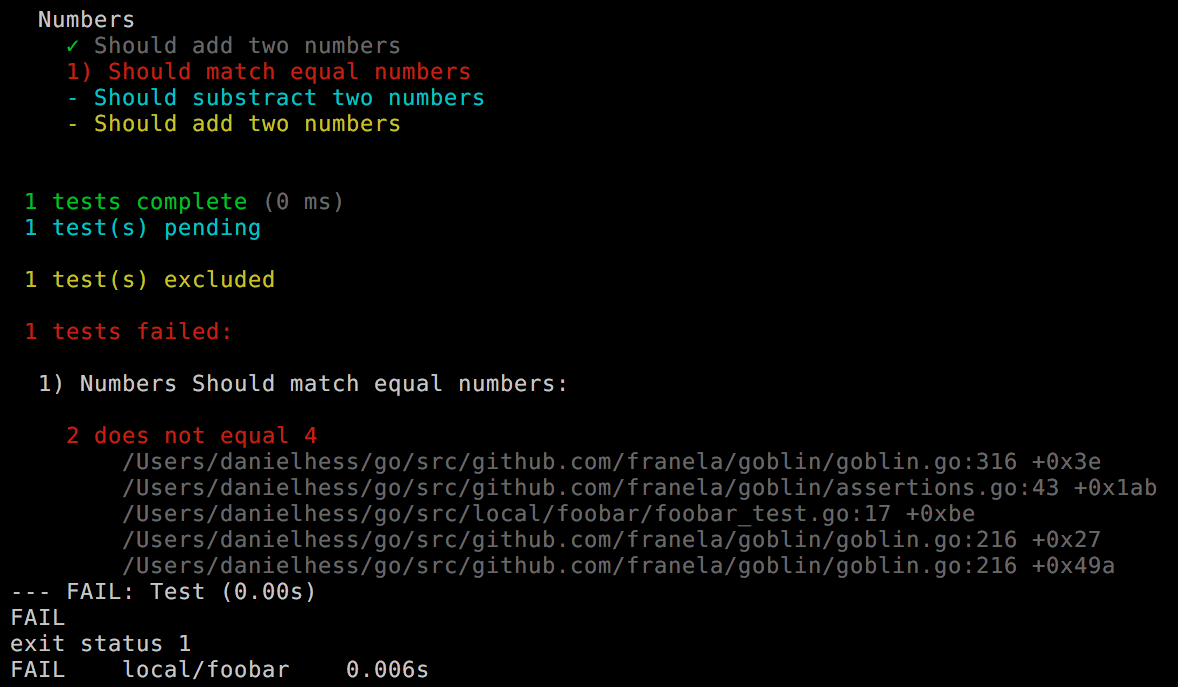
|
||||
|
||||
Nice and easy, right?
|
||||
|
||||
Can I do asynchronous tests?
|
||||
----------------------------
|
||||
|
||||
Yes! Goblin will help you to test asynchronous things, like goroutines, etc. You just need to add a ```done``` parameter to the handler function of your ```It```. This handler function should be called when your test passes.
|
||||
|
||||
```go
|
||||
...
|
||||
g.Describe("Numbers", func() {
|
||||
g.It("Should add two numbers asynchronously", func(done Done) {
|
||||
go func() {
|
||||
g.Assert(1+1).Equal(2)
|
||||
done()
|
||||
}()
|
||||
})
|
||||
})
|
||||
...
|
||||
```
|
||||
|
||||
Goblin will wait for the ```done``` call, a ```Fail``` call or any false assertion.
|
||||
|
||||
How do I use it with Gomega?
|
||||
----------------------------
|
||||
|
||||
Gomega is a nice assertion framework. But it doesn't provide a nice way to hook it to testing frameworks. It should just panic instead of requiring a fail function. There is an issue about that [here](https://github.com/onsi/gomega/issues/5).
|
||||
While this is being discussed and hopefully fixed, the way to use Gomega with Goblin is:
|
||||
|
||||
```go
|
||||
package foobar
|
||||
|
||||
import (
|
||||
"testing"
|
||||
. "github.com/franela/goblin"
|
||||
. "github.com/onsi/gomega"
|
||||
)
|
||||
|
||||
func Test(t *testing.T) {
|
||||
g := Goblin(t)
|
||||
|
||||
//special hook for gomega
|
||||
RegisterFailHandler(func(m string, _ ...int) { g.Fail(m) })
|
||||
|
||||
g.Describe("lala", func() {
|
||||
g.It("lslslslsls", func() {
|
||||
Expect(1).To(Equal(10))
|
||||
})
|
||||
})
|
||||
}
|
||||
```
|
||||
|
||||
|
||||
FAQ
|
||||
----
|
||||
|
||||
### How do I run specific tests?
|
||||
|
||||
If `-goblin.run=$REGES` is supplied to the `go test` command then only tests that match the supplied regex will run
|
||||
|
||||
|
||||
Contributing
|
||||
-----
|
||||
|
||||
We do have a couple of [issues](https://github.com/franela/goblin/issues) pending. Feel free to contribute and send us PRs (with tests please :smile:).
|
||||
|
||||
Special Thanks
|
||||
------------
|
||||
|
||||
Special thanks to [Leandro Reox](https://github.com/leandroreox) (Leitan) for the goblin logo.
|
||||
+70
@@ -0,0 +1,70 @@
|
||||
package goblin
|
||||
|
||||
import (
|
||||
"fmt"
|
||||
"reflect"
|
||||
"strings"
|
||||
)
|
||||
|
||||
// Assertion represents a fact stated about a source object. It contains the source object and function to call
|
||||
type Assertion struct {
|
||||
src interface{}
|
||||
fail func(interface{})
|
||||
}
|
||||
|
||||
func objectsAreEqual(a, b interface{}) bool {
|
||||
if reflect.TypeOf(a) != reflect.TypeOf(b) {
|
||||
return false
|
||||
}
|
||||
|
||||
if reflect.DeepEqual(a, b) {
|
||||
return true
|
||||
}
|
||||
|
||||
if fmt.Sprintf("%#v", a) == fmt.Sprintf("%#v", b) {
|
||||
return true
|
||||
}
|
||||
|
||||
return false
|
||||
}
|
||||
|
||||
func formatMessages(messages ...string) string {
|
||||
if len(messages) > 0 {
|
||||
return ", " + strings.Join(messages, " ")
|
||||
}
|
||||
return ""
|
||||
}
|
||||
|
||||
// Eql is a shorthand alias of Equal for convenience
|
||||
func (a *Assertion) Eql(dst interface{}) {
|
||||
a.Equal(dst)
|
||||
}
|
||||
|
||||
// Equal takes a destination object and asserts that a source object and
|
||||
// destination object are equal to one another. It will fail the assertion and
|
||||
// print a corresponding message if the objects are not equivalent.
|
||||
func (a *Assertion) Equal(dst interface{}) {
|
||||
if !objectsAreEqual(a.src, dst) {
|
||||
a.fail(fmt.Sprintf("%#v %s %#v", a.src, "does not equal", dst))
|
||||
}
|
||||
}
|
||||
|
||||
// IsTrue asserts that a source is equal to true. Optional messages can be
|
||||
// provided for inclusion in the displayed message if the assertion fails. It
|
||||
// will fail the assertion if the source does not resolve to true.
|
||||
func (a *Assertion) IsTrue(messages ...string) {
|
||||
if !objectsAreEqual(a.src, true) {
|
||||
message := fmt.Sprintf("%v %s%s", a.src, "expected false to be truthy", formatMessages(messages...))
|
||||
a.fail(message)
|
||||
}
|
||||
}
|
||||
|
||||
// IsFalse asserts that a source is equal to false. Optional messages can be
|
||||
// provided for inclusion in the displayed message if the assertion fails. It
|
||||
// will fail the assertion if the source does not resolve to false.
|
||||
func (a *Assertion) IsFalse(messages ...string) {
|
||||
if !objectsAreEqual(a.src, false) {
|
||||
message := fmt.Sprintf("%v %s%s", a.src, "expected true to be falsey", formatMessages(messages...))
|
||||
a.fail(message)
|
||||
}
|
||||
}
|
||||
+36
@@ -0,0 +1,36 @@
|
||||
snippet gd
|
||||
g.Describe("${1:name}", func() {
|
||||
${2}
|
||||
})
|
||||
${0}
|
||||
snippet git
|
||||
g.It("${1:name}", func() {
|
||||
${2}
|
||||
})
|
||||
${0}
|
||||
snippet gait
|
||||
g.It("${1:name}", func(done Done) {
|
||||
done()
|
||||
${2}
|
||||
})
|
||||
${0}
|
||||
snippet gb
|
||||
g.Before(func() {
|
||||
${1}
|
||||
})
|
||||
${0}
|
||||
snippet gbe
|
||||
g.BeforeEach(func() {
|
||||
${1}
|
||||
})
|
||||
${0}
|
||||
snippet ga
|
||||
g.After(func() {
|
||||
${1}
|
||||
})
|
||||
${0}
|
||||
snippet gae
|
||||
g.AfterEach(func() {
|
||||
${1}
|
||||
})
|
||||
${0}
|
||||
+337
@@ -0,0 +1,337 @@
|
||||
package goblin
|
||||
|
||||
import (
|
||||
"flag"
|
||||
"fmt"
|
||||
"regexp"
|
||||
"runtime"
|
||||
"sync"
|
||||
"testing"
|
||||
"time"
|
||||
)
|
||||
|
||||
type Done func(error ...interface{})
|
||||
|
||||
type Runnable interface {
|
||||
run(*G) bool
|
||||
}
|
||||
|
||||
type Itable interface {
|
||||
run(*G) bool
|
||||
failed(string, []string)
|
||||
}
|
||||
|
||||
func (g *G) Describe(name string, h func()) {
|
||||
d := &Describe{name: name, h: h, parent: g.parent}
|
||||
|
||||
if d.parent != nil {
|
||||
d.parent.children = append(d.parent.children, Runnable(d))
|
||||
}
|
||||
|
||||
g.parent = d
|
||||
|
||||
h()
|
||||
|
||||
g.parent = d.parent
|
||||
|
||||
if g.parent == nil && d.hasTests {
|
||||
g.reporter.begin()
|
||||
if d.run(g) {
|
||||
g.t.Fail()
|
||||
}
|
||||
g.reporter.end()
|
||||
}
|
||||
}
|
||||
func (g *G) Timeout(time time.Duration) {
|
||||
g.timeout = time
|
||||
g.timer.Reset(time)
|
||||
}
|
||||
|
||||
type Describe struct {
|
||||
name string
|
||||
h func()
|
||||
children []Runnable
|
||||
befores []func()
|
||||
afters []func()
|
||||
afterEach []func()
|
||||
beforeEach []func()
|
||||
hasTests bool
|
||||
parent *Describe
|
||||
}
|
||||
|
||||
func (d *Describe) runBeforeEach() {
|
||||
if d.parent != nil {
|
||||
d.parent.runBeforeEach()
|
||||
}
|
||||
|
||||
for _, b := range d.beforeEach {
|
||||
b()
|
||||
}
|
||||
}
|
||||
|
||||
func (d *Describe) runAfterEach() {
|
||||
|
||||
if d.parent != nil {
|
||||
d.parent.runAfterEach()
|
||||
}
|
||||
|
||||
for _, a := range d.afterEach {
|
||||
a()
|
||||
}
|
||||
}
|
||||
|
||||
func (d *Describe) run(g *G) bool {
|
||||
failed := false
|
||||
if d.hasTests {
|
||||
g.reporter.beginDescribe(d.name)
|
||||
|
||||
for _, b := range d.befores {
|
||||
b()
|
||||
}
|
||||
|
||||
for _, r := range d.children {
|
||||
if r.run(g) {
|
||||
failed = true
|
||||
}
|
||||
}
|
||||
|
||||
for _, a := range d.afters {
|
||||
a()
|
||||
}
|
||||
|
||||
g.reporter.endDescribe()
|
||||
}
|
||||
|
||||
return failed
|
||||
}
|
||||
|
||||
type Failure struct {
|
||||
stack []string
|
||||
testName string
|
||||
message string
|
||||
}
|
||||
|
||||
type It struct {
|
||||
h interface{}
|
||||
name string
|
||||
parent *Describe
|
||||
failure *Failure
|
||||
reporter Reporter
|
||||
isAsync bool
|
||||
}
|
||||
|
||||
func (it *It) run(g *G) bool {
|
||||
g.currentIt = it
|
||||
|
||||
if it.h == nil {
|
||||
g.reporter.itIsPending(it.name)
|
||||
return false
|
||||
}
|
||||
//TODO: should handle errors for beforeEach
|
||||
it.parent.runBeforeEach()
|
||||
|
||||
runIt(g, it.h)
|
||||
|
||||
it.parent.runAfterEach()
|
||||
|
||||
failed := false
|
||||
if it.failure != nil {
|
||||
failed = true
|
||||
}
|
||||
|
||||
if failed {
|
||||
g.reporter.itFailed(it.name)
|
||||
g.reporter.failure(it.failure)
|
||||
} else {
|
||||
g.reporter.itPassed(it.name)
|
||||
}
|
||||
return failed
|
||||
}
|
||||
|
||||
func (it *It) failed(msg string, stack []string) {
|
||||
it.failure = &Failure{stack: stack, message: msg, testName: it.parent.name + " " + it.name}
|
||||
}
|
||||
|
||||
type Xit struct {
|
||||
h interface{}
|
||||
name string
|
||||
parent *Describe
|
||||
failure *Failure
|
||||
reporter Reporter
|
||||
isAsync bool
|
||||
}
|
||||
|
||||
func (xit *Xit) run(g *G) bool {
|
||||
g.currentIt = xit
|
||||
|
||||
g.reporter.itIsExcluded(xit.name)
|
||||
return false
|
||||
}
|
||||
|
||||
func (xit *Xit) failed(msg string, stack []string) {
|
||||
xit.failure = nil
|
||||
}
|
||||
|
||||
func parseFlags() {
|
||||
//Flag parsing
|
||||
flag.Parse()
|
||||
if *regexParam != "" {
|
||||
runRegex = regexp.MustCompile(*regexParam)
|
||||
} else {
|
||||
runRegex = nil
|
||||
}
|
||||
}
|
||||
|
||||
var timeout = flag.Duration("goblin.timeout", 5*time.Second, "Sets default timeouts for all tests")
|
||||
var isTty = flag.Bool("goblin.tty", true, "Sets the default output format (color / monochrome)")
|
||||
var regexParam = flag.String("goblin.run", "", "Runs only tests which match the supplied regex")
|
||||
var runRegex *regexp.Regexp
|
||||
|
||||
func Goblin(t *testing.T, arguments ...string) *G {
|
||||
if !flag.Parsed() {
|
||||
parseFlags()
|
||||
}
|
||||
g := &G{t: t, timeout: *timeout}
|
||||
var fancy TextFancier
|
||||
if *isTty {
|
||||
fancy = &TerminalFancier{}
|
||||
} else {
|
||||
fancy = &Monochrome{}
|
||||
}
|
||||
|
||||
g.reporter = Reporter(&DetailedReporter{fancy: fancy})
|
||||
return g
|
||||
}
|
||||
|
||||
func runIt(g *G, h interface{}) {
|
||||
defer timeTrack(time.Now(), g)
|
||||
g.mutex.Lock()
|
||||
g.timedOut = false
|
||||
g.mutex.Unlock()
|
||||
g.timer = time.NewTimer(g.timeout)
|
||||
g.shouldContinue = make(chan bool)
|
||||
if call, ok := h.(func()); ok {
|
||||
// the test is synchronous
|
||||
go func(c chan bool) { call(); c <- true }(g.shouldContinue)
|
||||
} else if call, ok := h.(func(Done)); ok {
|
||||
doneCalled := 0
|
||||
go func(c chan bool) {
|
||||
call(func(msg ...interface{}) {
|
||||
if len(msg) > 0 {
|
||||
g.Fail(msg)
|
||||
} else {
|
||||
doneCalled++
|
||||
if doneCalled > 1 {
|
||||
g.Fail("Done called multiple times")
|
||||
}
|
||||
c <- true
|
||||
}
|
||||
})
|
||||
}(g.shouldContinue)
|
||||
} else {
|
||||
panic("Not implemented.")
|
||||
}
|
||||
select {
|
||||
case <-g.shouldContinue:
|
||||
case <-g.timer.C:
|
||||
//Set to nil as it shouldn't continue
|
||||
g.shouldContinue = nil
|
||||
g.timedOut = true
|
||||
g.Fail("Test exceeded " + fmt.Sprintf("%s", g.timeout))
|
||||
}
|
||||
// Reset timeout value
|
||||
g.timeout = *timeout
|
||||
}
|
||||
|
||||
type G struct {
|
||||
t *testing.T
|
||||
parent *Describe
|
||||
currentIt Itable
|
||||
timeout time.Duration
|
||||
reporter Reporter
|
||||
timedOut bool
|
||||
shouldContinue chan bool
|
||||
mutex sync.Mutex
|
||||
timer *time.Timer
|
||||
}
|
||||
|
||||
func (g *G) SetReporter(r Reporter) {
|
||||
g.reporter = r
|
||||
}
|
||||
|
||||
func (g *G) It(name string, h ...interface{}) {
|
||||
if matchesRegex(name) {
|
||||
it := &It{name: name, parent: g.parent, reporter: g.reporter}
|
||||
notifyParents(g.parent)
|
||||
if len(h) > 0 {
|
||||
it.h = h[0]
|
||||
}
|
||||
g.parent.children = append(g.parent.children, Runnable(it))
|
||||
}
|
||||
}
|
||||
|
||||
func (g *G) Xit(name string, h ...interface{}) {
|
||||
if matchesRegex(name) {
|
||||
xit := &Xit{name: name, parent: g.parent, reporter: g.reporter}
|
||||
notifyParents(g.parent)
|
||||
if len(h) > 0 {
|
||||
xit.h = h[0]
|
||||
}
|
||||
g.parent.children = append(g.parent.children, Runnable(xit))
|
||||
}
|
||||
}
|
||||
|
||||
func matchesRegex(value string) bool {
|
||||
if runRegex != nil {
|
||||
return runRegex.MatchString(value)
|
||||
}
|
||||
return true
|
||||
}
|
||||
|
||||
func notifyParents(d *Describe) {
|
||||
d.hasTests = true
|
||||
if d.parent != nil {
|
||||
notifyParents(d.parent)
|
||||
}
|
||||
}
|
||||
|
||||
func (g *G) Before(h func()) {
|
||||
g.parent.befores = append(g.parent.befores, h)
|
||||
}
|
||||
|
||||
func (g *G) BeforeEach(h func()) {
|
||||
g.parent.beforeEach = append(g.parent.beforeEach, h)
|
||||
}
|
||||
|
||||
func (g *G) After(h func()) {
|
||||
g.parent.afters = append(g.parent.afters, h)
|
||||
}
|
||||
|
||||
func (g *G) AfterEach(h func()) {
|
||||
g.parent.afterEach = append(g.parent.afterEach, h)
|
||||
}
|
||||
|
||||
func (g *G) Assert(src interface{}) *Assertion {
|
||||
return &Assertion{src: src, fail: g.Fail}
|
||||
}
|
||||
|
||||
func timeTrack(start time.Time, g *G) {
|
||||
g.reporter.itTook(time.Since(start))
|
||||
}
|
||||
|
||||
func (g *G) Fail(error interface{}) {
|
||||
//Skips 7 stacks due to the functions between the stack and the test
|
||||
stack := ResolveStack(7)
|
||||
message := fmt.Sprintf("%v", error)
|
||||
g.currentIt.failed(message, stack)
|
||||
if g.shouldContinue != nil {
|
||||
g.shouldContinue <- true
|
||||
}
|
||||
g.mutex.Lock()
|
||||
defer g.mutex.Unlock()
|
||||
if !g.timedOut {
|
||||
//Stop test function execution
|
||||
runtime.Goexit()
|
||||
}
|
||||
|
||||
}
|
||||
BIN

Binary file not shown.
|
After Width: | Height: | Size: 36 KiB |
BIN

Binary file not shown.
|
After Width: | Height: | Size: 48 KiB |
+30
@@ -0,0 +1,30 @@
|
||||
package goblin
|
||||
|
||||
import ()
|
||||
|
||||
type Monochrome struct {
|
||||
}
|
||||
|
||||
func (self *Monochrome) Red(text string) string {
|
||||
return "!" + text
|
||||
}
|
||||
|
||||
func (self *Monochrome) Gray(text string) string {
|
||||
return text
|
||||
}
|
||||
|
||||
func (self *Monochrome) Cyan(text string) string {
|
||||
return text
|
||||
}
|
||||
|
||||
func (self *Monochrome) WithCheck(text string) string {
|
||||
return ">>>" + text
|
||||
}
|
||||
|
||||
func (self *Monochrome) Green(text string) string {
|
||||
return text
|
||||
}
|
||||
|
||||
func (self *Monochrome) Yellow(text string) string {
|
||||
return text
|
||||
}
|
||||
+153
@@ -0,0 +1,153 @@
|
||||
package goblin
|
||||
|
||||
import (
|
||||
"fmt"
|
||||
"strconv"
|
||||
"strings"
|
||||
"time"
|
||||
)
|
||||
|
||||
type Reporter interface {
|
||||
beginDescribe(string)
|
||||
endDescribe()
|
||||
begin()
|
||||
end()
|
||||
failure(*Failure)
|
||||
itTook(time.Duration)
|
||||
itFailed(string)
|
||||
itPassed(string)
|
||||
itIsPending(string)
|
||||
itIsExcluded(string)
|
||||
}
|
||||
|
||||
type TextFancier interface {
|
||||
Red(text string) string
|
||||
Gray(text string) string
|
||||
Cyan(text string) string
|
||||
Green(text string) string
|
||||
Yellow(text string) string
|
||||
WithCheck(text string) string
|
||||
}
|
||||
|
||||
type DetailedReporter struct {
|
||||
level, failed, passed, pending, excluded int
|
||||
failures []*Failure
|
||||
executionTime, totalExecutionTime time.Duration
|
||||
fancy TextFancier
|
||||
}
|
||||
|
||||
func (r *DetailedReporter) SetTextFancier(f TextFancier) {
|
||||
r.fancy = f
|
||||
}
|
||||
|
||||
type TerminalFancier struct {
|
||||
}
|
||||
|
||||
func (self *TerminalFancier) Red(text string) string {
|
||||
return "\033[31m" + text + "\033[0m"
|
||||
}
|
||||
|
||||
func (self *TerminalFancier) Gray(text string) string {
|
||||
return "\033[90m" + text + "\033[0m"
|
||||
}
|
||||
|
||||
func (self *TerminalFancier) Cyan(text string) string {
|
||||
return "\033[36m" + text + "\033[0m"
|
||||
}
|
||||
|
||||
func (self *TerminalFancier) Green(text string) string {
|
||||
return "\033[32m" + text + "\033[0m"
|
||||
}
|
||||
|
||||
func (self *TerminalFancier) Yellow(text string) string {
|
||||
return "\033[33m" + text + "\033[0m"
|
||||
}
|
||||
|
||||
func (self *TerminalFancier) WithCheck(text string) string {
|
||||
return "\033[32m\u2713\033[0m " + text
|
||||
}
|
||||
|
||||
func (r *DetailedReporter) getSpace() string {
|
||||
return strings.Repeat(" ", (r.level+1)*2)
|
||||
}
|
||||
|
||||
func (r *DetailedReporter) failure(failure *Failure) {
|
||||
r.failures = append(r.failures, failure)
|
||||
}
|
||||
|
||||
func (r *DetailedReporter) print(text string) {
|
||||
fmt.Printf("%v%v\n", r.getSpace(), text)
|
||||
}
|
||||
|
||||
func (r *DetailedReporter) printWithCheck(text string) {
|
||||
fmt.Printf("%v%v\n", r.getSpace(), r.fancy.WithCheck(text))
|
||||
}
|
||||
|
||||
func (r *DetailedReporter) beginDescribe(name string) {
|
||||
fmt.Println("")
|
||||
r.print(name)
|
||||
r.level++
|
||||
}
|
||||
|
||||
func (r *DetailedReporter) endDescribe() {
|
||||
r.level--
|
||||
}
|
||||
|
||||
func (r *DetailedReporter) itTook(duration time.Duration) {
|
||||
r.executionTime = duration
|
||||
r.totalExecutionTime += duration
|
||||
}
|
||||
|
||||
func (r *DetailedReporter) itFailed(name string) {
|
||||
r.failed++
|
||||
r.print(r.fancy.Red(strconv.Itoa(r.failed) + ") " + name))
|
||||
}
|
||||
|
||||
func (r *DetailedReporter) itPassed(name string) {
|
||||
r.passed++
|
||||
r.printWithCheck(r.fancy.Gray(name))
|
||||
}
|
||||
|
||||
func (r *DetailedReporter) itIsPending(name string) {
|
||||
r.pending++
|
||||
r.print(r.fancy.Cyan("- " + name))
|
||||
}
|
||||
|
||||
func (r *DetailedReporter) itIsExcluded(name string) {
|
||||
r.excluded++
|
||||
r.print(r.fancy.Yellow("- " + name))
|
||||
}
|
||||
|
||||
func (r *DetailedReporter) begin() {
|
||||
}
|
||||
|
||||
func (r *DetailedReporter) end() {
|
||||
comp := fmt.Sprintf("%d tests complete", r.passed)
|
||||
t := fmt.Sprintf("(%d ms)", r.totalExecutionTime/time.Millisecond)
|
||||
|
||||
//fmt.Printf("\n\n \033[32m%d tests complete\033[0m \033[90m(%d ms)\033[0m\n", r.passed, r.totalExecutionTime/time.Millisecond)
|
||||
fmt.Printf("\n\n %v %v\n", r.fancy.Green(comp), r.fancy.Gray(t))
|
||||
|
||||
if r.pending > 0 {
|
||||
pend := fmt.Sprintf("%d test(s) pending", r.pending)
|
||||
fmt.Printf(" %v\n\n", r.fancy.Cyan(pend))
|
||||
}
|
||||
|
||||
if r.excluded > 0 {
|
||||
excl := fmt.Sprintf("%d test(s) excluded", r.excluded)
|
||||
fmt.Printf(" %v\n\n", r.fancy.Yellow(excl))
|
||||
}
|
||||
|
||||
if len(r.failures) > 0 {
|
||||
fmt.Printf("%s \n\n", r.fancy.Red(fmt.Sprintf(" %d tests failed:", len(r.failures))))
|
||||
|
||||
}
|
||||
|
||||
for i, failure := range r.failures {
|
||||
fmt.Printf(" %d) %s:\n\n", i+1, failure.testName)
|
||||
fmt.Printf(" %s\n", r.fancy.Red(failure.message))
|
||||
for _, stackItem := range failure.stack {
|
||||
fmt.Printf(" %s\n", r.fancy.Gray(stackItem))
|
||||
}
|
||||
}
|
||||
}
|
||||
+21
@@ -0,0 +1,21 @@
|
||||
package goblin
|
||||
|
||||
import (
|
||||
"runtime/debug"
|
||||
"strings"
|
||||
)
|
||||
|
||||
func ResolveStack(skip int) []string {
|
||||
return cleanStack(debug.Stack(), skip)
|
||||
}
|
||||
|
||||
func cleanStack(stack []byte, skip int) []string {
|
||||
arrayStack := strings.Split(string(stack), "\n")
|
||||
var finalStack []string
|
||||
for i := skip; i < len(arrayStack); i++ {
|
||||
if strings.Contains(arrayStack[i], ".go") {
|
||||
finalStack = append(finalStack, arrayStack[i])
|
||||
}
|
||||
}
|
||||
return finalStack
|
||||
}
|
||||
-3
@@ -1,7 +1,4 @@
|
||||
Go support for Protocol Buffers - Google's data interchange format
|
||||
|
||||
Copyright 2010 The Go Authors. All rights reserved.
|
||||
https://github.com/golang/protobuf
|
||||
|
||||
Redistribution and use in source and binary forms, with or without
|
||||
modification, are permitted provided that the following conditions are
|
||||
|
||||
-43
@@ -1,43 +0,0 @@
|
||||
# Go support for Protocol Buffers - Google's data interchange format
|
||||
#
|
||||
# Copyright 2010 The Go Authors. All rights reserved.
|
||||
# https://github.com/golang/protobuf
|
||||
#
|
||||
# Redistribution and use in source and binary forms, with or without
|
||||
# modification, are permitted provided that the following conditions are
|
||||
# met:
|
||||
#
|
||||
# * Redistributions of source code must retain the above copyright
|
||||
# notice, this list of conditions and the following disclaimer.
|
||||
# * Redistributions in binary form must reproduce the above
|
||||
# copyright notice, this list of conditions and the following disclaimer
|
||||
# in the documentation and/or other materials provided with the
|
||||
# distribution.
|
||||
# * Neither the name of Google Inc. nor the names of its
|
||||
# contributors may be used to endorse or promote products derived from
|
||||
# this software without specific prior written permission.
|
||||
#
|
||||
# THIS SOFTWARE IS PROVIDED BY THE COPYRIGHT HOLDERS AND CONTRIBUTORS
|
||||
# "AS IS" AND ANY EXPRESS OR IMPLIED WARRANTIES, INCLUDING, BUT NOT
|
||||
# LIMITED TO, THE IMPLIED WARRANTIES OF MERCHANTABILITY AND FITNESS FOR
|
||||
# A PARTICULAR PURPOSE ARE DISCLAIMED. IN NO EVENT SHALL THE COPYRIGHT
|
||||
# OWNER OR CONTRIBUTORS BE LIABLE FOR ANY DIRECT, INDIRECT, INCIDENTAL,
|
||||
# SPECIAL, EXEMPLARY, OR CONSEQUENTIAL DAMAGES (INCLUDING, BUT NOT
|
||||
# LIMITED TO, PROCUREMENT OF SUBSTITUTE GOODS OR SERVICES; LOSS OF USE,
|
||||
# DATA, OR PROFITS; OR BUSINESS INTERRUPTION) HOWEVER CAUSED AND ON ANY
|
||||
# THEORY OF LIABILITY, WHETHER IN CONTRACT, STRICT LIABILITY, OR TORT
|
||||
# (INCLUDING NEGLIGENCE OR OTHERWISE) ARISING IN ANY WAY OUT OF THE USE
|
||||
# OF THIS SOFTWARE, EVEN IF ADVISED OF THE POSSIBILITY OF SUCH DAMAGE.
|
||||
|
||||
install:
|
||||
go install
|
||||
|
||||
test: install generate-test-pbs
|
||||
go test
|
||||
|
||||
|
||||
generate-test-pbs:
|
||||
make install
|
||||
make -C testdata
|
||||
protoc --go_out=Mtestdata/test.proto=github.com/golang/protobuf/proto/testdata,Mgoogle/protobuf/any.proto=github.com/golang/protobuf/ptypes/any:. proto3_proto/proto3.proto
|
||||
make
|
||||
+35
-11
@@ -35,22 +35,39 @@
|
||||
package proto
|
||||
|
||||
import (
|
||||
"fmt"
|
||||
"log"
|
||||
"reflect"
|
||||
"strings"
|
||||
)
|
||||
|
||||
// Clone returns a deep copy of a protocol buffer.
|
||||
func Clone(pb Message) Message {
|
||||
in := reflect.ValueOf(pb)
|
||||
func Clone(src Message) Message {
|
||||
in := reflect.ValueOf(src)
|
||||
if in.IsNil() {
|
||||
return pb
|
||||
return src
|
||||
}
|
||||
|
||||
out := reflect.New(in.Type().Elem())
|
||||
// out is empty so a merge is a deep copy.
|
||||
mergeStruct(out.Elem(), in.Elem())
|
||||
return out.Interface().(Message)
|
||||
dst := out.Interface().(Message)
|
||||
Merge(dst, src)
|
||||
return dst
|
||||
}
|
||||
|
||||
// Merger is the interface representing objects that can merge messages of the same type.
|
||||
type Merger interface {
|
||||
// Merge merges src into this message.
|
||||
// Required and optional fields that are set in src will be set to that value in dst.
|
||||
// Elements of repeated fields will be appended.
|
||||
//
|
||||
// Merge may panic if called with a different argument type than the receiver.
|
||||
Merge(src Message)
|
||||
}
|
||||
|
||||
// generatedMerger is the custom merge method that generated protos will have.
|
||||
// We must add this method since a generate Merge method will conflict with
|
||||
// many existing protos that have a Merge data field already defined.
|
||||
type generatedMerger interface {
|
||||
XXX_Merge(src Message)
|
||||
}
|
||||
|
||||
// Merge merges src into dst.
|
||||
@@ -58,17 +75,24 @@ func Clone(pb Message) Message {
|
||||
// Elements of repeated fields will be appended.
|
||||
// Merge panics if src and dst are not the same type, or if dst is nil.
|
||||
func Merge(dst, src Message) {
|
||||
if m, ok := dst.(Merger); ok {
|
||||
m.Merge(src)
|
||||
return
|
||||
}
|
||||
|
||||
in := reflect.ValueOf(src)
|
||||
out := reflect.ValueOf(dst)
|
||||
if out.IsNil() {
|
||||
panic("proto: nil destination")
|
||||
}
|
||||
if in.Type() != out.Type() {
|
||||
// Explicit test prior to mergeStruct so that mistyped nils will fail
|
||||
panic("proto: type mismatch")
|
||||
panic(fmt.Sprintf("proto.Merge(%T, %T) type mismatch", dst, src))
|
||||
}
|
||||
if in.IsNil() {
|
||||
// Merging nil into non-nil is a quiet no-op
|
||||
return // Merge from nil src is a noop
|
||||
}
|
||||
if m, ok := dst.(generatedMerger); ok {
|
||||
m.XXX_Merge(src)
|
||||
return
|
||||
}
|
||||
mergeStruct(out.Elem(), in.Elem())
|
||||
@@ -84,7 +108,7 @@ func mergeStruct(out, in reflect.Value) {
|
||||
mergeAny(out.Field(i), in.Field(i), false, sprop.Prop[i])
|
||||
}
|
||||
|
||||
if emIn, ok := extendable(in.Addr().Interface()); ok {
|
||||
if emIn, err := extendable(in.Addr().Interface()); err == nil {
|
||||
emOut, _ := extendable(out.Addr().Interface())
|
||||
mIn, muIn := emIn.extensionsRead()
|
||||
if mIn != nil {
|
||||
|
||||
Loaded 100 of 756 files, more files were not shown because too many files have changed in this diff.
Show more
Reference in new issue
Block a user