mirror of
https://github.com/gitleaks/gitleaks.git
synced 2026-11-29 20:54:22 +01:00
Compare commits
| Author | SHA1 | Date | |
|---|---|---|---|
 Zachary Rice |
2a6bd1636f | ||
 zach rice |
7b82e29e7e | ||
|
zach rice
|
4fd2f06a0d | ||
|
zach rice
|
8016dffe18 | ||
|
zach rice
|
10004da36f | ||
|
zach rice
|
633e06a7c7 | ||
|
zach rice
|
660350c9b1 | ||
|
zach rice
|
9122aa6cf4 | ||
|
zach rice
|
56c89866a2 | ||
|
zach rice
|
f9be4e543a | ||
|
zach rice
|
042b82e2af | ||
|
zach rice
|
9176896742 | ||
|
zach rice
|
4ea0c66bec | ||
|
zach rice
|
ae4542abf0 | ||
|
zach rice
|
ac14d347de | ||
|
zach rice
|
c2143c5843 | ||
|
zach rice
|
e79ffc6ae8 | ||
|
zach rice
|
1c14586cde | ||
|
zach rice
|
2b995fda44 | ||
|
Zachary Rice
|
5d68b48af3 | ||
|
Zachary Rice
|
f90a00b564 | ||
|
Zachary Rice
|
c5f34a6704 | ||
|
Zachary Rice
|
463871a307 | ||
|
Zachary Rice
|
fa1080d066 | ||
|
Zachary Rice
|
52cfad1d08 | ||
|
Zachary Rice
|
9e294f5910 | ||
|
zach rice
|
9f8326de56 | ||
|
zach rice
|
79c3f99165 | ||
|
zach rice
|
d4925443c8 | ||
|
zach rice
|
fa27d32bfe | ||
|
zach rice
|
230a52e3e3 | ||
|
zach rice
|
15dedda59a | ||
|
Zachary Rice
|
3b45fb91e3 | ||
|
Zachary Rice
|
f378319395 | ||
|
Zachary Rice
|
98173b3aa6 | ||
|
Zachary Rice
|
36340c8f2f | ||
 Adam Kobi |
77b6d90a16 | ||
|
Adam Kobi
|
6b3bd46fa8 | ||
|
Zachary Rice
|
8485f88158 | ||
|
Zachary Rice
|
d2baa9e675 | ||
|
Zachary Rice
|
7fa9c802f5 | ||
|
zach rice
|
8f1bc74e26 | ||
|
zach rice
|
8de38be418 | ||
|
Zachary Rice
|
ec1ebd4686 | ||
|
zach rice
|
81ddfbed88 | ||
|
Zachary Rice
|
63814f1eaf | ||
|
zach rice
|
38a36add57 | ||
|
zach rice
|
9e39927ac6 | ||
 Milo Minderbinder |
0ba9dda0f0 | ||
|
zach rice
|
a24f9a2c92 | ||
|
Zachary Rice
|
f57158a893 | ||
 Pepe Bawagan |
1e3bf42464 | ||
|
Zachary Rice
|
9d6a75fbab | ||
|
Milo Minderbinder
|
6fa52ae7cc | ||
|
Milo Minderbinder
|
bb9c459a1a | ||
|
Adam Kobi
|
432c76a9d9 | ||
|
Adam Kobi
|
1cdf315bfa | ||
|
Zachary Rice
|
777601a0ea | ||
|
Zachary Rice
|
35d170018e | ||
 Arbaz Hussain |
af2e99ef45 | ||
|
Zachary Rice
|
734befb555 | ||
|
Milo Minderbinder
|
64c8d618a2 | ||
 Cristhian Amaya |
92bb4ea6fc | ||
|
zach rice
|
98b025da72 | ||
|
Zachary Rice
|
af7717412f | ||
|
Cristhian Amaya
|
68c2a18f6f | ||
|
Cristhian Amaya
|
ea49078ffd | ||
|
Zachary Rice
|
b902d7310a | ||
|
Zachary Rice
|
3591560b34 | ||
|
Cristhian Amaya
|
949029ca89 | ||
|
Cristhian Amaya
|
cde0894711 | ||
|
Zachary Rice
|
342e9f80db | ||
|
Zachary Rice
|
96b0f4aab7 | ||
 madblobfish |
3af6a546ac | ||
|
Cristhian Amaya
|
6e086c4297 |
No files matched your search
+3
-2
@@ -1,12 +1,13 @@
|
|||||||
sudo: required
|
sudo: required
|
||||||
language: go
|
language: go
|
||||||
go:
|
go:
|
||||||
- 1.9
|
- 1.11
|
||||||
services:
|
services:
|
||||||
- docker
|
- docker
|
||||||
script:
|
script:
|
||||||
- make test
|
- env GO111MODULE=on make test
|
||||||
after_success:
|
after_success:
|
||||||
|
- env GO111MODULE=on go build
|
||||||
- export REPO=zricethezav/gitleaks
|
- export REPO=zricethezav/gitleaks
|
||||||
- export TAG=`if [ "$TRAVIS_BRANCH" == "master" ]; then echo "latest"; else echo $TRAVIS_BRANCH;
|
- export TAG=`if [ "$TRAVIS_BRANCH" == "master" ]; then echo "latest"; else echo $TRAVIS_BRANCH;
|
||||||
fi`
|
fi`
|
||||||
|
|||||||
@@ -1,5 +1,26 @@
|
|||||||
CHANGELOG
|
CHANGELOG
|
||||||
=========
|
=========
|
||||||
|
1.25.0
|
||||||
|
----
|
||||||
|
- Pretty big refactor, see `src` directory
|
||||||
|
- Dropping dep for go modules
|
||||||
|
- Separating email and author
|
||||||
|
- Readding branch support with `--branch=`
|
||||||
|
|
||||||
|
1.24.0
|
||||||
|
----
|
||||||
|
- `--commit` now allows users to target a specific commit to audit
|
||||||
|
- `--commit-stop` audit all commits up to and including what is specified at `--commit-stop`
|
||||||
|
- Updated go-git version to 4.9.1
|
||||||
|
|
||||||
|
1.23.0
|
||||||
|
----
|
||||||
|
-- `--repo-config` allows users to load configs specific to a repo target
|
||||||
|
|
||||||
|
1.22.0
|
||||||
|
----
|
||||||
|
- context inclusion for redactions
|
||||||
|
- noise reduction for entropy signals
|
||||||
|
|
||||||
1.21.0
|
1.21.0
|
||||||
----
|
----
|
||||||
|
|||||||
@@ -13,7 +13,6 @@ Make sure you pass this list of requirements.
|
|||||||
|
|
||||||
- You've run `go fmt`.
|
- You've run `go fmt`.
|
||||||
- You've run `golint`.
|
- You've run `golint`.
|
||||||
- Your Go changes are confined to `gitleaks_test.go` and `main.go`. This is subject to change as the project evolves. Stylistically, I like having a single go file considering the size of this project (its tiny).
|
|
||||||
- You've added test cases for your changes.
|
- You've added test cases for your changes.
|
||||||
- You've updated [the changelog](CHANGELOG.md).
|
- You've updated [the changelog](CHANGELOG.md).
|
||||||
- Your tests pass.
|
- Your tests pass.
|
||||||
|
|||||||
+3
-3
@@ -1,7 +1,7 @@
|
|||||||
FROM golang:1.10.3 AS build
|
FROM golang:1.11.6 AS build
|
||||||
WORKDIR /go/src/github.com/zricethezav/gitleaks
|
WORKDIR /go/src/github.com/zricethezav/gitleaks
|
||||||
COPY . .
|
COPY . .
|
||||||
RUN CGO_ENABLED=0 go build -o bin/gitleaks *.go
|
RUN GO111MODULE=on CGO_ENABLED=0 go build -o bin/gitleaks *.go
|
||||||
|
|
||||||
FROM alpine:3.7
|
FROM alpine:3.7
|
||||||
RUN apk add --no-cache bash git openssh
|
RUN apk add --no-cache bash git openssh
|
||||||
@@ -11,6 +11,6 @@ ENTRYPOINT ["gitleaks"]
|
|||||||
# How to use me :
|
# How to use me :
|
||||||
|
|
||||||
# docker build -t gitleaks .
|
# docker build -t gitleaks .
|
||||||
# docker run --rm --name=gitleaks gitleaks https://github.com/zricethezav/gitleaks
|
# docker run --rm --name=gitleaks gitleaks --repo=https://github.com/zricethezav/gitleaks
|
||||||
|
|
||||||
# This will check for secrets in https://github.com/zricethezav/gitleaks
|
# This will check for secrets in https://github.com/zricethezav/gitleaks
|
||||||
Generated
-266
@@ -1,266 +0,0 @@
|
|||||||
# This file is autogenerated, do not edit; changes may be undone by the next 'dep ensure'.
|
|
||||||
|
|
||||||
|
|
||||||
[[projects]]
|
|
||||||
name = "github.com/BurntSushi/toml"
|
|
||||||
packages = ["."]
|
|
||||||
revision = "3012a1dbe2e4bd1391d42b32f0577cb7bbc7f005"
|
|
||||||
version = "v0.3.1"
|
|
||||||
|
|
||||||
[[projects]]
|
|
||||||
name = "github.com/emirpasic/gods"
|
|
||||||
packages = [
|
|
||||||
"containers",
|
|
||||||
"lists",
|
|
||||||
"lists/arraylist",
|
|
||||||
"trees",
|
|
||||||
"trees/binaryheap",
|
|
||||||
"utils"
|
|
||||||
]
|
|
||||||
revision = "1615341f118ae12f353cc8a983f35b584342c9b3"
|
|
||||||
version = "v1.12.0"
|
|
||||||
|
|
||||||
[[projects]]
|
|
||||||
name = "github.com/franela/goblin"
|
|
||||||
packages = ["."]
|
|
||||||
revision = "cd5d08fb4ede9eaac1812fdb513552e7404eae2e"
|
|
||||||
version = "0.0.2"
|
|
||||||
|
|
||||||
[[projects]]
|
|
||||||
name = "github.com/golang/protobuf"
|
|
||||||
packages = ["proto"]
|
|
||||||
revision = "aa810b61a9c79d51363740d207bb46cf8e620ed5"
|
|
||||||
version = "v1.2.0"
|
|
||||||
|
|
||||||
[[projects]]
|
|
||||||
name = "github.com/google/go-github"
|
|
||||||
packages = ["github"]
|
|
||||||
revision = "e48060a28fac52d0f1cb758bc8b87c07bac4a87d"
|
|
||||||
version = "v15.0.0"
|
|
||||||
|
|
||||||
[[projects]]
|
|
||||||
name = "github.com/google/go-querystring"
|
|
||||||
packages = ["query"]
|
|
||||||
revision = "44c6ddd0a2342c386950e880b658017258da92fc"
|
|
||||||
version = "v1.0.0"
|
|
||||||
|
|
||||||
[[projects]]
|
|
||||||
name = "github.com/hako/durafmt"
|
|
||||||
packages = ["."]
|
|
||||||
revision = "7b7ae1e72eade09dbc9c2cfba3e6c4bae7b8bcac"
|
|
||||||
version = "1.0.0"
|
|
||||||
|
|
||||||
[[projects]]
|
|
||||||
branch = "master"
|
|
||||||
name = "github.com/jbenet/go-context"
|
|
||||||
packages = ["io"]
|
|
||||||
revision = "d14ea06fba99483203c19d92cfcd13ebe73135f4"
|
|
||||||
|
|
||||||
[[projects]]
|
|
||||||
name = "github.com/jessevdk/go-flags"
|
|
||||||
packages = ["."]
|
|
||||||
revision = "c6ca198ec95c841fdb89fc0de7496fed11ab854e"
|
|
||||||
version = "v1.4.0"
|
|
||||||
|
|
||||||
[[projects]]
|
|
||||||
name = "github.com/kevinburke/ssh_config"
|
|
||||||
packages = ["."]
|
|
||||||
revision = "81db2a75821ed34e682567d48be488a1c3121088"
|
|
||||||
version = "0.5"
|
|
||||||
|
|
||||||
[[projects]]
|
|
||||||
name = "github.com/mitchellh/go-homedir"
|
|
||||||
packages = ["."]
|
|
||||||
revision = "ae18d6b8b3205b561c79e8e5f69bff09736185f4"
|
|
||||||
version = "v1.0.0"
|
|
||||||
|
|
||||||
[[projects]]
|
|
||||||
name = "github.com/pelletier/go-buffruneio"
|
|
||||||
packages = ["."]
|
|
||||||
revision = "c37440a7cf42ac63b919c752ca73a85067e05992"
|
|
||||||
version = "v0.2.0"
|
|
||||||
|
|
||||||
[[projects]]
|
|
||||||
name = "github.com/sergi/go-diff"
|
|
||||||
packages = ["diffmatchpatch"]
|
|
||||||
revision = "1744e2970ca51c86172c8190fadad617561ed6e7"
|
|
||||||
version = "v1.0.0"
|
|
||||||
|
|
||||||
[[projects]]
|
|
||||||
name = "github.com/sirupsen/logrus"
|
|
||||||
packages = ["."]
|
|
||||||
revision = "3e01752db0189b9157070a0e1668a620f9a85da2"
|
|
||||||
version = "v1.0.6"
|
|
||||||
|
|
||||||
[[projects]]
|
|
||||||
name = "github.com/src-d/gcfg"
|
|
||||||
packages = [
|
|
||||||
".",
|
|
||||||
"scanner",
|
|
||||||
"token",
|
|
||||||
"types"
|
|
||||||
]
|
|
||||||
revision = "f187355171c936ac84a82793659ebb4936bc1c23"
|
|
||||||
version = "v1.3.0"
|
|
||||||
|
|
||||||
[[projects]]
|
|
||||||
name = "github.com/xanzy/go-gitlab"
|
|
||||||
packages = ["."]
|
|
||||||
revision = "183a80bb43ec9746d72f7cb37116e756d075fb91"
|
|
||||||
version = "v0.11.3"
|
|
||||||
|
|
||||||
[[projects]]
|
|
||||||
name = "github.com/xanzy/ssh-agent"
|
|
||||||
packages = ["."]
|
|
||||||
revision = "640f0ab560aeb89d523bb6ac322b1244d5c3796c"
|
|
||||||
version = "v0.2.0"
|
|
||||||
|
|
||||||
[[projects]]
|
|
||||||
branch = "master"
|
|
||||||
name = "golang.org/x/crypto"
|
|
||||||
packages = [
|
|
||||||
"cast5",
|
|
||||||
"curve25519",
|
|
||||||
"ed25519",
|
|
||||||
"ed25519/internal/edwards25519",
|
|
||||||
"internal/chacha20",
|
|
||||||
"internal/subtle",
|
|
||||||
"openpgp",
|
|
||||||
"openpgp/armor",
|
|
||||||
"openpgp/elgamal",
|
|
||||||
"openpgp/errors",
|
|
||||||
"openpgp/packet",
|
|
||||||
"openpgp/s2k",
|
|
||||||
"poly1305",
|
|
||||||
"ssh",
|
|
||||||
"ssh/agent",
|
|
||||||
"ssh/knownhosts",
|
|
||||||
"ssh/terminal"
|
|
||||||
]
|
|
||||||
revision = "0e37d006457bf46f9e6692014ba72ef82c33022c"
|
|
||||||
|
|
||||||
[[projects]]
|
|
||||||
branch = "master"
|
|
||||||
name = "golang.org/x/net"
|
|
||||||
packages = [
|
|
||||||
"context",
|
|
||||||
"context/ctxhttp"
|
|
||||||
]
|
|
||||||
revision = "f04abc6bdfa7a0171a8a0c9fd2ada9391044d056"
|
|
||||||
|
|
||||||
[[projects]]
|
|
||||||
branch = "master"
|
|
||||||
name = "golang.org/x/oauth2"
|
|
||||||
packages = [
|
|
||||||
".",
|
|
||||||
"internal"
|
|
||||||
]
|
|
||||||
revision = "d2e6202438beef2727060aa7cabdd924d92ebfd9"
|
|
||||||
|
|
||||||
[[projects]]
|
|
||||||
branch = "master"
|
|
||||||
name = "golang.org/x/sys"
|
|
||||||
packages = [
|
|
||||||
"unix",
|
|
||||||
"windows"
|
|
||||||
]
|
|
||||||
revision = "b09afc3d579e346c4a7e4705953acaf6f9e551bd"
|
|
||||||
|
|
||||||
[[projects]]
|
|
||||||
name = "golang.org/x/text"
|
|
||||||
packages = [
|
|
||||||
"internal/gen",
|
|
||||||
"internal/triegen",
|
|
||||||
"internal/ucd",
|
|
||||||
"transform",
|
|
||||||
"unicode/cldr",
|
|
||||||
"unicode/norm"
|
|
||||||
]
|
|
||||||
revision = "f21a4dfb5e38f5895301dc265a8def02365cc3d0"
|
|
||||||
version = "v0.3.0"
|
|
||||||
|
|
||||||
[[projects]]
|
|
||||||
name = "google.golang.org/appengine"
|
|
||||||
packages = [
|
|
||||||
"internal",
|
|
||||||
"internal/base",
|
|
||||||
"internal/datastore",
|
|
||||||
"internal/log",
|
|
||||||
"internal/remote_api",
|
|
||||||
"internal/urlfetch",
|
|
||||||
"urlfetch"
|
|
||||||
]
|
|
||||||
revision = "ae0ab99deb4dc413a2b4bd6c8bdd0eb67f1e4d06"
|
|
||||||
version = "v1.2.0"
|
|
||||||
|
|
||||||
[[projects]]
|
|
||||||
name = "gopkg.in/src-d/go-billy.v4"
|
|
||||||
packages = [
|
|
||||||
".",
|
|
||||||
"helper/chroot",
|
|
||||||
"helper/polyfill",
|
|
||||||
"osfs",
|
|
||||||
"util"
|
|
||||||
]
|
|
||||||
revision = "982626487c60a5252e7d0b695ca23fb0fa2fd670"
|
|
||||||
version = "v4.3.0"
|
|
||||||
|
|
||||||
[[projects]]
|
|
||||||
name = "gopkg.in/src-d/go-git.v4"
|
|
||||||
packages = [
|
|
||||||
".",
|
|
||||||
"config",
|
|
||||||
"internal/revision",
|
|
||||||
"plumbing",
|
|
||||||
"plumbing/cache",
|
|
||||||
"plumbing/filemode",
|
|
||||||
"plumbing/format/config",
|
|
||||||
"plumbing/format/diff",
|
|
||||||
"plumbing/format/gitignore",
|
|
||||||
"plumbing/format/idxfile",
|
|
||||||
"plumbing/format/index",
|
|
||||||
"plumbing/format/objfile",
|
|
||||||
"plumbing/format/packfile",
|
|
||||||
"plumbing/format/pktline",
|
|
||||||
"plumbing/object",
|
|
||||||
"plumbing/protocol/packp",
|
|
||||||
"plumbing/protocol/packp/capability",
|
|
||||||
"plumbing/protocol/packp/sideband",
|
|
||||||
"plumbing/revlist",
|
|
||||||
"plumbing/storer",
|
|
||||||
"plumbing/transport",
|
|
||||||
"plumbing/transport/client",
|
|
||||||
"plumbing/transport/file",
|
|
||||||
"plumbing/transport/git",
|
|
||||||
"plumbing/transport/http",
|
|
||||||
"plumbing/transport/internal/common",
|
|
||||||
"plumbing/transport/server",
|
|
||||||
"plumbing/transport/ssh",
|
|
||||||
"storage",
|
|
||||||
"storage/filesystem",
|
|
||||||
"storage/filesystem/dotgit",
|
|
||||||
"storage/memory",
|
|
||||||
"utils/binary",
|
|
||||||
"utils/diff",
|
|
||||||
"utils/ioutil",
|
|
||||||
"utils/merkletrie",
|
|
||||||
"utils/merkletrie/filesystem",
|
|
||||||
"utils/merkletrie/index",
|
|
||||||
"utils/merkletrie/internal/frame",
|
|
||||||
"utils/merkletrie/noder"
|
|
||||||
]
|
|
||||||
revision = "d3cec13ac0b195bfb897ed038a08b5130ab9969e"
|
|
||||||
version = "v4.7.0"
|
|
||||||
|
|
||||||
[[projects]]
|
|
||||||
name = "gopkg.in/warnings.v0"
|
|
||||||
packages = ["."]
|
|
||||||
revision = "ec4a0fea49c7b46c2aeb0b51aac55779c607e52b"
|
|
||||||
version = "v0.1.2"
|
|
||||||
|
|
||||||
[solve-meta]
|
|
||||||
analyzer-name = "dep"
|
|
||||||
analyzer-version = 1
|
|
||||||
inputs-digest = "2f65be0be7c6fe6a209a87c7e8cf47d994af94a33c77478edb096a8e3b416d2d"
|
|
||||||
solver-name = "gps-cdcl"
|
|
||||||
solver-version = 1
|
|
||||||
-62
@@ -1,62 +0,0 @@
|
|||||||
# Gopkg.toml example
|
|
||||||
#
|
|
||||||
# Refer to https://github.com/golang/dep/blob/master/docs/Gopkg.toml.md
|
|
||||||
# for detailed Gopkg.toml documentation.
|
|
||||||
#
|
|
||||||
# required = ["github.com/user/thing/cmd/thing"]
|
|
||||||
# ignored = ["github.com/user/project/pkgX", "bitbucket.org/user/project/pkgA/pkgY"]
|
|
||||||
#
|
|
||||||
# [[constraint]]
|
|
||||||
# name = "github.com/user/project"
|
|
||||||
# version = "1.0.0"
|
|
||||||
#
|
|
||||||
# [[constraint]]
|
|
||||||
# name = "github.com/user/project2"
|
|
||||||
# branch = "dev"
|
|
||||||
# source = "github.com/myfork/project2"
|
|
||||||
#
|
|
||||||
# [[override]]
|
|
||||||
# name = "github.com/x/y"
|
|
||||||
# version = "2.4.0"
|
|
||||||
#
|
|
||||||
# [prune]
|
|
||||||
# non-go = false
|
|
||||||
# go-tests = true
|
|
||||||
# unused-packages = true
|
|
||||||
|
|
||||||
|
|
||||||
[[constraint]]
|
|
||||||
name = "github.com/BurntSushi/toml"
|
|
||||||
version = "0.3.0"
|
|
||||||
|
|
||||||
[[constraint]]
|
|
||||||
name = "github.com/franela/goblin"
|
|
||||||
version = "0.0.2"
|
|
||||||
|
|
||||||
[[constraint]]
|
|
||||||
name = "github.com/google/go-github"
|
|
||||||
version = "15.0.0"
|
|
||||||
|
|
||||||
[[constraint]]
|
|
||||||
name = "github.com/jessevdk/go-flags"
|
|
||||||
version = "1.4.0"
|
|
||||||
|
|
||||||
[[constraint]]
|
|
||||||
name = "github.com/sirupsen/logrus"
|
|
||||||
version = "1.0.5"
|
|
||||||
|
|
||||||
[[constraint]]
|
|
||||||
branch = "master"
|
|
||||||
name = "golang.org/x/oauth2"
|
|
||||||
|
|
||||||
[[constraint]]
|
|
||||||
name = "gopkg.in/src-d/go-git.v4"
|
|
||||||
version = "4.7.0"
|
|
||||||
|
|
||||||
[prune]
|
|
||||||
go-tests = true
|
|
||||||
unused-packages = true
|
|
||||||
|
|
||||||
[[constraint]]
|
|
||||||
name = "github.com/xanzy/go-gitlab"
|
|
||||||
version = "0.11.3"
|
|
||||||
@@ -4,7 +4,7 @@ test:
|
|||||||
go get golang.org/x/lint/golint
|
go get golang.org/x/lint/golint
|
||||||
go fmt
|
go fmt
|
||||||
golint
|
golint
|
||||||
go test --race --cover -run=Test$
|
go test --race --cover github.com/zricethezav/gitleaks/src -v
|
||||||
deploy:
|
deploy:
|
||||||
@echo "$(DOCKER_PASSWORD)" | docker login -u "$(DOCKER_USERNAME)" --password-stdin
|
@echo "$(DOCKER_PASSWORD)" | docker login -u "$(DOCKER_USERNAME)" --password-stdin
|
||||||
docker build -f Dockerfile -t $(REPO):$(TAG) .
|
docker build -f Dockerfile -t $(REPO):$(TAG) .
|
||||||
|
|||||||
@@ -1,26 +1,21 @@
|
|||||||
<p align="center">
|
Gitleaks
|
||||||
<img alt="gitleaks" src="https://raw.githubusercontent.com/zricethezav/gifs/master/gitleaks5.png" height="140" />
|
--------
|
||||||
<p align="center">
|
<p align="left">
|
||||||
<a href="https://travis-ci.org/zricethezav/gitleaks"><img alt="Travis" src="https://img.shields.io/travis/zricethezav/gitleaks/master.svg?style=flat-square"></a>
|
<a href="https://travis-ci.org/zricethezav/gitleaks"><img alt="Travis" src="https://img.shields.io/travis/zricethezav/gitleaks/master.svg?style=flat-square"></a>
|
||||||
</p>
|
</p>
|
||||||
</p>
|
Audit git repos for secrets. Gitleaks provides a way for you to find unencrypted secrets and other unwanted data types in git source code repositories. As part of it's core functionality, it provides;
|
||||||
|
|
||||||
## Audit git repos for secrets
|
* Github and Gitlab support including support for bulk organization and repository owner (user) repository scans, as well as pull request scanning for use in common CI workflows.
|
||||||
|
|
||||||
Gitleaks provides a way for you to find unencrypted secrets and other unwanted data types in git source code repositories.
|
|
||||||
|
|
||||||
As part of it's core functionality, it provides;
|
|
||||||
* Github support including support for bulk organisation and repository owner (user) repository scans, as well as pull request scanning for use in common CI workflows.
|
|
||||||
* Support for private repository scans, and repositories that require key based authentication
|
* Support for private repository scans, and repositories that require key based authentication
|
||||||
* Output in CSV and JSON formats for consumption in other reporting tools and frameworks
|
* Output in CSV and JSON formats for consumption in other reporting tools and frameworks
|
||||||
* Externalised configuration for environment specific customisation including regex rules
|
* Externalised configuration for environment specific customisation including regex rules
|
||||||
* Customisable repository name, file type, commit ID, branchname and regex whitelisting to reduce false positives
|
* Customizable repository name, file type, commit ID, branchname and regex whitelisting to reduce false positives
|
||||||
* High performance through the use of src-d's [go-git](https://github.com/src-d/go-git) framework
|
* High performance through the use of src-d's [go-git](https://github.com/src-d/go-git) framework
|
||||||
|
|
||||||
|
|
||||||
It has been sucessfully used in a number of different scenarios, including;
|
It has been sucessfully used in a number of different scenarios, including;
|
||||||
* Adhoc scans of local and remote repositories by filesystem path or clone URL
|
* Adhoc scans of local and remote repositories by filesystem path or clone URL
|
||||||
* Automated scans of github users and organisations (Both public and enterprise platforms)
|
* Automated scans of github users and organizations (Both public and enterprise platforms)
|
||||||
* As part of a CICD workflow to identify secrets before they make it deeper into your codebase
|
* As part of a CICD workflow to identify secrets before they make it deeper into your codebase
|
||||||
* As part of a wider secrets auditing automation capability for git data in large environments
|
* As part of a wider secrets auditing automation capability for git data in large environments
|
||||||
|
|
||||||
@@ -33,7 +28,12 @@ It has been sucessfully used in a number of different scenarios, including;
|
|||||||
</p>
|
</p>
|
||||||
|
|
||||||
#### Installation
|
#### Installation
|
||||||
Written in Go, gitleaks is available in binary form for many popular platforms and OS types from the [releases page](https://github.com/zricethezav/gitleaks). Alternatively, executed via Docker or it can be installed using Go directly, as per the below;
|
Written in Go, gitleaks is available in binary form for many popular platforms and OS types from the [releases page](https://github.com/zricethezav/gitleaks/releases). Alternatively, executed via Docker or it can be installed using Go directly, as per the below;
|
||||||
|
|
||||||
|
##### MacOS
|
||||||
|
```
|
||||||
|
brew install gitleaks
|
||||||
|
```
|
||||||
|
|
||||||
##### Docker
|
##### Docker
|
||||||
|
|
||||||
@@ -63,30 +63,34 @@ Usage:
|
|||||||
gitleaks [OPTIONS]
|
gitleaks [OPTIONS]
|
||||||
|
|
||||||
Application Options:
|
Application Options:
|
||||||
-r, --repo= Repo url to audit
|
-r, --repo= Repo url to audit
|
||||||
--github-user= Github user to audit
|
--github-user= Github user to audit
|
||||||
--github-org= Github organization to audit
|
--github-org= Github organization to audit
|
||||||
--github-url= GitHub API Base URL, use for GitHub Enterprise. Example: https://github.example.com/api/v3/ (default: https://api.github.com/)
|
--github-url= GitHub API Base URL, use for GitHub Enterprise. Example: https://github.example.com/api/v3/ (default: https://api.github.com/)
|
||||||
--github-pr= Github PR url to audit. This does not clone the repo. GITHUB_TOKEN must be set
|
--github-pr= Github PR url to audit. This does not clone the repo. GITHUB_TOKEN must be set
|
||||||
--gitlab-user= GitLab user ID to audit
|
--gitlab-user= GitLab user ID to audit
|
||||||
--gitlab-org= GitLab group ID to audit
|
--gitlab-org= GitLab group ID to audit
|
||||||
-c, --commit= sha of commit to stop at
|
--commit-stop= sha of commit to stop at
|
||||||
--depth= maximum commit depth
|
--commit= sha of commit to audit
|
||||||
--repo-path= Path to repo
|
--depth= maximum commit depth
|
||||||
--owner-path= Path to owner directory (repos discovered)
|
--repo-path= Path to repo
|
||||||
--threads= Maximum number of threads gitleaks spawns
|
--owner-path= Path to owner directory (repos discovered)
|
||||||
--disk Clones repo(s) to disk
|
--threads= Maximum number of threads gitleaks spawns
|
||||||
--single-search= single regular expression to search for
|
--disk Clones repo(s) to disk
|
||||||
--config= path to gitleaks config
|
--single-search= single regular expression to search for
|
||||||
--ssh-key= path to ssh key
|
--config= path to gitleaks config
|
||||||
--exclude-forks exclude forks for organization/user audits
|
--ssh-key= path to ssh key
|
||||||
-e, --entropy= Include entropy checks during audit. Entropy scale: 0.0(no entropy) - 8.0(max entropy)
|
--exclude-forks exclude forks for organization/user audits
|
||||||
-l, --log= log level
|
-e, --entropy= Include entropy checks during audit. Entropy scale: 0.0(no entropy) - 8.0(max entropy)
|
||||||
-v, --verbose Show verbose output from gitleaks audit
|
--noise-reduction Reduce the number of finds when entropy checks are enabled
|
||||||
--report= path to write report file
|
--repo-config Load config from target repo. Config file must be ".gitleaks.toml"
|
||||||
--redact redact secrets from log messages and report
|
--branch= Branch to audit
|
||||||
--version version number
|
-l, --log= log level
|
||||||
--sample-config prints a sample config file
|
-v, --verbose Show verbose output from gitleaks audit
|
||||||
|
--report= path to write report file
|
||||||
|
--redact redact secrets from log messages and report
|
||||||
|
--version version number
|
||||||
|
--sample-config prints a sample config file
|
||||||
|
|
||||||
Help Options:
|
Help Options:
|
||||||
-h, --help Show this help message
|
-h, --help Show this help message
|
||||||
@@ -121,12 +125,6 @@ The code return codes are:
|
|||||||
### Give Thanks
|
### Give Thanks
|
||||||
If using gitleaks has made you job easier consider donating to an organization, C-U at Home, that does vital work for those who most need it in the community of Champaign-Urbana, IL (my home).
|
If using gitleaks has made you job easier consider donating to an organization, C-U at Home, that does vital work for those who most need it in the community of Champaign-Urbana, IL (my home).
|
||||||
|
|
||||||
From C-U at Home:
|
Donate: https://www.cuathome.us/give/
|
||||||
|
|
||||||
```C-U at Home is a grassroots, 501 c (3), faith-based homelessness ministry with facilities located in the Champaign-Urbana area. Due to our not-for-profit status, all gifts made to C-U at Home (both monetary and in-kind) are tax deductible. Our ministry is funded 100% by the community and we have made it a priority not to accept any state or federal funds. We feel that through community dollars, we can stay true to our mission. While our mission statement reads, “C-U at Home engages and mobilizes our community to house and support the most vulnerable homeless on their journey of healing and restoration,” our connection with those we serve goes much deeper.```
|
|
||||||
|
|
||||||
<b>Donate</b>: https://www.cuathome.us/give/
|
|
||||||
|
|
||||||
|
|
||||||
|
|
||||||
|
|
||||||
+4
-4
@@ -21,19 +21,19 @@ regex = '''(?i)facebook.*['\"][0-9a-f]{32}['\"]'''
|
|||||||
description = "Twitter"
|
description = "Twitter"
|
||||||
regex = '''(?i)twitter.*['\"][0-9a-zA-Z]{35,44}['\"]'''
|
regex = '''(?i)twitter.*['\"][0-9a-zA-Z]{35,44}['\"]'''
|
||||||
[[regexes]]
|
[[regexes]]
|
||||||
description = "Telegram"
|
|
||||||
regex = '''(?i)telegram.*['\"][0-9]{1,12}+:[0-9a-zA-Z-]{32,44}['\"]'''
|
|
||||||
[[regexes]]
|
|
||||||
description = "PGP"
|
description = "PGP"
|
||||||
regex = '''-----BEGIN PGP PRIVATE KEY BLOCK-----'''
|
regex = '''-----BEGIN PGP PRIVATE KEY BLOCK-----'''
|
||||||
[[regexes]]
|
[[regexes]]
|
||||||
description = "Slack token"
|
description = "Slack token"
|
||||||
regex = '''xox[baprs]-.*'''
|
regex = '''xox[baprs]-.*'''
|
||||||
|
[[regexes]]
|
||||||
|
description = "Strip API Key"
|
||||||
|
regex = '''(?i)(sk|pk)_(test|live)_[0-9a-zA-Z]{10,32}'''
|
||||||
|
|
||||||
[whitelist]
|
[whitelist]
|
||||||
regexes = [
|
regexes = [
|
||||||
# "AKIA.*EXAMPLE",
|
# "AKIA.*EXAMPLE",
|
||||||
]
|
]
|
||||||
files = [
|
files = [
|
||||||
"(.*?)(jpg|gif|doc|pdf|bin|go)$"
|
"(.*?)(jpg|gif|doc|pdf|bin)$"
|
||||||
]
|
]
|
||||||
@@ -0,0 +1,26 @@
|
|||||||
|
module github.com/zricethezav/gitleaks
|
||||||
|
|
||||||
|
require (
|
||||||
|
github.com/BurntSushi/toml v0.3.1
|
||||||
|
github.com/emirpasic/gods v1.12.0 // indirect
|
||||||
|
github.com/franela/goblin v0.0.0-20181003173013-ead4ad1d2727
|
||||||
|
github.com/google/go-github v15.0.0+incompatible
|
||||||
|
github.com/google/go-querystring v1.0.0 // indirect
|
||||||
|
github.com/hako/durafmt v0.0.0-20180520121703-7b7ae1e72ead
|
||||||
|
github.com/ipfs/go-ipfs v0.4.19 // indirect
|
||||||
|
github.com/jessevdk/go-flags v1.4.0
|
||||||
|
github.com/onsi/ginkgo v1.8.0 // indirect
|
||||||
|
github.com/onsi/gomega v1.5.0 // indirect
|
||||||
|
github.com/sirupsen/logrus v1.0.6
|
||||||
|
github.com/xanzy/go-gitlab v0.11.3
|
||||||
|
golang.org/x/crypto v0.0.0-20180910181607-0e37d006457b // indirect
|
||||||
|
golang.org/x/net v0.0.0-20180925072008-f04abc6bdfa7 // indirect
|
||||||
|
golang.org/x/oauth2 v0.0.0-20180821212333-d2e6202438be
|
||||||
|
golang.org/x/sync v0.0.0-20190227155943-e225da77a7e6 // indirect
|
||||||
|
golang.org/x/sys v0.0.0-20180925112736-b09afc3d579e // indirect
|
||||||
|
google.golang.org/appengine v1.2.0 // indirect
|
||||||
|
gopkg.in/airbrake/gobrake.v2 v2.0.9 // indirect
|
||||||
|
gopkg.in/gemnasium/logrus-airbrake-hook.v2 v2.1.2 // indirect
|
||||||
|
gopkg.in/src-d/go-billy.v4 v4.3.0 // indirect
|
||||||
|
gopkg.in/src-d/go-git.v4 v4.9.1
|
||||||
|
)
|
||||||
@@ -0,0 +1,111 @@
|
|||||||
|
github.com/BurntSushi/toml v0.3.1 h1:WXkYYl6Yr3qBf1K79EBnL4mak0OimBfB0XUf9Vl28OQ=
|
||||||
|
github.com/BurntSushi/toml v0.3.1/go.mod h1:xHWCNGjB5oqiDr8zfno3MHue2Ht5sIBksp03qcyfWMU=
|
||||||
|
github.com/alcortesm/tgz v0.0.0-20161220082320-9c5fe88206d7 h1:uSoVVbwJiQipAclBbw+8quDsfcvFjOpI5iCf4p/cqCs=
|
||||||
|
github.com/alcortesm/tgz v0.0.0-20161220082320-9c5fe88206d7/go.mod h1:6zEj6s6u/ghQa61ZWa/C2Aw3RkjiTBOix7dkqa1VLIs=
|
||||||
|
github.com/anmitsu/go-shlex v0.0.0-20161002113705-648efa622239 h1:kFOfPq6dUM1hTo4JG6LR5AXSUEsOjtdm0kw0FtQtMJA=
|
||||||
|
github.com/anmitsu/go-shlex v0.0.0-20161002113705-648efa622239/go.mod h1:2FmKhYUyUczH0OGQWaF5ceTx0UBShxjsH6f8oGKYe2c=
|
||||||
|
github.com/davecgh/go-spew v1.1.1 h1:vj9j/u1bqnvCEfJOwUhtlOARqs3+rkHYY13jYWTU97c=
|
||||||
|
github.com/davecgh/go-spew v1.1.1/go.mod h1:J7Y8YcW2NihsgmVo/mv3lAwl/skON4iLHjSsI+c5H38=
|
||||||
|
github.com/emirpasic/gods v1.9.0/go.mod h1:YfzfFFoVP/catgzJb4IKIqXjX78Ha8FMSDh3ymbK86o=
|
||||||
|
github.com/emirpasic/gods v1.12.0 h1:QAUIPSaCu4G+POclxeqb3F+WPpdKqFGlw36+yOzGlrg=
|
||||||
|
github.com/emirpasic/gods v1.12.0/go.mod h1:YfzfFFoVP/catgzJb4IKIqXjX78Ha8FMSDh3ymbK86o=
|
||||||
|
github.com/flynn/go-shlex v0.0.0-20150515145356-3f9db97f8568 h1:BHsljHzVlRcyQhjrss6TZTdY2VfCqZPbv5k3iBFa2ZQ=
|
||||||
|
github.com/flynn/go-shlex v0.0.0-20150515145356-3f9db97f8568/go.mod h1:xEzjJPgXI435gkrCt3MPfRiAkVrwSbHsst4LCFVfpJc=
|
||||||
|
github.com/franela/goblin v0.0.0-20181003173013-ead4ad1d2727 h1:eouy4stZdUKn7n98c1+rdUTxWMg+jvhP+oHt0K8fiug=
|
||||||
|
github.com/franela/goblin v0.0.0-20181003173013-ead4ad1d2727/go.mod h1:7dvUGVsVBjqR7JHJk0brhHOZYGmfBYOrK0ZhYMEtBr4=
|
||||||
|
github.com/fsnotify/fsnotify v1.4.7 h1:IXs+QLmnXW2CcXuY+8Mzv/fWEsPGWxqefPtCP5CnV9I=
|
||||||
|
github.com/fsnotify/fsnotify v1.4.7/go.mod h1:jwhsz4b93w/PPRr/qN1Yymfu8t87LnFCMoQvtojpjFo=
|
||||||
|
github.com/gliderlabs/ssh v0.1.1 h1:j3L6gSLQalDETeEg/Jg0mGY0/y/N6zI2xX1978P0Uqw=
|
||||||
|
github.com/gliderlabs/ssh v0.1.1/go.mod h1:U7qILu1NlMHj9FlMhZLlkCdDnU1DBEAqr0aevW3Awn0=
|
||||||
|
github.com/golang/protobuf v1.2.0 h1:P3YflyNX/ehuJFLhxviNdFxQPkGK5cDcApsge1SqnvM=
|
||||||
|
github.com/golang/protobuf v1.2.0/go.mod h1:6lQm79b+lXiMfvg/cZm0SGofjICqVBUtrP5yJMmIC1U=
|
||||||
|
github.com/google/go-cmp v0.2.0 h1:+dTQ8DZQJz0Mb/HjFlkptS1FeQ4cWSnN941F8aEG4SQ=
|
||||||
|
github.com/google/go-cmp v0.2.0/go.mod h1:oXzfMopK8JAjlY9xF4vHSVASa0yLyX7SntLO5aqRK0M=
|
||||||
|
github.com/google/go-github v15.0.0+incompatible h1:jlPg2Cpsxb/FyEV/MFiIE9tW/2RAevQNZDPeHbf5a94=
|
||||||
|
github.com/google/go-github v15.0.0+incompatible/go.mod h1:zLgOLi98H3fifZn+44m+umXrS52loVEgC2AApnigrVQ=
|
||||||
|
github.com/google/go-querystring v1.0.0 h1:Xkwi/a1rcvNg1PPYe5vI8GbeBY/jrVuDX5ASuANWTrk=
|
||||||
|
github.com/google/go-querystring v1.0.0/go.mod h1:odCYkC5MyYFN7vkCjXpyrEuKhc/BUO6wN/zVPAxq5ck=
|
||||||
|
github.com/hako/durafmt v0.0.0-20180520121703-7b7ae1e72ead h1:Y9WOGZY2nw5ksbEf5AIpk+vK52Tdg/VN/rHFRfEeeGQ=
|
||||||
|
github.com/hako/durafmt v0.0.0-20180520121703-7b7ae1e72ead/go.mod h1:5Scbynm8dF1XAPwIwkGPqzkM/shndPm79Jd1003hTjE=
|
||||||
|
github.com/hpcloud/tail v1.0.0 h1:nfCOvKYfkgYP8hkirhJocXT2+zOD8yUNjXaWfTlyFKI=
|
||||||
|
github.com/hpcloud/tail v1.0.0/go.mod h1:ab1qPbhIpdTxEkNHXyeSf5vhxWSCs/tWer42PpOxQnU=
|
||||||
|
github.com/ipfs/go-ipfs v0.4.19 h1:ioUvuv1L3Zb9XgPi6S8selFMMlTa5AntQzVGvaoYHXM=
|
||||||
|
github.com/ipfs/go-ipfs v0.4.19/go.mod h1:iXzbK+Wa6eePj3jQg/uY6Uoq5iOwY+GToD/bgaRadto=
|
||||||
|
github.com/jbenet/go-context v0.0.0-20150711004518-d14ea06fba99 h1:BQSFePA1RWJOlocH6Fxy8MmwDt+yVQYULKfN0RoTN8A=
|
||||||
|
github.com/jbenet/go-context v0.0.0-20150711004518-d14ea06fba99/go.mod h1:1lJo3i6rXxKeerYnT8Nvf0QmHCRC1n8sfWVwXF2Frvo=
|
||||||
|
github.com/jessevdk/go-flags v1.4.0 h1:4IU2WS7AumrZ/40jfhf4QVDMsQwqA7VEHozFRrGARJA=
|
||||||
|
github.com/jessevdk/go-flags v1.4.0/go.mod h1:4FA24M0QyGHXBuZZK/XkWh8h0e1EYbRYJSGM75WSRxI=
|
||||||
|
github.com/kevinburke/ssh_config v0.0.0-20180830205328-81db2a75821e h1:RgQk53JHp/Cjunrr1WlsXSZpqXn+uREuHvUVcK82CV8=
|
||||||
|
github.com/kevinburke/ssh_config v0.0.0-20180830205328-81db2a75821e/go.mod h1:CT57kijsi8u/K/BOFA39wgDQJ9CxiF4nAY/ojJ6r6mM=
|
||||||
|
github.com/kr/pretty v0.1.0 h1:L/CwN0zerZDmRFUapSPitk6f+Q3+0za1rQkzVuMiMFI=
|
||||||
|
github.com/kr/pretty v0.1.0/go.mod h1:dAy3ld7l9f0ibDNOQOHHMYYIIbhfbHSm3C4ZsoJORNo=
|
||||||
|
github.com/kr/pty v1.1.1/go.mod h1:pFQYn66WHrOpPYNljwOMqo10TkYh1fy3cYio2l3bCsQ=
|
||||||
|
github.com/kr/text v0.1.0 h1:45sCR5RtlFHMR4UwH9sdQ5TC8v0qDQCHnXt+kaKSTVE=
|
||||||
|
github.com/kr/text v0.1.0/go.mod h1:4Jbv+DJW3UT/LiOwJeYQe1efqtUx/iVham/4vfdArNI=
|
||||||
|
github.com/mitchellh/go-homedir v1.0.0 h1:vKb8ShqSby24Yrqr/yDYkuFz8d0WUjys40rvnGC8aR0=
|
||||||
|
github.com/mitchellh/go-homedir v1.0.0/go.mod h1:SfyaCUpYCn1Vlf4IUYiD9fPX4A5wJrkLzIz1N1q0pr0=
|
||||||
|
github.com/onsi/ginkgo v1.6.0/go.mod h1:lLunBs/Ym6LB5Z9jYTR76FiuTmxDTDusOGeTQH+WWjE=
|
||||||
|
github.com/onsi/ginkgo v1.8.0 h1:VkHVNpR4iVnU8XQR6DBm8BqYjN7CRzw+xKUbVVbbW9w=
|
||||||
|
github.com/onsi/ginkgo v1.8.0/go.mod h1:lLunBs/Ym6LB5Z9jYTR76FiuTmxDTDusOGeTQH+WWjE=
|
||||||
|
github.com/onsi/gomega v1.5.0 h1:izbySO9zDPmjJ8rDjLvkA2zJHIo+HkYXHnf7eN7SSyo=
|
||||||
|
github.com/onsi/gomega v1.5.0/go.mod h1:ex+gbHU/CVuBBDIJjb2X0qEXbFg53c61hWP/1CpauHY=
|
||||||
|
github.com/pelletier/go-buffruneio v0.2.0 h1:U4t4R6YkofJ5xHm3dJzuRpPZ0mr5MMCoAWooScCR7aA=
|
||||||
|
github.com/pelletier/go-buffruneio v0.2.0/go.mod h1:JkE26KsDizTr40EUHkXVtNPvgGtbSNq5BcowyYOWdKo=
|
||||||
|
github.com/pkg/errors v0.8.0 h1:WdK/asTD0HN+q6hsWO3/vpuAkAr+tw6aNJNDFFf0+qw=
|
||||||
|
github.com/pkg/errors v0.8.0/go.mod h1:bwawxfHBFNV+L2hUp1rHADufV3IMtnDRdf1r5NINEl0=
|
||||||
|
github.com/pmezard/go-difflib v1.0.0 h1:4DBwDE0NGyQoBHbLQYPwSUPoCMWR5BEzIk/f1lZbAQM=
|
||||||
|
github.com/pmezard/go-difflib v1.0.0/go.mod h1:iKH77koFhYxTK1pcRnkKkqfTogsbg7gZNVY4sRDYZ/4=
|
||||||
|
github.com/sergi/go-diff v1.0.0 h1:Kpca3qRNrduNnOQeazBd0ysaKrUJiIuISHxogkT9RPQ=
|
||||||
|
github.com/sergi/go-diff v1.0.0/go.mod h1:0CfEIISq7TuYL3j771MWULgwwjU+GofnZX9QAmXWZgo=
|
||||||
|
github.com/sirupsen/logrus v1.0.6 h1:hcP1GmhGigz/O7h1WVUM5KklBp1JoNS9FggWKdj/j3s=
|
||||||
|
github.com/sirupsen/logrus v1.0.6/go.mod h1:pMByvHTf9Beacp5x1UXfOR9xyW/9antXMhjMPG0dEzc=
|
||||||
|
github.com/src-d/gcfg v1.4.0 h1:xXbNR5AlLSA315x2UO+fTSSAXCDf+Ar38/6oyGbDKQ4=
|
||||||
|
github.com/src-d/gcfg v1.4.0/go.mod h1:p/UMsR43ujA89BJY9duynAwIpvqEujIH/jFlfL7jWoI=
|
||||||
|
github.com/stretchr/testify v1.2.2 h1:bSDNvY7ZPG5RlJ8otE/7V6gMiyenm9RtJ7IUVIAoJ1w=
|
||||||
|
github.com/stretchr/testify v1.2.2/go.mod h1:a8OnRcib4nhh0OaRAV+Yts87kKdq0PP7pXfy6kDkUVs=
|
||||||
|
github.com/xanzy/go-gitlab v0.11.3 h1:gSYcSb+pCx3fco6/O3w784/omQVTcrgxRzyf14SBvUQ=
|
||||||
|
github.com/xanzy/go-gitlab v0.11.3/go.mod h1:CRKHkvFWNU6C3AEfqLWjnCNnAs4nj8Zk95rX2S3X6Mw=
|
||||||
|
github.com/xanzy/ssh-agent v0.2.0 h1:Adglfbi5p9Z0BmK2oKU9nTG+zKfniSfnaMYB+ULd+Ro=
|
||||||
|
github.com/xanzy/ssh-agent v0.2.0/go.mod h1:0NyE30eGUDliuLEHJgYte/zncp2zdTStcOnWhgSqHD8=
|
||||||
|
golang.org/x/crypto v0.0.0-20180904163835-0709b304e793/go.mod h1:6SG95UA2DQfeDnfUPMdvaQW0Q7yPrPDi9nlGo2tz2b4=
|
||||||
|
golang.org/x/crypto v0.0.0-20180910181607-0e37d006457b h1:2b9XGzhjiYsYPnKXoEfL7klWZQIt8IfyRCz62gCqqlQ=
|
||||||
|
golang.org/x/crypto v0.0.0-20180910181607-0e37d006457b/go.mod h1:6SG95UA2DQfeDnfUPMdvaQW0Q7yPrPDi9nlGo2tz2b4=
|
||||||
|
golang.org/x/net v0.0.0-20180724234803-3673e40ba225/go.mod h1:mL1N/T3taQHkDXs73rZJwtUhF3w3ftmwwsq0BUmARs4=
|
||||||
|
golang.org/x/net v0.0.0-20180906233101-161cd47e91fd/go.mod h1:mL1N/T3taQHkDXs73rZJwtUhF3w3ftmwwsq0BUmARs4=
|
||||||
|
golang.org/x/net v0.0.0-20180925072008-f04abc6bdfa7 h1:zKzVgSQ8WOSHzD7I4k8LQjrHUUCNOlBsgc0PcYLVNnY=
|
||||||
|
golang.org/x/net v0.0.0-20180925072008-f04abc6bdfa7/go.mod h1:mL1N/T3taQHkDXs73rZJwtUhF3w3ftmwwsq0BUmARs4=
|
||||||
|
golang.org/x/oauth2 v0.0.0-20180821212333-d2e6202438be h1:vEDujvNQGv4jgYKudGeI/+DAX4Jffq6hpD55MmoEvKs=
|
||||||
|
golang.org/x/oauth2 v0.0.0-20180821212333-d2e6202438be/go.mod h1:N/0e6XlmueqKjAGxoOufVs8QHGRruUQn6yWY3a++T0U=
|
||||||
|
golang.org/x/sync v0.0.0-20180314180146-1d60e4601c6f/go.mod h1:RxMgew5VJxzue5/jJTE5uejpjVlOe/izrB70Jof72aM=
|
||||||
|
golang.org/x/sync v0.0.0-20190227155943-e225da77a7e6 h1:bjcUS9ztw9kFmmIxJInhon/0Is3p+EHBKNgquIzo1OI=
|
||||||
|
golang.org/x/sync v0.0.0-20190227155943-e225da77a7e6/go.mod h1:RxMgew5VJxzue5/jJTE5uejpjVlOe/izrB70Jof72aM=
|
||||||
|
golang.org/x/sys v0.0.0-20180903190138-2b024373dcd9/go.mod h1:STP8DvDyc/dI5b8T5hshtkjS+E42TnysNCUPdjciGhY=
|
||||||
|
golang.org/x/sys v0.0.0-20180909124046-d0be0721c37e/go.mod h1:STP8DvDyc/dI5b8T5hshtkjS+E42TnysNCUPdjciGhY=
|
||||||
|
golang.org/x/sys v0.0.0-20180925112736-b09afc3d579e h1:LSlw/Dbj0MkNvPYAAkGinYmGliq+aqS7eKPYlE4oWC4=
|
||||||
|
golang.org/x/sys v0.0.0-20180925112736-b09afc3d579e/go.mod h1:STP8DvDyc/dI5b8T5hshtkjS+E42TnysNCUPdjciGhY=
|
||||||
|
golang.org/x/text v0.3.0 h1:g61tztE5qeGQ89tm6NTjjM9VPIm088od1l6aSorWRWg=
|
||||||
|
golang.org/x/text v0.3.0/go.mod h1:NqM8EUOU14njkJ3fqMW+pc6Ldnwhi/IjpwHt7yyuwOQ=
|
||||||
|
google.golang.org/appengine v1.2.0 h1:S0iUepdCWODXRvtE+gcRDd15L+k+k1AiHlMiMjefH24=
|
||||||
|
google.golang.org/appengine v1.2.0/go.mod h1:xpcJRLb0r/rnEns0DIKYYv+WjYCduHsrkT7/EB5XEv4=
|
||||||
|
gopkg.in/airbrake/gobrake.v2 v2.0.9 h1:7z2uVWwn7oVeeugY1DtlPAy5H+KYgB1KeKTnqjNatLo=
|
||||||
|
gopkg.in/airbrake/gobrake.v2 v2.0.9/go.mod h1:/h5ZAUhDkGaJfjzjKLSjv6zCL6O0LLBxU4K+aSYdM/U=
|
||||||
|
gopkg.in/check.v1 v0.0.0-20161208181325-20d25e280405/go.mod h1:Co6ibVJAznAaIkqp8huTwlJQCZ016jof/cbN4VW5Yz0=
|
||||||
|
gopkg.in/check.v1 v1.0.0-20180628173108-788fd7840127 h1:qIbj1fsPNlZgppZ+VLlY7N33q108Sa+fhmuc+sWQYwY=
|
||||||
|
gopkg.in/check.v1 v1.0.0-20180628173108-788fd7840127/go.mod h1:Co6ibVJAznAaIkqp8huTwlJQCZ016jof/cbN4VW5Yz0=
|
||||||
|
gopkg.in/fsnotify.v1 v1.4.7 h1:xOHLXZwVvI9hhs+cLKq5+I5onOuwQLhQwiu63xxlHs4=
|
||||||
|
gopkg.in/fsnotify.v1 v1.4.7/go.mod h1:Tz8NjZHkW78fSQdbUxIjBTcgA1z1m8ZHf0WmKUhAMys=
|
||||||
|
gopkg.in/gemnasium/logrus-airbrake-hook.v2 v2.1.2 h1:OAj3g0cR6Dx/R07QgQe8wkA9RNjB2u4i700xBkIT4e0=
|
||||||
|
gopkg.in/gemnasium/logrus-airbrake-hook.v2 v2.1.2/go.mod h1:Xk6kEKp8OKb+X14hQBKWaSkCsqBpgog8nAV2xsGOxlo=
|
||||||
|
gopkg.in/src-d/go-billy.v4 v4.2.1/go.mod h1:tm33zBoOwxjYHZIE+OV8bxTWFMJLrconzFMd38aARFk=
|
||||||
|
gopkg.in/src-d/go-billy.v4 v4.3.0 h1:KtlZ4c1OWbIs4jCv5ZXrTqG8EQocr0g/d4DjNg70aek=
|
||||||
|
gopkg.in/src-d/go-billy.v4 v4.3.0/go.mod h1:tm33zBoOwxjYHZIE+OV8bxTWFMJLrconzFMd38aARFk=
|
||||||
|
gopkg.in/src-d/go-git-fixtures.v3 v3.1.1 h1:XWW/s5W18RaJpmo1l0IYGqXKuJITWRFuA45iOf1dKJs=
|
||||||
|
gopkg.in/src-d/go-git-fixtures.v3 v3.1.1/go.mod h1:dLBcvytrw/TYZsNTWCnkNF2DSIlzWYqTe3rJR56Ac7g=
|
||||||
|
gopkg.in/src-d/go-git.v4 v4.9.1 h1:0oKHJZY8tM7B71378cfTg2c5jmWyNlXvestTT6WfY+4=
|
||||||
|
gopkg.in/src-d/go-git.v4 v4.9.1/go.mod h1:Vtut8izDyrM8BUVQnzJ+YvmNcem2J89EmfZYCkLokZk=
|
||||||
|
gopkg.in/tomb.v1 v1.0.0-20141024135613-dd632973f1e7 h1:uRGJdciOHaEIrze2W8Q3AKkepLTh2hOroT7a+7czfdQ=
|
||||||
|
gopkg.in/tomb.v1 v1.0.0-20141024135613-dd632973f1e7/go.mod h1:dt/ZhP58zS4L8KSrWDmTeBkI65Dw0HsyUHuEVlX15mw=
|
||||||
|
gopkg.in/warnings.v0 v0.1.2 h1:wFXVbFY8DY5/xOe1ECiWdKCzZlxgshcYVNkBHstARME=
|
||||||
|
gopkg.in/warnings.v0 v0.1.2/go.mod h1:jksf8JmL6Qr/oQM2OXTHunEvvTAsrWBLb6OOjuVWRNI=
|
||||||
|
gopkg.in/yaml.v2 v2.2.1 h1:mUhvW9EsL+naU5Q3cakzfE91YhliOondGd6ZrsDBHQE=
|
||||||
|
gopkg.in/yaml.v2 v2.2.1/go.mod h1:hI93XBmqTisBFMUTm0b8Fm+jr3Dg1NNxqwp+5A1VGuI=
|
||||||
@@ -1,927 +1,23 @@
|
|||||||
package main
|
package main
|
||||||
|
|
||||||
import (
|
import (
|
||||||
"crypto/md5"
|
|
||||||
"encoding/csv"
|
|
||||||
"encoding/json"
|
|
||||||
"errors"
|
|
||||||
"fmt"
|
|
||||||
"io/ioutil"
|
|
||||||
"math"
|
|
||||||
"net"
|
|
||||||
"net/url"
|
|
||||||
"os"
|
"os"
|
||||||
"os/user"
|
|
||||||
"path"
|
|
||||||
"path/filepath"
|
|
||||||
"regexp"
|
|
||||||
"runtime"
|
|
||||||
"strconv"
|
|
||||||
"strings"
|
|
||||||
"sync"
|
|
||||||
"time"
|
|
||||||
|
|
||||||
"gopkg.in/src-d/go-git.v4/plumbing"
|
|
||||||
|
|
||||||
"gopkg.in/src-d/go-git.v4/plumbing/object"
|
|
||||||
"gopkg.in/src-d/go-git.v4/plumbing/transport/ssh"
|
|
||||||
"gopkg.in/src-d/go-git.v4/storage/memory"
|
|
||||||
|
|
||||||
"github.com/BurntSushi/toml"
|
|
||||||
"github.com/google/go-github/github"
|
|
||||||
"github.com/hako/durafmt"
|
|
||||||
flags "github.com/jessevdk/go-flags"
|
|
||||||
log "github.com/sirupsen/logrus"
|
log "github.com/sirupsen/logrus"
|
||||||
git "gopkg.in/src-d/go-git.v4"
|
"github.com/zricethezav/gitleaks/src"
|
||||||
)
|
)
|
||||||
|
|
||||||
// Leak represents a leaked secret or regex match.
|
|
||||||
type Leak struct {
|
|
||||||
Line string `json:"line"`
|
|
||||||
Commit string `json:"commit"`
|
|
||||||
Offender string `json:"offender"`
|
|
||||||
Type string `json:"reason"`
|
|
||||||
Message string `json:"commitMsg"`
|
|
||||||
Author string `json:"author"`
|
|
||||||
File string `json:"file"`
|
|
||||||
Repo string `json:"repo"`
|
|
||||||
Date time.Time `json:"date"`
|
|
||||||
}
|
|
||||||
|
|
||||||
// RepoDescriptor contains a src-d git repository and other data about the repo
|
|
||||||
type RepoDescriptor struct {
|
|
||||||
path string
|
|
||||||
url string
|
|
||||||
name string
|
|
||||||
repository *git.Repository
|
|
||||||
err error
|
|
||||||
}
|
|
||||||
|
|
||||||
// Options for gitleaks
|
|
||||||
type Options struct {
|
|
||||||
// remote target options
|
|
||||||
Repo string `short:"r" long:"repo" description:"Repo url to audit"`
|
|
||||||
GithubUser string `long:"github-user" description:"Github user to audit"`
|
|
||||||
GithubOrg string `long:"github-org" description:"Github organization to audit"`
|
|
||||||
GithubURL string `long:"github-url" default:"https://api.github.com/" description:"GitHub API Base URL, use for GitHub Enterprise. Example: https://github.example.com/api/v3/"`
|
|
||||||
GithubPR string `long:"github-pr" description:"Github PR url to audit. This does not clone the repo. GITHUB_TOKEN must be set"`
|
|
||||||
|
|
||||||
GitLabUser string `long:"gitlab-user" description:"GitLab user ID to audit"`
|
|
||||||
GitLabOrg string `long:"gitlab-org" description:"GitLab group ID to audit"`
|
|
||||||
|
|
||||||
Commit string `short:"c" long:"commit" description:"sha of commit to stop at"`
|
|
||||||
Depth int `long:"depth" description:"maximum commit depth"`
|
|
||||||
|
|
||||||
// local target option
|
|
||||||
RepoPath string `long:"repo-path" description:"Path to repo"`
|
|
||||||
OwnerPath string `long:"owner-path" description:"Path to owner directory (repos discovered)"`
|
|
||||||
|
|
||||||
// Process options
|
|
||||||
Threads int `long:"threads" description:"Maximum number of threads gitleaks spawns"`
|
|
||||||
Disk bool `long:"disk" description:"Clones repo(s) to disk"`
|
|
||||||
SingleSearch string `long:"single-search" description:"single regular expression to search for"`
|
|
||||||
ConfigPath string `long:"config" description:"path to gitleaks config"`
|
|
||||||
SSHKey string `long:"ssh-key" description:"path to ssh key"`
|
|
||||||
ExcludeForks bool `long:"exclude-forks" description:"exclude forks for organization/user audits"`
|
|
||||||
Entropy float64 `long:"entropy" short:"e" description:"Include entropy checks during audit. Entropy scale: 0.0(no entropy) - 8.0(max entropy)"`
|
|
||||||
// TODO: IncludeMessages string `long:"messages" description:"include commit messages in audit"`
|
|
||||||
|
|
||||||
// Output options
|
|
||||||
Log string `short:"l" long:"log" description:"log level"`
|
|
||||||
Verbose bool `short:"v" long:"verbose" description:"Show verbose output from gitleaks audit"`
|
|
||||||
Report string `long:"report" description:"path to write report file. Needs to be csv or json"`
|
|
||||||
Redact bool `long:"redact" description:"redact secrets from log messages and report"`
|
|
||||||
Version bool `long:"version" description:"version number"`
|
|
||||||
SampleConfig bool `long:"sample-config" description:"prints a sample config file"`
|
|
||||||
}
|
|
||||||
|
|
||||||
// Config struct for regexes matching and whitelisting
|
|
||||||
type Config struct {
|
|
||||||
Regexes []struct {
|
|
||||||
Description string
|
|
||||||
Regex string
|
|
||||||
}
|
|
||||||
Whitelist struct {
|
|
||||||
Files []string
|
|
||||||
Regexes []string
|
|
||||||
Commits []string
|
|
||||||
Repos []string
|
|
||||||
}
|
|
||||||
Misc struct {
|
|
||||||
Entropy []string
|
|
||||||
}
|
|
||||||
}
|
|
||||||
|
|
||||||
type gitDiff struct {
|
|
||||||
content string
|
|
||||||
commit *object.Commit
|
|
||||||
filePath string
|
|
||||||
repoName string
|
|
||||||
githubCommit *github.RepositoryCommit
|
|
||||||
sha string
|
|
||||||
message string
|
|
||||||
author string
|
|
||||||
date time.Time
|
|
||||||
}
|
|
||||||
|
|
||||||
type entropyRange struct {
|
|
||||||
v1 float64
|
|
||||||
v2 float64
|
|
||||||
}
|
|
||||||
|
|
||||||
const defaultGithubURL = "https://api.github.com/"
|
|
||||||
const version = "1.21.0"
|
|
||||||
const errExit = 2
|
|
||||||
const leakExit = 1
|
|
||||||
const defaultConfig = `
|
|
||||||
# This is a sample config file for gitleaks. You can configure gitleaks what to search for and what to whitelist.
|
|
||||||
# The output you are seeing here is the default gitleaks config. If GITLEAKS_CONFIG environment variable
|
|
||||||
# is set, gitleaks will load configurations from that path. If option --config-path is set, gitleaks will load
|
|
||||||
# configurations from that path. Gitleaks does not whitelist anything by default.
|
|
||||||
|
|
||||||
title = "gitleaks config"
|
|
||||||
# add regexes to the regex table
|
|
||||||
[[regexes]]
|
|
||||||
description = "AWS"
|
|
||||||
regex = '''AKIA[0-9A-Z]{16}'''
|
|
||||||
[[regexes]]
|
|
||||||
description = "PKCS8"
|
|
||||||
regex = '''-----BEGIN PRIVATE KEY-----'''
|
|
||||||
[[regexes]]
|
|
||||||
description = "RSA"
|
|
||||||
regex = '''-----BEGIN RSA PRIVATE KEY-----'''
|
|
||||||
[[regexes]]
|
|
||||||
description = "SSH"
|
|
||||||
regex = '''-----BEGIN OPENSSH PRIVATE KEY-----'''
|
|
||||||
[[regexes]]
|
|
||||||
description = "PGP"
|
|
||||||
regex = '''-----BEGIN PGP PRIVATE KEY BLOCK-----'''
|
|
||||||
[[regexes]]
|
|
||||||
description = "Facebook"
|
|
||||||
regex = '''(?i)facebook(.{0,4})?['\"][0-9a-f]{32}['\"]'''
|
|
||||||
[[regexes]]
|
|
||||||
description = "Twitter"
|
|
||||||
regex = '''(?i)twitter(.{0,4})?['\"][0-9a-zA-Z]{35,44}['\"]'''
|
|
||||||
[[regexes]]
|
|
||||||
description = "Github"
|
|
||||||
regex = '''(?i)github(.{0,4})?['\"][0-9a-zA-Z]{35,40}['\"]'''
|
|
||||||
[[regexes]]
|
|
||||||
description = "Slack"
|
|
||||||
regex = '''xox[baprs]-([0-9a-zA-Z]{10,48})?'''
|
|
||||||
|
|
||||||
[whitelist]
|
|
||||||
files = [
|
|
||||||
"(.*?)(jpg|gif|doc|pdf|bin)$"
|
|
||||||
]
|
|
||||||
#commits = [
|
|
||||||
# "BADHA5H1",
|
|
||||||
# "BADHA5H2",
|
|
||||||
#]
|
|
||||||
#repos = [
|
|
||||||
# "mygoodrepo"
|
|
||||||
#]
|
|
||||||
[misc]
|
|
||||||
#entropy = [
|
|
||||||
# "3.3-4.30"
|
|
||||||
# "6.0-8.0
|
|
||||||
#]
|
|
||||||
`
|
|
||||||
|
|
||||||
var (
|
|
||||||
opts Options
|
|
||||||
regexes map[string]*regexp.Regexp
|
|
||||||
singleSearchRegex *regexp.Regexp
|
|
||||||
whiteListRegexes []*regexp.Regexp
|
|
||||||
whiteListFiles []*regexp.Regexp
|
|
||||||
whiteListCommits map[string]bool
|
|
||||||
whiteListRepos []*regexp.Regexp
|
|
||||||
entropyRanges []entropyRange
|
|
||||||
fileDiffRegex *regexp.Regexp
|
|
||||||
sshAuth *ssh.PublicKeys
|
|
||||||
dir string
|
|
||||||
threads int
|
|
||||||
totalCommits int64
|
|
||||||
commitMap = make(map[string]bool)
|
|
||||||
cMutex = &sync.Mutex{}
|
|
||||||
)
|
|
||||||
|
|
||||||
func init() {
|
|
||||||
log.SetOutput(os.Stdout)
|
|
||||||
// threads = runtime.GOMAXPROCS(0) / 2
|
|
||||||
threads = 1
|
|
||||||
regexes = make(map[string]*regexp.Regexp)
|
|
||||||
whiteListCommits = make(map[string]bool)
|
|
||||||
}
|
|
||||||
|
|
||||||
func main() {
|
func main() {
|
||||||
parser := flags.NewParser(&opts, flags.Default)
|
report, err := gitleaks.Run(gitleaks.ParseOpts())
|
||||||
_, err := parser.Parse()
|
|
||||||
|
|
||||||
if err != nil {
|
if err != nil {
|
||||||
if flagsErr, ok := err.(*flags.Error); ok && flagsErr.Type == flags.ErrHelp {
|
|
||||||
os.Exit(0)
|
|
||||||
}
|
|
||||||
}
|
|
||||||
|
|
||||||
if len(os.Args) == 1 {
|
|
||||||
parser.WriteHelp(os.Stdout)
|
|
||||||
os.Exit(0)
|
|
||||||
}
|
|
||||||
|
|
||||||
if opts.Version {
|
|
||||||
fmt.Println(version)
|
|
||||||
os.Exit(0)
|
|
||||||
}
|
|
||||||
if opts.SampleConfig {
|
|
||||||
fmt.Println(defaultConfig)
|
|
||||||
os.Exit(0)
|
|
||||||
}
|
|
||||||
now := time.Now()
|
|
||||||
leaks, err := run()
|
|
||||||
if err != nil {
|
|
||||||
if strings.Contains(err.Error(), "whitelisted") {
|
|
||||||
log.Info(err.Error())
|
|
||||||
os.Exit(0)
|
|
||||||
}
|
|
||||||
log.Error(err)
|
log.Error(err)
|
||||||
os.Exit(errExit)
|
os.Exit(gitleaks.ErrExit)
|
||||||
}
|
}
|
||||||
if opts.Report != "" {
|
|
||||||
writeReport(leaks)
|
if len(report.Leaks) != 0 {
|
||||||
}
|
log.Warnf("%d leaks detected. %d commits inspected in %s", len(report.Leaks), report.Commits, report.Duration)
|
||||||
if len(leaks) != 0 {
|
os.Exit(gitleaks.LeakExit)
|
||||||
log.Warnf("%d leaks detected. %d commits inspected in %s", len(leaks), totalCommits, durafmt.Parse(time.Now().Sub(now)).String())
|
|
||||||
os.Exit(leakExit)
|
|
||||||
} else {
|
} else {
|
||||||
log.Infof("%d leaks detected. %d commits inspected in %s", len(leaks), totalCommits, durafmt.Parse(time.Now().Sub(now)).String())
|
log.Infof("%d leaks detected. %d commits inspected in %s", len(report.Leaks), report.Commits, report.Duration)
|
||||||
}
|
}
|
||||||
}
|
}
|
||||||
|
|
||||||
// run parses options and kicks off the audit
|
|
||||||
func run() ([]Leak, error) {
|
|
||||||
var leaks []Leak
|
|
||||||
setLogs()
|
|
||||||
err := optsGuard()
|
|
||||||
if err != nil {
|
|
||||||
return nil, err
|
|
||||||
}
|
|
||||||
err = loadToml()
|
|
||||||
if err != nil {
|
|
||||||
return nil, err
|
|
||||||
}
|
|
||||||
sshAuth, err = getSSHAuth()
|
|
||||||
if err != nil {
|
|
||||||
return leaks, err
|
|
||||||
}
|
|
||||||
|
|
||||||
if opts.Disk {
|
|
||||||
// temporary directory where all the gitleaks plain clones will reside
|
|
||||||
dir, err = ioutil.TempDir("", "gitleaks")
|
|
||||||
defer os.RemoveAll(dir)
|
|
||||||
if err != nil {
|
|
||||||
return nil, err
|
|
||||||
}
|
|
||||||
}
|
|
||||||
|
|
||||||
// start audits
|
|
||||||
if opts.Repo != "" || opts.RepoPath != "" {
|
|
||||||
// Audit a single remote repo or a local repo.
|
|
||||||
repo, err := cloneRepo()
|
|
||||||
if err != nil {
|
|
||||||
return leaks, err
|
|
||||||
}
|
|
||||||
return auditGitRepo(repo)
|
|
||||||
} else if opts.OwnerPath != "" {
|
|
||||||
// Audit local repos. Gitleaks will look for all child directories of OwnerPath for
|
|
||||||
// git repos and perform an audit on said repos.
|
|
||||||
repos, err := discoverRepos(opts.OwnerPath)
|
|
||||||
if err != nil {
|
|
||||||
return leaks, err
|
|
||||||
}
|
|
||||||
for _, repo := range repos {
|
|
||||||
leaksFromRepo, err := auditGitRepo(repo)
|
|
||||||
if err != nil {
|
|
||||||
return leaks, err
|
|
||||||
}
|
|
||||||
leaks = append(leaksFromRepo, leaks...)
|
|
||||||
}
|
|
||||||
} else if opts.GithubOrg != "" || opts.GithubUser != "" {
|
|
||||||
// Audit a github owner -- a user or organization.
|
|
||||||
leaks, err = auditGithubRepos()
|
|
||||||
if err != nil {
|
|
||||||
return leaks, err
|
|
||||||
}
|
|
||||||
} else if opts.GitLabOrg != "" || opts.GitLabUser != "" {
|
|
||||||
leaks, err = auditGitlabRepos()
|
|
||||||
if err != nil {
|
|
||||||
return leaks, err
|
|
||||||
}
|
|
||||||
} else if opts.GithubPR != "" {
|
|
||||||
return auditGithubPR()
|
|
||||||
}
|
|
||||||
return leaks, nil
|
|
||||||
}
|
|
||||||
|
|
||||||
// writeReport writes a report to a file specified in the --report= option.
|
|
||||||
// Default format for report is JSON. You can use the --csv option to write the report as a csv
|
|
||||||
func writeReport(leaks []Leak) error {
|
|
||||||
var err error
|
|
||||||
log.Infof("writing report to %s", opts.Report)
|
|
||||||
if strings.HasSuffix(opts.Report, ".csv") {
|
|
||||||
f, err := os.Create(opts.Report)
|
|
||||||
if err != nil {
|
|
||||||
return err
|
|
||||||
}
|
|
||||||
defer f.Close()
|
|
||||||
w := csv.NewWriter(f)
|
|
||||||
w.Write([]string{"repo", "line", "commit", "offender", "reason", "commitMsg", "author", "file", "date"})
|
|
||||||
for _, leak := range leaks {
|
|
||||||
w.Write([]string{leak.Repo, leak.Line, leak.Commit, leak.Offender, leak.Type, leak.Message, leak.Author, leak.File, leak.Date.Format(time.RFC3339)})
|
|
||||||
}
|
|
||||||
w.Flush()
|
|
||||||
} else {
|
|
||||||
reportJSON, _ := json.MarshalIndent(leaks, "", "\t")
|
|
||||||
err = ioutil.WriteFile(opts.Report, reportJSON, 0644)
|
|
||||||
}
|
|
||||||
return err
|
|
||||||
}
|
|
||||||
|
|
||||||
// cloneRepo clones a repo to memory(default) or to disk if the --disk option is set.
|
|
||||||
func cloneRepo() (*RepoDescriptor, error) {
|
|
||||||
var (
|
|
||||||
err error
|
|
||||||
repo *git.Repository
|
|
||||||
)
|
|
||||||
// check if whitelist
|
|
||||||
for _, re := range whiteListRepos {
|
|
||||||
if re.FindString(opts.Repo) != "" {
|
|
||||||
return nil, fmt.Errorf("skipping %s, whitelisted", opts.Repo)
|
|
||||||
}
|
|
||||||
}
|
|
||||||
if opts.Disk {
|
|
||||||
log.Infof("cloning %s", opts.Repo)
|
|
||||||
cloneTarget := fmt.Sprintf("%s/%x", dir, md5.Sum([]byte(fmt.Sprintf("%s%s", opts.GithubUser, opts.Repo))))
|
|
||||||
if strings.HasPrefix(opts.Repo, "git") {
|
|
||||||
repo, err = git.PlainClone(cloneTarget, false, &git.CloneOptions{
|
|
||||||
URL: opts.Repo,
|
|
||||||
Progress: os.Stdout,
|
|
||||||
Auth: sshAuth,
|
|
||||||
})
|
|
||||||
} else {
|
|
||||||
repo, err = git.PlainClone(cloneTarget, false, &git.CloneOptions{
|
|
||||||
URL: opts.Repo,
|
|
||||||
Progress: os.Stdout,
|
|
||||||
})
|
|
||||||
}
|
|
||||||
} else if opts.RepoPath != "" {
|
|
||||||
log.Infof("opening %s", opts.RepoPath)
|
|
||||||
repo, err = git.PlainOpen(opts.RepoPath)
|
|
||||||
} else {
|
|
||||||
log.Infof("cloning %s", opts.Repo)
|
|
||||||
if strings.HasPrefix(opts.Repo, "git") {
|
|
||||||
repo, err = git.Clone(memory.NewStorage(), nil, &git.CloneOptions{
|
|
||||||
URL: opts.Repo,
|
|
||||||
Progress: os.Stdout,
|
|
||||||
Auth: sshAuth,
|
|
||||||
})
|
|
||||||
} else {
|
|
||||||
repo, err = git.Clone(memory.NewStorage(), nil, &git.CloneOptions{
|
|
||||||
URL: opts.Repo,
|
|
||||||
Progress: os.Stdout,
|
|
||||||
})
|
|
||||||
}
|
|
||||||
}
|
|
||||||
return &RepoDescriptor{
|
|
||||||
repository: repo,
|
|
||||||
path: opts.RepoPath,
|
|
||||||
url: opts.Repo,
|
|
||||||
name: filepath.Base(opts.Repo),
|
|
||||||
err: err,
|
|
||||||
}, nil
|
|
||||||
}
|
|
||||||
|
|
||||||
// auditGitRepo beings an audit on a git repository
|
|
||||||
func auditGitRepo(repo *RepoDescriptor) ([]Leak, error) {
|
|
||||||
var (
|
|
||||||
err error
|
|
||||||
leaks []Leak
|
|
||||||
)
|
|
||||||
for _, re := range whiteListRepos {
|
|
||||||
if re.FindString(repo.name) != "" {
|
|
||||||
return leaks, fmt.Errorf("skipping %s, whitelisted", repo.name)
|
|
||||||
}
|
|
||||||
}
|
|
||||||
|
|
||||||
// clear commit cache
|
|
||||||
commitMap = make(map[string]bool)
|
|
||||||
|
|
||||||
refs, err := repo.repository.Storer.IterReferences()
|
|
||||||
if err != nil {
|
|
||||||
return leaks, err
|
|
||||||
}
|
|
||||||
err = refs.ForEach(func(ref *plumbing.Reference) error {
|
|
||||||
if ref.Name().IsTag() {
|
|
||||||
return nil
|
|
||||||
}
|
|
||||||
branchLeaks := auditGitReference(repo, ref)
|
|
||||||
for _, leak := range branchLeaks {
|
|
||||||
leaks = append(leaks, leak)
|
|
||||||
}
|
|
||||||
return nil
|
|
||||||
})
|
|
||||||
return leaks, err
|
|
||||||
}
|
|
||||||
|
|
||||||
// auditGitReference beings the audit for a git reference. This function will
|
|
||||||
// traverse the git reference and audit each line of each diff.
|
|
||||||
func auditGitReference(repo *RepoDescriptor, ref *plumbing.Reference) []Leak {
|
|
||||||
var (
|
|
||||||
err error
|
|
||||||
repoName string
|
|
||||||
leaks []Leak
|
|
||||||
commitCount int
|
|
||||||
commitWg sync.WaitGroup
|
|
||||||
mutex = &sync.Mutex{}
|
|
||||||
semaphore chan bool
|
|
||||||
)
|
|
||||||
repoName = repo.name
|
|
||||||
if opts.Threads != 0 {
|
|
||||||
threads = opts.Threads
|
|
||||||
}
|
|
||||||
if opts.RepoPath != "" {
|
|
||||||
threads = 1
|
|
||||||
}
|
|
||||||
semaphore = make(chan bool, threads)
|
|
||||||
|
|
||||||
cIter, err := repo.repository.Log(&git.LogOptions{From: ref.Hash()})
|
|
||||||
if err != nil {
|
|
||||||
return nil
|
|
||||||
}
|
|
||||||
err = cIter.ForEach(func(c *object.Commit) error {
|
|
||||||
if c == nil || c.Hash.String() == opts.Commit || (opts.Depth != 0 && commitCount == opts.Depth) {
|
|
||||||
cIter.Close()
|
|
||||||
return errors.New("ErrStop")
|
|
||||||
}
|
|
||||||
commitCount = commitCount + 1
|
|
||||||
if whiteListCommits[c.Hash.String()] {
|
|
||||||
log.Infof("skipping commit: %s\n", c.Hash.String())
|
|
||||||
return nil
|
|
||||||
}
|
|
||||||
|
|
||||||
// commits w/o parent (root of git the git ref)
|
|
||||||
if len(c.ParentHashes) == 0 {
|
|
||||||
if commitMap[c.Hash.String()] {
|
|
||||||
return nil
|
|
||||||
}
|
|
||||||
cMutex.Lock()
|
|
||||||
commitMap[c.Hash.String()] = true
|
|
||||||
cMutex.Unlock()
|
|
||||||
|
|
||||||
totalCommits = totalCommits + 1
|
|
||||||
|
|
||||||
fIter, err := c.Files()
|
|
||||||
if err != nil {
|
|
||||||
return nil
|
|
||||||
}
|
|
||||||
err = fIter.ForEach(func(f *object.File) error {
|
|
||||||
bin, err := f.IsBinary()
|
|
||||||
if bin || err != nil {
|
|
||||||
return nil
|
|
||||||
}
|
|
||||||
content, err := f.Contents()
|
|
||||||
if err != nil {
|
|
||||||
return nil
|
|
||||||
}
|
|
||||||
diff := gitDiff{
|
|
||||||
repoName: repoName,
|
|
||||||
filePath: f.Name,
|
|
||||||
content: content,
|
|
||||||
sha: c.Hash.String(),
|
|
||||||
author: c.Author.String(),
|
|
||||||
message: strings.Replace(c.Message, "\n", " ", -1),
|
|
||||||
date: c.Author.When,
|
|
||||||
}
|
|
||||||
fileLeaks := inspect(diff)
|
|
||||||
mutex.Lock()
|
|
||||||
leaks = append(leaks, fileLeaks...)
|
|
||||||
mutex.Unlock()
|
|
||||||
return nil
|
|
||||||
})
|
|
||||||
return nil
|
|
||||||
}
|
|
||||||
skipCount := false
|
|
||||||
err = c.Parents().ForEach(func(parent *object.Commit) error {
|
|
||||||
// check if we've seen this diff before
|
|
||||||
if commitMap[c.Hash.String()+parent.Hash.String()] {
|
|
||||||
return nil
|
|
||||||
}
|
|
||||||
cMutex.Lock()
|
|
||||||
commitMap[c.Hash.String()+parent.Hash.String()] = true
|
|
||||||
cMutex.Unlock()
|
|
||||||
|
|
||||||
if !skipCount {
|
|
||||||
totalCommits = totalCommits + 1
|
|
||||||
skipCount = true
|
|
||||||
}
|
|
||||||
|
|
||||||
commitWg.Add(1)
|
|
||||||
semaphore <- true
|
|
||||||
go func(c *object.Commit, parent *object.Commit) {
|
|
||||||
var (
|
|
||||||
filePath string
|
|
||||||
skipFile bool
|
|
||||||
)
|
|
||||||
defer func() {
|
|
||||||
commitWg.Done()
|
|
||||||
<-semaphore
|
|
||||||
if r := recover(); r != nil {
|
|
||||||
log.Warnf("recoverying from panic on commit %s, likely large diff causing panic", c.Hash.String())
|
|
||||||
}
|
|
||||||
}()
|
|
||||||
patch, err := c.Patch(parent)
|
|
||||||
if err != nil {
|
|
||||||
log.Warnf("problem generating patch for commit: %s\n", c.Hash.String())
|
|
||||||
return
|
|
||||||
}
|
|
||||||
for _, f := range patch.FilePatches() {
|
|
||||||
if f.IsBinary() {
|
|
||||||
continue
|
|
||||||
}
|
|
||||||
skipFile = false
|
|
||||||
from, to := f.Files()
|
|
||||||
filePath = "???"
|
|
||||||
if from != nil {
|
|
||||||
filePath = from.Path()
|
|
||||||
} else if to != nil {
|
|
||||||
filePath = to.Path()
|
|
||||||
}
|
|
||||||
if skipFile {
|
|
||||||
continue
|
|
||||||
}
|
|
||||||
chunks := f.Chunks()
|
|
||||||
for _, chunk := range chunks {
|
|
||||||
if chunk.Type() == 1 || chunk.Type() == 2 {
|
|
||||||
diff := gitDiff{
|
|
||||||
repoName: repoName,
|
|
||||||
filePath: filePath,
|
|
||||||
content: chunk.Content(),
|
|
||||||
sha: c.Hash.String(),
|
|
||||||
author: c.Author.String(),
|
|
||||||
message: strings.Replace(c.Message, "\n", " ", -1),
|
|
||||||
date: c.Author.When,
|
|
||||||
}
|
|
||||||
chunkLeaks := inspect(diff)
|
|
||||||
for _, leak := range chunkLeaks {
|
|
||||||
mutex.Lock()
|
|
||||||
leaks = append(leaks, leak)
|
|
||||||
mutex.Unlock()
|
|
||||||
}
|
|
||||||
}
|
|
||||||
}
|
|
||||||
}
|
|
||||||
}(c, parent)
|
|
||||||
return nil
|
|
||||||
})
|
|
||||||
return nil
|
|
||||||
})
|
|
||||||
commitWg.Wait()
|
|
||||||
return leaks
|
|
||||||
}
|
|
||||||
|
|
||||||
// inspect will parse each line of the git diff's content against a set of regexes or
|
|
||||||
// a set of regexes set by the config (see gitleaks.toml for example). This function
|
|
||||||
// will skip lines that include a whitelisted regex. A list of leaks is returned.
|
|
||||||
// If verbose mode (-v/--verbose) is set, then checkDiff will log leaks as they are discovered.
|
|
||||||
func inspect(diff gitDiff) []Leak {
|
|
||||||
var (
|
|
||||||
leaks []Leak
|
|
||||||
skipLine bool
|
|
||||||
)
|
|
||||||
|
|
||||||
for _, re := range whiteListFiles {
|
|
||||||
if re.FindString(diff.filePath) != "" {
|
|
||||||
return leaks
|
|
||||||
}
|
|
||||||
}
|
|
||||||
|
|
||||||
lines := strings.Split(diff.content, "\n")
|
|
||||||
|
|
||||||
for _, line := range lines {
|
|
||||||
skipLine = false
|
|
||||||
for leakType, re := range regexes {
|
|
||||||
match := re.FindString(line)
|
|
||||||
if match == "" {
|
|
||||||
continue
|
|
||||||
}
|
|
||||||
|
|
||||||
// if offender matches whitelist regex, ignore it
|
|
||||||
for _, wRe := range whiteListRegexes {
|
|
||||||
whitelistMatch := wRe.FindString(line)
|
|
||||||
if whitelistMatch != "" {
|
|
||||||
skipLine = true
|
|
||||||
break
|
|
||||||
}
|
|
||||||
}
|
|
||||||
if skipLine {
|
|
||||||
break
|
|
||||||
}
|
|
||||||
|
|
||||||
leaks = addLeak(leaks, line, match, leakType, diff)
|
|
||||||
}
|
|
||||||
|
|
||||||
if opts.Entropy > 0 || len(entropyRanges) != 0 {
|
|
||||||
entropyLeak := false
|
|
||||||
words := strings.Fields(line)
|
|
||||||
for _, word := range words {
|
|
||||||
entropy := getShannonEntropy(word)
|
|
||||||
if entropy >= opts.Entropy && len(entropyRanges) == 0 {
|
|
||||||
entropyLeak = true
|
|
||||||
}
|
|
||||||
if len(entropyRanges) != 0 {
|
|
||||||
for _, eR := range entropyRanges {
|
|
||||||
if entropy > eR.v1 && entropy < eR.v2 {
|
|
||||||
entropyLeak = true
|
|
||||||
}
|
|
||||||
}
|
|
||||||
}
|
|
||||||
if entropyLeak {
|
|
||||||
leaks = addLeak(leaks, line, word, fmt.Sprintf("Entropy: %.2f", entropy), diff)
|
|
||||||
entropyLeak = false
|
|
||||||
}
|
|
||||||
}
|
|
||||||
}
|
|
||||||
}
|
|
||||||
return leaks
|
|
||||||
}
|
|
||||||
|
|
||||||
// addLeak is helper for func inspect() to append leaks if found during a diff check.
|
|
||||||
func addLeak(leaks []Leak, line string, offender string, leakType string, diff gitDiff) []Leak {
|
|
||||||
leak := Leak{
|
|
||||||
Line: line,
|
|
||||||
Commit: diff.sha,
|
|
||||||
Offender: offender,
|
|
||||||
Type: leakType,
|
|
||||||
Author: diff.author,
|
|
||||||
File: diff.filePath,
|
|
||||||
Repo: diff.repoName,
|
|
||||||
Message: diff.message,
|
|
||||||
Date: diff.date,
|
|
||||||
}
|
|
||||||
if opts.Redact {
|
|
||||||
leak.Offender = "REDACTED"
|
|
||||||
leak.Line = "REDACTED"
|
|
||||||
}
|
|
||||||
|
|
||||||
if opts.Verbose {
|
|
||||||
leak.log()
|
|
||||||
}
|
|
||||||
|
|
||||||
leaks = append(leaks, leak)
|
|
||||||
return leaks
|
|
||||||
}
|
|
||||||
|
|
||||||
// getShannonEntropy https://en.wiktionary.org/wiki/Shannon_entropy
|
|
||||||
func getShannonEntropy(data string) (entropy float64) {
|
|
||||||
if data == "" {
|
|
||||||
return 0
|
|
||||||
}
|
|
||||||
|
|
||||||
charCounts := make(map[rune]int)
|
|
||||||
for _, char := range data {
|
|
||||||
charCounts[char]++
|
|
||||||
}
|
|
||||||
|
|
||||||
invLength := 1.0 / float64(len(data))
|
|
||||||
for _, count := range charCounts {
|
|
||||||
freq := float64(count) * invLength
|
|
||||||
entropy -= freq * math.Log2(freq)
|
|
||||||
}
|
|
||||||
|
|
||||||
return entropy
|
|
||||||
}
|
|
||||||
|
|
||||||
// discoverRepos walks all the children of `path`. If a child directory
|
|
||||||
// contain a .git file then that repo will be added to the list of repos returned
|
|
||||||
func discoverRepos(ownerPath string) ([]*RepoDescriptor, error) {
|
|
||||||
var (
|
|
||||||
err error
|
|
||||||
repos []*RepoDescriptor
|
|
||||||
)
|
|
||||||
files, err := ioutil.ReadDir(ownerPath)
|
|
||||||
if err != nil {
|
|
||||||
return repos, err
|
|
||||||
}
|
|
||||||
for _, f := range files {
|
|
||||||
if f.IsDir() {
|
|
||||||
repoPath := path.Join(ownerPath, f.Name())
|
|
||||||
r, err := git.PlainOpen(repoPath)
|
|
||||||
if err != nil {
|
|
||||||
continue
|
|
||||||
}
|
|
||||||
repos = append(repos, &RepoDescriptor{
|
|
||||||
repository: r,
|
|
||||||
name: f.Name(),
|
|
||||||
path: repoPath,
|
|
||||||
})
|
|
||||||
}
|
|
||||||
}
|
|
||||||
return repos, err
|
|
||||||
}
|
|
||||||
|
|
||||||
// setLogLevel sets log level for gitleaks. Default is Warning
|
|
||||||
func setLogs() {
|
|
||||||
switch opts.Log {
|
|
||||||
case "info":
|
|
||||||
log.SetLevel(log.InfoLevel)
|
|
||||||
case "debug":
|
|
||||||
log.SetLevel(log.DebugLevel)
|
|
||||||
case "warn":
|
|
||||||
log.SetLevel(log.WarnLevel)
|
|
||||||
default:
|
|
||||||
log.SetLevel(log.InfoLevel)
|
|
||||||
}
|
|
||||||
log.SetFormatter(&log.TextFormatter{
|
|
||||||
FullTimestamp: true,
|
|
||||||
})
|
|
||||||
}
|
|
||||||
|
|
||||||
// optsGuard prevents invalid options
|
|
||||||
func optsGuard() error {
|
|
||||||
var err error
|
|
||||||
if opts.GithubOrg != "" && opts.GithubUser != "" {
|
|
||||||
return fmt.Errorf("github user and organization set")
|
|
||||||
} else if opts.GithubOrg != "" && opts.OwnerPath != "" {
|
|
||||||
return fmt.Errorf("github organization set and local owner path")
|
|
||||||
} else if opts.GithubUser != "" && opts.OwnerPath != "" {
|
|
||||||
return fmt.Errorf("github user set and local owner path")
|
|
||||||
}
|
|
||||||
|
|
||||||
if opts.Threads > runtime.GOMAXPROCS(0) {
|
|
||||||
return fmt.Errorf("%d available threads", runtime.GOMAXPROCS(0))
|
|
||||||
}
|
|
||||||
|
|
||||||
// do the URL Parse and error checking here, so we can skip it later
|
|
||||||
// empty string is OK, it will default to the public github URL.
|
|
||||||
if opts.GithubURL != "" && opts.GithubURL != defaultGithubURL {
|
|
||||||
if !strings.HasSuffix(opts.GithubURL, "/") {
|
|
||||||
opts.GithubURL += "/"
|
|
||||||
}
|
|
||||||
ghURL, err := url.Parse(opts.GithubURL)
|
|
||||||
if err != nil {
|
|
||||||
return err
|
|
||||||
}
|
|
||||||
tcpPort := "443"
|
|
||||||
if ghURL.Scheme == "http" {
|
|
||||||
tcpPort = "80"
|
|
||||||
}
|
|
||||||
timeout := time.Duration(1 * time.Second)
|
|
||||||
_, err = net.DialTimeout("tcp", ghURL.Host+":"+tcpPort, timeout)
|
|
||||||
if err != nil {
|
|
||||||
return fmt.Errorf("%s unreachable, error: %s", ghURL.Host, err)
|
|
||||||
}
|
|
||||||
}
|
|
||||||
|
|
||||||
if opts.SingleSearch != "" {
|
|
||||||
singleSearchRegex, err = regexp.Compile(opts.SingleSearch)
|
|
||||||
if err != nil {
|
|
||||||
return fmt.Errorf("unable to compile regex: %s, %v", opts.SingleSearch, err)
|
|
||||||
}
|
|
||||||
}
|
|
||||||
|
|
||||||
if opts.Entropy > 8 {
|
|
||||||
return fmt.Errorf("The maximum level of entropy is 8")
|
|
||||||
}
|
|
||||||
if opts.Report != "" {
|
|
||||||
if !strings.HasSuffix(opts.Report, ".json") && !strings.HasSuffix(opts.Report, ".csv") {
|
|
||||||
return fmt.Errorf("Report should be a .json or .csv file")
|
|
||||||
}
|
|
||||||
dirPath := filepath.Dir(opts.Report)
|
|
||||||
if _, err := os.Stat(dirPath); os.IsNotExist(err) {
|
|
||||||
return fmt.Errorf("%s does not exist", dirPath)
|
|
||||||
}
|
|
||||||
}
|
|
||||||
|
|
||||||
return nil
|
|
||||||
}
|
|
||||||
|
|
||||||
// loadToml loads of the toml config containing regexes and whitelists.
|
|
||||||
// This function will first look if the configPath is set and load the config
|
|
||||||
// from that file. Otherwise will then look for the path set by the GITHLEAKS_CONIFG
|
|
||||||
// env var. If that is not set, then gitleaks will continue with the default configs
|
|
||||||
// specified by the const var at the top `defaultConfig`
|
|
||||||
func loadToml() error {
|
|
||||||
var (
|
|
||||||
config Config
|
|
||||||
configPath string
|
|
||||||
)
|
|
||||||
if opts.ConfigPath != "" {
|
|
||||||
configPath = opts.ConfigPath
|
|
||||||
_, err := os.Stat(configPath)
|
|
||||||
if err != nil {
|
|
||||||
return fmt.Errorf("no gitleaks config at %s", configPath)
|
|
||||||
}
|
|
||||||
} else {
|
|
||||||
configPath = os.Getenv("GITLEAKS_CONFIG")
|
|
||||||
}
|
|
||||||
|
|
||||||
if configPath != "" {
|
|
||||||
if _, err := toml.DecodeFile(configPath, &config); err != nil {
|
|
||||||
return fmt.Errorf("problem loading config: %v", err)
|
|
||||||
}
|
|
||||||
} else {
|
|
||||||
_, err := toml.Decode(defaultConfig, &config)
|
|
||||||
if err != nil {
|
|
||||||
return fmt.Errorf("problem loading default config: %v", err)
|
|
||||||
}
|
|
||||||
}
|
|
||||||
|
|
||||||
if len(config.Misc.Entropy) != 0 {
|
|
||||||
err := entropyLimits(config.Misc.Entropy)
|
|
||||||
if err != nil {
|
|
||||||
return err
|
|
||||||
}
|
|
||||||
}
|
|
||||||
|
|
||||||
if singleSearchRegex != nil {
|
|
||||||
regexes["singleSearch"] = singleSearchRegex
|
|
||||||
} else {
|
|
||||||
for _, regex := range config.Regexes {
|
|
||||||
regexes[regex.Description] = regexp.MustCompile(regex.Regex)
|
|
||||||
}
|
|
||||||
}
|
|
||||||
whiteListCommits = make(map[string]bool)
|
|
||||||
for _, commit := range config.Whitelist.Commits {
|
|
||||||
whiteListCommits[commit] = true
|
|
||||||
}
|
|
||||||
for _, regex := range config.Whitelist.Files {
|
|
||||||
whiteListFiles = append(whiteListFiles, regexp.MustCompile(regex))
|
|
||||||
}
|
|
||||||
for _, regex := range config.Whitelist.Regexes {
|
|
||||||
whiteListRegexes = append(whiteListRegexes, regexp.MustCompile(regex))
|
|
||||||
}
|
|
||||||
for _, regex := range config.Whitelist.Repos {
|
|
||||||
whiteListRepos = append(whiteListRepos, regexp.MustCompile(regex))
|
|
||||||
}
|
|
||||||
|
|
||||||
return nil
|
|
||||||
}
|
|
||||||
|
|
||||||
// entropyLimits hydrates entropyRanges which allows for fine tuning entropy checking
|
|
||||||
func entropyLimits(entropyLimitStr []string) error {
|
|
||||||
for _, span := range entropyLimitStr {
|
|
||||||
split := strings.Split(span, "-")
|
|
||||||
v1, err := strconv.ParseFloat(split[0], 64)
|
|
||||||
if err != nil {
|
|
||||||
return err
|
|
||||||
}
|
|
||||||
v2, err := strconv.ParseFloat(split[1], 64)
|
|
||||||
if err != nil {
|
|
||||||
return err
|
|
||||||
}
|
|
||||||
if v1 > v2 {
|
|
||||||
return fmt.Errorf("entropy range must be ascending")
|
|
||||||
}
|
|
||||||
r := entropyRange{
|
|
||||||
v1: v1,
|
|
||||||
v2: v2,
|
|
||||||
}
|
|
||||||
if r.v1 > 8.0 || r.v1 < 0.0 || r.v2 > 8.0 || r.v2 < 0.0 {
|
|
||||||
return fmt.Errorf("invalid entropy ranges, must be within 0.0-8.0")
|
|
||||||
}
|
|
||||||
entropyRanges = append(entropyRanges, r)
|
|
||||||
}
|
|
||||||
return nil
|
|
||||||
}
|
|
||||||
|
|
||||||
// getSSHAuth return an ssh auth use by go-git to clone repos behind authentication.
|
|
||||||
// If --ssh-key is set then it will attempt to load the key from that path. If not,
|
|
||||||
// gitleaks will use the default $HOME/.ssh/id_rsa key
|
|
||||||
func getSSHAuth() (*ssh.PublicKeys, error) {
|
|
||||||
var (
|
|
||||||
sshKeyPath string
|
|
||||||
)
|
|
||||||
if opts.SSHKey != "" {
|
|
||||||
sshKeyPath = opts.SSHKey
|
|
||||||
} else {
|
|
||||||
// try grabbing default
|
|
||||||
c, err := user.Current()
|
|
||||||
if err != nil {
|
|
||||||
return nil, nil
|
|
||||||
}
|
|
||||||
sshKeyPath = fmt.Sprintf("%s/.ssh/id_rsa", c.HomeDir)
|
|
||||||
}
|
|
||||||
sshAuth, err := ssh.NewPublicKeysFromFile("git", sshKeyPath, "")
|
|
||||||
if err != nil {
|
|
||||||
if strings.HasPrefix(opts.Repo, "git") {
|
|
||||||
// if you are attempting to clone a git repo via ssh and supply a bad ssh key,
|
|
||||||
// the clone will fail.
|
|
||||||
return nil, fmt.Errorf("unable to generate ssh key: %v", err)
|
|
||||||
}
|
|
||||||
}
|
|
||||||
return sshAuth, nil
|
|
||||||
}
|
|
||||||
|
|
||||||
func (leak Leak) log() {
|
|
||||||
b, _ := json.MarshalIndent(leak, "", " ")
|
|
||||||
fmt.Println(string(b))
|
|
||||||
}
|
|
||||||
+224
@@ -0,0 +1,224 @@
|
|||||||
|
package gitleaks
|
||||||
|
|
||||||
|
import (
|
||||||
|
"fmt"
|
||||||
|
"os"
|
||||||
|
"os/user"
|
||||||
|
"regexp"
|
||||||
|
"strconv"
|
||||||
|
"strings"
|
||||||
|
|
||||||
|
"github.com/BurntSushi/toml"
|
||||||
|
"gopkg.in/src-d/go-git.v4/plumbing/transport/ssh"
|
||||||
|
)
|
||||||
|
|
||||||
|
type entropyRange struct {
|
||||||
|
v1 float64
|
||||||
|
v2 float64
|
||||||
|
}
|
||||||
|
|
||||||
|
type Regex struct {
|
||||||
|
description string
|
||||||
|
regex *regexp.Regexp
|
||||||
|
}
|
||||||
|
|
||||||
|
// TomlConfig is used for loading gitleaks configs from a toml file
|
||||||
|
type TomlConfig struct {
|
||||||
|
Regexes []struct {
|
||||||
|
Description string
|
||||||
|
Regex string
|
||||||
|
}
|
||||||
|
Entropy struct {
|
||||||
|
LineRegexes []string
|
||||||
|
Ranges []string
|
||||||
|
}
|
||||||
|
Whitelist struct {
|
||||||
|
Files []string
|
||||||
|
Regexes []string
|
||||||
|
Commits []string
|
||||||
|
Repos []string
|
||||||
|
}
|
||||||
|
}
|
||||||
|
|
||||||
|
// Config contains gitleaks config
|
||||||
|
type Config struct {
|
||||||
|
Regexes []Regex
|
||||||
|
WhiteList struct {
|
||||||
|
regexes []*regexp.Regexp
|
||||||
|
files []*regexp.Regexp
|
||||||
|
commits map[string]bool
|
||||||
|
repos []*regexp.Regexp
|
||||||
|
}
|
||||||
|
Entropy struct {
|
||||||
|
entropyRanges []*entropyRange
|
||||||
|
regexes []*regexp.Regexp
|
||||||
|
}
|
||||||
|
sshAuth *ssh.PublicKeys
|
||||||
|
}
|
||||||
|
|
||||||
|
// loadToml loads of the toml config containing regexes and whitelists.
|
||||||
|
// This function will first look if the configPath is set and load the config
|
||||||
|
// from that file. Otherwise will then look for the path set by the GITHLEAKS_CONIFG
|
||||||
|
// env var. If that is not set, then gitleaks will continue with the default configs
|
||||||
|
// specified by the const var at the top `defaultConfig`
|
||||||
|
func newConfig() (*Config, error) {
|
||||||
|
var (
|
||||||
|
tomlConfig TomlConfig
|
||||||
|
configPath string
|
||||||
|
config Config
|
||||||
|
)
|
||||||
|
|
||||||
|
if opts.ConfigPath != "" {
|
||||||
|
configPath = opts.ConfigPath
|
||||||
|
_, err := os.Stat(configPath)
|
||||||
|
if err != nil {
|
||||||
|
return nil, fmt.Errorf("no gitleaks config at %s", configPath)
|
||||||
|
}
|
||||||
|
} else {
|
||||||
|
configPath = os.Getenv("GITLEAKS_CONFIG")
|
||||||
|
}
|
||||||
|
|
||||||
|
if configPath != "" {
|
||||||
|
if _, err := toml.DecodeFile(configPath, &tomlConfig); err != nil {
|
||||||
|
return nil, fmt.Errorf("problem loading config: %v", err)
|
||||||
|
}
|
||||||
|
} else {
|
||||||
|
_, err := toml.Decode(defaultConfig, &tomlConfig)
|
||||||
|
if err != nil {
|
||||||
|
return nil, fmt.Errorf("problem loading default config: %v", err)
|
||||||
|
}
|
||||||
|
}
|
||||||
|
|
||||||
|
sshAuth, err := getSSHAuth()
|
||||||
|
if err != nil {
|
||||||
|
return nil, err
|
||||||
|
}
|
||||||
|
config.sshAuth = sshAuth
|
||||||
|
|
||||||
|
err = config.update(tomlConfig)
|
||||||
|
if err != nil {
|
||||||
|
return nil, err
|
||||||
|
}
|
||||||
|
return &config, err
|
||||||
|
}
|
||||||
|
|
||||||
|
// updateConfig will update a the global config values
|
||||||
|
func (config *Config) update(tomlConfig TomlConfig) error {
|
||||||
|
if len(tomlConfig.Entropy.Ranges) != 0 {
|
||||||
|
err := config.updateEntropyRanges(tomlConfig.Entropy.Ranges)
|
||||||
|
if err != nil {
|
||||||
|
return err
|
||||||
|
}
|
||||||
|
}
|
||||||
|
|
||||||
|
for _, regex := range tomlConfig.Entropy.LineRegexes {
|
||||||
|
config.Entropy.regexes = append(config.Entropy.regexes, regexp.MustCompile(regex))
|
||||||
|
}
|
||||||
|
|
||||||
|
if singleSearchRegex != nil {
|
||||||
|
config.Regexes = append(config.Regexes, Regex{
|
||||||
|
description: "single search",
|
||||||
|
regex: singleSearchRegex,
|
||||||
|
})
|
||||||
|
} else {
|
||||||
|
for _, regex := range tomlConfig.Regexes {
|
||||||
|
config.Regexes = append(config.Regexes, Regex{
|
||||||
|
description: regex.Description,
|
||||||
|
regex: regexp.MustCompile(regex.Regex),
|
||||||
|
})
|
||||||
|
}
|
||||||
|
}
|
||||||
|
|
||||||
|
config.WhiteList.commits = make(map[string]bool)
|
||||||
|
for _, commit := range tomlConfig.Whitelist.Commits {
|
||||||
|
config.WhiteList.commits[commit] = true
|
||||||
|
}
|
||||||
|
for _, regex := range tomlConfig.Whitelist.Files {
|
||||||
|
config.WhiteList.files = append(config.WhiteList.files, regexp.MustCompile(regex))
|
||||||
|
}
|
||||||
|
for _, regex := range tomlConfig.Whitelist.Regexes {
|
||||||
|
config.WhiteList.regexes = append(config.WhiteList.regexes, regexp.MustCompile(regex))
|
||||||
|
}
|
||||||
|
for _, regex := range tomlConfig.Whitelist.Repos {
|
||||||
|
config.WhiteList.repos = append(config.WhiteList.repos, regexp.MustCompile(regex))
|
||||||
|
}
|
||||||
|
|
||||||
|
return nil
|
||||||
|
}
|
||||||
|
|
||||||
|
// entropyRanges hydrates entropyRanges which allows for fine tuning entropy checking
|
||||||
|
func (config *Config) updateEntropyRanges(entropyLimitStr []string) error {
|
||||||
|
for _, span := range entropyLimitStr {
|
||||||
|
split := strings.Split(span, "-")
|
||||||
|
v1, err := strconv.ParseFloat(split[0], 64)
|
||||||
|
if err != nil {
|
||||||
|
return err
|
||||||
|
}
|
||||||
|
v2, err := strconv.ParseFloat(split[1], 64)
|
||||||
|
if err != nil {
|
||||||
|
return err
|
||||||
|
}
|
||||||
|
if v1 > v2 {
|
||||||
|
return fmt.Errorf("entropy range must be ascending")
|
||||||
|
}
|
||||||
|
r := &entropyRange{
|
||||||
|
v1: v1,
|
||||||
|
v2: v2,
|
||||||
|
}
|
||||||
|
if r.v1 > 8.0 || r.v1 < 0.0 || r.v2 > 8.0 || r.v2 < 0.0 {
|
||||||
|
return fmt.Errorf("invalid entropy ranges, must be within 0.0-8.0")
|
||||||
|
}
|
||||||
|
config.Entropy.entropyRanges = append(config.Entropy.entropyRanges, r)
|
||||||
|
}
|
||||||
|
return nil
|
||||||
|
}
|
||||||
|
|
||||||
|
// externalConfig will attempt to load a pinned ".gitleaks.toml" configuration file
|
||||||
|
// from a remote or local repo. Use the --repo-config option to trigger this.
|
||||||
|
func (config *Config) updateFromRepo(repo *RepoInfo) error {
|
||||||
|
var tomlConfig TomlConfig
|
||||||
|
wt, err := repo.repository.Worktree()
|
||||||
|
if err != nil {
|
||||||
|
return err
|
||||||
|
}
|
||||||
|
f, err := wt.Filesystem.Open(".gitleaks.toml")
|
||||||
|
if err != nil {
|
||||||
|
return err
|
||||||
|
}
|
||||||
|
if _, err := toml.DecodeReader(f, &config); err != nil {
|
||||||
|
return fmt.Errorf("problem loading config: %v", err)
|
||||||
|
}
|
||||||
|
f.Close()
|
||||||
|
if err != nil {
|
||||||
|
return err
|
||||||
|
}
|
||||||
|
return config.update(tomlConfig)
|
||||||
|
}
|
||||||
|
|
||||||
|
// getSSHAuth return an ssh auth use by go-git to clone repos behind authentication.
|
||||||
|
// If --ssh-key is set then it will attempt to load the key from that path. If not,
|
||||||
|
// gitleaks will use the default $HOME/.ssh/id_rsa key
|
||||||
|
func getSSHAuth() (*ssh.PublicKeys, error) {
|
||||||
|
var (
|
||||||
|
sshKeyPath string
|
||||||
|
)
|
||||||
|
if opts.SSHKey != "" {
|
||||||
|
sshKeyPath = opts.SSHKey
|
||||||
|
} else {
|
||||||
|
// try grabbing default
|
||||||
|
c, err := user.Current()
|
||||||
|
if err != nil {
|
||||||
|
return nil, nil
|
||||||
|
}
|
||||||
|
sshKeyPath = fmt.Sprintf("%s/.ssh/id_rsa", c.HomeDir)
|
||||||
|
}
|
||||||
|
sshAuth, err := ssh.NewPublicKeysFromFile("git", sshKeyPath, "")
|
||||||
|
if err != nil {
|
||||||
|
if strings.HasPrefix(opts.Repo, "git") {
|
||||||
|
// if you are attempting to clone a git repo via ssh and supply a bad ssh key,
|
||||||
|
// the clone will fail.
|
||||||
|
return nil, fmt.Errorf("unable to generate ssh key: %v", err)
|
||||||
|
}
|
||||||
|
}
|
||||||
|
return sshAuth, nil
|
||||||
|
}
|
||||||
@@ -0,0 +1,77 @@
|
|||||||
|
package gitleaks
|
||||||
|
|
||||||
|
const version = "1.25.0"
|
||||||
|
|
||||||
|
const defaultGithubURL = "https://api.github.com/"
|
||||||
|
const defaultThreadNum = 1
|
||||||
|
const ErrExit = 2
|
||||||
|
const LeakExit = 1
|
||||||
|
|
||||||
|
const defaultConfig = `
|
||||||
|
# This is a sample config file for gitleaks. You can configure gitleaks what to search for and what to whitelist.
|
||||||
|
# The output you are seeing here is the default gitleaks config. If GITLEAKS_CONFIG environment variable
|
||||||
|
# is set, gitleaks will load configurations from that path. If option --config-path is set, gitleaks will load
|
||||||
|
# configurations from that path. Gitleaks does not whitelist anything by default.
|
||||||
|
|
||||||
|
title = "gitleaks config"
|
||||||
|
# add regexes to the regex table
|
||||||
|
[[regexes]]
|
||||||
|
description = "AWS"
|
||||||
|
regex = '''AKIA[0-9A-Z]{16}'''
|
||||||
|
[[regexes]]
|
||||||
|
description = "PKCS8"
|
||||||
|
regex = '''-----BEGIN PRIVATE KEY-----'''
|
||||||
|
[[regexes]]
|
||||||
|
description = "RSA"
|
||||||
|
regex = '''-----BEGIN RSA PRIVATE KEY-----'''
|
||||||
|
[[regexes]]
|
||||||
|
description = "SSH"
|
||||||
|
regex = '''-----BEGIN OPENSSH PRIVATE KEY-----'''
|
||||||
|
[[regexes]]
|
||||||
|
description = "PGP"
|
||||||
|
regex = '''-----BEGIN PGP PRIVATE KEY BLOCK-----'''
|
||||||
|
[[regexes]]
|
||||||
|
description = "Facebook"
|
||||||
|
regex = '''(?i)facebook(.{0,4})?['\"][0-9a-f]{32}['\"]'''
|
||||||
|
[[regexes]]
|
||||||
|
description = "Twitter"
|
||||||
|
regex = '''(?i)twitter(.{0,4})?['\"][0-9a-zA-Z]{35,44}['\"]'''
|
||||||
|
[[regexes]]
|
||||||
|
description = "Github"
|
||||||
|
regex = '''(?i)github(.{0,4})?['\"][0-9a-zA-Z]{35,40}['\"]'''
|
||||||
|
[[regexes]]
|
||||||
|
description = "Slack"
|
||||||
|
regex = '''xox[baprs]-([0-9a-zA-Z]{10,48})?'''
|
||||||
|
|
||||||
|
[entropy]
|
||||||
|
lineregexes = [
|
||||||
|
"api",
|
||||||
|
"key",
|
||||||
|
"signature",
|
||||||
|
"secret",
|
||||||
|
"password",
|
||||||
|
"pass",
|
||||||
|
"pwd",
|
||||||
|
"token",
|
||||||
|
"curl",
|
||||||
|
"wget",
|
||||||
|
"https?",
|
||||||
|
]
|
||||||
|
|
||||||
|
[whitelist]
|
||||||
|
files = [
|
||||||
|
"(.*?)(jpg|gif|doc|pdf|bin)$"
|
||||||
|
]
|
||||||
|
#commits = [
|
||||||
|
# "BADHA5H1",
|
||||||
|
# "BADHA5H2",
|
||||||
|
#]
|
||||||
|
#repos = [
|
||||||
|
# "mygoodrepo"
|
||||||
|
#]
|
||||||
|
[misc]
|
||||||
|
#entropy = [
|
||||||
|
# "3.3-4.30"
|
||||||
|
# "6.0-8.0
|
||||||
|
#]
|
||||||
|
`
|
||||||
+117
@@ -0,0 +1,117 @@
|
|||||||
|
package gitleaks
|
||||||
|
|
||||||
|
import (
|
||||||
|
"io/ioutil"
|
||||||
|
"os"
|
||||||
|
"regexp"
|
||||||
|
"strings"
|
||||||
|
"sync"
|
||||||
|
"time"
|
||||||
|
|
||||||
|
"github.com/hako/durafmt"
|
||||||
|
log "github.com/sirupsen/logrus"
|
||||||
|
)
|
||||||
|
|
||||||
|
var (
|
||||||
|
opts *Options
|
||||||
|
config *Config
|
||||||
|
singleSearchRegex *regexp.Regexp
|
||||||
|
dir string
|
||||||
|
threads int
|
||||||
|
totalCommits int64
|
||||||
|
commitMap = make(map[string]bool)
|
||||||
|
auditDone bool
|
||||||
|
mutex = &sync.Mutex{}
|
||||||
|
)
|
||||||
|
|
||||||
|
func init() {
|
||||||
|
log.SetOutput(os.Stdout)
|
||||||
|
threads = defaultThreadNum
|
||||||
|
}
|
||||||
|
|
||||||
|
// Report is
|
||||||
|
type Report struct {
|
||||||
|
Leaks []Leak
|
||||||
|
Duration string
|
||||||
|
Commits int64
|
||||||
|
}
|
||||||
|
|
||||||
|
// Run is the entry point for gitleaks
|
||||||
|
func Run(optsL *Options) (*Report, error) {
|
||||||
|
var (
|
||||||
|
leaks []Leak
|
||||||
|
err error
|
||||||
|
)
|
||||||
|
|
||||||
|
now := time.Now()
|
||||||
|
opts = optsL
|
||||||
|
config, err = newConfig()
|
||||||
|
if err != nil {
|
||||||
|
return nil, err
|
||||||
|
}
|
||||||
|
|
||||||
|
if opts.Disk {
|
||||||
|
// temporary directory where all the gitleaks plain clones will reside
|
||||||
|
dir, err = ioutil.TempDir("", "gitleaks")
|
||||||
|
defer os.RemoveAll(dir)
|
||||||
|
if err != nil {
|
||||||
|
goto postAudit
|
||||||
|
}
|
||||||
|
}
|
||||||
|
|
||||||
|
// start audits
|
||||||
|
if opts.Repo != "" || opts.RepoPath != "" {
|
||||||
|
repoInfo, err := newRepoInfo()
|
||||||
|
if err != nil {
|
||||||
|
goto postAudit
|
||||||
|
}
|
||||||
|
err = repoInfo.clone()
|
||||||
|
if err != nil {
|
||||||
|
goto postAudit
|
||||||
|
}
|
||||||
|
leaks, err = repoInfo.audit()
|
||||||
|
} else if opts.OwnerPath != "" {
|
||||||
|
repoDs, err := discoverRepos(opts.OwnerPath)
|
||||||
|
if err != nil {
|
||||||
|
goto postAudit
|
||||||
|
}
|
||||||
|
for _, repoInfo := range repoDs {
|
||||||
|
err = repoInfo.clone()
|
||||||
|
if err != nil {
|
||||||
|
continue
|
||||||
|
}
|
||||||
|
leaksFromRepo, err := repoInfo.audit()
|
||||||
|
|
||||||
|
if err != nil {
|
||||||
|
log.Warnf("error occured auditing repo: %s, continuing", repoInfo.name)
|
||||||
|
}
|
||||||
|
leaks = append(leaksFromRepo, leaks...)
|
||||||
|
}
|
||||||
|
} else if opts.GithubOrg != "" || opts.GithubUser != "" {
|
||||||
|
leaks, err = auditGithubRepos()
|
||||||
|
} else if opts.GitLabOrg != "" || opts.GitLabUser != "" {
|
||||||
|
leaks, err = auditGitlabRepos()
|
||||||
|
} else if opts.GithubPR != "" {
|
||||||
|
leaks, err = auditGithubPR()
|
||||||
|
}
|
||||||
|
|
||||||
|
postAudit:
|
||||||
|
if err != nil {
|
||||||
|
if strings.Contains(err.Error(), "whitelisted") {
|
||||||
|
log.Info(err.Error())
|
||||||
|
os.Exit(0)
|
||||||
|
}
|
||||||
|
log.Error(err)
|
||||||
|
os.Exit(ErrExit)
|
||||||
|
}
|
||||||
|
|
||||||
|
if opts.Report != "" {
|
||||||
|
writeReport(leaks)
|
||||||
|
}
|
||||||
|
|
||||||
|
return &Report{
|
||||||
|
Leaks: leaks,
|
||||||
|
Duration: durafmt.Parse(time.Now().Sub(now)).String(),
|
||||||
|
Commits: totalCommits,
|
||||||
|
}, err
|
||||||
|
}
|
||||||
@@ -0,0 +1,52 @@
|
|||||||
|
package gitleaks
|
||||||
|
|
||||||
|
import (
|
||||||
|
"math"
|
||||||
|
)
|
||||||
|
|
||||||
|
// getShannonEntropy https://en.wiktionary.org/wiki/Shannon_entropy
|
||||||
|
func getShannonEntropy(data string) (entropy float64) {
|
||||||
|
if data == "" {
|
||||||
|
return 0
|
||||||
|
}
|
||||||
|
|
||||||
|
charCounts := make(map[rune]int)
|
||||||
|
for _, char := range data {
|
||||||
|
charCounts[char]++
|
||||||
|
}
|
||||||
|
|
||||||
|
invLength := 1.0 / float64(len(data))
|
||||||
|
for _, count := range charCounts {
|
||||||
|
freq := float64(count) * invLength
|
||||||
|
entropy -= freq * math.Log2(freq)
|
||||||
|
}
|
||||||
|
|
||||||
|
return entropy
|
||||||
|
}
|
||||||
|
|
||||||
|
func entropyIsHighEnough(entropy float64) bool {
|
||||||
|
if entropy >= opts.Entropy && len(config.Entropy.entropyRanges) == 0 {
|
||||||
|
return true
|
||||||
|
}
|
||||||
|
|
||||||
|
for _, eR := range config.Entropy.entropyRanges {
|
||||||
|
if entropy > eR.v1 && entropy < eR.v2 {
|
||||||
|
return true
|
||||||
|
}
|
||||||
|
}
|
||||||
|
|
||||||
|
return false
|
||||||
|
}
|
||||||
|
|
||||||
|
func highEntropyLineIsALeak(line string) bool {
|
||||||
|
if !opts.NoiseReduction {
|
||||||
|
return true
|
||||||
|
}
|
||||||
|
for _, re := range config.Entropy.regexes {
|
||||||
|
if re.FindString(line) != "" {
|
||||||
|
return true
|
||||||
|
}
|
||||||
|
}
|
||||||
|
|
||||||
|
return false
|
||||||
|
}
|
||||||
+38
-24
@@ -1,4 +1,4 @@
|
|||||||
package main
|
package gitleaks
|
||||||
|
|
||||||
import (
|
import (
|
||||||
"context"
|
"context"
|
||||||
@@ -43,24 +43,39 @@ func auditGithubPR() ([]Leak, error) {
|
|||||||
return leaks, err
|
return leaks, err
|
||||||
}
|
}
|
||||||
|
|
||||||
for _, commit := range commits {
|
for _, c := range commits {
|
||||||
totalCommits = totalCommits + 1
|
totalCommits = totalCommits + 1
|
||||||
commit, _, err := githubClient.Repositories.GetCommit(ctx, owner, repo, *commit.SHA)
|
c, _, err := githubClient.Repositories.GetCommit(ctx, owner, repo, *c.SHA)
|
||||||
if err != nil {
|
if err != nil {
|
||||||
continue
|
continue
|
||||||
}
|
}
|
||||||
files := commit.Files
|
files := c.Files
|
||||||
for _, f := range files {
|
for _, f := range files {
|
||||||
diff := gitDiff{
|
skipFile := false
|
||||||
sha: commit.GetSHA(),
|
if f.Patch == nil || f.Filename == nil {
|
||||||
content: *f.Patch,
|
continue
|
||||||
filePath: *f.Filename,
|
|
||||||
repoName: repo,
|
|
||||||
githubCommit: commit,
|
|
||||||
author: commit.GetCommitter().GetLogin(),
|
|
||||||
message: *commit.Commit.Message,
|
|
||||||
}
|
}
|
||||||
leaks = append(leaks, inspect(diff)...)
|
for _, re := range config.WhiteList.files {
|
||||||
|
if re.FindString(f.GetFilename()) != "" {
|
||||||
|
log.Infof("skipping whitelisted file (matched regex '%s'): %s", re.String(), f.GetFilename())
|
||||||
|
skipFile = true
|
||||||
|
break
|
||||||
|
}
|
||||||
|
}
|
||||||
|
if skipFile {
|
||||||
|
continue
|
||||||
|
}
|
||||||
|
|
||||||
|
commit := commitInfo{
|
||||||
|
sha: c.GetSHA(),
|
||||||
|
content: *f.Patch,
|
||||||
|
filePath: *f.Filename,
|
||||||
|
repoName: repo,
|
||||||
|
author: c.GetCommitter().GetLogin(),
|
||||||
|
message: *c.Commit.Message,
|
||||||
|
date: *c.Commit.Committer.Date,
|
||||||
|
}
|
||||||
|
leaks = append(leaks, inspect(commit)...)
|
||||||
}
|
}
|
||||||
}
|
}
|
||||||
page = resp.NextPage
|
page = resp.NextPage
|
||||||
@@ -148,12 +163,12 @@ func auditGithubRepos() ([]Leak, error) {
|
|||||||
ownerDir, _ = ioutil.TempDir(dir, opts.GithubUser)
|
ownerDir, _ = ioutil.TempDir(dir, opts.GithubUser)
|
||||||
}
|
}
|
||||||
for _, githubRepo := range githubRepos {
|
for _, githubRepo := range githubRepos {
|
||||||
repo, err := cloneGithubRepo(githubRepo)
|
repoD, err := cloneGithubRepo(githubRepo)
|
||||||
if err != nil {
|
if err != nil {
|
||||||
log.Warn(err)
|
log.Warn(err)
|
||||||
continue
|
continue
|
||||||
}
|
}
|
||||||
leaksFromRepo, err := auditGitRepo(repo)
|
leaksFromRepo, err := repoD.audit()
|
||||||
if opts.Disk {
|
if opts.Disk {
|
||||||
os.RemoveAll(fmt.Sprintf("%s/%s", ownerDir, *githubRepo.Name))
|
os.RemoveAll(fmt.Sprintf("%s/%s", ownerDir, *githubRepo.Name))
|
||||||
}
|
}
|
||||||
@@ -171,9 +186,8 @@ func auditGithubRepos() ([]Leak, error) {
|
|||||||
}
|
}
|
||||||
|
|
||||||
// cloneGithubRepo clones a repo from the url parsed from a github repo. The repo
|
// cloneGithubRepo clones a repo from the url parsed from a github repo. The repo
|
||||||
// will be cloned to disk if --disk is set. If the repo is private, you must include the
|
// will be cloned to disk if --disk is set.
|
||||||
// --private/-p option. After the repo is clone, an audit will begin.
|
func cloneGithubRepo(githubRepo *github.Repository) (*RepoInfo, error) {
|
||||||
func cloneGithubRepo(githubRepo *github.Repository) (*RepoDescriptor, error) {
|
|
||||||
var (
|
var (
|
||||||
repo *git.Repository
|
repo *git.Repository
|
||||||
err error
|
err error
|
||||||
@@ -182,7 +196,7 @@ func cloneGithubRepo(githubRepo *github.Repository) (*RepoDescriptor, error) {
|
|||||||
if opts.ExcludeForks && githubRepo.GetFork() {
|
if opts.ExcludeForks && githubRepo.GetFork() {
|
||||||
return nil, fmt.Errorf("skipping %s, excluding forks", *githubRepo.Name)
|
return nil, fmt.Errorf("skipping %s, excluding forks", *githubRepo.Name)
|
||||||
}
|
}
|
||||||
for _, re := range whiteListRepos {
|
for _, re := range config.WhiteList.repos {
|
||||||
if re.FindString(*githubRepo.Name) != "" {
|
if re.FindString(*githubRepo.Name) != "" {
|
||||||
return nil, fmt.Errorf("skipping %s, whitelisted", *githubRepo.Name)
|
return nil, fmt.Errorf("skipping %s, whitelisted", *githubRepo.Name)
|
||||||
}
|
}
|
||||||
@@ -193,10 +207,10 @@ func cloneGithubRepo(githubRepo *github.Repository) (*RepoDescriptor, error) {
|
|||||||
if err != nil {
|
if err != nil {
|
||||||
return nil, fmt.Errorf("unable to generater owner temp dir: %v", err)
|
return nil, fmt.Errorf("unable to generater owner temp dir: %v", err)
|
||||||
}
|
}
|
||||||
if sshAuth != nil && githubToken == "" {
|
if config.sshAuth != nil && githubToken == "" {
|
||||||
repo, err = git.PlainClone(fmt.Sprintf("%s/%s", ownerDir, *githubRepo.Name), false, &git.CloneOptions{
|
repo, err = git.PlainClone(fmt.Sprintf("%s/%s", ownerDir, *githubRepo.Name), false, &git.CloneOptions{
|
||||||
URL: *githubRepo.SSHURL,
|
URL: *githubRepo.SSHURL,
|
||||||
Auth: sshAuth,
|
Auth: config.sshAuth,
|
||||||
})
|
})
|
||||||
} else if githubToken != "" {
|
} else if githubToken != "" {
|
||||||
repo, err = git.PlainClone(fmt.Sprintf("%s/%s", ownerDir, *githubRepo.Name), false, &git.CloneOptions{
|
repo, err = git.PlainClone(fmt.Sprintf("%s/%s", ownerDir, *githubRepo.Name), false, &git.CloneOptions{
|
||||||
@@ -212,10 +226,10 @@ func cloneGithubRepo(githubRepo *github.Repository) (*RepoDescriptor, error) {
|
|||||||
})
|
})
|
||||||
}
|
}
|
||||||
} else {
|
} else {
|
||||||
if sshAuth != nil && githubToken == "" {
|
if config.sshAuth != nil && githubToken == "" {
|
||||||
repo, err = git.Clone(memory.NewStorage(), nil, &git.CloneOptions{
|
repo, err = git.Clone(memory.NewStorage(), nil, &git.CloneOptions{
|
||||||
URL: *githubRepo.SSHURL,
|
URL: *githubRepo.SSHURL,
|
||||||
Auth: sshAuth,
|
Auth: config.sshAuth,
|
||||||
})
|
})
|
||||||
} else if githubToken != "" {
|
} else if githubToken != "" {
|
||||||
repo, err = git.Clone(memory.NewStorage(), nil, &git.CloneOptions{
|
repo, err = git.Clone(memory.NewStorage(), nil, &git.CloneOptions{
|
||||||
@@ -234,7 +248,7 @@ func cloneGithubRepo(githubRepo *github.Repository) (*RepoDescriptor, error) {
|
|||||||
if err != nil {
|
if err != nil {
|
||||||
return nil, err
|
return nil, err
|
||||||
}
|
}
|
||||||
return &RepoDescriptor{
|
return &RepoInfo{
|
||||||
repository: repo,
|
repository: repo,
|
||||||
name: *githubRepo.Name,
|
name: *githubRepo.Name,
|
||||||
}, nil
|
}, nil
|
||||||
+12
-10
@@ -1,4 +1,4 @@
|
|||||||
package main
|
package gitleaks
|
||||||
|
|
||||||
import (
|
import (
|
||||||
"fmt"
|
"fmt"
|
||||||
@@ -57,13 +57,15 @@ func auditGitlabRepos() ([]Leak, error) {
|
|||||||
}
|
}
|
||||||
|
|
||||||
if err != nil {
|
if err != nil {
|
||||||
log.Fatal("error listing projects: ", err) // exit when can't make API call
|
// exit when can't make API call
|
||||||
|
log.Fatal("error listing projects: ", err)
|
||||||
}
|
}
|
||||||
|
|
||||||
repos = append(repos, ps...)
|
repos = append(repos, ps...)
|
||||||
|
|
||||||
if page >= resp.TotalPages {
|
if page >= resp.TotalPages {
|
||||||
break // exit when we've seen all pages
|
// exit when we've seen all pages
|
||||||
|
break
|
||||||
}
|
}
|
||||||
|
|
||||||
page = resp.NextPage
|
page = resp.NextPage
|
||||||
@@ -78,13 +80,13 @@ func auditGitlabRepos() ([]Leak, error) {
|
|||||||
}
|
}
|
||||||
|
|
||||||
for _, p := range repos {
|
for _, p := range repos {
|
||||||
repo, err := cloneGitlabRepo(tempDir, p)
|
repoInfo, err := cloneGitlabRepo(tempDir, p)
|
||||||
if err != nil {
|
if err != nil {
|
||||||
log.Warn(err)
|
log.Warn(err)
|
||||||
continue
|
continue
|
||||||
}
|
}
|
||||||
|
|
||||||
leaksFromRepo, err := auditGitRepo(repo)
|
leaksFromRepo, err := repoInfo.audit()
|
||||||
if err != nil {
|
if err != nil {
|
||||||
log.Warn(err)
|
log.Warn(err)
|
||||||
}
|
}
|
||||||
@@ -121,7 +123,7 @@ func createGitlabTempDir() (string, error) {
|
|||||||
return ownerDir, nil
|
return ownerDir, nil
|
||||||
}
|
}
|
||||||
|
|
||||||
func cloneGitlabRepo(tempDir string, p *gitlab.Project) (*RepoDescriptor, error) {
|
func cloneGitlabRepo(tempDir string, p *gitlab.Project) (*RepoInfo, error) {
|
||||||
var (
|
var (
|
||||||
repo *git.Repository
|
repo *git.Repository
|
||||||
err error
|
err error
|
||||||
@@ -130,7 +132,7 @@ func cloneGitlabRepo(tempDir string, p *gitlab.Project) (*RepoDescriptor, error)
|
|||||||
return nil, fmt.Errorf("skipping %s, excluding forks", p.Name)
|
return nil, fmt.Errorf("skipping %s, excluding forks", p.Name)
|
||||||
}
|
}
|
||||||
|
|
||||||
for _, re := range whiteListRepos {
|
for _, re := range config.WhiteList.repos {
|
||||||
if re.FindString(p.Name) != "" {
|
if re.FindString(p.Name) != "" {
|
||||||
return nil, fmt.Errorf("skipping %s, whitelisted", p.Name)
|
return nil, fmt.Errorf("skipping %s, whitelisted", p.Name)
|
||||||
}
|
}
|
||||||
@@ -140,9 +142,9 @@ func cloneGitlabRepo(tempDir string, p *gitlab.Project) (*RepoDescriptor, error)
|
|||||||
URL: p.HTTPURLToRepo,
|
URL: p.HTTPURLToRepo,
|
||||||
}
|
}
|
||||||
|
|
||||||
if sshAuth != nil {
|
if config.sshAuth != nil {
|
||||||
opt.URL = p.SSHURLToRepo
|
opt.URL = p.SSHURLToRepo
|
||||||
opt.Auth = sshAuth
|
opt.Auth = config.sshAuth
|
||||||
}
|
}
|
||||||
|
|
||||||
log.Infof("cloning: %s", p.Name)
|
log.Infof("cloning: %s", p.Name)
|
||||||
@@ -157,7 +159,7 @@ func cloneGitlabRepo(tempDir string, p *gitlab.Project) (*RepoDescriptor, error)
|
|||||||
return nil, err
|
return nil, err
|
||||||
}
|
}
|
||||||
|
|
||||||
return &RepoDescriptor{
|
return &RepoInfo{
|
||||||
repository: repo,
|
repository: repo,
|
||||||
name: p.Name,
|
name: p.Name,
|
||||||
}, nil
|
}, nil
|
||||||
@@ -1,4 +1,4 @@
|
|||||||
package main
|
package gitleaks
|
||||||
|
|
||||||
import (
|
import (
|
||||||
"fmt"
|
"fmt"
|
||||||
@@ -11,6 +11,7 @@ import (
|
|||||||
"time"
|
"time"
|
||||||
|
|
||||||
"github.com/franela/goblin"
|
"github.com/franela/goblin"
|
||||||
|
log "github.com/sirupsen/logrus"
|
||||||
git "gopkg.in/src-d/go-git.v4"
|
git "gopkg.in/src-d/go-git.v4"
|
||||||
"gopkg.in/src-d/go-git.v4/storage/memory"
|
"gopkg.in/src-d/go-git.v4/storage/memory"
|
||||||
)
|
)
|
||||||
@@ -59,21 +60,34 @@ repos = [
|
|||||||
`
|
`
|
||||||
|
|
||||||
const testEntropyRange = `
|
const testEntropyRange = `
|
||||||
[misc]
|
[entropy]
|
||||||
entropy = [
|
ranges = [
|
||||||
"7.5-8.0",
|
"7.5-8.0",
|
||||||
"3.3-3.4",
|
"3.2-3.4",
|
||||||
|
]
|
||||||
|
lineregexes = [
|
||||||
|
"(?i)api",
|
||||||
|
"(?i)key",
|
||||||
|
"signature",
|
||||||
|
"secret",
|
||||||
|
"password",
|
||||||
|
"pass",
|
||||||
|
"pwd",
|
||||||
|
"token",
|
||||||
|
"curl",
|
||||||
|
"wget",
|
||||||
|
"https?",
|
||||||
]
|
]
|
||||||
`
|
`
|
||||||
const testBadEntropyRange = `
|
const testBadEntropyRange = `
|
||||||
[misc]
|
[entropy]
|
||||||
entropy = [
|
ranges = [
|
||||||
"8.0-3.0",
|
"8.0-3.0",
|
||||||
]
|
]
|
||||||
`
|
`
|
||||||
const testBadEntropyRange2 = `
|
const testBadEntropyRange2 = `
|
||||||
[misc]
|
[entropy]
|
||||||
entropy = [
|
ranges = [
|
||||||
"8.0-8.9",
|
"8.0-8.9",
|
||||||
]
|
]
|
||||||
`
|
`
|
||||||
@@ -94,19 +108,19 @@ func TestGetRepo(t *testing.T) {
|
|||||||
}
|
}
|
||||||
|
|
||||||
var tests = []struct {
|
var tests = []struct {
|
||||||
testOpts Options
|
testOpts *Options
|
||||||
description string
|
description string
|
||||||
expectedErrMsg string
|
expectedErrMsg string
|
||||||
}{
|
}{
|
||||||
{
|
{
|
||||||
testOpts: Options{
|
testOpts: &Options{
|
||||||
Repo: "https://github.com/gitleakstest/gronit",
|
Repo: "https://github.com/gitleakstest/gronit",
|
||||||
},
|
},
|
||||||
description: "test plain clone remote repo",
|
description: "test plain clone remote repo",
|
||||||
expectedErrMsg: "",
|
expectedErrMsg: "",
|
||||||
},
|
},
|
||||||
{
|
{
|
||||||
testOpts: Options{
|
testOpts: &Options{
|
||||||
Repo: "https://github.com/gitleakstest/gronit",
|
Repo: "https://github.com/gitleakstest/gronit",
|
||||||
Disk: true,
|
Disk: true,
|
||||||
},
|
},
|
||||||
@@ -114,33 +128,33 @@ func TestGetRepo(t *testing.T) {
|
|||||||
expectedErrMsg: "",
|
expectedErrMsg: "",
|
||||||
},
|
},
|
||||||
{
|
{
|
||||||
testOpts: Options{
|
testOpts: &Options{
|
||||||
RepoPath: dir,
|
RepoPath: dir,
|
||||||
},
|
},
|
||||||
description: "test local clone repo",
|
description: "test local clone repo",
|
||||||
expectedErrMsg: "",
|
expectedErrMsg: "",
|
||||||
},
|
},
|
||||||
{
|
{
|
||||||
testOpts: Options{
|
testOpts: &Options{
|
||||||
Repo: "https://github.com/gitleakstest/nope",
|
Repo: "https://github.com/gitleakstest/nope",
|
||||||
},
|
},
|
||||||
description: "test no repo",
|
description: "test no repo",
|
||||||
expectedErrMsg: "authentication required",
|
expectedErrMsg: "authentication required",
|
||||||
},
|
},
|
||||||
{
|
{
|
||||||
testOpts: Options{
|
testOpts: &Options{
|
||||||
Repo: "https://github.com/gitleakstest/private",
|
Repo: "https://github.com/gitleakstest/private",
|
||||||
},
|
},
|
||||||
description: "test private repo",
|
description: "test private repo",
|
||||||
expectedErrMsg: "invalid auth method",
|
expectedErrMsg: "authentication required",
|
||||||
},
|
},
|
||||||
{
|
{
|
||||||
testOpts: Options{
|
testOpts: &Options{
|
||||||
Repo: "https://github.com/gitleakstest/private",
|
Repo: "https://github.com/gitleakstest/private",
|
||||||
Disk: true,
|
Disk: true,
|
||||||
},
|
},
|
||||||
description: "test private repo",
|
description: "test private repo",
|
||||||
expectedErrMsg: "invalid auth method",
|
expectedErrMsg: "authentication required",
|
||||||
},
|
},
|
||||||
}
|
}
|
||||||
g := goblin.Goblin(t)
|
g := goblin.Goblin(t)
|
||||||
@@ -148,7 +162,12 @@ func TestGetRepo(t *testing.T) {
|
|||||||
g.Describe("TestGetRepo", func() {
|
g.Describe("TestGetRepo", func() {
|
||||||
g.It(test.description, func() {
|
g.It(test.description, func() {
|
||||||
opts = test.testOpts
|
opts = test.testOpts
|
||||||
_, err := cloneRepo()
|
config, err = newConfig()
|
||||||
|
if err != nil {
|
||||||
|
log.Fatal(err)
|
||||||
|
}
|
||||||
|
repo, _ := newRepoInfo()
|
||||||
|
err := repo.clone()
|
||||||
if err != nil {
|
if err != nil {
|
||||||
g.Assert(err.Error()).Equal(test.expectedErrMsg)
|
g.Assert(err.Error()).Equal(test.expectedErrMsg)
|
||||||
}
|
}
|
||||||
@@ -156,6 +175,7 @@ func TestGetRepo(t *testing.T) {
|
|||||||
})
|
})
|
||||||
}
|
}
|
||||||
}
|
}
|
||||||
|
|
||||||
func TestRun(t *testing.T) {
|
func TestRun(t *testing.T) {
|
||||||
var err error
|
var err error
|
||||||
configsDir := testTomlLoader()
|
configsDir := testTomlLoader()
|
||||||
@@ -172,7 +192,7 @@ func TestRun(t *testing.T) {
|
|||||||
URL: "https://github.com/gitleakstest/h1domains",
|
URL: "https://github.com/gitleakstest/h1domains",
|
||||||
})
|
})
|
||||||
var tests = []struct {
|
var tests = []struct {
|
||||||
testOpts Options
|
testOpts *Options
|
||||||
description string
|
description string
|
||||||
expectedErrMsg string
|
expectedErrMsg string
|
||||||
whiteListRepos []string
|
whiteListRepos []string
|
||||||
@@ -182,15 +202,15 @@ func TestRun(t *testing.T) {
|
|||||||
commitPerPage int
|
commitPerPage int
|
||||||
}{
|
}{
|
||||||
{
|
{
|
||||||
testOpts: Options{
|
testOpts: &Options{
|
||||||
GitLabUser: "gitleakstest",
|
GitLabUser: "gitleakstest",
|
||||||
},
|
},
|
||||||
description: "test github user",
|
description: "test gitlab user",
|
||||||
numLeaks: 2,
|
numLeaks: 2,
|
||||||
expectedErrMsg: "",
|
expectedErrMsg: "",
|
||||||
},
|
},
|
||||||
{
|
{
|
||||||
testOpts: Options{
|
testOpts: &Options{
|
||||||
GithubUser: "gitleakstest",
|
GithubUser: "gitleakstest",
|
||||||
},
|
},
|
||||||
description: "test github user",
|
description: "test github user",
|
||||||
@@ -198,7 +218,7 @@ func TestRun(t *testing.T) {
|
|||||||
expectedErrMsg: "",
|
expectedErrMsg: "",
|
||||||
},
|
},
|
||||||
{
|
{
|
||||||
testOpts: Options{
|
testOpts: &Options{
|
||||||
GithubUser: "gitleakstest",
|
GithubUser: "gitleakstest",
|
||||||
Disk: true,
|
Disk: true,
|
||||||
},
|
},
|
||||||
@@ -207,7 +227,7 @@ func TestRun(t *testing.T) {
|
|||||||
expectedErrMsg: "",
|
expectedErrMsg: "",
|
||||||
},
|
},
|
||||||
{
|
{
|
||||||
testOpts: Options{
|
testOpts: &Options{
|
||||||
GithubOrg: "gitleakstestorg",
|
GithubOrg: "gitleakstestorg",
|
||||||
},
|
},
|
||||||
description: "test github org",
|
description: "test github org",
|
||||||
@@ -215,7 +235,7 @@ func TestRun(t *testing.T) {
|
|||||||
expectedErrMsg: "",
|
expectedErrMsg: "",
|
||||||
},
|
},
|
||||||
{
|
{
|
||||||
testOpts: Options{
|
testOpts: &Options{
|
||||||
GithubOrg: "gitleakstestorg",
|
GithubOrg: "gitleakstestorg",
|
||||||
Disk: true,
|
Disk: true,
|
||||||
},
|
},
|
||||||
@@ -224,7 +244,7 @@ func TestRun(t *testing.T) {
|
|||||||
expectedErrMsg: "",
|
expectedErrMsg: "",
|
||||||
},
|
},
|
||||||
{
|
{
|
||||||
testOpts: Options{
|
testOpts: &Options{
|
||||||
OwnerPath: dir,
|
OwnerPath: dir,
|
||||||
},
|
},
|
||||||
description: "test owner path",
|
description: "test owner path",
|
||||||
@@ -232,7 +252,7 @@ func TestRun(t *testing.T) {
|
|||||||
expectedErrMsg: "",
|
expectedErrMsg: "",
|
||||||
},
|
},
|
||||||
{
|
{
|
||||||
testOpts: Options{
|
testOpts: &Options{
|
||||||
Repo: "git@github.com:gitleakstest/gronit.git",
|
Repo: "git@github.com:gitleakstest/gronit.git",
|
||||||
SSHKey: "trash",
|
SSHKey: "trash",
|
||||||
},
|
},
|
||||||
@@ -241,7 +261,7 @@ func TestRun(t *testing.T) {
|
|||||||
expectedErrMsg: "unable to generate ssh key: open trash: no such file or directory",
|
expectedErrMsg: "unable to generate ssh key: open trash: no such file or directory",
|
||||||
},
|
},
|
||||||
{
|
{
|
||||||
testOpts: Options{
|
testOpts: &Options{
|
||||||
Repo: "https://github.com/gitleakstest/gronit.git",
|
Repo: "https://github.com/gitleakstest/gronit.git",
|
||||||
},
|
},
|
||||||
description: "test leak",
|
description: "test leak",
|
||||||
@@ -249,7 +269,7 @@ func TestRun(t *testing.T) {
|
|||||||
expectedErrMsg: "",
|
expectedErrMsg: "",
|
||||||
},
|
},
|
||||||
{
|
{
|
||||||
testOpts: Options{
|
testOpts: &Options{
|
||||||
Repo: "https://github.com/gitleakstest/h1domains.git",
|
Repo: "https://github.com/gitleakstest/h1domains.git",
|
||||||
},
|
},
|
||||||
description: "test clean",
|
description: "test clean",
|
||||||
@@ -257,7 +277,7 @@ func TestRun(t *testing.T) {
|
|||||||
expectedErrMsg: "",
|
expectedErrMsg: "",
|
||||||
},
|
},
|
||||||
{
|
{
|
||||||
testOpts: Options{
|
testOpts: &Options{
|
||||||
Repo: "https://github.com/gitleakstest/empty.git",
|
Repo: "https://github.com/gitleakstest/empty.git",
|
||||||
},
|
},
|
||||||
description: "test empty",
|
description: "test empty",
|
||||||
@@ -265,7 +285,7 @@ func TestRun(t *testing.T) {
|
|||||||
expectedErrMsg: "reference not found",
|
expectedErrMsg: "reference not found",
|
||||||
},
|
},
|
||||||
{
|
{
|
||||||
testOpts: Options{
|
testOpts: &Options{
|
||||||
GithubOrg: "gitleakstestorg",
|
GithubOrg: "gitleakstestorg",
|
||||||
},
|
},
|
||||||
description: "test github org, whitelist repo",
|
description: "test github org, whitelist repo",
|
||||||
@@ -274,7 +294,7 @@ func TestRun(t *testing.T) {
|
|||||||
configPath: path.Join(configsDir, "repo"),
|
configPath: path.Join(configsDir, "repo"),
|
||||||
},
|
},
|
||||||
{
|
{
|
||||||
testOpts: Options{
|
testOpts: &Options{
|
||||||
GithubOrg: "gitleakstestorg",
|
GithubOrg: "gitleakstestorg",
|
||||||
ExcludeForks: true,
|
ExcludeForks: true,
|
||||||
},
|
},
|
||||||
@@ -283,7 +303,7 @@ func TestRun(t *testing.T) {
|
|||||||
expectedErrMsg: "",
|
expectedErrMsg: "",
|
||||||
},
|
},
|
||||||
{
|
{
|
||||||
testOpts: Options{
|
testOpts: &Options{
|
||||||
GithubPR: "https://github.com/gitleakstest/gronit/pull/1",
|
GithubPR: "https://github.com/gitleakstest/gronit/pull/1",
|
||||||
},
|
},
|
||||||
description: "test github pr",
|
description: "test github pr",
|
||||||
@@ -291,7 +311,7 @@ func TestRun(t *testing.T) {
|
|||||||
expectedErrMsg: "",
|
expectedErrMsg: "",
|
||||||
},
|
},
|
||||||
{
|
{
|
||||||
testOpts: Options{
|
testOpts: &Options{
|
||||||
GithubPR: "https://github.com/gitleakstest/gronit/pull/1",
|
GithubPR: "https://github.com/gitleakstest/gronit/pull/1",
|
||||||
},
|
},
|
||||||
description: "test github pr",
|
description: "test github pr",
|
||||||
@@ -300,16 +320,23 @@ func TestRun(t *testing.T) {
|
|||||||
commitPerPage: 1,
|
commitPerPage: 1,
|
||||||
},
|
},
|
||||||
{
|
{
|
||||||
testOpts: Options{
|
testOpts: &Options{
|
||||||
GithubPR: "https://github.com/gitleakstest/gronit/pull/1",
|
GithubPR: "https://github.com/gitleakstest/gronit/pull/1",
|
||||||
},
|
},
|
||||||
description: "test github pr with whitelisted files",
|
description: "test github pr with whitelisted files",
|
||||||
numLeaks: 0,
|
numLeaks: 0,
|
||||||
expectedErrMsg: "",
|
expectedErrMsg: "",
|
||||||
commitPerPage: 1,
|
commitPerPage: 1,
|
||||||
whiteListFiles: []*regexp.Regexp{
|
configPath: path.Join(configsDir, "file"),
|
||||||
regexp.MustCompile("main.go"),
|
},
|
||||||
|
{
|
||||||
|
testOpts: &Options{
|
||||||
|
GithubPR: "https://github.com/gitleakstest/gronit/pull/2",
|
||||||
},
|
},
|
||||||
|
description: "test github pr with commits without patch info",
|
||||||
|
numLeaks: 0,
|
||||||
|
expectedErrMsg: "",
|
||||||
|
commitPerPage: 1,
|
||||||
},
|
},
|
||||||
}
|
}
|
||||||
g := goblin.Goblin(t)
|
g := goblin.Goblin(t)
|
||||||
@@ -322,17 +349,12 @@ func TestRun(t *testing.T) {
|
|||||||
if test.commitPerPage != 0 {
|
if test.commitPerPage != 0 {
|
||||||
githubPages = test.commitPerPage
|
githubPages = test.commitPerPage
|
||||||
}
|
}
|
||||||
if test.whiteListFiles != nil {
|
report, err := Run(test.testOpts)
|
||||||
whiteListFiles = test.whiteListFiles
|
|
||||||
} else {
|
|
||||||
whiteListFiles = nil
|
|
||||||
}
|
|
||||||
opts = test.testOpts
|
|
||||||
leaks, err := run()
|
|
||||||
if err != nil {
|
if err != nil {
|
||||||
g.Assert(err.Error()).Equal(test.expectedErrMsg)
|
g.Assert(err.Error()).Equal(test.expectedErrMsg)
|
||||||
|
} else {
|
||||||
|
g.Assert(len(report.Leaks)).Equal(test.numLeaks)
|
||||||
}
|
}
|
||||||
g.Assert(len(leaks)).Equal(test.numLeaks)
|
|
||||||
githubPages = 100
|
githubPages = 100
|
||||||
})
|
})
|
||||||
})
|
})
|
||||||
@@ -410,8 +432,8 @@ func TestWriteReport(t *testing.T) {
|
|||||||
for _, test := range tests {
|
for _, test := range tests {
|
||||||
g.Describe("TestWriteReport", func() {
|
g.Describe("TestWriteReport", func() {
|
||||||
g.It(test.description, func() {
|
g.It(test.description, func() {
|
||||||
opts = test.testOpts
|
opts = &(test.testOpts)
|
||||||
err := optsGuard()
|
err := opts.guard()
|
||||||
if err != nil {
|
if err != nil {
|
||||||
g.Assert(err.Error()).Equal(test.expectedErrMsg)
|
g.Assert(err.Error()).Equal(test.expectedErrMsg)
|
||||||
} else {
|
} else {
|
||||||
@@ -439,20 +461,16 @@ func testTomlLoader() string {
|
|||||||
|
|
||||||
func TestAuditRepo(t *testing.T) {
|
func TestAuditRepo(t *testing.T) {
|
||||||
var leaks []Leak
|
var leaks []Leak
|
||||||
err := loadToml()
|
|
||||||
configsDir := testTomlLoader()
|
configsDir := testTomlLoader()
|
||||||
defer os.RemoveAll(configsDir)
|
defer os.RemoveAll(configsDir)
|
||||||
|
|
||||||
if err != nil {
|
|
||||||
panic(err)
|
|
||||||
}
|
|
||||||
leaksR, err := git.Clone(memory.NewStorage(), nil, &git.CloneOptions{
|
leaksR, err := git.Clone(memory.NewStorage(), nil, &git.CloneOptions{
|
||||||
URL: "https://github.com/gitleakstest/gronit.git",
|
URL: "https://github.com/gitleakstest/gronit.git",
|
||||||
})
|
})
|
||||||
if err != nil {
|
if err != nil {
|
||||||
panic(err)
|
panic(err)
|
||||||
}
|
}
|
||||||
leaksRepo := &RepoDescriptor{
|
leaksRepo := &RepoInfo{
|
||||||
repository: leaksR,
|
repository: leaksR,
|
||||||
name: "gronit",
|
name: "gronit",
|
||||||
}
|
}
|
||||||
@@ -463,28 +481,36 @@ func TestAuditRepo(t *testing.T) {
|
|||||||
if err != nil {
|
if err != nil {
|
||||||
panic(err)
|
panic(err)
|
||||||
}
|
}
|
||||||
cleanRepo := &RepoDescriptor{
|
cleanRepo := &RepoInfo{
|
||||||
repository: cleanR,
|
repository: cleanR,
|
||||||
name: "h1domains",
|
name: "h1domains",
|
||||||
}
|
}
|
||||||
|
|
||||||
var tests = []struct {
|
var tests = []struct {
|
||||||
testOpts Options
|
testOpts *Options
|
||||||
description string
|
description string
|
||||||
expectedErrMsg string
|
expectedErrMsg string
|
||||||
numLeaks int
|
numLeaks int
|
||||||
repo *RepoDescriptor
|
repo *RepoInfo
|
||||||
whiteListFiles []*regexp.Regexp
|
whiteListFiles []*regexp.Regexp
|
||||||
whiteListCommits map[string]bool
|
whiteListCommits map[string]bool
|
||||||
whiteListRepos []*regexp.Regexp
|
whiteListRepos []*regexp.Regexp
|
||||||
whiteListRegexes []*regexp.Regexp
|
whiteListRegexes []*regexp.Regexp
|
||||||
configPath string
|
configPath string
|
||||||
}{
|
}{
|
||||||
|
{
|
||||||
|
repo: leaksRepo,
|
||||||
|
description: "pinned config",
|
||||||
|
numLeaks: 0,
|
||||||
|
testOpts: &Options{
|
||||||
|
RepoConfig: true,
|
||||||
|
},
|
||||||
|
},
|
||||||
{
|
{
|
||||||
repo: leaksRepo,
|
repo: leaksRepo,
|
||||||
description: "commit depth = 1, one leak",
|
description: "commit depth = 1, one leak",
|
||||||
numLeaks: 1,
|
numLeaks: 1,
|
||||||
testOpts: Options{
|
testOpts: &Options{
|
||||||
Depth: 1,
|
Depth: 1,
|
||||||
},
|
},
|
||||||
},
|
},
|
||||||
@@ -492,123 +518,180 @@ func TestAuditRepo(t *testing.T) {
|
|||||||
repo: leaksRepo,
|
repo: leaksRepo,
|
||||||
description: "two leaks present",
|
description: "two leaks present",
|
||||||
numLeaks: 2,
|
numLeaks: 2,
|
||||||
|
testOpts: &Options{},
|
||||||
|
},
|
||||||
|
{
|
||||||
|
repo: leaksRepo,
|
||||||
|
description: "no leaks present on branch",
|
||||||
|
numLeaks: 0,
|
||||||
|
testOpts: &Options{
|
||||||
|
Branch: "dev",
|
||||||
|
},
|
||||||
},
|
},
|
||||||
{
|
{
|
||||||
repo: leaksRepo,
|
repo: leaksRepo,
|
||||||
description: "two leaks present limit goroutines",
|
description: "two leaks present limit goroutines",
|
||||||
numLeaks: 2,
|
numLeaks: 2,
|
||||||
testOpts: Options{
|
testOpts: &Options{
|
||||||
Threads: 4,
|
Threads: 4,
|
||||||
},
|
},
|
||||||
},
|
},
|
||||||
{
|
{
|
||||||
repo: leaksRepo,
|
repo: leaksRepo,
|
||||||
description: "two leaks present whitelist AWS.. no leaks",
|
description: "two leaks present whitelist AWS.. no leaks",
|
||||||
whiteListRegexes: []*regexp.Regexp{
|
testOpts: &Options{},
|
||||||
regexp.MustCompile("AKIA"),
|
configPath: path.Join(configsDir, "regex"),
|
||||||
},
|
numLeaks: 0,
|
||||||
numLeaks: 0,
|
|
||||||
},
|
},
|
||||||
{
|
{
|
||||||
repo: leaksRepo,
|
repo: leaksRepo,
|
||||||
description: "two leaks present limit goroutines",
|
description: "two leaks present limit goroutines",
|
||||||
numLeaks: 2,
|
testOpts: &Options{
|
||||||
|
Threads: 2,
|
||||||
|
},
|
||||||
|
numLeaks: 2,
|
||||||
},
|
},
|
||||||
{
|
{
|
||||||
repo: cleanRepo,
|
repo: cleanRepo,
|
||||||
description: "no leaks present",
|
description: "no leaks present",
|
||||||
|
testOpts: &Options{},
|
||||||
numLeaks: 0,
|
numLeaks: 0,
|
||||||
},
|
},
|
||||||
{
|
{
|
||||||
repo: leaksRepo,
|
repo: leaksRepo,
|
||||||
description: "two leaks present whitelist go files",
|
description: "two leaks present whitelist go files",
|
||||||
whiteListFiles: []*regexp.Regexp{
|
testOpts: &Options{},
|
||||||
regexp.MustCompile(".go"),
|
configPath: path.Join(configsDir, "file"),
|
||||||
},
|
numLeaks: 0,
|
||||||
numLeaks: 0,
|
|
||||||
},
|
},
|
||||||
{
|
{
|
||||||
repo: leaksRepo,
|
repo: leaksRepo,
|
||||||
description: "two leaks present whitelist bad commit",
|
description: "two leaks present whitelist bad commit",
|
||||||
whiteListCommits: map[string]bool{
|
configPath: path.Join(configsDir, "commit"),
|
||||||
"eaeffdc65b4c73ccb67e75d96bd8743be2c85973": true,
|
testOpts: &Options{},
|
||||||
},
|
numLeaks: 1,
|
||||||
numLeaks: 1,
|
|
||||||
},
|
},
|
||||||
{
|
{
|
||||||
repo: leaksRepo,
|
repo: leaksRepo,
|
||||||
description: "redact",
|
description: "redact",
|
||||||
testOpts: Options{
|
testOpts: &Options{
|
||||||
Redact: true,
|
Redact: true,
|
||||||
},
|
},
|
||||||
numLeaks: 2,
|
numLeaks: 2,
|
||||||
},
|
},
|
||||||
|
{
|
||||||
|
repo: leaksRepo,
|
||||||
|
description: "Audit a specific commit",
|
||||||
|
numLeaks: 1,
|
||||||
|
testOpts: &Options{
|
||||||
|
Commit: "cb5599aeed261b2c038aa4729e2d53ca050a4988",
|
||||||
|
},
|
||||||
|
},
|
||||||
|
{
|
||||||
|
repo: leaksRepo,
|
||||||
|
description: "Audit a specific commit no leaks",
|
||||||
|
numLeaks: 0,
|
||||||
|
testOpts: &Options{
|
||||||
|
Commit: "2b033e012eee364fc41b4ab7c5db1497399b8e67",
|
||||||
|
},
|
||||||
|
},
|
||||||
{
|
{
|
||||||
repo: leaksRepo,
|
repo: leaksRepo,
|
||||||
description: "toml whitelist regex",
|
description: "toml whitelist regex",
|
||||||
configPath: path.Join(configsDir, "regex"),
|
configPath: path.Join(configsDir, "regex"),
|
||||||
|
testOpts: &Options{},
|
||||||
numLeaks: 0,
|
numLeaks: 0,
|
||||||
},
|
},
|
||||||
{
|
{
|
||||||
repo: leaksRepo,
|
repo: leaksRepo,
|
||||||
description: "toml whitelist file",
|
description: "toml whitelist file",
|
||||||
configPath: path.Join(configsDir, "file"),
|
configPath: path.Join(configsDir, "file"),
|
||||||
|
testOpts: &Options{},
|
||||||
numLeaks: 0,
|
numLeaks: 0,
|
||||||
},
|
},
|
||||||
{
|
{
|
||||||
repo: leaksRepo,
|
repo: leaksRepo,
|
||||||
description: "toml whitelist commit",
|
description: "toml whitelist commit",
|
||||||
configPath: path.Join(configsDir, "commit"),
|
configPath: path.Join(configsDir, "commit"),
|
||||||
|
testOpts: &Options{},
|
||||||
numLeaks: 1,
|
numLeaks: 1,
|
||||||
},
|
},
|
||||||
{
|
{
|
||||||
repo: leaksRepo,
|
repo: leaksRepo,
|
||||||
description: "audit whitelist repo",
|
description: "audit whitelist repo",
|
||||||
numLeaks: 0,
|
numLeaks: 0,
|
||||||
whiteListRepos: []*regexp.Regexp{
|
testOpts: &Options{},
|
||||||
regexp.MustCompile("gronit"),
|
configPath: path.Join(configsDir, "repo"),
|
||||||
},
|
|
||||||
},
|
},
|
||||||
{
|
{
|
||||||
repo: leaksRepo,
|
repo: leaksRepo,
|
||||||
description: "toml whitelist repo",
|
description: "toml whitelist repo",
|
||||||
numLeaks: 0,
|
numLeaks: 0,
|
||||||
|
testOpts: &Options{},
|
||||||
configPath: path.Join(configsDir, "repo"),
|
configPath: path.Join(configsDir, "repo"),
|
||||||
},
|
},
|
||||||
{
|
{
|
||||||
repo: leaksRepo,
|
repo: leaksRepo,
|
||||||
description: "leaks present with entropy",
|
description: "leaks present with entropy",
|
||||||
testOpts: Options{
|
testOpts: &Options{
|
||||||
Entropy: 4.7,
|
Entropy: 4.7,
|
||||||
},
|
},
|
||||||
numLeaks: 6,
|
numLeaks: 6,
|
||||||
},
|
},
|
||||||
|
{
|
||||||
|
repo: leaksRepo,
|
||||||
|
description: "leaks present with entropy",
|
||||||
|
testOpts: &Options{
|
||||||
|
Entropy: 4.7,
|
||||||
|
NoiseReduction: true,
|
||||||
|
},
|
||||||
|
numLeaks: 2,
|
||||||
|
},
|
||||||
{
|
{
|
||||||
repo: leaksRepo,
|
repo: leaksRepo,
|
||||||
description: "Audit until specific commit",
|
description: "Audit until specific commit",
|
||||||
numLeaks: 2,
|
numLeaks: 2,
|
||||||
testOpts: Options{
|
testOpts: &Options{
|
||||||
Commit: "f6839959b7bbdcd23008f1fb16f797f35bcd3a0c",
|
CommitStop: "f6839959b7bbdcd23008f1fb16f797f35bcd3a0c",
|
||||||
},
|
},
|
||||||
},
|
},
|
||||||
{
|
{
|
||||||
repo: leaksRepo,
|
repo: leaksRepo,
|
||||||
description: "commit depth = 2, two leaks",
|
description: "commit depth = 2, two leaks",
|
||||||
numLeaks: 2,
|
numLeaks: 2,
|
||||||
testOpts: Options{
|
testOpts: &Options{
|
||||||
Depth: 2,
|
Depth: 2,
|
||||||
},
|
},
|
||||||
},
|
},
|
||||||
|
{
|
||||||
|
repo: leaksRepo,
|
||||||
|
description: "toml entropy range from opts",
|
||||||
|
numLeaks: 454,
|
||||||
|
testOpts: &Options{
|
||||||
|
ConfigPath: path.Join(configsDir, "entropy"),
|
||||||
|
},
|
||||||
|
},
|
||||||
{
|
{
|
||||||
repo: leaksRepo,
|
repo: leaksRepo,
|
||||||
description: "toml entropy range",
|
description: "toml entropy range",
|
||||||
numLeaks: 298,
|
numLeaks: 454,
|
||||||
|
testOpts: &Options{},
|
||||||
|
configPath: path.Join(configsDir, "entropy"),
|
||||||
|
},
|
||||||
|
{
|
||||||
|
repo: leaksRepo,
|
||||||
|
testOpts: &Options{
|
||||||
|
NoiseReduction: true,
|
||||||
|
},
|
||||||
|
description: "toml entropy noise reduction range",
|
||||||
|
numLeaks: 64,
|
||||||
configPath: path.Join(configsDir, "entropy"),
|
configPath: path.Join(configsDir, "entropy"),
|
||||||
},
|
},
|
||||||
{
|
{
|
||||||
repo: leaksRepo,
|
repo: leaksRepo,
|
||||||
description: "toml bad entropy range",
|
description: "toml bad entropy range",
|
||||||
numLeaks: 0,
|
numLeaks: 0,
|
||||||
|
testOpts: &Options{},
|
||||||
configPath: path.Join(configsDir, "badEntropy"),
|
configPath: path.Join(configsDir, "badEntropy"),
|
||||||
expectedErrMsg: "entropy range must be ascending",
|
expectedErrMsg: "entropy range must be ascending",
|
||||||
},
|
},
|
||||||
@@ -616,55 +699,40 @@ func TestAuditRepo(t *testing.T) {
|
|||||||
repo: leaksRepo,
|
repo: leaksRepo,
|
||||||
description: "toml bad entropy2 range",
|
description: "toml bad entropy2 range",
|
||||||
numLeaks: 0,
|
numLeaks: 0,
|
||||||
|
testOpts: &Options{},
|
||||||
configPath: path.Join(configsDir, "badEntropy2"),
|
configPath: path.Join(configsDir, "badEntropy2"),
|
||||||
expectedErrMsg: "invalid entropy ranges, must be within 0.0-8.0",
|
expectedErrMsg: "invalid entropy ranges, must be within 0.0-8.0",
|
||||||
},
|
},
|
||||||
}
|
}
|
||||||
whiteListCommits = make(map[string]bool)
|
|
||||||
g := goblin.Goblin(t)
|
g := goblin.Goblin(t)
|
||||||
for _, test := range tests {
|
for _, test := range tests {
|
||||||
g.Describe("TestAuditRepo", func() {
|
g.Describe("TestAuditRepo", func() {
|
||||||
g.It(test.description, func() {
|
g.It(test.description, func() {
|
||||||
|
auditDone = false
|
||||||
opts = test.testOpts
|
opts = test.testOpts
|
||||||
// settin da globs
|
totalCommits = 0
|
||||||
if test.whiteListFiles != nil {
|
|
||||||
whiteListFiles = test.whiteListFiles
|
config, err = newConfig()
|
||||||
} else {
|
|
||||||
whiteListFiles = nil
|
|
||||||
}
|
|
||||||
if test.whiteListCommits != nil {
|
|
||||||
whiteListCommits = test.whiteListCommits
|
|
||||||
} else {
|
|
||||||
whiteListCommits = nil
|
|
||||||
}
|
|
||||||
if test.whiteListRegexes != nil {
|
|
||||||
whiteListRegexes = test.whiteListRegexes
|
|
||||||
} else {
|
|
||||||
whiteListRegexes = nil
|
|
||||||
}
|
|
||||||
if test.whiteListRepos != nil {
|
|
||||||
whiteListRepos = test.whiteListRepos
|
|
||||||
} else {
|
|
||||||
whiteListRepos = nil
|
|
||||||
}
|
|
||||||
skip := false
|
|
||||||
// config paths
|
// config paths
|
||||||
if test.configPath != "" {
|
if test.configPath != "" {
|
||||||
os.Setenv("GITLEAKS_CONFIG", test.configPath)
|
os.Setenv("GITLEAKS_CONFIG", test.configPath)
|
||||||
err := loadToml()
|
config, err = newConfig()
|
||||||
if err != nil {
|
if err != nil {
|
||||||
g.Assert(err.Error()).Equal(test.expectedErrMsg)
|
g.Assert(err.Error()).Equal(test.expectedErrMsg)
|
||||||
skip = true
|
goto next
|
||||||
}
|
}
|
||||||
}
|
}
|
||||||
if !skip {
|
leaks, err = test.repo.audit()
|
||||||
leaks, err = auditGitRepo(test.repo)
|
if test.testOpts.Depth != 0 {
|
||||||
|
g.Assert(totalCommits).Equal(test.testOpts.Depth)
|
||||||
|
} else {
|
||||||
if opts.Redact {
|
if opts.Redact {
|
||||||
g.Assert(leaks[0].Offender).Equal("REDACTED")
|
g.Assert(leaks[0].Offender).Equal("REDACTED")
|
||||||
}
|
}
|
||||||
g.Assert(len(leaks)).Equal(test.numLeaks)
|
g.Assert(len(leaks)).Equal(test.numLeaks)
|
||||||
}
|
}
|
||||||
|
next:
|
||||||
|
os.Setenv("GITLEAKS_CONFIG", "")
|
||||||
})
|
})
|
||||||
})
|
})
|
||||||
}
|
}
|
||||||
@@ -672,19 +740,19 @@ func TestAuditRepo(t *testing.T) {
|
|||||||
|
|
||||||
func TestOptionGuard(t *testing.T) {
|
func TestOptionGuard(t *testing.T) {
|
||||||
var tests = []struct {
|
var tests = []struct {
|
||||||
testOpts Options
|
testOpts *Options
|
||||||
githubToken bool
|
githubToken bool
|
||||||
description string
|
description string
|
||||||
expectedErrMsg string
|
expectedErrMsg string
|
||||||
expectedErrMsgFuzzy string
|
expectedErrMsgFuzzy string
|
||||||
}{
|
}{
|
||||||
{
|
{
|
||||||
testOpts: Options{},
|
testOpts: &Options{},
|
||||||
description: "default no opts",
|
description: "default no opts",
|
||||||
expectedErrMsg: "",
|
expectedErrMsg: "",
|
||||||
},
|
},
|
||||||
{
|
{
|
||||||
testOpts: Options{
|
testOpts: &Options{
|
||||||
GithubUser: "fakeUser",
|
GithubUser: "fakeUser",
|
||||||
GithubOrg: "fakeOrg",
|
GithubOrg: "fakeOrg",
|
||||||
},
|
},
|
||||||
@@ -692,7 +760,7 @@ func TestOptionGuard(t *testing.T) {
|
|||||||
expectedErrMsg: "github user and organization set",
|
expectedErrMsg: "github user and organization set",
|
||||||
},
|
},
|
||||||
{
|
{
|
||||||
testOpts: Options{
|
testOpts: &Options{
|
||||||
GithubOrg: "fakeOrg",
|
GithubOrg: "fakeOrg",
|
||||||
OwnerPath: "/dev/null",
|
OwnerPath: "/dev/null",
|
||||||
},
|
},
|
||||||
@@ -700,7 +768,7 @@ func TestOptionGuard(t *testing.T) {
|
|||||||
expectedErrMsg: "github organization set and local owner path",
|
expectedErrMsg: "github organization set and local owner path",
|
||||||
},
|
},
|
||||||
{
|
{
|
||||||
testOpts: Options{
|
testOpts: &Options{
|
||||||
GithubUser: "fakeUser",
|
GithubUser: "fakeUser",
|
||||||
OwnerPath: "/dev/null",
|
OwnerPath: "/dev/null",
|
||||||
},
|
},
|
||||||
@@ -708,7 +776,7 @@ func TestOptionGuard(t *testing.T) {
|
|||||||
expectedErrMsg: "github user set and local owner path",
|
expectedErrMsg: "github user set and local owner path",
|
||||||
},
|
},
|
||||||
{
|
{
|
||||||
testOpts: Options{
|
testOpts: &Options{
|
||||||
GithubUser: "fakeUser",
|
GithubUser: "fakeUser",
|
||||||
SingleSearch: "*/./....",
|
SingleSearch: "*/./....",
|
||||||
},
|
},
|
||||||
@@ -716,7 +784,7 @@ func TestOptionGuard(t *testing.T) {
|
|||||||
expectedErrMsgFuzzy: "unable to compile regex: */./...., ",
|
expectedErrMsgFuzzy: "unable to compile regex: */./...., ",
|
||||||
},
|
},
|
||||||
{
|
{
|
||||||
testOpts: Options{
|
testOpts: &Options{
|
||||||
GithubUser: "fakeUser",
|
GithubUser: "fakeUser",
|
||||||
SingleSearch: "mystring",
|
SingleSearch: "mystring",
|
||||||
},
|
},
|
||||||
@@ -724,7 +792,7 @@ func TestOptionGuard(t *testing.T) {
|
|||||||
expectedErrMsg: "",
|
expectedErrMsg: "",
|
||||||
},
|
},
|
||||||
{
|
{
|
||||||
testOpts: Options{
|
testOpts: &Options{
|
||||||
GithubOrg: "fakeOrg",
|
GithubOrg: "fakeOrg",
|
||||||
Entropy: 9,
|
Entropy: 9,
|
||||||
},
|
},
|
||||||
@@ -741,7 +809,7 @@ func TestOptionGuard(t *testing.T) {
|
|||||||
if test.githubToken {
|
if test.githubToken {
|
||||||
os.Setenv("GITHUB_TOKEN", "fakeToken")
|
os.Setenv("GITHUB_TOKEN", "fakeToken")
|
||||||
}
|
}
|
||||||
err := optsGuard()
|
err := opts.guard()
|
||||||
if err != nil {
|
if err != nil {
|
||||||
if test.expectedErrMsgFuzzy != "" {
|
if test.expectedErrMsgFuzzy != "" {
|
||||||
g.Assert(strings.Contains(err.Error(), test.expectedErrMsgFuzzy)).Equal(true)
|
g.Assert(strings.Contains(err.Error(), test.expectedErrMsgFuzzy)).Equal(true)
|
||||||
@@ -769,38 +837,38 @@ func TestLoadToml(t *testing.T) {
|
|||||||
noConfigPath := path.Join(tmpDir, "gitleaksConfigNope")
|
noConfigPath := path.Join(tmpDir, "gitleaksConfigNope")
|
||||||
|
|
||||||
var tests = []struct {
|
var tests = []struct {
|
||||||
testOpts Options
|
testOpts *Options
|
||||||
description string
|
description string
|
||||||
configPath string
|
configPath string
|
||||||
expectedErrMsg string
|
expectedErrMsg string
|
||||||
singleSearch bool
|
singleSearch bool
|
||||||
}{
|
}{
|
||||||
{
|
{
|
||||||
testOpts: Options{
|
testOpts: &Options{
|
||||||
ConfigPath: configPath,
|
ConfigPath: configPath,
|
||||||
},
|
},
|
||||||
description: "path to config",
|
description: "path to config",
|
||||||
},
|
},
|
||||||
{
|
{
|
||||||
testOpts: Options{},
|
testOpts: &Options{},
|
||||||
description: "env var path to no config",
|
description: "env var path to no config",
|
||||||
singleSearch: true,
|
singleSearch: true,
|
||||||
},
|
},
|
||||||
{
|
{
|
||||||
testOpts: Options{
|
testOpts: &Options{
|
||||||
ConfigPath: noConfigPath,
|
ConfigPath: noConfigPath,
|
||||||
},
|
},
|
||||||
description: "no path to config",
|
description: "no path to config",
|
||||||
expectedErrMsg: fmt.Sprintf("no gitleaks config at %s", noConfigPath),
|
expectedErrMsg: fmt.Sprintf("no gitleaks config at %s", noConfigPath),
|
||||||
},
|
},
|
||||||
{
|
{
|
||||||
testOpts: Options{},
|
testOpts: &Options{},
|
||||||
description: "env var path to config",
|
description: "env var path to config",
|
||||||
configPath: configPath,
|
configPath: configPath,
|
||||||
expectedErrMsg: "",
|
expectedErrMsg: "",
|
||||||
},
|
},
|
||||||
{
|
{
|
||||||
testOpts: Options{},
|
testOpts: &Options{},
|
||||||
description: "env var path to no config",
|
description: "env var path to no config",
|
||||||
configPath: noConfigPath,
|
configPath: noConfigPath,
|
||||||
expectedErrMsg: fmt.Sprintf("problem loading config: open %s: no such file or directory", noConfigPath),
|
expectedErrMsg: fmt.Sprintf("problem loading config: open %s: no such file or directory", noConfigPath),
|
||||||
@@ -822,7 +890,7 @@ func TestLoadToml(t *testing.T) {
|
|||||||
} else {
|
} else {
|
||||||
os.Clearenv()
|
os.Clearenv()
|
||||||
}
|
}
|
||||||
err := loadToml()
|
_, err = newConfig()
|
||||||
if err != nil {
|
if err != nil {
|
||||||
g.Assert(err.Error()).Equal(test.expectedErrMsg)
|
g.Assert(err.Error()).Equal(test.expectedErrMsg)
|
||||||
} else {
|
} else {
|
||||||
+170
@@ -0,0 +1,170 @@
|
|||||||
|
package gitleaks
|
||||||
|
|
||||||
|
import (
|
||||||
|
"fmt"
|
||||||
|
"net"
|
||||||
|
"net/url"
|
||||||
|
"os"
|
||||||
|
"path/filepath"
|
||||||
|
"regexp"
|
||||||
|
"runtime"
|
||||||
|
"strings"
|
||||||
|
"time"
|
||||||
|
|
||||||
|
"github.com/jessevdk/go-flags"
|
||||||
|
log "github.com/sirupsen/logrus"
|
||||||
|
)
|
||||||
|
|
||||||
|
// Options for gitleaks
|
||||||
|
type Options struct {
|
||||||
|
// remote target options
|
||||||
|
Repo string `short:"r" long:"repo" description:"Repo url to audit"`
|
||||||
|
GithubUser string `long:"github-user" description:"Github user to audit"`
|
||||||
|
GithubOrg string `long:"github-org" description:"Github organization to audit"`
|
||||||
|
GithubURL string `long:"github-url" default:"https://api.github.com/" description:"GitHub API Base URL, use for GitHub Enterprise. Example: https://github.example.com/api/v3/"`
|
||||||
|
GithubPR string `long:"github-pr" description:"Github PR url to audit. This does not clone the repo. GITHUB_TOKEN must be set"`
|
||||||
|
|
||||||
|
GitLabUser string `long:"gitlab-user" description:"GitLab user ID to audit"`
|
||||||
|
GitLabOrg string `long:"gitlab-org" description:"GitLab group ID to audit"`
|
||||||
|
|
||||||
|
CommitStop string `long:"commit-stop" description:"sha of commit to stop at"`
|
||||||
|
Commit string `long:"commit" description:"sha of commit to audit"`
|
||||||
|
Depth int64 `long:"depth" description:"maximum commit depth"`
|
||||||
|
|
||||||
|
// local target option
|
||||||
|
RepoPath string `long:"repo-path" description:"Path to repo"`
|
||||||
|
OwnerPath string `long:"owner-path" description:"Path to owner directory (repos discovered)"`
|
||||||
|
|
||||||
|
// Process options
|
||||||
|
Threads int `long:"threads" description:"Maximum number of threads gitleaks spawns"`
|
||||||
|
Disk bool `long:"disk" description:"Clones repo(s) to disk"`
|
||||||
|
SingleSearch string `long:"single-search" description:"single regular expression to search for"`
|
||||||
|
ConfigPath string `long:"config" description:"path to gitleaks config"`
|
||||||
|
SSHKey string `long:"ssh-key" description:"path to ssh key"`
|
||||||
|
ExcludeForks bool `long:"exclude-forks" description:"exclude forks for organization/user audits"`
|
||||||
|
Entropy float64 `long:"entropy" short:"e" description:"Include entropy checks during audit. Entropy scale: 0.0(no entropy) - 8.0(max entropy)"`
|
||||||
|
NoiseReduction bool `long:"noise-reduction" description:"Reduce the number of finds when entropy checks are enabled"`
|
||||||
|
RepoConfig bool `long:"repo-config" description:"Load config from target repo. Config file must be \".gitleaks.toml\""`
|
||||||
|
Branch string `long:"branch" description:"Branch to audit"`
|
||||||
|
// TODO: IncludeMessages string `long:"messages" description:"include commit messages in audit"`
|
||||||
|
|
||||||
|
// Output options
|
||||||
|
Log string `short:"l" long:"log" description:"log level"`
|
||||||
|
Verbose bool `short:"v" long:"verbose" description:"Show verbose output from gitleaks audit"`
|
||||||
|
Report string `long:"report" description:"path to write report file. Needs to be csv or json"`
|
||||||
|
Redact bool `long:"redact" description:"redact secrets from log messages and report"`
|
||||||
|
Version bool `long:"version" description:"version number"`
|
||||||
|
SampleConfig bool `long:"sample-config" description:"prints a sample config file"`
|
||||||
|
}
|
||||||
|
|
||||||
|
// ParseOpts parses the options
|
||||||
|
func ParseOpts() *Options {
|
||||||
|
var opts Options
|
||||||
|
parser := flags.NewParser(&opts, flags.Default)
|
||||||
|
_, err := parser.Parse()
|
||||||
|
|
||||||
|
if err != nil {
|
||||||
|
if flagsErr, ok := err.(*flags.Error); ok && flagsErr.Type == flags.ErrHelp {
|
||||||
|
os.Exit(0)
|
||||||
|
}
|
||||||
|
}
|
||||||
|
|
||||||
|
if len(os.Args) == 1 {
|
||||||
|
// TODO: this will be a feature, check locally
|
||||||
|
parser.WriteHelp(os.Stdout)
|
||||||
|
os.Exit(0)
|
||||||
|
}
|
||||||
|
|
||||||
|
if opts.Version {
|
||||||
|
fmt.Println(version)
|
||||||
|
os.Exit(0)
|
||||||
|
}
|
||||||
|
if opts.SampleConfig {
|
||||||
|
fmt.Println(defaultConfig)
|
||||||
|
os.Exit(0)
|
||||||
|
}
|
||||||
|
|
||||||
|
opts.setLogs()
|
||||||
|
|
||||||
|
err = opts.guard()
|
||||||
|
if err != nil {
|
||||||
|
log.Fatal(err)
|
||||||
|
}
|
||||||
|
return &opts
|
||||||
|
}
|
||||||
|
|
||||||
|
// optsGuard prevents invalid options
|
||||||
|
func (opts *Options) guard() error {
|
||||||
|
var err error
|
||||||
|
if opts.GithubOrg != "" && opts.GithubUser != "" {
|
||||||
|
return fmt.Errorf("github user and organization set")
|
||||||
|
} else if opts.GithubOrg != "" && opts.OwnerPath != "" {
|
||||||
|
return fmt.Errorf("github organization set and local owner path")
|
||||||
|
} else if opts.GithubUser != "" && opts.OwnerPath != "" {
|
||||||
|
return fmt.Errorf("github user set and local owner path")
|
||||||
|
}
|
||||||
|
|
||||||
|
if opts.Threads > runtime.GOMAXPROCS(0) {
|
||||||
|
return fmt.Errorf("%d available threads", runtime.GOMAXPROCS(0))
|
||||||
|
}
|
||||||
|
|
||||||
|
// do the URL Parse and error checking here, so we can skip it later
|
||||||
|
// empty string is OK, it will default to the public github URL.
|
||||||
|
if opts.GithubURL != "" && opts.GithubURL != defaultGithubURL {
|
||||||
|
if !strings.HasSuffix(opts.GithubURL, "/") {
|
||||||
|
opts.GithubURL += "/"
|
||||||
|
}
|
||||||
|
ghURL, err := url.Parse(opts.GithubURL)
|
||||||
|
if err != nil {
|
||||||
|
return err
|
||||||
|
}
|
||||||
|
tcpPort := "443"
|
||||||
|
if ghURL.Scheme == "http" {
|
||||||
|
tcpPort = "80"
|
||||||
|
}
|
||||||
|
timeout := time.Duration(1 * time.Second)
|
||||||
|
_, err = net.DialTimeout("tcp", ghURL.Host+":"+tcpPort, timeout)
|
||||||
|
if err != nil {
|
||||||
|
return fmt.Errorf("%s unreachable, error: %s", ghURL.Host, err)
|
||||||
|
}
|
||||||
|
}
|
||||||
|
|
||||||
|
if opts.SingleSearch != "" {
|
||||||
|
singleSearchRegex, err = regexp.Compile(opts.SingleSearch)
|
||||||
|
if err != nil {
|
||||||
|
return fmt.Errorf("unable to compile regex: %s, %v", opts.SingleSearch, err)
|
||||||
|
}
|
||||||
|
}
|
||||||
|
|
||||||
|
if opts.Entropy > 8 {
|
||||||
|
return fmt.Errorf("The maximum level of entropy is 8")
|
||||||
|
}
|
||||||
|
if opts.Report != "" {
|
||||||
|
if !strings.HasSuffix(opts.Report, ".json") && !strings.HasSuffix(opts.Report, ".csv") {
|
||||||
|
return fmt.Errorf("Report should be a .json or .csv file")
|
||||||
|
}
|
||||||
|
dirPath := filepath.Dir(opts.Report)
|
||||||
|
if _, err := os.Stat(dirPath); os.IsNotExist(err) {
|
||||||
|
return fmt.Errorf("%s does not exist", dirPath)
|
||||||
|
}
|
||||||
|
}
|
||||||
|
|
||||||
|
return nil
|
||||||
|
}
|
||||||
|
|
||||||
|
// setLogLevel sets log level for gitleaks. Default is Warning
|
||||||
|
func (opts *Options) setLogs() {
|
||||||
|
switch opts.Log {
|
||||||
|
case "info":
|
||||||
|
log.SetLevel(log.InfoLevel)
|
||||||
|
case "debug":
|
||||||
|
log.SetLevel(log.DebugLevel)
|
||||||
|
case "warn":
|
||||||
|
log.SetLevel(log.WarnLevel)
|
||||||
|
default:
|
||||||
|
log.SetLevel(log.InfoLevel)
|
||||||
|
}
|
||||||
|
log.SetFormatter(&log.TextFormatter{
|
||||||
|
FullTimestamp: true,
|
||||||
|
})
|
||||||
|
}
|
||||||
+318
@@ -0,0 +1,318 @@
|
|||||||
|
package gitleaks
|
||||||
|
|
||||||
|
import (
|
||||||
|
"crypto/md5"
|
||||||
|
"fmt"
|
||||||
|
"os"
|
||||||
|
"path/filepath"
|
||||||
|
"strings"
|
||||||
|
"sync"
|
||||||
|
"time"
|
||||||
|
|
||||||
|
log "github.com/sirupsen/logrus"
|
||||||
|
git "gopkg.in/src-d/go-git.v4"
|
||||||
|
"gopkg.in/src-d/go-git.v4/plumbing"
|
||||||
|
diffType "gopkg.in/src-d/go-git.v4/plumbing/format/diff"
|
||||||
|
"gopkg.in/src-d/go-git.v4/plumbing/object"
|
||||||
|
"gopkg.in/src-d/go-git.v4/plumbing/storer"
|
||||||
|
"gopkg.in/src-d/go-git.v4/storage/memory"
|
||||||
|
)
|
||||||
|
|
||||||
|
// Leak represents a leaked secret or regex match.
|
||||||
|
type Leak struct {
|
||||||
|
Line string `json:"line"`
|
||||||
|
Commit string `json:"commit"`
|
||||||
|
Offender string `json:"offender"`
|
||||||
|
Type string `json:"reason"`
|
||||||
|
Message string `json:"commitMsg"`
|
||||||
|
Author string `json:"author"`
|
||||||
|
Email string `json:"email"`
|
||||||
|
File string `json:"file"`
|
||||||
|
Repo string `json:"repo"`
|
||||||
|
Date time.Time `json:"date"`
|
||||||
|
}
|
||||||
|
|
||||||
|
// RepoInfo contains a src-d git repository and other data about the repo
|
||||||
|
type RepoInfo struct {
|
||||||
|
path string
|
||||||
|
url string
|
||||||
|
name string
|
||||||
|
repository *git.Repository
|
||||||
|
err error
|
||||||
|
}
|
||||||
|
|
||||||
|
func newRepoInfo() (*RepoInfo, error) {
|
||||||
|
for _, re := range config.WhiteList.repos {
|
||||||
|
if re.FindString(opts.Repo) != "" {
|
||||||
|
return nil, fmt.Errorf("skipping %s, whitelisted", opts.Repo)
|
||||||
|
}
|
||||||
|
}
|
||||||
|
return &RepoInfo{
|
||||||
|
path: opts.RepoPath,
|
||||||
|
url: opts.Repo,
|
||||||
|
name: filepath.Base(opts.Repo),
|
||||||
|
}, nil
|
||||||
|
}
|
||||||
|
|
||||||
|
// clone will clone a repo
|
||||||
|
func (repoInfo *RepoInfo) clone() error {
|
||||||
|
var (
|
||||||
|
err error
|
||||||
|
repo *git.Repository
|
||||||
|
)
|
||||||
|
|
||||||
|
// check if cloning to disk
|
||||||
|
if opts.Disk {
|
||||||
|
log.Infof("cloning %s to disk", opts.Repo)
|
||||||
|
cloneTarget := fmt.Sprintf("%s/%x", dir, md5.Sum([]byte(fmt.Sprintf("%s%s", opts.GithubUser, opts.Repo))))
|
||||||
|
if strings.HasPrefix(opts.Repo, "git") {
|
||||||
|
// private
|
||||||
|
repo, err = git.PlainClone(cloneTarget, false, &git.CloneOptions{
|
||||||
|
URL: opts.Repo,
|
||||||
|
Progress: os.Stdout,
|
||||||
|
Auth: config.sshAuth,
|
||||||
|
})
|
||||||
|
} else {
|
||||||
|
// public
|
||||||
|
repo, err = git.PlainClone(cloneTarget, false, &git.CloneOptions{
|
||||||
|
URL: opts.Repo,
|
||||||
|
Progress: os.Stdout,
|
||||||
|
})
|
||||||
|
}
|
||||||
|
} else if repoInfo.path != "" {
|
||||||
|
log.Infof("opening %s", opts.RepoPath)
|
||||||
|
repo, err = git.PlainOpen(repoInfo.path)
|
||||||
|
} else {
|
||||||
|
// cloning to memory
|
||||||
|
log.Infof("cloning %s", opts.Repo)
|
||||||
|
if strings.HasPrefix(opts.Repo, "git") {
|
||||||
|
repo, err = git.Clone(memory.NewStorage(), nil, &git.CloneOptions{
|
||||||
|
URL: opts.Repo,
|
||||||
|
Progress: os.Stdout,
|
||||||
|
Auth: config.sshAuth,
|
||||||
|
})
|
||||||
|
} else {
|
||||||
|
repo, err = git.Clone(memory.NewStorage(), nil, &git.CloneOptions{
|
||||||
|
URL: opts.Repo,
|
||||||
|
Progress: os.Stdout,
|
||||||
|
})
|
||||||
|
}
|
||||||
|
}
|
||||||
|
repoInfo.repository = repo
|
||||||
|
repoInfo.err = err
|
||||||
|
return err
|
||||||
|
}
|
||||||
|
|
||||||
|
// audit performs an audit
|
||||||
|
func (repoInfo *RepoInfo) audit() ([]Leak, error) {
|
||||||
|
var (
|
||||||
|
err error
|
||||||
|
leaks []Leak
|
||||||
|
commitCount int64
|
||||||
|
commitWg sync.WaitGroup
|
||||||
|
semaphore chan bool
|
||||||
|
logOpts git.LogOptions
|
||||||
|
)
|
||||||
|
for _, re := range config.WhiteList.repos {
|
||||||
|
if re.FindString(repoInfo.name) != "" {
|
||||||
|
return leaks, fmt.Errorf("skipping %s, whitelisted", repoInfo.name)
|
||||||
|
}
|
||||||
|
}
|
||||||
|
|
||||||
|
// check if target contains an external gitleaks toml
|
||||||
|
if opts.RepoConfig {
|
||||||
|
err := config.updateFromRepo(repoInfo)
|
||||||
|
if err != nil {
|
||||||
|
return leaks, nil
|
||||||
|
}
|
||||||
|
}
|
||||||
|
|
||||||
|
if opts.Branch != "" {
|
||||||
|
refs, err := repoInfo.repository.Storer.IterReferences()
|
||||||
|
if err != nil {
|
||||||
|
return leaks, err
|
||||||
|
}
|
||||||
|
err = refs.ForEach(func(ref *plumbing.Reference) error {
|
||||||
|
if ref.Name().IsTag() {
|
||||||
|
return nil
|
||||||
|
}
|
||||||
|
// check heads first
|
||||||
|
if ref.Name().String() == "refs/heads/"+opts.Branch {
|
||||||
|
logOpts = git.LogOptions{
|
||||||
|
From: ref.Hash(),
|
||||||
|
}
|
||||||
|
return nil
|
||||||
|
} else if ref.Name().String() == "refs/remotes/origin/"+opts.Branch {
|
||||||
|
logOpts = git.LogOptions{
|
||||||
|
From: ref.Hash(),
|
||||||
|
}
|
||||||
|
return nil
|
||||||
|
}
|
||||||
|
return nil
|
||||||
|
})
|
||||||
|
} else {
|
||||||
|
logOpts = git.LogOptions{
|
||||||
|
All: true,
|
||||||
|
}
|
||||||
|
}
|
||||||
|
|
||||||
|
// iterate all through commits
|
||||||
|
cIter, err := repoInfo.repository.Log(&logOpts)
|
||||||
|
|
||||||
|
if err != nil {
|
||||||
|
return leaks, nil
|
||||||
|
}
|
||||||
|
|
||||||
|
if opts.Threads != 0 {
|
||||||
|
threads = opts.Threads
|
||||||
|
}
|
||||||
|
if opts.RepoPath != "" {
|
||||||
|
threads = 1
|
||||||
|
}
|
||||||
|
semaphore = make(chan bool, threads)
|
||||||
|
|
||||||
|
err = cIter.ForEach(func(c *object.Commit) error {
|
||||||
|
if c == nil || (opts.Depth != 0 && commitCount == opts.Depth) {
|
||||||
|
return storer.ErrStop
|
||||||
|
}
|
||||||
|
|
||||||
|
if config.WhiteList.commits[c.Hash.String()] {
|
||||||
|
log.Infof("skipping commit: %s\n", c.Hash.String())
|
||||||
|
return nil
|
||||||
|
}
|
||||||
|
|
||||||
|
commitCount = commitCount + 1
|
||||||
|
totalCommits = totalCommits + 1
|
||||||
|
|
||||||
|
// commits w/o parent (root of git the git ref) or option for single commit is not empty str
|
||||||
|
if len(c.ParentHashes) == 0 || opts.Commit == c.Hash.String() {
|
||||||
|
leaksFromSingleCommit := repoInfo.auditSingleCommit(c)
|
||||||
|
mutex.Lock()
|
||||||
|
leaks = append(leaksFromSingleCommit, leaks...)
|
||||||
|
mutex.Unlock()
|
||||||
|
if opts.Commit == c.Hash.String() {
|
||||||
|
return storer.ErrStop
|
||||||
|
}
|
||||||
|
return nil
|
||||||
|
}
|
||||||
|
|
||||||
|
if opts.Commit != "" {
|
||||||
|
return nil
|
||||||
|
}
|
||||||
|
|
||||||
|
// regular commit audit
|
||||||
|
err = c.Parents().ForEach(func(parent *object.Commit) error {
|
||||||
|
commitWg.Add(1)
|
||||||
|
semaphore <- true
|
||||||
|
go func(c *object.Commit, parent *object.Commit) {
|
||||||
|
var (
|
||||||
|
filePath string
|
||||||
|
skipFile bool
|
||||||
|
)
|
||||||
|
defer func() {
|
||||||
|
commitWg.Done()
|
||||||
|
<-semaphore
|
||||||
|
if r := recover(); r != nil {
|
||||||
|
log.Warnf("recovering from panic on commit %s, likely large diff causing panic", c.Hash.String())
|
||||||
|
}
|
||||||
|
}()
|
||||||
|
patch, err := c.Patch(parent)
|
||||||
|
if err != nil {
|
||||||
|
log.Warnf("problem generating patch for commit: %s\n", c.Hash.String())
|
||||||
|
return
|
||||||
|
}
|
||||||
|
for _, f := range patch.FilePatches() {
|
||||||
|
if f.IsBinary() {
|
||||||
|
continue
|
||||||
|
}
|
||||||
|
skipFile = false
|
||||||
|
from, to := f.Files()
|
||||||
|
filePath = "???"
|
||||||
|
if from != nil {
|
||||||
|
filePath = from.Path()
|
||||||
|
} else if to != nil {
|
||||||
|
filePath = to.Path()
|
||||||
|
}
|
||||||
|
for _, re := range config.WhiteList.files {
|
||||||
|
if re.FindString(filePath) != "" {
|
||||||
|
log.Debugf("skipping whitelisted file (matched regex '%s'): %s", re.String(), filePath)
|
||||||
|
skipFile = true
|
||||||
|
break
|
||||||
|
}
|
||||||
|
}
|
||||||
|
if skipFile {
|
||||||
|
continue
|
||||||
|
}
|
||||||
|
chunks := f.Chunks()
|
||||||
|
for _, chunk := range chunks {
|
||||||
|
if chunk.Type() == diffType.Add || chunk.Type() == diffType.Delete {
|
||||||
|
diff := commitInfo{
|
||||||
|
repoName: repoInfo.name,
|
||||||
|
filePath: filePath,
|
||||||
|
content: chunk.Content(),
|
||||||
|
sha: c.Hash.String(),
|
||||||
|
author: c.Author.Name,
|
||||||
|
email: c.Author.Email,
|
||||||
|
message: strings.Replace(c.Message, "\n", " ", -1),
|
||||||
|
date: c.Author.When,
|
||||||
|
}
|
||||||
|
chunkLeaks := inspect(diff)
|
||||||
|
for _, leak := range chunkLeaks {
|
||||||
|
mutex.Lock()
|
||||||
|
leaks = append(leaks, leak)
|
||||||
|
mutex.Unlock()
|
||||||
|
}
|
||||||
|
}
|
||||||
|
}
|
||||||
|
}
|
||||||
|
}(c, parent)
|
||||||
|
|
||||||
|
return nil
|
||||||
|
})
|
||||||
|
|
||||||
|
return nil
|
||||||
|
})
|
||||||
|
|
||||||
|
commitWg.Wait()
|
||||||
|
return leaks, nil
|
||||||
|
}
|
||||||
|
|
||||||
|
func (repoInfo *RepoInfo) auditSingleCommit(c *object.Commit) []Leak {
|
||||||
|
var leaks []Leak
|
||||||
|
fIter, err := c.Files()
|
||||||
|
if err != nil {
|
||||||
|
return nil
|
||||||
|
}
|
||||||
|
err = fIter.ForEach(func(f *object.File) error {
|
||||||
|
bin, err := f.IsBinary()
|
||||||
|
if bin || err != nil {
|
||||||
|
return nil
|
||||||
|
}
|
||||||
|
for _, re := range config.WhiteList.files {
|
||||||
|
if re.FindString(f.Name) != "" {
|
||||||
|
log.Debugf("skipping whitelisted file (matched regex '%s'): %s", re.String(), f.Name)
|
||||||
|
return nil
|
||||||
|
}
|
||||||
|
}
|
||||||
|
content, err := f.Contents()
|
||||||
|
if err != nil {
|
||||||
|
return nil
|
||||||
|
}
|
||||||
|
diff := commitInfo{
|
||||||
|
repoName: repoInfo.name,
|
||||||
|
filePath: f.Name,
|
||||||
|
content: content,
|
||||||
|
sha: c.Hash.String(),
|
||||||
|
author: c.Author.Name,
|
||||||
|
email: c.Author.Email,
|
||||||
|
message: strings.Replace(c.Message, "\n", " ", -1),
|
||||||
|
date: c.Author.When,
|
||||||
|
}
|
||||||
|
fileLeaks := inspect(diff)
|
||||||
|
mutex.Lock()
|
||||||
|
leaks = append(leaks, fileLeaks...)
|
||||||
|
mutex.Unlock()
|
||||||
|
return nil
|
||||||
|
})
|
||||||
|
return leaks
|
||||||
|
}
|
||||||
+201
@@ -0,0 +1,201 @@
|
|||||||
|
package gitleaks
|
||||||
|
|
||||||
|
import (
|
||||||
|
"encoding/csv"
|
||||||
|
"encoding/json"
|
||||||
|
"fmt"
|
||||||
|
"io/ioutil"
|
||||||
|
"os"
|
||||||
|
"path"
|
||||||
|
"strings"
|
||||||
|
"time"
|
||||||
|
|
||||||
|
log "github.com/sirupsen/logrus"
|
||||||
|
"gopkg.in/src-d/go-git.v4/plumbing/object"
|
||||||
|
)
|
||||||
|
|
||||||
|
type commitInfo struct {
|
||||||
|
content string
|
||||||
|
commit *object.Commit
|
||||||
|
filePath string
|
||||||
|
repoName string
|
||||||
|
sha string
|
||||||
|
message string
|
||||||
|
author string
|
||||||
|
email string
|
||||||
|
date time.Time
|
||||||
|
}
|
||||||
|
|
||||||
|
// writeReport writes a report to a file specified in the --report= option.
|
||||||
|
// Default format for report is JSON. You can use the --csv option to write the report as a csv
|
||||||
|
func writeReport(leaks []Leak) error {
|
||||||
|
if len(leaks) == 0 {
|
||||||
|
return nil
|
||||||
|
}
|
||||||
|
|
||||||
|
log.Infof("writing report to %s", opts.Report)
|
||||||
|
if strings.HasSuffix(opts.Report, ".csv") {
|
||||||
|
f, err := os.Create(opts.Report)
|
||||||
|
if err != nil {
|
||||||
|
return err
|
||||||
|
}
|
||||||
|
defer f.Close()
|
||||||
|
w := csv.NewWriter(f)
|
||||||
|
w.Write([]string{"repo", "line", "commit", "offender", "reason", "commitMsg", "author", "email", "file", "date"})
|
||||||
|
for _, leak := range leaks {
|
||||||
|
w.Write([]string{leak.Repo, leak.Line, leak.Commit, leak.Offender, leak.Type, leak.Message, leak.Author, leak.Email, leak.File, leak.Date.Format(time.RFC3339)})
|
||||||
|
}
|
||||||
|
w.Flush()
|
||||||
|
} else {
|
||||||
|
f, err := os.Create(opts.Report)
|
||||||
|
if err != nil {
|
||||||
|
return err
|
||||||
|
}
|
||||||
|
defer f.Close()
|
||||||
|
encoder := json.NewEncoder(f)
|
||||||
|
encoder.SetIndent("", "\t")
|
||||||
|
if _, err := f.WriteString("[\n"); err != nil {
|
||||||
|
return err
|
||||||
|
}
|
||||||
|
for i := 0; i < len(leaks); i++ {
|
||||||
|
if err := encoder.Encode(leaks[i]); err != nil {
|
||||||
|
return err
|
||||||
|
}
|
||||||
|
// for all but the last leak, seek back and overwrite the newline appended by Encode() with comma & newline
|
||||||
|
if i+1 < len(leaks) {
|
||||||
|
if _, err := f.Seek(-1, 1); err != nil {
|
||||||
|
return err
|
||||||
|
}
|
||||||
|
if _, err := f.WriteString(",\n"); err != nil {
|
||||||
|
return err
|
||||||
|
}
|
||||||
|
}
|
||||||
|
}
|
||||||
|
if _, err := f.WriteString("]"); err != nil {
|
||||||
|
return err
|
||||||
|
}
|
||||||
|
if err := f.Sync(); err != nil {
|
||||||
|
log.Error(err)
|
||||||
|
return err
|
||||||
|
}
|
||||||
|
}
|
||||||
|
return nil
|
||||||
|
}
|
||||||
|
|
||||||
|
// inspect will parse each line of the git diff's content against a set of regexes or
|
||||||
|
// a set of regexes set by the config (see gitleaks.toml for example). This function
|
||||||
|
// will skip lines that include a whitelisted regex. A list of leaks is returned.
|
||||||
|
// If verbose mode (-v/--verbose) is set, then checkDiff will log leaks as they are discovered.
|
||||||
|
func inspect(commit commitInfo) []Leak {
|
||||||
|
var (
|
||||||
|
leaks []Leak
|
||||||
|
skipLine bool
|
||||||
|
)
|
||||||
|
lines := strings.Split(commit.content, "\n")
|
||||||
|
|
||||||
|
for _, line := range lines {
|
||||||
|
skipLine = false
|
||||||
|
for _, re := range config.Regexes {
|
||||||
|
match := re.regex.FindString(line)
|
||||||
|
if match == "" {
|
||||||
|
continue
|
||||||
|
}
|
||||||
|
if skipLine = isLineWhitelisted(line); skipLine {
|
||||||
|
break
|
||||||
|
}
|
||||||
|
leaks = addLeak(leaks, line, match, re.description, commit)
|
||||||
|
}
|
||||||
|
|
||||||
|
if !skipLine && (opts.Entropy > 0 || len(config.Entropy.entropyRanges) != 0) {
|
||||||
|
words := strings.Fields(line)
|
||||||
|
for _, word := range words {
|
||||||
|
entropy := getShannonEntropy(word)
|
||||||
|
// Only check entropyRegexes and whiteListRegexes once per line, and only if an entropy leak type
|
||||||
|
// was found above, since regex checks are expensive.
|
||||||
|
if !entropyIsHighEnough(entropy) {
|
||||||
|
continue
|
||||||
|
}
|
||||||
|
// If either the line is whitelisted or the line fails the noiseReduction check (when enabled),
|
||||||
|
// then we can skip checking the rest of the line for high entropy words.
|
||||||
|
if skipLine = !highEntropyLineIsALeak(line) || isLineWhitelisted(line); skipLine {
|
||||||
|
break
|
||||||
|
}
|
||||||
|
leaks = addLeak(leaks, line, word, fmt.Sprintf("Entropy: %.2f", entropy), commit)
|
||||||
|
}
|
||||||
|
}
|
||||||
|
}
|
||||||
|
return leaks
|
||||||
|
}
|
||||||
|
|
||||||
|
// isLineWhitelisted returns true iff the line is matched by at least one of the whiteListRegexes.
|
||||||
|
func isLineWhitelisted(line string) bool {
|
||||||
|
for _, wRe := range config.WhiteList.regexes {
|
||||||
|
whitelistMatch := wRe.FindString(line)
|
||||||
|
if whitelistMatch != "" {
|
||||||
|
return true
|
||||||
|
}
|
||||||
|
}
|
||||||
|
return false
|
||||||
|
}
|
||||||
|
|
||||||
|
// addLeak is helper for func inspect() to append leaks if found during a diff check.
|
||||||
|
func addLeak(leaks []Leak, line string, offender string, leakType string, commit commitInfo) []Leak {
|
||||||
|
leak := Leak{
|
||||||
|
Line: line,
|
||||||
|
Commit: commit.sha,
|
||||||
|
Offender: offender,
|
||||||
|
Type: leakType,
|
||||||
|
Author: commit.author,
|
||||||
|
Email: commit.email,
|
||||||
|
File: commit.filePath,
|
||||||
|
Repo: commit.repoName,
|
||||||
|
Message: commit.message,
|
||||||
|
Date: commit.date,
|
||||||
|
}
|
||||||
|
if opts.Redact {
|
||||||
|
leak.Offender = "REDACTED"
|
||||||
|
leak.Line = strings.Replace(line, offender, "REDACTED", -1)
|
||||||
|
}
|
||||||
|
|
||||||
|
if opts.Verbose {
|
||||||
|
leak.log()
|
||||||
|
}
|
||||||
|
|
||||||
|
leaks = append(leaks, leak)
|
||||||
|
return leaks
|
||||||
|
}
|
||||||
|
|
||||||
|
// discoverRepos walks all the children of `path`. If a child directory
|
||||||
|
// contain a .git subdirectory then that repo will be added to the list of repos returned
|
||||||
|
func discoverRepos(ownerPath string) ([]*RepoInfo, error) {
|
||||||
|
var (
|
||||||
|
err error
|
||||||
|
repoDs []*RepoInfo
|
||||||
|
)
|
||||||
|
files, err := ioutil.ReadDir(ownerPath)
|
||||||
|
if err != nil {
|
||||||
|
return repoDs, err
|
||||||
|
}
|
||||||
|
for _, f := range files {
|
||||||
|
repoPath := path.Join(ownerPath, f.Name())
|
||||||
|
if f.IsDir() && containsGit(repoPath) {
|
||||||
|
repoDs = append(repoDs, &RepoInfo{
|
||||||
|
name: f.Name(),
|
||||||
|
path: repoPath,
|
||||||
|
})
|
||||||
|
}
|
||||||
|
}
|
||||||
|
return repoDs, err
|
||||||
|
}
|
||||||
|
|
||||||
|
func (leak Leak) log() {
|
||||||
|
b, _ := json.MarshalIndent(leak, "", " ")
|
||||||
|
fmt.Println(string(b))
|
||||||
|
}
|
||||||
|
|
||||||
|
func containsGit(repoPath string) bool {
|
||||||
|
if _, err := os.Stat(repoPath); os.IsNotExist(err) {
|
||||||
|
return false
|
||||||
|
}
|
||||||
|
return true
|
||||||
|
}
|
||||||
-5
@@ -1,5 +0,0 @@
|
|||||||
TAGS
|
|
||||||
tags
|
|
||||||
.*.swp
|
|
||||||
tomlcheck/tomlcheck
|
|
||||||
toml.test
|
|
||||||
-15
@@ -1,15 +0,0 @@
|
|||||||
language: go
|
|
||||||
go:
|
|
||||||
- 1.1
|
|
||||||
- 1.2
|
|
||||||
- 1.3
|
|
||||||
- 1.4
|
|
||||||
- 1.5
|
|
||||||
- 1.6
|
|
||||||
- tip
|
|
||||||
install:
|
|
||||||
- go install ./...
|
|
||||||
- go get github.com/BurntSushi/toml-test
|
|
||||||
script:
|
|
||||||
- export PATH="$PATH:$HOME/gopath/bin"
|
|
||||||
- make test
|
|
||||||
-3
@@ -1,3 +0,0 @@
|
|||||||
Compatible with TOML version
|
|
||||||
[v0.4.0](https://github.com/toml-lang/toml/blob/v0.4.0/versions/en/toml-v0.4.0.md)
|
|
||||||
|
|
||||||
-21
@@ -1,21 +0,0 @@
|
|||||||
The MIT License (MIT)
|
|
||||||
|
|
||||||
Copyright (c) 2013 TOML authors
|
|
||||||
|
|
||||||
Permission is hereby granted, free of charge, to any person obtaining a copy
|
|
||||||
of this software and associated documentation files (the "Software"), to deal
|
|
||||||
in the Software without restriction, including without limitation the rights
|
|
||||||
to use, copy, modify, merge, publish, distribute, sublicense, and/or sell
|
|
||||||
copies of the Software, and to permit persons to whom the Software is
|
|
||||||
furnished to do so, subject to the following conditions:
|
|
||||||
|
|
||||||
The above copyright notice and this permission notice shall be included in
|
|
||||||
all copies or substantial portions of the Software.
|
|
||||||
|
|
||||||
THE SOFTWARE IS PROVIDED "AS IS", WITHOUT WARRANTY OF ANY KIND, EXPRESS OR
|
|
||||||
IMPLIED, INCLUDING BUT NOT LIMITED TO THE WARRANTIES OF MERCHANTABILITY,
|
|
||||||
FITNESS FOR A PARTICULAR PURPOSE AND NONINFRINGEMENT. IN NO EVENT SHALL THE
|
|
||||||
AUTHORS OR COPYRIGHT HOLDERS BE LIABLE FOR ANY CLAIM, DAMAGES OR OTHER
|
|
||||||
LIABILITY, WHETHER IN AN ACTION OF CONTRACT, TORT OR OTHERWISE, ARISING FROM,
|
|
||||||
OUT OF OR IN CONNECTION WITH THE SOFTWARE OR THE USE OR OTHER DEALINGS IN
|
|
||||||
THE SOFTWARE.
|
|
||||||
-19
@@ -1,19 +0,0 @@
|
|||||||
install:
|
|
||||||
go install ./...
|
|
||||||
|
|
||||||
test: install
|
|
||||||
go test -v
|
|
||||||
toml-test toml-test-decoder
|
|
||||||
toml-test -encoder toml-test-encoder
|
|
||||||
|
|
||||||
fmt:
|
|
||||||
gofmt -w *.go */*.go
|
|
||||||
colcheck *.go */*.go
|
|
||||||
|
|
||||||
tags:
|
|
||||||
find ./ -name '*.go' -print0 | xargs -0 gotags > TAGS
|
|
||||||
|
|
||||||
push:
|
|
||||||
git push origin master
|
|
||||||
git push github master
|
|
||||||
|
|
||||||
-218
@@ -1,218 +0,0 @@
|
|||||||
## TOML parser and encoder for Go with reflection
|
|
||||||
|
|
||||||
TOML stands for Tom's Obvious, Minimal Language. This Go package provides a
|
|
||||||
reflection interface similar to Go's standard library `json` and `xml`
|
|
||||||
packages. This package also supports the `encoding.TextUnmarshaler` and
|
|
||||||
`encoding.TextMarshaler` interfaces so that you can define custom data
|
|
||||||
representations. (There is an example of this below.)
|
|
||||||
|
|
||||||
Spec: https://github.com/toml-lang/toml
|
|
||||||
|
|
||||||
Compatible with TOML version
|
|
||||||
[v0.4.0](https://github.com/toml-lang/toml/blob/master/versions/en/toml-v0.4.0.md)
|
|
||||||
|
|
||||||
Documentation: https://godoc.org/github.com/BurntSushi/toml
|
|
||||||
|
|
||||||
Installation:
|
|
||||||
|
|
||||||
```bash
|
|
||||||
go get github.com/BurntSushi/toml
|
|
||||||
```
|
|
||||||
|
|
||||||
Try the toml validator:
|
|
||||||
|
|
||||||
```bash
|
|
||||||
go get github.com/BurntSushi/toml/cmd/tomlv
|
|
||||||
tomlv some-toml-file.toml
|
|
||||||
```
|
|
||||||
|
|
||||||
[](https://travis-ci.org/BurntSushi/toml) [](https://godoc.org/github.com/BurntSushi/toml)
|
|
||||||
|
|
||||||
### Testing
|
|
||||||
|
|
||||||
This package passes all tests in
|
|
||||||
[toml-test](https://github.com/BurntSushi/toml-test) for both the decoder
|
|
||||||
and the encoder.
|
|
||||||
|
|
||||||
### Examples
|
|
||||||
|
|
||||||
This package works similarly to how the Go standard library handles `XML`
|
|
||||||
and `JSON`. Namely, data is loaded into Go values via reflection.
|
|
||||||
|
|
||||||
For the simplest example, consider some TOML file as just a list of keys
|
|
||||||
and values:
|
|
||||||
|
|
||||||
```toml
|
|
||||||
Age = 25
|
|
||||||
Cats = [ "Cauchy", "Plato" ]
|
|
||||||
Pi = 3.14
|
|
||||||
Perfection = [ 6, 28, 496, 8128 ]
|
|
||||||
DOB = 1987-07-05T05:45:00Z
|
|
||||||
```
|
|
||||||
|
|
||||||
Which could be defined in Go as:
|
|
||||||
|
|
||||||
```go
|
|
||||||
type Config struct {
|
|
||||||
Age int
|
|
||||||
Cats []string
|
|
||||||
Pi float64
|
|
||||||
Perfection []int
|
|
||||||
DOB time.Time // requires `import time`
|
|
||||||
}
|
|
||||||
```
|
|
||||||
|
|
||||||
And then decoded with:
|
|
||||||
|
|
||||||
```go
|
|
||||||
var conf Config
|
|
||||||
if _, err := toml.Decode(tomlData, &conf); err != nil {
|
|
||||||
// handle error
|
|
||||||
}
|
|
||||||
```
|
|
||||||
|
|
||||||
You can also use struct tags if your struct field name doesn't map to a TOML
|
|
||||||
key value directly:
|
|
||||||
|
|
||||||
```toml
|
|
||||||
some_key_NAME = "wat"
|
|
||||||
```
|
|
||||||
|
|
||||||
```go
|
|
||||||
type TOML struct {
|
|
||||||
ObscureKey string `toml:"some_key_NAME"`
|
|
||||||
}
|
|
||||||
```
|
|
||||||
|
|
||||||
### Using the `encoding.TextUnmarshaler` interface
|
|
||||||
|
|
||||||
Here's an example that automatically parses duration strings into
|
|
||||||
`time.Duration` values:
|
|
||||||
|
|
||||||
```toml
|
|
||||||
[[song]]
|
|
||||||
name = "Thunder Road"
|
|
||||||
duration = "4m49s"
|
|
||||||
|
|
||||||
[[song]]
|
|
||||||
name = "Stairway to Heaven"
|
|
||||||
duration = "8m03s"
|
|
||||||
```
|
|
||||||
|
|
||||||
Which can be decoded with:
|
|
||||||
|
|
||||||
```go
|
|
||||||
type song struct {
|
|
||||||
Name string
|
|
||||||
Duration duration
|
|
||||||
}
|
|
||||||
type songs struct {
|
|
||||||
Song []song
|
|
||||||
}
|
|
||||||
var favorites songs
|
|
||||||
if _, err := toml.Decode(blob, &favorites); err != nil {
|
|
||||||
log.Fatal(err)
|
|
||||||
}
|
|
||||||
|
|
||||||
for _, s := range favorites.Song {
|
|
||||||
fmt.Printf("%s (%s)\n", s.Name, s.Duration)
|
|
||||||
}
|
|
||||||
```
|
|
||||||
|
|
||||||
And you'll also need a `duration` type that satisfies the
|
|
||||||
`encoding.TextUnmarshaler` interface:
|
|
||||||
|
|
||||||
```go
|
|
||||||
type duration struct {
|
|
||||||
time.Duration
|
|
||||||
}
|
|
||||||
|
|
||||||
func (d *duration) UnmarshalText(text []byte) error {
|
|
||||||
var err error
|
|
||||||
d.Duration, err = time.ParseDuration(string(text))
|
|
||||||
return err
|
|
||||||
}
|
|
||||||
```
|
|
||||||
|
|
||||||
### More complex usage
|
|
||||||
|
|
||||||
Here's an example of how to load the example from the official spec page:
|
|
||||||
|
|
||||||
```toml
|
|
||||||
# This is a TOML document. Boom.
|
|
||||||
|
|
||||||
title = "TOML Example"
|
|
||||||
|
|
||||||
[owner]
|
|
||||||
name = "Tom Preston-Werner"
|
|
||||||
organization = "GitHub"
|
|
||||||
bio = "GitHub Cofounder & CEO\nLikes tater tots and beer."
|
|
||||||
dob = 1979-05-27T07:32:00Z # First class dates? Why not?
|
|
||||||
|
|
||||||
[database]
|
|
||||||
server = "192.168.1.1"
|
|
||||||
ports = [ 8001, 8001, 8002 ]
|
|
||||||
connection_max = 5000
|
|
||||||
enabled = true
|
|
||||||
|
|
||||||
[servers]
|
|
||||||
|
|
||||||
# You can indent as you please. Tabs or spaces. TOML don't care.
|
|
||||||
[servers.alpha]
|
|
||||||
ip = "10.0.0.1"
|
|
||||||
dc = "eqdc10"
|
|
||||||
|
|
||||||
[servers.beta]
|
|
||||||
ip = "10.0.0.2"
|
|
||||||
dc = "eqdc10"
|
|
||||||
|
|
||||||
[clients]
|
|
||||||
data = [ ["gamma", "delta"], [1, 2] ] # just an update to make sure parsers support it
|
|
||||||
|
|
||||||
# Line breaks are OK when inside arrays
|
|
||||||
hosts = [
|
|
||||||
"alpha",
|
|
||||||
"omega"
|
|
||||||
]
|
|
||||||
```
|
|
||||||
|
|
||||||
And the corresponding Go types are:
|
|
||||||
|
|
||||||
```go
|
|
||||||
type tomlConfig struct {
|
|
||||||
Title string
|
|
||||||
Owner ownerInfo
|
|
||||||
DB database `toml:"database"`
|
|
||||||
Servers map[string]server
|
|
||||||
Clients clients
|
|
||||||
}
|
|
||||||
|
|
||||||
type ownerInfo struct {
|
|
||||||
Name string
|
|
||||||
Org string `toml:"organization"`
|
|
||||||
Bio string
|
|
||||||
DOB time.Time
|
|
||||||
}
|
|
||||||
|
|
||||||
type database struct {
|
|
||||||
Server string
|
|
||||||
Ports []int
|
|
||||||
ConnMax int `toml:"connection_max"`
|
|
||||||
Enabled bool
|
|
||||||
}
|
|
||||||
|
|
||||||
type server struct {
|
|
||||||
IP string
|
|
||||||
DC string
|
|
||||||
}
|
|
||||||
|
|
||||||
type clients struct {
|
|
||||||
Data [][]interface{}
|
|
||||||
Hosts []string
|
|
||||||
}
|
|
||||||
```
|
|
||||||
|
|
||||||
Note that a case insensitive match will be tried if an exact match can't be
|
|
||||||
found.
|
|
||||||
|
|
||||||
A working example of the above can be found in `_examples/example.{go,toml}`.
|
|
||||||
-21
@@ -1,21 +0,0 @@
|
|||||||
The MIT License (MIT)
|
|
||||||
|
|
||||||
Copyright (c) 2013 TOML authors
|
|
||||||
|
|
||||||
Permission is hereby granted, free of charge, to any person obtaining a copy
|
|
||||||
of this software and associated documentation files (the "Software"), to deal
|
|
||||||
in the Software without restriction, including without limitation the rights
|
|
||||||
to use, copy, modify, merge, publish, distribute, sublicense, and/or sell
|
|
||||||
copies of the Software, and to permit persons to whom the Software is
|
|
||||||
furnished to do so, subject to the following conditions:
|
|
||||||
|
|
||||||
The above copyright notice and this permission notice shall be included in
|
|
||||||
all copies or substantial portions of the Software.
|
|
||||||
|
|
||||||
THE SOFTWARE IS PROVIDED "AS IS", WITHOUT WARRANTY OF ANY KIND, EXPRESS OR
|
|
||||||
IMPLIED, INCLUDING BUT NOT LIMITED TO THE WARRANTIES OF MERCHANTABILITY,
|
|
||||||
FITNESS FOR A PARTICULAR PURPOSE AND NONINFRINGEMENT. IN NO EVENT SHALL THE
|
|
||||||
AUTHORS OR COPYRIGHT HOLDERS BE LIABLE FOR ANY CLAIM, DAMAGES OR OTHER
|
|
||||||
LIABILITY, WHETHER IN AN ACTION OF CONTRACT, TORT OR OTHERWISE, ARISING FROM,
|
|
||||||
OUT OF OR IN CONNECTION WITH THE SOFTWARE OR THE USE OR OTHER DEALINGS IN
|
|
||||||
THE SOFTWARE.
|
|
||||||
-509
@@ -1,509 +0,0 @@
|
|||||||
package toml
|
|
||||||
|
|
||||||
import (
|
|
||||||
"fmt"
|
|
||||||
"io"
|
|
||||||
"io/ioutil"
|
|
||||||
"math"
|
|
||||||
"reflect"
|
|
||||||
"strings"
|
|
||||||
"time"
|
|
||||||
)
|
|
||||||
|
|
||||||
func e(format string, args ...interface{}) error {
|
|
||||||
return fmt.Errorf("toml: "+format, args...)
|
|
||||||
}
|
|
||||||
|
|
||||||
// Unmarshaler is the interface implemented by objects that can unmarshal a
|
|
||||||
// TOML description of themselves.
|
|
||||||
type Unmarshaler interface {
|
|
||||||
UnmarshalTOML(interface{}) error
|
|
||||||
}
|
|
||||||
|
|
||||||
// Unmarshal decodes the contents of `p` in TOML format into a pointer `v`.
|
|
||||||
func Unmarshal(p []byte, v interface{}) error {
|
|
||||||
_, err := Decode(string(p), v)
|
|
||||||
return err
|
|
||||||
}
|
|
||||||
|
|
||||||
// Primitive is a TOML value that hasn't been decoded into a Go value.
|
|
||||||
// When using the various `Decode*` functions, the type `Primitive` may
|
|
||||||
// be given to any value, and its decoding will be delayed.
|
|
||||||
//
|
|
||||||
// A `Primitive` value can be decoded using the `PrimitiveDecode` function.
|
|
||||||
//
|
|
||||||
// The underlying representation of a `Primitive` value is subject to change.
|
|
||||||
// Do not rely on it.
|
|
||||||
//
|
|
||||||
// N.B. Primitive values are still parsed, so using them will only avoid
|
|
||||||
// the overhead of reflection. They can be useful when you don't know the
|
|
||||||
// exact type of TOML data until run time.
|
|
||||||
type Primitive struct {
|
|
||||||
undecoded interface{}
|
|
||||||
context Key
|
|
||||||
}
|
|
||||||
|
|
||||||
// DEPRECATED!
|
|
||||||
//
|
|
||||||
// Use MetaData.PrimitiveDecode instead.
|
|
||||||
func PrimitiveDecode(primValue Primitive, v interface{}) error {
|
|
||||||
md := MetaData{decoded: make(map[string]bool)}
|
|
||||||
return md.unify(primValue.undecoded, rvalue(v))
|
|
||||||
}
|
|
||||||
|
|
||||||
// PrimitiveDecode is just like the other `Decode*` functions, except it
|
|
||||||
// decodes a TOML value that has already been parsed. Valid primitive values
|
|
||||||
// can *only* be obtained from values filled by the decoder functions,
|
|
||||||
// including this method. (i.e., `v` may contain more `Primitive`
|
|
||||||
// values.)
|
|
||||||
//
|
|
||||||
// Meta data for primitive values is included in the meta data returned by
|
|
||||||
// the `Decode*` functions with one exception: keys returned by the Undecoded
|
|
||||||
// method will only reflect keys that were decoded. Namely, any keys hidden
|
|
||||||
// behind a Primitive will be considered undecoded. Executing this method will
|
|
||||||
// update the undecoded keys in the meta data. (See the example.)
|
|
||||||
func (md *MetaData) PrimitiveDecode(primValue Primitive, v interface{}) error {
|
|
||||||
md.context = primValue.context
|
|
||||||
defer func() { md.context = nil }()
|
|
||||||
return md.unify(primValue.undecoded, rvalue(v))
|
|
||||||
}
|
|
||||||
|
|
||||||
// Decode will decode the contents of `data` in TOML format into a pointer
|
|
||||||
// `v`.
|
|
||||||
//
|
|
||||||
// TOML hashes correspond to Go structs or maps. (Dealer's choice. They can be
|
|
||||||
// used interchangeably.)
|
|
||||||
//
|
|
||||||
// TOML arrays of tables correspond to either a slice of structs or a slice
|
|
||||||
// of maps.
|
|
||||||
//
|
|
||||||
// TOML datetimes correspond to Go `time.Time` values.
|
|
||||||
//
|
|
||||||
// All other TOML types (float, string, int, bool and array) correspond
|
|
||||||
// to the obvious Go types.
|
|
||||||
//
|
|
||||||
// An exception to the above rules is if a type implements the
|
|
||||||
// encoding.TextUnmarshaler interface. In this case, any primitive TOML value
|
|
||||||
// (floats, strings, integers, booleans and datetimes) will be converted to
|
|
||||||
// a byte string and given to the value's UnmarshalText method. See the
|
|
||||||
// Unmarshaler example for a demonstration with time duration strings.
|
|
||||||
//
|
|
||||||
// Key mapping
|
|
||||||
//
|
|
||||||
// TOML keys can map to either keys in a Go map or field names in a Go
|
|
||||||
// struct. The special `toml` struct tag may be used to map TOML keys to
|
|
||||||
// struct fields that don't match the key name exactly. (See the example.)
|
|
||||||
// A case insensitive match to struct names will be tried if an exact match
|
|
||||||
// can't be found.
|
|
||||||
//
|
|
||||||
// The mapping between TOML values and Go values is loose. That is, there
|
|
||||||
// may exist TOML values that cannot be placed into your representation, and
|
|
||||||
// there may be parts of your representation that do not correspond to
|
|
||||||
// TOML values. This loose mapping can be made stricter by using the IsDefined
|
|
||||||
// and/or Undecoded methods on the MetaData returned.
|
|
||||||
//
|
|
||||||
// This decoder will not handle cyclic types. If a cyclic type is passed,
|
|
||||||
// `Decode` will not terminate.
|
|
||||||
func Decode(data string, v interface{}) (MetaData, error) {
|
|
||||||
rv := reflect.ValueOf(v)
|
|
||||||
if rv.Kind() != reflect.Ptr {
|
|
||||||
return MetaData{}, e("Decode of non-pointer %s", reflect.TypeOf(v))
|
|
||||||
}
|
|
||||||
if rv.IsNil() {
|
|
||||||
return MetaData{}, e("Decode of nil %s", reflect.TypeOf(v))
|
|
||||||
}
|
|
||||||
p, err := parse(data)
|
|
||||||
if err != nil {
|
|
||||||
return MetaData{}, err
|
|
||||||
}
|
|
||||||
md := MetaData{
|
|
||||||
p.mapping, p.types, p.ordered,
|
|
||||||
make(map[string]bool, len(p.ordered)), nil,
|
|
||||||
}
|
|
||||||
return md, md.unify(p.mapping, indirect(rv))
|
|
||||||
}
|
|
||||||
|
|
||||||
// DecodeFile is just like Decode, except it will automatically read the
|
|
||||||
// contents of the file at `fpath` and decode it for you.
|
|
||||||
func DecodeFile(fpath string, v interface{}) (MetaData, error) {
|
|
||||||
bs, err := ioutil.ReadFile(fpath)
|
|
||||||
if err != nil {
|
|
||||||
return MetaData{}, err
|
|
||||||
}
|
|
||||||
return Decode(string(bs), v)
|
|
||||||
}
|
|
||||||
|
|
||||||
// DecodeReader is just like Decode, except it will consume all bytes
|
|
||||||
// from the reader and decode it for you.
|
|
||||||
func DecodeReader(r io.Reader, v interface{}) (MetaData, error) {
|
|
||||||
bs, err := ioutil.ReadAll(r)
|
|
||||||
if err != nil {
|
|
||||||
return MetaData{}, err
|
|
||||||
}
|
|
||||||
return Decode(string(bs), v)
|
|
||||||
}
|
|
||||||
|
|
||||||
// unify performs a sort of type unification based on the structure of `rv`,
|
|
||||||
// which is the client representation.
|
|
||||||
//
|
|
||||||
// Any type mismatch produces an error. Finding a type that we don't know
|
|
||||||
// how to handle produces an unsupported type error.
|
|
||||||
func (md *MetaData) unify(data interface{}, rv reflect.Value) error {
|
|
||||||
|
|
||||||
// Special case. Look for a `Primitive` value.
|
|
||||||
if rv.Type() == reflect.TypeOf((*Primitive)(nil)).Elem() {
|
|
||||||
// Save the undecoded data and the key context into the primitive
|
|
||||||
// value.
|
|
||||||
context := make(Key, len(md.context))
|
|
||||||
copy(context, md.context)
|
|
||||||
rv.Set(reflect.ValueOf(Primitive{
|
|
||||||
undecoded: data,
|
|
||||||
context: context,
|
|
||||||
}))
|
|
||||||
return nil
|
|
||||||
}
|
|
||||||
|
|
||||||
// Special case. Unmarshaler Interface support.
|
|
||||||
if rv.CanAddr() {
|
|
||||||
if v, ok := rv.Addr().Interface().(Unmarshaler); ok {
|
|
||||||
return v.UnmarshalTOML(data)
|
|
||||||
}
|
|
||||||
}
|
|
||||||
|
|
||||||
// Special case. Handle time.Time values specifically.
|
|
||||||
// TODO: Remove this code when we decide to drop support for Go 1.1.
|
|
||||||
// This isn't necessary in Go 1.2 because time.Time satisfies the encoding
|
|
||||||
// interfaces.
|
|
||||||
if rv.Type().AssignableTo(rvalue(time.Time{}).Type()) {
|
|
||||||
return md.unifyDatetime(data, rv)
|
|
||||||
}
|
|
||||||
|
|
||||||
// Special case. Look for a value satisfying the TextUnmarshaler interface.
|
|
||||||
if v, ok := rv.Interface().(TextUnmarshaler); ok {
|
|
||||||
return md.unifyText(data, v)
|
|
||||||
}
|
|
||||||
// BUG(burntsushi)
|
|
||||||
// The behavior here is incorrect whenever a Go type satisfies the
|
|
||||||
// encoding.TextUnmarshaler interface but also corresponds to a TOML
|
|
||||||
// hash or array. In particular, the unmarshaler should only be applied
|
|
||||||
// to primitive TOML values. But at this point, it will be applied to
|
|
||||||
// all kinds of values and produce an incorrect error whenever those values
|
|
||||||
// are hashes or arrays (including arrays of tables).
|
|
||||||
|
|
||||||
k := rv.Kind()
|
|
||||||
|
|
||||||
// laziness
|
|
||||||
if k >= reflect.Int && k <= reflect.Uint64 {
|
|
||||||
return md.unifyInt(data, rv)
|
|
||||||
}
|
|
||||||
switch k {
|
|
||||||
case reflect.Ptr:
|
|
||||||
elem := reflect.New(rv.Type().Elem())
|
|
||||||
err := md.unify(data, reflect.Indirect(elem))
|
|
||||||
if err != nil {
|
|
||||||
return err
|
|
||||||
}
|
|
||||||
rv.Set(elem)
|
|
||||||
return nil
|
|
||||||
case reflect.Struct:
|
|
||||||
return md.unifyStruct(data, rv)
|
|
||||||
case reflect.Map:
|
|
||||||
return md.unifyMap(data, rv)
|
|
||||||
case reflect.Array:
|
|
||||||
return md.unifyArray(data, rv)
|
|
||||||
case reflect.Slice:
|
|
||||||
return md.unifySlice(data, rv)
|
|
||||||
case reflect.String:
|
|
||||||
return md.unifyString(data, rv)
|
|
||||||
case reflect.Bool:
|
|
||||||
return md.unifyBool(data, rv)
|
|
||||||
case reflect.Interface:
|
|
||||||
// we only support empty interfaces.
|
|
||||||
if rv.NumMethod() > 0 {
|
|
||||||
return e("unsupported type %s", rv.Type())
|
|
||||||
}
|
|
||||||
return md.unifyAnything(data, rv)
|
|
||||||
case reflect.Float32:
|
|
||||||
fallthrough
|
|
||||||
case reflect.Float64:
|
|
||||||
return md.unifyFloat64(data, rv)
|
|
||||||
}
|
|
||||||
return e("unsupported type %s", rv.Kind())
|
|
||||||
}
|
|
||||||
|
|
||||||
func (md *MetaData) unifyStruct(mapping interface{}, rv reflect.Value) error {
|
|
||||||
tmap, ok := mapping.(map[string]interface{})
|
|
||||||
if !ok {
|
|
||||||
if mapping == nil {
|
|
||||||
return nil
|
|
||||||
}
|
|
||||||
return e("type mismatch for %s: expected table but found %T",
|
|
||||||
rv.Type().String(), mapping)
|
|
||||||
}
|
|
||||||
|
|
||||||
for key, datum := range tmap {
|
|
||||||
var f *field
|
|
||||||
fields := cachedTypeFields(rv.Type())
|
|
||||||
for i := range fields {
|
|
||||||
ff := &fields[i]
|
|
||||||
if ff.name == key {
|
|
||||||
f = ff
|
|
||||||
break
|
|
||||||
}
|
|
||||||
if f == nil && strings.EqualFold(ff.name, key) {
|
|
||||||
f = ff
|
|
||||||
}
|
|
||||||
}
|
|
||||||
if f != nil {
|
|
||||||
subv := rv
|
|
||||||
for _, i := range f.index {
|
|
||||||
subv = indirect(subv.Field(i))
|
|
||||||
}
|
|
||||||
if isUnifiable(subv) {
|
|
||||||
md.decoded[md.context.add(key).String()] = true
|
|
||||||
md.context = append(md.context, key)
|
|
||||||
if err := md.unify(datum, subv); err != nil {
|
|
||||||
return err
|
|
||||||
}
|
|
||||||
md.context = md.context[0 : len(md.context)-1]
|
|
||||||
} else if f.name != "" {
|
|
||||||
// Bad user! No soup for you!
|
|
||||||
return e("cannot write unexported field %s.%s",
|
|
||||||
rv.Type().String(), f.name)
|
|
||||||
}
|
|
||||||
}
|
|
||||||
}
|
|
||||||
return nil
|
|
||||||
}
|
|
||||||
|
|
||||||
func (md *MetaData) unifyMap(mapping interface{}, rv reflect.Value) error {
|
|
||||||
tmap, ok := mapping.(map[string]interface{})
|
|
||||||
if !ok {
|
|
||||||
if tmap == nil {
|
|
||||||
return nil
|
|
||||||
}
|
|
||||||
return badtype("map", mapping)
|
|
||||||
}
|
|
||||||
if rv.IsNil() {
|
|
||||||
rv.Set(reflect.MakeMap(rv.Type()))
|
|
||||||
}
|
|
||||||
for k, v := range tmap {
|
|
||||||
md.decoded[md.context.add(k).String()] = true
|
|
||||||
md.context = append(md.context, k)
|
|
||||||
|
|
||||||
rvkey := indirect(reflect.New(rv.Type().Key()))
|
|
||||||
rvval := reflect.Indirect(reflect.New(rv.Type().Elem()))
|
|
||||||
if err := md.unify(v, rvval); err != nil {
|
|
||||||
return err
|
|
||||||
}
|
|
||||||
md.context = md.context[0 : len(md.context)-1]
|
|
||||||
|
|
||||||
rvkey.SetString(k)
|
|
||||||
rv.SetMapIndex(rvkey, rvval)
|
|
||||||
}
|
|
||||||
return nil
|
|
||||||
}
|
|
||||||
|
|
||||||
func (md *MetaData) unifyArray(data interface{}, rv reflect.Value) error {
|
|
||||||
datav := reflect.ValueOf(data)
|
|
||||||
if datav.Kind() != reflect.Slice {
|
|
||||||
if !datav.IsValid() {
|
|
||||||
return nil
|
|
||||||
}
|
|
||||||
return badtype("slice", data)
|
|
||||||
}
|
|
||||||
sliceLen := datav.Len()
|
|
||||||
if sliceLen != rv.Len() {
|
|
||||||
return e("expected array length %d; got TOML array of length %d",
|
|
||||||
rv.Len(), sliceLen)
|
|
||||||
}
|
|
||||||
return md.unifySliceArray(datav, rv)
|
|
||||||
}
|
|
||||||
|
|
||||||
func (md *MetaData) unifySlice(data interface{}, rv reflect.Value) error {
|
|
||||||
datav := reflect.ValueOf(data)
|
|
||||||
if datav.Kind() != reflect.Slice {
|
|
||||||
if !datav.IsValid() {
|
|
||||||
return nil
|
|
||||||
}
|
|
||||||
return badtype("slice", data)
|
|
||||||
}
|
|
||||||
n := datav.Len()
|
|
||||||
if rv.IsNil() || rv.Cap() < n {
|
|
||||||
rv.Set(reflect.MakeSlice(rv.Type(), n, n))
|
|
||||||
}
|
|
||||||
rv.SetLen(n)
|
|
||||||
return md.unifySliceArray(datav, rv)
|
|
||||||
}
|
|
||||||
|
|
||||||
func (md *MetaData) unifySliceArray(data, rv reflect.Value) error {
|
|
||||||
sliceLen := data.Len()
|
|
||||||
for i := 0; i < sliceLen; i++ {
|
|
||||||
v := data.Index(i).Interface()
|
|
||||||
sliceval := indirect(rv.Index(i))
|
|
||||||
if err := md.unify(v, sliceval); err != nil {
|
|
||||||
return err
|
|
||||||
}
|
|
||||||
}
|
|
||||||
return nil
|
|
||||||
}
|
|
||||||
|
|
||||||
func (md *MetaData) unifyDatetime(data interface{}, rv reflect.Value) error {
|
|
||||||
if _, ok := data.(time.Time); ok {
|
|
||||||
rv.Set(reflect.ValueOf(data))
|
|
||||||
return nil
|
|
||||||
}
|
|
||||||
return badtype("time.Time", data)
|
|
||||||
}
|
|
||||||
|
|
||||||
func (md *MetaData) unifyString(data interface{}, rv reflect.Value) error {
|
|
||||||
if s, ok := data.(string); ok {
|
|
||||||
rv.SetString(s)
|
|
||||||
return nil
|
|
||||||
}
|
|
||||||
return badtype("string", data)
|
|
||||||
}
|
|
||||||
|
|
||||||
func (md *MetaData) unifyFloat64(data interface{}, rv reflect.Value) error {
|
|
||||||
if num, ok := data.(float64); ok {
|
|
||||||
switch rv.Kind() {
|
|
||||||
case reflect.Float32:
|
|
||||||
fallthrough
|
|
||||||
case reflect.Float64:
|
|
||||||
rv.SetFloat(num)
|
|
||||||
default:
|
|
||||||
panic("bug")
|
|
||||||
}
|
|
||||||
return nil
|
|
||||||
}
|
|
||||||
return badtype("float", data)
|
|
||||||
}
|
|
||||||
|
|
||||||
func (md *MetaData) unifyInt(data interface{}, rv reflect.Value) error {
|
|
||||||
if num, ok := data.(int64); ok {
|
|
||||||
if rv.Kind() >= reflect.Int && rv.Kind() <= reflect.Int64 {
|
|
||||||
switch rv.Kind() {
|
|
||||||
case reflect.Int, reflect.Int64:
|
|
||||||
// No bounds checking necessary.
|
|
||||||
case reflect.Int8:
|
|
||||||
if num < math.MinInt8 || num > math.MaxInt8 {
|
|
||||||
return e("value %d is out of range for int8", num)
|
|
||||||
}
|
|
||||||
case reflect.Int16:
|
|
||||||
if num < math.MinInt16 || num > math.MaxInt16 {
|
|
||||||
return e("value %d is out of range for int16", num)
|
|
||||||
}
|
|
||||||
case reflect.Int32:
|
|
||||||
if num < math.MinInt32 || num > math.MaxInt32 {
|
|
||||||
return e("value %d is out of range for int32", num)
|
|
||||||
}
|
|
||||||
}
|
|
||||||
rv.SetInt(num)
|
|
||||||
} else if rv.Kind() >= reflect.Uint && rv.Kind() <= reflect.Uint64 {
|
|
||||||
unum := uint64(num)
|
|
||||||
switch rv.Kind() {
|
|
||||||
case reflect.Uint, reflect.Uint64:
|
|
||||||
// No bounds checking necessary.
|
|
||||||
case reflect.Uint8:
|
|
||||||
if num < 0 || unum > math.MaxUint8 {
|
|
||||||
return e("value %d is out of range for uint8", num)
|
|
||||||
}
|
|
||||||
case reflect.Uint16:
|
|
||||||
if num < 0 || unum > math.MaxUint16 {
|
|
||||||
return e("value %d is out of range for uint16", num)
|
|
||||||
}
|
|
||||||
case reflect.Uint32:
|
|
||||||
if num < 0 || unum > math.MaxUint32 {
|
|
||||||
return e("value %d is out of range for uint32", num)
|
|
||||||
}
|
|
||||||
}
|
|
||||||
rv.SetUint(unum)
|
|
||||||
} else {
|
|
||||||
panic("unreachable")
|
|
||||||
}
|
|
||||||
return nil
|
|
||||||
}
|
|
||||||
return badtype("integer", data)
|
|
||||||
}
|
|
||||||
|
|
||||||
func (md *MetaData) unifyBool(data interface{}, rv reflect.Value) error {
|
|
||||||
if b, ok := data.(bool); ok {
|
|
||||||
rv.SetBool(b)
|
|
||||||
return nil
|
|
||||||
}
|
|
||||||
return badtype("boolean", data)
|
|
||||||
}
|
|
||||||
|
|
||||||
func (md *MetaData) unifyAnything(data interface{}, rv reflect.Value) error {
|
|
||||||
rv.Set(reflect.ValueOf(data))
|
|
||||||
return nil
|
|
||||||
}
|
|
||||||
|
|
||||||
func (md *MetaData) unifyText(data interface{}, v TextUnmarshaler) error {
|
|
||||||
var s string
|
|
||||||
switch sdata := data.(type) {
|
|
||||||
case TextMarshaler:
|
|
||||||
text, err := sdata.MarshalText()
|
|
||||||
if err != nil {
|
|
||||||
return err
|
|
||||||
}
|
|
||||||
s = string(text)
|
|
||||||
case fmt.Stringer:
|
|
||||||
s = sdata.String()
|
|
||||||
case string:
|
|
||||||
s = sdata
|
|
||||||
case bool:
|
|
||||||
s = fmt.Sprintf("%v", sdata)
|
|
||||||
case int64:
|
|
||||||
s = fmt.Sprintf("%d", sdata)
|
|
||||||
case float64:
|
|
||||||
s = fmt.Sprintf("%f", sdata)
|
|
||||||
default:
|
|
||||||
return badtype("primitive (string-like)", data)
|
|
||||||
}
|
|
||||||
if err := v.UnmarshalText([]byte(s)); err != nil {
|
|
||||||
return err
|
|
||||||
}
|
|
||||||
return nil
|
|
||||||
}
|
|
||||||
|
|
||||||
// rvalue returns a reflect.Value of `v`. All pointers are resolved.
|
|
||||||
func rvalue(v interface{}) reflect.Value {
|
|
||||||
return indirect(reflect.ValueOf(v))
|
|
||||||
}
|
|
||||||
|
|
||||||
// indirect returns the value pointed to by a pointer.
|
|
||||||
// Pointers are followed until the value is not a pointer.
|
|
||||||
// New values are allocated for each nil pointer.
|
|
||||||
//
|
|
||||||
// An exception to this rule is if the value satisfies an interface of
|
|
||||||
// interest to us (like encoding.TextUnmarshaler).
|
|
||||||
func indirect(v reflect.Value) reflect.Value {
|
|
||||||
if v.Kind() != reflect.Ptr {
|
|
||||||
if v.CanSet() {
|
|
||||||
pv := v.Addr()
|
|
||||||
if _, ok := pv.Interface().(TextUnmarshaler); ok {
|
|
||||||
return pv
|
|
||||||
}
|
|
||||||
}
|
|
||||||
return v
|
|
||||||
}
|
|
||||||
if v.IsNil() {
|
|
||||||
v.Set(reflect.New(v.Type().Elem()))
|
|
||||||
}
|
|
||||||
return indirect(reflect.Indirect(v))
|
|
||||||
}
|
|
||||||
|
|
||||||
func isUnifiable(rv reflect.Value) bool {
|
|
||||||
if rv.CanSet() {
|
|
||||||
return true
|
|
||||||
}
|
|
||||||
if _, ok := rv.Interface().(TextUnmarshaler); ok {
|
|
||||||
return true
|
|
||||||
}
|
|
||||||
return false
|
|
||||||
}
|
|
||||||
|
|
||||||
func badtype(expected string, data interface{}) error {
|
|
||||||
return e("cannot load TOML value of type %T into a Go %s", data, expected)
|
|
||||||
}
|
|
||||||
-121
@@ -1,121 +0,0 @@
|
|||||||
package toml
|
|
||||||
|
|
||||||
import "strings"
|
|
||||||
|
|
||||||
// MetaData allows access to meta information about TOML data that may not
|
|
||||||
// be inferrable via reflection. In particular, whether a key has been defined
|
|
||||||
// and the TOML type of a key.
|
|
||||||
type MetaData struct {
|
|
||||||
mapping map[string]interface{}
|
|
||||||
types map[string]tomlType
|
|
||||||
keys []Key
|
|
||||||
decoded map[string]bool
|
|
||||||
context Key // Used only during decoding.
|
|
||||||
}
|
|
||||||
|
|
||||||
// IsDefined returns true if the key given exists in the TOML data. The key
|
|
||||||
// should be specified hierarchially. e.g.,
|
|
||||||
//
|
|
||||||
// // access the TOML key 'a.b.c'
|
|
||||||
// IsDefined("a", "b", "c")
|
|
||||||
//
|
|
||||||
// IsDefined will return false if an empty key given. Keys are case sensitive.
|
|
||||||
func (md *MetaData) IsDefined(key ...string) bool {
|
|
||||||
if len(key) == 0 {
|
|
||||||
return false
|
|
||||||
}
|
|
||||||
|
|
||||||
var hash map[string]interface{}
|
|
||||||
var ok bool
|
|
||||||
var hashOrVal interface{} = md.mapping
|
|
||||||
for _, k := range key {
|
|
||||||
if hash, ok = hashOrVal.(map[string]interface{}); !ok {
|
|
||||||
return false
|
|
||||||
}
|
|
||||||
if hashOrVal, ok = hash[k]; !ok {
|
|
||||||
return false
|
|
||||||
}
|
|
||||||
}
|
|
||||||
return true
|
|
||||||
}
|
|
||||||
|
|
||||||
// Type returns a string representation of the type of the key specified.
|
|
||||||
//
|
|
||||||
// Type will return the empty string if given an empty key or a key that
|
|
||||||
// does not exist. Keys are case sensitive.
|
|
||||||
func (md *MetaData) Type(key ...string) string {
|
|
||||||
fullkey := strings.Join(key, ".")
|
|
||||||
if typ, ok := md.types[fullkey]; ok {
|
|
||||||
return typ.typeString()
|
|
||||||
}
|
|
||||||
return ""
|
|
||||||
}
|
|
||||||
|
|
||||||
// Key is the type of any TOML key, including key groups. Use (MetaData).Keys
|
|
||||||
// to get values of this type.
|
|
||||||
type Key []string
|
|
||||||
|
|
||||||
func (k Key) String() string {
|
|
||||||
return strings.Join(k, ".")
|
|
||||||
}
|
|
||||||
|
|
||||||
func (k Key) maybeQuotedAll() string {
|
|
||||||
var ss []string
|
|
||||||
for i := range k {
|
|
||||||
ss = append(ss, k.maybeQuoted(i))
|
|
||||||
}
|
|
||||||
return strings.Join(ss, ".")
|
|
||||||
}
|
|
||||||
|
|
||||||
func (k Key) maybeQuoted(i int) string {
|
|
||||||
quote := false
|
|
||||||
for _, c := range k[i] {
|
|
||||||
if !isBareKeyChar(c) {
|
|
||||||
quote = true
|
|
||||||
break
|
|
||||||
}
|
|
||||||
}
|
|
||||||
if quote {
|
|
||||||
return "\"" + strings.Replace(k[i], "\"", "\\\"", -1) + "\""
|
|
||||||
}
|
|
||||||
return k[i]
|
|
||||||
}
|
|
||||||
|
|
||||||
func (k Key) add(piece string) Key {
|
|
||||||
newKey := make(Key, len(k)+1)
|
|
||||||
copy(newKey, k)
|
|
||||||
newKey[len(k)] = piece
|
|
||||||
return newKey
|
|
||||||
}
|
|
||||||
|
|
||||||
// Keys returns a slice of every key in the TOML data, including key groups.
|
|
||||||
// Each key is itself a slice, where the first element is the top of the
|
|
||||||
// hierarchy and the last is the most specific.
|
|
||||||
//
|
|
||||||
// The list will have the same order as the keys appeared in the TOML data.
|
|
||||||
//
|
|
||||||
// All keys returned are non-empty.
|
|
||||||
func (md *MetaData) Keys() []Key {
|
|
||||||
return md.keys
|
|
||||||
}
|
|
||||||
|
|
||||||
// Undecoded returns all keys that have not been decoded in the order in which
|
|
||||||
// they appear in the original TOML document.
|
|
||||||
//
|
|
||||||
// This includes keys that haven't been decoded because of a Primitive value.
|
|
||||||
// Once the Primitive value is decoded, the keys will be considered decoded.
|
|
||||||
//
|
|
||||||
// Also note that decoding into an empty interface will result in no decoding,
|
|
||||||
// and so no keys will be considered decoded.
|
|
||||||
//
|
|
||||||
// In this sense, the Undecoded keys correspond to keys in the TOML document
|
|
||||||
// that do not have a concrete type in your representation.
|
|
||||||
func (md *MetaData) Undecoded() []Key {
|
|
||||||
undecoded := make([]Key, 0, len(md.keys))
|
|
||||||
for _, key := range md.keys {
|
|
||||||
if !md.decoded[key.String()] {
|
|
||||||
undecoded = append(undecoded, key)
|
|
||||||
}
|
|
||||||
}
|
|
||||||
return undecoded
|
|
||||||
}
|
|
||||||
-27
@@ -1,27 +0,0 @@
|
|||||||
/*
|
|
||||||
Package toml provides facilities for decoding and encoding TOML configuration
|
|
||||||
files via reflection. There is also support for delaying decoding with
|
|
||||||
the Primitive type, and querying the set of keys in a TOML document with the
|
|
||||||
MetaData type.
|
|
||||||
|
|
||||||
The specification implemented: https://github.com/toml-lang/toml
|
|
||||||
|
|
||||||
The sub-command github.com/BurntSushi/toml/cmd/tomlv can be used to verify
|
|
||||||
whether a file is a valid TOML document. It can also be used to print the
|
|
||||||
type of each key in a TOML document.
|
|
||||||
|
|
||||||
Testing
|
|
||||||
|
|
||||||
There are two important types of tests used for this package. The first is
|
|
||||||
contained inside '*_test.go' files and uses the standard Go unit testing
|
|
||||||
framework. These tests are primarily devoted to holistically testing the
|
|
||||||
decoder and encoder.
|
|
||||||
|
|
||||||
The second type of testing is used to verify the implementation's adherence
|
|
||||||
to the TOML specification. These tests have been factored into their own
|
|
||||||
project: https://github.com/BurntSushi/toml-test
|
|
||||||
|
|
||||||
The reason the tests are in a separate project is so that they can be used by
|
|
||||||
any implementation of TOML. Namely, it is language agnostic.
|
|
||||||
*/
|
|
||||||
package toml
|
|
||||||
-568
@@ -1,568 +0,0 @@
|
|||||||
package toml
|
|
||||||
|
|
||||||
import (
|
|
||||||
"bufio"
|
|
||||||
"errors"
|
|
||||||
"fmt"
|
|
||||||
"io"
|
|
||||||
"reflect"
|
|
||||||
"sort"
|
|
||||||
"strconv"
|
|
||||||
"strings"
|
|
||||||
"time"
|
|
||||||
)
|
|
||||||
|
|
||||||
type tomlEncodeError struct{ error }
|
|
||||||
|
|
||||||
var (
|
|
||||||
errArrayMixedElementTypes = errors.New(
|
|
||||||
"toml: cannot encode array with mixed element types")
|
|
||||||
errArrayNilElement = errors.New(
|
|
||||||
"toml: cannot encode array with nil element")
|
|
||||||
errNonString = errors.New(
|
|
||||||
"toml: cannot encode a map with non-string key type")
|
|
||||||
errAnonNonStruct = errors.New(
|
|
||||||
"toml: cannot encode an anonymous field that is not a struct")
|
|
||||||
errArrayNoTable = errors.New(
|
|
||||||
"toml: TOML array element cannot contain a table")
|
|
||||||
errNoKey = errors.New(
|
|
||||||
"toml: top-level values must be Go maps or structs")
|
|
||||||
errAnything = errors.New("") // used in testing
|
|
||||||
)
|
|
||||||
|
|
||||||
var quotedReplacer = strings.NewReplacer(
|
|
||||||
"\t", "\\t",
|
|
||||||
"\n", "\\n",
|
|
||||||
"\r", "\\r",
|
|
||||||
"\"", "\\\"",
|
|
||||||
"\\", "\\\\",
|
|
||||||
)
|
|
||||||
|
|
||||||
// Encoder controls the encoding of Go values to a TOML document to some
|
|
||||||
// io.Writer.
|
|
||||||
//
|
|
||||||
// The indentation level can be controlled with the Indent field.
|
|
||||||
type Encoder struct {
|
|
||||||
// A single indentation level. By default it is two spaces.
|
|
||||||
Indent string
|
|
||||||
|
|
||||||
// hasWritten is whether we have written any output to w yet.
|
|
||||||
hasWritten bool
|
|
||||||
w *bufio.Writer
|
|
||||||
}
|
|
||||||
|
|
||||||
// NewEncoder returns a TOML encoder that encodes Go values to the io.Writer
|
|
||||||
// given. By default, a single indentation level is 2 spaces.
|
|
||||||
func NewEncoder(w io.Writer) *Encoder {
|
|
||||||
return &Encoder{
|
|
||||||
w: bufio.NewWriter(w),
|
|
||||||
Indent: " ",
|
|
||||||
}
|
|
||||||
}
|
|
||||||
|
|
||||||
// Encode writes a TOML representation of the Go value to the underlying
|
|
||||||
// io.Writer. If the value given cannot be encoded to a valid TOML document,
|
|
||||||
// then an error is returned.
|
|
||||||
//
|
|
||||||
// The mapping between Go values and TOML values should be precisely the same
|
|
||||||
// as for the Decode* functions. Similarly, the TextMarshaler interface is
|
|
||||||
// supported by encoding the resulting bytes as strings. (If you want to write
|
|
||||||
// arbitrary binary data then you will need to use something like base64 since
|
|
||||||
// TOML does not have any binary types.)
|
|
||||||
//
|
|
||||||
// When encoding TOML hashes (i.e., Go maps or structs), keys without any
|
|
||||||
// sub-hashes are encoded first.
|
|
||||||
//
|
|
||||||
// If a Go map is encoded, then its keys are sorted alphabetically for
|
|
||||||
// deterministic output. More control over this behavior may be provided if
|
|
||||||
// there is demand for it.
|
|
||||||
//
|
|
||||||
// Encoding Go values without a corresponding TOML representation---like map
|
|
||||||
// types with non-string keys---will cause an error to be returned. Similarly
|
|
||||||
// for mixed arrays/slices, arrays/slices with nil elements, embedded
|
|
||||||
// non-struct types and nested slices containing maps or structs.
|
|
||||||
// (e.g., [][]map[string]string is not allowed but []map[string]string is OK
|
|
||||||
// and so is []map[string][]string.)
|
|
||||||
func (enc *Encoder) Encode(v interface{}) error {
|
|
||||||
rv := eindirect(reflect.ValueOf(v))
|
|
||||||
if err := enc.safeEncode(Key([]string{}), rv); err != nil {
|
|
||||||
return err
|
|
||||||
}
|
|
||||||
return enc.w.Flush()
|
|
||||||
}
|
|
||||||
|
|
||||||
func (enc *Encoder) safeEncode(key Key, rv reflect.Value) (err error) {
|
|
||||||
defer func() {
|
|
||||||
if r := recover(); r != nil {
|
|
||||||
if terr, ok := r.(tomlEncodeError); ok {
|
|
||||||
err = terr.error
|
|
||||||
return
|
|
||||||
}
|
|
||||||
panic(r)
|
|
||||||
}
|
|
||||||
}()
|
|
||||||
enc.encode(key, rv)
|
|
||||||
return nil
|
|
||||||
}
|
|
||||||
|
|
||||||
func (enc *Encoder) encode(key Key, rv reflect.Value) {
|
|
||||||
// Special case. Time needs to be in ISO8601 format.
|
|
||||||
// Special case. If we can marshal the type to text, then we used that.
|
|
||||||
// Basically, this prevents the encoder for handling these types as
|
|
||||||
// generic structs (or whatever the underlying type of a TextMarshaler is).
|
|
||||||
switch rv.Interface().(type) {
|
|
||||||
case time.Time, TextMarshaler:
|
|
||||||
enc.keyEqElement(key, rv)
|
|
||||||
return
|
|
||||||
}
|
|
||||||
|
|
||||||
k := rv.Kind()
|
|
||||||
switch k {
|
|
||||||
case reflect.Int, reflect.Int8, reflect.Int16, reflect.Int32,
|
|
||||||
reflect.Int64,
|
|
||||||
reflect.Uint, reflect.Uint8, reflect.Uint16, reflect.Uint32,
|
|
||||||
reflect.Uint64,
|
|
||||||
reflect.Float32, reflect.Float64, reflect.String, reflect.Bool:
|
|
||||||
enc.keyEqElement(key, rv)
|
|
||||||
case reflect.Array, reflect.Slice:
|
|
||||||
if typeEqual(tomlArrayHash, tomlTypeOfGo(rv)) {
|
|
||||||
enc.eArrayOfTables(key, rv)
|
|
||||||
} else {
|
|
||||||
enc.keyEqElement(key, rv)
|
|
||||||
}
|
|
||||||
case reflect.Interface:
|
|
||||||
if rv.IsNil() {
|
|
||||||
return
|
|
||||||
}
|
|
||||||
enc.encode(key, rv.Elem())
|
|
||||||
case reflect.Map:
|
|
||||||
if rv.IsNil() {
|
|
||||||
return
|
|
||||||
}
|
|
||||||
enc.eTable(key, rv)
|
|
||||||
case reflect.Ptr:
|
|
||||||
if rv.IsNil() {
|
|
||||||
return
|
|
||||||
}
|
|
||||||
enc.encode(key, rv.Elem())
|
|
||||||
case reflect.Struct:
|
|
||||||
enc.eTable(key, rv)
|
|
||||||
default:
|
|
||||||
panic(e("unsupported type for key '%s': %s", key, k))
|
|
||||||
}
|
|
||||||
}
|
|
||||||
|
|
||||||
// eElement encodes any value that can be an array element (primitives and
|
|
||||||
// arrays).
|
|
||||||
func (enc *Encoder) eElement(rv reflect.Value) {
|
|
||||||
switch v := rv.Interface().(type) {
|
|
||||||
case time.Time:
|
|
||||||
// Special case time.Time as a primitive. Has to come before
|
|
||||||
// TextMarshaler below because time.Time implements
|
|
||||||
// encoding.TextMarshaler, but we need to always use UTC.
|
|
||||||
enc.wf(v.UTC().Format("2006-01-02T15:04:05Z"))
|
|
||||||
return
|
|
||||||
case TextMarshaler:
|
|
||||||
// Special case. Use text marshaler if it's available for this value.
|
|
||||||
if s, err := v.MarshalText(); err != nil {
|
|
||||||
encPanic(err)
|
|
||||||
} else {
|
|
||||||
enc.writeQuoted(string(s))
|
|
||||||
}
|
|
||||||
return
|
|
||||||
}
|
|
||||||
switch rv.Kind() {
|
|
||||||
case reflect.Bool:
|
|
||||||
enc.wf(strconv.FormatBool(rv.Bool()))
|
|
||||||
case reflect.Int, reflect.Int8, reflect.Int16, reflect.Int32,
|
|
||||||
reflect.Int64:
|
|
||||||
enc.wf(strconv.FormatInt(rv.Int(), 10))
|
|
||||||
case reflect.Uint, reflect.Uint8, reflect.Uint16,
|
|
||||||
reflect.Uint32, reflect.Uint64:
|
|
||||||
enc.wf(strconv.FormatUint(rv.Uint(), 10))
|
|
||||||
case reflect.Float32:
|
|
||||||
enc.wf(floatAddDecimal(strconv.FormatFloat(rv.Float(), 'f', -1, 32)))
|
|
||||||
case reflect.Float64:
|
|
||||||
enc.wf(floatAddDecimal(strconv.FormatFloat(rv.Float(), 'f', -1, 64)))
|
|
||||||
case reflect.Array, reflect.Slice:
|
|
||||||
enc.eArrayOrSliceElement(rv)
|
|
||||||
case reflect.Interface:
|
|
||||||
enc.eElement(rv.Elem())
|
|
||||||
case reflect.String:
|
|
||||||
enc.writeQuoted(rv.String())
|
|
||||||
default:
|
|
||||||
panic(e("unexpected primitive type: %s", rv.Kind()))
|
|
||||||
}
|
|
||||||
}
|
|
||||||
|
|
||||||
// By the TOML spec, all floats must have a decimal with at least one
|
|
||||||
// number on either side.
|
|
||||||
func floatAddDecimal(fstr string) string {
|
|
||||||
if !strings.Contains(fstr, ".") {
|
|
||||||
return fstr + ".0"
|
|
||||||
}
|
|
||||||
return fstr
|
|
||||||
}
|
|
||||||
|
|
||||||
func (enc *Encoder) writeQuoted(s string) {
|
|
||||||
enc.wf("\"%s\"", quotedReplacer.Replace(s))
|
|
||||||
}
|
|
||||||
|
|
||||||
func (enc *Encoder) eArrayOrSliceElement(rv reflect.Value) {
|
|
||||||
length := rv.Len()
|
|
||||||
enc.wf("[")
|
|
||||||
for i := 0; i < length; i++ {
|
|
||||||
elem := rv.Index(i)
|
|
||||||
enc.eElement(elem)
|
|
||||||
if i != length-1 {
|
|
||||||
enc.wf(", ")
|
|
||||||
}
|
|
||||||
}
|
|
||||||
enc.wf("]")
|
|
||||||
}
|
|
||||||
|
|
||||||
func (enc *Encoder) eArrayOfTables(key Key, rv reflect.Value) {
|
|
||||||
if len(key) == 0 {
|
|
||||||
encPanic(errNoKey)
|
|
||||||
}
|
|
||||||
for i := 0; i < rv.Len(); i++ {
|
|
||||||
trv := rv.Index(i)
|
|
||||||
if isNil(trv) {
|
|
||||||
continue
|
|
||||||
}
|
|
||||||
panicIfInvalidKey(key)
|
|
||||||
enc.newline()
|
|
||||||
enc.wf("%s[[%s]]", enc.indentStr(key), key.maybeQuotedAll())
|
|
||||||
enc.newline()
|
|
||||||
enc.eMapOrStruct(key, trv)
|
|
||||||
}
|
|
||||||
}
|
|
||||||
|
|
||||||
func (enc *Encoder) eTable(key Key, rv reflect.Value) {
|
|
||||||
panicIfInvalidKey(key)
|
|
||||||
if len(key) == 1 {
|
|
||||||
// Output an extra newline between top-level tables.
|
|
||||||
// (The newline isn't written if nothing else has been written though.)
|
|
||||||
enc.newline()
|
|
||||||
}
|
|
||||||
if len(key) > 0 {
|
|
||||||
enc.wf("%s[%s]", enc.indentStr(key), key.maybeQuotedAll())
|
|
||||||
enc.newline()
|
|
||||||
}
|
|
||||||
enc.eMapOrStruct(key, rv)
|
|
||||||
}
|
|
||||||
|
|
||||||
func (enc *Encoder) eMapOrStruct(key Key, rv reflect.Value) {
|
|
||||||
switch rv := eindirect(rv); rv.Kind() {
|
|
||||||
case reflect.Map:
|
|
||||||
enc.eMap(key, rv)
|
|
||||||
case reflect.Struct:
|
|
||||||
enc.eStruct(key, rv)
|
|
||||||
default:
|
|
||||||
panic("eTable: unhandled reflect.Value Kind: " + rv.Kind().String())
|
|
||||||
}
|
|
||||||
}
|
|
||||||
|
|
||||||
func (enc *Encoder) eMap(key Key, rv reflect.Value) {
|
|
||||||
rt := rv.Type()
|
|
||||||
if rt.Key().Kind() != reflect.String {
|
|
||||||
encPanic(errNonString)
|
|
||||||
}
|
|
||||||
|
|
||||||
// Sort keys so that we have deterministic output. And write keys directly
|
|
||||||
// underneath this key first, before writing sub-structs or sub-maps.
|
|
||||||
var mapKeysDirect, mapKeysSub []string
|
|
||||||
for _, mapKey := range rv.MapKeys() {
|
|
||||||
k := mapKey.String()
|
|
||||||
if typeIsHash(tomlTypeOfGo(rv.MapIndex(mapKey))) {
|
|
||||||
mapKeysSub = append(mapKeysSub, k)
|
|
||||||
} else {
|
|
||||||
mapKeysDirect = append(mapKeysDirect, k)
|
|
||||||
}
|
|
||||||
}
|
|
||||||
|
|
||||||
var writeMapKeys = func(mapKeys []string) {
|
|
||||||
sort.Strings(mapKeys)
|
|
||||||
for _, mapKey := range mapKeys {
|
|
||||||
mrv := rv.MapIndex(reflect.ValueOf(mapKey))
|
|
||||||
if isNil(mrv) {
|
|
||||||
// Don't write anything for nil fields.
|
|
||||||
continue
|
|
||||||
}
|
|
||||||
enc.encode(key.add(mapKey), mrv)
|
|
||||||
}
|
|
||||||
}
|
|
||||||
writeMapKeys(mapKeysDirect)
|
|
||||||
writeMapKeys(mapKeysSub)
|
|
||||||
}
|
|
||||||
|
|
||||||
func (enc *Encoder) eStruct(key Key, rv reflect.Value) {
|
|
||||||
// Write keys for fields directly under this key first, because if we write
|
|
||||||
// a field that creates a new table, then all keys under it will be in that
|
|
||||||
// table (not the one we're writing here).
|
|
||||||
rt := rv.Type()
|
|
||||||
var fieldsDirect, fieldsSub [][]int
|
|
||||||
var addFields func(rt reflect.Type, rv reflect.Value, start []int)
|
|
||||||
addFields = func(rt reflect.Type, rv reflect.Value, start []int) {
|
|
||||||
for i := 0; i < rt.NumField(); i++ {
|
|
||||||
f := rt.Field(i)
|
|
||||||
// skip unexported fields
|
|
||||||
if f.PkgPath != "" && !f.Anonymous {
|
|
||||||
continue
|
|
||||||
}
|
|
||||||
frv := rv.Field(i)
|
|
||||||
if f.Anonymous {
|
|
||||||
t := f.Type
|
|
||||||
switch t.Kind() {
|
|
||||||
case reflect.Struct:
|
|
||||||
// Treat anonymous struct fields with
|
|
||||||
// tag names as though they are not
|
|
||||||
// anonymous, like encoding/json does.
|
|
||||||
if getOptions(f.Tag).name == "" {
|
|
||||||
addFields(t, frv, f.Index)
|
|
||||||
continue
|
|
||||||
}
|
|
||||||
case reflect.Ptr:
|
|
||||||
if t.Elem().Kind() == reflect.Struct &&
|
|
||||||
getOptions(f.Tag).name == "" {
|
|
||||||
if !frv.IsNil() {
|
|
||||||
addFields(t.Elem(), frv.Elem(), f.Index)
|
|
||||||
}
|
|
||||||
continue
|
|
||||||
}
|
|
||||||
// Fall through to the normal field encoding logic below
|
|
||||||
// for non-struct anonymous fields.
|
|
||||||
}
|
|
||||||
}
|
|
||||||
|
|
||||||
if typeIsHash(tomlTypeOfGo(frv)) {
|
|
||||||
fieldsSub = append(fieldsSub, append(start, f.Index...))
|
|
||||||
} else {
|
|
||||||
fieldsDirect = append(fieldsDirect, append(start, f.Index...))
|
|
||||||
}
|
|
||||||
}
|
|
||||||
}
|
|
||||||
addFields(rt, rv, nil)
|
|
||||||
|
|
||||||
var writeFields = func(fields [][]int) {
|
|
||||||
for _, fieldIndex := range fields {
|
|
||||||
sft := rt.FieldByIndex(fieldIndex)
|
|
||||||
sf := rv.FieldByIndex(fieldIndex)
|
|
||||||
if isNil(sf) {
|
|
||||||
// Don't write anything for nil fields.
|
|
||||||
continue
|
|
||||||
}
|
|
||||||
|
|
||||||
opts := getOptions(sft.Tag)
|
|
||||||
if opts.skip {
|
|
||||||
continue
|
|
||||||
}
|
|
||||||
keyName := sft.Name
|
|
||||||
if opts.name != "" {
|
|
||||||
keyName = opts.name
|
|
||||||
}
|
|
||||||
if opts.omitempty && isEmpty(sf) {
|
|
||||||
continue
|
|
||||||
}
|
|
||||||
if opts.omitzero && isZero(sf) {
|
|
||||||
continue
|
|
||||||
}
|
|
||||||
|
|
||||||
enc.encode(key.add(keyName), sf)
|
|
||||||
}
|
|
||||||
}
|
|
||||||
writeFields(fieldsDirect)
|
|
||||||
writeFields(fieldsSub)
|
|
||||||
}
|
|
||||||
|
|
||||||
// tomlTypeName returns the TOML type name of the Go value's type. It is
|
|
||||||
// used to determine whether the types of array elements are mixed (which is
|
|
||||||
// forbidden). If the Go value is nil, then it is illegal for it to be an array
|
|
||||||
// element, and valueIsNil is returned as true.
|
|
||||||
|
|
||||||
// Returns the TOML type of a Go value. The type may be `nil`, which means
|
|
||||||
// no concrete TOML type could be found.
|
|
||||||
func tomlTypeOfGo(rv reflect.Value) tomlType {
|
|
||||||
if isNil(rv) || !rv.IsValid() {
|
|
||||||
return nil
|
|
||||||
}
|
|
||||||
switch rv.Kind() {
|
|
||||||
case reflect.Bool:
|
|
||||||
return tomlBool
|
|
||||||
case reflect.Int, reflect.Int8, reflect.Int16, reflect.Int32,
|
|
||||||
reflect.Int64,
|
|
||||||
reflect.Uint, reflect.Uint8, reflect.Uint16, reflect.Uint32,
|
|
||||||
reflect.Uint64:
|
|
||||||
return tomlInteger
|
|
||||||
case reflect.Float32, reflect.Float64:
|
|
||||||
return tomlFloat
|
|
||||||
case reflect.Array, reflect.Slice:
|
|
||||||
if typeEqual(tomlHash, tomlArrayType(rv)) {
|
|
||||||
return tomlArrayHash
|
|
||||||
}
|
|
||||||
return tomlArray
|
|
||||||
case reflect.Ptr, reflect.Interface:
|
|
||||||
return tomlTypeOfGo(rv.Elem())
|
|
||||||
case reflect.String:
|
|
||||||
return tomlString
|
|
||||||
case reflect.Map:
|
|
||||||
return tomlHash
|
|
||||||
case reflect.Struct:
|
|
||||||
switch rv.Interface().(type) {
|
|
||||||
case time.Time:
|
|
||||||
return tomlDatetime
|
|
||||||
case TextMarshaler:
|
|
||||||
return tomlString
|
|
||||||
default:
|
|
||||||
return tomlHash
|
|
||||||
}
|
|
||||||
default:
|
|
||||||
panic("unexpected reflect.Kind: " + rv.Kind().String())
|
|
||||||
}
|
|
||||||
}
|
|
||||||
|
|
||||||
// tomlArrayType returns the element type of a TOML array. The type returned
|
|
||||||
// may be nil if it cannot be determined (e.g., a nil slice or a zero length
|
|
||||||
// slize). This function may also panic if it finds a type that cannot be
|
|
||||||
// expressed in TOML (such as nil elements, heterogeneous arrays or directly
|
|
||||||
// nested arrays of tables).
|
|
||||||
func tomlArrayType(rv reflect.Value) tomlType {
|
|
||||||
if isNil(rv) || !rv.IsValid() || rv.Len() == 0 {
|
|
||||||
return nil
|
|
||||||
}
|
|
||||||
firstType := tomlTypeOfGo(rv.Index(0))
|
|
||||||
if firstType == nil {
|
|
||||||
encPanic(errArrayNilElement)
|
|
||||||
}
|
|
||||||
|
|
||||||
rvlen := rv.Len()
|
|
||||||
for i := 1; i < rvlen; i++ {
|
|
||||||
elem := rv.Index(i)
|
|
||||||
switch elemType := tomlTypeOfGo(elem); {
|
|
||||||
case elemType == nil:
|
|
||||||
encPanic(errArrayNilElement)
|
|
||||||
case !typeEqual(firstType, elemType):
|
|
||||||
encPanic(errArrayMixedElementTypes)
|
|
||||||
}
|
|
||||||
}
|
|
||||||
// If we have a nested array, then we must make sure that the nested
|
|
||||||
// array contains ONLY primitives.
|
|
||||||
// This checks arbitrarily nested arrays.
|
|
||||||
if typeEqual(firstType, tomlArray) || typeEqual(firstType, tomlArrayHash) {
|
|
||||||
nest := tomlArrayType(eindirect(rv.Index(0)))
|
|
||||||
if typeEqual(nest, tomlHash) || typeEqual(nest, tomlArrayHash) {
|
|
||||||
encPanic(errArrayNoTable)
|
|
||||||
}
|
|
||||||
}
|
|
||||||
return firstType
|
|
||||||
}
|
|
||||||
|
|
||||||
type tagOptions struct {
|
|
||||||
skip bool // "-"
|
|
||||||
name string
|
|
||||||
omitempty bool
|
|
||||||
omitzero bool
|
|
||||||
}
|
|
||||||
|
|
||||||
func getOptions(tag reflect.StructTag) tagOptions {
|
|
||||||
t := tag.Get("toml")
|
|
||||||
if t == "-" {
|
|
||||||
return tagOptions{skip: true}
|
|
||||||
}
|
|
||||||
var opts tagOptions
|
|
||||||
parts := strings.Split(t, ",")
|
|
||||||
opts.name = parts[0]
|
|
||||||
for _, s := range parts[1:] {
|
|
||||||
switch s {
|
|
||||||
case "omitempty":
|
|
||||||
opts.omitempty = true
|
|
||||||
case "omitzero":
|
|
||||||
opts.omitzero = true
|
|
||||||
}
|
|
||||||
}
|
|
||||||
return opts
|
|
||||||
}
|
|
||||||
|
|
||||||
func isZero(rv reflect.Value) bool {
|
|
||||||
switch rv.Kind() {
|
|
||||||
case reflect.Int, reflect.Int8, reflect.Int16, reflect.Int32, reflect.Int64:
|
|
||||||
return rv.Int() == 0
|
|
||||||
case reflect.Uint, reflect.Uint8, reflect.Uint16, reflect.Uint32, reflect.Uint64:
|
|
||||||
return rv.Uint() == 0
|
|
||||||
case reflect.Float32, reflect.Float64:
|
|
||||||
return rv.Float() == 0.0
|
|
||||||
}
|
|
||||||
return false
|
|
||||||
}
|
|
||||||
|
|
||||||
func isEmpty(rv reflect.Value) bool {
|
|
||||||
switch rv.Kind() {
|
|
||||||
case reflect.Array, reflect.Slice, reflect.Map, reflect.String:
|
|
||||||
return rv.Len() == 0
|
|
||||||
case reflect.Bool:
|
|
||||||
return !rv.Bool()
|
|
||||||
}
|
|
||||||
return false
|
|
||||||
}
|
|
||||||
|
|
||||||
func (enc *Encoder) newline() {
|
|
||||||
if enc.hasWritten {
|
|
||||||
enc.wf("\n")
|
|
||||||
}
|
|
||||||
}
|
|
||||||
|
|
||||||
func (enc *Encoder) keyEqElement(key Key, val reflect.Value) {
|
|
||||||
if len(key) == 0 {
|
|
||||||
encPanic(errNoKey)
|
|
||||||
}
|
|
||||||
panicIfInvalidKey(key)
|
|
||||||
enc.wf("%s%s = ", enc.indentStr(key), key.maybeQuoted(len(key)-1))
|
|
||||||
enc.eElement(val)
|
|
||||||
enc.newline()
|
|
||||||
}
|
|
||||||
|
|
||||||
func (enc *Encoder) wf(format string, v ...interface{}) {
|
|
||||||
if _, err := fmt.Fprintf(enc.w, format, v...); err != nil {
|
|
||||||
encPanic(err)
|
|
||||||
}
|
|
||||||
enc.hasWritten = true
|
|
||||||
}
|
|
||||||
|
|
||||||
func (enc *Encoder) indentStr(key Key) string {
|
|
||||||
return strings.Repeat(enc.Indent, len(key)-1)
|
|
||||||
}
|
|
||||||
|
|
||||||
func encPanic(err error) {
|
|
||||||
panic(tomlEncodeError{err})
|
|
||||||
}
|
|
||||||
|
|
||||||
func eindirect(v reflect.Value) reflect.Value {
|
|
||||||
switch v.Kind() {
|
|
||||||
case reflect.Ptr, reflect.Interface:
|
|
||||||
return eindirect(v.Elem())
|
|
||||||
default:
|
|
||||||
return v
|
|
||||||
}
|
|
||||||
}
|
|
||||||
|
|
||||||
func isNil(rv reflect.Value) bool {
|
|
||||||
switch rv.Kind() {
|
|
||||||
case reflect.Interface, reflect.Map, reflect.Ptr, reflect.Slice:
|
|
||||||
return rv.IsNil()
|
|
||||||
default:
|
|
||||||
return false
|
|
||||||
}
|
|
||||||
}
|
|
||||||
|
|
||||||
func panicIfInvalidKey(key Key) {
|
|
||||||
for _, k := range key {
|
|
||||||
if len(k) == 0 {
|
|
||||||
encPanic(e("Key '%s' is not a valid table name. Key names "+
|
|
||||||
"cannot be empty.", key.maybeQuotedAll()))
|
|
||||||
}
|
|
||||||
}
|
|
||||||
}
|
|
||||||
|
|
||||||
func isValidKeyName(s string) bool {
|
|
||||||
return len(s) != 0
|
|
||||||
}
|
|
||||||
-19
@@ -1,19 +0,0 @@
|
|||||||
// +build go1.2
|
|
||||||
|
|
||||||
package toml
|
|
||||||
|
|
||||||
// In order to support Go 1.1, we define our own TextMarshaler and
|
|
||||||
// TextUnmarshaler types. For Go 1.2+, we just alias them with the
|
|
||||||
// standard library interfaces.
|
|
||||||
|
|
||||||
import (
|
|
||||||
"encoding"
|
|
||||||
)
|
|
||||||
|
|
||||||
// TextMarshaler is a synonym for encoding.TextMarshaler. It is defined here
|
|
||||||
// so that Go 1.1 can be supported.
|
|
||||||
type TextMarshaler encoding.TextMarshaler
|
|
||||||
|
|
||||||
// TextUnmarshaler is a synonym for encoding.TextUnmarshaler. It is defined
|
|
||||||
// here so that Go 1.1 can be supported.
|
|
||||||
type TextUnmarshaler encoding.TextUnmarshaler
|
|
||||||
-18
@@ -1,18 +0,0 @@
|
|||||||
// +build !go1.2
|
|
||||||
|
|
||||||
package toml
|
|
||||||
|
|
||||||
// These interfaces were introduced in Go 1.2, so we add them manually when
|
|
||||||
// compiling for Go 1.1.
|
|
||||||
|
|
||||||
// TextMarshaler is a synonym for encoding.TextMarshaler. It is defined here
|
|
||||||
// so that Go 1.1 can be supported.
|
|
||||||
type TextMarshaler interface {
|
|
||||||
MarshalText() (text []byte, err error)
|
|
||||||
}
|
|
||||||
|
|
||||||
// TextUnmarshaler is a synonym for encoding.TextUnmarshaler. It is defined
|
|
||||||
// here so that Go 1.1 can be supported.
|
|
||||||
type TextUnmarshaler interface {
|
|
||||||
UnmarshalText(text []byte) error
|
|
||||||
}
|
|
||||||
-953
@@ -1,953 +0,0 @@
|
|||||||
package toml
|
|
||||||
|
|
||||||
import (
|
|
||||||
"fmt"
|
|
||||||
"strings"
|
|
||||||
"unicode"
|
|
||||||
"unicode/utf8"
|
|
||||||
)
|
|
||||||
|
|
||||||
type itemType int
|
|
||||||
|
|
||||||
const (
|
|
||||||
itemError itemType = iota
|
|
||||||
itemNIL // used in the parser to indicate no type
|
|
||||||
itemEOF
|
|
||||||
itemText
|
|
||||||
itemString
|
|
||||||
itemRawString
|
|
||||||
itemMultilineString
|
|
||||||
itemRawMultilineString
|
|
||||||
itemBool
|
|
||||||
itemInteger
|
|
||||||
itemFloat
|
|
||||||
itemDatetime
|
|
||||||
itemArray // the start of an array
|
|
||||||
itemArrayEnd
|
|
||||||
itemTableStart
|
|
||||||
itemTableEnd
|
|
||||||
itemArrayTableStart
|
|
||||||
itemArrayTableEnd
|
|
||||||
itemKeyStart
|
|
||||||
itemCommentStart
|
|
||||||
itemInlineTableStart
|
|
||||||
itemInlineTableEnd
|
|
||||||
)
|
|
||||||
|
|
||||||
const (
|
|
||||||
eof = 0
|
|
||||||
comma = ','
|
|
||||||
tableStart = '['
|
|
||||||
tableEnd = ']'
|
|
||||||
arrayTableStart = '['
|
|
||||||
arrayTableEnd = ']'
|
|
||||||
tableSep = '.'
|
|
||||||
keySep = '='
|
|
||||||
arrayStart = '['
|
|
||||||
arrayEnd = ']'
|
|
||||||
commentStart = '#'
|
|
||||||
stringStart = '"'
|
|
||||||
stringEnd = '"'
|
|
||||||
rawStringStart = '\''
|
|
||||||
rawStringEnd = '\''
|
|
||||||
inlineTableStart = '{'
|
|
||||||
inlineTableEnd = '}'
|
|
||||||
)
|
|
||||||
|
|
||||||
type stateFn func(lx *lexer) stateFn
|
|
||||||
|
|
||||||
type lexer struct {
|
|
||||||
input string
|
|
||||||
start int
|
|
||||||
pos int
|
|
||||||
line int
|
|
||||||
state stateFn
|
|
||||||
items chan item
|
|
||||||
|
|
||||||
// Allow for backing up up to three runes.
|
|
||||||
// This is necessary because TOML contains 3-rune tokens (""" and ''').
|
|
||||||
prevWidths [3]int
|
|
||||||
nprev int // how many of prevWidths are in use
|
|
||||||
// If we emit an eof, we can still back up, but it is not OK to call
|
|
||||||
// next again.
|
|
||||||
atEOF bool
|
|
||||||
|
|
||||||
// A stack of state functions used to maintain context.
|
|
||||||
// The idea is to reuse parts of the state machine in various places.
|
|
||||||
// For example, values can appear at the top level or within arbitrarily
|
|
||||||
// nested arrays. The last state on the stack is used after a value has
|
|
||||||
// been lexed. Similarly for comments.
|
|
||||||
stack []stateFn
|
|
||||||
}
|
|
||||||
|
|
||||||
type item struct {
|
|
||||||
typ itemType
|
|
||||||
val string
|
|
||||||
line int
|
|
||||||
}
|
|
||||||
|
|
||||||
func (lx *lexer) nextItem() item {
|
|
||||||
for {
|
|
||||||
select {
|
|
||||||
case item := <-lx.items:
|
|
||||||
return item
|
|
||||||
default:
|
|
||||||
lx.state = lx.state(lx)
|
|
||||||
}
|
|
||||||
}
|
|
||||||
}
|
|
||||||
|
|
||||||
func lex(input string) *lexer {
|
|
||||||
lx := &lexer{
|
|
||||||
input: input,
|
|
||||||
state: lexTop,
|
|
||||||
line: 1,
|
|
||||||
items: make(chan item, 10),
|
|
||||||
stack: make([]stateFn, 0, 10),
|
|
||||||
}
|
|
||||||
return lx
|
|
||||||
}
|
|
||||||
|
|
||||||
func (lx *lexer) push(state stateFn) {
|
|
||||||
lx.stack = append(lx.stack, state)
|
|
||||||
}
|
|
||||||
|
|
||||||
func (lx *lexer) pop() stateFn {
|
|
||||||
if len(lx.stack) == 0 {
|
|
||||||
return lx.errorf("BUG in lexer: no states to pop")
|
|
||||||
}
|
|
||||||
last := lx.stack[len(lx.stack)-1]
|
|
||||||
lx.stack = lx.stack[0 : len(lx.stack)-1]
|
|
||||||
return last
|
|
||||||
}
|
|
||||||
|
|
||||||
func (lx *lexer) current() string {
|
|
||||||
return lx.input[lx.start:lx.pos]
|
|
||||||
}
|
|
||||||
|
|
||||||
func (lx *lexer) emit(typ itemType) {
|
|
||||||
lx.items <- item{typ, lx.current(), lx.line}
|
|
||||||
lx.start = lx.pos
|
|
||||||
}
|
|
||||||
|
|
||||||
func (lx *lexer) emitTrim(typ itemType) {
|
|
||||||
lx.items <- item{typ, strings.TrimSpace(lx.current()), lx.line}
|
|
||||||
lx.start = lx.pos
|
|
||||||
}
|
|
||||||
|
|
||||||
func (lx *lexer) next() (r rune) {
|
|
||||||
if lx.atEOF {
|
|
||||||
panic("next called after EOF")
|
|
||||||
}
|
|
||||||
if lx.pos >= len(lx.input) {
|
|
||||||
lx.atEOF = true
|
|
||||||
return eof
|
|
||||||
}
|
|
||||||
|
|
||||||
if lx.input[lx.pos] == '\n' {
|
|
||||||
lx.line++
|
|
||||||
}
|
|
||||||
lx.prevWidths[2] = lx.prevWidths[1]
|
|
||||||
lx.prevWidths[1] = lx.prevWidths[0]
|
|
||||||
if lx.nprev < 3 {
|
|
||||||
lx.nprev++
|
|
||||||
}
|
|
||||||
r, w := utf8.DecodeRuneInString(lx.input[lx.pos:])
|
|
||||||
lx.prevWidths[0] = w
|
|
||||||
lx.pos += w
|
|
||||||
return r
|
|
||||||
}
|
|
||||||
|
|
||||||
// ignore skips over the pending input before this point.
|
|
||||||
func (lx *lexer) ignore() {
|
|
||||||
lx.start = lx.pos
|
|
||||||
}
|
|
||||||
|
|
||||||
// backup steps back one rune. Can be called only twice between calls to next.
|
|
||||||
func (lx *lexer) backup() {
|
|
||||||
if lx.atEOF {
|
|
||||||
lx.atEOF = false
|
|
||||||
return
|
|
||||||
}
|
|
||||||
if lx.nprev < 1 {
|
|
||||||
panic("backed up too far")
|
|
||||||
}
|
|
||||||
w := lx.prevWidths[0]
|
|
||||||
lx.prevWidths[0] = lx.prevWidths[1]
|
|
||||||
lx.prevWidths[1] = lx.prevWidths[2]
|
|
||||||
lx.nprev--
|
|
||||||
lx.pos -= w
|
|
||||||
if lx.pos < len(lx.input) && lx.input[lx.pos] == '\n' {
|
|
||||||
lx.line--
|
|
||||||
}
|
|
||||||
}
|
|
||||||
|
|
||||||
// accept consumes the next rune if it's equal to `valid`.
|
|
||||||
func (lx *lexer) accept(valid rune) bool {
|
|
||||||
if lx.next() == valid {
|
|
||||||
return true
|
|
||||||
}
|
|
||||||
lx.backup()
|
|
||||||
return false
|
|
||||||
}
|
|
||||||
|
|
||||||
// peek returns but does not consume the next rune in the input.
|
|
||||||
func (lx *lexer) peek() rune {
|
|
||||||
r := lx.next()
|
|
||||||
lx.backup()
|
|
||||||
return r
|
|
||||||
}
|
|
||||||
|
|
||||||
// skip ignores all input that matches the given predicate.
|
|
||||||
func (lx *lexer) skip(pred func(rune) bool) {
|
|
||||||
for {
|
|
||||||
r := lx.next()
|
|
||||||
if pred(r) {
|
|
||||||
continue
|
|
||||||
}
|
|
||||||
lx.backup()
|
|
||||||
lx.ignore()
|
|
||||||
return
|
|
||||||
}
|
|
||||||
}
|
|
||||||
|
|
||||||
// errorf stops all lexing by emitting an error and returning `nil`.
|
|
||||||
// Note that any value that is a character is escaped if it's a special
|
|
||||||
// character (newlines, tabs, etc.).
|
|
||||||
func (lx *lexer) errorf(format string, values ...interface{}) stateFn {
|
|
||||||
lx.items <- item{
|
|
||||||
itemError,
|
|
||||||
fmt.Sprintf(format, values...),
|
|
||||||
lx.line,
|
|
||||||
}
|
|
||||||
return nil
|
|
||||||
}
|
|
||||||
|
|
||||||
// lexTop consumes elements at the top level of TOML data.
|
|
||||||
func lexTop(lx *lexer) stateFn {
|
|
||||||
r := lx.next()
|
|
||||||
if isWhitespace(r) || isNL(r) {
|
|
||||||
return lexSkip(lx, lexTop)
|
|
||||||
}
|
|
||||||
switch r {
|
|
||||||
case commentStart:
|
|
||||||
lx.push(lexTop)
|
|
||||||
return lexCommentStart
|
|
||||||
case tableStart:
|
|
||||||
return lexTableStart
|
|
||||||
case eof:
|
|
||||||
if lx.pos > lx.start {
|
|
||||||
return lx.errorf("unexpected EOF")
|
|
||||||
}
|
|
||||||
lx.emit(itemEOF)
|
|
||||||
return nil
|
|
||||||
}
|
|
||||||
|
|
||||||
// At this point, the only valid item can be a key, so we back up
|
|
||||||
// and let the key lexer do the rest.
|
|
||||||
lx.backup()
|
|
||||||
lx.push(lexTopEnd)
|
|
||||||
return lexKeyStart
|
|
||||||
}
|
|
||||||
|
|
||||||
// lexTopEnd is entered whenever a top-level item has been consumed. (A value
|
|
||||||
// or a table.) It must see only whitespace, and will turn back to lexTop
|
|
||||||
// upon a newline. If it sees EOF, it will quit the lexer successfully.
|
|
||||||
func lexTopEnd(lx *lexer) stateFn {
|
|
||||||
r := lx.next()
|
|
||||||
switch {
|
|
||||||
case r == commentStart:
|
|
||||||
// a comment will read to a newline for us.
|
|
||||||
lx.push(lexTop)
|
|
||||||
return lexCommentStart
|
|
||||||
case isWhitespace(r):
|
|
||||||
return lexTopEnd
|
|
||||||
case isNL(r):
|
|
||||||
lx.ignore()
|
|
||||||
return lexTop
|
|
||||||
case r == eof:
|
|
||||||
lx.emit(itemEOF)
|
|
||||||
return nil
|
|
||||||
}
|
|
||||||
return lx.errorf("expected a top-level item to end with a newline, "+
|
|
||||||
"comment, or EOF, but got %q instead", r)
|
|
||||||
}
|
|
||||||
|
|
||||||
// lexTable lexes the beginning of a table. Namely, it makes sure that
|
|
||||||
// it starts with a character other than '.' and ']'.
|
|
||||||
// It assumes that '[' has already been consumed.
|
|
||||||
// It also handles the case that this is an item in an array of tables.
|
|
||||||
// e.g., '[[name]]'.
|
|
||||||
func lexTableStart(lx *lexer) stateFn {
|
|
||||||
if lx.peek() == arrayTableStart {
|
|
||||||
lx.next()
|
|
||||||
lx.emit(itemArrayTableStart)
|
|
||||||
lx.push(lexArrayTableEnd)
|
|
||||||
} else {
|
|
||||||
lx.emit(itemTableStart)
|
|
||||||
lx.push(lexTableEnd)
|
|
||||||
}
|
|
||||||
return lexTableNameStart
|
|
||||||
}
|
|
||||||
|
|
||||||
func lexTableEnd(lx *lexer) stateFn {
|
|
||||||
lx.emit(itemTableEnd)
|
|
||||||
return lexTopEnd
|
|
||||||
}
|
|
||||||
|
|
||||||
func lexArrayTableEnd(lx *lexer) stateFn {
|
|
||||||
if r := lx.next(); r != arrayTableEnd {
|
|
||||||
return lx.errorf("expected end of table array name delimiter %q, "+
|
|
||||||
"but got %q instead", arrayTableEnd, r)
|
|
||||||
}
|
|
||||||
lx.emit(itemArrayTableEnd)
|
|
||||||
return lexTopEnd
|
|
||||||
}
|
|
||||||
|
|
||||||
func lexTableNameStart(lx *lexer) stateFn {
|
|
||||||
lx.skip(isWhitespace)
|
|
||||||
switch r := lx.peek(); {
|
|
||||||
case r == tableEnd || r == eof:
|
|
||||||
return lx.errorf("unexpected end of table name " +
|
|
||||||
"(table names cannot be empty)")
|
|
||||||
case r == tableSep:
|
|
||||||
return lx.errorf("unexpected table separator " +
|
|
||||||
"(table names cannot be empty)")
|
|
||||||
case r == stringStart || r == rawStringStart:
|
|
||||||
lx.ignore()
|
|
||||||
lx.push(lexTableNameEnd)
|
|
||||||
return lexValue // reuse string lexing
|
|
||||||
default:
|
|
||||||
return lexBareTableName
|
|
||||||
}
|
|
||||||
}
|
|
||||||
|
|
||||||
// lexBareTableName lexes the name of a table. It assumes that at least one
|
|
||||||
// valid character for the table has already been read.
|
|
||||||
func lexBareTableName(lx *lexer) stateFn {
|
|
||||||
r := lx.next()
|
|
||||||
if isBareKeyChar(r) {
|
|
||||||
return lexBareTableName
|
|
||||||
}
|
|
||||||
lx.backup()
|
|
||||||
lx.emit(itemText)
|
|
||||||
return lexTableNameEnd
|
|
||||||
}
|
|
||||||
|
|
||||||
// lexTableNameEnd reads the end of a piece of a table name, optionally
|
|
||||||
// consuming whitespace.
|
|
||||||
func lexTableNameEnd(lx *lexer) stateFn {
|
|
||||||
lx.skip(isWhitespace)
|
|
||||||
switch r := lx.next(); {
|
|
||||||
case isWhitespace(r):
|
|
||||||
return lexTableNameEnd
|
|
||||||
case r == tableSep:
|
|
||||||
lx.ignore()
|
|
||||||
return lexTableNameStart
|
|
||||||
case r == tableEnd:
|
|
||||||
return lx.pop()
|
|
||||||
default:
|
|
||||||
return lx.errorf("expected '.' or ']' to end table name, "+
|
|
||||||
"but got %q instead", r)
|
|
||||||
}
|
|
||||||
}
|
|
||||||
|
|
||||||
// lexKeyStart consumes a key name up until the first non-whitespace character.
|
|
||||||
// lexKeyStart will ignore whitespace.
|
|
||||||
func lexKeyStart(lx *lexer) stateFn {
|
|
||||||
r := lx.peek()
|
|
||||||
switch {
|
|
||||||
case r == keySep:
|
|
||||||
return lx.errorf("unexpected key separator %q", keySep)
|
|
||||||
case isWhitespace(r) || isNL(r):
|
|
||||||
lx.next()
|
|
||||||
return lexSkip(lx, lexKeyStart)
|
|
||||||
case r == stringStart || r == rawStringStart:
|
|
||||||
lx.ignore()
|
|
||||||
lx.emit(itemKeyStart)
|
|
||||||
lx.push(lexKeyEnd)
|
|
||||||
return lexValue // reuse string lexing
|
|
||||||
default:
|
|
||||||
lx.ignore()
|
|
||||||
lx.emit(itemKeyStart)
|
|
||||||
return lexBareKey
|
|
||||||
}
|
|
||||||
}
|
|
||||||
|
|
||||||
// lexBareKey consumes the text of a bare key. Assumes that the first character
|
|
||||||
// (which is not whitespace) has not yet been consumed.
|
|
||||||
func lexBareKey(lx *lexer) stateFn {
|
|
||||||
switch r := lx.next(); {
|
|
||||||
case isBareKeyChar(r):
|
|
||||||
return lexBareKey
|
|
||||||
case isWhitespace(r):
|
|
||||||
lx.backup()
|
|
||||||
lx.emit(itemText)
|
|
||||||
return lexKeyEnd
|
|
||||||
case r == keySep:
|
|
||||||
lx.backup()
|
|
||||||
lx.emit(itemText)
|
|
||||||
return lexKeyEnd
|
|
||||||
default:
|
|
||||||
return lx.errorf("bare keys cannot contain %q", r)
|
|
||||||
}
|
|
||||||
}
|
|
||||||
|
|
||||||
// lexKeyEnd consumes the end of a key and trims whitespace (up to the key
|
|
||||||
// separator).
|
|
||||||
func lexKeyEnd(lx *lexer) stateFn {
|
|
||||||
switch r := lx.next(); {
|
|
||||||
case r == keySep:
|
|
||||||
return lexSkip(lx, lexValue)
|
|
||||||
case isWhitespace(r):
|
|
||||||
return lexSkip(lx, lexKeyEnd)
|
|
||||||
default:
|
|
||||||
return lx.errorf("expected key separator %q, but got %q instead",
|
|
||||||
keySep, r)
|
|
||||||
}
|
|
||||||
}
|
|
||||||
|
|
||||||
// lexValue starts the consumption of a value anywhere a value is expected.
|
|
||||||
// lexValue will ignore whitespace.
|
|
||||||
// After a value is lexed, the last state on the next is popped and returned.
|
|
||||||
func lexValue(lx *lexer) stateFn {
|
|
||||||
// We allow whitespace to precede a value, but NOT newlines.
|
|
||||||
// In array syntax, the array states are responsible for ignoring newlines.
|
|
||||||
r := lx.next()
|
|
||||||
switch {
|
|
||||||
case isWhitespace(r):
|
|
||||||
return lexSkip(lx, lexValue)
|
|
||||||
case isDigit(r):
|
|
||||||
lx.backup() // avoid an extra state and use the same as above
|
|
||||||
return lexNumberOrDateStart
|
|
||||||
}
|
|
||||||
switch r {
|
|
||||||
case arrayStart:
|
|
||||||
lx.ignore()
|
|
||||||
lx.emit(itemArray)
|
|
||||||
return lexArrayValue
|
|
||||||
case inlineTableStart:
|
|
||||||
lx.ignore()
|
|
||||||
lx.emit(itemInlineTableStart)
|
|
||||||
return lexInlineTableValue
|
|
||||||
case stringStart:
|
|
||||||
if lx.accept(stringStart) {
|
|
||||||
if lx.accept(stringStart) {
|
|
||||||
lx.ignore() // Ignore """
|
|
||||||
return lexMultilineString
|
|
||||||
}
|
|
||||||
lx.backup()
|
|
||||||
}
|
|
||||||
lx.ignore() // ignore the '"'
|
|
||||||
return lexString
|
|
||||||
case rawStringStart:
|
|
||||||
if lx.accept(rawStringStart) {
|
|
||||||
if lx.accept(rawStringStart) {
|
|
||||||
lx.ignore() // Ignore """
|
|
||||||
return lexMultilineRawString
|
|
||||||
}
|
|
||||||
lx.backup()
|
|
||||||
}
|
|
||||||
lx.ignore() // ignore the "'"
|
|
||||||
return lexRawString
|
|
||||||
case '+', '-':
|
|
||||||
return lexNumberStart
|
|
||||||
case '.': // special error case, be kind to users
|
|
||||||
return lx.errorf("floats must start with a digit, not '.'")
|
|
||||||
}
|
|
||||||
if unicode.IsLetter(r) {
|
|
||||||
// Be permissive here; lexBool will give a nice error if the
|
|
||||||
// user wrote something like
|
|
||||||
// x = foo
|
|
||||||
// (i.e. not 'true' or 'false' but is something else word-like.)
|
|
||||||
lx.backup()
|
|
||||||
return lexBool
|
|
||||||
}
|
|
||||||
return lx.errorf("expected value but found %q instead", r)
|
|
||||||
}
|
|
||||||
|
|
||||||
// lexArrayValue consumes one value in an array. It assumes that '[' or ','
|
|
||||||
// have already been consumed. All whitespace and newlines are ignored.
|
|
||||||
func lexArrayValue(lx *lexer) stateFn {
|
|
||||||
r := lx.next()
|
|
||||||
switch {
|
|
||||||
case isWhitespace(r) || isNL(r):
|
|
||||||
return lexSkip(lx, lexArrayValue)
|
|
||||||
case r == commentStart:
|
|
||||||
lx.push(lexArrayValue)
|
|
||||||
return lexCommentStart
|
|
||||||
case r == comma:
|
|
||||||
return lx.errorf("unexpected comma")
|
|
||||||
case r == arrayEnd:
|
|
||||||
// NOTE(caleb): The spec isn't clear about whether you can have
|
|
||||||
// a trailing comma or not, so we'll allow it.
|
|
||||||
return lexArrayEnd
|
|
||||||
}
|
|
||||||
|
|
||||||
lx.backup()
|
|
||||||
lx.push(lexArrayValueEnd)
|
|
||||||
return lexValue
|
|
||||||
}
|
|
||||||
|
|
||||||
// lexArrayValueEnd consumes everything between the end of an array value and
|
|
||||||
// the next value (or the end of the array): it ignores whitespace and newlines
|
|
||||||
// and expects either a ',' or a ']'.
|
|
||||||
func lexArrayValueEnd(lx *lexer) stateFn {
|
|
||||||
r := lx.next()
|
|
||||||
switch {
|
|
||||||
case isWhitespace(r) || isNL(r):
|
|
||||||
return lexSkip(lx, lexArrayValueEnd)
|
|
||||||
case r == commentStart:
|
|
||||||
lx.push(lexArrayValueEnd)
|
|
||||||
return lexCommentStart
|
|
||||||
case r == comma:
|
|
||||||
lx.ignore()
|
|
||||||
return lexArrayValue // move on to the next value
|
|
||||||
case r == arrayEnd:
|
|
||||||
return lexArrayEnd
|
|
||||||
}
|
|
||||||
return lx.errorf(
|
|
||||||
"expected a comma or array terminator %q, but got %q instead",
|
|
||||||
arrayEnd, r,
|
|
||||||
)
|
|
||||||
}
|
|
||||||
|
|
||||||
// lexArrayEnd finishes the lexing of an array.
|
|
||||||
// It assumes that a ']' has just been consumed.
|
|
||||||
func lexArrayEnd(lx *lexer) stateFn {
|
|
||||||
lx.ignore()
|
|
||||||
lx.emit(itemArrayEnd)
|
|
||||||
return lx.pop()
|
|
||||||
}
|
|
||||||
|
|
||||||
// lexInlineTableValue consumes one key/value pair in an inline table.
|
|
||||||
// It assumes that '{' or ',' have already been consumed. Whitespace is ignored.
|
|
||||||
func lexInlineTableValue(lx *lexer) stateFn {
|
|
||||||
r := lx.next()
|
|
||||||
switch {
|
|
||||||
case isWhitespace(r):
|
|
||||||
return lexSkip(lx, lexInlineTableValue)
|
|
||||||
case isNL(r):
|
|
||||||
return lx.errorf("newlines not allowed within inline tables")
|
|
||||||
case r == commentStart:
|
|
||||||
lx.push(lexInlineTableValue)
|
|
||||||
return lexCommentStart
|
|
||||||
case r == comma:
|
|
||||||
return lx.errorf("unexpected comma")
|
|
||||||
case r == inlineTableEnd:
|
|
||||||
return lexInlineTableEnd
|
|
||||||
}
|
|
||||||
lx.backup()
|
|
||||||
lx.push(lexInlineTableValueEnd)
|
|
||||||
return lexKeyStart
|
|
||||||
}
|
|
||||||
|
|
||||||
// lexInlineTableValueEnd consumes everything between the end of an inline table
|
|
||||||
// key/value pair and the next pair (or the end of the table):
|
|
||||||
// it ignores whitespace and expects either a ',' or a '}'.
|
|
||||||
func lexInlineTableValueEnd(lx *lexer) stateFn {
|
|
||||||
r := lx.next()
|
|
||||||
switch {
|
|
||||||
case isWhitespace(r):
|
|
||||||
return lexSkip(lx, lexInlineTableValueEnd)
|
|
||||||
case isNL(r):
|
|
||||||
return lx.errorf("newlines not allowed within inline tables")
|
|
||||||
case r == commentStart:
|
|
||||||
lx.push(lexInlineTableValueEnd)
|
|
||||||
return lexCommentStart
|
|
||||||
case r == comma:
|
|
||||||
lx.ignore()
|
|
||||||
return lexInlineTableValue
|
|
||||||
case r == inlineTableEnd:
|
|
||||||
return lexInlineTableEnd
|
|
||||||
}
|
|
||||||
return lx.errorf("expected a comma or an inline table terminator %q, "+
|
|
||||||
"but got %q instead", inlineTableEnd, r)
|
|
||||||
}
|
|
||||||
|
|
||||||
// lexInlineTableEnd finishes the lexing of an inline table.
|
|
||||||
// It assumes that a '}' has just been consumed.
|
|
||||||
func lexInlineTableEnd(lx *lexer) stateFn {
|
|
||||||
lx.ignore()
|
|
||||||
lx.emit(itemInlineTableEnd)
|
|
||||||
return lx.pop()
|
|
||||||
}
|
|
||||||
|
|
||||||
// lexString consumes the inner contents of a string. It assumes that the
|
|
||||||
// beginning '"' has already been consumed and ignored.
|
|
||||||
func lexString(lx *lexer) stateFn {
|
|
||||||
r := lx.next()
|
|
||||||
switch {
|
|
||||||
case r == eof:
|
|
||||||
return lx.errorf("unexpected EOF")
|
|
||||||
case isNL(r):
|
|
||||||
return lx.errorf("strings cannot contain newlines")
|
|
||||||
case r == '\\':
|
|
||||||
lx.push(lexString)
|
|
||||||
return lexStringEscape
|
|
||||||
case r == stringEnd:
|
|
||||||
lx.backup()
|
|
||||||
lx.emit(itemString)
|
|
||||||
lx.next()
|
|
||||||
lx.ignore()
|
|
||||||
return lx.pop()
|
|
||||||
}
|
|
||||||
return lexString
|
|
||||||
}
|
|
||||||
|
|
||||||
// lexMultilineString consumes the inner contents of a string. It assumes that
|
|
||||||
// the beginning '"""' has already been consumed and ignored.
|
|
||||||
func lexMultilineString(lx *lexer) stateFn {
|
|
||||||
switch lx.next() {
|
|
||||||
case eof:
|
|
||||||
return lx.errorf("unexpected EOF")
|
|
||||||
case '\\':
|
|
||||||
return lexMultilineStringEscape
|
|
||||||
case stringEnd:
|
|
||||||
if lx.accept(stringEnd) {
|
|
||||||
if lx.accept(stringEnd) {
|
|
||||||
lx.backup()
|
|
||||||
lx.backup()
|
|
||||||
lx.backup()
|
|
||||||
lx.emit(itemMultilineString)
|
|
||||||
lx.next()
|
|
||||||
lx.next()
|
|
||||||
lx.next()
|
|
||||||
lx.ignore()
|
|
||||||
return lx.pop()
|
|
||||||
}
|
|
||||||
lx.backup()
|
|
||||||
}
|
|
||||||
}
|
|
||||||
return lexMultilineString
|
|
||||||
}
|
|
||||||
|
|
||||||
// lexRawString consumes a raw string. Nothing can be escaped in such a string.
|
|
||||||
// It assumes that the beginning "'" has already been consumed and ignored.
|
|
||||||
func lexRawString(lx *lexer) stateFn {
|
|
||||||
r := lx.next()
|
|
||||||
switch {
|
|
||||||
case r == eof:
|
|
||||||
return lx.errorf("unexpected EOF")
|
|
||||||
case isNL(r):
|
|
||||||
return lx.errorf("strings cannot contain newlines")
|
|
||||||
case r == rawStringEnd:
|
|
||||||
lx.backup()
|
|
||||||
lx.emit(itemRawString)
|
|
||||||
lx.next()
|
|
||||||
lx.ignore()
|
|
||||||
return lx.pop()
|
|
||||||
}
|
|
||||||
return lexRawString
|
|
||||||
}
|
|
||||||
|
|
||||||
// lexMultilineRawString consumes a raw string. Nothing can be escaped in such
|
|
||||||
// a string. It assumes that the beginning "'''" has already been consumed and
|
|
||||||
// ignored.
|
|
||||||
func lexMultilineRawString(lx *lexer) stateFn {
|
|
||||||
switch lx.next() {
|
|
||||||
case eof:
|
|
||||||
return lx.errorf("unexpected EOF")
|
|
||||||
case rawStringEnd:
|
|
||||||
if lx.accept(rawStringEnd) {
|
|
||||||
if lx.accept(rawStringEnd) {
|
|
||||||
lx.backup()
|
|
||||||
lx.backup()
|
|
||||||
lx.backup()
|
|
||||||
lx.emit(itemRawMultilineString)
|
|
||||||
lx.next()
|
|
||||||
lx.next()
|
|
||||||
lx.next()
|
|
||||||
lx.ignore()
|
|
||||||
return lx.pop()
|
|
||||||
}
|
|
||||||
lx.backup()
|
|
||||||
}
|
|
||||||
}
|
|
||||||
return lexMultilineRawString
|
|
||||||
}
|
|
||||||
|
|
||||||
// lexMultilineStringEscape consumes an escaped character. It assumes that the
|
|
||||||
// preceding '\\' has already been consumed.
|
|
||||||
func lexMultilineStringEscape(lx *lexer) stateFn {
|
|
||||||
// Handle the special case first:
|
|
||||||
if isNL(lx.next()) {
|
|
||||||
return lexMultilineString
|
|
||||||
}
|
|
||||||
lx.backup()
|
|
||||||
lx.push(lexMultilineString)
|
|
||||||
return lexStringEscape(lx)
|
|
||||||
}
|
|
||||||
|
|
||||||
func lexStringEscape(lx *lexer) stateFn {
|
|
||||||
r := lx.next()
|
|
||||||
switch r {
|
|
||||||
case 'b':
|
|
||||||
fallthrough
|
|
||||||
case 't':
|
|
||||||
fallthrough
|
|
||||||
case 'n':
|
|
||||||
fallthrough
|
|
||||||
case 'f':
|
|
||||||
fallthrough
|
|
||||||
case 'r':
|
|
||||||
fallthrough
|
|
||||||
case '"':
|
|
||||||
fallthrough
|
|
||||||
case '\\':
|
|
||||||
return lx.pop()
|
|
||||||
case 'u':
|
|
||||||
return lexShortUnicodeEscape
|
|
||||||
case 'U':
|
|
||||||
return lexLongUnicodeEscape
|
|
||||||
}
|
|
||||||
return lx.errorf("invalid escape character %q; only the following "+
|
|
||||||
"escape characters are allowed: "+
|
|
||||||
`\b, \t, \n, \f, \r, \", \\, \uXXXX, and \UXXXXXXXX`, r)
|
|
||||||
}
|
|
||||||
|
|
||||||
func lexShortUnicodeEscape(lx *lexer) stateFn {
|
|
||||||
var r rune
|
|
||||||
for i := 0; i < 4; i++ {
|
|
||||||
r = lx.next()
|
|
||||||
if !isHexadecimal(r) {
|
|
||||||
return lx.errorf(`expected four hexadecimal digits after '\u', `+
|
|
||||||
"but got %q instead", lx.current())
|
|
||||||
}
|
|
||||||
}
|
|
||||||
return lx.pop()
|
|
||||||
}
|
|
||||||
|
|
||||||
func lexLongUnicodeEscape(lx *lexer) stateFn {
|
|
||||||
var r rune
|
|
||||||
for i := 0; i < 8; i++ {
|
|
||||||
r = lx.next()
|
|
||||||
if !isHexadecimal(r) {
|
|
||||||
return lx.errorf(`expected eight hexadecimal digits after '\U', `+
|
|
||||||
"but got %q instead", lx.current())
|
|
||||||
}
|
|
||||||
}
|
|
||||||
return lx.pop()
|
|
||||||
}
|
|
||||||
|
|
||||||
// lexNumberOrDateStart consumes either an integer, a float, or datetime.
|
|
||||||
func lexNumberOrDateStart(lx *lexer) stateFn {
|
|
||||||
r := lx.next()
|
|
||||||
if isDigit(r) {
|
|
||||||
return lexNumberOrDate
|
|
||||||
}
|
|
||||||
switch r {
|
|
||||||
case '_':
|
|
||||||
return lexNumber
|
|
||||||
case 'e', 'E':
|
|
||||||
return lexFloat
|
|
||||||
case '.':
|
|
||||||
return lx.errorf("floats must start with a digit, not '.'")
|
|
||||||
}
|
|
||||||
return lx.errorf("expected a digit but got %q", r)
|
|
||||||
}
|
|
||||||
|
|
||||||
// lexNumberOrDate consumes either an integer, float or datetime.
|
|
||||||
func lexNumberOrDate(lx *lexer) stateFn {
|
|
||||||
r := lx.next()
|
|
||||||
if isDigit(r) {
|
|
||||||
return lexNumberOrDate
|
|
||||||
}
|
|
||||||
switch r {
|
|
||||||
case '-':
|
|
||||||
return lexDatetime
|
|
||||||
case '_':
|
|
||||||
return lexNumber
|
|
||||||
case '.', 'e', 'E':
|
|
||||||
return lexFloat
|
|
||||||
}
|
|
||||||
|
|
||||||
lx.backup()
|
|
||||||
lx.emit(itemInteger)
|
|
||||||
return lx.pop()
|
|
||||||
}
|
|
||||||
|
|
||||||
// lexDatetime consumes a Datetime, to a first approximation.
|
|
||||||
// The parser validates that it matches one of the accepted formats.
|
|
||||||
func lexDatetime(lx *lexer) stateFn {
|
|
||||||
r := lx.next()
|
|
||||||
if isDigit(r) {
|
|
||||||
return lexDatetime
|
|
||||||
}
|
|
||||||
switch r {
|
|
||||||
case '-', 'T', ':', '.', 'Z', '+':
|
|
||||||
return lexDatetime
|
|
||||||
}
|
|
||||||
|
|
||||||
lx.backup()
|
|
||||||
lx.emit(itemDatetime)
|
|
||||||
return lx.pop()
|
|
||||||
}
|
|
||||||
|
|
||||||
// lexNumberStart consumes either an integer or a float. It assumes that a sign
|
|
||||||
// has already been read, but that *no* digits have been consumed.
|
|
||||||
// lexNumberStart will move to the appropriate integer or float states.
|
|
||||||
func lexNumberStart(lx *lexer) stateFn {
|
|
||||||
// We MUST see a digit. Even floats have to start with a digit.
|
|
||||||
r := lx.next()
|
|
||||||
if !isDigit(r) {
|
|
||||||
if r == '.' {
|
|
||||||
return lx.errorf("floats must start with a digit, not '.'")
|
|
||||||
}
|
|
||||||
return lx.errorf("expected a digit but got %q", r)
|
|
||||||
}
|
|
||||||
return lexNumber
|
|
||||||
}
|
|
||||||
|
|
||||||
// lexNumber consumes an integer or a float after seeing the first digit.
|
|
||||||
func lexNumber(lx *lexer) stateFn {
|
|
||||||
r := lx.next()
|
|
||||||
if isDigit(r) {
|
|
||||||
return lexNumber
|
|
||||||
}
|
|
||||||
switch r {
|
|
||||||
case '_':
|
|
||||||
return lexNumber
|
|
||||||
case '.', 'e', 'E':
|
|
||||||
return lexFloat
|
|
||||||
}
|
|
||||||
|
|
||||||
lx.backup()
|
|
||||||
lx.emit(itemInteger)
|
|
||||||
return lx.pop()
|
|
||||||
}
|
|
||||||
|
|
||||||
// lexFloat consumes the elements of a float. It allows any sequence of
|
|
||||||
// float-like characters, so floats emitted by the lexer are only a first
|
|
||||||
// approximation and must be validated by the parser.
|
|
||||||
func lexFloat(lx *lexer) stateFn {
|
|
||||||
r := lx.next()
|
|
||||||
if isDigit(r) {
|
|
||||||
return lexFloat
|
|
||||||
}
|
|
||||||
switch r {
|
|
||||||
case '_', '.', '-', '+', 'e', 'E':
|
|
||||||
return lexFloat
|
|
||||||
}
|
|
||||||
|
|
||||||
lx.backup()
|
|
||||||
lx.emit(itemFloat)
|
|
||||||
return lx.pop()
|
|
||||||
}
|
|
||||||
|
|
||||||
// lexBool consumes a bool string: 'true' or 'false.
|
|
||||||
func lexBool(lx *lexer) stateFn {
|
|
||||||
var rs []rune
|
|
||||||
for {
|
|
||||||
r := lx.next()
|
|
||||||
if !unicode.IsLetter(r) {
|
|
||||||
lx.backup()
|
|
||||||
break
|
|
||||||
}
|
|
||||||
rs = append(rs, r)
|
|
||||||
}
|
|
||||||
s := string(rs)
|
|
||||||
switch s {
|
|
||||||
case "true", "false":
|
|
||||||
lx.emit(itemBool)
|
|
||||||
return lx.pop()
|
|
||||||
}
|
|
||||||
return lx.errorf("expected value but found %q instead", s)
|
|
||||||
}
|
|
||||||
|
|
||||||
// lexCommentStart begins the lexing of a comment. It will emit
|
|
||||||
// itemCommentStart and consume no characters, passing control to lexComment.
|
|
||||||
func lexCommentStart(lx *lexer) stateFn {
|
|
||||||
lx.ignore()
|
|
||||||
lx.emit(itemCommentStart)
|
|
||||||
return lexComment
|
|
||||||
}
|
|
||||||
|
|
||||||
// lexComment lexes an entire comment. It assumes that '#' has been consumed.
|
|
||||||
// It will consume *up to* the first newline character, and pass control
|
|
||||||
// back to the last state on the stack.
|
|
||||||
func lexComment(lx *lexer) stateFn {
|
|
||||||
r := lx.peek()
|
|
||||||
if isNL(r) || r == eof {
|
|
||||||
lx.emit(itemText)
|
|
||||||
return lx.pop()
|
|
||||||
}
|
|
||||||
lx.next()
|
|
||||||
return lexComment
|
|
||||||
}
|
|
||||||
|
|
||||||
// lexSkip ignores all slurped input and moves on to the next state.
|
|
||||||
func lexSkip(lx *lexer, nextState stateFn) stateFn {
|
|
||||||
return func(lx *lexer) stateFn {
|
|
||||||
lx.ignore()
|
|
||||||
return nextState
|
|
||||||
}
|
|
||||||
}
|
|
||||||
|
|
||||||
// isWhitespace returns true if `r` is a whitespace character according
|
|
||||||
// to the spec.
|
|
||||||
func isWhitespace(r rune) bool {
|
|
||||||
return r == '\t' || r == ' '
|
|
||||||
}
|
|
||||||
|
|
||||||
func isNL(r rune) bool {
|
|
||||||
return r == '\n' || r == '\r'
|
|
||||||
}
|
|
||||||
|
|
||||||
func isDigit(r rune) bool {
|
|
||||||
return r >= '0' && r <= '9'
|
|
||||||
}
|
|
||||||
|
|
||||||
func isHexadecimal(r rune) bool {
|
|
||||||
return (r >= '0' && r <= '9') ||
|
|
||||||
(r >= 'a' && r <= 'f') ||
|
|
||||||
(r >= 'A' && r <= 'F')
|
|
||||||
}
|
|
||||||
|
|
||||||
func isBareKeyChar(r rune) bool {
|
|
||||||
return (r >= 'A' && r <= 'Z') ||
|
|
||||||
(r >= 'a' && r <= 'z') ||
|
|
||||||
(r >= '0' && r <= '9') ||
|
|
||||||
r == '_' ||
|
|
||||||
r == '-'
|
|
||||||
}
|
|
||||||
|
|
||||||
func (itype itemType) String() string {
|
|
||||||
switch itype {
|
|
||||||
case itemError:
|
|
||||||
return "Error"
|
|
||||||
case itemNIL:
|
|
||||||
return "NIL"
|
|
||||||
case itemEOF:
|
|
||||||
return "EOF"
|
|
||||||
case itemText:
|
|
||||||
return "Text"
|
|
||||||
case itemString, itemRawString, itemMultilineString, itemRawMultilineString:
|
|
||||||
return "String"
|
|
||||||
case itemBool:
|
|
||||||
return "Bool"
|
|
||||||
case itemInteger:
|
|
||||||
return "Integer"
|
|
||||||
case itemFloat:
|
|
||||||
return "Float"
|
|
||||||
case itemDatetime:
|
|
||||||
return "DateTime"
|
|
||||||
case itemTableStart:
|
|
||||||
return "TableStart"
|
|
||||||
case itemTableEnd:
|
|
||||||
return "TableEnd"
|
|
||||||
case itemKeyStart:
|
|
||||||
return "KeyStart"
|
|
||||||
case itemArray:
|
|
||||||
return "Array"
|
|
||||||
case itemArrayEnd:
|
|
||||||
return "ArrayEnd"
|
|
||||||
case itemCommentStart:
|
|
||||||
return "CommentStart"
|
|
||||||
}
|
|
||||||
panic(fmt.Sprintf("BUG: Unknown type '%d'.", int(itype)))
|
|
||||||
}
|
|
||||||
|
|
||||||
func (item item) String() string {
|
|
||||||
return fmt.Sprintf("(%s, %s)", item.typ.String(), item.val)
|
|
||||||
}
|
|
||||||
-592
@@ -1,592 +0,0 @@
|
|||||||
package toml
|
|
||||||
|
|
||||||
import (
|
|
||||||
"fmt"
|
|
||||||
"strconv"
|
|
||||||
"strings"
|
|
||||||
"time"
|
|
||||||
"unicode"
|
|
||||||
"unicode/utf8"
|
|
||||||
)
|
|
||||||
|
|
||||||
type parser struct {
|
|
||||||
mapping map[string]interface{}
|
|
||||||
types map[string]tomlType
|
|
||||||
lx *lexer
|
|
||||||
|
|
||||||
// A list of keys in the order that they appear in the TOML data.
|
|
||||||
ordered []Key
|
|
||||||
|
|
||||||
// the full key for the current hash in scope
|
|
||||||
context Key
|
|
||||||
|
|
||||||
// the base key name for everything except hashes
|
|
||||||
currentKey string
|
|
||||||
|
|
||||||
// rough approximation of line number
|
|
||||||
approxLine int
|
|
||||||
|
|
||||||
// A map of 'key.group.names' to whether they were created implicitly.
|
|
||||||
implicits map[string]bool
|
|
||||||
}
|
|
||||||
|
|
||||||
type parseError string
|
|
||||||
|
|
||||||
func (pe parseError) Error() string {
|
|
||||||
return string(pe)
|
|
||||||
}
|
|
||||||
|
|
||||||
func parse(data string) (p *parser, err error) {
|
|
||||||
defer func() {
|
|
||||||
if r := recover(); r != nil {
|
|
||||||
var ok bool
|
|
||||||
if err, ok = r.(parseError); ok {
|
|
||||||
return
|
|
||||||
}
|
|
||||||
panic(r)
|
|
||||||
}
|
|
||||||
}()
|
|
||||||
|
|
||||||
p = &parser{
|
|
||||||
mapping: make(map[string]interface{}),
|
|
||||||
types: make(map[string]tomlType),
|
|
||||||
lx: lex(data),
|
|
||||||
ordered: make([]Key, 0),
|
|
||||||
implicits: make(map[string]bool),
|
|
||||||
}
|
|
||||||
for {
|
|
||||||
item := p.next()
|
|
||||||
if item.typ == itemEOF {
|
|
||||||
break
|
|
||||||
}
|
|
||||||
p.topLevel(item)
|
|
||||||
}
|
|
||||||
|
|
||||||
return p, nil
|
|
||||||
}
|
|
||||||
|
|
||||||
func (p *parser) panicf(format string, v ...interface{}) {
|
|
||||||
msg := fmt.Sprintf("Near line %d (last key parsed '%s'): %s",
|
|
||||||
p.approxLine, p.current(), fmt.Sprintf(format, v...))
|
|
||||||
panic(parseError(msg))
|
|
||||||
}
|
|
||||||
|
|
||||||
func (p *parser) next() item {
|
|
||||||
it := p.lx.nextItem()
|
|
||||||
if it.typ == itemError {
|
|
||||||
p.panicf("%s", it.val)
|
|
||||||
}
|
|
||||||
return it
|
|
||||||
}
|
|
||||||
|
|
||||||
func (p *parser) bug(format string, v ...interface{}) {
|
|
||||||
panic(fmt.Sprintf("BUG: "+format+"\n\n", v...))
|
|
||||||
}
|
|
||||||
|
|
||||||
func (p *parser) expect(typ itemType) item {
|
|
||||||
it := p.next()
|
|
||||||
p.assertEqual(typ, it.typ)
|
|
||||||
return it
|
|
||||||
}
|
|
||||||
|
|
||||||
func (p *parser) assertEqual(expected, got itemType) {
|
|
||||||
if expected != got {
|
|
||||||
p.bug("Expected '%s' but got '%s'.", expected, got)
|
|
||||||
}
|
|
||||||
}
|
|
||||||
|
|
||||||
func (p *parser) topLevel(item item) {
|
|
||||||
switch item.typ {
|
|
||||||
case itemCommentStart:
|
|
||||||
p.approxLine = item.line
|
|
||||||
p.expect(itemText)
|
|
||||||
case itemTableStart:
|
|
||||||
kg := p.next()
|
|
||||||
p.approxLine = kg.line
|
|
||||||
|
|
||||||
var key Key
|
|
||||||
for ; kg.typ != itemTableEnd && kg.typ != itemEOF; kg = p.next() {
|
|
||||||
key = append(key, p.keyString(kg))
|
|
||||||
}
|
|
||||||
p.assertEqual(itemTableEnd, kg.typ)
|
|
||||||
|
|
||||||
p.establishContext(key, false)
|
|
||||||
p.setType("", tomlHash)
|
|
||||||
p.ordered = append(p.ordered, key)
|
|
||||||
case itemArrayTableStart:
|
|
||||||
kg := p.next()
|
|
||||||
p.approxLine = kg.line
|
|
||||||
|
|
||||||
var key Key
|
|
||||||
for ; kg.typ != itemArrayTableEnd && kg.typ != itemEOF; kg = p.next() {
|
|
||||||
key = append(key, p.keyString(kg))
|
|
||||||
}
|
|
||||||
p.assertEqual(itemArrayTableEnd, kg.typ)
|
|
||||||
|
|
||||||
p.establishContext(key, true)
|
|
||||||
p.setType("", tomlArrayHash)
|
|
||||||
p.ordered = append(p.ordered, key)
|
|
||||||
case itemKeyStart:
|
|
||||||
kname := p.next()
|
|
||||||
p.approxLine = kname.line
|
|
||||||
p.currentKey = p.keyString(kname)
|
|
||||||
|
|
||||||
val, typ := p.value(p.next())
|
|
||||||
p.setValue(p.currentKey, val)
|
|
||||||
p.setType(p.currentKey, typ)
|
|
||||||
p.ordered = append(p.ordered, p.context.add(p.currentKey))
|
|
||||||
p.currentKey = ""
|
|
||||||
default:
|
|
||||||
p.bug("Unexpected type at top level: %s", item.typ)
|
|
||||||
}
|
|
||||||
}
|
|
||||||
|
|
||||||
// Gets a string for a key (or part of a key in a table name).
|
|
||||||
func (p *parser) keyString(it item) string {
|
|
||||||
switch it.typ {
|
|
||||||
case itemText:
|
|
||||||
return it.val
|
|
||||||
case itemString, itemMultilineString,
|
|
||||||
itemRawString, itemRawMultilineString:
|
|
||||||
s, _ := p.value(it)
|
|
||||||
return s.(string)
|
|
||||||
default:
|
|
||||||
p.bug("Unexpected key type: %s", it.typ)
|
|
||||||
panic("unreachable")
|
|
||||||
}
|
|
||||||
}
|
|
||||||
|
|
||||||
// value translates an expected value from the lexer into a Go value wrapped
|
|
||||||
// as an empty interface.
|
|
||||||
func (p *parser) value(it item) (interface{}, tomlType) {
|
|
||||||
switch it.typ {
|
|
||||||
case itemString:
|
|
||||||
return p.replaceEscapes(it.val), p.typeOfPrimitive(it)
|
|
||||||
case itemMultilineString:
|
|
||||||
trimmed := stripFirstNewline(stripEscapedWhitespace(it.val))
|
|
||||||
return p.replaceEscapes(trimmed), p.typeOfPrimitive(it)
|
|
||||||
case itemRawString:
|
|
||||||
return it.val, p.typeOfPrimitive(it)
|
|
||||||
case itemRawMultilineString:
|
|
||||||
return stripFirstNewline(it.val), p.typeOfPrimitive(it)
|
|
||||||
case itemBool:
|
|
||||||
switch it.val {
|
|
||||||
case "true":
|
|
||||||
return true, p.typeOfPrimitive(it)
|
|
||||||
case "false":
|
|
||||||
return false, p.typeOfPrimitive(it)
|
|
||||||
}
|
|
||||||
p.bug("Expected boolean value, but got '%s'.", it.val)
|
|
||||||
case itemInteger:
|
|
||||||
if !numUnderscoresOK(it.val) {
|
|
||||||
p.panicf("Invalid integer %q: underscores must be surrounded by digits",
|
|
||||||
it.val)
|
|
||||||
}
|
|
||||||
val := strings.Replace(it.val, "_", "", -1)
|
|
||||||
num, err := strconv.ParseInt(val, 10, 64)
|
|
||||||
if err != nil {
|
|
||||||
// Distinguish integer values. Normally, it'd be a bug if the lexer
|
|
||||||
// provides an invalid integer, but it's possible that the number is
|
|
||||||
// out of range of valid values (which the lexer cannot determine).
|
|
||||||
// So mark the former as a bug but the latter as a legitimate user
|
|
||||||
// error.
|
|
||||||
if e, ok := err.(*strconv.NumError); ok &&
|
|
||||||
e.Err == strconv.ErrRange {
|
|
||||||
|
|
||||||
p.panicf("Integer '%s' is out of the range of 64-bit "+
|
|
||||||
"signed integers.", it.val)
|
|
||||||
} else {
|
|
||||||
p.bug("Expected integer value, but got '%s'.", it.val)
|
|
||||||
}
|
|
||||||
}
|
|
||||||
return num, p.typeOfPrimitive(it)
|
|
||||||
case itemFloat:
|
|
||||||
parts := strings.FieldsFunc(it.val, func(r rune) bool {
|
|
||||||
switch r {
|
|
||||||
case '.', 'e', 'E':
|
|
||||||
return true
|
|
||||||
}
|
|
||||||
return false
|
|
||||||
})
|
|
||||||
for _, part := range parts {
|
|
||||||
if !numUnderscoresOK(part) {
|
|
||||||
p.panicf("Invalid float %q: underscores must be "+
|
|
||||||
"surrounded by digits", it.val)
|
|
||||||
}
|
|
||||||
}
|
|
||||||
if !numPeriodsOK(it.val) {
|
|
||||||
// As a special case, numbers like '123.' or '1.e2',
|
|
||||||
// which are valid as far as Go/strconv are concerned,
|
|
||||||
// must be rejected because TOML says that a fractional
|
|
||||||
// part consists of '.' followed by 1+ digits.
|
|
||||||
p.panicf("Invalid float %q: '.' must be followed "+
|
|
||||||
"by one or more digits", it.val)
|
|
||||||
}
|
|
||||||
val := strings.Replace(it.val, "_", "", -1)
|
|
||||||
num, err := strconv.ParseFloat(val, 64)
|
|
||||||
if err != nil {
|
|
||||||
if e, ok := err.(*strconv.NumError); ok &&
|
|
||||||
e.Err == strconv.ErrRange {
|
|
||||||
|
|
||||||
p.panicf("Float '%s' is out of the range of 64-bit "+
|
|
||||||
"IEEE-754 floating-point numbers.", it.val)
|
|
||||||
} else {
|
|
||||||
p.panicf("Invalid float value: %q", it.val)
|
|
||||||
}
|
|
||||||
}
|
|
||||||
return num, p.typeOfPrimitive(it)
|
|
||||||
case itemDatetime:
|
|
||||||
var t time.Time
|
|
||||||
var ok bool
|
|
||||||
var err error
|
|
||||||
for _, format := range []string{
|
|
||||||
"2006-01-02T15:04:05Z07:00",
|
|
||||||
"2006-01-02T15:04:05",
|
|
||||||
"2006-01-02",
|
|
||||||
} {
|
|
||||||
t, err = time.ParseInLocation(format, it.val, time.Local)
|
|
||||||
if err == nil {
|
|
||||||
ok = true
|
|
||||||
break
|
|
||||||
}
|
|
||||||
}
|
|
||||||
if !ok {
|
|
||||||
p.panicf("Invalid TOML Datetime: %q.", it.val)
|
|
||||||
}
|
|
||||||
return t, p.typeOfPrimitive(it)
|
|
||||||
case itemArray:
|
|
||||||
array := make([]interface{}, 0)
|
|
||||||
types := make([]tomlType, 0)
|
|
||||||
|
|
||||||
for it = p.next(); it.typ != itemArrayEnd; it = p.next() {
|
|
||||||
if it.typ == itemCommentStart {
|
|
||||||
p.expect(itemText)
|
|
||||||
continue
|
|
||||||
}
|
|
||||||
|
|
||||||
val, typ := p.value(it)
|
|
||||||
array = append(array, val)
|
|
||||||
types = append(types, typ)
|
|
||||||
}
|
|
||||||
return array, p.typeOfArray(types)
|
|
||||||
case itemInlineTableStart:
|
|
||||||
var (
|
|
||||||
hash = make(map[string]interface{})
|
|
||||||
outerContext = p.context
|
|
||||||
outerKey = p.currentKey
|
|
||||||
)
|
|
||||||
|
|
||||||
p.context = append(p.context, p.currentKey)
|
|
||||||
p.currentKey = ""
|
|
||||||
for it := p.next(); it.typ != itemInlineTableEnd; it = p.next() {
|
|
||||||
if it.typ != itemKeyStart {
|
|
||||||
p.bug("Expected key start but instead found %q, around line %d",
|
|
||||||
it.val, p.approxLine)
|
|
||||||
}
|
|
||||||
if it.typ == itemCommentStart {
|
|
||||||
p.expect(itemText)
|
|
||||||
continue
|
|
||||||
}
|
|
||||||
|
|
||||||
// retrieve key
|
|
||||||
k := p.next()
|
|
||||||
p.approxLine = k.line
|
|
||||||
kname := p.keyString(k)
|
|
||||||
|
|
||||||
// retrieve value
|
|
||||||
p.currentKey = kname
|
|
||||||
val, typ := p.value(p.next())
|
|
||||||
// make sure we keep metadata up to date
|
|
||||||
p.setType(kname, typ)
|
|
||||||
p.ordered = append(p.ordered, p.context.add(p.currentKey))
|
|
||||||
hash[kname] = val
|
|
||||||
}
|
|
||||||
p.context = outerContext
|
|
||||||
p.currentKey = outerKey
|
|
||||||
return hash, tomlHash
|
|
||||||
}
|
|
||||||
p.bug("Unexpected value type: %s", it.typ)
|
|
||||||
panic("unreachable")
|
|
||||||
}
|
|
||||||
|
|
||||||
// numUnderscoresOK checks whether each underscore in s is surrounded by
|
|
||||||
// characters that are not underscores.
|
|
||||||
func numUnderscoresOK(s string) bool {
|
|
||||||
accept := false
|
|
||||||
for _, r := range s {
|
|
||||||
if r == '_' {
|
|
||||||
if !accept {
|
|
||||||
return false
|
|
||||||
}
|
|
||||||
accept = false
|
|
||||||
continue
|
|
||||||
}
|
|
||||||
accept = true
|
|
||||||
}
|
|
||||||
return accept
|
|
||||||
}
|
|
||||||
|
|
||||||
// numPeriodsOK checks whether every period in s is followed by a digit.
|
|
||||||
func numPeriodsOK(s string) bool {
|
|
||||||
period := false
|
|
||||||
for _, r := range s {
|
|
||||||
if period && !isDigit(r) {
|
|
||||||
return false
|
|
||||||
}
|
|
||||||
period = r == '.'
|
|
||||||
}
|
|
||||||
return !period
|
|
||||||
}
|
|
||||||
|
|
||||||
// establishContext sets the current context of the parser,
|
|
||||||
// where the context is either a hash or an array of hashes. Which one is
|
|
||||||
// set depends on the value of the `array` parameter.
|
|
||||||
//
|
|
||||||
// Establishing the context also makes sure that the key isn't a duplicate, and
|
|
||||||
// will create implicit hashes automatically.
|
|
||||||
func (p *parser) establishContext(key Key, array bool) {
|
|
||||||
var ok bool
|
|
||||||
|
|
||||||
// Always start at the top level and drill down for our context.
|
|
||||||
hashContext := p.mapping
|
|
||||||
keyContext := make(Key, 0)
|
|
||||||
|
|
||||||
// We only need implicit hashes for key[0:-1]
|
|
||||||
for _, k := range key[0 : len(key)-1] {
|
|
||||||
_, ok = hashContext[k]
|
|
||||||
keyContext = append(keyContext, k)
|
|
||||||
|
|
||||||
// No key? Make an implicit hash and move on.
|
|
||||||
if !ok {
|
|
||||||
p.addImplicit(keyContext)
|
|
||||||
hashContext[k] = make(map[string]interface{})
|
|
||||||
}
|
|
||||||
|
|
||||||
// If the hash context is actually an array of tables, then set
|
|
||||||
// the hash context to the last element in that array.
|
|
||||||
//
|
|
||||||
// Otherwise, it better be a table, since this MUST be a key group (by
|
|
||||||
// virtue of it not being the last element in a key).
|
|
||||||
switch t := hashContext[k].(type) {
|
|
||||||
case []map[string]interface{}:
|
|
||||||
hashContext = t[len(t)-1]
|
|
||||||
case map[string]interface{}:
|
|
||||||
hashContext = t
|
|
||||||
default:
|
|
||||||
p.panicf("Key '%s' was already created as a hash.", keyContext)
|
|
||||||
}
|
|
||||||
}
|
|
||||||
|
|
||||||
p.context = keyContext
|
|
||||||
if array {
|
|
||||||
// If this is the first element for this array, then allocate a new
|
|
||||||
// list of tables for it.
|
|
||||||
k := key[len(key)-1]
|
|
||||||
if _, ok := hashContext[k]; !ok {
|
|
||||||
hashContext[k] = make([]map[string]interface{}, 0, 5)
|
|
||||||
}
|
|
||||||
|
|
||||||
// Add a new table. But make sure the key hasn't already been used
|
|
||||||
// for something else.
|
|
||||||
if hash, ok := hashContext[k].([]map[string]interface{}); ok {
|
|
||||||
hashContext[k] = append(hash, make(map[string]interface{}))
|
|
||||||
} else {
|
|
||||||
p.panicf("Key '%s' was already created and cannot be used as "+
|
|
||||||
"an array.", keyContext)
|
|
||||||
}
|
|
||||||
} else {
|
|
||||||
p.setValue(key[len(key)-1], make(map[string]interface{}))
|
|
||||||
}
|
|
||||||
p.context = append(p.context, key[len(key)-1])
|
|
||||||
}
|
|
||||||
|
|
||||||
// setValue sets the given key to the given value in the current context.
|
|
||||||
// It will make sure that the key hasn't already been defined, account for
|
|
||||||
// implicit key groups.
|
|
||||||
func (p *parser) setValue(key string, value interface{}) {
|
|
||||||
var tmpHash interface{}
|
|
||||||
var ok bool
|
|
||||||
|
|
||||||
hash := p.mapping
|
|
||||||
keyContext := make(Key, 0)
|
|
||||||
for _, k := range p.context {
|
|
||||||
keyContext = append(keyContext, k)
|
|
||||||
if tmpHash, ok = hash[k]; !ok {
|
|
||||||
p.bug("Context for key '%s' has not been established.", keyContext)
|
|
||||||
}
|
|
||||||
switch t := tmpHash.(type) {
|
|
||||||
case []map[string]interface{}:
|
|
||||||
// The context is a table of hashes. Pick the most recent table
|
|
||||||
// defined as the current hash.
|
|
||||||
hash = t[len(t)-1]
|
|
||||||
case map[string]interface{}:
|
|
||||||
hash = t
|
|
||||||
default:
|
|
||||||
p.bug("Expected hash to have type 'map[string]interface{}', but "+
|
|
||||||
"it has '%T' instead.", tmpHash)
|
|
||||||
}
|
|
||||||
}
|
|
||||||
keyContext = append(keyContext, key)
|
|
||||||
|
|
||||||
if _, ok := hash[key]; ok {
|
|
||||||
// Typically, if the given key has already been set, then we have
|
|
||||||
// to raise an error since duplicate keys are disallowed. However,
|
|
||||||
// it's possible that a key was previously defined implicitly. In this
|
|
||||||
// case, it is allowed to be redefined concretely. (See the
|
|
||||||
// `tests/valid/implicit-and-explicit-after.toml` test in `toml-test`.)
|
|
||||||
//
|
|
||||||
// But we have to make sure to stop marking it as an implicit. (So that
|
|
||||||
// another redefinition provokes an error.)
|
|
||||||
//
|
|
||||||
// Note that since it has already been defined (as a hash), we don't
|
|
||||||
// want to overwrite it. So our business is done.
|
|
||||||
if p.isImplicit(keyContext) {
|
|
||||||
p.removeImplicit(keyContext)
|
|
||||||
return
|
|
||||||
}
|
|
||||||
|
|
||||||
// Otherwise, we have a concrete key trying to override a previous
|
|
||||||
// key, which is *always* wrong.
|
|
||||||
p.panicf("Key '%s' has already been defined.", keyContext)
|
|
||||||
}
|
|
||||||
hash[key] = value
|
|
||||||
}
|
|
||||||
|
|
||||||
// setType sets the type of a particular value at a given key.
|
|
||||||
// It should be called immediately AFTER setValue.
|
|
||||||
//
|
|
||||||
// Note that if `key` is empty, then the type given will be applied to the
|
|
||||||
// current context (which is either a table or an array of tables).
|
|
||||||
func (p *parser) setType(key string, typ tomlType) {
|
|
||||||
keyContext := make(Key, 0, len(p.context)+1)
|
|
||||||
for _, k := range p.context {
|
|
||||||
keyContext = append(keyContext, k)
|
|
||||||
}
|
|
||||||
if len(key) > 0 { // allow type setting for hashes
|
|
||||||
keyContext = append(keyContext, key)
|
|
||||||
}
|
|
||||||
p.types[keyContext.String()] = typ
|
|
||||||
}
|
|
||||||
|
|
||||||
// addImplicit sets the given Key as having been created implicitly.
|
|
||||||
func (p *parser) addImplicit(key Key) {
|
|
||||||
p.implicits[key.String()] = true
|
|
||||||
}
|
|
||||||
|
|
||||||
// removeImplicit stops tagging the given key as having been implicitly
|
|
||||||
// created.
|
|
||||||
func (p *parser) removeImplicit(key Key) {
|
|
||||||
p.implicits[key.String()] = false
|
|
||||||
}
|
|
||||||
|
|
||||||
// isImplicit returns true if the key group pointed to by the key was created
|
|
||||||
// implicitly.
|
|
||||||
func (p *parser) isImplicit(key Key) bool {
|
|
||||||
return p.implicits[key.String()]
|
|
||||||
}
|
|
||||||
|
|
||||||
// current returns the full key name of the current context.
|
|
||||||
func (p *parser) current() string {
|
|
||||||
if len(p.currentKey) == 0 {
|
|
||||||
return p.context.String()
|
|
||||||
}
|
|
||||||
if len(p.context) == 0 {
|
|
||||||
return p.currentKey
|
|
||||||
}
|
|
||||||
return fmt.Sprintf("%s.%s", p.context, p.currentKey)
|
|
||||||
}
|
|
||||||
|
|
||||||
func stripFirstNewline(s string) string {
|
|
||||||
if len(s) == 0 || s[0] != '\n' {
|
|
||||||
return s
|
|
||||||
}
|
|
||||||
return s[1:]
|
|
||||||
}
|
|
||||||
|
|
||||||
func stripEscapedWhitespace(s string) string {
|
|
||||||
esc := strings.Split(s, "\\\n")
|
|
||||||
if len(esc) > 1 {
|
|
||||||
for i := 1; i < len(esc); i++ {
|
|
||||||
esc[i] = strings.TrimLeftFunc(esc[i], unicode.IsSpace)
|
|
||||||
}
|
|
||||||
}
|
|
||||||
return strings.Join(esc, "")
|
|
||||||
}
|
|
||||||
|
|
||||||
func (p *parser) replaceEscapes(str string) string {
|
|
||||||
var replaced []rune
|
|
||||||
s := []byte(str)
|
|
||||||
r := 0
|
|
||||||
for r < len(s) {
|
|
||||||
if s[r] != '\\' {
|
|
||||||
c, size := utf8.DecodeRune(s[r:])
|
|
||||||
r += size
|
|
||||||
replaced = append(replaced, c)
|
|
||||||
continue
|
|
||||||
}
|
|
||||||
r += 1
|
|
||||||
if r >= len(s) {
|
|
||||||
p.bug("Escape sequence at end of string.")
|
|
||||||
return ""
|
|
||||||
}
|
|
||||||
switch s[r] {
|
|
||||||
default:
|
|
||||||
p.bug("Expected valid escape code after \\, but got %q.", s[r])
|
|
||||||
return ""
|
|
||||||
case 'b':
|
|
||||||
replaced = append(replaced, rune(0x0008))
|
|
||||||
r += 1
|
|
||||||
case 't':
|
|
||||||
replaced = append(replaced, rune(0x0009))
|
|
||||||
r += 1
|
|
||||||
case 'n':
|
|
||||||
replaced = append(replaced, rune(0x000A))
|
|
||||||
r += 1
|
|
||||||
case 'f':
|
|
||||||
replaced = append(replaced, rune(0x000C))
|
|
||||||
r += 1
|
|
||||||
case 'r':
|
|
||||||
replaced = append(replaced, rune(0x000D))
|
|
||||||
r += 1
|
|
||||||
case '"':
|
|
||||||
replaced = append(replaced, rune(0x0022))
|
|
||||||
r += 1
|
|
||||||
case '\\':
|
|
||||||
replaced = append(replaced, rune(0x005C))
|
|
||||||
r += 1
|
|
||||||
case 'u':
|
|
||||||
// At this point, we know we have a Unicode escape of the form
|
|
||||||
// `uXXXX` at [r, r+5). (Because the lexer guarantees this
|
|
||||||
// for us.)
|
|
||||||
escaped := p.asciiEscapeToUnicode(s[r+1 : r+5])
|
|
||||||
replaced = append(replaced, escaped)
|
|
||||||
r += 5
|
|
||||||
case 'U':
|
|
||||||
// At this point, we know we have a Unicode escape of the form
|
|
||||||
// `uXXXX` at [r, r+9). (Because the lexer guarantees this
|
|
||||||
// for us.)
|
|
||||||
escaped := p.asciiEscapeToUnicode(s[r+1 : r+9])
|
|
||||||
replaced = append(replaced, escaped)
|
|
||||||
r += 9
|
|
||||||
}
|
|
||||||
}
|
|
||||||
return string(replaced)
|
|
||||||
}
|
|
||||||
|
|
||||||
func (p *parser) asciiEscapeToUnicode(bs []byte) rune {
|
|
||||||
s := string(bs)
|
|
||||||
hex, err := strconv.ParseUint(strings.ToLower(s), 16, 32)
|
|
||||||
if err != nil {
|
|
||||||
p.bug("Could not parse '%s' as a hexadecimal number, but the "+
|
|
||||||
"lexer claims it's OK: %s", s, err)
|
|
||||||
}
|
|
||||||
if !utf8.ValidRune(rune(hex)) {
|
|
||||||
p.panicf("Escaped character '\\u%s' is not valid UTF-8.", s)
|
|
||||||
}
|
|
||||||
return rune(hex)
|
|
||||||
}
|
|
||||||
|
|
||||||
func isStringType(ty itemType) bool {
|
|
||||||
return ty == itemString || ty == itemMultilineString ||
|
|
||||||
ty == itemRawString || ty == itemRawMultilineString
|
|
||||||
}
|
|
||||||
-1
@@ -1 +0,0 @@
|
|||||||
au BufWritePost *.go silent!make tags > /dev/null 2>&1
|
|
||||||
-91
@@ -1,91 +0,0 @@
|
|||||||
package toml
|
|
||||||
|
|
||||||
// tomlType represents any Go type that corresponds to a TOML type.
|
|
||||||
// While the first draft of the TOML spec has a simplistic type system that
|
|
||||||
// probably doesn't need this level of sophistication, we seem to be militating
|
|
||||||
// toward adding real composite types.
|
|
||||||
type tomlType interface {
|
|
||||||
typeString() string
|
|
||||||
}
|
|
||||||
|
|
||||||
// typeEqual accepts any two types and returns true if they are equal.
|
|
||||||
func typeEqual(t1, t2 tomlType) bool {
|
|
||||||
if t1 == nil || t2 == nil {
|
|
||||||
return false
|
|
||||||
}
|
|
||||||
return t1.typeString() == t2.typeString()
|
|
||||||
}
|
|
||||||
|
|
||||||
func typeIsHash(t tomlType) bool {
|
|
||||||
return typeEqual(t, tomlHash) || typeEqual(t, tomlArrayHash)
|
|
||||||
}
|
|
||||||
|
|
||||||
type tomlBaseType string
|
|
||||||
|
|
||||||
func (btype tomlBaseType) typeString() string {
|
|
||||||
return string(btype)
|
|
||||||
}
|
|
||||||
|
|
||||||
func (btype tomlBaseType) String() string {
|
|
||||||
return btype.typeString()
|
|
||||||
}
|
|
||||||
|
|
||||||
var (
|
|
||||||
tomlInteger tomlBaseType = "Integer"
|
|
||||||
tomlFloat tomlBaseType = "Float"
|
|
||||||
tomlDatetime tomlBaseType = "Datetime"
|
|
||||||
tomlString tomlBaseType = "String"
|
|
||||||
tomlBool tomlBaseType = "Bool"
|
|
||||||
tomlArray tomlBaseType = "Array"
|
|
||||||
tomlHash tomlBaseType = "Hash"
|
|
||||||
tomlArrayHash tomlBaseType = "ArrayHash"
|
|
||||||
)
|
|
||||||
|
|
||||||
// typeOfPrimitive returns a tomlType of any primitive value in TOML.
|
|
||||||
// Primitive values are: Integer, Float, Datetime, String and Bool.
|
|
||||||
//
|
|
||||||
// Passing a lexer item other than the following will cause a BUG message
|
|
||||||
// to occur: itemString, itemBool, itemInteger, itemFloat, itemDatetime.
|
|
||||||
func (p *parser) typeOfPrimitive(lexItem item) tomlType {
|
|
||||||
switch lexItem.typ {
|
|
||||||
case itemInteger:
|
|
||||||
return tomlInteger
|
|
||||||
case itemFloat:
|
|
||||||
return tomlFloat
|
|
||||||
case itemDatetime:
|
|
||||||
return tomlDatetime
|
|
||||||
case itemString:
|
|
||||||
return tomlString
|
|
||||||
case itemMultilineString:
|
|
||||||
return tomlString
|
|
||||||
case itemRawString:
|
|
||||||
return tomlString
|
|
||||||
case itemRawMultilineString:
|
|
||||||
return tomlString
|
|
||||||
case itemBool:
|
|
||||||
return tomlBool
|
|
||||||
}
|
|
||||||
p.bug("Cannot infer primitive type of lex item '%s'.", lexItem)
|
|
||||||
panic("unreachable")
|
|
||||||
}
|
|
||||||
|
|
||||||
// typeOfArray returns a tomlType for an array given a list of types of its
|
|
||||||
// values.
|
|
||||||
//
|
|
||||||
// In the current spec, if an array is homogeneous, then its type is always
|
|
||||||
// "Array". If the array is not homogeneous, an error is generated.
|
|
||||||
func (p *parser) typeOfArray(types []tomlType) tomlType {
|
|
||||||
// Empty arrays are cool.
|
|
||||||
if len(types) == 0 {
|
|
||||||
return tomlArray
|
|
||||||
}
|
|
||||||
|
|
||||||
theType := types[0]
|
|
||||||
for _, t := range types[1:] {
|
|
||||||
if !typeEqual(theType, t) {
|
|
||||||
p.panicf("Array contains values of type '%s' and '%s', but "+
|
|
||||||
"arrays must be homogeneous.", theType, t)
|
|
||||||
}
|
|
||||||
}
|
|
||||||
return tomlArray
|
|
||||||
}
|
|
||||||
-242
@@ -1,242 +0,0 @@
|
|||||||
package toml
|
|
||||||
|
|
||||||
// Struct field handling is adapted from code in encoding/json:
|
|
||||||
//
|
|
||||||
// Copyright 2010 The Go Authors. All rights reserved.
|
|
||||||
// Use of this source code is governed by a BSD-style
|
|
||||||
// license that can be found in the Go distribution.
|
|
||||||
|
|
||||||
import (
|
|
||||||
"reflect"
|
|
||||||
"sort"
|
|
||||||
"sync"
|
|
||||||
)
|
|
||||||
|
|
||||||
// A field represents a single field found in a struct.
|
|
||||||
type field struct {
|
|
||||||
name string // the name of the field (`toml` tag included)
|
|
||||||
tag bool // whether field has a `toml` tag
|
|
||||||
index []int // represents the depth of an anonymous field
|
|
||||||
typ reflect.Type // the type of the field
|
|
||||||
}
|
|
||||||
|
|
||||||
// byName sorts field by name, breaking ties with depth,
|
|
||||||
// then breaking ties with "name came from toml tag", then
|
|
||||||
// breaking ties with index sequence.
|
|
||||||
type byName []field
|
|
||||||
|
|
||||||
func (x byName) Len() int { return len(x) }
|
|
||||||
|
|
||||||
func (x byName) Swap(i, j int) { x[i], x[j] = x[j], x[i] }
|
|
||||||
|
|
||||||
func (x byName) Less(i, j int) bool {
|
|
||||||
if x[i].name != x[j].name {
|
|
||||||
return x[i].name < x[j].name
|
|
||||||
}
|
|
||||||
if len(x[i].index) != len(x[j].index) {
|
|
||||||
return len(x[i].index) < len(x[j].index)
|
|
||||||
}
|
|
||||||
if x[i].tag != x[j].tag {
|
|
||||||
return x[i].tag
|
|
||||||
}
|
|
||||||
return byIndex(x).Less(i, j)
|
|
||||||
}
|
|
||||||
|
|
||||||
// byIndex sorts field by index sequence.
|
|
||||||
type byIndex []field
|
|
||||||
|
|
||||||
func (x byIndex) Len() int { return len(x) }
|
|
||||||
|
|
||||||
func (x byIndex) Swap(i, j int) { x[i], x[j] = x[j], x[i] }
|
|
||||||
|
|
||||||
func (x byIndex) Less(i, j int) bool {
|
|
||||||
for k, xik := range x[i].index {
|
|
||||||
if k >= len(x[j].index) {
|
|
||||||
return false
|
|
||||||
}
|
|
||||||
if xik != x[j].index[k] {
|
|
||||||
return xik < x[j].index[k]
|
|
||||||
}
|
|
||||||
}
|
|
||||||
return len(x[i].index) < len(x[j].index)
|
|
||||||
}
|
|
||||||
|
|
||||||
// typeFields returns a list of fields that TOML should recognize for the given
|
|
||||||
// type. The algorithm is breadth-first search over the set of structs to
|
|
||||||
// include - the top struct and then any reachable anonymous structs.
|
|
||||||
func typeFields(t reflect.Type) []field {
|
|
||||||
// Anonymous fields to explore at the current level and the next.
|
|
||||||
current := []field{}
|
|
||||||
next := []field{{typ: t}}
|
|
||||||
|
|
||||||
// Count of queued names for current level and the next.
|
|
||||||
count := map[reflect.Type]int{}
|
|
||||||
nextCount := map[reflect.Type]int{}
|
|
||||||
|
|
||||||
// Types already visited at an earlier level.
|
|
||||||
visited := map[reflect.Type]bool{}
|
|
||||||
|
|
||||||
// Fields found.
|
|
||||||
var fields []field
|
|
||||||
|
|
||||||
for len(next) > 0 {
|
|
||||||
current, next = next, current[:0]
|
|
||||||
count, nextCount = nextCount, map[reflect.Type]int{}
|
|
||||||
|
|
||||||
for _, f := range current {
|
|
||||||
if visited[f.typ] {
|
|
||||||
continue
|
|
||||||
}
|
|
||||||
visited[f.typ] = true
|
|
||||||
|
|
||||||
// Scan f.typ for fields to include.
|
|
||||||
for i := 0; i < f.typ.NumField(); i++ {
|
|
||||||
sf := f.typ.Field(i)
|
|
||||||
if sf.PkgPath != "" && !sf.Anonymous { // unexported
|
|
||||||
continue
|
|
||||||
}
|
|
||||||
opts := getOptions(sf.Tag)
|
|
||||||
if opts.skip {
|
|
||||||
continue
|
|
||||||
}
|
|
||||||
index := make([]int, len(f.index)+1)
|
|
||||||
copy(index, f.index)
|
|
||||||
index[len(f.index)] = i
|
|
||||||
|
|
||||||
ft := sf.Type
|
|
||||||
if ft.Name() == "" && ft.Kind() == reflect.Ptr {
|
|
||||||
// Follow pointer.
|
|
||||||
ft = ft.Elem()
|
|
||||||
}
|
|
||||||
|
|
||||||
// Record found field and index sequence.
|
|
||||||
if opts.name != "" || !sf.Anonymous || ft.Kind() != reflect.Struct {
|
|
||||||
tagged := opts.name != ""
|
|
||||||
name := opts.name
|
|
||||||
if name == "" {
|
|
||||||
name = sf.Name
|
|
||||||
}
|
|
||||||
fields = append(fields, field{name, tagged, index, ft})
|
|
||||||
if count[f.typ] > 1 {
|
|
||||||
// If there were multiple instances, add a second,
|
|
||||||
// so that the annihilation code will see a duplicate.
|
|
||||||
// It only cares about the distinction between 1 or 2,
|
|
||||||
// so don't bother generating any more copies.
|
|
||||||
fields = append(fields, fields[len(fields)-1])
|
|
||||||
}
|
|
||||||
continue
|
|
||||||
}
|
|
||||||
|
|
||||||
// Record new anonymous struct to explore in next round.
|
|
||||||
nextCount[ft]++
|
|
||||||
if nextCount[ft] == 1 {
|
|
||||||
f := field{name: ft.Name(), index: index, typ: ft}
|
|
||||||
next = append(next, f)
|
|
||||||
}
|
|
||||||
}
|
|
||||||
}
|
|
||||||
}
|
|
||||||
|
|
||||||
sort.Sort(byName(fields))
|
|
||||||
|
|
||||||
// Delete all fields that are hidden by the Go rules for embedded fields,
|
|
||||||
// except that fields with TOML tags are promoted.
|
|
||||||
|
|
||||||
// The fields are sorted in primary order of name, secondary order
|
|
||||||
// of field index length. Loop over names; for each name, delete
|
|
||||||
// hidden fields by choosing the one dominant field that survives.
|
|
||||||
out := fields[:0]
|
|
||||||
for advance, i := 0, 0; i < len(fields); i += advance {
|
|
||||||
// One iteration per name.
|
|
||||||
// Find the sequence of fields with the name of this first field.
|
|
||||||
fi := fields[i]
|
|
||||||
name := fi.name
|
|
||||||
for advance = 1; i+advance < len(fields); advance++ {
|
|
||||||
fj := fields[i+advance]
|
|
||||||
if fj.name != name {
|
|
||||||
break
|
|
||||||
}
|
|
||||||
}
|
|
||||||
if advance == 1 { // Only one field with this name
|
|
||||||
out = append(out, fi)
|
|
||||||
continue
|
|
||||||
}
|
|
||||||
dominant, ok := dominantField(fields[i : i+advance])
|
|
||||||
if ok {
|
|
||||||
out = append(out, dominant)
|
|
||||||
}
|
|
||||||
}
|
|
||||||
|
|
||||||
fields = out
|
|
||||||
sort.Sort(byIndex(fields))
|
|
||||||
|
|
||||||
return fields
|
|
||||||
}
|
|
||||||
|
|
||||||
// dominantField looks through the fields, all of which are known to
|
|
||||||
// have the same name, to find the single field that dominates the
|
|
||||||
// others using Go's embedding rules, modified by the presence of
|
|
||||||
// TOML tags. If there are multiple top-level fields, the boolean
|
|
||||||
// will be false: This condition is an error in Go and we skip all
|
|
||||||
// the fields.
|
|
||||||
func dominantField(fields []field) (field, bool) {
|
|
||||||
// The fields are sorted in increasing index-length order. The winner
|
|
||||||
// must therefore be one with the shortest index length. Drop all
|
|
||||||
// longer entries, which is easy: just truncate the slice.
|
|
||||||
length := len(fields[0].index)
|
|
||||||
tagged := -1 // Index of first tagged field.
|
|
||||||
for i, f := range fields {
|
|
||||||
if len(f.index) > length {
|
|
||||||
fields = fields[:i]
|
|
||||||
break
|
|
||||||
}
|
|
||||||
if f.tag {
|
|
||||||
if tagged >= 0 {
|
|
||||||
// Multiple tagged fields at the same level: conflict.
|
|
||||||
// Return no field.
|
|
||||||
return field{}, false
|
|
||||||
}
|
|
||||||
tagged = i
|
|
||||||
}
|
|
||||||
}
|
|
||||||
if tagged >= 0 {
|
|
||||||
return fields[tagged], true
|
|
||||||
}
|
|
||||||
// All remaining fields have the same length. If there's more than one,
|
|
||||||
// we have a conflict (two fields named "X" at the same level) and we
|
|
||||||
// return no field.
|
|
||||||
if len(fields) > 1 {
|
|
||||||
return field{}, false
|
|
||||||
}
|
|
||||||
return fields[0], true
|
|
||||||
}
|
|
||||||
|
|
||||||
var fieldCache struct {
|
|
||||||
sync.RWMutex
|
|
||||||
m map[reflect.Type][]field
|
|
||||||
}
|
|
||||||
|
|
||||||
// cachedTypeFields is like typeFields but uses a cache to avoid repeated work.
|
|
||||||
func cachedTypeFields(t reflect.Type) []field {
|
|
||||||
fieldCache.RLock()
|
|
||||||
f := fieldCache.m[t]
|
|
||||||
fieldCache.RUnlock()
|
|
||||||
if f != nil {
|
|
||||||
return f
|
|
||||||
}
|
|
||||||
|
|
||||||
// Compute fields without lock.
|
|
||||||
// Might duplicate effort but won't hold other computations back.
|
|
||||||
f = typeFields(t)
|
|
||||||
if f == nil {
|
|
||||||
f = []field{}
|
|
||||||
}
|
|
||||||
|
|
||||||
fieldCache.Lock()
|
|
||||||
if fieldCache.m == nil {
|
|
||||||
fieldCache.m = map[reflect.Type][]field{}
|
|
||||||
}
|
|
||||||
fieldCache.m[t] = f
|
|
||||||
fieldCache.Unlock()
|
|
||||||
return f
|
|
||||||
}
|
|
||||||
-41
@@ -1,41 +0,0 @@
|
|||||||
Copyright (c) 2015, Emir Pasic
|
|
||||||
All rights reserved.
|
|
||||||
|
|
||||||
Redistribution and use in source and binary forms, with or without
|
|
||||||
modification, are permitted provided that the following conditions are met:
|
|
||||||
|
|
||||||
* Redistributions of source code must retain the above copyright notice, this
|
|
||||||
list of conditions and the following disclaimer.
|
|
||||||
|
|
||||||
* Redistributions in binary form must reproduce the above copyright notice,
|
|
||||||
this list of conditions and the following disclaimer in the documentation
|
|
||||||
and/or other materials provided with the distribution.
|
|
||||||
|
|
||||||
THIS SOFTWARE IS PROVIDED BY THE COPYRIGHT HOLDERS AND CONTRIBUTORS "AS IS"
|
|
||||||
AND ANY EXPRESS OR IMPLIED WARRANTIES, INCLUDING, BUT NOT LIMITED TO, THE
|
|
||||||
IMPLIED WARRANTIES OF MERCHANTABILITY AND FITNESS FOR A PARTICULAR PURPOSE ARE
|
|
||||||
DISCLAIMED. IN NO EVENT SHALL THE COPYRIGHT HOLDER OR CONTRIBUTORS BE LIABLE
|
|
||||||
FOR ANY DIRECT, INDIRECT, INCIDENTAL, SPECIAL, EXEMPLARY, OR CONSEQUENTIAL
|
|
||||||
DAMAGES (INCLUDING, BUT NOT LIMITED TO, PROCUREMENT OF SUBSTITUTE GOODS OR
|
|
||||||
SERVICES; LOSS OF USE, DATA, OR PROFITS; OR BUSINESS INTERRUPTION) HOWEVER
|
|
||||||
CAUSED AND ON ANY THEORY OF LIABILITY, WHETHER IN CONTRACT, STRICT LIABILITY,
|
|
||||||
OR TORT (INCLUDING NEGLIGENCE OR OTHERWISE) ARISING IN ANY WAY OUT OF THE USE
|
|
||||||
OF THIS SOFTWARE, EVEN IF ADVISED OF THE POSSIBILITY OF SUCH DAMAGE.
|
|
||||||
|
|
||||||
-------------------------------------------------------------------------------
|
|
||||||
|
|
||||||
AVL Tree:
|
|
||||||
|
|
||||||
Copyright (c) 2017 Benjamin Scher Purcell <benjapurcell@gmail.com>
|
|
||||||
|
|
||||||
Permission to use, copy, modify, and distribute this software for any
|
|
||||||
purpose with or without fee is hereby granted, provided that the above
|
|
||||||
copyright notice and this permission notice appear in all copies.
|
|
||||||
|
|
||||||
THE SOFTWARE IS PROVIDED "AS IS" AND THE AUTHOR DISCLAIMS ALL WARRANTIES
|
|
||||||
WITH REGARD TO THIS SOFTWARE INCLUDING ALL IMPLIED WARRANTIES OF
|
|
||||||
MERCHANTABILITY AND FITNESS. IN NO EVENT SHALL THE AUTHOR BE LIABLE FOR
|
|
||||||
ANY SPECIAL, DIRECT, INDIRECT, OR CONSEQUENTIAL DAMAGES OR ANY DAMAGES
|
|
||||||
WHATSOEVER RESULTING FROM LOSS OF USE, DATA OR PROFITS, WHETHER IN AN
|
|
||||||
ACTION OF CONTRACT, NEGLIGENCE OR OTHER TORTIOUS ACTION, ARISING OUT OF
|
|
||||||
OR IN CONNECTION WITH THE USE OR PERFORMANCE OF THIS SOFTWARE.
|
|
||||||
-35
@@ -1,35 +0,0 @@
|
|||||||
// Copyright (c) 2015, Emir Pasic. All rights reserved.
|
|
||||||
// Use of this source code is governed by a BSD-style
|
|
||||||
// license that can be found in the LICENSE file.
|
|
||||||
|
|
||||||
// Package containers provides core interfaces and functions for data structures.
|
|
||||||
//
|
|
||||||
// Container is the base interface for all data structures to implement.
|
|
||||||
//
|
|
||||||
// Iterators provide stateful iterators.
|
|
||||||
//
|
|
||||||
// Enumerable provides Ruby inspired (each, select, map, find, any?, etc.) container functions.
|
|
||||||
//
|
|
||||||
// Serialization provides serializers (marshalers) and deserializers (unmarshalers).
|
|
||||||
package containers
|
|
||||||
|
|
||||||
import "github.com/emirpasic/gods/utils"
|
|
||||||
|
|
||||||
// Container is base interface that all data structures implement.
|
|
||||||
type Container interface {
|
|
||||||
Empty() bool
|
|
||||||
Size() int
|
|
||||||
Clear()
|
|
||||||
Values() []interface{}
|
|
||||||
}
|
|
||||||
|
|
||||||
// GetSortedValues returns sorted container's elements with respect to the passed comparator.
|
|
||||||
// Does not effect the ordering of elements within the container.
|
|
||||||
func GetSortedValues(container Container, comparator utils.Comparator) []interface{} {
|
|
||||||
values := container.Values()
|
|
||||||
if len(values) < 2 {
|
|
||||||
return values
|
|
||||||
}
|
|
||||||
utils.Sort(values, comparator)
|
|
||||||
return values
|
|
||||||
}
|
|
||||||
-61
@@ -1,61 +0,0 @@
|
|||||||
// Copyright (c) 2015, Emir Pasic. All rights reserved.
|
|
||||||
// Use of this source code is governed by a BSD-style
|
|
||||||
// license that can be found in the LICENSE file.
|
|
||||||
|
|
||||||
package containers
|
|
||||||
|
|
||||||
// EnumerableWithIndex provides functions for ordered containers whose values can be fetched by an index.
|
|
||||||
type EnumerableWithIndex interface {
|
|
||||||
// Each calls the given function once for each element, passing that element's index and value.
|
|
||||||
Each(func(index int, value interface{}))
|
|
||||||
|
|
||||||
// Map invokes the given function once for each element and returns a
|
|
||||||
// container containing the values returned by the given function.
|
|
||||||
// TODO would appreciate help on how to enforce this in containers (don't want to type assert when chaining)
|
|
||||||
// Map(func(index int, value interface{}) interface{}) Container
|
|
||||||
|
|
||||||
// Select returns a new container containing all elements for which the given function returns a true value.
|
|
||||||
// TODO need help on how to enforce this in containers (don't want to type assert when chaining)
|
|
||||||
// Select(func(index int, value interface{}) bool) Container
|
|
||||||
|
|
||||||
// Any passes each element of the container to the given function and
|
|
||||||
// returns true if the function ever returns true for any element.
|
|
||||||
Any(func(index int, value interface{}) bool) bool
|
|
||||||
|
|
||||||
// All passes each element of the container to the given function and
|
|
||||||
// returns true if the function returns true for all elements.
|
|
||||||
All(func(index int, value interface{}) bool) bool
|
|
||||||
|
|
||||||
// Find passes each element of the container to the given function and returns
|
|
||||||
// the first (index,value) for which the function is true or -1,nil otherwise
|
|
||||||
// if no element matches the criteria.
|
|
||||||
Find(func(index int, value interface{}) bool) (int, interface{})
|
|
||||||
}
|
|
||||||
|
|
||||||
// EnumerableWithKey provides functions for ordered containers whose values whose elements are key/value pairs.
|
|
||||||
type EnumerableWithKey interface {
|
|
||||||
// Each calls the given function once for each element, passing that element's key and value.
|
|
||||||
Each(func(key interface{}, value interface{}))
|
|
||||||
|
|
||||||
// Map invokes the given function once for each element and returns a container
|
|
||||||
// containing the values returned by the given function as key/value pairs.
|
|
||||||
// TODO need help on how to enforce this in containers (don't want to type assert when chaining)
|
|
||||||
// Map(func(key interface{}, value interface{}) (interface{}, interface{})) Container
|
|
||||||
|
|
||||||
// Select returns a new container containing all elements for which the given function returns a true value.
|
|
||||||
// TODO need help on how to enforce this in containers (don't want to type assert when chaining)
|
|
||||||
// Select(func(key interface{}, value interface{}) bool) Container
|
|
||||||
|
|
||||||
// Any passes each element of the container to the given function and
|
|
||||||
// returns true if the function ever returns true for any element.
|
|
||||||
Any(func(key interface{}, value interface{}) bool) bool
|
|
||||||
|
|
||||||
// All passes each element of the container to the given function and
|
|
||||||
// returns true if the function returns true for all elements.
|
|
||||||
All(func(key interface{}, value interface{}) bool) bool
|
|
||||||
|
|
||||||
// Find passes each element of the container to the given function and returns
|
|
||||||
// the first (key,value) for which the function is true or nil,nil otherwise if no element
|
|
||||||
// matches the criteria.
|
|
||||||
Find(func(key interface{}, value interface{}) bool) (interface{}, interface{})
|
|
||||||
}
|
|
||||||
-109
@@ -1,109 +0,0 @@
|
|||||||
// Copyright (c) 2015, Emir Pasic. All rights reserved.
|
|
||||||
// Use of this source code is governed by a BSD-style
|
|
||||||
// license that can be found in the LICENSE file.
|
|
||||||
|
|
||||||
package containers
|
|
||||||
|
|
||||||
// IteratorWithIndex is stateful iterator for ordered containers whose values can be fetched by an index.
|
|
||||||
type IteratorWithIndex interface {
|
|
||||||
// Next moves the iterator to the next element and returns true if there was a next element in the container.
|
|
||||||
// If Next() returns true, then next element's index and value can be retrieved by Index() and Value().
|
|
||||||
// If Next() was called for the first time, then it will point the iterator to the first element if it exists.
|
|
||||||
// Modifies the state of the iterator.
|
|
||||||
Next() bool
|
|
||||||
|
|
||||||
// Value returns the current element's value.
|
|
||||||
// Does not modify the state of the iterator.
|
|
||||||
Value() interface{}
|
|
||||||
|
|
||||||
// Index returns the current element's index.
|
|
||||||
// Does not modify the state of the iterator.
|
|
||||||
Index() int
|
|
||||||
|
|
||||||
// Begin resets the iterator to its initial state (one-before-first)
|
|
||||||
// Call Next() to fetch the first element if any.
|
|
||||||
Begin()
|
|
||||||
|
|
||||||
// First moves the iterator to the first element and returns true if there was a first element in the container.
|
|
||||||
// If First() returns true, then first element's index and value can be retrieved by Index() and Value().
|
|
||||||
// Modifies the state of the iterator.
|
|
||||||
First() bool
|
|
||||||
}
|
|
||||||
|
|
||||||
// IteratorWithKey is a stateful iterator for ordered containers whose elements are key value pairs.
|
|
||||||
type IteratorWithKey interface {
|
|
||||||
// Next moves the iterator to the next element and returns true if there was a next element in the container.
|
|
||||||
// If Next() returns true, then next element's key and value can be retrieved by Key() and Value().
|
|
||||||
// If Next() was called for the first time, then it will point the iterator to the first element if it exists.
|
|
||||||
// Modifies the state of the iterator.
|
|
||||||
Next() bool
|
|
||||||
|
|
||||||
// Value returns the current element's value.
|
|
||||||
// Does not modify the state of the iterator.
|
|
||||||
Value() interface{}
|
|
||||||
|
|
||||||
// Key returns the current element's key.
|
|
||||||
// Does not modify the state of the iterator.
|
|
||||||
Key() interface{}
|
|
||||||
|
|
||||||
// Begin resets the iterator to its initial state (one-before-first)
|
|
||||||
// Call Next() to fetch the first element if any.
|
|
||||||
Begin()
|
|
||||||
|
|
||||||
// First moves the iterator to the first element and returns true if there was a first element in the container.
|
|
||||||
// If First() returns true, then first element's key and value can be retrieved by Key() and Value().
|
|
||||||
// Modifies the state of the iterator.
|
|
||||||
First() bool
|
|
||||||
}
|
|
||||||
|
|
||||||
// ReverseIteratorWithIndex is stateful iterator for ordered containers whose values can be fetched by an index.
|
|
||||||
//
|
|
||||||
// Essentially it is the same as IteratorWithIndex, but provides additional:
|
|
||||||
//
|
|
||||||
// Prev() function to enable traversal in reverse
|
|
||||||
//
|
|
||||||
// Last() function to move the iterator to the last element.
|
|
||||||
//
|
|
||||||
// End() function to move the iterator past the last element (one-past-the-end).
|
|
||||||
type ReverseIteratorWithIndex interface {
|
|
||||||
// Prev moves the iterator to the previous element and returns true if there was a previous element in the container.
|
|
||||||
// If Prev() returns true, then previous element's index and value can be retrieved by Index() and Value().
|
|
||||||
// Modifies the state of the iterator.
|
|
||||||
Prev() bool
|
|
||||||
|
|
||||||
// End moves the iterator past the last element (one-past-the-end).
|
|
||||||
// Call Prev() to fetch the last element if any.
|
|
||||||
End()
|
|
||||||
|
|
||||||
// Last moves the iterator to the last element and returns true if there was a last element in the container.
|
|
||||||
// If Last() returns true, then last element's index and value can be retrieved by Index() and Value().
|
|
||||||
// Modifies the state of the iterator.
|
|
||||||
Last() bool
|
|
||||||
|
|
||||||
IteratorWithIndex
|
|
||||||
}
|
|
||||||
|
|
||||||
// ReverseIteratorWithKey is a stateful iterator for ordered containers whose elements are key value pairs.
|
|
||||||
//
|
|
||||||
// Essentially it is the same as IteratorWithKey, but provides additional:
|
|
||||||
//
|
|
||||||
// Prev() function to enable traversal in reverse
|
|
||||||
//
|
|
||||||
// Last() function to move the iterator to the last element.
|
|
||||||
type ReverseIteratorWithKey interface {
|
|
||||||
// Prev moves the iterator to the previous element and returns true if there was a previous element in the container.
|
|
||||||
// If Prev() returns true, then previous element's key and value can be retrieved by Key() and Value().
|
|
||||||
// Modifies the state of the iterator.
|
|
||||||
Prev() bool
|
|
||||||
|
|
||||||
// End moves the iterator past the last element (one-past-the-end).
|
|
||||||
// Call Prev() to fetch the last element if any.
|
|
||||||
End()
|
|
||||||
|
|
||||||
// Last moves the iterator to the last element and returns true if there was a last element in the container.
|
|
||||||
// If Last() returns true, then last element's key and value can be retrieved by Key() and Value().
|
|
||||||
// Modifies the state of the iterator.
|
|
||||||
Last() bool
|
|
||||||
|
|
||||||
IteratorWithKey
|
|
||||||
}
|
|
||||||
-17
@@ -1,17 +0,0 @@
|
|||||||
// Copyright (c) 2015, Emir Pasic. All rights reserved.
|
|
||||||
// Use of this source code is governed by a BSD-style
|
|
||||||
// license that can be found in the LICENSE file.
|
|
||||||
|
|
||||||
package containers
|
|
||||||
|
|
||||||
// JSONSerializer provides JSON serialization
|
|
||||||
type JSONSerializer interface {
|
|
||||||
// ToJSON outputs the JSON representation of containers's elements.
|
|
||||||
ToJSON() ([]byte, error)
|
|
||||||
}
|
|
||||||
|
|
||||||
// JSONDeserializer provides JSON deserialization
|
|
||||||
type JSONDeserializer interface {
|
|
||||||
// FromJSON populates containers's elements from the input JSON representation.
|
|
||||||
FromJSON([]byte) error
|
|
||||||
}
|
|
||||||
-228
@@ -1,228 +0,0 @@
|
|||||||
// Copyright (c) 2015, Emir Pasic. All rights reserved.
|
|
||||||
// Use of this source code is governed by a BSD-style
|
|
||||||
// license that can be found in the LICENSE file.
|
|
||||||
|
|
||||||
// Package arraylist implements the array list.
|
|
||||||
//
|
|
||||||
// Structure is not thread safe.
|
|
||||||
//
|
|
||||||
// Reference: https://en.wikipedia.org/wiki/List_%28abstract_data_type%29
|
|
||||||
package arraylist
|
|
||||||
|
|
||||||
import (
|
|
||||||
"fmt"
|
|
||||||
"strings"
|
|
||||||
|
|
||||||
"github.com/emirpasic/gods/lists"
|
|
||||||
"github.com/emirpasic/gods/utils"
|
|
||||||
)
|
|
||||||
|
|
||||||
func assertListImplementation() {
|
|
||||||
var _ lists.List = (*List)(nil)
|
|
||||||
}
|
|
||||||
|
|
||||||
// List holds the elements in a slice
|
|
||||||
type List struct {
|
|
||||||
elements []interface{}
|
|
||||||
size int
|
|
||||||
}
|
|
||||||
|
|
||||||
const (
|
|
||||||
growthFactor = float32(2.0) // growth by 100%
|
|
||||||
shrinkFactor = float32(0.25) // shrink when size is 25% of capacity (0 means never shrink)
|
|
||||||
)
|
|
||||||
|
|
||||||
// New instantiates a new list and adds the passed values, if any, to the list
|
|
||||||
func New(values ...interface{}) *List {
|
|
||||||
list := &List{}
|
|
||||||
if len(values) > 0 {
|
|
||||||
list.Add(values...)
|
|
||||||
}
|
|
||||||
return list
|
|
||||||
}
|
|
||||||
|
|
||||||
// Add appends a value at the end of the list
|
|
||||||
func (list *List) Add(values ...interface{}) {
|
|
||||||
list.growBy(len(values))
|
|
||||||
for _, value := range values {
|
|
||||||
list.elements[list.size] = value
|
|
||||||
list.size++
|
|
||||||
}
|
|
||||||
}
|
|
||||||
|
|
||||||
// Get returns the element at index.
|
|
||||||
// Second return parameter is true if index is within bounds of the array and array is not empty, otherwise false.
|
|
||||||
func (list *List) Get(index int) (interface{}, bool) {
|
|
||||||
|
|
||||||
if !list.withinRange(index) {
|
|
||||||
return nil, false
|
|
||||||
}
|
|
||||||
|
|
||||||
return list.elements[index], true
|
|
||||||
}
|
|
||||||
|
|
||||||
// Remove removes the element at the given index from the list.
|
|
||||||
func (list *List) Remove(index int) {
|
|
||||||
|
|
||||||
if !list.withinRange(index) {
|
|
||||||
return
|
|
||||||
}
|
|
||||||
|
|
||||||
list.elements[index] = nil // cleanup reference
|
|
||||||
copy(list.elements[index:], list.elements[index+1:list.size]) // shift to the left by one (slow operation, need ways to optimize this)
|
|
||||||
list.size--
|
|
||||||
|
|
||||||
list.shrink()
|
|
||||||
}
|
|
||||||
|
|
||||||
// Contains checks if elements (one or more) are present in the set.
|
|
||||||
// All elements have to be present in the set for the method to return true.
|
|
||||||
// Performance time complexity of n^2.
|
|
||||||
// Returns true if no arguments are passed at all, i.e. set is always super-set of empty set.
|
|
||||||
func (list *List) Contains(values ...interface{}) bool {
|
|
||||||
|
|
||||||
for _, searchValue := range values {
|
|
||||||
found := false
|
|
||||||
for _, element := range list.elements {
|
|
||||||
if element == searchValue {
|
|
||||||
found = true
|
|
||||||
break
|
|
||||||
}
|
|
||||||
}
|
|
||||||
if !found {
|
|
||||||
return false
|
|
||||||
}
|
|
||||||
}
|
|
||||||
return true
|
|
||||||
}
|
|
||||||
|
|
||||||
// Values returns all elements in the list.
|
|
||||||
func (list *List) Values() []interface{} {
|
|
||||||
newElements := make([]interface{}, list.size, list.size)
|
|
||||||
copy(newElements, list.elements[:list.size])
|
|
||||||
return newElements
|
|
||||||
}
|
|
||||||
|
|
||||||
//IndexOf returns index of provided element
|
|
||||||
func (list *List) IndexOf(value interface{}) int {
|
|
||||||
if list.size == 0 {
|
|
||||||
return -1
|
|
||||||
}
|
|
||||||
for index, element := range list.elements {
|
|
||||||
if element == value {
|
|
||||||
return index
|
|
||||||
}
|
|
||||||
}
|
|
||||||
return -1
|
|
||||||
}
|
|
||||||
|
|
||||||
// Empty returns true if list does not contain any elements.
|
|
||||||
func (list *List) Empty() bool {
|
|
||||||
return list.size == 0
|
|
||||||
}
|
|
||||||
|
|
||||||
// Size returns number of elements within the list.
|
|
||||||
func (list *List) Size() int {
|
|
||||||
return list.size
|
|
||||||
}
|
|
||||||
|
|
||||||
// Clear removes all elements from the list.
|
|
||||||
func (list *List) Clear() {
|
|
||||||
list.size = 0
|
|
||||||
list.elements = []interface{}{}
|
|
||||||
}
|
|
||||||
|
|
||||||
// Sort sorts values (in-place) using.
|
|
||||||
func (list *List) Sort(comparator utils.Comparator) {
|
|
||||||
if len(list.elements) < 2 {
|
|
||||||
return
|
|
||||||
}
|
|
||||||
utils.Sort(list.elements[:list.size], comparator)
|
|
||||||
}
|
|
||||||
|
|
||||||
// Swap swaps the two values at the specified positions.
|
|
||||||
func (list *List) Swap(i, j int) {
|
|
||||||
if list.withinRange(i) && list.withinRange(j) {
|
|
||||||
list.elements[i], list.elements[j] = list.elements[j], list.elements[i]
|
|
||||||
}
|
|
||||||
}
|
|
||||||
|
|
||||||
// Insert inserts values at specified index position shifting the value at that position (if any) and any subsequent elements to the right.
|
|
||||||
// Does not do anything if position is negative or bigger than list's size
|
|
||||||
// Note: position equal to list's size is valid, i.e. append.
|
|
||||||
func (list *List) Insert(index int, values ...interface{}) {
|
|
||||||
|
|
||||||
if !list.withinRange(index) {
|
|
||||||
// Append
|
|
||||||
if index == list.size {
|
|
||||||
list.Add(values...)
|
|
||||||
}
|
|
||||||
return
|
|
||||||
}
|
|
||||||
|
|
||||||
l := len(values)
|
|
||||||
list.growBy(l)
|
|
||||||
list.size += l
|
|
||||||
copy(list.elements[index+l:], list.elements[index:list.size-l])
|
|
||||||
copy(list.elements[index:], values)
|
|
||||||
}
|
|
||||||
|
|
||||||
// Set the value at specified index
|
|
||||||
// Does not do anything if position is negative or bigger than list's size
|
|
||||||
// Note: position equal to list's size is valid, i.e. append.
|
|
||||||
func (list *List) Set(index int, value interface{}) {
|
|
||||||
|
|
||||||
if !list.withinRange(index) {
|
|
||||||
// Append
|
|
||||||
if index == list.size {
|
|
||||||
list.Add(value)
|
|
||||||
}
|
|
||||||
return
|
|
||||||
}
|
|
||||||
|
|
||||||
list.elements[index] = value
|
|
||||||
}
|
|
||||||
|
|
||||||
// String returns a string representation of container
|
|
||||||
func (list *List) String() string {
|
|
||||||
str := "ArrayList\n"
|
|
||||||
values := []string{}
|
|
||||||
for _, value := range list.elements[:list.size] {
|
|
||||||
values = append(values, fmt.Sprintf("%v", value))
|
|
||||||
}
|
|
||||||
str += strings.Join(values, ", ")
|
|
||||||
return str
|
|
||||||
}
|
|
||||||
|
|
||||||
// Check that the index is within bounds of the list
|
|
||||||
func (list *List) withinRange(index int) bool {
|
|
||||||
return index >= 0 && index < list.size
|
|
||||||
}
|
|
||||||
|
|
||||||
func (list *List) resize(cap int) {
|
|
||||||
newElements := make([]interface{}, cap, cap)
|
|
||||||
copy(newElements, list.elements)
|
|
||||||
list.elements = newElements
|
|
||||||
}
|
|
||||||
|
|
||||||
// Expand the array if necessary, i.e. capacity will be reached if we add n elements
|
|
||||||
func (list *List) growBy(n int) {
|
|
||||||
// When capacity is reached, grow by a factor of growthFactor and add number of elements
|
|
||||||
currentCapacity := cap(list.elements)
|
|
||||||
if list.size+n >= currentCapacity {
|
|
||||||
newCapacity := int(growthFactor * float32(currentCapacity+n))
|
|
||||||
list.resize(newCapacity)
|
|
||||||
}
|
|
||||||
}
|
|
||||||
|
|
||||||
// Shrink the array if necessary, i.e. when size is shrinkFactor percent of current capacity
|
|
||||||
func (list *List) shrink() {
|
|
||||||
if shrinkFactor == 0.0 {
|
|
||||||
return
|
|
||||||
}
|
|
||||||
// Shrink when size is at shrinkFactor * capacity
|
|
||||||
currentCapacity := cap(list.elements)
|
|
||||||
if list.size <= int(float32(currentCapacity)*shrinkFactor) {
|
|
||||||
list.resize(list.size)
|
|
||||||
}
|
|
||||||
}
|
|
||||||
-79
@@ -1,79 +0,0 @@
|
|||||||
// Copyright (c) 2015, Emir Pasic. All rights reserved.
|
|
||||||
// Use of this source code is governed by a BSD-style
|
|
||||||
// license that can be found in the LICENSE file.
|
|
||||||
|
|
||||||
package arraylist
|
|
||||||
|
|
||||||
import "github.com/emirpasic/gods/containers"
|
|
||||||
|
|
||||||
func assertEnumerableImplementation() {
|
|
||||||
var _ containers.EnumerableWithIndex = (*List)(nil)
|
|
||||||
}
|
|
||||||
|
|
||||||
// Each calls the given function once for each element, passing that element's index and value.
|
|
||||||
func (list *List) Each(f func(index int, value interface{})) {
|
|
||||||
iterator := list.Iterator()
|
|
||||||
for iterator.Next() {
|
|
||||||
f(iterator.Index(), iterator.Value())
|
|
||||||
}
|
|
||||||
}
|
|
||||||
|
|
||||||
// Map invokes the given function once for each element and returns a
|
|
||||||
// container containing the values returned by the given function.
|
|
||||||
func (list *List) Map(f func(index int, value interface{}) interface{}) *List {
|
|
||||||
newList := &List{}
|
|
||||||
iterator := list.Iterator()
|
|
||||||
for iterator.Next() {
|
|
||||||
newList.Add(f(iterator.Index(), iterator.Value()))
|
|
||||||
}
|
|
||||||
return newList
|
|
||||||
}
|
|
||||||
|
|
||||||
// Select returns a new container containing all elements for which the given function returns a true value.
|
|
||||||
func (list *List) Select(f func(index int, value interface{}) bool) *List {
|
|
||||||
newList := &List{}
|
|
||||||
iterator := list.Iterator()
|
|
||||||
for iterator.Next() {
|
|
||||||
if f(iterator.Index(), iterator.Value()) {
|
|
||||||
newList.Add(iterator.Value())
|
|
||||||
}
|
|
||||||
}
|
|
||||||
return newList
|
|
||||||
}
|
|
||||||
|
|
||||||
// Any passes each element of the collection to the given function and
|
|
||||||
// returns true if the function ever returns true for any element.
|
|
||||||
func (list *List) Any(f func(index int, value interface{}) bool) bool {
|
|
||||||
iterator := list.Iterator()
|
|
||||||
for iterator.Next() {
|
|
||||||
if f(iterator.Index(), iterator.Value()) {
|
|
||||||
return true
|
|
||||||
}
|
|
||||||
}
|
|
||||||
return false
|
|
||||||
}
|
|
||||||
|
|
||||||
// All passes each element of the collection to the given function and
|
|
||||||
// returns true if the function returns true for all elements.
|
|
||||||
func (list *List) All(f func(index int, value interface{}) bool) bool {
|
|
||||||
iterator := list.Iterator()
|
|
||||||
for iterator.Next() {
|
|
||||||
if !f(iterator.Index(), iterator.Value()) {
|
|
||||||
return false
|
|
||||||
}
|
|
||||||
}
|
|
||||||
return true
|
|
||||||
}
|
|
||||||
|
|
||||||
// Find passes each element of the container to the given function and returns
|
|
||||||
// the first (index,value) for which the function is true or -1,nil otherwise
|
|
||||||
// if no element matches the criteria.
|
|
||||||
func (list *List) Find(f func(index int, value interface{}) bool) (int, interface{}) {
|
|
||||||
iterator := list.Iterator()
|
|
||||||
for iterator.Next() {
|
|
||||||
if f(iterator.Index(), iterator.Value()) {
|
|
||||||
return iterator.Index(), iterator.Value()
|
|
||||||
}
|
|
||||||
}
|
|
||||||
return -1, nil
|
|
||||||
}
|
|
||||||
-83
@@ -1,83 +0,0 @@
|
|||||||
// Copyright (c) 2015, Emir Pasic. All rights reserved.
|
|
||||||
// Use of this source code is governed by a BSD-style
|
|
||||||
// license that can be found in the LICENSE file.
|
|
||||||
|
|
||||||
package arraylist
|
|
||||||
|
|
||||||
import "github.com/emirpasic/gods/containers"
|
|
||||||
|
|
||||||
func assertIteratorImplementation() {
|
|
||||||
var _ containers.ReverseIteratorWithIndex = (*Iterator)(nil)
|
|
||||||
}
|
|
||||||
|
|
||||||
// Iterator holding the iterator's state
|
|
||||||
type Iterator struct {
|
|
||||||
list *List
|
|
||||||
index int
|
|
||||||
}
|
|
||||||
|
|
||||||
// Iterator returns a stateful iterator whose values can be fetched by an index.
|
|
||||||
func (list *List) Iterator() Iterator {
|
|
||||||
return Iterator{list: list, index: -1}
|
|
||||||
}
|
|
||||||
|
|
||||||
// Next moves the iterator to the next element and returns true if there was a next element in the container.
|
|
||||||
// If Next() returns true, then next element's index and value can be retrieved by Index() and Value().
|
|
||||||
// If Next() was called for the first time, then it will point the iterator to the first element if it exists.
|
|
||||||
// Modifies the state of the iterator.
|
|
||||||
func (iterator *Iterator) Next() bool {
|
|
||||||
if iterator.index < iterator.list.size {
|
|
||||||
iterator.index++
|
|
||||||
}
|
|
||||||
return iterator.list.withinRange(iterator.index)
|
|
||||||
}
|
|
||||||
|
|
||||||
// Prev moves the iterator to the previous element and returns true if there was a previous element in the container.
|
|
||||||
// If Prev() returns true, then previous element's index and value can be retrieved by Index() and Value().
|
|
||||||
// Modifies the state of the iterator.
|
|
||||||
func (iterator *Iterator) Prev() bool {
|
|
||||||
if iterator.index >= 0 {
|
|
||||||
iterator.index--
|
|
||||||
}
|
|
||||||
return iterator.list.withinRange(iterator.index)
|
|
||||||
}
|
|
||||||
|
|
||||||
// Value returns the current element's value.
|
|
||||||
// Does not modify the state of the iterator.
|
|
||||||
func (iterator *Iterator) Value() interface{} {
|
|
||||||
return iterator.list.elements[iterator.index]
|
|
||||||
}
|
|
||||||
|
|
||||||
// Index returns the current element's index.
|
|
||||||
// Does not modify the state of the iterator.
|
|
||||||
func (iterator *Iterator) Index() int {
|
|
||||||
return iterator.index
|
|
||||||
}
|
|
||||||
|
|
||||||
// Begin resets the iterator to its initial state (one-before-first)
|
|
||||||
// Call Next() to fetch the first element if any.
|
|
||||||
func (iterator *Iterator) Begin() {
|
|
||||||
iterator.index = -1
|
|
||||||
}
|
|
||||||
|
|
||||||
// End moves the iterator past the last element (one-past-the-end).
|
|
||||||
// Call Prev() to fetch the last element if any.
|
|
||||||
func (iterator *Iterator) End() {
|
|
||||||
iterator.index = iterator.list.size
|
|
||||||
}
|
|
||||||
|
|
||||||
// First moves the iterator to the first element and returns true if there was a first element in the container.
|
|
||||||
// If First() returns true, then first element's index and value can be retrieved by Index() and Value().
|
|
||||||
// Modifies the state of the iterator.
|
|
||||||
func (iterator *Iterator) First() bool {
|
|
||||||
iterator.Begin()
|
|
||||||
return iterator.Next()
|
|
||||||
}
|
|
||||||
|
|
||||||
// Last moves the iterator to the last element and returns true if there was a last element in the container.
|
|
||||||
// If Last() returns true, then last element's index and value can be retrieved by Index() and Value().
|
|
||||||
// Modifies the state of the iterator.
|
|
||||||
func (iterator *Iterator) Last() bool {
|
|
||||||
iterator.End()
|
|
||||||
return iterator.Prev()
|
|
||||||
}
|
|
||||||
-29
@@ -1,29 +0,0 @@
|
|||||||
// Copyright (c) 2015, Emir Pasic. All rights reserved.
|
|
||||||
// Use of this source code is governed by a BSD-style
|
|
||||||
// license that can be found in the LICENSE file.
|
|
||||||
|
|
||||||
package arraylist
|
|
||||||
|
|
||||||
import (
|
|
||||||
"encoding/json"
|
|
||||||
"github.com/emirpasic/gods/containers"
|
|
||||||
)
|
|
||||||
|
|
||||||
func assertSerializationImplementation() {
|
|
||||||
var _ containers.JSONSerializer = (*List)(nil)
|
|
||||||
var _ containers.JSONDeserializer = (*List)(nil)
|
|
||||||
}
|
|
||||||
|
|
||||||
// ToJSON outputs the JSON representation of list's elements.
|
|
||||||
func (list *List) ToJSON() ([]byte, error) {
|
|
||||||
return json.Marshal(list.elements[:list.size])
|
|
||||||
}
|
|
||||||
|
|
||||||
// FromJSON populates list's elements from the input JSON representation.
|
|
||||||
func (list *List) FromJSON(data []byte) error {
|
|
||||||
err := json.Unmarshal(data, &list.elements)
|
|
||||||
if err == nil {
|
|
||||||
list.size = len(list.elements)
|
|
||||||
}
|
|
||||||
return err
|
|
||||||
}
|
|
||||||
-33
@@ -1,33 +0,0 @@
|
|||||||
// Copyright (c) 2015, Emir Pasic. All rights reserved.
|
|
||||||
// Use of this source code is governed by a BSD-style
|
|
||||||
// license that can be found in the LICENSE file.
|
|
||||||
|
|
||||||
// Package lists provides an abstract List interface.
|
|
||||||
//
|
|
||||||
// In computer science, a list or sequence is an abstract data type that represents an ordered sequence of values, where the same value may occur more than once. An instance of a list is a computer representation of the mathematical concept of a finite sequence; the (potentially) infinite analog of a list is a stream. Lists are a basic example of containers, as they contain other values. If the same value occurs multiple times, each occurrence is considered a distinct item.
|
|
||||||
//
|
|
||||||
// Reference: https://en.wikipedia.org/wiki/List_%28abstract_data_type%29
|
|
||||||
package lists
|
|
||||||
|
|
||||||
import (
|
|
||||||
"github.com/emirpasic/gods/containers"
|
|
||||||
"github.com/emirpasic/gods/utils"
|
|
||||||
)
|
|
||||||
|
|
||||||
// List interface that all lists implement
|
|
||||||
type List interface {
|
|
||||||
Get(index int) (interface{}, bool)
|
|
||||||
Remove(index int)
|
|
||||||
Add(values ...interface{})
|
|
||||||
Contains(values ...interface{}) bool
|
|
||||||
Sort(comparator utils.Comparator)
|
|
||||||
Swap(index1, index2 int)
|
|
||||||
Insert(index int, values ...interface{})
|
|
||||||
Set(index int, value interface{})
|
|
||||||
|
|
||||||
containers.Container
|
|
||||||
// Empty() bool
|
|
||||||
// Size() int
|
|
||||||
// Clear()
|
|
||||||
// Values() []interface{}
|
|
||||||
}
|
|
||||||
-163
@@ -1,163 +0,0 @@
|
|||||||
// Copyright (c) 2015, Emir Pasic. All rights reserved.
|
|
||||||
// Use of this source code is governed by a BSD-style
|
|
||||||
// license that can be found in the LICENSE file.
|
|
||||||
|
|
||||||
// Package binaryheap implements a binary heap backed by array list.
|
|
||||||
//
|
|
||||||
// Comparator defines this heap as either min or max heap.
|
|
||||||
//
|
|
||||||
// Structure is not thread safe.
|
|
||||||
//
|
|
||||||
// References: http://en.wikipedia.org/wiki/Binary_heap
|
|
||||||
package binaryheap
|
|
||||||
|
|
||||||
import (
|
|
||||||
"fmt"
|
|
||||||
"github.com/emirpasic/gods/lists/arraylist"
|
|
||||||
"github.com/emirpasic/gods/trees"
|
|
||||||
"github.com/emirpasic/gods/utils"
|
|
||||||
"strings"
|
|
||||||
)
|
|
||||||
|
|
||||||
func assertTreeImplementation() {
|
|
||||||
var _ trees.Tree = (*Heap)(nil)
|
|
||||||
}
|
|
||||||
|
|
||||||
// Heap holds elements in an array-list
|
|
||||||
type Heap struct {
|
|
||||||
list *arraylist.List
|
|
||||||
Comparator utils.Comparator
|
|
||||||
}
|
|
||||||
|
|
||||||
// NewWith instantiates a new empty heap tree with the custom comparator.
|
|
||||||
func NewWith(comparator utils.Comparator) *Heap {
|
|
||||||
return &Heap{list: arraylist.New(), Comparator: comparator}
|
|
||||||
}
|
|
||||||
|
|
||||||
// NewWithIntComparator instantiates a new empty heap with the IntComparator, i.e. elements are of type int.
|
|
||||||
func NewWithIntComparator() *Heap {
|
|
||||||
return &Heap{list: arraylist.New(), Comparator: utils.IntComparator}
|
|
||||||
}
|
|
||||||
|
|
||||||
// NewWithStringComparator instantiates a new empty heap with the StringComparator, i.e. elements are of type string.
|
|
||||||
func NewWithStringComparator() *Heap {
|
|
||||||
return &Heap{list: arraylist.New(), Comparator: utils.StringComparator}
|
|
||||||
}
|
|
||||||
|
|
||||||
// Push adds a value onto the heap and bubbles it up accordingly.
|
|
||||||
func (heap *Heap) Push(values ...interface{}) {
|
|
||||||
if len(values) == 1 {
|
|
||||||
heap.list.Add(values[0])
|
|
||||||
heap.bubbleUp()
|
|
||||||
} else {
|
|
||||||
// Reference: https://en.wikipedia.org/wiki/Binary_heap#Building_a_heap
|
|
||||||
for _, value := range values {
|
|
||||||
heap.list.Add(value)
|
|
||||||
}
|
|
||||||
size := heap.list.Size()/2 + 1
|
|
||||||
for i := size; i >= 0; i-- {
|
|
||||||
heap.bubbleDownIndex(i)
|
|
||||||
}
|
|
||||||
}
|
|
||||||
}
|
|
||||||
|
|
||||||
// Pop removes top element on heap and returns it, or nil if heap is empty.
|
|
||||||
// Second return parameter is true, unless the heap was empty and there was nothing to pop.
|
|
||||||
func (heap *Heap) Pop() (value interface{}, ok bool) {
|
|
||||||
value, ok = heap.list.Get(0)
|
|
||||||
if !ok {
|
|
||||||
return
|
|
||||||
}
|
|
||||||
lastIndex := heap.list.Size() - 1
|
|
||||||
heap.list.Swap(0, lastIndex)
|
|
||||||
heap.list.Remove(lastIndex)
|
|
||||||
heap.bubbleDown()
|
|
||||||
return
|
|
||||||
}
|
|
||||||
|
|
||||||
// Peek returns top element on the heap without removing it, or nil if heap is empty.
|
|
||||||
// Second return parameter is true, unless the heap was empty and there was nothing to peek.
|
|
||||||
func (heap *Heap) Peek() (value interface{}, ok bool) {
|
|
||||||
return heap.list.Get(0)
|
|
||||||
}
|
|
||||||
|
|
||||||
// Empty returns true if heap does not contain any elements.
|
|
||||||
func (heap *Heap) Empty() bool {
|
|
||||||
return heap.list.Empty()
|
|
||||||
}
|
|
||||||
|
|
||||||
// Size returns number of elements within the heap.
|
|
||||||
func (heap *Heap) Size() int {
|
|
||||||
return heap.list.Size()
|
|
||||||
}
|
|
||||||
|
|
||||||
// Clear removes all elements from the heap.
|
|
||||||
func (heap *Heap) Clear() {
|
|
||||||
heap.list.Clear()
|
|
||||||
}
|
|
||||||
|
|
||||||
// Values returns all elements in the heap.
|
|
||||||
func (heap *Heap) Values() []interface{} {
|
|
||||||
return heap.list.Values()
|
|
||||||
}
|
|
||||||
|
|
||||||
// String returns a string representation of container
|
|
||||||
func (heap *Heap) String() string {
|
|
||||||
str := "BinaryHeap\n"
|
|
||||||
values := []string{}
|
|
||||||
for _, value := range heap.list.Values() {
|
|
||||||
values = append(values, fmt.Sprintf("%v", value))
|
|
||||||
}
|
|
||||||
str += strings.Join(values, ", ")
|
|
||||||
return str
|
|
||||||
}
|
|
||||||
|
|
||||||
// Performs the "bubble down" operation. This is to place the element that is at the root
|
|
||||||
// of the heap in its correct place so that the heap maintains the min/max-heap order property.
|
|
||||||
func (heap *Heap) bubbleDown() {
|
|
||||||
heap.bubbleDownIndex(0)
|
|
||||||
}
|
|
||||||
|
|
||||||
// Performs the "bubble down" operation. This is to place the element that is at the index
|
|
||||||
// of the heap in its correct place so that the heap maintains the min/max-heap order property.
|
|
||||||
func (heap *Heap) bubbleDownIndex(index int) {
|
|
||||||
size := heap.list.Size()
|
|
||||||
for leftIndex := index<<1 + 1; leftIndex < size; leftIndex = index<<1 + 1 {
|
|
||||||
rightIndex := index<<1 + 2
|
|
||||||
smallerIndex := leftIndex
|
|
||||||
leftValue, _ := heap.list.Get(leftIndex)
|
|
||||||
rightValue, _ := heap.list.Get(rightIndex)
|
|
||||||
if rightIndex < size && heap.Comparator(leftValue, rightValue) > 0 {
|
|
||||||
smallerIndex = rightIndex
|
|
||||||
}
|
|
||||||
indexValue, _ := heap.list.Get(index)
|
|
||||||
smallerValue, _ := heap.list.Get(smallerIndex)
|
|
||||||
if heap.Comparator(indexValue, smallerValue) > 0 {
|
|
||||||
heap.list.Swap(index, smallerIndex)
|
|
||||||
} else {
|
|
||||||
break
|
|
||||||
}
|
|
||||||
index = smallerIndex
|
|
||||||
}
|
|
||||||
}
|
|
||||||
|
|
||||||
// Performs the "bubble up" operation. This is to place a newly inserted
|
|
||||||
// element (i.e. last element in the list) in its correct place so that
|
|
||||||
// the heap maintains the min/max-heap order property.
|
|
||||||
func (heap *Heap) bubbleUp() {
|
|
||||||
index := heap.list.Size() - 1
|
|
||||||
for parentIndex := (index - 1) >> 1; index > 0; parentIndex = (index - 1) >> 1 {
|
|
||||||
indexValue, _ := heap.list.Get(index)
|
|
||||||
parentValue, _ := heap.list.Get(parentIndex)
|
|
||||||
if heap.Comparator(parentValue, indexValue) <= 0 {
|
|
||||||
break
|
|
||||||
}
|
|
||||||
heap.list.Swap(index, parentIndex)
|
|
||||||
index = parentIndex
|
|
||||||
}
|
|
||||||
}
|
|
||||||
|
|
||||||
// Check that the index is within bounds of the list
|
|
||||||
func (heap *Heap) withinRange(index int) bool {
|
|
||||||
return index >= 0 && index < heap.list.Size()
|
|
||||||
}
|
|
||||||
-84
@@ -1,84 +0,0 @@
|
|||||||
// Copyright (c) 2015, Emir Pasic. All rights reserved.
|
|
||||||
// Use of this source code is governed by a BSD-style
|
|
||||||
// license that can be found in the LICENSE file.
|
|
||||||
|
|
||||||
package binaryheap
|
|
||||||
|
|
||||||
import "github.com/emirpasic/gods/containers"
|
|
||||||
|
|
||||||
func assertIteratorImplementation() {
|
|
||||||
var _ containers.ReverseIteratorWithIndex = (*Iterator)(nil)
|
|
||||||
}
|
|
||||||
|
|
||||||
// Iterator returns a stateful iterator whose values can be fetched by an index.
|
|
||||||
type Iterator struct {
|
|
||||||
heap *Heap
|
|
||||||
index int
|
|
||||||
}
|
|
||||||
|
|
||||||
// Iterator returns a stateful iterator whose values can be fetched by an index.
|
|
||||||
func (heap *Heap) Iterator() Iterator {
|
|
||||||
return Iterator{heap: heap, index: -1}
|
|
||||||
}
|
|
||||||
|
|
||||||
// Next moves the iterator to the next element and returns true if there was a next element in the container.
|
|
||||||
// If Next() returns true, then next element's index and value can be retrieved by Index() and Value().
|
|
||||||
// If Next() was called for the first time, then it will point the iterator to the first element if it exists.
|
|
||||||
// Modifies the state of the iterator.
|
|
||||||
func (iterator *Iterator) Next() bool {
|
|
||||||
if iterator.index < iterator.heap.Size() {
|
|
||||||
iterator.index++
|
|
||||||
}
|
|
||||||
return iterator.heap.withinRange(iterator.index)
|
|
||||||
}
|
|
||||||
|
|
||||||
// Prev moves the iterator to the previous element and returns true if there was a previous element in the container.
|
|
||||||
// If Prev() returns true, then previous element's index and value can be retrieved by Index() and Value().
|
|
||||||
// Modifies the state of the iterator.
|
|
||||||
func (iterator *Iterator) Prev() bool {
|
|
||||||
if iterator.index >= 0 {
|
|
||||||
iterator.index--
|
|
||||||
}
|
|
||||||
return iterator.heap.withinRange(iterator.index)
|
|
||||||
}
|
|
||||||
|
|
||||||
// Value returns the current element's value.
|
|
||||||
// Does not modify the state of the iterator.
|
|
||||||
func (iterator *Iterator) Value() interface{} {
|
|
||||||
value, _ := iterator.heap.list.Get(iterator.index)
|
|
||||||
return value
|
|
||||||
}
|
|
||||||
|
|
||||||
// Index returns the current element's index.
|
|
||||||
// Does not modify the state of the iterator.
|
|
||||||
func (iterator *Iterator) Index() int {
|
|
||||||
return iterator.index
|
|
||||||
}
|
|
||||||
|
|
||||||
// Begin resets the iterator to its initial state (one-before-first)
|
|
||||||
// Call Next() to fetch the first element if any.
|
|
||||||
func (iterator *Iterator) Begin() {
|
|
||||||
iterator.index = -1
|
|
||||||
}
|
|
||||||
|
|
||||||
// End moves the iterator past the last element (one-past-the-end).
|
|
||||||
// Call Prev() to fetch the last element if any.
|
|
||||||
func (iterator *Iterator) End() {
|
|
||||||
iterator.index = iterator.heap.Size()
|
|
||||||
}
|
|
||||||
|
|
||||||
// First moves the iterator to the first element and returns true if there was a first element in the container.
|
|
||||||
// If First() returns true, then first element's index and value can be retrieved by Index() and Value().
|
|
||||||
// Modifies the state of the iterator.
|
|
||||||
func (iterator *Iterator) First() bool {
|
|
||||||
iterator.Begin()
|
|
||||||
return iterator.Next()
|
|
||||||
}
|
|
||||||
|
|
||||||
// Last moves the iterator to the last element and returns true if there was a last element in the container.
|
|
||||||
// If Last() returns true, then last element's index and value can be retrieved by Index() and Value().
|
|
||||||
// Modifies the state of the iterator.
|
|
||||||
func (iterator *Iterator) Last() bool {
|
|
||||||
iterator.End()
|
|
||||||
return iterator.Prev()
|
|
||||||
}
|
|
||||||
-22
@@ -1,22 +0,0 @@
|
|||||||
// Copyright (c) 2015, Emir Pasic. All rights reserved.
|
|
||||||
// Use of this source code is governed by a BSD-style
|
|
||||||
// license that can be found in the LICENSE file.
|
|
||||||
|
|
||||||
package binaryheap
|
|
||||||
|
|
||||||
import "github.com/emirpasic/gods/containers"
|
|
||||||
|
|
||||||
func assertSerializationImplementation() {
|
|
||||||
var _ containers.JSONSerializer = (*Heap)(nil)
|
|
||||||
var _ containers.JSONDeserializer = (*Heap)(nil)
|
|
||||||
}
|
|
||||||
|
|
||||||
// ToJSON outputs the JSON representation of the heap.
|
|
||||||
func (heap *Heap) ToJSON() ([]byte, error) {
|
|
||||||
return heap.list.ToJSON()
|
|
||||||
}
|
|
||||||
|
|
||||||
// FromJSON populates the heap from the input JSON representation.
|
|
||||||
func (heap *Heap) FromJSON(data []byte) error {
|
|
||||||
return heap.list.FromJSON(data)
|
|
||||||
}
|
|
||||||
-21
@@ -1,21 +0,0 @@
|
|||||||
// Copyright (c) 2015, Emir Pasic. All rights reserved.
|
|
||||||
// Use of this source code is governed by a BSD-style
|
|
||||||
// license that can be found in the LICENSE file.
|
|
||||||
|
|
||||||
// Package trees provides an abstract Tree interface.
|
|
||||||
//
|
|
||||||
// In computer science, a tree is a widely used abstract data type (ADT) or data structure implementing this ADT that simulates a hierarchical tree structure, with a root value and subtrees of children with a parent node, represented as a set of linked nodes.
|
|
||||||
//
|
|
||||||
// Reference: https://en.wikipedia.org/wiki/Tree_%28data_structure%29
|
|
||||||
package trees
|
|
||||||
|
|
||||||
import "github.com/emirpasic/gods/containers"
|
|
||||||
|
|
||||||
// Tree interface that all trees implement
|
|
||||||
type Tree interface {
|
|
||||||
containers.Container
|
|
||||||
// Empty() bool
|
|
||||||
// Size() int
|
|
||||||
// Clear()
|
|
||||||
// Values() []interface{}
|
|
||||||
}
|
|
||||||
-251
@@ -1,251 +0,0 @@
|
|||||||
// Copyright (c) 2015, Emir Pasic. All rights reserved.
|
|
||||||
// Use of this source code is governed by a BSD-style
|
|
||||||
// license that can be found in the LICENSE file.
|
|
||||||
|
|
||||||
package utils
|
|
||||||
|
|
||||||
import "time"
|
|
||||||
|
|
||||||
// Comparator will make type assertion (see IntComparator for example),
|
|
||||||
// which will panic if a or b are not of the asserted type.
|
|
||||||
//
|
|
||||||
// Should return a number:
|
|
||||||
// negative , if a < b
|
|
||||||
// zero , if a == b
|
|
||||||
// positive , if a > b
|
|
||||||
type Comparator func(a, b interface{}) int
|
|
||||||
|
|
||||||
// StringComparator provides a fast comparison on strings
|
|
||||||
func StringComparator(a, b interface{}) int {
|
|
||||||
s1 := a.(string)
|
|
||||||
s2 := b.(string)
|
|
||||||
min := len(s2)
|
|
||||||
if len(s1) < len(s2) {
|
|
||||||
min = len(s1)
|
|
||||||
}
|
|
||||||
diff := 0
|
|
||||||
for i := 0; i < min && diff == 0; i++ {
|
|
||||||
diff = int(s1[i]) - int(s2[i])
|
|
||||||
}
|
|
||||||
if diff == 0 {
|
|
||||||
diff = len(s1) - len(s2)
|
|
||||||
}
|
|
||||||
if diff < 0 {
|
|
||||||
return -1
|
|
||||||
}
|
|
||||||
if diff > 0 {
|
|
||||||
return 1
|
|
||||||
}
|
|
||||||
return 0
|
|
||||||
}
|
|
||||||
|
|
||||||
// IntComparator provides a basic comparison on int
|
|
||||||
func IntComparator(a, b interface{}) int {
|
|
||||||
aAsserted := a.(int)
|
|
||||||
bAsserted := b.(int)
|
|
||||||
switch {
|
|
||||||
case aAsserted > bAsserted:
|
|
||||||
return 1
|
|
||||||
case aAsserted < bAsserted:
|
|
||||||
return -1
|
|
||||||
default:
|
|
||||||
return 0
|
|
||||||
}
|
|
||||||
}
|
|
||||||
|
|
||||||
// Int8Comparator provides a basic comparison on int8
|
|
||||||
func Int8Comparator(a, b interface{}) int {
|
|
||||||
aAsserted := a.(int8)
|
|
||||||
bAsserted := b.(int8)
|
|
||||||
switch {
|
|
||||||
case aAsserted > bAsserted:
|
|
||||||
return 1
|
|
||||||
case aAsserted < bAsserted:
|
|
||||||
return -1
|
|
||||||
default:
|
|
||||||
return 0
|
|
||||||
}
|
|
||||||
}
|
|
||||||
|
|
||||||
// Int16Comparator provides a basic comparison on int16
|
|
||||||
func Int16Comparator(a, b interface{}) int {
|
|
||||||
aAsserted := a.(int16)
|
|
||||||
bAsserted := b.(int16)
|
|
||||||
switch {
|
|
||||||
case aAsserted > bAsserted:
|
|
||||||
return 1
|
|
||||||
case aAsserted < bAsserted:
|
|
||||||
return -1
|
|
||||||
default:
|
|
||||||
return 0
|
|
||||||
}
|
|
||||||
}
|
|
||||||
|
|
||||||
// Int32Comparator provides a basic comparison on int32
|
|
||||||
func Int32Comparator(a, b interface{}) int {
|
|
||||||
aAsserted := a.(int32)
|
|
||||||
bAsserted := b.(int32)
|
|
||||||
switch {
|
|
||||||
case aAsserted > bAsserted:
|
|
||||||
return 1
|
|
||||||
case aAsserted < bAsserted:
|
|
||||||
return -1
|
|
||||||
default:
|
|
||||||
return 0
|
|
||||||
}
|
|
||||||
}
|
|
||||||
|
|
||||||
// Int64Comparator provides a basic comparison on int64
|
|
||||||
func Int64Comparator(a, b interface{}) int {
|
|
||||||
aAsserted := a.(int64)
|
|
||||||
bAsserted := b.(int64)
|
|
||||||
switch {
|
|
||||||
case aAsserted > bAsserted:
|
|
||||||
return 1
|
|
||||||
case aAsserted < bAsserted:
|
|
||||||
return -1
|
|
||||||
default:
|
|
||||||
return 0
|
|
||||||
}
|
|
||||||
}
|
|
||||||
|
|
||||||
// UIntComparator provides a basic comparison on uint
|
|
||||||
func UIntComparator(a, b interface{}) int {
|
|
||||||
aAsserted := a.(uint)
|
|
||||||
bAsserted := b.(uint)
|
|
||||||
switch {
|
|
||||||
case aAsserted > bAsserted:
|
|
||||||
return 1
|
|
||||||
case aAsserted < bAsserted:
|
|
||||||
return -1
|
|
||||||
default:
|
|
||||||
return 0
|
|
||||||
}
|
|
||||||
}
|
|
||||||
|
|
||||||
// UInt8Comparator provides a basic comparison on uint8
|
|
||||||
func UInt8Comparator(a, b interface{}) int {
|
|
||||||
aAsserted := a.(uint8)
|
|
||||||
bAsserted := b.(uint8)
|
|
||||||
switch {
|
|
||||||
case aAsserted > bAsserted:
|
|
||||||
return 1
|
|
||||||
case aAsserted < bAsserted:
|
|
||||||
return -1
|
|
||||||
default:
|
|
||||||
return 0
|
|
||||||
}
|
|
||||||
}
|
|
||||||
|
|
||||||
// UInt16Comparator provides a basic comparison on uint16
|
|
||||||
func UInt16Comparator(a, b interface{}) int {
|
|
||||||
aAsserted := a.(uint16)
|
|
||||||
bAsserted := b.(uint16)
|
|
||||||
switch {
|
|
||||||
case aAsserted > bAsserted:
|
|
||||||
return 1
|
|
||||||
case aAsserted < bAsserted:
|
|
||||||
return -1
|
|
||||||
default:
|
|
||||||
return 0
|
|
||||||
}
|
|
||||||
}
|
|
||||||
|
|
||||||
// UInt32Comparator provides a basic comparison on uint32
|
|
||||||
func UInt32Comparator(a, b interface{}) int {
|
|
||||||
aAsserted := a.(uint32)
|
|
||||||
bAsserted := b.(uint32)
|
|
||||||
switch {
|
|
||||||
case aAsserted > bAsserted:
|
|
||||||
return 1
|
|
||||||
case aAsserted < bAsserted:
|
|
||||||
return -1
|
|
||||||
default:
|
|
||||||
return 0
|
|
||||||
}
|
|
||||||
}
|
|
||||||
|
|
||||||
// UInt64Comparator provides a basic comparison on uint64
|
|
||||||
func UInt64Comparator(a, b interface{}) int {
|
|
||||||
aAsserted := a.(uint64)
|
|
||||||
bAsserted := b.(uint64)
|
|
||||||
switch {
|
|
||||||
case aAsserted > bAsserted:
|
|
||||||
return 1
|
|
||||||
case aAsserted < bAsserted:
|
|
||||||
return -1
|
|
||||||
default:
|
|
||||||
return 0
|
|
||||||
}
|
|
||||||
}
|
|
||||||
|
|
||||||
// Float32Comparator provides a basic comparison on float32
|
|
||||||
func Float32Comparator(a, b interface{}) int {
|
|
||||||
aAsserted := a.(float32)
|
|
||||||
bAsserted := b.(float32)
|
|
||||||
switch {
|
|
||||||
case aAsserted > bAsserted:
|
|
||||||
return 1
|
|
||||||
case aAsserted < bAsserted:
|
|
||||||
return -1
|
|
||||||
default:
|
|
||||||
return 0
|
|
||||||
}
|
|
||||||
}
|
|
||||||
|
|
||||||
// Float64Comparator provides a basic comparison on float64
|
|
||||||
func Float64Comparator(a, b interface{}) int {
|
|
||||||
aAsserted := a.(float64)
|
|
||||||
bAsserted := b.(float64)
|
|
||||||
switch {
|
|
||||||
case aAsserted > bAsserted:
|
|
||||||
return 1
|
|
||||||
case aAsserted < bAsserted:
|
|
||||||
return -1
|
|
||||||
default:
|
|
||||||
return 0
|
|
||||||
}
|
|
||||||
}
|
|
||||||
|
|
||||||
// ByteComparator provides a basic comparison on byte
|
|
||||||
func ByteComparator(a, b interface{}) int {
|
|
||||||
aAsserted := a.(byte)
|
|
||||||
bAsserted := b.(byte)
|
|
||||||
switch {
|
|
||||||
case aAsserted > bAsserted:
|
|
||||||
return 1
|
|
||||||
case aAsserted < bAsserted:
|
|
||||||
return -1
|
|
||||||
default:
|
|
||||||
return 0
|
|
||||||
}
|
|
||||||
}
|
|
||||||
|
|
||||||
// RuneComparator provides a basic comparison on rune
|
|
||||||
func RuneComparator(a, b interface{}) int {
|
|
||||||
aAsserted := a.(rune)
|
|
||||||
bAsserted := b.(rune)
|
|
||||||
switch {
|
|
||||||
case aAsserted > bAsserted:
|
|
||||||
return 1
|
|
||||||
case aAsserted < bAsserted:
|
|
||||||
return -1
|
|
||||||
default:
|
|
||||||
return 0
|
|
||||||
}
|
|
||||||
}
|
|
||||||
|
|
||||||
// TimeComparator provides a basic comparison on time.Time
|
|
||||||
func TimeComparator(a, b interface{}) int {
|
|
||||||
aAsserted := a.(time.Time)
|
|
||||||
bAsserted := b.(time.Time)
|
|
||||||
|
|
||||||
switch {
|
|
||||||
case aAsserted.After(bAsserted):
|
|
||||||
return 1
|
|
||||||
case aAsserted.Before(bAsserted):
|
|
||||||
return -1
|
|
||||||
default:
|
|
||||||
return 0
|
|
||||||
}
|
|
||||||
}
|
|
||||||
-29
@@ -1,29 +0,0 @@
|
|||||||
// Copyright (c) 2015, Emir Pasic. All rights reserved.
|
|
||||||
// Use of this source code is governed by a BSD-style
|
|
||||||
// license that can be found in the LICENSE file.
|
|
||||||
|
|
||||||
package utils
|
|
||||||
|
|
||||||
import "sort"
|
|
||||||
|
|
||||||
// Sort sorts values (in-place) with respect to the given comparator.
|
|
||||||
//
|
|
||||||
// Uses Go's sort (hybrid of quicksort for large and then insertion sort for smaller slices).
|
|
||||||
func Sort(values []interface{}, comparator Comparator) {
|
|
||||||
sort.Sort(sortable{values, comparator})
|
|
||||||
}
|
|
||||||
|
|
||||||
type sortable struct {
|
|
||||||
values []interface{}
|
|
||||||
comparator Comparator
|
|
||||||
}
|
|
||||||
|
|
||||||
func (s sortable) Len() int {
|
|
||||||
return len(s.values)
|
|
||||||
}
|
|
||||||
func (s sortable) Swap(i, j int) {
|
|
||||||
s.values[i], s.values[j] = s.values[j], s.values[i]
|
|
||||||
}
|
|
||||||
func (s sortable) Less(i, j int) bool {
|
|
||||||
return s.comparator(s.values[i], s.values[j]) < 0
|
|
||||||
}
|
|
||||||
-47
@@ -1,47 +0,0 @@
|
|||||||
// Copyright (c) 2015, Emir Pasic. All rights reserved.
|
|
||||||
// Use of this source code is governed by a BSD-style
|
|
||||||
// license that can be found in the LICENSE file.
|
|
||||||
|
|
||||||
// Package utils provides common utility functions.
|
|
||||||
//
|
|
||||||
// Provided functionalities:
|
|
||||||
// - sorting
|
|
||||||
// - comparators
|
|
||||||
package utils
|
|
||||||
|
|
||||||
import (
|
|
||||||
"fmt"
|
|
||||||
"strconv"
|
|
||||||
)
|
|
||||||
|
|
||||||
// ToString converts a value to string.
|
|
||||||
func ToString(value interface{}) string {
|
|
||||||
switch value.(type) {
|
|
||||||
case string:
|
|
||||||
return value.(string)
|
|
||||||
case int8:
|
|
||||||
return strconv.FormatInt(int64(value.(int8)), 10)
|
|
||||||
case int16:
|
|
||||||
return strconv.FormatInt(int64(value.(int16)), 10)
|
|
||||||
case int32:
|
|
||||||
return strconv.FormatInt(int64(value.(int32)), 10)
|
|
||||||
case int64:
|
|
||||||
return strconv.FormatInt(int64(value.(int64)), 10)
|
|
||||||
case uint8:
|
|
||||||
return strconv.FormatUint(uint64(value.(uint8)), 10)
|
|
||||||
case uint16:
|
|
||||||
return strconv.FormatUint(uint64(value.(uint16)), 10)
|
|
||||||
case uint32:
|
|
||||||
return strconv.FormatUint(uint64(value.(uint32)), 10)
|
|
||||||
case uint64:
|
|
||||||
return strconv.FormatUint(uint64(value.(uint64)), 10)
|
|
||||||
case float32:
|
|
||||||
return strconv.FormatFloat(float64(value.(float32)), 'g', -1, 64)
|
|
||||||
case float64:
|
|
||||||
return strconv.FormatFloat(float64(value.(float64)), 'g', -1, 64)
|
|
||||||
case bool:
|
|
||||||
return strconv.FormatBool(value.(bool))
|
|
||||||
default:
|
|
||||||
return fmt.Sprintf("%+v", value)
|
|
||||||
}
|
|
||||||
}
|
|
||||||
-22
@@ -1,22 +0,0 @@
|
|||||||
# Compiled Object files, Static and Dynamic libs (Shared Objects)
|
|
||||||
*.o
|
|
||||||
*.a
|
|
||||||
*.so
|
|
||||||
|
|
||||||
# Folders
|
|
||||||
_obj
|
|
||||||
_test
|
|
||||||
|
|
||||||
# Architecture specific extensions/prefixes
|
|
||||||
*.[568vq]
|
|
||||||
[568vq].out
|
|
||||||
|
|
||||||
*.cgo1.go
|
|
||||||
*.cgo2.c
|
|
||||||
_cgo_defun.c
|
|
||||||
_cgo_gotypes.go
|
|
||||||
_cgo_export.*
|
|
||||||
|
|
||||||
_testmain.go
|
|
||||||
|
|
||||||
*.exe
|
|
||||||
-7
@@ -1,7 +0,0 @@
|
|||||||
language: go
|
|
||||||
go:
|
|
||||||
- 1.6.3
|
|
||||||
notifications:
|
|
||||||
email:
|
|
||||||
- ionathan@gmail.com
|
|
||||||
- marcosnils@gmail.com
|
|
||||||
-19
@@ -1,19 +0,0 @@
|
|||||||
Copyright (c) 2013 Marcos Lilljedahl and Jonathan Leibiusky
|
|
||||||
|
|
||||||
Permission is hereby granted, free of charge, to any person obtaining a copy
|
|
||||||
of this software and associated documentation files (the "Software"), to deal
|
|
||||||
in the Software without restriction, including without limitation the rights
|
|
||||||
to use, copy, modify, merge, publish, distribute, sublicense, and/or sell
|
|
||||||
copies of the Software, and to permit persons to whom the Software is
|
|
||||||
furnished to do so, subject to the following conditions:
|
|
||||||
|
|
||||||
The above copyright notice and this permission notice shall be included in
|
|
||||||
all copies or substantial portions of the Software.
|
|
||||||
|
|
||||||
THE SOFTWARE IS PROVIDED "AS IS", WITHOUT WARRANTY OF ANY KIND, EXPRESS OR
|
|
||||||
IMPLIED, INCLUDING BUT NOT LIMITED TO THE WARRANTIES OF MERCHANTABILITY,
|
|
||||||
FITNESS FOR A PARTICULAR PURPOSE AND NONINFRINGEMENT. IN NO EVENT SHALL THE
|
|
||||||
AUTHORS OR COPYRIGHT HOLDERS BE LIABLE FOR ANY CLAIM, DAMAGES OR OTHER
|
|
||||||
LIABILITY, WHETHER IN AN ACTION OF CONTRACT, TORT OR OTHERWISE, ARISING FROM,
|
|
||||||
OUT OF OR IN CONNECTION WITH THE SOFTWARE OR THE USE OR OTHER DEALINGS IN
|
|
||||||
THE SOFTWARE.
|
|
||||||
-3
@@ -1,3 +0,0 @@
|
|||||||
export GOPATH=$(shell pwd)
|
|
||||||
test:
|
|
||||||
go test -v
|
|
||||||
-149
@@ -1,149 +0,0 @@
|
|||||||
Goblin
|
|
||||||
======
|
|
||||||
|
|
||||||
[](https://travis-ci.org/franela/goblin)
|
|
||||||
[](https://goreportcard.com/report/github.com/franela/goblin)
|
|
||||||
[](https://godoc.org/github.com/franela/goblin)
|
|
||||||
[](https://github.com/franela/goblin/blob/master/LICENSE.md)
|
|
||||||
[](https://github.com/franela/goblin/releases/latest)
|
|
||||||
|
|
||||||
|
|
||||||
A [Mocha](http://mochajs.org/) like BDD testing framework written in Go that requires no additional dependencies. Requires no extensive documentation nor complicated steps to get it running.
|
|
||||||
|
|
||||||

|
|
||||||
|
|
||||||
Why Goblin?
|
|
||||||
-----------
|
|
||||||
|
|
||||||
Inspired by the flexibility and simplicity of Node BDD and frustrated by the
|
|
||||||
rigorousness of Go way of testing, we wanted to bring a new tool to
|
|
||||||
write self-describing and comprehensive code.
|
|
||||||
|
|
||||||
|
|
||||||
|
|
||||||
What do I get with it?
|
|
||||||
----------------------
|
|
||||||
|
|
||||||
- Run tests as usual with `go test`
|
|
||||||
- Colorful reports and beautiful syntax
|
|
||||||
- Preserve the exact same syntax and behaviour as Node's Mocha
|
|
||||||
- Nest as many `Describe` and `It` blocks as you want
|
|
||||||
- Use `Before`, `BeforeEach`, `After` and `AfterEach` for setup and teardown your tests
|
|
||||||
- No need to remember confusing parameters in `Describe` and `It` blocks
|
|
||||||
- Use a declarative and expressive language to write your tests
|
|
||||||
- Plug different assertion libraries
|
|
||||||
- [Gomega](https://github.com/onsi/gomega) (supported so far)
|
|
||||||
- Skip your tests the same way as you would do in Mocha
|
|
||||||
- Automatic terminal support for colored outputs
|
|
||||||
- Two line setup is all you need to get up running
|
|
||||||
|
|
||||||
|
|
||||||
|
|
||||||
How do I use it?
|
|
||||||
----------------
|
|
||||||
|
|
||||||
Since ```go test``` is not currently extensive, you will have to hook Goblin to it. You do that by
|
|
||||||
adding a single test method in your test file. All your goblin tests will be implemented inside this function.
|
|
||||||
|
|
||||||
```go
|
|
||||||
package foobar
|
|
||||||
|
|
||||||
import (
|
|
||||||
"testing"
|
|
||||||
. "github.com/franela/goblin"
|
|
||||||
)
|
|
||||||
|
|
||||||
func Test(t *testing.T) {
|
|
||||||
g := Goblin(t)
|
|
||||||
g.Describe("Numbers", func() {
|
|
||||||
// Passing Test
|
|
||||||
g.It("Should add two numbers ", func() {
|
|
||||||
g.Assert(1+1).Equal(2)
|
|
||||||
})
|
|
||||||
// Failing Test
|
|
||||||
g.It("Should match equal numbers", func() {
|
|
||||||
g.Assert(2).Equal(4)
|
|
||||||
})
|
|
||||||
// Pending Test
|
|
||||||
g.It("Should substract two numbers")
|
|
||||||
// Excluded Test
|
|
||||||
g.XIt("Should add two numbers ", func() {
|
|
||||||
g.Assert(3+1).Equal(4)
|
|
||||||
})
|
|
||||||
})
|
|
||||||
}
|
|
||||||
```
|
|
||||||
|
|
||||||
Ouput will be something like:
|
|
||||||
|
|
||||||
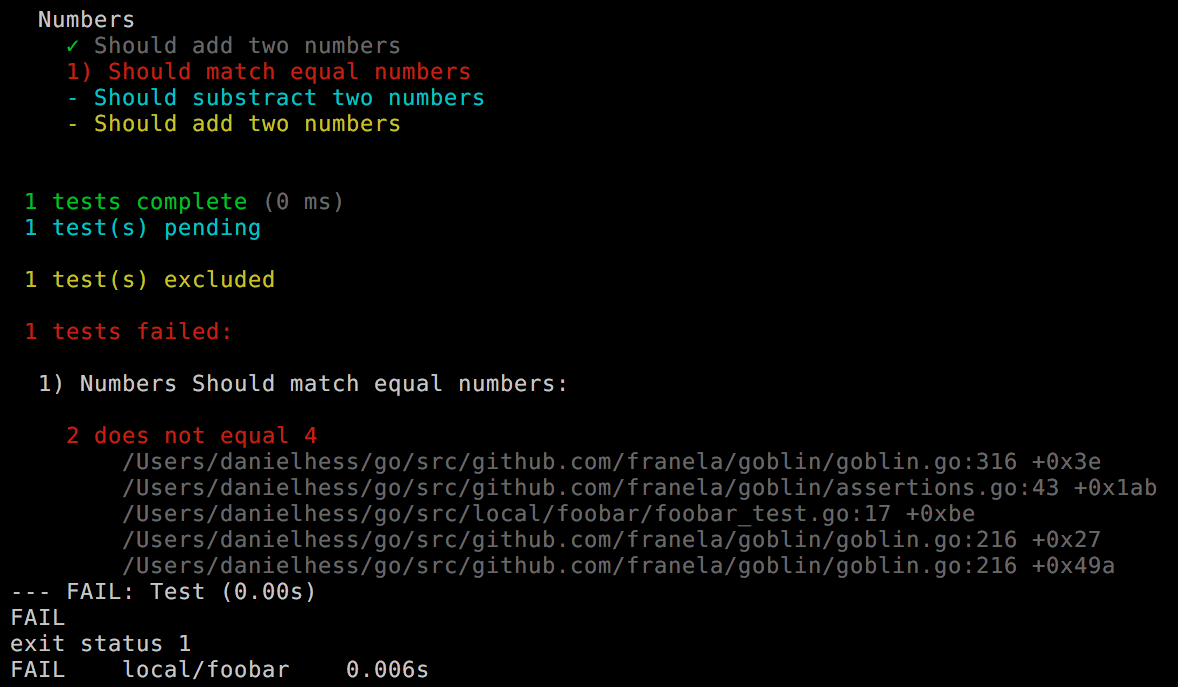
|
|
||||||
|
|
||||||
Nice and easy, right?
|
|
||||||
|
|
||||||
Can I do asynchronous tests?
|
|
||||||
----------------------------
|
|
||||||
|
|
||||||
Yes! Goblin will help you to test asynchronous things, like goroutines, etc. You just need to add a ```done``` parameter to the handler function of your ```It```. This handler function should be called when your test passes.
|
|
||||||
|
|
||||||
```go
|
|
||||||
...
|
|
||||||
g.Describe("Numbers", func() {
|
|
||||||
g.It("Should add two numbers asynchronously", func(done Done) {
|
|
||||||
go func() {
|
|
||||||
g.Assert(1+1).Equal(2)
|
|
||||||
done()
|
|
||||||
}()
|
|
||||||
})
|
|
||||||
})
|
|
||||||
...
|
|
||||||
```
|
|
||||||
|
|
||||||
Goblin will wait for the ```done``` call, a ```Fail``` call or any false assertion.
|
|
||||||
|
|
||||||
How do I use it with Gomega?
|
|
||||||
----------------------------
|
|
||||||
|
|
||||||
Gomega is a nice assertion framework. But it doesn't provide a nice way to hook it to testing frameworks. It should just panic instead of requiring a fail function. There is an issue about that [here](https://github.com/onsi/gomega/issues/5).
|
|
||||||
While this is being discussed and hopefully fixed, the way to use Gomega with Goblin is:
|
|
||||||
|
|
||||||
```go
|
|
||||||
package foobar
|
|
||||||
|
|
||||||
import (
|
|
||||||
"testing"
|
|
||||||
. "github.com/franela/goblin"
|
|
||||||
. "github.com/onsi/gomega"
|
|
||||||
)
|
|
||||||
|
|
||||||
func Test(t *testing.T) {
|
|
||||||
g := Goblin(t)
|
|
||||||
|
|
||||||
//special hook for gomega
|
|
||||||
RegisterFailHandler(func(m string, _ ...int) { g.Fail(m) })
|
|
||||||
|
|
||||||
g.Describe("lala", func() {
|
|
||||||
g.It("lslslslsls", func() {
|
|
||||||
Expect(1).To(Equal(10))
|
|
||||||
})
|
|
||||||
})
|
|
||||||
}
|
|
||||||
```
|
|
||||||
|
|
||||||
|
|
||||||
FAQ
|
|
||||||
----
|
|
||||||
|
|
||||||
### How do I run specific tests?
|
|
||||||
|
|
||||||
If `-goblin.run=$REGES` is supplied to the `go test` command then only tests that match the supplied regex will run
|
|
||||||
|
|
||||||
|
|
||||||
Contributing
|
|
||||||
-----
|
|
||||||
|
|
||||||
We do have a couple of [issues](https://github.com/franela/goblin/issues) pending. Feel free to contribute and send us PRs (with tests please :smile:).
|
|
||||||
|
|
||||||
Special Thanks
|
|
||||||
------------
|
|
||||||
|
|
||||||
Special thanks to [Leandro Reox](https://github.com/leandroreox) (Leitan) for the goblin logo.
|
|
||||||
-70
@@ -1,70 +0,0 @@
|
|||||||
package goblin
|
|
||||||
|
|
||||||
import (
|
|
||||||
"fmt"
|
|
||||||
"reflect"
|
|
||||||
"strings"
|
|
||||||
)
|
|
||||||
|
|
||||||
// Assertion represents a fact stated about a source object. It contains the source object and function to call
|
|
||||||
type Assertion struct {
|
|
||||||
src interface{}
|
|
||||||
fail func(interface{})
|
|
||||||
}
|
|
||||||
|
|
||||||
func objectsAreEqual(a, b interface{}) bool {
|
|
||||||
if reflect.TypeOf(a) != reflect.TypeOf(b) {
|
|
||||||
return false
|
|
||||||
}
|
|
||||||
|
|
||||||
if reflect.DeepEqual(a, b) {
|
|
||||||
return true
|
|
||||||
}
|
|
||||||
|
|
||||||
if fmt.Sprintf("%#v", a) == fmt.Sprintf("%#v", b) {
|
|
||||||
return true
|
|
||||||
}
|
|
||||||
|
|
||||||
return false
|
|
||||||
}
|
|
||||||
|
|
||||||
func formatMessages(messages ...string) string {
|
|
||||||
if len(messages) > 0 {
|
|
||||||
return ", " + strings.Join(messages, " ")
|
|
||||||
}
|
|
||||||
return ""
|
|
||||||
}
|
|
||||||
|
|
||||||
// Eql is a shorthand alias of Equal for convenience
|
|
||||||
func (a *Assertion) Eql(dst interface{}) {
|
|
||||||
a.Equal(dst)
|
|
||||||
}
|
|
||||||
|
|
||||||
// Equal takes a destination object and asserts that a source object and
|
|
||||||
// destination object are equal to one another. It will fail the assertion and
|
|
||||||
// print a corresponding message if the objects are not equivalent.
|
|
||||||
func (a *Assertion) Equal(dst interface{}) {
|
|
||||||
if !objectsAreEqual(a.src, dst) {
|
|
||||||
a.fail(fmt.Sprintf("%#v %s %#v", a.src, "does not equal", dst))
|
|
||||||
}
|
|
||||||
}
|
|
||||||
|
|
||||||
// IsTrue asserts that a source is equal to true. Optional messages can be
|
|
||||||
// provided for inclusion in the displayed message if the assertion fails. It
|
|
||||||
// will fail the assertion if the source does not resolve to true.
|
|
||||||
func (a *Assertion) IsTrue(messages ...string) {
|
|
||||||
if !objectsAreEqual(a.src, true) {
|
|
||||||
message := fmt.Sprintf("%v %s%s", a.src, "expected false to be truthy", formatMessages(messages...))
|
|
||||||
a.fail(message)
|
|
||||||
}
|
|
||||||
}
|
|
||||||
|
|
||||||
// IsFalse asserts that a source is equal to false. Optional messages can be
|
|
||||||
// provided for inclusion in the displayed message if the assertion fails. It
|
|
||||||
// will fail the assertion if the source does not resolve to false.
|
|
||||||
func (a *Assertion) IsFalse(messages ...string) {
|
|
||||||
if !objectsAreEqual(a.src, false) {
|
|
||||||
message := fmt.Sprintf("%v %s%s", a.src, "expected true to be falsey", formatMessages(messages...))
|
|
||||||
a.fail(message)
|
|
||||||
}
|
|
||||||
}
|
|
||||||
-36
@@ -1,36 +0,0 @@
|
|||||||
snippet gd
|
|
||||||
g.Describe("${1:name}", func() {
|
|
||||||
${2}
|
|
||||||
})
|
|
||||||
${0}
|
|
||||||
snippet git
|
|
||||||
g.It("${1:name}", func() {
|
|
||||||
${2}
|
|
||||||
})
|
|
||||||
${0}
|
|
||||||
snippet gait
|
|
||||||
g.It("${1:name}", func(done Done) {
|
|
||||||
done()
|
|
||||||
${2}
|
|
||||||
})
|
|
||||||
${0}
|
|
||||||
snippet gb
|
|
||||||
g.Before(func() {
|
|
||||||
${1}
|
|
||||||
})
|
|
||||||
${0}
|
|
||||||
snippet gbe
|
|
||||||
g.BeforeEach(func() {
|
|
||||||
${1}
|
|
||||||
})
|
|
||||||
${0}
|
|
||||||
snippet ga
|
|
||||||
g.After(func() {
|
|
||||||
${1}
|
|
||||||
})
|
|
||||||
${0}
|
|
||||||
snippet gae
|
|
||||||
g.AfterEach(func() {
|
|
||||||
${1}
|
|
||||||
})
|
|
||||||
${0}
|
|
||||||
-337
@@ -1,337 +0,0 @@
|
|||||||
package goblin
|
|
||||||
|
|
||||||
import (
|
|
||||||
"flag"
|
|
||||||
"fmt"
|
|
||||||
"regexp"
|
|
||||||
"runtime"
|
|
||||||
"sync"
|
|
||||||
"testing"
|
|
||||||
"time"
|
|
||||||
)
|
|
||||||
|
|
||||||
type Done func(error ...interface{})
|
|
||||||
|
|
||||||
type Runnable interface {
|
|
||||||
run(*G) bool
|
|
||||||
}
|
|
||||||
|
|
||||||
type Itable interface {
|
|
||||||
run(*G) bool
|
|
||||||
failed(string, []string)
|
|
||||||
}
|
|
||||||
|
|
||||||
func (g *G) Describe(name string, h func()) {
|
|
||||||
d := &Describe{name: name, h: h, parent: g.parent}
|
|
||||||
|
|
||||||
if d.parent != nil {
|
|
||||||
d.parent.children = append(d.parent.children, Runnable(d))
|
|
||||||
}
|
|
||||||
|
|
||||||
g.parent = d
|
|
||||||
|
|
||||||
h()
|
|
||||||
|
|
||||||
g.parent = d.parent
|
|
||||||
|
|
||||||
if g.parent == nil && d.hasTests {
|
|
||||||
g.reporter.begin()
|
|
||||||
if d.run(g) {
|
|
||||||
g.t.Fail()
|
|
||||||
}
|
|
||||||
g.reporter.end()
|
|
||||||
}
|
|
||||||
}
|
|
||||||
func (g *G) Timeout(time time.Duration) {
|
|
||||||
g.timeout = time
|
|
||||||
g.timer.Reset(time)
|
|
||||||
}
|
|
||||||
|
|
||||||
type Describe struct {
|
|
||||||
name string
|
|
||||||
h func()
|
|
||||||
children []Runnable
|
|
||||||
befores []func()
|
|
||||||
afters []func()
|
|
||||||
afterEach []func()
|
|
||||||
beforeEach []func()
|
|
||||||
hasTests bool
|
|
||||||
parent *Describe
|
|
||||||
}
|
|
||||||
|
|
||||||
func (d *Describe) runBeforeEach() {
|
|
||||||
if d.parent != nil {
|
|
||||||
d.parent.runBeforeEach()
|
|
||||||
}
|
|
||||||
|
|
||||||
for _, b := range d.beforeEach {
|
|
||||||
b()
|
|
||||||
}
|
|
||||||
}
|
|
||||||
|
|
||||||
func (d *Describe) runAfterEach() {
|
|
||||||
|
|
||||||
if d.parent != nil {
|
|
||||||
d.parent.runAfterEach()
|
|
||||||
}
|
|
||||||
|
|
||||||
for _, a := range d.afterEach {
|
|
||||||
a()
|
|
||||||
}
|
|
||||||
}
|
|
||||||
|
|
||||||
func (d *Describe) run(g *G) bool {
|
|
||||||
failed := false
|
|
||||||
if d.hasTests {
|
|
||||||
g.reporter.beginDescribe(d.name)
|
|
||||||
|
|
||||||
for _, b := range d.befores {
|
|
||||||
b()
|
|
||||||
}
|
|
||||||
|
|
||||||
for _, r := range d.children {
|
|
||||||
if r.run(g) {
|
|
||||||
failed = true
|
|
||||||
}
|
|
||||||
}
|
|
||||||
|
|
||||||
for _, a := range d.afters {
|
|
||||||
a()
|
|
||||||
}
|
|
||||||
|
|
||||||
g.reporter.endDescribe()
|
|
||||||
}
|
|
||||||
|
|
||||||
return failed
|
|
||||||
}
|
|
||||||
|
|
||||||
type Failure struct {
|
|
||||||
stack []string
|
|
||||||
testName string
|
|
||||||
message string
|
|
||||||
}
|
|
||||||
|
|
||||||
type It struct {
|
|
||||||
h interface{}
|
|
||||||
name string
|
|
||||||
parent *Describe
|
|
||||||
failure *Failure
|
|
||||||
reporter Reporter
|
|
||||||
isAsync bool
|
|
||||||
}
|
|
||||||
|
|
||||||
func (it *It) run(g *G) bool {
|
|
||||||
g.currentIt = it
|
|
||||||
|
|
||||||
if it.h == nil {
|
|
||||||
g.reporter.itIsPending(it.name)
|
|
||||||
return false
|
|
||||||
}
|
|
||||||
//TODO: should handle errors for beforeEach
|
|
||||||
it.parent.runBeforeEach()
|
|
||||||
|
|
||||||
runIt(g, it.h)
|
|
||||||
|
|
||||||
it.parent.runAfterEach()
|
|
||||||
|
|
||||||
failed := false
|
|
||||||
if it.failure != nil {
|
|
||||||
failed = true
|
|
||||||
}
|
|
||||||
|
|
||||||
if failed {
|
|
||||||
g.reporter.itFailed(it.name)
|
|
||||||
g.reporter.failure(it.failure)
|
|
||||||
} else {
|
|
||||||
g.reporter.itPassed(it.name)
|
|
||||||
}
|
|
||||||
return failed
|
|
||||||
}
|
|
||||||
|
|
||||||
func (it *It) failed(msg string, stack []string) {
|
|
||||||
it.failure = &Failure{stack: stack, message: msg, testName: it.parent.name + " " + it.name}
|
|
||||||
}
|
|
||||||
|
|
||||||
type Xit struct {
|
|
||||||
h interface{}
|
|
||||||
name string
|
|
||||||
parent *Describe
|
|
||||||
failure *Failure
|
|
||||||
reporter Reporter
|
|
||||||
isAsync bool
|
|
||||||
}
|
|
||||||
|
|
||||||
func (xit *Xit) run(g *G) bool {
|
|
||||||
g.currentIt = xit
|
|
||||||
|
|
||||||
g.reporter.itIsExcluded(xit.name)
|
|
||||||
return false
|
|
||||||
}
|
|
||||||
|
|
||||||
func (xit *Xit) failed(msg string, stack []string) {
|
|
||||||
xit.failure = nil
|
|
||||||
}
|
|
||||||
|
|
||||||
func parseFlags() {
|
|
||||||
//Flag parsing
|
|
||||||
flag.Parse()
|
|
||||||
if *regexParam != "" {
|
|
||||||
runRegex = regexp.MustCompile(*regexParam)
|
|
||||||
} else {
|
|
||||||
runRegex = nil
|
|
||||||
}
|
|
||||||
}
|
|
||||||
|
|
||||||
var timeout = flag.Duration("goblin.timeout", 5*time.Second, "Sets default timeouts for all tests")
|
|
||||||
var isTty = flag.Bool("goblin.tty", true, "Sets the default output format (color / monochrome)")
|
|
||||||
var regexParam = flag.String("goblin.run", "", "Runs only tests which match the supplied regex")
|
|
||||||
var runRegex *regexp.Regexp
|
|
||||||
|
|
||||||
func Goblin(t *testing.T, arguments ...string) *G {
|
|
||||||
if !flag.Parsed() {
|
|
||||||
parseFlags()
|
|
||||||
}
|
|
||||||
g := &G{t: t, timeout: *timeout}
|
|
||||||
var fancy TextFancier
|
|
||||||
if *isTty {
|
|
||||||
fancy = &TerminalFancier{}
|
|
||||||
} else {
|
|
||||||
fancy = &Monochrome{}
|
|
||||||
}
|
|
||||||
|
|
||||||
g.reporter = Reporter(&DetailedReporter{fancy: fancy})
|
|
||||||
return g
|
|
||||||
}
|
|
||||||
|
|
||||||
func runIt(g *G, h interface{}) {
|
|
||||||
defer timeTrack(time.Now(), g)
|
|
||||||
g.mutex.Lock()
|
|
||||||
g.timedOut = false
|
|
||||||
g.mutex.Unlock()
|
|
||||||
g.timer = time.NewTimer(g.timeout)
|
|
||||||
g.shouldContinue = make(chan bool)
|
|
||||||
if call, ok := h.(func()); ok {
|
|
||||||
// the test is synchronous
|
|
||||||
go func(c chan bool) { call(); c <- true }(g.shouldContinue)
|
|
||||||
} else if call, ok := h.(func(Done)); ok {
|
|
||||||
doneCalled := 0
|
|
||||||
go func(c chan bool) {
|
|
||||||
call(func(msg ...interface{}) {
|
|
||||||
if len(msg) > 0 {
|
|
||||||
g.Fail(msg)
|
|
||||||
} else {
|
|
||||||
doneCalled++
|
|
||||||
if doneCalled > 1 {
|
|
||||||
g.Fail("Done called multiple times")
|
|
||||||
}
|
|
||||||
c <- true
|
|
||||||
}
|
|
||||||
})
|
|
||||||
}(g.shouldContinue)
|
|
||||||
} else {
|
|
||||||
panic("Not implemented.")
|
|
||||||
}
|
|
||||||
select {
|
|
||||||
case <-g.shouldContinue:
|
|
||||||
case <-g.timer.C:
|
|
||||||
//Set to nil as it shouldn't continue
|
|
||||||
g.shouldContinue = nil
|
|
||||||
g.timedOut = true
|
|
||||||
g.Fail("Test exceeded " + fmt.Sprintf("%s", g.timeout))
|
|
||||||
}
|
|
||||||
// Reset timeout value
|
|
||||||
g.timeout = *timeout
|
|
||||||
}
|
|
||||||
|
|
||||||
type G struct {
|
|
||||||
t *testing.T
|
|
||||||
parent *Describe
|
|
||||||
currentIt Itable
|
|
||||||
timeout time.Duration
|
|
||||||
reporter Reporter
|
|
||||||
timedOut bool
|
|
||||||
shouldContinue chan bool
|
|
||||||
mutex sync.Mutex
|
|
||||||
timer *time.Timer
|
|
||||||
}
|
|
||||||
|
|
||||||
func (g *G) SetReporter(r Reporter) {
|
|
||||||
g.reporter = r
|
|
||||||
}
|
|
||||||
|
|
||||||
func (g *G) It(name string, h ...interface{}) {
|
|
||||||
if matchesRegex(name) {
|
|
||||||
it := &It{name: name, parent: g.parent, reporter: g.reporter}
|
|
||||||
notifyParents(g.parent)
|
|
||||||
if len(h) > 0 {
|
|
||||||
it.h = h[0]
|
|
||||||
}
|
|
||||||
g.parent.children = append(g.parent.children, Runnable(it))
|
|
||||||
}
|
|
||||||
}
|
|
||||||
|
|
||||||
func (g *G) Xit(name string, h ...interface{}) {
|
|
||||||
if matchesRegex(name) {
|
|
||||||
xit := &Xit{name: name, parent: g.parent, reporter: g.reporter}
|
|
||||||
notifyParents(g.parent)
|
|
||||||
if len(h) > 0 {
|
|
||||||
xit.h = h[0]
|
|
||||||
}
|
|
||||||
g.parent.children = append(g.parent.children, Runnable(xit))
|
|
||||||
}
|
|
||||||
}
|
|
||||||
|
|
||||||
func matchesRegex(value string) bool {
|
|
||||||
if runRegex != nil {
|
|
||||||
return runRegex.MatchString(value)
|
|
||||||
}
|
|
||||||
return true
|
|
||||||
}
|
|
||||||
|
|
||||||
func notifyParents(d *Describe) {
|
|
||||||
d.hasTests = true
|
|
||||||
if d.parent != nil {
|
|
||||||
notifyParents(d.parent)
|
|
||||||
}
|
|
||||||
}
|
|
||||||
|
|
||||||
func (g *G) Before(h func()) {
|
|
||||||
g.parent.befores = append(g.parent.befores, h)
|
|
||||||
}
|
|
||||||
|
|
||||||
func (g *G) BeforeEach(h func()) {
|
|
||||||
g.parent.beforeEach = append(g.parent.beforeEach, h)
|
|
||||||
}
|
|
||||||
|
|
||||||
func (g *G) After(h func()) {
|
|
||||||
g.parent.afters = append(g.parent.afters, h)
|
|
||||||
}
|
|
||||||
|
|
||||||
func (g *G) AfterEach(h func()) {
|
|
||||||
g.parent.afterEach = append(g.parent.afterEach, h)
|
|
||||||
}
|
|
||||||
|
|
||||||
func (g *G) Assert(src interface{}) *Assertion {
|
|
||||||
return &Assertion{src: src, fail: g.Fail}
|
|
||||||
}
|
|
||||||
|
|
||||||
func timeTrack(start time.Time, g *G) {
|
|
||||||
g.reporter.itTook(time.Since(start))
|
|
||||||
}
|
|
||||||
|
|
||||||
func (g *G) Fail(error interface{}) {
|
|
||||||
//Skips 7 stacks due to the functions between the stack and the test
|
|
||||||
stack := ResolveStack(7)
|
|
||||||
message := fmt.Sprintf("%v", error)
|
|
||||||
g.currentIt.failed(message, stack)
|
|
||||||
if g.shouldContinue != nil {
|
|
||||||
g.shouldContinue <- true
|
|
||||||
}
|
|
||||||
g.mutex.Lock()
|
|
||||||
defer g.mutex.Unlock()
|
|
||||||
if !g.timedOut {
|
|
||||||
//Stop test function execution
|
|
||||||
runtime.Goexit()
|
|
||||||
}
|
|
||||||
|
|
||||||
}
|
|
||||||
BIN

Binary file not shown.
|
Before Width: | Height: | Size: 36 KiB |
BIN

Binary file not shown.
|
Before Width: | Height: | Size: 48 KiB |
-30
@@ -1,30 +0,0 @@
|
|||||||
package goblin
|
|
||||||
|
|
||||||
import ()
|
|
||||||
|
|
||||||
type Monochrome struct {
|
|
||||||
}
|
|
||||||
|
|
||||||
func (self *Monochrome) Red(text string) string {
|
|
||||||
return "!" + text
|
|
||||||
}
|
|
||||||
|
|
||||||
func (self *Monochrome) Gray(text string) string {
|
|
||||||
return text
|
|
||||||
}
|
|
||||||
|
|
||||||
func (self *Monochrome) Cyan(text string) string {
|
|
||||||
return text
|
|
||||||
}
|
|
||||||
|
|
||||||
func (self *Monochrome) WithCheck(text string) string {
|
|
||||||
return ">>>" + text
|
|
||||||
}
|
|
||||||
|
|
||||||
func (self *Monochrome) Green(text string) string {
|
|
||||||
return text
|
|
||||||
}
|
|
||||||
|
|
||||||
func (self *Monochrome) Yellow(text string) string {
|
|
||||||
return text
|
|
||||||
}
|
|
||||||
-153
@@ -1,153 +0,0 @@
|
|||||||
package goblin
|
|
||||||
|
|
||||||
import (
|
|
||||||
"fmt"
|
|
||||||
"strconv"
|
|
||||||
"strings"
|
|
||||||
"time"
|
|
||||||
)
|
|
||||||
|
|
||||||
type Reporter interface {
|
|
||||||
beginDescribe(string)
|
|
||||||
endDescribe()
|
|
||||||
begin()
|
|
||||||
end()
|
|
||||||
failure(*Failure)
|
|
||||||
itTook(time.Duration)
|
|
||||||
itFailed(string)
|
|
||||||
itPassed(string)
|
|
||||||
itIsPending(string)
|
|
||||||
itIsExcluded(string)
|
|
||||||
}
|
|
||||||
|
|
||||||
type TextFancier interface {
|
|
||||||
Red(text string) string
|
|
||||||
Gray(text string) string
|
|
||||||
Cyan(text string) string
|
|
||||||
Green(text string) string
|
|
||||||
Yellow(text string) string
|
|
||||||
WithCheck(text string) string
|
|
||||||
}
|
|
||||||
|
|
||||||
type DetailedReporter struct {
|
|
||||||
level, failed, passed, pending, excluded int
|
|
||||||
failures []*Failure
|
|
||||||
executionTime, totalExecutionTime time.Duration
|
|
||||||
fancy TextFancier
|
|
||||||
}
|
|
||||||
|
|
||||||
func (r *DetailedReporter) SetTextFancier(f TextFancier) {
|
|
||||||
r.fancy = f
|
|
||||||
}
|
|
||||||
|
|
||||||
type TerminalFancier struct {
|
|
||||||
}
|
|
||||||
|
|
||||||
func (self *TerminalFancier) Red(text string) string {
|
|
||||||
return "\033[31m" + text + "\033[0m"
|
|
||||||
}
|
|
||||||
|
|
||||||
func (self *TerminalFancier) Gray(text string) string {
|
|
||||||
return "\033[90m" + text + "\033[0m"
|
|
||||||
}
|
|
||||||
|
|
||||||
func (self *TerminalFancier) Cyan(text string) string {
|
|
||||||
return "\033[36m" + text + "\033[0m"
|
|
||||||
}
|
|
||||||
|
|
||||||
func (self *TerminalFancier) Green(text string) string {
|
|
||||||
return "\033[32m" + text + "\033[0m"
|
|
||||||
}
|
|
||||||
|
|
||||||
func (self *TerminalFancier) Yellow(text string) string {
|
|
||||||
return "\033[33m" + text + "\033[0m"
|
|
||||||
}
|
|
||||||
|
|
||||||
func (self *TerminalFancier) WithCheck(text string) string {
|
|
||||||
return "\033[32m\u2713\033[0m " + text
|
|
||||||
}
|
|
||||||
|
|
||||||
func (r *DetailedReporter) getSpace() string {
|
|
||||||
return strings.Repeat(" ", (r.level+1)*2)
|
|
||||||
}
|
|
||||||
|
|
||||||
func (r *DetailedReporter) failure(failure *Failure) {
|
|
||||||
r.failures = append(r.failures, failure)
|
|
||||||
}
|
|
||||||
|
|
||||||
func (r *DetailedReporter) print(text string) {
|
|
||||||
fmt.Printf("%v%v\n", r.getSpace(), text)
|
|
||||||
}
|
|
||||||
|
|
||||||
func (r *DetailedReporter) printWithCheck(text string) {
|
|
||||||
fmt.Printf("%v%v\n", r.getSpace(), r.fancy.WithCheck(text))
|
|
||||||
}
|
|
||||||
|
|
||||||
func (r *DetailedReporter) beginDescribe(name string) {
|
|
||||||
fmt.Println("")
|
|
||||||
r.print(name)
|
|
||||||
r.level++
|
|
||||||
}
|
|
||||||
|
|
||||||
func (r *DetailedReporter) endDescribe() {
|
|
||||||
r.level--
|
|
||||||
}
|
|
||||||
|
|
||||||
func (r *DetailedReporter) itTook(duration time.Duration) {
|
|
||||||
r.executionTime = duration
|
|
||||||
r.totalExecutionTime += duration
|
|
||||||
}
|
|
||||||
|
|
||||||
func (r *DetailedReporter) itFailed(name string) {
|
|
||||||
r.failed++
|
|
||||||
r.print(r.fancy.Red(strconv.Itoa(r.failed) + ") " + name))
|
|
||||||
}
|
|
||||||
|
|
||||||
func (r *DetailedReporter) itPassed(name string) {
|
|
||||||
r.passed++
|
|
||||||
r.printWithCheck(r.fancy.Gray(name))
|
|
||||||
}
|
|
||||||
|
|
||||||
func (r *DetailedReporter) itIsPending(name string) {
|
|
||||||
r.pending++
|
|
||||||
r.print(r.fancy.Cyan("- " + name))
|
|
||||||
}
|
|
||||||
|
|
||||||
func (r *DetailedReporter) itIsExcluded(name string) {
|
|
||||||
r.excluded++
|
|
||||||
r.print(r.fancy.Yellow("- " + name))
|
|
||||||
}
|
|
||||||
|
|
||||||
func (r *DetailedReporter) begin() {
|
|
||||||
}
|
|
||||||
|
|
||||||
func (r *DetailedReporter) end() {
|
|
||||||
comp := fmt.Sprintf("%d tests complete", r.passed)
|
|
||||||
t := fmt.Sprintf("(%d ms)", r.totalExecutionTime/time.Millisecond)
|
|
||||||
|
|
||||||
//fmt.Printf("\n\n \033[32m%d tests complete\033[0m \033[90m(%d ms)\033[0m\n", r.passed, r.totalExecutionTime/time.Millisecond)
|
|
||||||
fmt.Printf("\n\n %v %v\n", r.fancy.Green(comp), r.fancy.Gray(t))
|
|
||||||
|
|
||||||
if r.pending > 0 {
|
|
||||||
pend := fmt.Sprintf("%d test(s) pending", r.pending)
|
|
||||||
fmt.Printf(" %v\n\n", r.fancy.Cyan(pend))
|
|
||||||
}
|
|
||||||
|
|
||||||
if r.excluded > 0 {
|
|
||||||
excl := fmt.Sprintf("%d test(s) excluded", r.excluded)
|
|
||||||
fmt.Printf(" %v\n\n", r.fancy.Yellow(excl))
|
|
||||||
}
|
|
||||||
|
|
||||||
if len(r.failures) > 0 {
|
|
||||||
fmt.Printf("%s \n\n", r.fancy.Red(fmt.Sprintf(" %d tests failed:", len(r.failures))))
|
|
||||||
|
|
||||||
}
|
|
||||||
|
|
||||||
for i, failure := range r.failures {
|
|
||||||
fmt.Printf(" %d) %s:\n\n", i+1, failure.testName)
|
|
||||||
fmt.Printf(" %s\n", r.fancy.Red(failure.message))
|
|
||||||
for _, stackItem := range failure.stack {
|
|
||||||
fmt.Printf(" %s\n", r.fancy.Gray(stackItem))
|
|
||||||
}
|
|
||||||
}
|
|
||||||
}
|
|
||||||
-21
@@ -1,21 +0,0 @@
|
|||||||
package goblin
|
|
||||||
|
|
||||||
import (
|
|
||||||
"runtime/debug"
|
|
||||||
"strings"
|
|
||||||
)
|
|
||||||
|
|
||||||
func ResolveStack(skip int) []string {
|
|
||||||
return cleanStack(debug.Stack(), skip)
|
|
||||||
}
|
|
||||||
|
|
||||||
func cleanStack(stack []byte, skip int) []string {
|
|
||||||
arrayStack := strings.Split(string(stack), "\n")
|
|
||||||
var finalStack []string
|
|
||||||
for i := skip; i < len(arrayStack); i++ {
|
|
||||||
if strings.Contains(arrayStack[i], ".go") {
|
|
||||||
finalStack = append(finalStack, arrayStack[i])
|
|
||||||
}
|
|
||||||
}
|
|
||||||
return finalStack
|
|
||||||
}
|
|
||||||
-3
@@ -1,3 +0,0 @@
|
|||||||
# This source code refers to The Go Authors for copyright purposes.
|
|
||||||
# The master list of authors is in the main Go distribution,
|
|
||||||
# visible at http://tip.golang.org/AUTHORS.
|
|
||||||
-3
@@ -1,3 +0,0 @@
|
|||||||
# This source code was written by the Go contributors.
|
|
||||||
# The master list of contributors is in the main Go distribution,
|
|
||||||
# visible at http://tip.golang.org/CONTRIBUTORS.
|
|
||||||
-28
@@ -1,28 +0,0 @@
|
|||||||
Copyright 2010 The Go Authors. All rights reserved.
|
|
||||||
|
|
||||||
Redistribution and use in source and binary forms, with or without
|
|
||||||
modification, are permitted provided that the following conditions are
|
|
||||||
met:
|
|
||||||
|
|
||||||
* Redistributions of source code must retain the above copyright
|
|
||||||
notice, this list of conditions and the following disclaimer.
|
|
||||||
* Redistributions in binary form must reproduce the above
|
|
||||||
copyright notice, this list of conditions and the following disclaimer
|
|
||||||
in the documentation and/or other materials provided with the
|
|
||||||
distribution.
|
|
||||||
* Neither the name of Google Inc. nor the names of its
|
|
||||||
contributors may be used to endorse or promote products derived from
|
|
||||||
this software without specific prior written permission.
|
|
||||||
|
|
||||||
THIS SOFTWARE IS PROVIDED BY THE COPYRIGHT HOLDERS AND CONTRIBUTORS
|
|
||||||
"AS IS" AND ANY EXPRESS OR IMPLIED WARRANTIES, INCLUDING, BUT NOT
|
|
||||||
LIMITED TO, THE IMPLIED WARRANTIES OF MERCHANTABILITY AND FITNESS FOR
|
|
||||||
A PARTICULAR PURPOSE ARE DISCLAIMED. IN NO EVENT SHALL THE COPYRIGHT
|
|
||||||
OWNER OR CONTRIBUTORS BE LIABLE FOR ANY DIRECT, INDIRECT, INCIDENTAL,
|
|
||||||
SPECIAL, EXEMPLARY, OR CONSEQUENTIAL DAMAGES (INCLUDING, BUT NOT
|
|
||||||
LIMITED TO, PROCUREMENT OF SUBSTITUTE GOODS OR SERVICES; LOSS OF USE,
|
|
||||||
DATA, OR PROFITS; OR BUSINESS INTERRUPTION) HOWEVER CAUSED AND ON ANY
|
|
||||||
THEORY OF LIABILITY, WHETHER IN CONTRACT, STRICT LIABILITY, OR TORT
|
|
||||||
(INCLUDING NEGLIGENCE OR OTHERWISE) ARISING IN ANY WAY OUT OF THE USE
|
|
||||||
OF THIS SOFTWARE, EVEN IF ADVISED OF THE POSSIBILITY OF SUCH DAMAGE.
|
|
||||||
|
|
||||||
-253
@@ -1,253 +0,0 @@
|
|||||||
// Go support for Protocol Buffers - Google's data interchange format
|
|
||||||
//
|
|
||||||
// Copyright 2011 The Go Authors. All rights reserved.
|
|
||||||
// https://github.com/golang/protobuf
|
|
||||||
//
|
|
||||||
// Redistribution and use in source and binary forms, with or without
|
|
||||||
// modification, are permitted provided that the following conditions are
|
|
||||||
// met:
|
|
||||||
//
|
|
||||||
// * Redistributions of source code must retain the above copyright
|
|
||||||
// notice, this list of conditions and the following disclaimer.
|
|
||||||
// * Redistributions in binary form must reproduce the above
|
|
||||||
// copyright notice, this list of conditions and the following disclaimer
|
|
||||||
// in the documentation and/or other materials provided with the
|
|
||||||
// distribution.
|
|
||||||
// * Neither the name of Google Inc. nor the names of its
|
|
||||||
// contributors may be used to endorse or promote products derived from
|
|
||||||
// this software without specific prior written permission.
|
|
||||||
//
|
|
||||||
// THIS SOFTWARE IS PROVIDED BY THE COPYRIGHT HOLDERS AND CONTRIBUTORS
|
|
||||||
// "AS IS" AND ANY EXPRESS OR IMPLIED WARRANTIES, INCLUDING, BUT NOT
|
|
||||||
// LIMITED TO, THE IMPLIED WARRANTIES OF MERCHANTABILITY AND FITNESS FOR
|
|
||||||
// A PARTICULAR PURPOSE ARE DISCLAIMED. IN NO EVENT SHALL THE COPYRIGHT
|
|
||||||
// OWNER OR CONTRIBUTORS BE LIABLE FOR ANY DIRECT, INDIRECT, INCIDENTAL,
|
|
||||||
// SPECIAL, EXEMPLARY, OR CONSEQUENTIAL DAMAGES (INCLUDING, BUT NOT
|
|
||||||
// LIMITED TO, PROCUREMENT OF SUBSTITUTE GOODS OR SERVICES; LOSS OF USE,
|
|
||||||
// DATA, OR PROFITS; OR BUSINESS INTERRUPTION) HOWEVER CAUSED AND ON ANY
|
|
||||||
// THEORY OF LIABILITY, WHETHER IN CONTRACT, STRICT LIABILITY, OR TORT
|
|
||||||
// (INCLUDING NEGLIGENCE OR OTHERWISE) ARISING IN ANY WAY OUT OF THE USE
|
|
||||||
// OF THIS SOFTWARE, EVEN IF ADVISED OF THE POSSIBILITY OF SUCH DAMAGE.
|
|
||||||
|
|
||||||
// Protocol buffer deep copy and merge.
|
|
||||||
// TODO: RawMessage.
|
|
||||||
|
|
||||||
package proto
|
|
||||||
|
|
||||||
import (
|
|
||||||
"fmt"
|
|
||||||
"log"
|
|
||||||
"reflect"
|
|
||||||
"strings"
|
|
||||||
)
|
|
||||||
|
|
||||||
// Clone returns a deep copy of a protocol buffer.
|
|
||||||
func Clone(src Message) Message {
|
|
||||||
in := reflect.ValueOf(src)
|
|
||||||
if in.IsNil() {
|
|
||||||
return src
|
|
||||||
}
|
|
||||||
out := reflect.New(in.Type().Elem())
|
|
||||||
dst := out.Interface().(Message)
|
|
||||||
Merge(dst, src)
|
|
||||||
return dst
|
|
||||||
}
|
|
||||||
|
|
||||||
// Merger is the interface representing objects that can merge messages of the same type.
|
|
||||||
type Merger interface {
|
|
||||||
// Merge merges src into this message.
|
|
||||||
// Required and optional fields that are set in src will be set to that value in dst.
|
|
||||||
// Elements of repeated fields will be appended.
|
|
||||||
//
|
|
||||||
// Merge may panic if called with a different argument type than the receiver.
|
|
||||||
Merge(src Message)
|
|
||||||
}
|
|
||||||
|
|
||||||
// generatedMerger is the custom merge method that generated protos will have.
|
|
||||||
// We must add this method since a generate Merge method will conflict with
|
|
||||||
// many existing protos that have a Merge data field already defined.
|
|
||||||
type generatedMerger interface {
|
|
||||||
XXX_Merge(src Message)
|
|
||||||
}
|
|
||||||
|
|
||||||
// Merge merges src into dst.
|
|
||||||
// Required and optional fields that are set in src will be set to that value in dst.
|
|
||||||
// Elements of repeated fields will be appended.
|
|
||||||
// Merge panics if src and dst are not the same type, or if dst is nil.
|
|
||||||
func Merge(dst, src Message) {
|
|
||||||
if m, ok := dst.(Merger); ok {
|
|
||||||
m.Merge(src)
|
|
||||||
return
|
|
||||||
}
|
|
||||||
|
|
||||||
in := reflect.ValueOf(src)
|
|
||||||
out := reflect.ValueOf(dst)
|
|
||||||
if out.IsNil() {
|
|
||||||
panic("proto: nil destination")
|
|
||||||
}
|
|
||||||
if in.Type() != out.Type() {
|
|
||||||
panic(fmt.Sprintf("proto.Merge(%T, %T) type mismatch", dst, src))
|
|
||||||
}
|
|
||||||
if in.IsNil() {
|
|
||||||
return // Merge from nil src is a noop
|
|
||||||
}
|
|
||||||
if m, ok := dst.(generatedMerger); ok {
|
|
||||||
m.XXX_Merge(src)
|
|
||||||
return
|
|
||||||
}
|
|
||||||
mergeStruct(out.Elem(), in.Elem())
|
|
||||||
}
|
|
||||||
|
|
||||||
func mergeStruct(out, in reflect.Value) {
|
|
||||||
sprop := GetProperties(in.Type())
|
|
||||||
for i := 0; i < in.NumField(); i++ {
|
|
||||||
f := in.Type().Field(i)
|
|
||||||
if strings.HasPrefix(f.Name, "XXX_") {
|
|
||||||
continue
|
|
||||||
}
|
|
||||||
mergeAny(out.Field(i), in.Field(i), false, sprop.Prop[i])
|
|
||||||
}
|
|
||||||
|
|
||||||
if emIn, err := extendable(in.Addr().Interface()); err == nil {
|
|
||||||
emOut, _ := extendable(out.Addr().Interface())
|
|
||||||
mIn, muIn := emIn.extensionsRead()
|
|
||||||
if mIn != nil {
|
|
||||||
mOut := emOut.extensionsWrite()
|
|
||||||
muIn.Lock()
|
|
||||||
mergeExtension(mOut, mIn)
|
|
||||||
muIn.Unlock()
|
|
||||||
}
|
|
||||||
}
|
|
||||||
|
|
||||||
uf := in.FieldByName("XXX_unrecognized")
|
|
||||||
if !uf.IsValid() {
|
|
||||||
return
|
|
||||||
}
|
|
||||||
uin := uf.Bytes()
|
|
||||||
if len(uin) > 0 {
|
|
||||||
out.FieldByName("XXX_unrecognized").SetBytes(append([]byte(nil), uin...))
|
|
||||||
}
|
|
||||||
}
|
|
||||||
|
|
||||||
// mergeAny performs a merge between two values of the same type.
|
|
||||||
// viaPtr indicates whether the values were indirected through a pointer (implying proto2).
|
|
||||||
// prop is set if this is a struct field (it may be nil).
|
|
||||||
func mergeAny(out, in reflect.Value, viaPtr bool, prop *Properties) {
|
|
||||||
if in.Type() == protoMessageType {
|
|
||||||
if !in.IsNil() {
|
|
||||||
if out.IsNil() {
|
|
||||||
out.Set(reflect.ValueOf(Clone(in.Interface().(Message))))
|
|
||||||
} else {
|
|
||||||
Merge(out.Interface().(Message), in.Interface().(Message))
|
|
||||||
}
|
|
||||||
}
|
|
||||||
return
|
|
||||||
}
|
|
||||||
switch in.Kind() {
|
|
||||||
case reflect.Bool, reflect.Float32, reflect.Float64, reflect.Int32, reflect.Int64,
|
|
||||||
reflect.String, reflect.Uint32, reflect.Uint64:
|
|
||||||
if !viaPtr && isProto3Zero(in) {
|
|
||||||
return
|
|
||||||
}
|
|
||||||
out.Set(in)
|
|
||||||
case reflect.Interface:
|
|
||||||
// Probably a oneof field; copy non-nil values.
|
|
||||||
if in.IsNil() {
|
|
||||||
return
|
|
||||||
}
|
|
||||||
// Allocate destination if it is not set, or set to a different type.
|
|
||||||
// Otherwise we will merge as normal.
|
|
||||||
if out.IsNil() || out.Elem().Type() != in.Elem().Type() {
|
|
||||||
out.Set(reflect.New(in.Elem().Elem().Type())) // interface -> *T -> T -> new(T)
|
|
||||||
}
|
|
||||||
mergeAny(out.Elem(), in.Elem(), false, nil)
|
|
||||||
case reflect.Map:
|
|
||||||
if in.Len() == 0 {
|
|
||||||
return
|
|
||||||
}
|
|
||||||
if out.IsNil() {
|
|
||||||
out.Set(reflect.MakeMap(in.Type()))
|
|
||||||
}
|
|
||||||
// For maps with value types of *T or []byte we need to deep copy each value.
|
|
||||||
elemKind := in.Type().Elem().Kind()
|
|
||||||
for _, key := range in.MapKeys() {
|
|
||||||
var val reflect.Value
|
|
||||||
switch elemKind {
|
|
||||||
case reflect.Ptr:
|
|
||||||
val = reflect.New(in.Type().Elem().Elem())
|
|
||||||
mergeAny(val, in.MapIndex(key), false, nil)
|
|
||||||
case reflect.Slice:
|
|
||||||
val = in.MapIndex(key)
|
|
||||||
val = reflect.ValueOf(append([]byte{}, val.Bytes()...))
|
|
||||||
default:
|
|
||||||
val = in.MapIndex(key)
|
|
||||||
}
|
|
||||||
out.SetMapIndex(key, val)
|
|
||||||
}
|
|
||||||
case reflect.Ptr:
|
|
||||||
if in.IsNil() {
|
|
||||||
return
|
|
||||||
}
|
|
||||||
if out.IsNil() {
|
|
||||||
out.Set(reflect.New(in.Elem().Type()))
|
|
||||||
}
|
|
||||||
mergeAny(out.Elem(), in.Elem(), true, nil)
|
|
||||||
case reflect.Slice:
|
|
||||||
if in.IsNil() {
|
|
||||||
return
|
|
||||||
}
|
|
||||||
if in.Type().Elem().Kind() == reflect.Uint8 {
|
|
||||||
// []byte is a scalar bytes field, not a repeated field.
|
|
||||||
|
|
||||||
// Edge case: if this is in a proto3 message, a zero length
|
|
||||||
// bytes field is considered the zero value, and should not
|
|
||||||
// be merged.
|
|
||||||
if prop != nil && prop.proto3 && in.Len() == 0 {
|
|
||||||
return
|
|
||||||
}
|
|
||||||
|
|
||||||
// Make a deep copy.
|
|
||||||
// Append to []byte{} instead of []byte(nil) so that we never end up
|
|
||||||
// with a nil result.
|
|
||||||
out.SetBytes(append([]byte{}, in.Bytes()...))
|
|
||||||
return
|
|
||||||
}
|
|
||||||
n := in.Len()
|
|
||||||
if out.IsNil() {
|
|
||||||
out.Set(reflect.MakeSlice(in.Type(), 0, n))
|
|
||||||
}
|
|
||||||
switch in.Type().Elem().Kind() {
|
|
||||||
case reflect.Bool, reflect.Float32, reflect.Float64, reflect.Int32, reflect.Int64,
|
|
||||||
reflect.String, reflect.Uint32, reflect.Uint64:
|
|
||||||
out.Set(reflect.AppendSlice(out, in))
|
|
||||||
default:
|
|
||||||
for i := 0; i < n; i++ {
|
|
||||||
x := reflect.Indirect(reflect.New(in.Type().Elem()))
|
|
||||||
mergeAny(x, in.Index(i), false, nil)
|
|
||||||
out.Set(reflect.Append(out, x))
|
|
||||||
}
|
|
||||||
}
|
|
||||||
case reflect.Struct:
|
|
||||||
mergeStruct(out, in)
|
|
||||||
default:
|
|
||||||
// unknown type, so not a protocol buffer
|
|
||||||
log.Printf("proto: don't know how to copy %v", in)
|
|
||||||
}
|
|
||||||
}
|
|
||||||
|
|
||||||
func mergeExtension(out, in map[int32]Extension) {
|
|
||||||
for extNum, eIn := range in {
|
|
||||||
eOut := Extension{desc: eIn.desc}
|
|
||||||
if eIn.value != nil {
|
|
||||||
v := reflect.New(reflect.TypeOf(eIn.value)).Elem()
|
|
||||||
mergeAny(v, reflect.ValueOf(eIn.value), false, nil)
|
|
||||||
eOut.value = v.Interface()
|
|
||||||
}
|
|
||||||
if eIn.enc != nil {
|
|
||||||
eOut.enc = make([]byte, len(eIn.enc))
|
|
||||||
copy(eOut.enc, eIn.enc)
|
|
||||||
}
|
|
||||||
|
|
||||||
out[extNum] = eOut
|
|
||||||
}
|
|
||||||
}
|
|
||||||
-428
@@ -1,428 +0,0 @@
|
|||||||
// Go support for Protocol Buffers - Google's data interchange format
|
|
||||||
//
|
|
||||||
// Copyright 2010 The Go Authors. All rights reserved.
|
|
||||||
// https://github.com/golang/protobuf
|
|
||||||
//
|
|
||||||
// Redistribution and use in source and binary forms, with or without
|
|
||||||
// modification, are permitted provided that the following conditions are
|
|
||||||
// met:
|
|
||||||
//
|
|
||||||
// * Redistributions of source code must retain the above copyright
|
|
||||||
// notice, this list of conditions and the following disclaimer.
|
|
||||||
// * Redistributions in binary form must reproduce the above
|
|
||||||
// copyright notice, this list of conditions and the following disclaimer
|
|
||||||
// in the documentation and/or other materials provided with the
|
|
||||||
// distribution.
|
|
||||||
// * Neither the name of Google Inc. nor the names of its
|
|
||||||
// contributors may be used to endorse or promote products derived from
|
|
||||||
// this software without specific prior written permission.
|
|
||||||
//
|
|
||||||
// THIS SOFTWARE IS PROVIDED BY THE COPYRIGHT HOLDERS AND CONTRIBUTORS
|
|
||||||
// "AS IS" AND ANY EXPRESS OR IMPLIED WARRANTIES, INCLUDING, BUT NOT
|
|
||||||
// LIMITED TO, THE IMPLIED WARRANTIES OF MERCHANTABILITY AND FITNESS FOR
|
|
||||||
// A PARTICULAR PURPOSE ARE DISCLAIMED. IN NO EVENT SHALL THE COPYRIGHT
|
|
||||||
// OWNER OR CONTRIBUTORS BE LIABLE FOR ANY DIRECT, INDIRECT, INCIDENTAL,
|
|
||||||
// SPECIAL, EXEMPLARY, OR CONSEQUENTIAL DAMAGES (INCLUDING, BUT NOT
|
|
||||||
// LIMITED TO, PROCUREMENT OF SUBSTITUTE GOODS OR SERVICES; LOSS OF USE,
|
|
||||||
// DATA, OR PROFITS; OR BUSINESS INTERRUPTION) HOWEVER CAUSED AND ON ANY
|
|
||||||
// THEORY OF LIABILITY, WHETHER IN CONTRACT, STRICT LIABILITY, OR TORT
|
|
||||||
// (INCLUDING NEGLIGENCE OR OTHERWISE) ARISING IN ANY WAY OUT OF THE USE
|
|
||||||
// OF THIS SOFTWARE, EVEN IF ADVISED OF THE POSSIBILITY OF SUCH DAMAGE.
|
|
||||||
|
|
||||||
package proto
|
|
||||||
|
|
||||||
/*
|
|
||||||
* Routines for decoding protocol buffer data to construct in-memory representations.
|
|
||||||
*/
|
|
||||||
|
|
||||||
import (
|
|
||||||
"errors"
|
|
||||||
"fmt"
|
|
||||||
"io"
|
|
||||||
)
|
|
||||||
|
|
||||||
// errOverflow is returned when an integer is too large to be represented.
|
|
||||||
var errOverflow = errors.New("proto: integer overflow")
|
|
||||||
|
|
||||||
// ErrInternalBadWireType is returned by generated code when an incorrect
|
|
||||||
// wire type is encountered. It does not get returned to user code.
|
|
||||||
var ErrInternalBadWireType = errors.New("proto: internal error: bad wiretype for oneof")
|
|
||||||
|
|
||||||
// DecodeVarint reads a varint-encoded integer from the slice.
|
|
||||||
// It returns the integer and the number of bytes consumed, or
|
|
||||||
// zero if there is not enough.
|
|
||||||
// This is the format for the
|
|
||||||
// int32, int64, uint32, uint64, bool, and enum
|
|
||||||
// protocol buffer types.
|
|
||||||
func DecodeVarint(buf []byte) (x uint64, n int) {
|
|
||||||
for shift := uint(0); shift < 64; shift += 7 {
|
|
||||||
if n >= len(buf) {
|
|
||||||
return 0, 0
|
|
||||||
}
|
|
||||||
b := uint64(buf[n])
|
|
||||||
n++
|
|
||||||
x |= (b & 0x7F) << shift
|
|
||||||
if (b & 0x80) == 0 {
|
|
||||||
return x, n
|
|
||||||
}
|
|
||||||
}
|
|
||||||
|
|
||||||
// The number is too large to represent in a 64-bit value.
|
|
||||||
return 0, 0
|
|
||||||
}
|
|
||||||
|
|
||||||
func (p *Buffer) decodeVarintSlow() (x uint64, err error) {
|
|
||||||
i := p.index
|
|
||||||
l := len(p.buf)
|
|
||||||
|
|
||||||
for shift := uint(0); shift < 64; shift += 7 {
|
|
||||||
if i >= l {
|
|
||||||
err = io.ErrUnexpectedEOF
|
|
||||||
return
|
|
||||||
}
|
|
||||||
b := p.buf[i]
|
|
||||||
i++
|
|
||||||
x |= (uint64(b) & 0x7F) << shift
|
|
||||||
if b < 0x80 {
|
|
||||||
p.index = i
|
|
||||||
return
|
|
||||||
}
|
|
||||||
}
|
|
||||||
|
|
||||||
// The number is too large to represent in a 64-bit value.
|
|
||||||
err = errOverflow
|
|
||||||
return
|
|
||||||
}
|
|
||||||
|
|
||||||
// DecodeVarint reads a varint-encoded integer from the Buffer.
|
|
||||||
// This is the format for the
|
|
||||||
// int32, int64, uint32, uint64, bool, and enum
|
|
||||||
// protocol buffer types.
|
|
||||||
func (p *Buffer) DecodeVarint() (x uint64, err error) {
|
|
||||||
i := p.index
|
|
||||||
buf := p.buf
|
|
||||||
|
|
||||||
if i >= len(buf) {
|
|
||||||
return 0, io.ErrUnexpectedEOF
|
|
||||||
} else if buf[i] < 0x80 {
|
|
||||||
p.index++
|
|
||||||
return uint64(buf[i]), nil
|
|
||||||
} else if len(buf)-i < 10 {
|
|
||||||
return p.decodeVarintSlow()
|
|
||||||
}
|
|
||||||
|
|
||||||
var b uint64
|
|
||||||
// we already checked the first byte
|
|
||||||
x = uint64(buf[i]) - 0x80
|
|
||||||
i++
|
|
||||||
|
|
||||||
b = uint64(buf[i])
|
|
||||||
i++
|
|
||||||
x += b << 7
|
|
||||||
if b&0x80 == 0 {
|
|
||||||
goto done
|
|
||||||
}
|
|
||||||
x -= 0x80 << 7
|
|
||||||
|
|
||||||
b = uint64(buf[i])
|
|
||||||
i++
|
|
||||||
x += b << 14
|
|
||||||
if b&0x80 == 0 {
|
|
||||||
goto done
|
|
||||||
}
|
|
||||||
x -= 0x80 << 14
|
|
||||||
|
|
||||||
b = uint64(buf[i])
|
|
||||||
i++
|
|
||||||
x += b << 21
|
|
||||||
if b&0x80 == 0 {
|
|
||||||
goto done
|
|
||||||
}
|
|
||||||
x -= 0x80 << 21
|
|
||||||
|
|
||||||
b = uint64(buf[i])
|
|
||||||
i++
|
|
||||||
x += b << 28
|
|
||||||
if b&0x80 == 0 {
|
|
||||||
goto done
|
|
||||||
}
|
|
||||||
x -= 0x80 << 28
|
|
||||||
|
|
||||||
b = uint64(buf[i])
|
|
||||||
i++
|
|
||||||
x += b << 35
|
|
||||||
if b&0x80 == 0 {
|
|
||||||
goto done
|
|
||||||
}
|
|
||||||
x -= 0x80 << 35
|
|
||||||
|
|
||||||
b = uint64(buf[i])
|
|
||||||
i++
|
|
||||||
x += b << 42
|
|
||||||
if b&0x80 == 0 {
|
|
||||||
goto done
|
|
||||||
}
|
|
||||||
x -= 0x80 << 42
|
|
||||||
|
|
||||||
b = uint64(buf[i])
|
|
||||||
i++
|
|
||||||
x += b << 49
|
|
||||||
if b&0x80 == 0 {
|
|
||||||
goto done
|
|
||||||
}
|
|
||||||
x -= 0x80 << 49
|
|
||||||
|
|
||||||
b = uint64(buf[i])
|
|
||||||
i++
|
|
||||||
x += b << 56
|
|
||||||
if b&0x80 == 0 {
|
|
||||||
goto done
|
|
||||||
}
|
|
||||||
x -= 0x80 << 56
|
|
||||||
|
|
||||||
b = uint64(buf[i])
|
|
||||||
i++
|
|
||||||
x += b << 63
|
|
||||||
if b&0x80 == 0 {
|
|
||||||
goto done
|
|
||||||
}
|
|
||||||
// x -= 0x80 << 63 // Always zero.
|
|
||||||
|
|
||||||
return 0, errOverflow
|
|
||||||
|
|
||||||
done:
|
|
||||||
p.index = i
|
|
||||||
return x, nil
|
|
||||||
}
|
|
||||||
|
|
||||||
// DecodeFixed64 reads a 64-bit integer from the Buffer.
|
|
||||||
// This is the format for the
|
|
||||||
// fixed64, sfixed64, and double protocol buffer types.
|
|
||||||
func (p *Buffer) DecodeFixed64() (x uint64, err error) {
|
|
||||||
// x, err already 0
|
|
||||||
i := p.index + 8
|
|
||||||
if i < 0 || i > len(p.buf) {
|
|
||||||
err = io.ErrUnexpectedEOF
|
|
||||||
return
|
|
||||||
}
|
|
||||||
p.index = i
|
|
||||||
|
|
||||||
x = uint64(p.buf[i-8])
|
|
||||||
x |= uint64(p.buf[i-7]) << 8
|
|
||||||
x |= uint64(p.buf[i-6]) << 16
|
|
||||||
x |= uint64(p.buf[i-5]) << 24
|
|
||||||
x |= uint64(p.buf[i-4]) << 32
|
|
||||||
x |= uint64(p.buf[i-3]) << 40
|
|
||||||
x |= uint64(p.buf[i-2]) << 48
|
|
||||||
x |= uint64(p.buf[i-1]) << 56
|
|
||||||
return
|
|
||||||
}
|
|
||||||
|
|
||||||
// DecodeFixed32 reads a 32-bit integer from the Buffer.
|
|
||||||
// This is the format for the
|
|
||||||
// fixed32, sfixed32, and float protocol buffer types.
|
|
||||||
func (p *Buffer) DecodeFixed32() (x uint64, err error) {
|
|
||||||
// x, err already 0
|
|
||||||
i := p.index + 4
|
|
||||||
if i < 0 || i > len(p.buf) {
|
|
||||||
err = io.ErrUnexpectedEOF
|
|
||||||
return
|
|
||||||
}
|
|
||||||
p.index = i
|
|
||||||
|
|
||||||
x = uint64(p.buf[i-4])
|
|
||||||
x |= uint64(p.buf[i-3]) << 8
|
|
||||||
x |= uint64(p.buf[i-2]) << 16
|
|
||||||
x |= uint64(p.buf[i-1]) << 24
|
|
||||||
return
|
|
||||||
}
|
|
||||||
|
|
||||||
// DecodeZigzag64 reads a zigzag-encoded 64-bit integer
|
|
||||||
// from the Buffer.
|
|
||||||
// This is the format used for the sint64 protocol buffer type.
|
|
||||||
func (p *Buffer) DecodeZigzag64() (x uint64, err error) {
|
|
||||||
x, err = p.DecodeVarint()
|
|
||||||
if err != nil {
|
|
||||||
return
|
|
||||||
}
|
|
||||||
x = (x >> 1) ^ uint64((int64(x&1)<<63)>>63)
|
|
||||||
return
|
|
||||||
}
|
|
||||||
|
|
||||||
// DecodeZigzag32 reads a zigzag-encoded 32-bit integer
|
|
||||||
// from the Buffer.
|
|
||||||
// This is the format used for the sint32 protocol buffer type.
|
|
||||||
func (p *Buffer) DecodeZigzag32() (x uint64, err error) {
|
|
||||||
x, err = p.DecodeVarint()
|
|
||||||
if err != nil {
|
|
||||||
return
|
|
||||||
}
|
|
||||||
x = uint64((uint32(x) >> 1) ^ uint32((int32(x&1)<<31)>>31))
|
|
||||||
return
|
|
||||||
}
|
|
||||||
|
|
||||||
// DecodeRawBytes reads a count-delimited byte buffer from the Buffer.
|
|
||||||
// This is the format used for the bytes protocol buffer
|
|
||||||
// type and for embedded messages.
|
|
||||||
func (p *Buffer) DecodeRawBytes(alloc bool) (buf []byte, err error) {
|
|
||||||
n, err := p.DecodeVarint()
|
|
||||||
if err != nil {
|
|
||||||
return nil, err
|
|
||||||
}
|
|
||||||
|
|
||||||
nb := int(n)
|
|
||||||
if nb < 0 {
|
|
||||||
return nil, fmt.Errorf("proto: bad byte length %d", nb)
|
|
||||||
}
|
|
||||||
end := p.index + nb
|
|
||||||
if end < p.index || end > len(p.buf) {
|
|
||||||
return nil, io.ErrUnexpectedEOF
|
|
||||||
}
|
|
||||||
|
|
||||||
if !alloc {
|
|
||||||
// todo: check if can get more uses of alloc=false
|
|
||||||
buf = p.buf[p.index:end]
|
|
||||||
p.index += nb
|
|
||||||
return
|
|
||||||
}
|
|
||||||
|
|
||||||
buf = make([]byte, nb)
|
|
||||||
copy(buf, p.buf[p.index:])
|
|
||||||
p.index += nb
|
|
||||||
return
|
|
||||||
}
|
|
||||||
|
|
||||||
// DecodeStringBytes reads an encoded string from the Buffer.
|
|
||||||
// This is the format used for the proto2 string type.
|
|
||||||
func (p *Buffer) DecodeStringBytes() (s string, err error) {
|
|
||||||
buf, err := p.DecodeRawBytes(false)
|
|
||||||
if err != nil {
|
|
||||||
return
|
|
||||||
}
|
|
||||||
return string(buf), nil
|
|
||||||
}
|
|
||||||
|
|
||||||
// Unmarshaler is the interface representing objects that can
|
|
||||||
// unmarshal themselves. The argument points to data that may be
|
|
||||||
// overwritten, so implementations should not keep references to the
|
|
||||||
// buffer.
|
|
||||||
// Unmarshal implementations should not clear the receiver.
|
|
||||||
// Any unmarshaled data should be merged into the receiver.
|
|
||||||
// Callers of Unmarshal that do not want to retain existing data
|
|
||||||
// should Reset the receiver before calling Unmarshal.
|
|
||||||
type Unmarshaler interface {
|
|
||||||
Unmarshal([]byte) error
|
|
||||||
}
|
|
||||||
|
|
||||||
// newUnmarshaler is the interface representing objects that can
|
|
||||||
// unmarshal themselves. The semantics are identical to Unmarshaler.
|
|
||||||
//
|
|
||||||
// This exists to support protoc-gen-go generated messages.
|
|
||||||
// The proto package will stop type-asserting to this interface in the future.
|
|
||||||
//
|
|
||||||
// DO NOT DEPEND ON THIS.
|
|
||||||
type newUnmarshaler interface {
|
|
||||||
XXX_Unmarshal([]byte) error
|
|
||||||
}
|
|
||||||
|
|
||||||
// Unmarshal parses the protocol buffer representation in buf and places the
|
|
||||||
// decoded result in pb. If the struct underlying pb does not match
|
|
||||||
// the data in buf, the results can be unpredictable.
|
|
||||||
//
|
|
||||||
// Unmarshal resets pb before starting to unmarshal, so any
|
|
||||||
// existing data in pb is always removed. Use UnmarshalMerge
|
|
||||||
// to preserve and append to existing data.
|
|
||||||
func Unmarshal(buf []byte, pb Message) error {
|
|
||||||
pb.Reset()
|
|
||||||
if u, ok := pb.(newUnmarshaler); ok {
|
|
||||||
return u.XXX_Unmarshal(buf)
|
|
||||||
}
|
|
||||||
if u, ok := pb.(Unmarshaler); ok {
|
|
||||||
return u.Unmarshal(buf)
|
|
||||||
}
|
|
||||||
return NewBuffer(buf).Unmarshal(pb)
|
|
||||||
}
|
|
||||||
|
|
||||||
// UnmarshalMerge parses the protocol buffer representation in buf and
|
|
||||||
// writes the decoded result to pb. If the struct underlying pb does not match
|
|
||||||
// the data in buf, the results can be unpredictable.
|
|
||||||
//
|
|
||||||
// UnmarshalMerge merges into existing data in pb.
|
|
||||||
// Most code should use Unmarshal instead.
|
|
||||||
func UnmarshalMerge(buf []byte, pb Message) error {
|
|
||||||
if u, ok := pb.(newUnmarshaler); ok {
|
|
||||||
return u.XXX_Unmarshal(buf)
|
|
||||||
}
|
|
||||||
if u, ok := pb.(Unmarshaler); ok {
|
|
||||||
// NOTE: The history of proto have unfortunately been inconsistent
|
|
||||||
// whether Unmarshaler should or should not implicitly clear itself.
|
|
||||||
// Some implementations do, most do not.
|
|
||||||
// Thus, calling this here may or may not do what people want.
|
|
||||||
//
|
|
||||||
// See https://github.com/golang/protobuf/issues/424
|
|
||||||
return u.Unmarshal(buf)
|
|
||||||
}
|
|
||||||
return NewBuffer(buf).Unmarshal(pb)
|
|
||||||
}
|
|
||||||
|
|
||||||
// DecodeMessage reads a count-delimited message from the Buffer.
|
|
||||||
func (p *Buffer) DecodeMessage(pb Message) error {
|
|
||||||
enc, err := p.DecodeRawBytes(false)
|
|
||||||
if err != nil {
|
|
||||||
return err
|
|
||||||
}
|
|
||||||
return NewBuffer(enc).Unmarshal(pb)
|
|
||||||
}
|
|
||||||
|
|
||||||
// DecodeGroup reads a tag-delimited group from the Buffer.
|
|
||||||
// StartGroup tag is already consumed. This function consumes
|
|
||||||
// EndGroup tag.
|
|
||||||
func (p *Buffer) DecodeGroup(pb Message) error {
|
|
||||||
b := p.buf[p.index:]
|
|
||||||
x, y := findEndGroup(b)
|
|
||||||
if x < 0 {
|
|
||||||
return io.ErrUnexpectedEOF
|
|
||||||
}
|
|
||||||
err := Unmarshal(b[:x], pb)
|
|
||||||
p.index += y
|
|
||||||
return err
|
|
||||||
}
|
|
||||||
|
|
||||||
// Unmarshal parses the protocol buffer representation in the
|
|
||||||
// Buffer and places the decoded result in pb. If the struct
|
|
||||||
// underlying pb does not match the data in the buffer, the results can be
|
|
||||||
// unpredictable.
|
|
||||||
//
|
|
||||||
// Unlike proto.Unmarshal, this does not reset pb before starting to unmarshal.
|
|
||||||
func (p *Buffer) Unmarshal(pb Message) error {
|
|
||||||
// If the object can unmarshal itself, let it.
|
|
||||||
if u, ok := pb.(newUnmarshaler); ok {
|
|
||||||
err := u.XXX_Unmarshal(p.buf[p.index:])
|
|
||||||
p.index = len(p.buf)
|
|
||||||
return err
|
|
||||||
}
|
|
||||||
if u, ok := pb.(Unmarshaler); ok {
|
|
||||||
// NOTE: The history of proto have unfortunately been inconsistent
|
|
||||||
// whether Unmarshaler should or should not implicitly clear itself.
|
|
||||||
// Some implementations do, most do not.
|
|
||||||
// Thus, calling this here may or may not do what people want.
|
|
||||||
//
|
|
||||||
// See https://github.com/golang/protobuf/issues/424
|
|
||||||
err := u.Unmarshal(p.buf[p.index:])
|
|
||||||
p.index = len(p.buf)
|
|
||||||
return err
|
|
||||||
}
|
|
||||||
|
|
||||||
// Slow workaround for messages that aren't Unmarshalers.
|
|
||||||
// This includes some hand-coded .pb.go files and
|
|
||||||
// bootstrap protos.
|
|
||||||
// TODO: fix all of those and then add Unmarshal to
|
|
||||||
// the Message interface. Then:
|
|
||||||
// The cast above and code below can be deleted.
|
|
||||||
// The old unmarshaler can be deleted.
|
|
||||||
// Clients can call Unmarshal directly (can already do that, actually).
|
|
||||||
var info InternalMessageInfo
|
|
||||||
err := info.Unmarshal(pb, p.buf[p.index:])
|
|
||||||
p.index = len(p.buf)
|
|
||||||
return err
|
|
||||||
}
|
|
||||||
-350
@@ -1,350 +0,0 @@
|
|||||||
// Go support for Protocol Buffers - Google's data interchange format
|
|
||||||
//
|
|
||||||
// Copyright 2017 The Go Authors. All rights reserved.
|
|
||||||
// https://github.com/golang/protobuf
|
|
||||||
//
|
|
||||||
// Redistribution and use in source and binary forms, with or without
|
|
||||||
// modification, are permitted provided that the following conditions are
|
|
||||||
// met:
|
|
||||||
//
|
|
||||||
// * Redistributions of source code must retain the above copyright
|
|
||||||
// notice, this list of conditions and the following disclaimer.
|
|
||||||
// * Redistributions in binary form must reproduce the above
|
|
||||||
// copyright notice, this list of conditions and the following disclaimer
|
|
||||||
// in the documentation and/or other materials provided with the
|
|
||||||
// distribution.
|
|
||||||
// * Neither the name of Google Inc. nor the names of its
|
|
||||||
// contributors may be used to endorse or promote products derived from
|
|
||||||
// this software without specific prior written permission.
|
|
||||||
//
|
|
||||||
// THIS SOFTWARE IS PROVIDED BY THE COPYRIGHT HOLDERS AND CONTRIBUTORS
|
|
||||||
// "AS IS" AND ANY EXPRESS OR IMPLIED WARRANTIES, INCLUDING, BUT NOT
|
|
||||||
// LIMITED TO, THE IMPLIED WARRANTIES OF MERCHANTABILITY AND FITNESS FOR
|
|
||||||
// A PARTICULAR PURPOSE ARE DISCLAIMED. IN NO EVENT SHALL THE COPYRIGHT
|
|
||||||
// OWNER OR CONTRIBUTORS BE LIABLE FOR ANY DIRECT, INDIRECT, INCIDENTAL,
|
|
||||||
// SPECIAL, EXEMPLARY, OR CONSEQUENTIAL DAMAGES (INCLUDING, BUT NOT
|
|
||||||
// LIMITED TO, PROCUREMENT OF SUBSTITUTE GOODS OR SERVICES; LOSS OF USE,
|
|
||||||
// DATA, OR PROFITS; OR BUSINESS INTERRUPTION) HOWEVER CAUSED AND ON ANY
|
|
||||||
// THEORY OF LIABILITY, WHETHER IN CONTRACT, STRICT LIABILITY, OR TORT
|
|
||||||
// (INCLUDING NEGLIGENCE OR OTHERWISE) ARISING IN ANY WAY OUT OF THE USE
|
|
||||||
// OF THIS SOFTWARE, EVEN IF ADVISED OF THE POSSIBILITY OF SUCH DAMAGE.
|
|
||||||
|
|
||||||
package proto
|
|
||||||
|
|
||||||
import (
|
|
||||||
"fmt"
|
|
||||||
"reflect"
|
|
||||||
"strings"
|
|
||||||
"sync"
|
|
||||||
"sync/atomic"
|
|
||||||
)
|
|
||||||
|
|
||||||
type generatedDiscarder interface {
|
|
||||||
XXX_DiscardUnknown()
|
|
||||||
}
|
|
||||||
|
|
||||||
// DiscardUnknown recursively discards all unknown fields from this message
|
|
||||||
// and all embedded messages.
|
|
||||||
//
|
|
||||||
// When unmarshaling a message with unrecognized fields, the tags and values
|
|
||||||
// of such fields are preserved in the Message. This allows a later call to
|
|
||||||
// marshal to be able to produce a message that continues to have those
|
|
||||||
// unrecognized fields. To avoid this, DiscardUnknown is used to
|
|
||||||
// explicitly clear the unknown fields after unmarshaling.
|
|
||||||
//
|
|
||||||
// For proto2 messages, the unknown fields of message extensions are only
|
|
||||||
// discarded from messages that have been accessed via GetExtension.
|
|
||||||
func DiscardUnknown(m Message) {
|
|
||||||
if m, ok := m.(generatedDiscarder); ok {
|
|
||||||
m.XXX_DiscardUnknown()
|
|
||||||
return
|
|
||||||
}
|
|
||||||
// TODO: Dynamically populate a InternalMessageInfo for legacy messages,
|
|
||||||
// but the master branch has no implementation for InternalMessageInfo,
|
|
||||||
// so it would be more work to replicate that approach.
|
|
||||||
discardLegacy(m)
|
|
||||||
}
|
|
||||||
|
|
||||||
// DiscardUnknown recursively discards all unknown fields.
|
|
||||||
func (a *InternalMessageInfo) DiscardUnknown(m Message) {
|
|
||||||
di := atomicLoadDiscardInfo(&a.discard)
|
|
||||||
if di == nil {
|
|
||||||
di = getDiscardInfo(reflect.TypeOf(m).Elem())
|
|
||||||
atomicStoreDiscardInfo(&a.discard, di)
|
|
||||||
}
|
|
||||||
di.discard(toPointer(&m))
|
|
||||||
}
|
|
||||||
|
|
||||||
type discardInfo struct {
|
|
||||||
typ reflect.Type
|
|
||||||
|
|
||||||
initialized int32 // 0: only typ is valid, 1: everything is valid
|
|
||||||
lock sync.Mutex
|
|
||||||
|
|
||||||
fields []discardFieldInfo
|
|
||||||
unrecognized field
|
|
||||||
}
|
|
||||||
|
|
||||||
type discardFieldInfo struct {
|
|
||||||
field field // Offset of field, guaranteed to be valid
|
|
||||||
discard func(src pointer)
|
|
||||||
}
|
|
||||||
|
|
||||||
var (
|
|
||||||
discardInfoMap = map[reflect.Type]*discardInfo{}
|
|
||||||
discardInfoLock sync.Mutex
|
|
||||||
)
|
|
||||||
|
|
||||||
func getDiscardInfo(t reflect.Type) *discardInfo {
|
|
||||||
discardInfoLock.Lock()
|
|
||||||
defer discardInfoLock.Unlock()
|
|
||||||
di := discardInfoMap[t]
|
|
||||||
if di == nil {
|
|
||||||
di = &discardInfo{typ: t}
|
|
||||||
discardInfoMap[t] = di
|
|
||||||
}
|
|
||||||
return di
|
|
||||||
}
|
|
||||||
|
|
||||||
func (di *discardInfo) discard(src pointer) {
|
|
||||||
if src.isNil() {
|
|
||||||
return // Nothing to do.
|
|
||||||
}
|
|
||||||
|
|
||||||
if atomic.LoadInt32(&di.initialized) == 0 {
|
|
||||||
di.computeDiscardInfo()
|
|
||||||
}
|
|
||||||
|
|
||||||
for _, fi := range di.fields {
|
|
||||||
sfp := src.offset(fi.field)
|
|
||||||
fi.discard(sfp)
|
|
||||||
}
|
|
||||||
|
|
||||||
// For proto2 messages, only discard unknown fields in message extensions
|
|
||||||
// that have been accessed via GetExtension.
|
|
||||||
if em, err := extendable(src.asPointerTo(di.typ).Interface()); err == nil {
|
|
||||||
// Ignore lock since DiscardUnknown is not concurrency safe.
|
|
||||||
emm, _ := em.extensionsRead()
|
|
||||||
for _, mx := range emm {
|
|
||||||
if m, ok := mx.value.(Message); ok {
|
|
||||||
DiscardUnknown(m)
|
|
||||||
}
|
|
||||||
}
|
|
||||||
}
|
|
||||||
|
|
||||||
if di.unrecognized.IsValid() {
|
|
||||||
*src.offset(di.unrecognized).toBytes() = nil
|
|
||||||
}
|
|
||||||
}
|
|
||||||
|
|
||||||
func (di *discardInfo) computeDiscardInfo() {
|
|
||||||
di.lock.Lock()
|
|
||||||
defer di.lock.Unlock()
|
|
||||||
if di.initialized != 0 {
|
|
||||||
return
|
|
||||||
}
|
|
||||||
t := di.typ
|
|
||||||
n := t.NumField()
|
|
||||||
|
|
||||||
for i := 0; i < n; i++ {
|
|
||||||
f := t.Field(i)
|
|
||||||
if strings.HasPrefix(f.Name, "XXX_") {
|
|
||||||
continue
|
|
||||||
}
|
|
||||||
|
|
||||||
dfi := discardFieldInfo{field: toField(&f)}
|
|
||||||
tf := f.Type
|
|
||||||
|
|
||||||
// Unwrap tf to get its most basic type.
|
|
||||||
var isPointer, isSlice bool
|
|
||||||
if tf.Kind() == reflect.Slice && tf.Elem().Kind() != reflect.Uint8 {
|
|
||||||
isSlice = true
|
|
||||||
tf = tf.Elem()
|
|
||||||
}
|
|
||||||
if tf.Kind() == reflect.Ptr {
|
|
||||||
isPointer = true
|
|
||||||
tf = tf.Elem()
|
|
||||||
}
|
|
||||||
if isPointer && isSlice && tf.Kind() != reflect.Struct {
|
|
||||||
panic(fmt.Sprintf("%v.%s cannot be a slice of pointers to primitive types", t, f.Name))
|
|
||||||
}
|
|
||||||
|
|
||||||
switch tf.Kind() {
|
|
||||||
case reflect.Struct:
|
|
||||||
switch {
|
|
||||||
case !isPointer:
|
|
||||||
panic(fmt.Sprintf("%v.%s cannot be a direct struct value", t, f.Name))
|
|
||||||
case isSlice: // E.g., []*pb.T
|
|
||||||
di := getDiscardInfo(tf)
|
|
||||||
dfi.discard = func(src pointer) {
|
|
||||||
sps := src.getPointerSlice()
|
|
||||||
for _, sp := range sps {
|
|
||||||
if !sp.isNil() {
|
|
||||||
di.discard(sp)
|
|
||||||
}
|
|
||||||
}
|
|
||||||
}
|
|
||||||
default: // E.g., *pb.T
|
|
||||||
di := getDiscardInfo(tf)
|
|
||||||
dfi.discard = func(src pointer) {
|
|
||||||
sp := src.getPointer()
|
|
||||||
if !sp.isNil() {
|
|
||||||
di.discard(sp)
|
|
||||||
}
|
|
||||||
}
|
|
||||||
}
|
|
||||||
case reflect.Map:
|
|
||||||
switch {
|
|
||||||
case isPointer || isSlice:
|
|
||||||
panic(fmt.Sprintf("%v.%s cannot be a pointer to a map or a slice of map values", t, f.Name))
|
|
||||||
default: // E.g., map[K]V
|
|
||||||
if tf.Elem().Kind() == reflect.Ptr { // Proto struct (e.g., *T)
|
|
||||||
dfi.discard = func(src pointer) {
|
|
||||||
sm := src.asPointerTo(tf).Elem()
|
|
||||||
if sm.Len() == 0 {
|
|
||||||
return
|
|
||||||
}
|
|
||||||
for _, key := range sm.MapKeys() {
|
|
||||||
val := sm.MapIndex(key)
|
|
||||||
DiscardUnknown(val.Interface().(Message))
|
|
||||||
}
|
|
||||||
}
|
|
||||||
} else {
|
|
||||||
dfi.discard = func(pointer) {} // Noop
|
|
||||||
}
|
|
||||||
}
|
|
||||||
case reflect.Interface:
|
|
||||||
// Must be oneof field.
|
|
||||||
switch {
|
|
||||||
case isPointer || isSlice:
|
|
||||||
panic(fmt.Sprintf("%v.%s cannot be a pointer to a interface or a slice of interface values", t, f.Name))
|
|
||||||
default: // E.g., interface{}
|
|
||||||
// TODO: Make this faster?
|
|
||||||
dfi.discard = func(src pointer) {
|
|
||||||
su := src.asPointerTo(tf).Elem()
|
|
||||||
if !su.IsNil() {
|
|
||||||
sv := su.Elem().Elem().Field(0)
|
|
||||||
if sv.Kind() == reflect.Ptr && sv.IsNil() {
|
|
||||||
return
|
|
||||||
}
|
|
||||||
switch sv.Type().Kind() {
|
|
||||||
case reflect.Ptr: // Proto struct (e.g., *T)
|
|
||||||
DiscardUnknown(sv.Interface().(Message))
|
|
||||||
}
|
|
||||||
}
|
|
||||||
}
|
|
||||||
}
|
|
||||||
default:
|
|
||||||
continue
|
|
||||||
}
|
|
||||||
di.fields = append(di.fields, dfi)
|
|
||||||
}
|
|
||||||
|
|
||||||
di.unrecognized = invalidField
|
|
||||||
if f, ok := t.FieldByName("XXX_unrecognized"); ok {
|
|
||||||
if f.Type != reflect.TypeOf([]byte{}) {
|
|
||||||
panic("expected XXX_unrecognized to be of type []byte")
|
|
||||||
}
|
|
||||||
di.unrecognized = toField(&f)
|
|
||||||
}
|
|
||||||
|
|
||||||
atomic.StoreInt32(&di.initialized, 1)
|
|
||||||
}
|
|
||||||
|
|
||||||
func discardLegacy(m Message) {
|
|
||||||
v := reflect.ValueOf(m)
|
|
||||||
if v.Kind() != reflect.Ptr || v.IsNil() {
|
|
||||||
return
|
|
||||||
}
|
|
||||||
v = v.Elem()
|
|
||||||
if v.Kind() != reflect.Struct {
|
|
||||||
return
|
|
||||||
}
|
|
||||||
t := v.Type()
|
|
||||||
|
|
||||||
for i := 0; i < v.NumField(); i++ {
|
|
||||||
f := t.Field(i)
|
|
||||||
if strings.HasPrefix(f.Name, "XXX_") {
|
|
||||||
continue
|
|
||||||
}
|
|
||||||
vf := v.Field(i)
|
|
||||||
tf := f.Type
|
|
||||||
|
|
||||||
// Unwrap tf to get its most basic type.
|
|
||||||
var isPointer, isSlice bool
|
|
||||||
if tf.Kind() == reflect.Slice && tf.Elem().Kind() != reflect.Uint8 {
|
|
||||||
isSlice = true
|
|
||||||
tf = tf.Elem()
|
|
||||||
}
|
|
||||||
if tf.Kind() == reflect.Ptr {
|
|
||||||
isPointer = true
|
|
||||||
tf = tf.Elem()
|
|
||||||
}
|
|
||||||
if isPointer && isSlice && tf.Kind() != reflect.Struct {
|
|
||||||
panic(fmt.Sprintf("%T.%s cannot be a slice of pointers to primitive types", m, f.Name))
|
|
||||||
}
|
|
||||||
|
|
||||||
switch tf.Kind() {
|
|
||||||
case reflect.Struct:
|
|
||||||
switch {
|
|
||||||
case !isPointer:
|
|
||||||
panic(fmt.Sprintf("%T.%s cannot be a direct struct value", m, f.Name))
|
|
||||||
case isSlice: // E.g., []*pb.T
|
|
||||||
for j := 0; j < vf.Len(); j++ {
|
|
||||||
discardLegacy(vf.Index(j).Interface().(Message))
|
|
||||||
}
|
|
||||||
default: // E.g., *pb.T
|
|
||||||
discardLegacy(vf.Interface().(Message))
|
|
||||||
}
|
|
||||||
case reflect.Map:
|
|
||||||
switch {
|
|
||||||
case isPointer || isSlice:
|
|
||||||
panic(fmt.Sprintf("%T.%s cannot be a pointer to a map or a slice of map values", m, f.Name))
|
|
||||||
default: // E.g., map[K]V
|
|
||||||
tv := vf.Type().Elem()
|
|
||||||
if tv.Kind() == reflect.Ptr && tv.Implements(protoMessageType) { // Proto struct (e.g., *T)
|
|
||||||
for _, key := range vf.MapKeys() {
|
|
||||||
val := vf.MapIndex(key)
|
|
||||||
discardLegacy(val.Interface().(Message))
|
|
||||||
}
|
|
||||||
}
|
|
||||||
}
|
|
||||||
case reflect.Interface:
|
|
||||||
// Must be oneof field.
|
|
||||||
switch {
|
|
||||||
case isPointer || isSlice:
|
|
||||||
panic(fmt.Sprintf("%T.%s cannot be a pointer to a interface or a slice of interface values", m, f.Name))
|
|
||||||
default: // E.g., test_proto.isCommunique_Union interface
|
|
||||||
if !vf.IsNil() && f.Tag.Get("protobuf_oneof") != "" {
|
|
||||||
vf = vf.Elem() // E.g., *test_proto.Communique_Msg
|
|
||||||
if !vf.IsNil() {
|
|
||||||
vf = vf.Elem() // E.g., test_proto.Communique_Msg
|
|
||||||
vf = vf.Field(0) // E.g., Proto struct (e.g., *T) or primitive value
|
|
||||||
if vf.Kind() == reflect.Ptr {
|
|
||||||
discardLegacy(vf.Interface().(Message))
|
|
||||||
}
|
|
||||||
}
|
|
||||||
}
|
|
||||||
}
|
|
||||||
}
|
|
||||||
}
|
|
||||||
|
|
||||||
if vf := v.FieldByName("XXX_unrecognized"); vf.IsValid() {
|
|
||||||
if vf.Type() != reflect.TypeOf([]byte{}) {
|
|
||||||
panic("expected XXX_unrecognized to be of type []byte")
|
|
||||||
}
|
|
||||||
vf.Set(reflect.ValueOf([]byte(nil)))
|
|
||||||
}
|
|
||||||
|
|
||||||
// For proto2 messages, only discard unknown fields in message extensions
|
|
||||||
// that have been accessed via GetExtension.
|
|
||||||
if em, err := extendable(m); err == nil {
|
|
||||||
// Ignore lock since discardLegacy is not concurrency safe.
|
|
||||||
emm, _ := em.extensionsRead()
|
|
||||||
for _, mx := range emm {
|
|
||||||
if m, ok := mx.value.(Message); ok {
|
|
||||||
discardLegacy(m)
|
|
||||||
}
|
|
||||||
}
|
|
||||||
}
|
|
||||||
}
|
|
||||||
-203
@@ -1,203 +0,0 @@
|
|||||||
// Go support for Protocol Buffers - Google's data interchange format
|
|
||||||
//
|
|
||||||
// Copyright 2010 The Go Authors. All rights reserved.
|
|
||||||
// https://github.com/golang/protobuf
|
|
||||||
//
|
|
||||||
// Redistribution and use in source and binary forms, with or without
|
|
||||||
// modification, are permitted provided that the following conditions are
|
|
||||||
// met:
|
|
||||||
//
|
|
||||||
// * Redistributions of source code must retain the above copyright
|
|
||||||
// notice, this list of conditions and the following disclaimer.
|
|
||||||
// * Redistributions in binary form must reproduce the above
|
|
||||||
// copyright notice, this list of conditions and the following disclaimer
|
|
||||||
// in the documentation and/or other materials provided with the
|
|
||||||
// distribution.
|
|
||||||
// * Neither the name of Google Inc. nor the names of its
|
|
||||||
// contributors may be used to endorse or promote products derived from
|
|
||||||
// this software without specific prior written permission.
|
|
||||||
//
|
|
||||||
// THIS SOFTWARE IS PROVIDED BY THE COPYRIGHT HOLDERS AND CONTRIBUTORS
|
|
||||||
// "AS IS" AND ANY EXPRESS OR IMPLIED WARRANTIES, INCLUDING, BUT NOT
|
|
||||||
// LIMITED TO, THE IMPLIED WARRANTIES OF MERCHANTABILITY AND FITNESS FOR
|
|
||||||
// A PARTICULAR PURPOSE ARE DISCLAIMED. IN NO EVENT SHALL THE COPYRIGHT
|
|
||||||
// OWNER OR CONTRIBUTORS BE LIABLE FOR ANY DIRECT, INDIRECT, INCIDENTAL,
|
|
||||||
// SPECIAL, EXEMPLARY, OR CONSEQUENTIAL DAMAGES (INCLUDING, BUT NOT
|
|
||||||
// LIMITED TO, PROCUREMENT OF SUBSTITUTE GOODS OR SERVICES; LOSS OF USE,
|
|
||||||
// DATA, OR PROFITS; OR BUSINESS INTERRUPTION) HOWEVER CAUSED AND ON ANY
|
|
||||||
// THEORY OF LIABILITY, WHETHER IN CONTRACT, STRICT LIABILITY, OR TORT
|
|
||||||
// (INCLUDING NEGLIGENCE OR OTHERWISE) ARISING IN ANY WAY OUT OF THE USE
|
|
||||||
// OF THIS SOFTWARE, EVEN IF ADVISED OF THE POSSIBILITY OF SUCH DAMAGE.
|
|
||||||
|
|
||||||
package proto
|
|
||||||
|
|
||||||
/*
|
|
||||||
* Routines for encoding data into the wire format for protocol buffers.
|
|
||||||
*/
|
|
||||||
|
|
||||||
import (
|
|
||||||
"errors"
|
|
||||||
"reflect"
|
|
||||||
)
|
|
||||||
|
|
||||||
var (
|
|
||||||
// errRepeatedHasNil is the error returned if Marshal is called with
|
|
||||||
// a struct with a repeated field containing a nil element.
|
|
||||||
errRepeatedHasNil = errors.New("proto: repeated field has nil element")
|
|
||||||
|
|
||||||
// errOneofHasNil is the error returned if Marshal is called with
|
|
||||||
// a struct with a oneof field containing a nil element.
|
|
||||||
errOneofHasNil = errors.New("proto: oneof field has nil value")
|
|
||||||
|
|
||||||
// ErrNil is the error returned if Marshal is called with nil.
|
|
||||||
ErrNil = errors.New("proto: Marshal called with nil")
|
|
||||||
|
|
||||||
// ErrTooLarge is the error returned if Marshal is called with a
|
|
||||||
// message that encodes to >2GB.
|
|
||||||
ErrTooLarge = errors.New("proto: message encodes to over 2 GB")
|
|
||||||
)
|
|
||||||
|
|
||||||
// The fundamental encoders that put bytes on the wire.
|
|
||||||
// Those that take integer types all accept uint64 and are
|
|
||||||
// therefore of type valueEncoder.
|
|
||||||
|
|
||||||
const maxVarintBytes = 10 // maximum length of a varint
|
|
||||||
|
|
||||||
// EncodeVarint returns the varint encoding of x.
|
|
||||||
// This is the format for the
|
|
||||||
// int32, int64, uint32, uint64, bool, and enum
|
|
||||||
// protocol buffer types.
|
|
||||||
// Not used by the package itself, but helpful to clients
|
|
||||||
// wishing to use the same encoding.
|
|
||||||
func EncodeVarint(x uint64) []byte {
|
|
||||||
var buf [maxVarintBytes]byte
|
|
||||||
var n int
|
|
||||||
for n = 0; x > 127; n++ {
|
|
||||||
buf[n] = 0x80 | uint8(x&0x7F)
|
|
||||||
x >>= 7
|
|
||||||
}
|
|
||||||
buf[n] = uint8(x)
|
|
||||||
n++
|
|
||||||
return buf[0:n]
|
|
||||||
}
|
|
||||||
|
|
||||||
// EncodeVarint writes a varint-encoded integer to the Buffer.
|
|
||||||
// This is the format for the
|
|
||||||
// int32, int64, uint32, uint64, bool, and enum
|
|
||||||
// protocol buffer types.
|
|
||||||
func (p *Buffer) EncodeVarint(x uint64) error {
|
|
||||||
for x >= 1<<7 {
|
|
||||||
p.buf = append(p.buf, uint8(x&0x7f|0x80))
|
|
||||||
x >>= 7
|
|
||||||
}
|
|
||||||
p.buf = append(p.buf, uint8(x))
|
|
||||||
return nil
|
|
||||||
}
|
|
||||||
|
|
||||||
// SizeVarint returns the varint encoding size of an integer.
|
|
||||||
func SizeVarint(x uint64) int {
|
|
||||||
switch {
|
|
||||||
case x < 1<<7:
|
|
||||||
return 1
|
|
||||||
case x < 1<<14:
|
|
||||||
return 2
|
|
||||||
case x < 1<<21:
|
|
||||||
return 3
|
|
||||||
case x < 1<<28:
|
|
||||||
return 4
|
|
||||||
case x < 1<<35:
|
|
||||||
return 5
|
|
||||||
case x < 1<<42:
|
|
||||||
return 6
|
|
||||||
case x < 1<<49:
|
|
||||||
return 7
|
|
||||||
case x < 1<<56:
|
|
||||||
return 8
|
|
||||||
case x < 1<<63:
|
|
||||||
return 9
|
|
||||||
}
|
|
||||||
return 10
|
|
||||||
}
|
|
||||||
|
|
||||||
// EncodeFixed64 writes a 64-bit integer to the Buffer.
|
|
||||||
// This is the format for the
|
|
||||||
// fixed64, sfixed64, and double protocol buffer types.
|
|
||||||
func (p *Buffer) EncodeFixed64(x uint64) error {
|
|
||||||
p.buf = append(p.buf,
|
|
||||||
uint8(x),
|
|
||||||
uint8(x>>8),
|
|
||||||
uint8(x>>16),
|
|
||||||
uint8(x>>24),
|
|
||||||
uint8(x>>32),
|
|
||||||
uint8(x>>40),
|
|
||||||
uint8(x>>48),
|
|
||||||
uint8(x>>56))
|
|
||||||
return nil
|
|
||||||
}
|
|
||||||
|
|
||||||
// EncodeFixed32 writes a 32-bit integer to the Buffer.
|
|
||||||
// This is the format for the
|
|
||||||
// fixed32, sfixed32, and float protocol buffer types.
|
|
||||||
func (p *Buffer) EncodeFixed32(x uint64) error {
|
|
||||||
p.buf = append(p.buf,
|
|
||||||
uint8(x),
|
|
||||||
uint8(x>>8),
|
|
||||||
uint8(x>>16),
|
|
||||||
uint8(x>>24))
|
|
||||||
return nil
|
|
||||||
}
|
|
||||||
|
|
||||||
// EncodeZigzag64 writes a zigzag-encoded 64-bit integer
|
|
||||||
// to the Buffer.
|
|
||||||
// This is the format used for the sint64 protocol buffer type.
|
|
||||||
func (p *Buffer) EncodeZigzag64(x uint64) error {
|
|
||||||
// use signed number to get arithmetic right shift.
|
|
||||||
return p.EncodeVarint(uint64((x << 1) ^ uint64((int64(x) >> 63))))
|
|
||||||
}
|
|
||||||
|
|
||||||
// EncodeZigzag32 writes a zigzag-encoded 32-bit integer
|
|
||||||
// to the Buffer.
|
|
||||||
// This is the format used for the sint32 protocol buffer type.
|
|
||||||
func (p *Buffer) EncodeZigzag32(x uint64) error {
|
|
||||||
// use signed number to get arithmetic right shift.
|
|
||||||
return p.EncodeVarint(uint64((uint32(x) << 1) ^ uint32((int32(x) >> 31))))
|
|
||||||
}
|
|
||||||
|
|
||||||
// EncodeRawBytes writes a count-delimited byte buffer to the Buffer.
|
|
||||||
// This is the format used for the bytes protocol buffer
|
|
||||||
// type and for embedded messages.
|
|
||||||
func (p *Buffer) EncodeRawBytes(b []byte) error {
|
|
||||||
p.EncodeVarint(uint64(len(b)))
|
|
||||||
p.buf = append(p.buf, b...)
|
|
||||||
return nil
|
|
||||||
}
|
|
||||||
|
|
||||||
// EncodeStringBytes writes an encoded string to the Buffer.
|
|
||||||
// This is the format used for the proto2 string type.
|
|
||||||
func (p *Buffer) EncodeStringBytes(s string) error {
|
|
||||||
p.EncodeVarint(uint64(len(s)))
|
|
||||||
p.buf = append(p.buf, s...)
|
|
||||||
return nil
|
|
||||||
}
|
|
||||||
|
|
||||||
// Marshaler is the interface representing objects that can marshal themselves.
|
|
||||||
type Marshaler interface {
|
|
||||||
Marshal() ([]byte, error)
|
|
||||||
}
|
|
||||||
|
|
||||||
// EncodeMessage writes the protocol buffer to the Buffer,
|
|
||||||
// prefixed by a varint-encoded length.
|
|
||||||
func (p *Buffer) EncodeMessage(pb Message) error {
|
|
||||||
siz := Size(pb)
|
|
||||||
p.EncodeVarint(uint64(siz))
|
|
||||||
return p.Marshal(pb)
|
|
||||||
}
|
|
||||||
|
|
||||||
// All protocol buffer fields are nillable, but be careful.
|
|
||||||
func isNil(v reflect.Value) bool {
|
|
||||||
switch v.Kind() {
|
|
||||||
case reflect.Interface, reflect.Map, reflect.Ptr, reflect.Slice:
|
|
||||||
return v.IsNil()
|
|
||||||
}
|
|
||||||
return false
|
|
||||||
}
|
|
||||||
-300
@@ -1,300 +0,0 @@
|
|||||||
// Go support for Protocol Buffers - Google's data interchange format
|
|
||||||
//
|
|
||||||
// Copyright 2011 The Go Authors. All rights reserved.
|
|
||||||
// https://github.com/golang/protobuf
|
|
||||||
//
|
|
||||||
// Redistribution and use in source and binary forms, with or without
|
|
||||||
// modification, are permitted provided that the following conditions are
|
|
||||||
// met:
|
|
||||||
//
|
|
||||||
// * Redistributions of source code must retain the above copyright
|
|
||||||
// notice, this list of conditions and the following disclaimer.
|
|
||||||
// * Redistributions in binary form must reproduce the above
|
|
||||||
// copyright notice, this list of conditions and the following disclaimer
|
|
||||||
// in the documentation and/or other materials provided with the
|
|
||||||
// distribution.
|
|
||||||
// * Neither the name of Google Inc. nor the names of its
|
|
||||||
// contributors may be used to endorse or promote products derived from
|
|
||||||
// this software without specific prior written permission.
|
|
||||||
//
|
|
||||||
// THIS SOFTWARE IS PROVIDED BY THE COPYRIGHT HOLDERS AND CONTRIBUTORS
|
|
||||||
// "AS IS" AND ANY EXPRESS OR IMPLIED WARRANTIES, INCLUDING, BUT NOT
|
|
||||||
// LIMITED TO, THE IMPLIED WARRANTIES OF MERCHANTABILITY AND FITNESS FOR
|
|
||||||
// A PARTICULAR PURPOSE ARE DISCLAIMED. IN NO EVENT SHALL THE COPYRIGHT
|
|
||||||
// OWNER OR CONTRIBUTORS BE LIABLE FOR ANY DIRECT, INDIRECT, INCIDENTAL,
|
|
||||||
// SPECIAL, EXEMPLARY, OR CONSEQUENTIAL DAMAGES (INCLUDING, BUT NOT
|
|
||||||
// LIMITED TO, PROCUREMENT OF SUBSTITUTE GOODS OR SERVICES; LOSS OF USE,
|
|
||||||
// DATA, OR PROFITS; OR BUSINESS INTERRUPTION) HOWEVER CAUSED AND ON ANY
|
|
||||||
// THEORY OF LIABILITY, WHETHER IN CONTRACT, STRICT LIABILITY, OR TORT
|
|
||||||
// (INCLUDING NEGLIGENCE OR OTHERWISE) ARISING IN ANY WAY OUT OF THE USE
|
|
||||||
// OF THIS SOFTWARE, EVEN IF ADVISED OF THE POSSIBILITY OF SUCH DAMAGE.
|
|
||||||
|
|
||||||
// Protocol buffer comparison.
|
|
||||||
|
|
||||||
package proto
|
|
||||||
|
|
||||||
import (
|
|
||||||
"bytes"
|
|
||||||
"log"
|
|
||||||
"reflect"
|
|
||||||
"strings"
|
|
||||||
)
|
|
||||||
|
|
||||||
/*
|
|
||||||
Equal returns true iff protocol buffers a and b are equal.
|
|
||||||
The arguments must both be pointers to protocol buffer structs.
|
|
||||||
|
|
||||||
Equality is defined in this way:
|
|
||||||
- Two messages are equal iff they are the same type,
|
|
||||||
corresponding fields are equal, unknown field sets
|
|
||||||
are equal, and extensions sets are equal.
|
|
||||||
- Two set scalar fields are equal iff their values are equal.
|
|
||||||
If the fields are of a floating-point type, remember that
|
|
||||||
NaN != x for all x, including NaN. If the message is defined
|
|
||||||
in a proto3 .proto file, fields are not "set"; specifically,
|
|
||||||
zero length proto3 "bytes" fields are equal (nil == {}).
|
|
||||||
- Two repeated fields are equal iff their lengths are the same,
|
|
||||||
and their corresponding elements are equal. Note a "bytes" field,
|
|
||||||
although represented by []byte, is not a repeated field and the
|
|
||||||
rule for the scalar fields described above applies.
|
|
||||||
- Two unset fields are equal.
|
|
||||||
- Two unknown field sets are equal if their current
|
|
||||||
encoded state is equal.
|
|
||||||
- Two extension sets are equal iff they have corresponding
|
|
||||||
elements that are pairwise equal.
|
|
||||||
- Two map fields are equal iff their lengths are the same,
|
|
||||||
and they contain the same set of elements. Zero-length map
|
|
||||||
fields are equal.
|
|
||||||
- Every other combination of things are not equal.
|
|
||||||
|
|
||||||
The return value is undefined if a and b are not protocol buffers.
|
|
||||||
*/
|
|
||||||
func Equal(a, b Message) bool {
|
|
||||||
if a == nil || b == nil {
|
|
||||||
return a == b
|
|
||||||
}
|
|
||||||
v1, v2 := reflect.ValueOf(a), reflect.ValueOf(b)
|
|
||||||
if v1.Type() != v2.Type() {
|
|
||||||
return false
|
|
||||||
}
|
|
||||||
if v1.Kind() == reflect.Ptr {
|
|
||||||
if v1.IsNil() {
|
|
||||||
return v2.IsNil()
|
|
||||||
}
|
|
||||||
if v2.IsNil() {
|
|
||||||
return false
|
|
||||||
}
|
|
||||||
v1, v2 = v1.Elem(), v2.Elem()
|
|
||||||
}
|
|
||||||
if v1.Kind() != reflect.Struct {
|
|
||||||
return false
|
|
||||||
}
|
|
||||||
return equalStruct(v1, v2)
|
|
||||||
}
|
|
||||||
|
|
||||||
// v1 and v2 are known to have the same type.
|
|
||||||
func equalStruct(v1, v2 reflect.Value) bool {
|
|
||||||
sprop := GetProperties(v1.Type())
|
|
||||||
for i := 0; i < v1.NumField(); i++ {
|
|
||||||
f := v1.Type().Field(i)
|
|
||||||
if strings.HasPrefix(f.Name, "XXX_") {
|
|
||||||
continue
|
|
||||||
}
|
|
||||||
f1, f2 := v1.Field(i), v2.Field(i)
|
|
||||||
if f.Type.Kind() == reflect.Ptr {
|
|
||||||
if n1, n2 := f1.IsNil(), f2.IsNil(); n1 && n2 {
|
|
||||||
// both unset
|
|
||||||
continue
|
|
||||||
} else if n1 != n2 {
|
|
||||||
// set/unset mismatch
|
|
||||||
return false
|
|
||||||
}
|
|
||||||
f1, f2 = f1.Elem(), f2.Elem()
|
|
||||||
}
|
|
||||||
if !equalAny(f1, f2, sprop.Prop[i]) {
|
|
||||||
return false
|
|
||||||
}
|
|
||||||
}
|
|
||||||
|
|
||||||
if em1 := v1.FieldByName("XXX_InternalExtensions"); em1.IsValid() {
|
|
||||||
em2 := v2.FieldByName("XXX_InternalExtensions")
|
|
||||||
if !equalExtensions(v1.Type(), em1.Interface().(XXX_InternalExtensions), em2.Interface().(XXX_InternalExtensions)) {
|
|
||||||
return false
|
|
||||||
}
|
|
||||||
}
|
|
||||||
|
|
||||||
if em1 := v1.FieldByName("XXX_extensions"); em1.IsValid() {
|
|
||||||
em2 := v2.FieldByName("XXX_extensions")
|
|
||||||
if !equalExtMap(v1.Type(), em1.Interface().(map[int32]Extension), em2.Interface().(map[int32]Extension)) {
|
|
||||||
return false
|
|
||||||
}
|
|
||||||
}
|
|
||||||
|
|
||||||
uf := v1.FieldByName("XXX_unrecognized")
|
|
||||||
if !uf.IsValid() {
|
|
||||||
return true
|
|
||||||
}
|
|
||||||
|
|
||||||
u1 := uf.Bytes()
|
|
||||||
u2 := v2.FieldByName("XXX_unrecognized").Bytes()
|
|
||||||
return bytes.Equal(u1, u2)
|
|
||||||
}
|
|
||||||
|
|
||||||
// v1 and v2 are known to have the same type.
|
|
||||||
// prop may be nil.
|
|
||||||
func equalAny(v1, v2 reflect.Value, prop *Properties) bool {
|
|
||||||
if v1.Type() == protoMessageType {
|
|
||||||
m1, _ := v1.Interface().(Message)
|
|
||||||
m2, _ := v2.Interface().(Message)
|
|
||||||
return Equal(m1, m2)
|
|
||||||
}
|
|
||||||
switch v1.Kind() {
|
|
||||||
case reflect.Bool:
|
|
||||||
return v1.Bool() == v2.Bool()
|
|
||||||
case reflect.Float32, reflect.Float64:
|
|
||||||
return v1.Float() == v2.Float()
|
|
||||||
case reflect.Int32, reflect.Int64:
|
|
||||||
return v1.Int() == v2.Int()
|
|
||||||
case reflect.Interface:
|
|
||||||
// Probably a oneof field; compare the inner values.
|
|
||||||
n1, n2 := v1.IsNil(), v2.IsNil()
|
|
||||||
if n1 || n2 {
|
|
||||||
return n1 == n2
|
|
||||||
}
|
|
||||||
e1, e2 := v1.Elem(), v2.Elem()
|
|
||||||
if e1.Type() != e2.Type() {
|
|
||||||
return false
|
|
||||||
}
|
|
||||||
return equalAny(e1, e2, nil)
|
|
||||||
case reflect.Map:
|
|
||||||
if v1.Len() != v2.Len() {
|
|
||||||
return false
|
|
||||||
}
|
|
||||||
for _, key := range v1.MapKeys() {
|
|
||||||
val2 := v2.MapIndex(key)
|
|
||||||
if !val2.IsValid() {
|
|
||||||
// This key was not found in the second map.
|
|
||||||
return false
|
|
||||||
}
|
|
||||||
if !equalAny(v1.MapIndex(key), val2, nil) {
|
|
||||||
return false
|
|
||||||
}
|
|
||||||
}
|
|
||||||
return true
|
|
||||||
case reflect.Ptr:
|
|
||||||
// Maps may have nil values in them, so check for nil.
|
|
||||||
if v1.IsNil() && v2.IsNil() {
|
|
||||||
return true
|
|
||||||
}
|
|
||||||
if v1.IsNil() != v2.IsNil() {
|
|
||||||
return false
|
|
||||||
}
|
|
||||||
return equalAny(v1.Elem(), v2.Elem(), prop)
|
|
||||||
case reflect.Slice:
|
|
||||||
if v1.Type().Elem().Kind() == reflect.Uint8 {
|
|
||||||
// short circuit: []byte
|
|
||||||
|
|
||||||
// Edge case: if this is in a proto3 message, a zero length
|
|
||||||
// bytes field is considered the zero value.
|
|
||||||
if prop != nil && prop.proto3 && v1.Len() == 0 && v2.Len() == 0 {
|
|
||||||
return true
|
|
||||||
}
|
|
||||||
if v1.IsNil() != v2.IsNil() {
|
|
||||||
return false
|
|
||||||
}
|
|
||||||
return bytes.Equal(v1.Interface().([]byte), v2.Interface().([]byte))
|
|
||||||
}
|
|
||||||
|
|
||||||
if v1.Len() != v2.Len() {
|
|
||||||
return false
|
|
||||||
}
|
|
||||||
for i := 0; i < v1.Len(); i++ {
|
|
||||||
if !equalAny(v1.Index(i), v2.Index(i), prop) {
|
|
||||||
return false
|
|
||||||
}
|
|
||||||
}
|
|
||||||
return true
|
|
||||||
case reflect.String:
|
|
||||||
return v1.Interface().(string) == v2.Interface().(string)
|
|
||||||
case reflect.Struct:
|
|
||||||
return equalStruct(v1, v2)
|
|
||||||
case reflect.Uint32, reflect.Uint64:
|
|
||||||
return v1.Uint() == v2.Uint()
|
|
||||||
}
|
|
||||||
|
|
||||||
// unknown type, so not a protocol buffer
|
|
||||||
log.Printf("proto: don't know how to compare %v", v1)
|
|
||||||
return false
|
|
||||||
}
|
|
||||||
|
|
||||||
// base is the struct type that the extensions are based on.
|
|
||||||
// x1 and x2 are InternalExtensions.
|
|
||||||
func equalExtensions(base reflect.Type, x1, x2 XXX_InternalExtensions) bool {
|
|
||||||
em1, _ := x1.extensionsRead()
|
|
||||||
em2, _ := x2.extensionsRead()
|
|
||||||
return equalExtMap(base, em1, em2)
|
|
||||||
}
|
|
||||||
|
|
||||||
func equalExtMap(base reflect.Type, em1, em2 map[int32]Extension) bool {
|
|
||||||
if len(em1) != len(em2) {
|
|
||||||
return false
|
|
||||||
}
|
|
||||||
|
|
||||||
for extNum, e1 := range em1 {
|
|
||||||
e2, ok := em2[extNum]
|
|
||||||
if !ok {
|
|
||||||
return false
|
|
||||||
}
|
|
||||||
|
|
||||||
m1, m2 := e1.value, e2.value
|
|
||||||
|
|
||||||
if m1 == nil && m2 == nil {
|
|
||||||
// Both have only encoded form.
|
|
||||||
if bytes.Equal(e1.enc, e2.enc) {
|
|
||||||
continue
|
|
||||||
}
|
|
||||||
// The bytes are different, but the extensions might still be
|
|
||||||
// equal. We need to decode them to compare.
|
|
||||||
}
|
|
||||||
|
|
||||||
if m1 != nil && m2 != nil {
|
|
||||||
// Both are unencoded.
|
|
||||||
if !equalAny(reflect.ValueOf(m1), reflect.ValueOf(m2), nil) {
|
|
||||||
return false
|
|
||||||
}
|
|
||||||
continue
|
|
||||||
}
|
|
||||||
|
|
||||||
// At least one is encoded. To do a semantically correct comparison
|
|
||||||
// we need to unmarshal them first.
|
|
||||||
var desc *ExtensionDesc
|
|
||||||
if m := extensionMaps[base]; m != nil {
|
|
||||||
desc = m[extNum]
|
|
||||||
}
|
|
||||||
if desc == nil {
|
|
||||||
// If both have only encoded form and the bytes are the same,
|
|
||||||
// it is handled above. We get here when the bytes are different.
|
|
||||||
// We don't know how to decode it, so just compare them as byte
|
|
||||||
// slices.
|
|
||||||
log.Printf("proto: don't know how to compare extension %d of %v", extNum, base)
|
|
||||||
return false
|
|
||||||
}
|
|
||||||
var err error
|
|
||||||
if m1 == nil {
|
|
||||||
m1, err = decodeExtension(e1.enc, desc)
|
|
||||||
}
|
|
||||||
if m2 == nil && err == nil {
|
|
||||||
m2, err = decodeExtension(e2.enc, desc)
|
|
||||||
}
|
|
||||||
if err != nil {
|
|
||||||
// The encoded form is invalid.
|
|
||||||
log.Printf("proto: badly encoded extension %d of %v: %v", extNum, base, err)
|
|
||||||
return false
|
|
||||||
}
|
|
||||||
if !equalAny(reflect.ValueOf(m1), reflect.ValueOf(m2), nil) {
|
|
||||||
return false
|
|
||||||
}
|
|
||||||
}
|
|
||||||
|
|
||||||
return true
|
|
||||||
}
|
|
||||||
-543
@@ -1,543 +0,0 @@
|
|||||||
// Go support for Protocol Buffers - Google's data interchange format
|
|
||||||
//
|
|
||||||
// Copyright 2010 The Go Authors. All rights reserved.
|
|
||||||
// https://github.com/golang/protobuf
|
|
||||||
//
|
|
||||||
// Redistribution and use in source and binary forms, with or without
|
|
||||||
// modification, are permitted provided that the following conditions are
|
|
||||||
// met:
|
|
||||||
//
|
|
||||||
// * Redistributions of source code must retain the above copyright
|
|
||||||
// notice, this list of conditions and the following disclaimer.
|
|
||||||
// * Redistributions in binary form must reproduce the above
|
|
||||||
// copyright notice, this list of conditions and the following disclaimer
|
|
||||||
// in the documentation and/or other materials provided with the
|
|
||||||
// distribution.
|
|
||||||
// * Neither the name of Google Inc. nor the names of its
|
|
||||||
// contributors may be used to endorse or promote products derived from
|
|
||||||
// this software without specific prior written permission.
|
|
||||||
//
|
|
||||||
// THIS SOFTWARE IS PROVIDED BY THE COPYRIGHT HOLDERS AND CONTRIBUTORS
|
|
||||||
// "AS IS" AND ANY EXPRESS OR IMPLIED WARRANTIES, INCLUDING, BUT NOT
|
|
||||||
// LIMITED TO, THE IMPLIED WARRANTIES OF MERCHANTABILITY AND FITNESS FOR
|
|
||||||
// A PARTICULAR PURPOSE ARE DISCLAIMED. IN NO EVENT SHALL THE COPYRIGHT
|
|
||||||
// OWNER OR CONTRIBUTORS BE LIABLE FOR ANY DIRECT, INDIRECT, INCIDENTAL,
|
|
||||||
// SPECIAL, EXEMPLARY, OR CONSEQUENTIAL DAMAGES (INCLUDING, BUT NOT
|
|
||||||
// LIMITED TO, PROCUREMENT OF SUBSTITUTE GOODS OR SERVICES; LOSS OF USE,
|
|
||||||
// DATA, OR PROFITS; OR BUSINESS INTERRUPTION) HOWEVER CAUSED AND ON ANY
|
|
||||||
// THEORY OF LIABILITY, WHETHER IN CONTRACT, STRICT LIABILITY, OR TORT
|
|
||||||
// (INCLUDING NEGLIGENCE OR OTHERWISE) ARISING IN ANY WAY OUT OF THE USE
|
|
||||||
// OF THIS SOFTWARE, EVEN IF ADVISED OF THE POSSIBILITY OF SUCH DAMAGE.
|
|
||||||
|
|
||||||
package proto
|
|
||||||
|
|
||||||
/*
|
|
||||||
* Types and routines for supporting protocol buffer extensions.
|
|
||||||
*/
|
|
||||||
|
|
||||||
import (
|
|
||||||
"errors"
|
|
||||||
"fmt"
|
|
||||||
"io"
|
|
||||||
"reflect"
|
|
||||||
"strconv"
|
|
||||||
"sync"
|
|
||||||
)
|
|
||||||
|
|
||||||
// ErrMissingExtension is the error returned by GetExtension if the named extension is not in the message.
|
|
||||||
var ErrMissingExtension = errors.New("proto: missing extension")
|
|
||||||
|
|
||||||
// ExtensionRange represents a range of message extensions for a protocol buffer.
|
|
||||||
// Used in code generated by the protocol compiler.
|
|
||||||
type ExtensionRange struct {
|
|
||||||
Start, End int32 // both inclusive
|
|
||||||
}
|
|
||||||
|
|
||||||
// extendableProto is an interface implemented by any protocol buffer generated by the current
|
|
||||||
// proto compiler that may be extended.
|
|
||||||
type extendableProto interface {
|
|
||||||
Message
|
|
||||||
ExtensionRangeArray() []ExtensionRange
|
|
||||||
extensionsWrite() map[int32]Extension
|
|
||||||
extensionsRead() (map[int32]Extension, sync.Locker)
|
|
||||||
}
|
|
||||||
|
|
||||||
// extendableProtoV1 is an interface implemented by a protocol buffer generated by the previous
|
|
||||||
// version of the proto compiler that may be extended.
|
|
||||||
type extendableProtoV1 interface {
|
|
||||||
Message
|
|
||||||
ExtensionRangeArray() []ExtensionRange
|
|
||||||
ExtensionMap() map[int32]Extension
|
|
||||||
}
|
|
||||||
|
|
||||||
// extensionAdapter is a wrapper around extendableProtoV1 that implements extendableProto.
|
|
||||||
type extensionAdapter struct {
|
|
||||||
extendableProtoV1
|
|
||||||
}
|
|
||||||
|
|
||||||
func (e extensionAdapter) extensionsWrite() map[int32]Extension {
|
|
||||||
return e.ExtensionMap()
|
|
||||||
}
|
|
||||||
|
|
||||||
func (e extensionAdapter) extensionsRead() (map[int32]Extension, sync.Locker) {
|
|
||||||
return e.ExtensionMap(), notLocker{}
|
|
||||||
}
|
|
||||||
|
|
||||||
// notLocker is a sync.Locker whose Lock and Unlock methods are nops.
|
|
||||||
type notLocker struct{}
|
|
||||||
|
|
||||||
func (n notLocker) Lock() {}
|
|
||||||
func (n notLocker) Unlock() {}
|
|
||||||
|
|
||||||
// extendable returns the extendableProto interface for the given generated proto message.
|
|
||||||
// If the proto message has the old extension format, it returns a wrapper that implements
|
|
||||||
// the extendableProto interface.
|
|
||||||
func extendable(p interface{}) (extendableProto, error) {
|
|
||||||
switch p := p.(type) {
|
|
||||||
case extendableProto:
|
|
||||||
if isNilPtr(p) {
|
|
||||||
return nil, fmt.Errorf("proto: nil %T is not extendable", p)
|
|
||||||
}
|
|
||||||
return p, nil
|
|
||||||
case extendableProtoV1:
|
|
||||||
if isNilPtr(p) {
|
|
||||||
return nil, fmt.Errorf("proto: nil %T is not extendable", p)
|
|
||||||
}
|
|
||||||
return extensionAdapter{p}, nil
|
|
||||||
}
|
|
||||||
// Don't allocate a specific error containing %T:
|
|
||||||
// this is the hot path for Clone and MarshalText.
|
|
||||||
return nil, errNotExtendable
|
|
||||||
}
|
|
||||||
|
|
||||||
var errNotExtendable = errors.New("proto: not an extendable proto.Message")
|
|
||||||
|
|
||||||
func isNilPtr(x interface{}) bool {
|
|
||||||
v := reflect.ValueOf(x)
|
|
||||||
return v.Kind() == reflect.Ptr && v.IsNil()
|
|
||||||
}
|
|
||||||
|
|
||||||
// XXX_InternalExtensions is an internal representation of proto extensions.
|
|
||||||
//
|
|
||||||
// Each generated message struct type embeds an anonymous XXX_InternalExtensions field,
|
|
||||||
// thus gaining the unexported 'extensions' method, which can be called only from the proto package.
|
|
||||||
//
|
|
||||||
// The methods of XXX_InternalExtensions are not concurrency safe in general,
|
|
||||||
// but calls to logically read-only methods such as has and get may be executed concurrently.
|
|
||||||
type XXX_InternalExtensions struct {
|
|
||||||
// The struct must be indirect so that if a user inadvertently copies a
|
|
||||||
// generated message and its embedded XXX_InternalExtensions, they
|
|
||||||
// avoid the mayhem of a copied mutex.
|
|
||||||
//
|
|
||||||
// The mutex serializes all logically read-only operations to p.extensionMap.
|
|
||||||
// It is up to the client to ensure that write operations to p.extensionMap are
|
|
||||||
// mutually exclusive with other accesses.
|
|
||||||
p *struct {
|
|
||||||
mu sync.Mutex
|
|
||||||
extensionMap map[int32]Extension
|
|
||||||
}
|
|
||||||
}
|
|
||||||
|
|
||||||
// extensionsWrite returns the extension map, creating it on first use.
|
|
||||||
func (e *XXX_InternalExtensions) extensionsWrite() map[int32]Extension {
|
|
||||||
if e.p == nil {
|
|
||||||
e.p = new(struct {
|
|
||||||
mu sync.Mutex
|
|
||||||
extensionMap map[int32]Extension
|
|
||||||
})
|
|
||||||
e.p.extensionMap = make(map[int32]Extension)
|
|
||||||
}
|
|
||||||
return e.p.extensionMap
|
|
||||||
}
|
|
||||||
|
|
||||||
// extensionsRead returns the extensions map for read-only use. It may be nil.
|
|
||||||
// The caller must hold the returned mutex's lock when accessing Elements within the map.
|
|
||||||
func (e *XXX_InternalExtensions) extensionsRead() (map[int32]Extension, sync.Locker) {
|
|
||||||
if e.p == nil {
|
|
||||||
return nil, nil
|
|
||||||
}
|
|
||||||
return e.p.extensionMap, &e.p.mu
|
|
||||||
}
|
|
||||||
|
|
||||||
// ExtensionDesc represents an extension specification.
|
|
||||||
// Used in generated code from the protocol compiler.
|
|
||||||
type ExtensionDesc struct {
|
|
||||||
ExtendedType Message // nil pointer to the type that is being extended
|
|
||||||
ExtensionType interface{} // nil pointer to the extension type
|
|
||||||
Field int32 // field number
|
|
||||||
Name string // fully-qualified name of extension, for text formatting
|
|
||||||
Tag string // protobuf tag style
|
|
||||||
Filename string // name of the file in which the extension is defined
|
|
||||||
}
|
|
||||||
|
|
||||||
func (ed *ExtensionDesc) repeated() bool {
|
|
||||||
t := reflect.TypeOf(ed.ExtensionType)
|
|
||||||
return t.Kind() == reflect.Slice && t.Elem().Kind() != reflect.Uint8
|
|
||||||
}
|
|
||||||
|
|
||||||
// Extension represents an extension in a message.
|
|
||||||
type Extension struct {
|
|
||||||
// When an extension is stored in a message using SetExtension
|
|
||||||
// only desc and value are set. When the message is marshaled
|
|
||||||
// enc will be set to the encoded form of the message.
|
|
||||||
//
|
|
||||||
// When a message is unmarshaled and contains extensions, each
|
|
||||||
// extension will have only enc set. When such an extension is
|
|
||||||
// accessed using GetExtension (or GetExtensions) desc and value
|
|
||||||
// will be set.
|
|
||||||
desc *ExtensionDesc
|
|
||||||
value interface{}
|
|
||||||
enc []byte
|
|
||||||
}
|
|
||||||
|
|
||||||
// SetRawExtension is for testing only.
|
|
||||||
func SetRawExtension(base Message, id int32, b []byte) {
|
|
||||||
epb, err := extendable(base)
|
|
||||||
if err != nil {
|
|
||||||
return
|
|
||||||
}
|
|
||||||
extmap := epb.extensionsWrite()
|
|
||||||
extmap[id] = Extension{enc: b}
|
|
||||||
}
|
|
||||||
|
|
||||||
// isExtensionField returns true iff the given field number is in an extension range.
|
|
||||||
func isExtensionField(pb extendableProto, field int32) bool {
|
|
||||||
for _, er := range pb.ExtensionRangeArray() {
|
|
||||||
if er.Start <= field && field <= er.End {
|
|
||||||
return true
|
|
||||||
}
|
|
||||||
}
|
|
||||||
return false
|
|
||||||
}
|
|
||||||
|
|
||||||
// checkExtensionTypes checks that the given extension is valid for pb.
|
|
||||||
func checkExtensionTypes(pb extendableProto, extension *ExtensionDesc) error {
|
|
||||||
var pbi interface{} = pb
|
|
||||||
// Check the extended type.
|
|
||||||
if ea, ok := pbi.(extensionAdapter); ok {
|
|
||||||
pbi = ea.extendableProtoV1
|
|
||||||
}
|
|
||||||
if a, b := reflect.TypeOf(pbi), reflect.TypeOf(extension.ExtendedType); a != b {
|
|
||||||
return fmt.Errorf("proto: bad extended type; %v does not extend %v", b, a)
|
|
||||||
}
|
|
||||||
// Check the range.
|
|
||||||
if !isExtensionField(pb, extension.Field) {
|
|
||||||
return errors.New("proto: bad extension number; not in declared ranges")
|
|
||||||
}
|
|
||||||
return nil
|
|
||||||
}
|
|
||||||
|
|
||||||
// extPropKey is sufficient to uniquely identify an extension.
|
|
||||||
type extPropKey struct {
|
|
||||||
base reflect.Type
|
|
||||||
field int32
|
|
||||||
}
|
|
||||||
|
|
||||||
var extProp = struct {
|
|
||||||
sync.RWMutex
|
|
||||||
m map[extPropKey]*Properties
|
|
||||||
}{
|
|
||||||
m: make(map[extPropKey]*Properties),
|
|
||||||
}
|
|
||||||
|
|
||||||
func extensionProperties(ed *ExtensionDesc) *Properties {
|
|
||||||
key := extPropKey{base: reflect.TypeOf(ed.ExtendedType), field: ed.Field}
|
|
||||||
|
|
||||||
extProp.RLock()
|
|
||||||
if prop, ok := extProp.m[key]; ok {
|
|
||||||
extProp.RUnlock()
|
|
||||||
return prop
|
|
||||||
}
|
|
||||||
extProp.RUnlock()
|
|
||||||
|
|
||||||
extProp.Lock()
|
|
||||||
defer extProp.Unlock()
|
|
||||||
// Check again.
|
|
||||||
if prop, ok := extProp.m[key]; ok {
|
|
||||||
return prop
|
|
||||||
}
|
|
||||||
|
|
||||||
prop := new(Properties)
|
|
||||||
prop.Init(reflect.TypeOf(ed.ExtensionType), "unknown_name", ed.Tag, nil)
|
|
||||||
extProp.m[key] = prop
|
|
||||||
return prop
|
|
||||||
}
|
|
||||||
|
|
||||||
// HasExtension returns whether the given extension is present in pb.
|
|
||||||
func HasExtension(pb Message, extension *ExtensionDesc) bool {
|
|
||||||
// TODO: Check types, field numbers, etc.?
|
|
||||||
epb, err := extendable(pb)
|
|
||||||
if err != nil {
|
|
||||||
return false
|
|
||||||
}
|
|
||||||
extmap, mu := epb.extensionsRead()
|
|
||||||
if extmap == nil {
|
|
||||||
return false
|
|
||||||
}
|
|
||||||
mu.Lock()
|
|
||||||
_, ok := extmap[extension.Field]
|
|
||||||
mu.Unlock()
|
|
||||||
return ok
|
|
||||||
}
|
|
||||||
|
|
||||||
// ClearExtension removes the given extension from pb.
|
|
||||||
func ClearExtension(pb Message, extension *ExtensionDesc) {
|
|
||||||
epb, err := extendable(pb)
|
|
||||||
if err != nil {
|
|
||||||
return
|
|
||||||
}
|
|
||||||
// TODO: Check types, field numbers, etc.?
|
|
||||||
extmap := epb.extensionsWrite()
|
|
||||||
delete(extmap, extension.Field)
|
|
||||||
}
|
|
||||||
|
|
||||||
// GetExtension retrieves a proto2 extended field from pb.
|
|
||||||
//
|
|
||||||
// If the descriptor is type complete (i.e., ExtensionDesc.ExtensionType is non-nil),
|
|
||||||
// then GetExtension parses the encoded field and returns a Go value of the specified type.
|
|
||||||
// If the field is not present, then the default value is returned (if one is specified),
|
|
||||||
// otherwise ErrMissingExtension is reported.
|
|
||||||
//
|
|
||||||
// If the descriptor is not type complete (i.e., ExtensionDesc.ExtensionType is nil),
|
|
||||||
// then GetExtension returns the raw encoded bytes of the field extension.
|
|
||||||
func GetExtension(pb Message, extension *ExtensionDesc) (interface{}, error) {
|
|
||||||
epb, err := extendable(pb)
|
|
||||||
if err != nil {
|
|
||||||
return nil, err
|
|
||||||
}
|
|
||||||
|
|
||||||
if extension.ExtendedType != nil {
|
|
||||||
// can only check type if this is a complete descriptor
|
|
||||||
if err := checkExtensionTypes(epb, extension); err != nil {
|
|
||||||
return nil, err
|
|
||||||
}
|
|
||||||
}
|
|
||||||
|
|
||||||
emap, mu := epb.extensionsRead()
|
|
||||||
if emap == nil {
|
|
||||||
return defaultExtensionValue(extension)
|
|
||||||
}
|
|
||||||
mu.Lock()
|
|
||||||
defer mu.Unlock()
|
|
||||||
e, ok := emap[extension.Field]
|
|
||||||
if !ok {
|
|
||||||
// defaultExtensionValue returns the default value or
|
|
||||||
// ErrMissingExtension if there is no default.
|
|
||||||
return defaultExtensionValue(extension)
|
|
||||||
}
|
|
||||||
|
|
||||||
if e.value != nil {
|
|
||||||
// Already decoded. Check the descriptor, though.
|
|
||||||
if e.desc != extension {
|
|
||||||
// This shouldn't happen. If it does, it means that
|
|
||||||
// GetExtension was called twice with two different
|
|
||||||
// descriptors with the same field number.
|
|
||||||
return nil, errors.New("proto: descriptor conflict")
|
|
||||||
}
|
|
||||||
return e.value, nil
|
|
||||||
}
|
|
||||||
|
|
||||||
if extension.ExtensionType == nil {
|
|
||||||
// incomplete descriptor
|
|
||||||
return e.enc, nil
|
|
||||||
}
|
|
||||||
|
|
||||||
v, err := decodeExtension(e.enc, extension)
|
|
||||||
if err != nil {
|
|
||||||
return nil, err
|
|
||||||
}
|
|
||||||
|
|
||||||
// Remember the decoded version and drop the encoded version.
|
|
||||||
// That way it is safe to mutate what we return.
|
|
||||||
e.value = v
|
|
||||||
e.desc = extension
|
|
||||||
e.enc = nil
|
|
||||||
emap[extension.Field] = e
|
|
||||||
return e.value, nil
|
|
||||||
}
|
|
||||||
|
|
||||||
// defaultExtensionValue returns the default value for extension.
|
|
||||||
// If no default for an extension is defined ErrMissingExtension is returned.
|
|
||||||
func defaultExtensionValue(extension *ExtensionDesc) (interface{}, error) {
|
|
||||||
if extension.ExtensionType == nil {
|
|
||||||
// incomplete descriptor, so no default
|
|
||||||
return nil, ErrMissingExtension
|
|
||||||
}
|
|
||||||
|
|
||||||
t := reflect.TypeOf(extension.ExtensionType)
|
|
||||||
props := extensionProperties(extension)
|
|
||||||
|
|
||||||
sf, _, err := fieldDefault(t, props)
|
|
||||||
if err != nil {
|
|
||||||
return nil, err
|
|
||||||
}
|
|
||||||
|
|
||||||
if sf == nil || sf.value == nil {
|
|
||||||
// There is no default value.
|
|
||||||
return nil, ErrMissingExtension
|
|
||||||
}
|
|
||||||
|
|
||||||
if t.Kind() != reflect.Ptr {
|
|
||||||
// We do not need to return a Ptr, we can directly return sf.value.
|
|
||||||
return sf.value, nil
|
|
||||||
}
|
|
||||||
|
|
||||||
// We need to return an interface{} that is a pointer to sf.value.
|
|
||||||
value := reflect.New(t).Elem()
|
|
||||||
value.Set(reflect.New(value.Type().Elem()))
|
|
||||||
if sf.kind == reflect.Int32 {
|
|
||||||
// We may have an int32 or an enum, but the underlying data is int32.
|
|
||||||
// Since we can't set an int32 into a non int32 reflect.value directly
|
|
||||||
// set it as a int32.
|
|
||||||
value.Elem().SetInt(int64(sf.value.(int32)))
|
|
||||||
} else {
|
|
||||||
value.Elem().Set(reflect.ValueOf(sf.value))
|
|
||||||
}
|
|
||||||
return value.Interface(), nil
|
|
||||||
}
|
|
||||||
|
|
||||||
// decodeExtension decodes an extension encoded in b.
|
|
||||||
func decodeExtension(b []byte, extension *ExtensionDesc) (interface{}, error) {
|
|
||||||
t := reflect.TypeOf(extension.ExtensionType)
|
|
||||||
unmarshal := typeUnmarshaler(t, extension.Tag)
|
|
||||||
|
|
||||||
// t is a pointer to a struct, pointer to basic type or a slice.
|
|
||||||
// Allocate space to store the pointer/slice.
|
|
||||||
value := reflect.New(t).Elem()
|
|
||||||
|
|
||||||
var err error
|
|
||||||
for {
|
|
||||||
x, n := decodeVarint(b)
|
|
||||||
if n == 0 {
|
|
||||||
return nil, io.ErrUnexpectedEOF
|
|
||||||
}
|
|
||||||
b = b[n:]
|
|
||||||
wire := int(x) & 7
|
|
||||||
|
|
||||||
b, err = unmarshal(b, valToPointer(value.Addr()), wire)
|
|
||||||
if err != nil {
|
|
||||||
return nil, err
|
|
||||||
}
|
|
||||||
|
|
||||||
if len(b) == 0 {
|
|
||||||
break
|
|
||||||
}
|
|
||||||
}
|
|
||||||
return value.Interface(), nil
|
|
||||||
}
|
|
||||||
|
|
||||||
// GetExtensions returns a slice of the extensions present in pb that are also listed in es.
|
|
||||||
// The returned slice has the same length as es; missing extensions will appear as nil elements.
|
|
||||||
func GetExtensions(pb Message, es []*ExtensionDesc) (extensions []interface{}, err error) {
|
|
||||||
epb, err := extendable(pb)
|
|
||||||
if err != nil {
|
|
||||||
return nil, err
|
|
||||||
}
|
|
||||||
extensions = make([]interface{}, len(es))
|
|
||||||
for i, e := range es {
|
|
||||||
extensions[i], err = GetExtension(epb, e)
|
|
||||||
if err == ErrMissingExtension {
|
|
||||||
err = nil
|
|
||||||
}
|
|
||||||
if err != nil {
|
|
||||||
return
|
|
||||||
}
|
|
||||||
}
|
|
||||||
return
|
|
||||||
}
|
|
||||||
|
|
||||||
// ExtensionDescs returns a new slice containing pb's extension descriptors, in undefined order.
|
|
||||||
// For non-registered extensions, ExtensionDescs returns an incomplete descriptor containing
|
|
||||||
// just the Field field, which defines the extension's field number.
|
|
||||||
func ExtensionDescs(pb Message) ([]*ExtensionDesc, error) {
|
|
||||||
epb, err := extendable(pb)
|
|
||||||
if err != nil {
|
|
||||||
return nil, err
|
|
||||||
}
|
|
||||||
registeredExtensions := RegisteredExtensions(pb)
|
|
||||||
|
|
||||||
emap, mu := epb.extensionsRead()
|
|
||||||
if emap == nil {
|
|
||||||
return nil, nil
|
|
||||||
}
|
|
||||||
mu.Lock()
|
|
||||||
defer mu.Unlock()
|
|
||||||
extensions := make([]*ExtensionDesc, 0, len(emap))
|
|
||||||
for extid, e := range emap {
|
|
||||||
desc := e.desc
|
|
||||||
if desc == nil {
|
|
||||||
desc = registeredExtensions[extid]
|
|
||||||
if desc == nil {
|
|
||||||
desc = &ExtensionDesc{Field: extid}
|
|
||||||
}
|
|
||||||
}
|
|
||||||
|
|
||||||
extensions = append(extensions, desc)
|
|
||||||
}
|
|
||||||
return extensions, nil
|
|
||||||
}
|
|
||||||
|
|
||||||
// SetExtension sets the specified extension of pb to the specified value.
|
|
||||||
func SetExtension(pb Message, extension *ExtensionDesc, value interface{}) error {
|
|
||||||
epb, err := extendable(pb)
|
|
||||||
if err != nil {
|
|
||||||
return err
|
|
||||||
}
|
|
||||||
if err := checkExtensionTypes(epb, extension); err != nil {
|
|
||||||
return err
|
|
||||||
}
|
|
||||||
typ := reflect.TypeOf(extension.ExtensionType)
|
|
||||||
if typ != reflect.TypeOf(value) {
|
|
||||||
return errors.New("proto: bad extension value type")
|
|
||||||
}
|
|
||||||
// nil extension values need to be caught early, because the
|
|
||||||
// encoder can't distinguish an ErrNil due to a nil extension
|
|
||||||
// from an ErrNil due to a missing field. Extensions are
|
|
||||||
// always optional, so the encoder would just swallow the error
|
|
||||||
// and drop all the extensions from the encoded message.
|
|
||||||
if reflect.ValueOf(value).IsNil() {
|
|
||||||
return fmt.Errorf("proto: SetExtension called with nil value of type %T", value)
|
|
||||||
}
|
|
||||||
|
|
||||||
extmap := epb.extensionsWrite()
|
|
||||||
extmap[extension.Field] = Extension{desc: extension, value: value}
|
|
||||||
return nil
|
|
||||||
}
|
|
||||||
|
|
||||||
// ClearAllExtensions clears all extensions from pb.
|
|
||||||
func ClearAllExtensions(pb Message) {
|
|
||||||
epb, err := extendable(pb)
|
|
||||||
if err != nil {
|
|
||||||
return
|
|
||||||
}
|
|
||||||
m := epb.extensionsWrite()
|
|
||||||
for k := range m {
|
|
||||||
delete(m, k)
|
|
||||||
}
|
|
||||||
}
|
|
||||||
|
|
||||||
// A global registry of extensions.
|
|
||||||
// The generated code will register the generated descriptors by calling RegisterExtension.
|
|
||||||
|
|
||||||
var extensionMaps = make(map[reflect.Type]map[int32]*ExtensionDesc)
|
|
||||||
|
|
||||||
// RegisterExtension is called from the generated code.
|
|
||||||
func RegisterExtension(desc *ExtensionDesc) {
|
|
||||||
st := reflect.TypeOf(desc.ExtendedType).Elem()
|
|
||||||
m := extensionMaps[st]
|
|
||||||
if m == nil {
|
|
||||||
m = make(map[int32]*ExtensionDesc)
|
|
||||||
extensionMaps[st] = m
|
|
||||||
}
|
|
||||||
if _, ok := m[desc.Field]; ok {
|
|
||||||
panic("proto: duplicate extension registered: " + st.String() + " " + strconv.Itoa(int(desc.Field)))
|
|
||||||
}
|
|
||||||
m[desc.Field] = desc
|
|
||||||
}
|
|
||||||
|
|
||||||
// RegisteredExtensions returns a map of the registered extensions of a
|
|
||||||
// protocol buffer struct, indexed by the extension number.
|
|
||||||
// The argument pb should be a nil pointer to the struct type.
|
|
||||||
func RegisteredExtensions(pb Message) map[int32]*ExtensionDesc {
|
|
||||||
return extensionMaps[reflect.TypeOf(pb).Elem()]
|
|
||||||
}
|
|
||||||
-979
@@ -1,979 +0,0 @@
|
|||||||
// Go support for Protocol Buffers - Google's data interchange format
|
|
||||||
//
|
|
||||||
// Copyright 2010 The Go Authors. All rights reserved.
|
|
||||||
// https://github.com/golang/protobuf
|
|
||||||
//
|
|
||||||
// Redistribution and use in source and binary forms, with or without
|
|
||||||
// modification, are permitted provided that the following conditions are
|
|
||||||
// met:
|
|
||||||
//
|
|
||||||
// * Redistributions of source code must retain the above copyright
|
|
||||||
// notice, this list of conditions and the following disclaimer.
|
|
||||||
// * Redistributions in binary form must reproduce the above
|
|
||||||
// copyright notice, this list of conditions and the following disclaimer
|
|
||||||
// in the documentation and/or other materials provided with the
|
|
||||||
// distribution.
|
|
||||||
// * Neither the name of Google Inc. nor the names of its
|
|
||||||
// contributors may be used to endorse or promote products derived from
|
|
||||||
// this software without specific prior written permission.
|
|
||||||
//
|
|
||||||
// THIS SOFTWARE IS PROVIDED BY THE COPYRIGHT HOLDERS AND CONTRIBUTORS
|
|
||||||
// "AS IS" AND ANY EXPRESS OR IMPLIED WARRANTIES, INCLUDING, BUT NOT
|
|
||||||
// LIMITED TO, THE IMPLIED WARRANTIES OF MERCHANTABILITY AND FITNESS FOR
|
|
||||||
// A PARTICULAR PURPOSE ARE DISCLAIMED. IN NO EVENT SHALL THE COPYRIGHT
|
|
||||||
// OWNER OR CONTRIBUTORS BE LIABLE FOR ANY DIRECT, INDIRECT, INCIDENTAL,
|
|
||||||
// SPECIAL, EXEMPLARY, OR CONSEQUENTIAL DAMAGES (INCLUDING, BUT NOT
|
|
||||||
// LIMITED TO, PROCUREMENT OF SUBSTITUTE GOODS OR SERVICES; LOSS OF USE,
|
|
||||||
// DATA, OR PROFITS; OR BUSINESS INTERRUPTION) HOWEVER CAUSED AND ON ANY
|
|
||||||
// THEORY OF LIABILITY, WHETHER IN CONTRACT, STRICT LIABILITY, OR TORT
|
|
||||||
// (INCLUDING NEGLIGENCE OR OTHERWISE) ARISING IN ANY WAY OUT OF THE USE
|
|
||||||
// OF THIS SOFTWARE, EVEN IF ADVISED OF THE POSSIBILITY OF SUCH DAMAGE.
|
|
||||||
|
|
||||||
/*
|
|
||||||
Package proto converts data structures to and from the wire format of
|
|
||||||
protocol buffers. It works in concert with the Go source code generated
|
|
||||||
for .proto files by the protocol compiler.
|
|
||||||
|
|
||||||
A summary of the properties of the protocol buffer interface
|
|
||||||
for a protocol buffer variable v:
|
|
||||||
|
|
||||||
- Names are turned from camel_case to CamelCase for export.
|
|
||||||
- There are no methods on v to set fields; just treat
|
|
||||||
them as structure fields.
|
|
||||||
- There are getters that return a field's value if set,
|
|
||||||
and return the field's default value if unset.
|
|
||||||
The getters work even if the receiver is a nil message.
|
|
||||||
- The zero value for a struct is its correct initialization state.
|
|
||||||
All desired fields must be set before marshaling.
|
|
||||||
- A Reset() method will restore a protobuf struct to its zero state.
|
|
||||||
- Non-repeated fields are pointers to the values; nil means unset.
|
|
||||||
That is, optional or required field int32 f becomes F *int32.
|
|
||||||
- Repeated fields are slices.
|
|
||||||
- Helper functions are available to aid the setting of fields.
|
|
||||||
msg.Foo = proto.String("hello") // set field
|
|
||||||
- Constants are defined to hold the default values of all fields that
|
|
||||||
have them. They have the form Default_StructName_FieldName.
|
|
||||||
Because the getter methods handle defaulted values,
|
|
||||||
direct use of these constants should be rare.
|
|
||||||
- Enums are given type names and maps from names to values.
|
|
||||||
Enum values are prefixed by the enclosing message's name, or by the
|
|
||||||
enum's type name if it is a top-level enum. Enum types have a String
|
|
||||||
method, and a Enum method to assist in message construction.
|
|
||||||
- Nested messages, groups and enums have type names prefixed with the name of
|
|
||||||
the surrounding message type.
|
|
||||||
- Extensions are given descriptor names that start with E_,
|
|
||||||
followed by an underscore-delimited list of the nested messages
|
|
||||||
that contain it (if any) followed by the CamelCased name of the
|
|
||||||
extension field itself. HasExtension, ClearExtension, GetExtension
|
|
||||||
and SetExtension are functions for manipulating extensions.
|
|
||||||
- Oneof field sets are given a single field in their message,
|
|
||||||
with distinguished wrapper types for each possible field value.
|
|
||||||
- Marshal and Unmarshal are functions to encode and decode the wire format.
|
|
||||||
|
|
||||||
When the .proto file specifies `syntax="proto3"`, there are some differences:
|
|
||||||
|
|
||||||
- Non-repeated fields of non-message type are values instead of pointers.
|
|
||||||
- Enum types do not get an Enum method.
|
|
||||||
|
|
||||||
The simplest way to describe this is to see an example.
|
|
||||||
Given file test.proto, containing
|
|
||||||
|
|
||||||
package example;
|
|
||||||
|
|
||||||
enum FOO { X = 17; }
|
|
||||||
|
|
||||||
message Test {
|
|
||||||
required string label = 1;
|
|
||||||
optional int32 type = 2 [default=77];
|
|
||||||
repeated int64 reps = 3;
|
|
||||||
optional group OptionalGroup = 4 {
|
|
||||||
required string RequiredField = 5;
|
|
||||||
}
|
|
||||||
oneof union {
|
|
||||||
int32 number = 6;
|
|
||||||
string name = 7;
|
|
||||||
}
|
|
||||||
}
|
|
||||||
|
|
||||||
The resulting file, test.pb.go, is:
|
|
||||||
|
|
||||||
package example
|
|
||||||
|
|
||||||
import proto "github.com/golang/protobuf/proto"
|
|
||||||
import math "math"
|
|
||||||
|
|
||||||
type FOO int32
|
|
||||||
const (
|
|
||||||
FOO_X FOO = 17
|
|
||||||
)
|
|
||||||
var FOO_name = map[int32]string{
|
|
||||||
17: "X",
|
|
||||||
}
|
|
||||||
var FOO_value = map[string]int32{
|
|
||||||
"X": 17,
|
|
||||||
}
|
|
||||||
|
|
||||||
func (x FOO) Enum() *FOO {
|
|
||||||
p := new(FOO)
|
|
||||||
*p = x
|
|
||||||
return p
|
|
||||||
}
|
|
||||||
func (x FOO) String() string {
|
|
||||||
return proto.EnumName(FOO_name, int32(x))
|
|
||||||
}
|
|
||||||
func (x *FOO) UnmarshalJSON(data []byte) error {
|
|
||||||
value, err := proto.UnmarshalJSONEnum(FOO_value, data)
|
|
||||||
if err != nil {
|
|
||||||
return err
|
|
||||||
}
|
|
||||||
*x = FOO(value)
|
|
||||||
return nil
|
|
||||||
}
|
|
||||||
|
|
||||||
type Test struct {
|
|
||||||
Label *string `protobuf:"bytes,1,req,name=label" json:"label,omitempty"`
|
|
||||||
Type *int32 `protobuf:"varint,2,opt,name=type,def=77" json:"type,omitempty"`
|
|
||||||
Reps []int64 `protobuf:"varint,3,rep,name=reps" json:"reps,omitempty"`
|
|
||||||
Optionalgroup *Test_OptionalGroup `protobuf:"group,4,opt,name=OptionalGroup" json:"optionalgroup,omitempty"`
|
|
||||||
// Types that are valid to be assigned to Union:
|
|
||||||
// *Test_Number
|
|
||||||
// *Test_Name
|
|
||||||
Union isTest_Union `protobuf_oneof:"union"`
|
|
||||||
XXX_unrecognized []byte `json:"-"`
|
|
||||||
}
|
|
||||||
func (m *Test) Reset() { *m = Test{} }
|
|
||||||
func (m *Test) String() string { return proto.CompactTextString(m) }
|
|
||||||
func (*Test) ProtoMessage() {}
|
|
||||||
|
|
||||||
type isTest_Union interface {
|
|
||||||
isTest_Union()
|
|
||||||
}
|
|
||||||
|
|
||||||
type Test_Number struct {
|
|
||||||
Number int32 `protobuf:"varint,6,opt,name=number"`
|
|
||||||
}
|
|
||||||
type Test_Name struct {
|
|
||||||
Name string `protobuf:"bytes,7,opt,name=name"`
|
|
||||||
}
|
|
||||||
|
|
||||||
func (*Test_Number) isTest_Union() {}
|
|
||||||
func (*Test_Name) isTest_Union() {}
|
|
||||||
|
|
||||||
func (m *Test) GetUnion() isTest_Union {
|
|
||||||
if m != nil {
|
|
||||||
return m.Union
|
|
||||||
}
|
|
||||||
return nil
|
|
||||||
}
|
|
||||||
const Default_Test_Type int32 = 77
|
|
||||||
|
|
||||||
func (m *Test) GetLabel() string {
|
|
||||||
if m != nil && m.Label != nil {
|
|
||||||
return *m.Label
|
|
||||||
}
|
|
||||||
return ""
|
|
||||||
}
|
|
||||||
|
|
||||||
func (m *Test) GetType() int32 {
|
|
||||||
if m != nil && m.Type != nil {
|
|
||||||
return *m.Type
|
|
||||||
}
|
|
||||||
return Default_Test_Type
|
|
||||||
}
|
|
||||||
|
|
||||||
func (m *Test) GetOptionalgroup() *Test_OptionalGroup {
|
|
||||||
if m != nil {
|
|
||||||
return m.Optionalgroup
|
|
||||||
}
|
|
||||||
return nil
|
|
||||||
}
|
|
||||||
|
|
||||||
type Test_OptionalGroup struct {
|
|
||||||
RequiredField *string `protobuf:"bytes,5,req" json:"RequiredField,omitempty"`
|
|
||||||
}
|
|
||||||
func (m *Test_OptionalGroup) Reset() { *m = Test_OptionalGroup{} }
|
|
||||||
func (m *Test_OptionalGroup) String() string { return proto.CompactTextString(m) }
|
|
||||||
|
|
||||||
func (m *Test_OptionalGroup) GetRequiredField() string {
|
|
||||||
if m != nil && m.RequiredField != nil {
|
|
||||||
return *m.RequiredField
|
|
||||||
}
|
|
||||||
return ""
|
|
||||||
}
|
|
||||||
|
|
||||||
func (m *Test) GetNumber() int32 {
|
|
||||||
if x, ok := m.GetUnion().(*Test_Number); ok {
|
|
||||||
return x.Number
|
|
||||||
}
|
|
||||||
return 0
|
|
||||||
}
|
|
||||||
|
|
||||||
func (m *Test) GetName() string {
|
|
||||||
if x, ok := m.GetUnion().(*Test_Name); ok {
|
|
||||||
return x.Name
|
|
||||||
}
|
|
||||||
return ""
|
|
||||||
}
|
|
||||||
|
|
||||||
func init() {
|
|
||||||
proto.RegisterEnum("example.FOO", FOO_name, FOO_value)
|
|
||||||
}
|
|
||||||
|
|
||||||
To create and play with a Test object:
|
|
||||||
|
|
||||||
package main
|
|
||||||
|
|
||||||
import (
|
|
||||||
"log"
|
|
||||||
|
|
||||||
"github.com/golang/protobuf/proto"
|
|
||||||
pb "./example.pb"
|
|
||||||
)
|
|
||||||
|
|
||||||
func main() {
|
|
||||||
test := &pb.Test{
|
|
||||||
Label: proto.String("hello"),
|
|
||||||
Type: proto.Int32(17),
|
|
||||||
Reps: []int64{1, 2, 3},
|
|
||||||
Optionalgroup: &pb.Test_OptionalGroup{
|
|
||||||
RequiredField: proto.String("good bye"),
|
|
||||||
},
|
|
||||||
Union: &pb.Test_Name{"fred"},
|
|
||||||
}
|
|
||||||
data, err := proto.Marshal(test)
|
|
||||||
if err != nil {
|
|
||||||
log.Fatal("marshaling error: ", err)
|
|
||||||
}
|
|
||||||
newTest := &pb.Test{}
|
|
||||||
err = proto.Unmarshal(data, newTest)
|
|
||||||
if err != nil {
|
|
||||||
log.Fatal("unmarshaling error: ", err)
|
|
||||||
}
|
|
||||||
// Now test and newTest contain the same data.
|
|
||||||
if test.GetLabel() != newTest.GetLabel() {
|
|
||||||
log.Fatalf("data mismatch %q != %q", test.GetLabel(), newTest.GetLabel())
|
|
||||||
}
|
|
||||||
// Use a type switch to determine which oneof was set.
|
|
||||||
switch u := test.Union.(type) {
|
|
||||||
case *pb.Test_Number: // u.Number contains the number.
|
|
||||||
case *pb.Test_Name: // u.Name contains the string.
|
|
||||||
}
|
|
||||||
// etc.
|
|
||||||
}
|
|
||||||
*/
|
|
||||||
package proto
|
|
||||||
|
|
||||||
import (
|
|
||||||
"encoding/json"
|
|
||||||
"fmt"
|
|
||||||
"log"
|
|
||||||
"reflect"
|
|
||||||
"sort"
|
|
||||||
"strconv"
|
|
||||||
"sync"
|
|
||||||
)
|
|
||||||
|
|
||||||
// RequiredNotSetError is an error type returned by either Marshal or Unmarshal.
|
|
||||||
// Marshal reports this when a required field is not initialized.
|
|
||||||
// Unmarshal reports this when a required field is missing from the wire data.
|
|
||||||
type RequiredNotSetError struct{ field string }
|
|
||||||
|
|
||||||
func (e *RequiredNotSetError) Error() string {
|
|
||||||
if e.field == "" {
|
|
||||||
return fmt.Sprintf("proto: required field not set")
|
|
||||||
}
|
|
||||||
return fmt.Sprintf("proto: required field %q not set", e.field)
|
|
||||||
}
|
|
||||||
func (e *RequiredNotSetError) RequiredNotSet() bool {
|
|
||||||
return true
|
|
||||||
}
|
|
||||||
|
|
||||||
type invalidUTF8Error struct{ field string }
|
|
||||||
|
|
||||||
func (e *invalidUTF8Error) Error() string {
|
|
||||||
if e.field == "" {
|
|
||||||
return "proto: invalid UTF-8 detected"
|
|
||||||
}
|
|
||||||
return fmt.Sprintf("proto: field %q contains invalid UTF-8", e.field)
|
|
||||||
}
|
|
||||||
func (e *invalidUTF8Error) InvalidUTF8() bool {
|
|
||||||
return true
|
|
||||||
}
|
|
||||||
|
|
||||||
// errInvalidUTF8 is a sentinel error to identify fields with invalid UTF-8.
|
|
||||||
// This error should not be exposed to the external API as such errors should
|
|
||||||
// be recreated with the field information.
|
|
||||||
var errInvalidUTF8 = &invalidUTF8Error{}
|
|
||||||
|
|
||||||
// isNonFatal reports whether the error is either a RequiredNotSet error
|
|
||||||
// or a InvalidUTF8 error.
|
|
||||||
func isNonFatal(err error) bool {
|
|
||||||
if re, ok := err.(interface{ RequiredNotSet() bool }); ok && re.RequiredNotSet() {
|
|
||||||
return true
|
|
||||||
}
|
|
||||||
if re, ok := err.(interface{ InvalidUTF8() bool }); ok && re.InvalidUTF8() {
|
|
||||||
return true
|
|
||||||
}
|
|
||||||
return false
|
|
||||||
}
|
|
||||||
|
|
||||||
type nonFatal struct{ E error }
|
|
||||||
|
|
||||||
// Merge merges err into nf and reports whether it was successful.
|
|
||||||
// Otherwise it returns false for any fatal non-nil errors.
|
|
||||||
func (nf *nonFatal) Merge(err error) (ok bool) {
|
|
||||||
if err == nil {
|
|
||||||
return true // not an error
|
|
||||||
}
|
|
||||||
if !isNonFatal(err) {
|
|
||||||
return false // fatal error
|
|
||||||
}
|
|
||||||
if nf.E == nil {
|
|
||||||
nf.E = err // store first instance of non-fatal error
|
|
||||||
}
|
|
||||||
return true
|
|
||||||
}
|
|
||||||
|
|
||||||
// Message is implemented by generated protocol buffer messages.
|
|
||||||
type Message interface {
|
|
||||||
Reset()
|
|
||||||
String() string
|
|
||||||
ProtoMessage()
|
|
||||||
}
|
|
||||||
|
|
||||||
// Stats records allocation details about the protocol buffer encoders
|
|
||||||
// and decoders. Useful for tuning the library itself.
|
|
||||||
type Stats struct {
|
|
||||||
Emalloc uint64 // mallocs in encode
|
|
||||||
Dmalloc uint64 // mallocs in decode
|
|
||||||
Encode uint64 // number of encodes
|
|
||||||
Decode uint64 // number of decodes
|
|
||||||
Chit uint64 // number of cache hits
|
|
||||||
Cmiss uint64 // number of cache misses
|
|
||||||
Size uint64 // number of sizes
|
|
||||||
}
|
|
||||||
|
|
||||||
// Set to true to enable stats collection.
|
|
||||||
const collectStats = false
|
|
||||||
|
|
||||||
var stats Stats
|
|
||||||
|
|
||||||
// GetStats returns a copy of the global Stats structure.
|
|
||||||
func GetStats() Stats { return stats }
|
|
||||||
|
|
||||||
// A Buffer is a buffer manager for marshaling and unmarshaling
|
|
||||||
// protocol buffers. It may be reused between invocations to
|
|
||||||
// reduce memory usage. It is not necessary to use a Buffer;
|
|
||||||
// the global functions Marshal and Unmarshal create a
|
|
||||||
// temporary Buffer and are fine for most applications.
|
|
||||||
type Buffer struct {
|
|
||||||
buf []byte // encode/decode byte stream
|
|
||||||
index int // read point
|
|
||||||
|
|
||||||
deterministic bool
|
|
||||||
}
|
|
||||||
|
|
||||||
// NewBuffer allocates a new Buffer and initializes its internal data to
|
|
||||||
// the contents of the argument slice.
|
|
||||||
func NewBuffer(e []byte) *Buffer {
|
|
||||||
return &Buffer{buf: e}
|
|
||||||
}
|
|
||||||
|
|
||||||
// Reset resets the Buffer, ready for marshaling a new protocol buffer.
|
|
||||||
func (p *Buffer) Reset() {
|
|
||||||
p.buf = p.buf[0:0] // for reading/writing
|
|
||||||
p.index = 0 // for reading
|
|
||||||
}
|
|
||||||
|
|
||||||
// SetBuf replaces the internal buffer with the slice,
|
|
||||||
// ready for unmarshaling the contents of the slice.
|
|
||||||
func (p *Buffer) SetBuf(s []byte) {
|
|
||||||
p.buf = s
|
|
||||||
p.index = 0
|
|
||||||
}
|
|
||||||
|
|
||||||
// Bytes returns the contents of the Buffer.
|
|
||||||
func (p *Buffer) Bytes() []byte { return p.buf }
|
|
||||||
|
|
||||||
// SetDeterministic sets whether to use deterministic serialization.
|
|
||||||
//
|
|
||||||
// Deterministic serialization guarantees that for a given binary, equal
|
|
||||||
// messages will always be serialized to the same bytes. This implies:
|
|
||||||
//
|
|
||||||
// - Repeated serialization of a message will return the same bytes.
|
|
||||||
// - Different processes of the same binary (which may be executing on
|
|
||||||
// different machines) will serialize equal messages to the same bytes.
|
|
||||||
//
|
|
||||||
// Note that the deterministic serialization is NOT canonical across
|
|
||||||
// languages. It is not guaranteed to remain stable over time. It is unstable
|
|
||||||
// across different builds with schema changes due to unknown fields.
|
|
||||||
// Users who need canonical serialization (e.g., persistent storage in a
|
|
||||||
// canonical form, fingerprinting, etc.) should define their own
|
|
||||||
// canonicalization specification and implement their own serializer rather
|
|
||||||
// than relying on this API.
|
|
||||||
//
|
|
||||||
// If deterministic serialization is requested, map entries will be sorted
|
|
||||||
// by keys in lexographical order. This is an implementation detail and
|
|
||||||
// subject to change.
|
|
||||||
func (p *Buffer) SetDeterministic(deterministic bool) {
|
|
||||||
p.deterministic = deterministic
|
|
||||||
}
|
|
||||||
|
|
||||||
/*
|
|
||||||
* Helper routines for simplifying the creation of optional fields of basic type.
|
|
||||||
*/
|
|
||||||
|
|
||||||
// Bool is a helper routine that allocates a new bool value
|
|
||||||
// to store v and returns a pointer to it.
|
|
||||||
func Bool(v bool) *bool {
|
|
||||||
return &v
|
|
||||||
}
|
|
||||||
|
|
||||||
// Int32 is a helper routine that allocates a new int32 value
|
|
||||||
// to store v and returns a pointer to it.
|
|
||||||
func Int32(v int32) *int32 {
|
|
||||||
return &v
|
|
||||||
}
|
|
||||||
|
|
||||||
// Int is a helper routine that allocates a new int32 value
|
|
||||||
// to store v and returns a pointer to it, but unlike Int32
|
|
||||||
// its argument value is an int.
|
|
||||||
func Int(v int) *int32 {
|
|
||||||
p := new(int32)
|
|
||||||
*p = int32(v)
|
|
||||||
return p
|
|
||||||
}
|
|
||||||
|
|
||||||
// Int64 is a helper routine that allocates a new int64 value
|
|
||||||
// to store v and returns a pointer to it.
|
|
||||||
func Int64(v int64) *int64 {
|
|
||||||
return &v
|
|
||||||
}
|
|
||||||
|
|
||||||
// Float32 is a helper routine that allocates a new float32 value
|
|
||||||
// to store v and returns a pointer to it.
|
|
||||||
func Float32(v float32) *float32 {
|
|
||||||
return &v
|
|
||||||
}
|
|
||||||
|
|
||||||
// Float64 is a helper routine that allocates a new float64 value
|
|
||||||
// to store v and returns a pointer to it.
|
|
||||||
func Float64(v float64) *float64 {
|
|
||||||
return &v
|
|
||||||
}
|
|
||||||
|
|
||||||
// Uint32 is a helper routine that allocates a new uint32 value
|
|
||||||
// to store v and returns a pointer to it.
|
|
||||||
func Uint32(v uint32) *uint32 {
|
|
||||||
return &v
|
|
||||||
}
|
|
||||||
|
|
||||||
// Uint64 is a helper routine that allocates a new uint64 value
|
|
||||||
// to store v and returns a pointer to it.
|
|
||||||
func Uint64(v uint64) *uint64 {
|
|
||||||
return &v
|
|
||||||
}
|
|
||||||
|
|
||||||
// String is a helper routine that allocates a new string value
|
|
||||||
// to store v and returns a pointer to it.
|
|
||||||
func String(v string) *string {
|
|
||||||
return &v
|
|
||||||
}
|
|
||||||
|
|
||||||
// EnumName is a helper function to simplify printing protocol buffer enums
|
|
||||||
// by name. Given an enum map and a value, it returns a useful string.
|
|
||||||
func EnumName(m map[int32]string, v int32) string {
|
|
||||||
s, ok := m[v]
|
|
||||||
if ok {
|
|
||||||
return s
|
|
||||||
}
|
|
||||||
return strconv.Itoa(int(v))
|
|
||||||
}
|
|
||||||
|
|
||||||
// UnmarshalJSONEnum is a helper function to simplify recovering enum int values
|
|
||||||
// from their JSON-encoded representation. Given a map from the enum's symbolic
|
|
||||||
// names to its int values, and a byte buffer containing the JSON-encoded
|
|
||||||
// value, it returns an int32 that can be cast to the enum type by the caller.
|
|
||||||
//
|
|
||||||
// The function can deal with both JSON representations, numeric and symbolic.
|
|
||||||
func UnmarshalJSONEnum(m map[string]int32, data []byte, enumName string) (int32, error) {
|
|
||||||
if data[0] == '"' {
|
|
||||||
// New style: enums are strings.
|
|
||||||
var repr string
|
|
||||||
if err := json.Unmarshal(data, &repr); err != nil {
|
|
||||||
return -1, err
|
|
||||||
}
|
|
||||||
val, ok := m[repr]
|
|
||||||
if !ok {
|
|
||||||
return 0, fmt.Errorf("unrecognized enum %s value %q", enumName, repr)
|
|
||||||
}
|
|
||||||
return val, nil
|
|
||||||
}
|
|
||||||
// Old style: enums are ints.
|
|
||||||
var val int32
|
|
||||||
if err := json.Unmarshal(data, &val); err != nil {
|
|
||||||
return 0, fmt.Errorf("cannot unmarshal %#q into enum %s", data, enumName)
|
|
||||||
}
|
|
||||||
return val, nil
|
|
||||||
}
|
|
||||||
|
|
||||||
// DebugPrint dumps the encoded data in b in a debugging format with a header
|
|
||||||
// including the string s. Used in testing but made available for general debugging.
|
|
||||||
func (p *Buffer) DebugPrint(s string, b []byte) {
|
|
||||||
var u uint64
|
|
||||||
|
|
||||||
obuf := p.buf
|
|
||||||
index := p.index
|
|
||||||
p.buf = b
|
|
||||||
p.index = 0
|
|
||||||
depth := 0
|
|
||||||
|
|
||||||
fmt.Printf("\n--- %s ---\n", s)
|
|
||||||
|
|
||||||
out:
|
|
||||||
for {
|
|
||||||
for i := 0; i < depth; i++ {
|
|
||||||
fmt.Print(" ")
|
|
||||||
}
|
|
||||||
|
|
||||||
index := p.index
|
|
||||||
if index == len(p.buf) {
|
|
||||||
break
|
|
||||||
}
|
|
||||||
|
|
||||||
op, err := p.DecodeVarint()
|
|
||||||
if err != nil {
|
|
||||||
fmt.Printf("%3d: fetching op err %v\n", index, err)
|
|
||||||
break out
|
|
||||||
}
|
|
||||||
tag := op >> 3
|
|
||||||
wire := op & 7
|
|
||||||
|
|
||||||
switch wire {
|
|
||||||
default:
|
|
||||||
fmt.Printf("%3d: t=%3d unknown wire=%d\n",
|
|
||||||
index, tag, wire)
|
|
||||||
break out
|
|
||||||
|
|
||||||
case WireBytes:
|
|
||||||
var r []byte
|
|
||||||
|
|
||||||
r, err = p.DecodeRawBytes(false)
|
|
||||||
if err != nil {
|
|
||||||
break out
|
|
||||||
}
|
|
||||||
fmt.Printf("%3d: t=%3d bytes [%d]", index, tag, len(r))
|
|
||||||
if len(r) <= 6 {
|
|
||||||
for i := 0; i < len(r); i++ {
|
|
||||||
fmt.Printf(" %.2x", r[i])
|
|
||||||
}
|
|
||||||
} else {
|
|
||||||
for i := 0; i < 3; i++ {
|
|
||||||
fmt.Printf(" %.2x", r[i])
|
|
||||||
}
|
|
||||||
fmt.Printf(" ..")
|
|
||||||
for i := len(r) - 3; i < len(r); i++ {
|
|
||||||
fmt.Printf(" %.2x", r[i])
|
|
||||||
}
|
|
||||||
}
|
|
||||||
fmt.Printf("\n")
|
|
||||||
|
|
||||||
case WireFixed32:
|
|
||||||
u, err = p.DecodeFixed32()
|
|
||||||
if err != nil {
|
|
||||||
fmt.Printf("%3d: t=%3d fix32 err %v\n", index, tag, err)
|
|
||||||
break out
|
|
||||||
}
|
|
||||||
fmt.Printf("%3d: t=%3d fix32 %d\n", index, tag, u)
|
|
||||||
|
|
||||||
case WireFixed64:
|
|
||||||
u, err = p.DecodeFixed64()
|
|
||||||
if err != nil {
|
|
||||||
fmt.Printf("%3d: t=%3d fix64 err %v\n", index, tag, err)
|
|
||||||
break out
|
|
||||||
}
|
|
||||||
fmt.Printf("%3d: t=%3d fix64 %d\n", index, tag, u)
|
|
||||||
|
|
||||||
case WireVarint:
|
|
||||||
u, err = p.DecodeVarint()
|
|
||||||
if err != nil {
|
|
||||||
fmt.Printf("%3d: t=%3d varint err %v\n", index, tag, err)
|
|
||||||
break out
|
|
||||||
}
|
|
||||||
fmt.Printf("%3d: t=%3d varint %d\n", index, tag, u)
|
|
||||||
|
|
||||||
case WireStartGroup:
|
|
||||||
fmt.Printf("%3d: t=%3d start\n", index, tag)
|
|
||||||
depth++
|
|
||||||
|
|
||||||
case WireEndGroup:
|
|
||||||
depth--
|
|
||||||
fmt.Printf("%3d: t=%3d end\n", index, tag)
|
|
||||||
}
|
|
||||||
}
|
|
||||||
|
|
||||||
if depth != 0 {
|
|
||||||
fmt.Printf("%3d: start-end not balanced %d\n", p.index, depth)
|
|
||||||
}
|
|
||||||
fmt.Printf("\n")
|
|
||||||
|
|
||||||
p.buf = obuf
|
|
||||||
p.index = index
|
|
||||||
}
|
|
||||||
|
|
||||||
// SetDefaults sets unset protocol buffer fields to their default values.
|
|
||||||
// It only modifies fields that are both unset and have defined defaults.
|
|
||||||
// It recursively sets default values in any non-nil sub-messages.
|
|
||||||
func SetDefaults(pb Message) {
|
|
||||||
setDefaults(reflect.ValueOf(pb), true, false)
|
|
||||||
}
|
|
||||||
|
|
||||||
// v is a pointer to a struct.
|
|
||||||
func setDefaults(v reflect.Value, recur, zeros bool) {
|
|
||||||
v = v.Elem()
|
|
||||||
|
|
||||||
defaultMu.RLock()
|
|
||||||
dm, ok := defaults[v.Type()]
|
|
||||||
defaultMu.RUnlock()
|
|
||||||
if !ok {
|
|
||||||
dm = buildDefaultMessage(v.Type())
|
|
||||||
defaultMu.Lock()
|
|
||||||
defaults[v.Type()] = dm
|
|
||||||
defaultMu.Unlock()
|
|
||||||
}
|
|
||||||
|
|
||||||
for _, sf := range dm.scalars {
|
|
||||||
f := v.Field(sf.index)
|
|
||||||
if !f.IsNil() {
|
|
||||||
// field already set
|
|
||||||
continue
|
|
||||||
}
|
|
||||||
dv := sf.value
|
|
||||||
if dv == nil && !zeros {
|
|
||||||
// no explicit default, and don't want to set zeros
|
|
||||||
continue
|
|
||||||
}
|
|
||||||
fptr := f.Addr().Interface() // **T
|
|
||||||
// TODO: Consider batching the allocations we do here.
|
|
||||||
switch sf.kind {
|
|
||||||
case reflect.Bool:
|
|
||||||
b := new(bool)
|
|
||||||
if dv != nil {
|
|
||||||
*b = dv.(bool)
|
|
||||||
}
|
|
||||||
*(fptr.(**bool)) = b
|
|
||||||
case reflect.Float32:
|
|
||||||
f := new(float32)
|
|
||||||
if dv != nil {
|
|
||||||
*f = dv.(float32)
|
|
||||||
}
|
|
||||||
*(fptr.(**float32)) = f
|
|
||||||
case reflect.Float64:
|
|
||||||
f := new(float64)
|
|
||||||
if dv != nil {
|
|
||||||
*f = dv.(float64)
|
|
||||||
}
|
|
||||||
*(fptr.(**float64)) = f
|
|
||||||
case reflect.Int32:
|
|
||||||
// might be an enum
|
|
||||||
if ft := f.Type(); ft != int32PtrType {
|
|
||||||
// enum
|
|
||||||
f.Set(reflect.New(ft.Elem()))
|
|
||||||
if dv != nil {
|
|
||||||
f.Elem().SetInt(int64(dv.(int32)))
|
|
||||||
}
|
|
||||||
} else {
|
|
||||||
// int32 field
|
|
||||||
i := new(int32)
|
|
||||||
if dv != nil {
|
|
||||||
*i = dv.(int32)
|
|
||||||
}
|
|
||||||
*(fptr.(**int32)) = i
|
|
||||||
}
|
|
||||||
case reflect.Int64:
|
|
||||||
i := new(int64)
|
|
||||||
if dv != nil {
|
|
||||||
*i = dv.(int64)
|
|
||||||
}
|
|
||||||
*(fptr.(**int64)) = i
|
|
||||||
case reflect.String:
|
|
||||||
s := new(string)
|
|
||||||
if dv != nil {
|
|
||||||
*s = dv.(string)
|
|
||||||
}
|
|
||||||
*(fptr.(**string)) = s
|
|
||||||
case reflect.Uint8:
|
|
||||||
// exceptional case: []byte
|
|
||||||
var b []byte
|
|
||||||
if dv != nil {
|
|
||||||
db := dv.([]byte)
|
|
||||||
b = make([]byte, len(db))
|
|
||||||
copy(b, db)
|
|
||||||
} else {
|
|
||||||
b = []byte{}
|
|
||||||
}
|
|
||||||
*(fptr.(*[]byte)) = b
|
|
||||||
case reflect.Uint32:
|
|
||||||
u := new(uint32)
|
|
||||||
if dv != nil {
|
|
||||||
*u = dv.(uint32)
|
|
||||||
}
|
|
||||||
*(fptr.(**uint32)) = u
|
|
||||||
case reflect.Uint64:
|
|
||||||
u := new(uint64)
|
|
||||||
if dv != nil {
|
|
||||||
*u = dv.(uint64)
|
|
||||||
}
|
|
||||||
*(fptr.(**uint64)) = u
|
|
||||||
default:
|
|
||||||
log.Printf("proto: can't set default for field %v (sf.kind=%v)", f, sf.kind)
|
|
||||||
}
|
|
||||||
}
|
|
||||||
|
|
||||||
for _, ni := range dm.nested {
|
|
||||||
f := v.Field(ni)
|
|
||||||
// f is *T or []*T or map[T]*T
|
|
||||||
switch f.Kind() {
|
|
||||||
case reflect.Ptr:
|
|
||||||
if f.IsNil() {
|
|
||||||
continue
|
|
||||||
}
|
|
||||||
setDefaults(f, recur, zeros)
|
|
||||||
|
|
||||||
case reflect.Slice:
|
|
||||||
for i := 0; i < f.Len(); i++ {
|
|
||||||
e := f.Index(i)
|
|
||||||
if e.IsNil() {
|
|
||||||
continue
|
|
||||||
}
|
|
||||||
setDefaults(e, recur, zeros)
|
|
||||||
}
|
|
||||||
|
|
||||||
case reflect.Map:
|
|
||||||
for _, k := range f.MapKeys() {
|
|
||||||
e := f.MapIndex(k)
|
|
||||||
if e.IsNil() {
|
|
||||||
continue
|
|
||||||
}
|
|
||||||
setDefaults(e, recur, zeros)
|
|
||||||
}
|
|
||||||
}
|
|
||||||
}
|
|
||||||
}
|
|
||||||
|
|
||||||
var (
|
|
||||||
// defaults maps a protocol buffer struct type to a slice of the fields,
|
|
||||||
// with its scalar fields set to their proto-declared non-zero default values.
|
|
||||||
defaultMu sync.RWMutex
|
|
||||||
defaults = make(map[reflect.Type]defaultMessage)
|
|
||||||
|
|
||||||
int32PtrType = reflect.TypeOf((*int32)(nil))
|
|
||||||
)
|
|
||||||
|
|
||||||
// defaultMessage represents information about the default values of a message.
|
|
||||||
type defaultMessage struct {
|
|
||||||
scalars []scalarField
|
|
||||||
nested []int // struct field index of nested messages
|
|
||||||
}
|
|
||||||
|
|
||||||
type scalarField struct {
|
|
||||||
index int // struct field index
|
|
||||||
kind reflect.Kind // element type (the T in *T or []T)
|
|
||||||
value interface{} // the proto-declared default value, or nil
|
|
||||||
}
|
|
||||||
|
|
||||||
// t is a struct type.
|
|
||||||
func buildDefaultMessage(t reflect.Type) (dm defaultMessage) {
|
|
||||||
sprop := GetProperties(t)
|
|
||||||
for _, prop := range sprop.Prop {
|
|
||||||
fi, ok := sprop.decoderTags.get(prop.Tag)
|
|
||||||
if !ok {
|
|
||||||
// XXX_unrecognized
|
|
||||||
continue
|
|
||||||
}
|
|
||||||
ft := t.Field(fi).Type
|
|
||||||
|
|
||||||
sf, nested, err := fieldDefault(ft, prop)
|
|
||||||
switch {
|
|
||||||
case err != nil:
|
|
||||||
log.Print(err)
|
|
||||||
case nested:
|
|
||||||
dm.nested = append(dm.nested, fi)
|
|
||||||
case sf != nil:
|
|
||||||
sf.index = fi
|
|
||||||
dm.scalars = append(dm.scalars, *sf)
|
|
||||||
}
|
|
||||||
}
|
|
||||||
|
|
||||||
return dm
|
|
||||||
}
|
|
||||||
|
|
||||||
// fieldDefault returns the scalarField for field type ft.
|
|
||||||
// sf will be nil if the field can not have a default.
|
|
||||||
// nestedMessage will be true if this is a nested message.
|
|
||||||
// Note that sf.index is not set on return.
|
|
||||||
func fieldDefault(ft reflect.Type, prop *Properties) (sf *scalarField, nestedMessage bool, err error) {
|
|
||||||
var canHaveDefault bool
|
|
||||||
switch ft.Kind() {
|
|
||||||
case reflect.Ptr:
|
|
||||||
if ft.Elem().Kind() == reflect.Struct {
|
|
||||||
nestedMessage = true
|
|
||||||
} else {
|
|
||||||
canHaveDefault = true // proto2 scalar field
|
|
||||||
}
|
|
||||||
|
|
||||||
case reflect.Slice:
|
|
||||||
switch ft.Elem().Kind() {
|
|
||||||
case reflect.Ptr:
|
|
||||||
nestedMessage = true // repeated message
|
|
||||||
case reflect.Uint8:
|
|
||||||
canHaveDefault = true // bytes field
|
|
||||||
}
|
|
||||||
|
|
||||||
case reflect.Map:
|
|
||||||
if ft.Elem().Kind() == reflect.Ptr {
|
|
||||||
nestedMessage = true // map with message values
|
|
||||||
}
|
|
||||||
}
|
|
||||||
|
|
||||||
if !canHaveDefault {
|
|
||||||
if nestedMessage {
|
|
||||||
return nil, true, nil
|
|
||||||
}
|
|
||||||
return nil, false, nil
|
|
||||||
}
|
|
||||||
|
|
||||||
// We now know that ft is a pointer or slice.
|
|
||||||
sf = &scalarField{kind: ft.Elem().Kind()}
|
|
||||||
|
|
||||||
// scalar fields without defaults
|
|
||||||
if !prop.HasDefault {
|
|
||||||
return sf, false, nil
|
|
||||||
}
|
|
||||||
|
|
||||||
// a scalar field: either *T or []byte
|
|
||||||
switch ft.Elem().Kind() {
|
|
||||||
case reflect.Bool:
|
|
||||||
x, err := strconv.ParseBool(prop.Default)
|
|
||||||
if err != nil {
|
|
||||||
return nil, false, fmt.Errorf("proto: bad default bool %q: %v", prop.Default, err)
|
|
||||||
}
|
|
||||||
sf.value = x
|
|
||||||
case reflect.Float32:
|
|
||||||
x, err := strconv.ParseFloat(prop.Default, 32)
|
|
||||||
if err != nil {
|
|
||||||
return nil, false, fmt.Errorf("proto: bad default float32 %q: %v", prop.Default, err)
|
|
||||||
}
|
|
||||||
sf.value = float32(x)
|
|
||||||
case reflect.Float64:
|
|
||||||
x, err := strconv.ParseFloat(prop.Default, 64)
|
|
||||||
if err != nil {
|
|
||||||
return nil, false, fmt.Errorf("proto: bad default float64 %q: %v", prop.Default, err)
|
|
||||||
}
|
|
||||||
sf.value = x
|
|
||||||
case reflect.Int32:
|
|
||||||
x, err := strconv.ParseInt(prop.Default, 10, 32)
|
|
||||||
if err != nil {
|
|
||||||
return nil, false, fmt.Errorf("proto: bad default int32 %q: %v", prop.Default, err)
|
|
||||||
}
|
|
||||||
sf.value = int32(x)
|
|
||||||
case reflect.Int64:
|
|
||||||
x, err := strconv.ParseInt(prop.Default, 10, 64)
|
|
||||||
if err != nil {
|
|
||||||
return nil, false, fmt.Errorf("proto: bad default int64 %q: %v", prop.Default, err)
|
|
||||||
}
|
|
||||||
sf.value = x
|
|
||||||
case reflect.String:
|
|
||||||
sf.value = prop.Default
|
|
||||||
case reflect.Uint8:
|
|
||||||
// []byte (not *uint8)
|
|
||||||
sf.value = []byte(prop.Default)
|
|
||||||
case reflect.Uint32:
|
|
||||||
x, err := strconv.ParseUint(prop.Default, 10, 32)
|
|
||||||
if err != nil {
|
|
||||||
return nil, false, fmt.Errorf("proto: bad default uint32 %q: %v", prop.Default, err)
|
|
||||||
}
|
|
||||||
sf.value = uint32(x)
|
|
||||||
case reflect.Uint64:
|
|
||||||
x, err := strconv.ParseUint(prop.Default, 10, 64)
|
|
||||||
if err != nil {
|
|
||||||
return nil, false, fmt.Errorf("proto: bad default uint64 %q: %v", prop.Default, err)
|
|
||||||
}
|
|
||||||
sf.value = x
|
|
||||||
default:
|
|
||||||
return nil, false, fmt.Errorf("proto: unhandled def kind %v", ft.Elem().Kind())
|
|
||||||
}
|
|
||||||
|
|
||||||
return sf, false, nil
|
|
||||||
}
|
|
||||||
|
|
||||||
// mapKeys returns a sort.Interface to be used for sorting the map keys.
|
|
||||||
// Map fields may have key types of non-float scalars, strings and enums.
|
|
||||||
func mapKeys(vs []reflect.Value) sort.Interface {
|
|
||||||
s := mapKeySorter{vs: vs}
|
|
||||||
|
|
||||||
// Type specialization per https://developers.google.com/protocol-buffers/docs/proto#maps.
|
|
||||||
if len(vs) == 0 {
|
|
||||||
return s
|
|
||||||
}
|
|
||||||
switch vs[0].Kind() {
|
|
||||||
case reflect.Int32, reflect.Int64:
|
|
||||||
s.less = func(a, b reflect.Value) bool { return a.Int() < b.Int() }
|
|
||||||
case reflect.Uint32, reflect.Uint64:
|
|
||||||
s.less = func(a, b reflect.Value) bool { return a.Uint() < b.Uint() }
|
|
||||||
case reflect.Bool:
|
|
||||||
s.less = func(a, b reflect.Value) bool { return !a.Bool() && b.Bool() } // false < true
|
|
||||||
case reflect.String:
|
|
||||||
s.less = func(a, b reflect.Value) bool { return a.String() < b.String() }
|
|
||||||
default:
|
|
||||||
panic(fmt.Sprintf("unsupported map key type: %v", vs[0].Kind()))
|
|
||||||
}
|
|
||||||
|
|
||||||
return s
|
|
||||||
}
|
|
||||||
|
|
||||||
type mapKeySorter struct {
|
|
||||||
vs []reflect.Value
|
|
||||||
less func(a, b reflect.Value) bool
|
|
||||||
}
|
|
||||||
|
|
||||||
func (s mapKeySorter) Len() int { return len(s.vs) }
|
|
||||||
func (s mapKeySorter) Swap(i, j int) { s.vs[i], s.vs[j] = s.vs[j], s.vs[i] }
|
|
||||||
func (s mapKeySorter) Less(i, j int) bool {
|
|
||||||
return s.less(s.vs[i], s.vs[j])
|
|
||||||
}
|
|
||||||
|
|
||||||
// isProto3Zero reports whether v is a zero proto3 value.
|
|
||||||
func isProto3Zero(v reflect.Value) bool {
|
|
||||||
switch v.Kind() {
|
|
||||||
case reflect.Bool:
|
|
||||||
return !v.Bool()
|
|
||||||
case reflect.Int32, reflect.Int64:
|
|
||||||
return v.Int() == 0
|
|
||||||
case reflect.Uint32, reflect.Uint64:
|
|
||||||
return v.Uint() == 0
|
|
||||||
case reflect.Float32, reflect.Float64:
|
|
||||||
return v.Float() == 0
|
|
||||||
case reflect.String:
|
|
||||||
return v.String() == ""
|
|
||||||
}
|
|
||||||
return false
|
|
||||||
}
|
|
||||||
|
|
||||||
// ProtoPackageIsVersion2 is referenced from generated protocol buffer files
|
|
||||||
// to assert that that code is compatible with this version of the proto package.
|
|
||||||
const ProtoPackageIsVersion2 = true
|
|
||||||
|
|
||||||
// ProtoPackageIsVersion1 is referenced from generated protocol buffer files
|
|
||||||
// to assert that that code is compatible with this version of the proto package.
|
|
||||||
const ProtoPackageIsVersion1 = true
|
|
||||||
|
|
||||||
// InternalMessageInfo is a type used internally by generated .pb.go files.
|
|
||||||
// This type is not intended to be used by non-generated code.
|
|
||||||
// This type is not subject to any compatibility guarantee.
|
|
||||||
type InternalMessageInfo struct {
|
|
||||||
marshal *marshalInfo
|
|
||||||
unmarshal *unmarshalInfo
|
|
||||||
merge *mergeInfo
|
|
||||||
discard *discardInfo
|
|
||||||
}
|
|
||||||
-314
@@ -1,314 +0,0 @@
|
|||||||
// Go support for Protocol Buffers - Google's data interchange format
|
|
||||||
//
|
|
||||||
// Copyright 2010 The Go Authors. All rights reserved.
|
|
||||||
// https://github.com/golang/protobuf
|
|
||||||
//
|
|
||||||
// Redistribution and use in source and binary forms, with or without
|
|
||||||
// modification, are permitted provided that the following conditions are
|
|
||||||
// met:
|
|
||||||
//
|
|
||||||
// * Redistributions of source code must retain the above copyright
|
|
||||||
// notice, this list of conditions and the following disclaimer.
|
|
||||||
// * Redistributions in binary form must reproduce the above
|
|
||||||
// copyright notice, this list of conditions and the following disclaimer
|
|
||||||
// in the documentation and/or other materials provided with the
|
|
||||||
// distribution.
|
|
||||||
// * Neither the name of Google Inc. nor the names of its
|
|
||||||
// contributors may be used to endorse or promote products derived from
|
|
||||||
// this software without specific prior written permission.
|
|
||||||
//
|
|
||||||
// THIS SOFTWARE IS PROVIDED BY THE COPYRIGHT HOLDERS AND CONTRIBUTORS
|
|
||||||
// "AS IS" AND ANY EXPRESS OR IMPLIED WARRANTIES, INCLUDING, BUT NOT
|
|
||||||
// LIMITED TO, THE IMPLIED WARRANTIES OF MERCHANTABILITY AND FITNESS FOR
|
|
||||||
// A PARTICULAR PURPOSE ARE DISCLAIMED. IN NO EVENT SHALL THE COPYRIGHT
|
|
||||||
// OWNER OR CONTRIBUTORS BE LIABLE FOR ANY DIRECT, INDIRECT, INCIDENTAL,
|
|
||||||
// SPECIAL, EXEMPLARY, OR CONSEQUENTIAL DAMAGES (INCLUDING, BUT NOT
|
|
||||||
// LIMITED TO, PROCUREMENT OF SUBSTITUTE GOODS OR SERVICES; LOSS OF USE,
|
|
||||||
// DATA, OR PROFITS; OR BUSINESS INTERRUPTION) HOWEVER CAUSED AND ON ANY
|
|
||||||
// THEORY OF LIABILITY, WHETHER IN CONTRACT, STRICT LIABILITY, OR TORT
|
|
||||||
// (INCLUDING NEGLIGENCE OR OTHERWISE) ARISING IN ANY WAY OUT OF THE USE
|
|
||||||
// OF THIS SOFTWARE, EVEN IF ADVISED OF THE POSSIBILITY OF SUCH DAMAGE.
|
|
||||||
|
|
||||||
package proto
|
|
||||||
|
|
||||||
/*
|
|
||||||
* Support for message sets.
|
|
||||||
*/
|
|
||||||
|
|
||||||
import (
|
|
||||||
"bytes"
|
|
||||||
"encoding/json"
|
|
||||||
"errors"
|
|
||||||
"fmt"
|
|
||||||
"reflect"
|
|
||||||
"sort"
|
|
||||||
"sync"
|
|
||||||
)
|
|
||||||
|
|
||||||
// errNoMessageTypeID occurs when a protocol buffer does not have a message type ID.
|
|
||||||
// A message type ID is required for storing a protocol buffer in a message set.
|
|
||||||
var errNoMessageTypeID = errors.New("proto does not have a message type ID")
|
|
||||||
|
|
||||||
// The first two types (_MessageSet_Item and messageSet)
|
|
||||||
// model what the protocol compiler produces for the following protocol message:
|
|
||||||
// message MessageSet {
|
|
||||||
// repeated group Item = 1 {
|
|
||||||
// required int32 type_id = 2;
|
|
||||||
// required string message = 3;
|
|
||||||
// };
|
|
||||||
// }
|
|
||||||
// That is the MessageSet wire format. We can't use a proto to generate these
|
|
||||||
// because that would introduce a circular dependency between it and this package.
|
|
||||||
|
|
||||||
type _MessageSet_Item struct {
|
|
||||||
TypeId *int32 `protobuf:"varint,2,req,name=type_id"`
|
|
||||||
Message []byte `protobuf:"bytes,3,req,name=message"`
|
|
||||||
}
|
|
||||||
|
|
||||||
type messageSet struct {
|
|
||||||
Item []*_MessageSet_Item `protobuf:"group,1,rep"`
|
|
||||||
XXX_unrecognized []byte
|
|
||||||
// TODO: caching?
|
|
||||||
}
|
|
||||||
|
|
||||||
// Make sure messageSet is a Message.
|
|
||||||
var _ Message = (*messageSet)(nil)
|
|
||||||
|
|
||||||
// messageTypeIder is an interface satisfied by a protocol buffer type
|
|
||||||
// that may be stored in a MessageSet.
|
|
||||||
type messageTypeIder interface {
|
|
||||||
MessageTypeId() int32
|
|
||||||
}
|
|
||||||
|
|
||||||
func (ms *messageSet) find(pb Message) *_MessageSet_Item {
|
|
||||||
mti, ok := pb.(messageTypeIder)
|
|
||||||
if !ok {
|
|
||||||
return nil
|
|
||||||
}
|
|
||||||
id := mti.MessageTypeId()
|
|
||||||
for _, item := range ms.Item {
|
|
||||||
if *item.TypeId == id {
|
|
||||||
return item
|
|
||||||
}
|
|
||||||
}
|
|
||||||
return nil
|
|
||||||
}
|
|
||||||
|
|
||||||
func (ms *messageSet) Has(pb Message) bool {
|
|
||||||
return ms.find(pb) != nil
|
|
||||||
}
|
|
||||||
|
|
||||||
func (ms *messageSet) Unmarshal(pb Message) error {
|
|
||||||
if item := ms.find(pb); item != nil {
|
|
||||||
return Unmarshal(item.Message, pb)
|
|
||||||
}
|
|
||||||
if _, ok := pb.(messageTypeIder); !ok {
|
|
||||||
return errNoMessageTypeID
|
|
||||||
}
|
|
||||||
return nil // TODO: return error instead?
|
|
||||||
}
|
|
||||||
|
|
||||||
func (ms *messageSet) Marshal(pb Message) error {
|
|
||||||
msg, err := Marshal(pb)
|
|
||||||
if err != nil {
|
|
||||||
return err
|
|
||||||
}
|
|
||||||
if item := ms.find(pb); item != nil {
|
|
||||||
// reuse existing item
|
|
||||||
item.Message = msg
|
|
||||||
return nil
|
|
||||||
}
|
|
||||||
|
|
||||||
mti, ok := pb.(messageTypeIder)
|
|
||||||
if !ok {
|
|
||||||
return errNoMessageTypeID
|
|
||||||
}
|
|
||||||
|
|
||||||
mtid := mti.MessageTypeId()
|
|
||||||
ms.Item = append(ms.Item, &_MessageSet_Item{
|
|
||||||
TypeId: &mtid,
|
|
||||||
Message: msg,
|
|
||||||
})
|
|
||||||
return nil
|
|
||||||
}
|
|
||||||
|
|
||||||
func (ms *messageSet) Reset() { *ms = messageSet{} }
|
|
||||||
func (ms *messageSet) String() string { return CompactTextString(ms) }
|
|
||||||
func (*messageSet) ProtoMessage() {}
|
|
||||||
|
|
||||||
// Support for the message_set_wire_format message option.
|
|
||||||
|
|
||||||
func skipVarint(buf []byte) []byte {
|
|
||||||
i := 0
|
|
||||||
for ; buf[i]&0x80 != 0; i++ {
|
|
||||||
}
|
|
||||||
return buf[i+1:]
|
|
||||||
}
|
|
||||||
|
|
||||||
// MarshalMessageSet encodes the extension map represented by m in the message set wire format.
|
|
||||||
// It is called by generated Marshal methods on protocol buffer messages with the message_set_wire_format option.
|
|
||||||
func MarshalMessageSet(exts interface{}) ([]byte, error) {
|
|
||||||
return marshalMessageSet(exts, false)
|
|
||||||
}
|
|
||||||
|
|
||||||
// marshaMessageSet implements above function, with the opt to turn on / off deterministic during Marshal.
|
|
||||||
func marshalMessageSet(exts interface{}, deterministic bool) ([]byte, error) {
|
|
||||||
switch exts := exts.(type) {
|
|
||||||
case *XXX_InternalExtensions:
|
|
||||||
var u marshalInfo
|
|
||||||
siz := u.sizeMessageSet(exts)
|
|
||||||
b := make([]byte, 0, siz)
|
|
||||||
return u.appendMessageSet(b, exts, deterministic)
|
|
||||||
|
|
||||||
case map[int32]Extension:
|
|
||||||
// This is an old-style extension map.
|
|
||||||
// Wrap it in a new-style XXX_InternalExtensions.
|
|
||||||
ie := XXX_InternalExtensions{
|
|
||||||
p: &struct {
|
|
||||||
mu sync.Mutex
|
|
||||||
extensionMap map[int32]Extension
|
|
||||||
}{
|
|
||||||
extensionMap: exts,
|
|
||||||
},
|
|
||||||
}
|
|
||||||
|
|
||||||
var u marshalInfo
|
|
||||||
siz := u.sizeMessageSet(&ie)
|
|
||||||
b := make([]byte, 0, siz)
|
|
||||||
return u.appendMessageSet(b, &ie, deterministic)
|
|
||||||
|
|
||||||
default:
|
|
||||||
return nil, errors.New("proto: not an extension map")
|
|
||||||
}
|
|
||||||
}
|
|
||||||
|
|
||||||
// UnmarshalMessageSet decodes the extension map encoded in buf in the message set wire format.
|
|
||||||
// It is called by Unmarshal methods on protocol buffer messages with the message_set_wire_format option.
|
|
||||||
func UnmarshalMessageSet(buf []byte, exts interface{}) error {
|
|
||||||
var m map[int32]Extension
|
|
||||||
switch exts := exts.(type) {
|
|
||||||
case *XXX_InternalExtensions:
|
|
||||||
m = exts.extensionsWrite()
|
|
||||||
case map[int32]Extension:
|
|
||||||
m = exts
|
|
||||||
default:
|
|
||||||
return errors.New("proto: not an extension map")
|
|
||||||
}
|
|
||||||
|
|
||||||
ms := new(messageSet)
|
|
||||||
if err := Unmarshal(buf, ms); err != nil {
|
|
||||||
return err
|
|
||||||
}
|
|
||||||
for _, item := range ms.Item {
|
|
||||||
id := *item.TypeId
|
|
||||||
msg := item.Message
|
|
||||||
|
|
||||||
// Restore wire type and field number varint, plus length varint.
|
|
||||||
// Be careful to preserve duplicate items.
|
|
||||||
b := EncodeVarint(uint64(id)<<3 | WireBytes)
|
|
||||||
if ext, ok := m[id]; ok {
|
|
||||||
// Existing data; rip off the tag and length varint
|
|
||||||
// so we join the new data correctly.
|
|
||||||
// We can assume that ext.enc is set because we are unmarshaling.
|
|
||||||
o := ext.enc[len(b):] // skip wire type and field number
|
|
||||||
_, n := DecodeVarint(o) // calculate length of length varint
|
|
||||||
o = o[n:] // skip length varint
|
|
||||||
msg = append(o, msg...) // join old data and new data
|
|
||||||
}
|
|
||||||
b = append(b, EncodeVarint(uint64(len(msg)))...)
|
|
||||||
b = append(b, msg...)
|
|
||||||
|
|
||||||
m[id] = Extension{enc: b}
|
|
||||||
}
|
|
||||||
return nil
|
|
||||||
}
|
|
||||||
|
|
||||||
// MarshalMessageSetJSON encodes the extension map represented by m in JSON format.
|
|
||||||
// It is called by generated MarshalJSON methods on protocol buffer messages with the message_set_wire_format option.
|
|
||||||
func MarshalMessageSetJSON(exts interface{}) ([]byte, error) {
|
|
||||||
var m map[int32]Extension
|
|
||||||
switch exts := exts.(type) {
|
|
||||||
case *XXX_InternalExtensions:
|
|
||||||
var mu sync.Locker
|
|
||||||
m, mu = exts.extensionsRead()
|
|
||||||
if m != nil {
|
|
||||||
// Keep the extensions map locked until we're done marshaling to prevent
|
|
||||||
// races between marshaling and unmarshaling the lazily-{en,de}coded
|
|
||||||
// values.
|
|
||||||
mu.Lock()
|
|
||||||
defer mu.Unlock()
|
|
||||||
}
|
|
||||||
case map[int32]Extension:
|
|
||||||
m = exts
|
|
||||||
default:
|
|
||||||
return nil, errors.New("proto: not an extension map")
|
|
||||||
}
|
|
||||||
var b bytes.Buffer
|
|
||||||
b.WriteByte('{')
|
|
||||||
|
|
||||||
// Process the map in key order for deterministic output.
|
|
||||||
ids := make([]int32, 0, len(m))
|
|
||||||
for id := range m {
|
|
||||||
ids = append(ids, id)
|
|
||||||
}
|
|
||||||
sort.Sort(int32Slice(ids)) // int32Slice defined in text.go
|
|
||||||
|
|
||||||
for i, id := range ids {
|
|
||||||
ext := m[id]
|
|
||||||
msd, ok := messageSetMap[id]
|
|
||||||
if !ok {
|
|
||||||
// Unknown type; we can't render it, so skip it.
|
|
||||||
continue
|
|
||||||
}
|
|
||||||
|
|
||||||
if i > 0 && b.Len() > 1 {
|
|
||||||
b.WriteByte(',')
|
|
||||||
}
|
|
||||||
|
|
||||||
fmt.Fprintf(&b, `"[%s]":`, msd.name)
|
|
||||||
|
|
||||||
x := ext.value
|
|
||||||
if x == nil {
|
|
||||||
x = reflect.New(msd.t.Elem()).Interface()
|
|
||||||
if err := Unmarshal(ext.enc, x.(Message)); err != nil {
|
|
||||||
return nil, err
|
|
||||||
}
|
|
||||||
}
|
|
||||||
d, err := json.Marshal(x)
|
|
||||||
if err != nil {
|
|
||||||
return nil, err
|
|
||||||
}
|
|
||||||
b.Write(d)
|
|
||||||
}
|
|
||||||
b.WriteByte('}')
|
|
||||||
return b.Bytes(), nil
|
|
||||||
}
|
|
||||||
|
|
||||||
// UnmarshalMessageSetJSON decodes the extension map encoded in buf in JSON format.
|
|
||||||
// It is called by generated UnmarshalJSON methods on protocol buffer messages with the message_set_wire_format option.
|
|
||||||
func UnmarshalMessageSetJSON(buf []byte, exts interface{}) error {
|
|
||||||
// Common-case fast path.
|
|
||||||
if len(buf) == 0 || bytes.Equal(buf, []byte("{}")) {
|
|
||||||
return nil
|
|
||||||
}
|
|
||||||
|
|
||||||
// This is fairly tricky, and it's not clear that it is needed.
|
|
||||||
return errors.New("TODO: UnmarshalMessageSetJSON not yet implemented")
|
|
||||||
}
|
|
||||||
|
|
||||||
// A global registry of types that can be used in a MessageSet.
|
|
||||||
|
|
||||||
var messageSetMap = make(map[int32]messageSetDesc)
|
|
||||||
|
|
||||||
type messageSetDesc struct {
|
|
||||||
t reflect.Type // pointer to struct
|
|
||||||
name string
|
|
||||||
}
|
|
||||||
|
|
||||||
// RegisterMessageSetType is called from the generated code.
|
|
||||||
func RegisterMessageSetType(m Message, fieldNum int32, name string) {
|
|
||||||
messageSetMap[fieldNum] = messageSetDesc{
|
|
||||||
t: reflect.TypeOf(m),
|
|
||||||
name: name,
|
|
||||||
}
|
|
||||||
}
|
|
||||||
-357
@@ -1,357 +0,0 @@
|
|||||||
// Go support for Protocol Buffers - Google's data interchange format
|
|
||||||
//
|
|
||||||
// Copyright 2012 The Go Authors. All rights reserved.
|
|
||||||
// https://github.com/golang/protobuf
|
|
||||||
//
|
|
||||||
// Redistribution and use in source and binary forms, with or without
|
|
||||||
// modification, are permitted provided that the following conditions are
|
|
||||||
// met:
|
|
||||||
//
|
|
||||||
// * Redistributions of source code must retain the above copyright
|
|
||||||
// notice, this list of conditions and the following disclaimer.
|
|
||||||
// * Redistributions in binary form must reproduce the above
|
|
||||||
// copyright notice, this list of conditions and the following disclaimer
|
|
||||||
// in the documentation and/or other materials provided with the
|
|
||||||
// distribution.
|
|
||||||
// * Neither the name of Google Inc. nor the names of its
|
|
||||||
// contributors may be used to endorse or promote products derived from
|
|
||||||
// this software without specific prior written permission.
|
|
||||||
//
|
|
||||||
// THIS SOFTWARE IS PROVIDED BY THE COPYRIGHT HOLDERS AND CONTRIBUTORS
|
|
||||||
// "AS IS" AND ANY EXPRESS OR IMPLIED WARRANTIES, INCLUDING, BUT NOT
|
|
||||||
// LIMITED TO, THE IMPLIED WARRANTIES OF MERCHANTABILITY AND FITNESS FOR
|
|
||||||
// A PARTICULAR PURPOSE ARE DISCLAIMED. IN NO EVENT SHALL THE COPYRIGHT
|
|
||||||
// OWNER OR CONTRIBUTORS BE LIABLE FOR ANY DIRECT, INDIRECT, INCIDENTAL,
|
|
||||||
// SPECIAL, EXEMPLARY, OR CONSEQUENTIAL DAMAGES (INCLUDING, BUT NOT
|
|
||||||
// LIMITED TO, PROCUREMENT OF SUBSTITUTE GOODS OR SERVICES; LOSS OF USE,
|
|
||||||
// DATA, OR PROFITS; OR BUSINESS INTERRUPTION) HOWEVER CAUSED AND ON ANY
|
|
||||||
// THEORY OF LIABILITY, WHETHER IN CONTRACT, STRICT LIABILITY, OR TORT
|
|
||||||
// (INCLUDING NEGLIGENCE OR OTHERWISE) ARISING IN ANY WAY OUT OF THE USE
|
|
||||||
// OF THIS SOFTWARE, EVEN IF ADVISED OF THE POSSIBILITY OF SUCH DAMAGE.
|
|
||||||
|
|
||||||
// +build purego appengine js
|
|
||||||
|
|
||||||
// This file contains an implementation of proto field accesses using package reflect.
|
|
||||||
// It is slower than the code in pointer_unsafe.go but it avoids package unsafe and can
|
|
||||||
// be used on App Engine.
|
|
||||||
|
|
||||||
package proto
|
|
||||||
|
|
||||||
import (
|
|
||||||
"reflect"
|
|
||||||
"sync"
|
|
||||||
)
|
|
||||||
|
|
||||||
const unsafeAllowed = false
|
|
||||||
|
|
||||||
// A field identifies a field in a struct, accessible from a pointer.
|
|
||||||
// In this implementation, a field is identified by the sequence of field indices
|
|
||||||
// passed to reflect's FieldByIndex.
|
|
||||||
type field []int
|
|
||||||
|
|
||||||
// toField returns a field equivalent to the given reflect field.
|
|
||||||
func toField(f *reflect.StructField) field {
|
|
||||||
return f.Index
|
|
||||||
}
|
|
||||||
|
|
||||||
// invalidField is an invalid field identifier.
|
|
||||||
var invalidField = field(nil)
|
|
||||||
|
|
||||||
// zeroField is a noop when calling pointer.offset.
|
|
||||||
var zeroField = field([]int{})
|
|
||||||
|
|
||||||
// IsValid reports whether the field identifier is valid.
|
|
||||||
func (f field) IsValid() bool { return f != nil }
|
|
||||||
|
|
||||||
// The pointer type is for the table-driven decoder.
|
|
||||||
// The implementation here uses a reflect.Value of pointer type to
|
|
||||||
// create a generic pointer. In pointer_unsafe.go we use unsafe
|
|
||||||
// instead of reflect to implement the same (but faster) interface.
|
|
||||||
type pointer struct {
|
|
||||||
v reflect.Value
|
|
||||||
}
|
|
||||||
|
|
||||||
// toPointer converts an interface of pointer type to a pointer
|
|
||||||
// that points to the same target.
|
|
||||||
func toPointer(i *Message) pointer {
|
|
||||||
return pointer{v: reflect.ValueOf(*i)}
|
|
||||||
}
|
|
||||||
|
|
||||||
// toAddrPointer converts an interface to a pointer that points to
|
|
||||||
// the interface data.
|
|
||||||
func toAddrPointer(i *interface{}, isptr bool) pointer {
|
|
||||||
v := reflect.ValueOf(*i)
|
|
||||||
u := reflect.New(v.Type())
|
|
||||||
u.Elem().Set(v)
|
|
||||||
return pointer{v: u}
|
|
||||||
}
|
|
||||||
|
|
||||||
// valToPointer converts v to a pointer. v must be of pointer type.
|
|
||||||
func valToPointer(v reflect.Value) pointer {
|
|
||||||
return pointer{v: v}
|
|
||||||
}
|
|
||||||
|
|
||||||
// offset converts from a pointer to a structure to a pointer to
|
|
||||||
// one of its fields.
|
|
||||||
func (p pointer) offset(f field) pointer {
|
|
||||||
return pointer{v: p.v.Elem().FieldByIndex(f).Addr()}
|
|
||||||
}
|
|
||||||
|
|
||||||
func (p pointer) isNil() bool {
|
|
||||||
return p.v.IsNil()
|
|
||||||
}
|
|
||||||
|
|
||||||
// grow updates the slice s in place to make it one element longer.
|
|
||||||
// s must be addressable.
|
|
||||||
// Returns the (addressable) new element.
|
|
||||||
func grow(s reflect.Value) reflect.Value {
|
|
||||||
n, m := s.Len(), s.Cap()
|
|
||||||
if n < m {
|
|
||||||
s.SetLen(n + 1)
|
|
||||||
} else {
|
|
||||||
s.Set(reflect.Append(s, reflect.Zero(s.Type().Elem())))
|
|
||||||
}
|
|
||||||
return s.Index(n)
|
|
||||||
}
|
|
||||||
|
|
||||||
func (p pointer) toInt64() *int64 {
|
|
||||||
return p.v.Interface().(*int64)
|
|
||||||
}
|
|
||||||
func (p pointer) toInt64Ptr() **int64 {
|
|
||||||
return p.v.Interface().(**int64)
|
|
||||||
}
|
|
||||||
func (p pointer) toInt64Slice() *[]int64 {
|
|
||||||
return p.v.Interface().(*[]int64)
|
|
||||||
}
|
|
||||||
|
|
||||||
var int32ptr = reflect.TypeOf((*int32)(nil))
|
|
||||||
|
|
||||||
func (p pointer) toInt32() *int32 {
|
|
||||||
return p.v.Convert(int32ptr).Interface().(*int32)
|
|
||||||
}
|
|
||||||
|
|
||||||
// The toInt32Ptr/Slice methods don't work because of enums.
|
|
||||||
// Instead, we must use set/get methods for the int32ptr/slice case.
|
|
||||||
/*
|
|
||||||
func (p pointer) toInt32Ptr() **int32 {
|
|
||||||
return p.v.Interface().(**int32)
|
|
||||||
}
|
|
||||||
func (p pointer) toInt32Slice() *[]int32 {
|
|
||||||
return p.v.Interface().(*[]int32)
|
|
||||||
}
|
|
||||||
*/
|
|
||||||
func (p pointer) getInt32Ptr() *int32 {
|
|
||||||
if p.v.Type().Elem().Elem() == reflect.TypeOf(int32(0)) {
|
|
||||||
// raw int32 type
|
|
||||||
return p.v.Elem().Interface().(*int32)
|
|
||||||
}
|
|
||||||
// an enum
|
|
||||||
return p.v.Elem().Convert(int32PtrType).Interface().(*int32)
|
|
||||||
}
|
|
||||||
func (p pointer) setInt32Ptr(v int32) {
|
|
||||||
// Allocate value in a *int32. Possibly convert that to a *enum.
|
|
||||||
// Then assign it to a **int32 or **enum.
|
|
||||||
// Note: we can convert *int32 to *enum, but we can't convert
|
|
||||||
// **int32 to **enum!
|
|
||||||
p.v.Elem().Set(reflect.ValueOf(&v).Convert(p.v.Type().Elem()))
|
|
||||||
}
|
|
||||||
|
|
||||||
// getInt32Slice copies []int32 from p as a new slice.
|
|
||||||
// This behavior differs from the implementation in pointer_unsafe.go.
|
|
||||||
func (p pointer) getInt32Slice() []int32 {
|
|
||||||
if p.v.Type().Elem().Elem() == reflect.TypeOf(int32(0)) {
|
|
||||||
// raw int32 type
|
|
||||||
return p.v.Elem().Interface().([]int32)
|
|
||||||
}
|
|
||||||
// an enum
|
|
||||||
// Allocate a []int32, then assign []enum's values into it.
|
|
||||||
// Note: we can't convert []enum to []int32.
|
|
||||||
slice := p.v.Elem()
|
|
||||||
s := make([]int32, slice.Len())
|
|
||||||
for i := 0; i < slice.Len(); i++ {
|
|
||||||
s[i] = int32(slice.Index(i).Int())
|
|
||||||
}
|
|
||||||
return s
|
|
||||||
}
|
|
||||||
|
|
||||||
// setInt32Slice copies []int32 into p as a new slice.
|
|
||||||
// This behavior differs from the implementation in pointer_unsafe.go.
|
|
||||||
func (p pointer) setInt32Slice(v []int32) {
|
|
||||||
if p.v.Type().Elem().Elem() == reflect.TypeOf(int32(0)) {
|
|
||||||
// raw int32 type
|
|
||||||
p.v.Elem().Set(reflect.ValueOf(v))
|
|
||||||
return
|
|
||||||
}
|
|
||||||
// an enum
|
|
||||||
// Allocate a []enum, then assign []int32's values into it.
|
|
||||||
// Note: we can't convert []enum to []int32.
|
|
||||||
slice := reflect.MakeSlice(p.v.Type().Elem(), len(v), cap(v))
|
|
||||||
for i, x := range v {
|
|
||||||
slice.Index(i).SetInt(int64(x))
|
|
||||||
}
|
|
||||||
p.v.Elem().Set(slice)
|
|
||||||
}
|
|
||||||
func (p pointer) appendInt32Slice(v int32) {
|
|
||||||
grow(p.v.Elem()).SetInt(int64(v))
|
|
||||||
}
|
|
||||||
|
|
||||||
func (p pointer) toUint64() *uint64 {
|
|
||||||
return p.v.Interface().(*uint64)
|
|
||||||
}
|
|
||||||
func (p pointer) toUint64Ptr() **uint64 {
|
|
||||||
return p.v.Interface().(**uint64)
|
|
||||||
}
|
|
||||||
func (p pointer) toUint64Slice() *[]uint64 {
|
|
||||||
return p.v.Interface().(*[]uint64)
|
|
||||||
}
|
|
||||||
func (p pointer) toUint32() *uint32 {
|
|
||||||
return p.v.Interface().(*uint32)
|
|
||||||
}
|
|
||||||
func (p pointer) toUint32Ptr() **uint32 {
|
|
||||||
return p.v.Interface().(**uint32)
|
|
||||||
}
|
|
||||||
func (p pointer) toUint32Slice() *[]uint32 {
|
|
||||||
return p.v.Interface().(*[]uint32)
|
|
||||||
}
|
|
||||||
func (p pointer) toBool() *bool {
|
|
||||||
return p.v.Interface().(*bool)
|
|
||||||
}
|
|
||||||
func (p pointer) toBoolPtr() **bool {
|
|
||||||
return p.v.Interface().(**bool)
|
|
||||||
}
|
|
||||||
func (p pointer) toBoolSlice() *[]bool {
|
|
||||||
return p.v.Interface().(*[]bool)
|
|
||||||
}
|
|
||||||
func (p pointer) toFloat64() *float64 {
|
|
||||||
return p.v.Interface().(*float64)
|
|
||||||
}
|
|
||||||
func (p pointer) toFloat64Ptr() **float64 {
|
|
||||||
return p.v.Interface().(**float64)
|
|
||||||
}
|
|
||||||
func (p pointer) toFloat64Slice() *[]float64 {
|
|
||||||
return p.v.Interface().(*[]float64)
|
|
||||||
}
|
|
||||||
func (p pointer) toFloat32() *float32 {
|
|
||||||
return p.v.Interface().(*float32)
|
|
||||||
}
|
|
||||||
func (p pointer) toFloat32Ptr() **float32 {
|
|
||||||
return p.v.Interface().(**float32)
|
|
||||||
}
|
|
||||||
func (p pointer) toFloat32Slice() *[]float32 {
|
|
||||||
return p.v.Interface().(*[]float32)
|
|
||||||
}
|
|
||||||
func (p pointer) toString() *string {
|
|
||||||
return p.v.Interface().(*string)
|
|
||||||
}
|
|
||||||
func (p pointer) toStringPtr() **string {
|
|
||||||
return p.v.Interface().(**string)
|
|
||||||
}
|
|
||||||
func (p pointer) toStringSlice() *[]string {
|
|
||||||
return p.v.Interface().(*[]string)
|
|
||||||
}
|
|
||||||
func (p pointer) toBytes() *[]byte {
|
|
||||||
return p.v.Interface().(*[]byte)
|
|
||||||
}
|
|
||||||
func (p pointer) toBytesSlice() *[][]byte {
|
|
||||||
return p.v.Interface().(*[][]byte)
|
|
||||||
}
|
|
||||||
func (p pointer) toExtensions() *XXX_InternalExtensions {
|
|
||||||
return p.v.Interface().(*XXX_InternalExtensions)
|
|
||||||
}
|
|
||||||
func (p pointer) toOldExtensions() *map[int32]Extension {
|
|
||||||
return p.v.Interface().(*map[int32]Extension)
|
|
||||||
}
|
|
||||||
func (p pointer) getPointer() pointer {
|
|
||||||
return pointer{v: p.v.Elem()}
|
|
||||||
}
|
|
||||||
func (p pointer) setPointer(q pointer) {
|
|
||||||
p.v.Elem().Set(q.v)
|
|
||||||
}
|
|
||||||
func (p pointer) appendPointer(q pointer) {
|
|
||||||
grow(p.v.Elem()).Set(q.v)
|
|
||||||
}
|
|
||||||
|
|
||||||
// getPointerSlice copies []*T from p as a new []pointer.
|
|
||||||
// This behavior differs from the implementation in pointer_unsafe.go.
|
|
||||||
func (p pointer) getPointerSlice() []pointer {
|
|
||||||
if p.v.IsNil() {
|
|
||||||
return nil
|
|
||||||
}
|
|
||||||
n := p.v.Elem().Len()
|
|
||||||
s := make([]pointer, n)
|
|
||||||
for i := 0; i < n; i++ {
|
|
||||||
s[i] = pointer{v: p.v.Elem().Index(i)}
|
|
||||||
}
|
|
||||||
return s
|
|
||||||
}
|
|
||||||
|
|
||||||
// setPointerSlice copies []pointer into p as a new []*T.
|
|
||||||
// This behavior differs from the implementation in pointer_unsafe.go.
|
|
||||||
func (p pointer) setPointerSlice(v []pointer) {
|
|
||||||
if v == nil {
|
|
||||||
p.v.Elem().Set(reflect.New(p.v.Elem().Type()).Elem())
|
|
||||||
return
|
|
||||||
}
|
|
||||||
s := reflect.MakeSlice(p.v.Elem().Type(), 0, len(v))
|
|
||||||
for _, p := range v {
|
|
||||||
s = reflect.Append(s, p.v)
|
|
||||||
}
|
|
||||||
p.v.Elem().Set(s)
|
|
||||||
}
|
|
||||||
|
|
||||||
// getInterfacePointer returns a pointer that points to the
|
|
||||||
// interface data of the interface pointed by p.
|
|
||||||
func (p pointer) getInterfacePointer() pointer {
|
|
||||||
if p.v.Elem().IsNil() {
|
|
||||||
return pointer{v: p.v.Elem()}
|
|
||||||
}
|
|
||||||
return pointer{v: p.v.Elem().Elem().Elem().Field(0).Addr()} // *interface -> interface -> *struct -> struct
|
|
||||||
}
|
|
||||||
|
|
||||||
func (p pointer) asPointerTo(t reflect.Type) reflect.Value {
|
|
||||||
// TODO: check that p.v.Type().Elem() == t?
|
|
||||||
return p.v
|
|
||||||
}
|
|
||||||
|
|
||||||
func atomicLoadUnmarshalInfo(p **unmarshalInfo) *unmarshalInfo {
|
|
||||||
atomicLock.Lock()
|
|
||||||
defer atomicLock.Unlock()
|
|
||||||
return *p
|
|
||||||
}
|
|
||||||
func atomicStoreUnmarshalInfo(p **unmarshalInfo, v *unmarshalInfo) {
|
|
||||||
atomicLock.Lock()
|
|
||||||
defer atomicLock.Unlock()
|
|
||||||
*p = v
|
|
||||||
}
|
|
||||||
func atomicLoadMarshalInfo(p **marshalInfo) *marshalInfo {
|
|
||||||
atomicLock.Lock()
|
|
||||||
defer atomicLock.Unlock()
|
|
||||||
return *p
|
|
||||||
}
|
|
||||||
func atomicStoreMarshalInfo(p **marshalInfo, v *marshalInfo) {
|
|
||||||
atomicLock.Lock()
|
|
||||||
defer atomicLock.Unlock()
|
|
||||||
*p = v
|
|
||||||
}
|
|
||||||
func atomicLoadMergeInfo(p **mergeInfo) *mergeInfo {
|
|
||||||
atomicLock.Lock()
|
|
||||||
defer atomicLock.Unlock()
|
|
||||||
return *p
|
|
||||||
}
|
|
||||||
func atomicStoreMergeInfo(p **mergeInfo, v *mergeInfo) {
|
|
||||||
atomicLock.Lock()
|
|
||||||
defer atomicLock.Unlock()
|
|
||||||
*p = v
|
|
||||||
}
|
|
||||||
func atomicLoadDiscardInfo(p **discardInfo) *discardInfo {
|
|
||||||
atomicLock.Lock()
|
|
||||||
defer atomicLock.Unlock()
|
|
||||||
return *p
|
|
||||||
}
|
|
||||||
func atomicStoreDiscardInfo(p **discardInfo, v *discardInfo) {
|
|
||||||
atomicLock.Lock()
|
|
||||||
defer atomicLock.Unlock()
|
|
||||||
*p = v
|
|
||||||
}
|
|
||||||
|
|
||||||
var atomicLock sync.Mutex
|
|
||||||
-308
@@ -1,308 +0,0 @@
|
|||||||
// Go support for Protocol Buffers - Google's data interchange format
|
|
||||||
//
|
|
||||||
// Copyright 2012 The Go Authors. All rights reserved.
|
|
||||||
// https://github.com/golang/protobuf
|
|
||||||
//
|
|
||||||
// Redistribution and use in source and binary forms, with or without
|
|
||||||
// modification, are permitted provided that the following conditions are
|
|
||||||
// met:
|
|
||||||
//
|
|
||||||
// * Redistributions of source code must retain the above copyright
|
|
||||||
// notice, this list of conditions and the following disclaimer.
|
|
||||||
// * Redistributions in binary form must reproduce the above
|
|
||||||
// copyright notice, this list of conditions and the following disclaimer
|
|
||||||
// in the documentation and/or other materials provided with the
|
|
||||||
// distribution.
|
|
||||||
// * Neither the name of Google Inc. nor the names of its
|
|
||||||
// contributors may be used to endorse or promote products derived from
|
|
||||||
// this software without specific prior written permission.
|
|
||||||
//
|
|
||||||
// THIS SOFTWARE IS PROVIDED BY THE COPYRIGHT HOLDERS AND CONTRIBUTORS
|
|
||||||
// "AS IS" AND ANY EXPRESS OR IMPLIED WARRANTIES, INCLUDING, BUT NOT
|
|
||||||
// LIMITED TO, THE IMPLIED WARRANTIES OF MERCHANTABILITY AND FITNESS FOR
|
|
||||||
// A PARTICULAR PURPOSE ARE DISCLAIMED. IN NO EVENT SHALL THE COPYRIGHT
|
|
||||||
// OWNER OR CONTRIBUTORS BE LIABLE FOR ANY DIRECT, INDIRECT, INCIDENTAL,
|
|
||||||
// SPECIAL, EXEMPLARY, OR CONSEQUENTIAL DAMAGES (INCLUDING, BUT NOT
|
|
||||||
// LIMITED TO, PROCUREMENT OF SUBSTITUTE GOODS OR SERVICES; LOSS OF USE,
|
|
||||||
// DATA, OR PROFITS; OR BUSINESS INTERRUPTION) HOWEVER CAUSED AND ON ANY
|
|
||||||
// THEORY OF LIABILITY, WHETHER IN CONTRACT, STRICT LIABILITY, OR TORT
|
|
||||||
// (INCLUDING NEGLIGENCE OR OTHERWISE) ARISING IN ANY WAY OUT OF THE USE
|
|
||||||
// OF THIS SOFTWARE, EVEN IF ADVISED OF THE POSSIBILITY OF SUCH DAMAGE.
|
|
||||||
|
|
||||||
// +build !purego,!appengine,!js
|
|
||||||
|
|
||||||
// This file contains the implementation of the proto field accesses using package unsafe.
|
|
||||||
|
|
||||||
package proto
|
|
||||||
|
|
||||||
import (
|
|
||||||
"reflect"
|
|
||||||
"sync/atomic"
|
|
||||||
"unsafe"
|
|
||||||
)
|
|
||||||
|
|
||||||
const unsafeAllowed = true
|
|
||||||
|
|
||||||
// A field identifies a field in a struct, accessible from a pointer.
|
|
||||||
// In this implementation, a field is identified by its byte offset from the start of the struct.
|
|
||||||
type field uintptr
|
|
||||||
|
|
||||||
// toField returns a field equivalent to the given reflect field.
|
|
||||||
func toField(f *reflect.StructField) field {
|
|
||||||
return field(f.Offset)
|
|
||||||
}
|
|
||||||
|
|
||||||
// invalidField is an invalid field identifier.
|
|
||||||
const invalidField = ^field(0)
|
|
||||||
|
|
||||||
// zeroField is a noop when calling pointer.offset.
|
|
||||||
const zeroField = field(0)
|
|
||||||
|
|
||||||
// IsValid reports whether the field identifier is valid.
|
|
||||||
func (f field) IsValid() bool {
|
|
||||||
return f != invalidField
|
|
||||||
}
|
|
||||||
|
|
||||||
// The pointer type below is for the new table-driven encoder/decoder.
|
|
||||||
// The implementation here uses unsafe.Pointer to create a generic pointer.
|
|
||||||
// In pointer_reflect.go we use reflect instead of unsafe to implement
|
|
||||||
// the same (but slower) interface.
|
|
||||||
type pointer struct {
|
|
||||||
p unsafe.Pointer
|
|
||||||
}
|
|
||||||
|
|
||||||
// size of pointer
|
|
||||||
var ptrSize = unsafe.Sizeof(uintptr(0))
|
|
||||||
|
|
||||||
// toPointer converts an interface of pointer type to a pointer
|
|
||||||
// that points to the same target.
|
|
||||||
func toPointer(i *Message) pointer {
|
|
||||||
// Super-tricky - read pointer out of data word of interface value.
|
|
||||||
// Saves ~25ns over the equivalent:
|
|
||||||
// return valToPointer(reflect.ValueOf(*i))
|
|
||||||
return pointer{p: (*[2]unsafe.Pointer)(unsafe.Pointer(i))[1]}
|
|
||||||
}
|
|
||||||
|
|
||||||
// toAddrPointer converts an interface to a pointer that points to
|
|
||||||
// the interface data.
|
|
||||||
func toAddrPointer(i *interface{}, isptr bool) pointer {
|
|
||||||
// Super-tricky - read or get the address of data word of interface value.
|
|
||||||
if isptr {
|
|
||||||
// The interface is of pointer type, thus it is a direct interface.
|
|
||||||
// The data word is the pointer data itself. We take its address.
|
|
||||||
return pointer{p: unsafe.Pointer(uintptr(unsafe.Pointer(i)) + ptrSize)}
|
|
||||||
}
|
|
||||||
// The interface is not of pointer type. The data word is the pointer
|
|
||||||
// to the data.
|
|
||||||
return pointer{p: (*[2]unsafe.Pointer)(unsafe.Pointer(i))[1]}
|
|
||||||
}
|
|
||||||
|
|
||||||
// valToPointer converts v to a pointer. v must be of pointer type.
|
|
||||||
func valToPointer(v reflect.Value) pointer {
|
|
||||||
return pointer{p: unsafe.Pointer(v.Pointer())}
|
|
||||||
}
|
|
||||||
|
|
||||||
// offset converts from a pointer to a structure to a pointer to
|
|
||||||
// one of its fields.
|
|
||||||
func (p pointer) offset(f field) pointer {
|
|
||||||
// For safety, we should panic if !f.IsValid, however calling panic causes
|
|
||||||
// this to no longer be inlineable, which is a serious performance cost.
|
|
||||||
/*
|
|
||||||
if !f.IsValid() {
|
|
||||||
panic("invalid field")
|
|
||||||
}
|
|
||||||
*/
|
|
||||||
return pointer{p: unsafe.Pointer(uintptr(p.p) + uintptr(f))}
|
|
||||||
}
|
|
||||||
|
|
||||||
func (p pointer) isNil() bool {
|
|
||||||
return p.p == nil
|
|
||||||
}
|
|
||||||
|
|
||||||
func (p pointer) toInt64() *int64 {
|
|
||||||
return (*int64)(p.p)
|
|
||||||
}
|
|
||||||
func (p pointer) toInt64Ptr() **int64 {
|
|
||||||
return (**int64)(p.p)
|
|
||||||
}
|
|
||||||
func (p pointer) toInt64Slice() *[]int64 {
|
|
||||||
return (*[]int64)(p.p)
|
|
||||||
}
|
|
||||||
func (p pointer) toInt32() *int32 {
|
|
||||||
return (*int32)(p.p)
|
|
||||||
}
|
|
||||||
|
|
||||||
// See pointer_reflect.go for why toInt32Ptr/Slice doesn't exist.
|
|
||||||
/*
|
|
||||||
func (p pointer) toInt32Ptr() **int32 {
|
|
||||||
return (**int32)(p.p)
|
|
||||||
}
|
|
||||||
func (p pointer) toInt32Slice() *[]int32 {
|
|
||||||
return (*[]int32)(p.p)
|
|
||||||
}
|
|
||||||
*/
|
|
||||||
func (p pointer) getInt32Ptr() *int32 {
|
|
||||||
return *(**int32)(p.p)
|
|
||||||
}
|
|
||||||
func (p pointer) setInt32Ptr(v int32) {
|
|
||||||
*(**int32)(p.p) = &v
|
|
||||||
}
|
|
||||||
|
|
||||||
// getInt32Slice loads a []int32 from p.
|
|
||||||
// The value returned is aliased with the original slice.
|
|
||||||
// This behavior differs from the implementation in pointer_reflect.go.
|
|
||||||
func (p pointer) getInt32Slice() []int32 {
|
|
||||||
return *(*[]int32)(p.p)
|
|
||||||
}
|
|
||||||
|
|
||||||
// setInt32Slice stores a []int32 to p.
|
|
||||||
// The value set is aliased with the input slice.
|
|
||||||
// This behavior differs from the implementation in pointer_reflect.go.
|
|
||||||
func (p pointer) setInt32Slice(v []int32) {
|
|
||||||
*(*[]int32)(p.p) = v
|
|
||||||
}
|
|
||||||
|
|
||||||
// TODO: Can we get rid of appendInt32Slice and use setInt32Slice instead?
|
|
||||||
func (p pointer) appendInt32Slice(v int32) {
|
|
||||||
s := (*[]int32)(p.p)
|
|
||||||
*s = append(*s, v)
|
|
||||||
}
|
|
||||||
|
|
||||||
func (p pointer) toUint64() *uint64 {
|
|
||||||
return (*uint64)(p.p)
|
|
||||||
}
|
|
||||||
func (p pointer) toUint64Ptr() **uint64 {
|
|
||||||
return (**uint64)(p.p)
|
|
||||||
}
|
|
||||||
func (p pointer) toUint64Slice() *[]uint64 {
|
|
||||||
return (*[]uint64)(p.p)
|
|
||||||
}
|
|
||||||
func (p pointer) toUint32() *uint32 {
|
|
||||||
return (*uint32)(p.p)
|
|
||||||
}
|
|
||||||
func (p pointer) toUint32Ptr() **uint32 {
|
|
||||||
return (**uint32)(p.p)
|
|
||||||
}
|
|
||||||
func (p pointer) toUint32Slice() *[]uint32 {
|
|
||||||
return (*[]uint32)(p.p)
|
|
||||||
}
|
|
||||||
func (p pointer) toBool() *bool {
|
|
||||||
return (*bool)(p.p)
|
|
||||||
}
|
|
||||||
func (p pointer) toBoolPtr() **bool {
|
|
||||||
return (**bool)(p.p)
|
|
||||||
}
|
|
||||||
func (p pointer) toBoolSlice() *[]bool {
|
|
||||||
return (*[]bool)(p.p)
|
|
||||||
}
|
|
||||||
func (p pointer) toFloat64() *float64 {
|
|
||||||
return (*float64)(p.p)
|
|
||||||
}
|
|
||||||
func (p pointer) toFloat64Ptr() **float64 {
|
|
||||||
return (**float64)(p.p)
|
|
||||||
}
|
|
||||||
func (p pointer) toFloat64Slice() *[]float64 {
|
|
||||||
return (*[]float64)(p.p)
|
|
||||||
}
|
|
||||||
func (p pointer) toFloat32() *float32 {
|
|
||||||
return (*float32)(p.p)
|
|
||||||
}
|
|
||||||
func (p pointer) toFloat32Ptr() **float32 {
|
|
||||||
return (**float32)(p.p)
|
|
||||||
}
|
|
||||||
func (p pointer) toFloat32Slice() *[]float32 {
|
|
||||||
return (*[]float32)(p.p)
|
|
||||||
}
|
|
||||||
func (p pointer) toString() *string {
|
|
||||||
return (*string)(p.p)
|
|
||||||
}
|
|
||||||
func (p pointer) toStringPtr() **string {
|
|
||||||
return (**string)(p.p)
|
|
||||||
}
|
|
||||||
func (p pointer) toStringSlice() *[]string {
|
|
||||||
return (*[]string)(p.p)
|
|
||||||
}
|
|
||||||
func (p pointer) toBytes() *[]byte {
|
|
||||||
return (*[]byte)(p.p)
|
|
||||||
}
|
|
||||||
func (p pointer) toBytesSlice() *[][]byte {
|
|
||||||
return (*[][]byte)(p.p)
|
|
||||||
}
|
|
||||||
func (p pointer) toExtensions() *XXX_InternalExtensions {
|
|
||||||
return (*XXX_InternalExtensions)(p.p)
|
|
||||||
}
|
|
||||||
func (p pointer) toOldExtensions() *map[int32]Extension {
|
|
||||||
return (*map[int32]Extension)(p.p)
|
|
||||||
}
|
|
||||||
|
|
||||||
// getPointerSlice loads []*T from p as a []pointer.
|
|
||||||
// The value returned is aliased with the original slice.
|
|
||||||
// This behavior differs from the implementation in pointer_reflect.go.
|
|
||||||
func (p pointer) getPointerSlice() []pointer {
|
|
||||||
// Super-tricky - p should point to a []*T where T is a
|
|
||||||
// message type. We load it as []pointer.
|
|
||||||
return *(*[]pointer)(p.p)
|
|
||||||
}
|
|
||||||
|
|
||||||
// setPointerSlice stores []pointer into p as a []*T.
|
|
||||||
// The value set is aliased with the input slice.
|
|
||||||
// This behavior differs from the implementation in pointer_reflect.go.
|
|
||||||
func (p pointer) setPointerSlice(v []pointer) {
|
|
||||||
// Super-tricky - p should point to a []*T where T is a
|
|
||||||
// message type. We store it as []pointer.
|
|
||||||
*(*[]pointer)(p.p) = v
|
|
||||||
}
|
|
||||||
|
|
||||||
// getPointer loads the pointer at p and returns it.
|
|
||||||
func (p pointer) getPointer() pointer {
|
|
||||||
return pointer{p: *(*unsafe.Pointer)(p.p)}
|
|
||||||
}
|
|
||||||
|
|
||||||
// setPointer stores the pointer q at p.
|
|
||||||
func (p pointer) setPointer(q pointer) {
|
|
||||||
*(*unsafe.Pointer)(p.p) = q.p
|
|
||||||
}
|
|
||||||
|
|
||||||
// append q to the slice pointed to by p.
|
|
||||||
func (p pointer) appendPointer(q pointer) {
|
|
||||||
s := (*[]unsafe.Pointer)(p.p)
|
|
||||||
*s = append(*s, q.p)
|
|
||||||
}
|
|
||||||
|
|
||||||
// getInterfacePointer returns a pointer that points to the
|
|
||||||
// interface data of the interface pointed by p.
|
|
||||||
func (p pointer) getInterfacePointer() pointer {
|
|
||||||
// Super-tricky - read pointer out of data word of interface value.
|
|
||||||
return pointer{p: (*(*[2]unsafe.Pointer)(p.p))[1]}
|
|
||||||
}
|
|
||||||
|
|
||||||
// asPointerTo returns a reflect.Value that is a pointer to an
|
|
||||||
// object of type t stored at p.
|
|
||||||
func (p pointer) asPointerTo(t reflect.Type) reflect.Value {
|
|
||||||
return reflect.NewAt(t, p.p)
|
|
||||||
}
|
|
||||||
|
|
||||||
func atomicLoadUnmarshalInfo(p **unmarshalInfo) *unmarshalInfo {
|
|
||||||
return (*unmarshalInfo)(atomic.LoadPointer((*unsafe.Pointer)(unsafe.Pointer(p))))
|
|
||||||
}
|
|
||||||
func atomicStoreUnmarshalInfo(p **unmarshalInfo, v *unmarshalInfo) {
|
|
||||||
atomic.StorePointer((*unsafe.Pointer)(unsafe.Pointer(p)), unsafe.Pointer(v))
|
|
||||||
}
|
|
||||||
func atomicLoadMarshalInfo(p **marshalInfo) *marshalInfo {
|
|
||||||
return (*marshalInfo)(atomic.LoadPointer((*unsafe.Pointer)(unsafe.Pointer(p))))
|
|
||||||
}
|
|
||||||
func atomicStoreMarshalInfo(p **marshalInfo, v *marshalInfo) {
|
|
||||||
atomic.StorePointer((*unsafe.Pointer)(unsafe.Pointer(p)), unsafe.Pointer(v))
|
|
||||||
}
|
|
||||||
func atomicLoadMergeInfo(p **mergeInfo) *mergeInfo {
|
|
||||||
return (*mergeInfo)(atomic.LoadPointer((*unsafe.Pointer)(unsafe.Pointer(p))))
|
|
||||||
}
|
|
||||||
func atomicStoreMergeInfo(p **mergeInfo, v *mergeInfo) {
|
|
||||||
atomic.StorePointer((*unsafe.Pointer)(unsafe.Pointer(p)), unsafe.Pointer(v))
|
|
||||||
}
|
|
||||||
func atomicLoadDiscardInfo(p **discardInfo) *discardInfo {
|
|
||||||
return (*discardInfo)(atomic.LoadPointer((*unsafe.Pointer)(unsafe.Pointer(p))))
|
|
||||||
}
|
|
||||||
func atomicStoreDiscardInfo(p **discardInfo, v *discardInfo) {
|
|
||||||
atomic.StorePointer((*unsafe.Pointer)(unsafe.Pointer(p)), unsafe.Pointer(v))
|
|
||||||
}
|
|
||||||
-544
@@ -1,544 +0,0 @@
|
|||||||
// Go support for Protocol Buffers - Google's data interchange format
|
|
||||||
//
|
|
||||||
// Copyright 2010 The Go Authors. All rights reserved.
|
|
||||||
// https://github.com/golang/protobuf
|
|
||||||
//
|
|
||||||
// Redistribution and use in source and binary forms, with or without
|
|
||||||
// modification, are permitted provided that the following conditions are
|
|
||||||
// met:
|
|
||||||
//
|
|
||||||
// * Redistributions of source code must retain the above copyright
|
|
||||||
// notice, this list of conditions and the following disclaimer.
|
|
||||||
// * Redistributions in binary form must reproduce the above
|
|
||||||
// copyright notice, this list of conditions and the following disclaimer
|
|
||||||
// in the documentation and/or other materials provided with the
|
|
||||||
// distribution.
|
|
||||||
// * Neither the name of Google Inc. nor the names of its
|
|
||||||
// contributors may be used to endorse or promote products derived from
|
|
||||||
// this software without specific prior written permission.
|
|
||||||
//
|
|
||||||
// THIS SOFTWARE IS PROVIDED BY THE COPYRIGHT HOLDERS AND CONTRIBUTORS
|
|
||||||
// "AS IS" AND ANY EXPRESS OR IMPLIED WARRANTIES, INCLUDING, BUT NOT
|
|
||||||
// LIMITED TO, THE IMPLIED WARRANTIES OF MERCHANTABILITY AND FITNESS FOR
|
|
||||||
// A PARTICULAR PURPOSE ARE DISCLAIMED. IN NO EVENT SHALL THE COPYRIGHT
|
|
||||||
// OWNER OR CONTRIBUTORS BE LIABLE FOR ANY DIRECT, INDIRECT, INCIDENTAL,
|
|
||||||
// SPECIAL, EXEMPLARY, OR CONSEQUENTIAL DAMAGES (INCLUDING, BUT NOT
|
|
||||||
// LIMITED TO, PROCUREMENT OF SUBSTITUTE GOODS OR SERVICES; LOSS OF USE,
|
|
||||||
// DATA, OR PROFITS; OR BUSINESS INTERRUPTION) HOWEVER CAUSED AND ON ANY
|
|
||||||
// THEORY OF LIABILITY, WHETHER IN CONTRACT, STRICT LIABILITY, OR TORT
|
|
||||||
// (INCLUDING NEGLIGENCE OR OTHERWISE) ARISING IN ANY WAY OUT OF THE USE
|
|
||||||
// OF THIS SOFTWARE, EVEN IF ADVISED OF THE POSSIBILITY OF SUCH DAMAGE.
|
|
||||||
|
|
||||||
package proto
|
|
||||||
|
|
||||||
/*
|
|
||||||
* Routines for encoding data into the wire format for protocol buffers.
|
|
||||||
*/
|
|
||||||
|
|
||||||
import (
|
|
||||||
"fmt"
|
|
||||||
"log"
|
|
||||||
"os"
|
|
||||||
"reflect"
|
|
||||||
"sort"
|
|
||||||
"strconv"
|
|
||||||
"strings"
|
|
||||||
"sync"
|
|
||||||
)
|
|
||||||
|
|
||||||
const debug bool = false
|
|
||||||
|
|
||||||
// Constants that identify the encoding of a value on the wire.
|
|
||||||
const (
|
|
||||||
WireVarint = 0
|
|
||||||
WireFixed64 = 1
|
|
||||||
WireBytes = 2
|
|
||||||
WireStartGroup = 3
|
|
||||||
WireEndGroup = 4
|
|
||||||
WireFixed32 = 5
|
|
||||||
)
|
|
||||||
|
|
||||||
// tagMap is an optimization over map[int]int for typical protocol buffer
|
|
||||||
// use-cases. Encoded protocol buffers are often in tag order with small tag
|
|
||||||
// numbers.
|
|
||||||
type tagMap struct {
|
|
||||||
fastTags []int
|
|
||||||
slowTags map[int]int
|
|
||||||
}
|
|
||||||
|
|
||||||
// tagMapFastLimit is the upper bound on the tag number that will be stored in
|
|
||||||
// the tagMap slice rather than its map.
|
|
||||||
const tagMapFastLimit = 1024
|
|
||||||
|
|
||||||
func (p *tagMap) get(t int) (int, bool) {
|
|
||||||
if t > 0 && t < tagMapFastLimit {
|
|
||||||
if t >= len(p.fastTags) {
|
|
||||||
return 0, false
|
|
||||||
}
|
|
||||||
fi := p.fastTags[t]
|
|
||||||
return fi, fi >= 0
|
|
||||||
}
|
|
||||||
fi, ok := p.slowTags[t]
|
|
||||||
return fi, ok
|
|
||||||
}
|
|
||||||
|
|
||||||
func (p *tagMap) put(t int, fi int) {
|
|
||||||
if t > 0 && t < tagMapFastLimit {
|
|
||||||
for len(p.fastTags) < t+1 {
|
|
||||||
p.fastTags = append(p.fastTags, -1)
|
|
||||||
}
|
|
||||||
p.fastTags[t] = fi
|
|
||||||
return
|
|
||||||
}
|
|
||||||
if p.slowTags == nil {
|
|
||||||
p.slowTags = make(map[int]int)
|
|
||||||
}
|
|
||||||
p.slowTags[t] = fi
|
|
||||||
}
|
|
||||||
|
|
||||||
// StructProperties represents properties for all the fields of a struct.
|
|
||||||
// decoderTags and decoderOrigNames should only be used by the decoder.
|
|
||||||
type StructProperties struct {
|
|
||||||
Prop []*Properties // properties for each field
|
|
||||||
reqCount int // required count
|
|
||||||
decoderTags tagMap // map from proto tag to struct field number
|
|
||||||
decoderOrigNames map[string]int // map from original name to struct field number
|
|
||||||
order []int // list of struct field numbers in tag order
|
|
||||||
|
|
||||||
// OneofTypes contains information about the oneof fields in this message.
|
|
||||||
// It is keyed by the original name of a field.
|
|
||||||
OneofTypes map[string]*OneofProperties
|
|
||||||
}
|
|
||||||
|
|
||||||
// OneofProperties represents information about a specific field in a oneof.
|
|
||||||
type OneofProperties struct {
|
|
||||||
Type reflect.Type // pointer to generated struct type for this oneof field
|
|
||||||
Field int // struct field number of the containing oneof in the message
|
|
||||||
Prop *Properties
|
|
||||||
}
|
|
||||||
|
|
||||||
// Implement the sorting interface so we can sort the fields in tag order, as recommended by the spec.
|
|
||||||
// See encode.go, (*Buffer).enc_struct.
|
|
||||||
|
|
||||||
func (sp *StructProperties) Len() int { return len(sp.order) }
|
|
||||||
func (sp *StructProperties) Less(i, j int) bool {
|
|
||||||
return sp.Prop[sp.order[i]].Tag < sp.Prop[sp.order[j]].Tag
|
|
||||||
}
|
|
||||||
func (sp *StructProperties) Swap(i, j int) { sp.order[i], sp.order[j] = sp.order[j], sp.order[i] }
|
|
||||||
|
|
||||||
// Properties represents the protocol-specific behavior of a single struct field.
|
|
||||||
type Properties struct {
|
|
||||||
Name string // name of the field, for error messages
|
|
||||||
OrigName string // original name before protocol compiler (always set)
|
|
||||||
JSONName string // name to use for JSON; determined by protoc
|
|
||||||
Wire string
|
|
||||||
WireType int
|
|
||||||
Tag int
|
|
||||||
Required bool
|
|
||||||
Optional bool
|
|
||||||
Repeated bool
|
|
||||||
Packed bool // relevant for repeated primitives only
|
|
||||||
Enum string // set for enum types only
|
|
||||||
proto3 bool // whether this is known to be a proto3 field
|
|
||||||
oneof bool // whether this is a oneof field
|
|
||||||
|
|
||||||
Default string // default value
|
|
||||||
HasDefault bool // whether an explicit default was provided
|
|
||||||
|
|
||||||
stype reflect.Type // set for struct types only
|
|
||||||
sprop *StructProperties // set for struct types only
|
|
||||||
|
|
||||||
mtype reflect.Type // set for map types only
|
|
||||||
MapKeyProp *Properties // set for map types only
|
|
||||||
MapValProp *Properties // set for map types only
|
|
||||||
}
|
|
||||||
|
|
||||||
// String formats the properties in the protobuf struct field tag style.
|
|
||||||
func (p *Properties) String() string {
|
|
||||||
s := p.Wire
|
|
||||||
s += ","
|
|
||||||
s += strconv.Itoa(p.Tag)
|
|
||||||
if p.Required {
|
|
||||||
s += ",req"
|
|
||||||
}
|
|
||||||
if p.Optional {
|
|
||||||
s += ",opt"
|
|
||||||
}
|
|
||||||
if p.Repeated {
|
|
||||||
s += ",rep"
|
|
||||||
}
|
|
||||||
if p.Packed {
|
|
||||||
s += ",packed"
|
|
||||||
}
|
|
||||||
s += ",name=" + p.OrigName
|
|
||||||
if p.JSONName != p.OrigName {
|
|
||||||
s += ",json=" + p.JSONName
|
|
||||||
}
|
|
||||||
if p.proto3 {
|
|
||||||
s += ",proto3"
|
|
||||||
}
|
|
||||||
if p.oneof {
|
|
||||||
s += ",oneof"
|
|
||||||
}
|
|
||||||
if len(p.Enum) > 0 {
|
|
||||||
s += ",enum=" + p.Enum
|
|
||||||
}
|
|
||||||
if p.HasDefault {
|
|
||||||
s += ",def=" + p.Default
|
|
||||||
}
|
|
||||||
return s
|
|
||||||
}
|
|
||||||
|
|
||||||
// Parse populates p by parsing a string in the protobuf struct field tag style.
|
|
||||||
func (p *Properties) Parse(s string) {
|
|
||||||
// "bytes,49,opt,name=foo,def=hello!"
|
|
||||||
fields := strings.Split(s, ",") // breaks def=, but handled below.
|
|
||||||
if len(fields) < 2 {
|
|
||||||
fmt.Fprintf(os.Stderr, "proto: tag has too few fields: %q\n", s)
|
|
||||||
return
|
|
||||||
}
|
|
||||||
|
|
||||||
p.Wire = fields[0]
|
|
||||||
switch p.Wire {
|
|
||||||
case "varint":
|
|
||||||
p.WireType = WireVarint
|
|
||||||
case "fixed32":
|
|
||||||
p.WireType = WireFixed32
|
|
||||||
case "fixed64":
|
|
||||||
p.WireType = WireFixed64
|
|
||||||
case "zigzag32":
|
|
||||||
p.WireType = WireVarint
|
|
||||||
case "zigzag64":
|
|
||||||
p.WireType = WireVarint
|
|
||||||
case "bytes", "group":
|
|
||||||
p.WireType = WireBytes
|
|
||||||
// no numeric converter for non-numeric types
|
|
||||||
default:
|
|
||||||
fmt.Fprintf(os.Stderr, "proto: tag has unknown wire type: %q\n", s)
|
|
||||||
return
|
|
||||||
}
|
|
||||||
|
|
||||||
var err error
|
|
||||||
p.Tag, err = strconv.Atoi(fields[1])
|
|
||||||
if err != nil {
|
|
||||||
return
|
|
||||||
}
|
|
||||||
|
|
||||||
outer:
|
|
||||||
for i := 2; i < len(fields); i++ {
|
|
||||||
f := fields[i]
|
|
||||||
switch {
|
|
||||||
case f == "req":
|
|
||||||
p.Required = true
|
|
||||||
case f == "opt":
|
|
||||||
p.Optional = true
|
|
||||||
case f == "rep":
|
|
||||||
p.Repeated = true
|
|
||||||
case f == "packed":
|
|
||||||
p.Packed = true
|
|
||||||
case strings.HasPrefix(f, "name="):
|
|
||||||
p.OrigName = f[5:]
|
|
||||||
case strings.HasPrefix(f, "json="):
|
|
||||||
p.JSONName = f[5:]
|
|
||||||
case strings.HasPrefix(f, "enum="):
|
|
||||||
p.Enum = f[5:]
|
|
||||||
case f == "proto3":
|
|
||||||
p.proto3 = true
|
|
||||||
case f == "oneof":
|
|
||||||
p.oneof = true
|
|
||||||
case strings.HasPrefix(f, "def="):
|
|
||||||
p.HasDefault = true
|
|
||||||
p.Default = f[4:] // rest of string
|
|
||||||
if i+1 < len(fields) {
|
|
||||||
// Commas aren't escaped, and def is always last.
|
|
||||||
p.Default += "," + strings.Join(fields[i+1:], ",")
|
|
||||||
break outer
|
|
||||||
}
|
|
||||||
}
|
|
||||||
}
|
|
||||||
}
|
|
||||||
|
|
||||||
var protoMessageType = reflect.TypeOf((*Message)(nil)).Elem()
|
|
||||||
|
|
||||||
// setFieldProps initializes the field properties for submessages and maps.
|
|
||||||
func (p *Properties) setFieldProps(typ reflect.Type, f *reflect.StructField, lockGetProp bool) {
|
|
||||||
switch t1 := typ; t1.Kind() {
|
|
||||||
case reflect.Ptr:
|
|
||||||
if t1.Elem().Kind() == reflect.Struct {
|
|
||||||
p.stype = t1.Elem()
|
|
||||||
}
|
|
||||||
|
|
||||||
case reflect.Slice:
|
|
||||||
if t2 := t1.Elem(); t2.Kind() == reflect.Ptr && t2.Elem().Kind() == reflect.Struct {
|
|
||||||
p.stype = t2.Elem()
|
|
||||||
}
|
|
||||||
|
|
||||||
case reflect.Map:
|
|
||||||
p.mtype = t1
|
|
||||||
p.MapKeyProp = &Properties{}
|
|
||||||
p.MapKeyProp.init(reflect.PtrTo(p.mtype.Key()), "Key", f.Tag.Get("protobuf_key"), nil, lockGetProp)
|
|
||||||
p.MapValProp = &Properties{}
|
|
||||||
vtype := p.mtype.Elem()
|
|
||||||
if vtype.Kind() != reflect.Ptr && vtype.Kind() != reflect.Slice {
|
|
||||||
// The value type is not a message (*T) or bytes ([]byte),
|
|
||||||
// so we need encoders for the pointer to this type.
|
|
||||||
vtype = reflect.PtrTo(vtype)
|
|
||||||
}
|
|
||||||
p.MapValProp.init(vtype, "Value", f.Tag.Get("protobuf_val"), nil, lockGetProp)
|
|
||||||
}
|
|
||||||
|
|
||||||
if p.stype != nil {
|
|
||||||
if lockGetProp {
|
|
||||||
p.sprop = GetProperties(p.stype)
|
|
||||||
} else {
|
|
||||||
p.sprop = getPropertiesLocked(p.stype)
|
|
||||||
}
|
|
||||||
}
|
|
||||||
}
|
|
||||||
|
|
||||||
var (
|
|
||||||
marshalerType = reflect.TypeOf((*Marshaler)(nil)).Elem()
|
|
||||||
)
|
|
||||||
|
|
||||||
// Init populates the properties from a protocol buffer struct tag.
|
|
||||||
func (p *Properties) Init(typ reflect.Type, name, tag string, f *reflect.StructField) {
|
|
||||||
p.init(typ, name, tag, f, true)
|
|
||||||
}
|
|
||||||
|
|
||||||
func (p *Properties) init(typ reflect.Type, name, tag string, f *reflect.StructField, lockGetProp bool) {
|
|
||||||
// "bytes,49,opt,def=hello!"
|
|
||||||
p.Name = name
|
|
||||||
p.OrigName = name
|
|
||||||
if tag == "" {
|
|
||||||
return
|
|
||||||
}
|
|
||||||
p.Parse(tag)
|
|
||||||
p.setFieldProps(typ, f, lockGetProp)
|
|
||||||
}
|
|
||||||
|
|
||||||
var (
|
|
||||||
propertiesMu sync.RWMutex
|
|
||||||
propertiesMap = make(map[reflect.Type]*StructProperties)
|
|
||||||
)
|
|
||||||
|
|
||||||
// GetProperties returns the list of properties for the type represented by t.
|
|
||||||
// t must represent a generated struct type of a protocol message.
|
|
||||||
func GetProperties(t reflect.Type) *StructProperties {
|
|
||||||
if t.Kind() != reflect.Struct {
|
|
||||||
panic("proto: type must have kind struct")
|
|
||||||
}
|
|
||||||
|
|
||||||
// Most calls to GetProperties in a long-running program will be
|
|
||||||
// retrieving details for types we have seen before.
|
|
||||||
propertiesMu.RLock()
|
|
||||||
sprop, ok := propertiesMap[t]
|
|
||||||
propertiesMu.RUnlock()
|
|
||||||
if ok {
|
|
||||||
if collectStats {
|
|
||||||
stats.Chit++
|
|
||||||
}
|
|
||||||
return sprop
|
|
||||||
}
|
|
||||||
|
|
||||||
propertiesMu.Lock()
|
|
||||||
sprop = getPropertiesLocked(t)
|
|
||||||
propertiesMu.Unlock()
|
|
||||||
return sprop
|
|
||||||
}
|
|
||||||
|
|
||||||
// getPropertiesLocked requires that propertiesMu is held.
|
|
||||||
func getPropertiesLocked(t reflect.Type) *StructProperties {
|
|
||||||
if prop, ok := propertiesMap[t]; ok {
|
|
||||||
if collectStats {
|
|
||||||
stats.Chit++
|
|
||||||
}
|
|
||||||
return prop
|
|
||||||
}
|
|
||||||
if collectStats {
|
|
||||||
stats.Cmiss++
|
|
||||||
}
|
|
||||||
|
|
||||||
prop := new(StructProperties)
|
|
||||||
// in case of recursive protos, fill this in now.
|
|
||||||
propertiesMap[t] = prop
|
|
||||||
|
|
||||||
// build properties
|
|
||||||
prop.Prop = make([]*Properties, t.NumField())
|
|
||||||
prop.order = make([]int, t.NumField())
|
|
||||||
|
|
||||||
for i := 0; i < t.NumField(); i++ {
|
|
||||||
f := t.Field(i)
|
|
||||||
p := new(Properties)
|
|
||||||
name := f.Name
|
|
||||||
p.init(f.Type, name, f.Tag.Get("protobuf"), &f, false)
|
|
||||||
|
|
||||||
oneof := f.Tag.Get("protobuf_oneof") // special case
|
|
||||||
if oneof != "" {
|
|
||||||
// Oneof fields don't use the traditional protobuf tag.
|
|
||||||
p.OrigName = oneof
|
|
||||||
}
|
|
||||||
prop.Prop[i] = p
|
|
||||||
prop.order[i] = i
|
|
||||||
if debug {
|
|
||||||
print(i, " ", f.Name, " ", t.String(), " ")
|
|
||||||
if p.Tag > 0 {
|
|
||||||
print(p.String())
|
|
||||||
}
|
|
||||||
print("\n")
|
|
||||||
}
|
|
||||||
}
|
|
||||||
|
|
||||||
// Re-order prop.order.
|
|
||||||
sort.Sort(prop)
|
|
||||||
|
|
||||||
type oneofMessage interface {
|
|
||||||
XXX_OneofFuncs() (func(Message, *Buffer) error, func(Message, int, int, *Buffer) (bool, error), func(Message) int, []interface{})
|
|
||||||
}
|
|
||||||
if om, ok := reflect.Zero(reflect.PtrTo(t)).Interface().(oneofMessage); ok {
|
|
||||||
var oots []interface{}
|
|
||||||
_, _, _, oots = om.XXX_OneofFuncs()
|
|
||||||
|
|
||||||
// Interpret oneof metadata.
|
|
||||||
prop.OneofTypes = make(map[string]*OneofProperties)
|
|
||||||
for _, oot := range oots {
|
|
||||||
oop := &OneofProperties{
|
|
||||||
Type: reflect.ValueOf(oot).Type(), // *T
|
|
||||||
Prop: new(Properties),
|
|
||||||
}
|
|
||||||
sft := oop.Type.Elem().Field(0)
|
|
||||||
oop.Prop.Name = sft.Name
|
|
||||||
oop.Prop.Parse(sft.Tag.Get("protobuf"))
|
|
||||||
// There will be exactly one interface field that
|
|
||||||
// this new value is assignable to.
|
|
||||||
for i := 0; i < t.NumField(); i++ {
|
|
||||||
f := t.Field(i)
|
|
||||||
if f.Type.Kind() != reflect.Interface {
|
|
||||||
continue
|
|
||||||
}
|
|
||||||
if !oop.Type.AssignableTo(f.Type) {
|
|
||||||
continue
|
|
||||||
}
|
|
||||||
oop.Field = i
|
|
||||||
break
|
|
||||||
}
|
|
||||||
prop.OneofTypes[oop.Prop.OrigName] = oop
|
|
||||||
}
|
|
||||||
}
|
|
||||||
|
|
||||||
// build required counts
|
|
||||||
// build tags
|
|
||||||
reqCount := 0
|
|
||||||
prop.decoderOrigNames = make(map[string]int)
|
|
||||||
for i, p := range prop.Prop {
|
|
||||||
if strings.HasPrefix(p.Name, "XXX_") {
|
|
||||||
// Internal fields should not appear in tags/origNames maps.
|
|
||||||
// They are handled specially when encoding and decoding.
|
|
||||||
continue
|
|
||||||
}
|
|
||||||
if p.Required {
|
|
||||||
reqCount++
|
|
||||||
}
|
|
||||||
prop.decoderTags.put(p.Tag, i)
|
|
||||||
prop.decoderOrigNames[p.OrigName] = i
|
|
||||||
}
|
|
||||||
prop.reqCount = reqCount
|
|
||||||
|
|
||||||
return prop
|
|
||||||
}
|
|
||||||
|
|
||||||
// A global registry of enum types.
|
|
||||||
// The generated code will register the generated maps by calling RegisterEnum.
|
|
||||||
|
|
||||||
var enumValueMaps = make(map[string]map[string]int32)
|
|
||||||
|
|
||||||
// RegisterEnum is called from the generated code to install the enum descriptor
|
|
||||||
// maps into the global table to aid parsing text format protocol buffers.
|
|
||||||
func RegisterEnum(typeName string, unusedNameMap map[int32]string, valueMap map[string]int32) {
|
|
||||||
if _, ok := enumValueMaps[typeName]; ok {
|
|
||||||
panic("proto: duplicate enum registered: " + typeName)
|
|
||||||
}
|
|
||||||
enumValueMaps[typeName] = valueMap
|
|
||||||
}
|
|
||||||
|
|
||||||
// EnumValueMap returns the mapping from names to integers of the
|
|
||||||
// enum type enumType, or a nil if not found.
|
|
||||||
func EnumValueMap(enumType string) map[string]int32 {
|
|
||||||
return enumValueMaps[enumType]
|
|
||||||
}
|
|
||||||
|
|
||||||
// A registry of all linked message types.
|
|
||||||
// The string is a fully-qualified proto name ("pkg.Message").
|
|
||||||
var (
|
|
||||||
protoTypedNils = make(map[string]Message) // a map from proto names to typed nil pointers
|
|
||||||
protoMapTypes = make(map[string]reflect.Type) // a map from proto names to map types
|
|
||||||
revProtoTypes = make(map[reflect.Type]string)
|
|
||||||
)
|
|
||||||
|
|
||||||
// RegisterType is called from generated code and maps from the fully qualified
|
|
||||||
// proto name to the type (pointer to struct) of the protocol buffer.
|
|
||||||
func RegisterType(x Message, name string) {
|
|
||||||
if _, ok := protoTypedNils[name]; ok {
|
|
||||||
// TODO: Some day, make this a panic.
|
|
||||||
log.Printf("proto: duplicate proto type registered: %s", name)
|
|
||||||
return
|
|
||||||
}
|
|
||||||
t := reflect.TypeOf(x)
|
|
||||||
if v := reflect.ValueOf(x); v.Kind() == reflect.Ptr && v.Pointer() == 0 {
|
|
||||||
// Generated code always calls RegisterType with nil x.
|
|
||||||
// This check is just for extra safety.
|
|
||||||
protoTypedNils[name] = x
|
|
||||||
} else {
|
|
||||||
protoTypedNils[name] = reflect.Zero(t).Interface().(Message)
|
|
||||||
}
|
|
||||||
revProtoTypes[t] = name
|
|
||||||
}
|
|
||||||
|
|
||||||
// RegisterMapType is called from generated code and maps from the fully qualified
|
|
||||||
// proto name to the native map type of the proto map definition.
|
|
||||||
func RegisterMapType(x interface{}, name string) {
|
|
||||||
if reflect.TypeOf(x).Kind() != reflect.Map {
|
|
||||||
panic(fmt.Sprintf("RegisterMapType(%T, %q); want map", x, name))
|
|
||||||
}
|
|
||||||
if _, ok := protoMapTypes[name]; ok {
|
|
||||||
log.Printf("proto: duplicate proto type registered: %s", name)
|
|
||||||
return
|
|
||||||
}
|
|
||||||
t := reflect.TypeOf(x)
|
|
||||||
protoMapTypes[name] = t
|
|
||||||
revProtoTypes[t] = name
|
|
||||||
}
|
|
||||||
|
|
||||||
// MessageName returns the fully-qualified proto name for the given message type.
|
|
||||||
func MessageName(x Message) string {
|
|
||||||
type xname interface {
|
|
||||||
XXX_MessageName() string
|
|
||||||
}
|
|
||||||
if m, ok := x.(xname); ok {
|
|
||||||
return m.XXX_MessageName()
|
|
||||||
}
|
|
||||||
return revProtoTypes[reflect.TypeOf(x)]
|
|
||||||
}
|
|
||||||
|
|
||||||
// MessageType returns the message type (pointer to struct) for a named message.
|
|
||||||
// The type is not guaranteed to implement proto.Message if the name refers to a
|
|
||||||
// map entry.
|
|
||||||
func MessageType(name string) reflect.Type {
|
|
||||||
if t, ok := protoTypedNils[name]; ok {
|
|
||||||
return reflect.TypeOf(t)
|
|
||||||
}
|
|
||||||
return protoMapTypes[name]
|
|
||||||
}
|
|
||||||
|
|
||||||
// A registry of all linked proto files.
|
|
||||||
var (
|
|
||||||
protoFiles = make(map[string][]byte) // file name => fileDescriptor
|
|
||||||
)
|
|
||||||
|
|
||||||
// RegisterFile is called from generated code and maps from the
|
|
||||||
// full file name of a .proto file to its compressed FileDescriptorProto.
|
|
||||||
func RegisterFile(filename string, fileDescriptor []byte) {
|
|
||||||
protoFiles[filename] = fileDescriptor
|
|
||||||
}
|
|
||||||
|
|
||||||
// FileDescriptor returns the compressed FileDescriptorProto for a .proto file.
|
|
||||||
func FileDescriptor(filename string) []byte { return protoFiles[filename] }
|
|
||||||
-2767
File diff suppressed because it is too large.
Load diff
-654
@@ -1,654 +0,0 @@
|
|||||||
// Go support for Protocol Buffers - Google's data interchange format
|
|
||||||
//
|
|
||||||
// Copyright 2016 The Go Authors. All rights reserved.
|
|
||||||
// https://github.com/golang/protobuf
|
|
||||||
//
|
|
||||||
// Redistribution and use in source and binary forms, with or without
|
|
||||||
// modification, are permitted provided that the following conditions are
|
|
||||||
// met:
|
|
||||||
//
|
|
||||||
// * Redistributions of source code must retain the above copyright
|
|
||||||
// notice, this list of conditions and the following disclaimer.
|
|
||||||
// * Redistributions in binary form must reproduce the above
|
|
||||||
// copyright notice, this list of conditions and the following disclaimer
|
|
||||||
// in the documentation and/or other materials provided with the
|
|
||||||
// distribution.
|
|
||||||
// * Neither the name of Google Inc. nor the names of its
|
|
||||||
// contributors may be used to endorse or promote products derived from
|
|
||||||
// this software without specific prior written permission.
|
|
||||||
//
|
|
||||||
// THIS SOFTWARE IS PROVIDED BY THE COPYRIGHT HOLDERS AND CONTRIBUTORS
|
|
||||||
// "AS IS" AND ANY EXPRESS OR IMPLIED WARRANTIES, INCLUDING, BUT NOT
|
|
||||||
// LIMITED TO, THE IMPLIED WARRANTIES OF MERCHANTABILITY AND FITNESS FOR
|
|
||||||
// A PARTICULAR PURPOSE ARE DISCLAIMED. IN NO EVENT SHALL THE COPYRIGHT
|
|
||||||
// OWNER OR CONTRIBUTORS BE LIABLE FOR ANY DIRECT, INDIRECT, INCIDENTAL,
|
|
||||||
// SPECIAL, EXEMPLARY, OR CONSEQUENTIAL DAMAGES (INCLUDING, BUT NOT
|
|
||||||
// LIMITED TO, PROCUREMENT OF SUBSTITUTE GOODS OR SERVICES; LOSS OF USE,
|
|
||||||
// DATA, OR PROFITS; OR BUSINESS INTERRUPTION) HOWEVER CAUSED AND ON ANY
|
|
||||||
// THEORY OF LIABILITY, WHETHER IN CONTRACT, STRICT LIABILITY, OR TORT
|
|
||||||
// (INCLUDING NEGLIGENCE OR OTHERWISE) ARISING IN ANY WAY OUT OF THE USE
|
|
||||||
// OF THIS SOFTWARE, EVEN IF ADVISED OF THE POSSIBILITY OF SUCH DAMAGE.
|
|
||||||
|
|
||||||
package proto
|
|
||||||
|
|
||||||
import (
|
|
||||||
"fmt"
|
|
||||||
"reflect"
|
|
||||||
"strings"
|
|
||||||
"sync"
|
|
||||||
"sync/atomic"
|
|
||||||
)
|
|
||||||
|
|
||||||
// Merge merges the src message into dst.
|
|
||||||
// This assumes that dst and src of the same type and are non-nil.
|
|
||||||
func (a *InternalMessageInfo) Merge(dst, src Message) {
|
|
||||||
mi := atomicLoadMergeInfo(&a.merge)
|
|
||||||
if mi == nil {
|
|
||||||
mi = getMergeInfo(reflect.TypeOf(dst).Elem())
|
|
||||||
atomicStoreMergeInfo(&a.merge, mi)
|
|
||||||
}
|
|
||||||
mi.merge(toPointer(&dst), toPointer(&src))
|
|
||||||
}
|
|
||||||
|
|
||||||
type mergeInfo struct {
|
|
||||||
typ reflect.Type
|
|
||||||
|
|
||||||
initialized int32 // 0: only typ is valid, 1: everything is valid
|
|
||||||
lock sync.Mutex
|
|
||||||
|
|
||||||
fields []mergeFieldInfo
|
|
||||||
unrecognized field // Offset of XXX_unrecognized
|
|
||||||
}
|
|
||||||
|
|
||||||
type mergeFieldInfo struct {
|
|
||||||
field field // Offset of field, guaranteed to be valid
|
|
||||||
|
|
||||||
// isPointer reports whether the value in the field is a pointer.
|
|
||||||
// This is true for the following situations:
|
|
||||||
// * Pointer to struct
|
|
||||||
// * Pointer to basic type (proto2 only)
|
|
||||||
// * Slice (first value in slice header is a pointer)
|
|
||||||
// * String (first value in string header is a pointer)
|
|
||||||
isPointer bool
|
|
||||||
|
|
||||||
// basicWidth reports the width of the field assuming that it is directly
|
|
||||||
// embedded in the struct (as is the case for basic types in proto3).
|
|
||||||
// The possible values are:
|
|
||||||
// 0: invalid
|
|
||||||
// 1: bool
|
|
||||||
// 4: int32, uint32, float32
|
|
||||||
// 8: int64, uint64, float64
|
|
||||||
basicWidth int
|
|
||||||
|
|
||||||
// Where dst and src are pointers to the types being merged.
|
|
||||||
merge func(dst, src pointer)
|
|
||||||
}
|
|
||||||
|
|
||||||
var (
|
|
||||||
mergeInfoMap = map[reflect.Type]*mergeInfo{}
|
|
||||||
mergeInfoLock sync.Mutex
|
|
||||||
)
|
|
||||||
|
|
||||||
func getMergeInfo(t reflect.Type) *mergeInfo {
|
|
||||||
mergeInfoLock.Lock()
|
|
||||||
defer mergeInfoLock.Unlock()
|
|
||||||
mi := mergeInfoMap[t]
|
|
||||||
if mi == nil {
|
|
||||||
mi = &mergeInfo{typ: t}
|
|
||||||
mergeInfoMap[t] = mi
|
|
||||||
}
|
|
||||||
return mi
|
|
||||||
}
|
|
||||||
|
|
||||||
// merge merges src into dst assuming they are both of type *mi.typ.
|
|
||||||
func (mi *mergeInfo) merge(dst, src pointer) {
|
|
||||||
if dst.isNil() {
|
|
||||||
panic("proto: nil destination")
|
|
||||||
}
|
|
||||||
if src.isNil() {
|
|
||||||
return // Nothing to do.
|
|
||||||
}
|
|
||||||
|
|
||||||
if atomic.LoadInt32(&mi.initialized) == 0 {
|
|
||||||
mi.computeMergeInfo()
|
|
||||||
}
|
|
||||||
|
|
||||||
for _, fi := range mi.fields {
|
|
||||||
sfp := src.offset(fi.field)
|
|
||||||
|
|
||||||
// As an optimization, we can avoid the merge function call cost
|
|
||||||
// if we know for sure that the source will have no effect
|
|
||||||
// by checking if it is the zero value.
|
|
||||||
if unsafeAllowed {
|
|
||||||
if fi.isPointer && sfp.getPointer().isNil() { // Could be slice or string
|
|
||||||
continue
|
|
||||||
}
|
|
||||||
if fi.basicWidth > 0 {
|
|
||||||
switch {
|
|
||||||
case fi.basicWidth == 1 && !*sfp.toBool():
|
|
||||||
continue
|
|
||||||
case fi.basicWidth == 4 && *sfp.toUint32() == 0:
|
|
||||||
continue
|
|
||||||
case fi.basicWidth == 8 && *sfp.toUint64() == 0:
|
|
||||||
continue
|
|
||||||
}
|
|
||||||
}
|
|
||||||
}
|
|
||||||
|
|
||||||
dfp := dst.offset(fi.field)
|
|
||||||
fi.merge(dfp, sfp)
|
|
||||||
}
|
|
||||||
|
|
||||||
// TODO: Make this faster?
|
|
||||||
out := dst.asPointerTo(mi.typ).Elem()
|
|
||||||
in := src.asPointerTo(mi.typ).Elem()
|
|
||||||
if emIn, err := extendable(in.Addr().Interface()); err == nil {
|
|
||||||
emOut, _ := extendable(out.Addr().Interface())
|
|
||||||
mIn, muIn := emIn.extensionsRead()
|
|
||||||
if mIn != nil {
|
|
||||||
mOut := emOut.extensionsWrite()
|
|
||||||
muIn.Lock()
|
|
||||||
mergeExtension(mOut, mIn)
|
|
||||||
muIn.Unlock()
|
|
||||||
}
|
|
||||||
}
|
|
||||||
|
|
||||||
if mi.unrecognized.IsValid() {
|
|
||||||
if b := *src.offset(mi.unrecognized).toBytes(); len(b) > 0 {
|
|
||||||
*dst.offset(mi.unrecognized).toBytes() = append([]byte(nil), b...)
|
|
||||||
}
|
|
||||||
}
|
|
||||||
}
|
|
||||||
|
|
||||||
func (mi *mergeInfo) computeMergeInfo() {
|
|
||||||
mi.lock.Lock()
|
|
||||||
defer mi.lock.Unlock()
|
|
||||||
if mi.initialized != 0 {
|
|
||||||
return
|
|
||||||
}
|
|
||||||
t := mi.typ
|
|
||||||
n := t.NumField()
|
|
||||||
|
|
||||||
props := GetProperties(t)
|
|
||||||
for i := 0; i < n; i++ {
|
|
||||||
f := t.Field(i)
|
|
||||||
if strings.HasPrefix(f.Name, "XXX_") {
|
|
||||||
continue
|
|
||||||
}
|
|
||||||
|
|
||||||
mfi := mergeFieldInfo{field: toField(&f)}
|
|
||||||
tf := f.Type
|
|
||||||
|
|
||||||
// As an optimization, we can avoid the merge function call cost
|
|
||||||
// if we know for sure that the source will have no effect
|
|
||||||
// by checking if it is the zero value.
|
|
||||||
if unsafeAllowed {
|
|
||||||
switch tf.Kind() {
|
|
||||||
case reflect.Ptr, reflect.Slice, reflect.String:
|
|
||||||
// As a special case, we assume slices and strings are pointers
|
|
||||||
// since we know that the first field in the SliceSlice or
|
|
||||||
// StringHeader is a data pointer.
|
|
||||||
mfi.isPointer = true
|
|
||||||
case reflect.Bool:
|
|
||||||
mfi.basicWidth = 1
|
|
||||||
case reflect.Int32, reflect.Uint32, reflect.Float32:
|
|
||||||
mfi.basicWidth = 4
|
|
||||||
case reflect.Int64, reflect.Uint64, reflect.Float64:
|
|
||||||
mfi.basicWidth = 8
|
|
||||||
}
|
|
||||||
}
|
|
||||||
|
|
||||||
// Unwrap tf to get at its most basic type.
|
|
||||||
var isPointer, isSlice bool
|
|
||||||
if tf.Kind() == reflect.Slice && tf.Elem().Kind() != reflect.Uint8 {
|
|
||||||
isSlice = true
|
|
||||||
tf = tf.Elem()
|
|
||||||
}
|
|
||||||
if tf.Kind() == reflect.Ptr {
|
|
||||||
isPointer = true
|
|
||||||
tf = tf.Elem()
|
|
||||||
}
|
|
||||||
if isPointer && isSlice && tf.Kind() != reflect.Struct {
|
|
||||||
panic("both pointer and slice for basic type in " + tf.Name())
|
|
||||||
}
|
|
||||||
|
|
||||||
switch tf.Kind() {
|
|
||||||
case reflect.Int32:
|
|
||||||
switch {
|
|
||||||
case isSlice: // E.g., []int32
|
|
||||||
mfi.merge = func(dst, src pointer) {
|
|
||||||
// NOTE: toInt32Slice is not defined (see pointer_reflect.go).
|
|
||||||
/*
|
|
||||||
sfsp := src.toInt32Slice()
|
|
||||||
if *sfsp != nil {
|
|
||||||
dfsp := dst.toInt32Slice()
|
|
||||||
*dfsp = append(*dfsp, *sfsp...)
|
|
||||||
if *dfsp == nil {
|
|
||||||
*dfsp = []int64{}
|
|
||||||
}
|
|
||||||
}
|
|
||||||
*/
|
|
||||||
sfs := src.getInt32Slice()
|
|
||||||
if sfs != nil {
|
|
||||||
dfs := dst.getInt32Slice()
|
|
||||||
dfs = append(dfs, sfs...)
|
|
||||||
if dfs == nil {
|
|
||||||
dfs = []int32{}
|
|
||||||
}
|
|
||||||
dst.setInt32Slice(dfs)
|
|
||||||
}
|
|
||||||
}
|
|
||||||
case isPointer: // E.g., *int32
|
|
||||||
mfi.merge = func(dst, src pointer) {
|
|
||||||
// NOTE: toInt32Ptr is not defined (see pointer_reflect.go).
|
|
||||||
/*
|
|
||||||
sfpp := src.toInt32Ptr()
|
|
||||||
if *sfpp != nil {
|
|
||||||
dfpp := dst.toInt32Ptr()
|
|
||||||
if *dfpp == nil {
|
|
||||||
*dfpp = Int32(**sfpp)
|
|
||||||
} else {
|
|
||||||
**dfpp = **sfpp
|
|
||||||
}
|
|
||||||
}
|
|
||||||
*/
|
|
||||||
sfp := src.getInt32Ptr()
|
|
||||||
if sfp != nil {
|
|
||||||
dfp := dst.getInt32Ptr()
|
|
||||||
if dfp == nil {
|
|
||||||
dst.setInt32Ptr(*sfp)
|
|
||||||
} else {
|
|
||||||
*dfp = *sfp
|
|
||||||
}
|
|
||||||
}
|
|
||||||
}
|
|
||||||
default: // E.g., int32
|
|
||||||
mfi.merge = func(dst, src pointer) {
|
|
||||||
if v := *src.toInt32(); v != 0 {
|
|
||||||
*dst.toInt32() = v
|
|
||||||
}
|
|
||||||
}
|
|
||||||
}
|
|
||||||
case reflect.Int64:
|
|
||||||
switch {
|
|
||||||
case isSlice: // E.g., []int64
|
|
||||||
mfi.merge = func(dst, src pointer) {
|
|
||||||
sfsp := src.toInt64Slice()
|
|
||||||
if *sfsp != nil {
|
|
||||||
dfsp := dst.toInt64Slice()
|
|
||||||
*dfsp = append(*dfsp, *sfsp...)
|
|
||||||
if *dfsp == nil {
|
|
||||||
*dfsp = []int64{}
|
|
||||||
}
|
|
||||||
}
|
|
||||||
}
|
|
||||||
case isPointer: // E.g., *int64
|
|
||||||
mfi.merge = func(dst, src pointer) {
|
|
||||||
sfpp := src.toInt64Ptr()
|
|
||||||
if *sfpp != nil {
|
|
||||||
dfpp := dst.toInt64Ptr()
|
|
||||||
if *dfpp == nil {
|
|
||||||
*dfpp = Int64(**sfpp)
|
|
||||||
} else {
|
|
||||||
**dfpp = **sfpp
|
|
||||||
}
|
|
||||||
}
|
|
||||||
}
|
|
||||||
default: // E.g., int64
|
|
||||||
mfi.merge = func(dst, src pointer) {
|
|
||||||
if v := *src.toInt64(); v != 0 {
|
|
||||||
*dst.toInt64() = v
|
|
||||||
}
|
|
||||||
}
|
|
||||||
}
|
|
||||||
case reflect.Uint32:
|
|
||||||
switch {
|
|
||||||
case isSlice: // E.g., []uint32
|
|
||||||
mfi.merge = func(dst, src pointer) {
|
|
||||||
sfsp := src.toUint32Slice()
|
|
||||||
if *sfsp != nil {
|
|
||||||
dfsp := dst.toUint32Slice()
|
|
||||||
*dfsp = append(*dfsp, *sfsp...)
|
|
||||||
if *dfsp == nil {
|
|
||||||
*dfsp = []uint32{}
|
|
||||||
}
|
|
||||||
}
|
|
||||||
}
|
|
||||||
case isPointer: // E.g., *uint32
|
|
||||||
mfi.merge = func(dst, src pointer) {
|
|
||||||
sfpp := src.toUint32Ptr()
|
|
||||||
if *sfpp != nil {
|
|
||||||
dfpp := dst.toUint32Ptr()
|
|
||||||
if *dfpp == nil {
|
|
||||||
*dfpp = Uint32(**sfpp)
|
|
||||||
} else {
|
|
||||||
**dfpp = **sfpp
|
|
||||||
}
|
|
||||||
}
|
|
||||||
}
|
|
||||||
default: // E.g., uint32
|
|
||||||
mfi.merge = func(dst, src pointer) {
|
|
||||||
if v := *src.toUint32(); v != 0 {
|
|
||||||
*dst.toUint32() = v
|
|
||||||
}
|
|
||||||
}
|
|
||||||
}
|
|
||||||
case reflect.Uint64:
|
|
||||||
switch {
|
|
||||||
case isSlice: // E.g., []uint64
|
|
||||||
mfi.merge = func(dst, src pointer) {
|
|
||||||
sfsp := src.toUint64Slice()
|
|
||||||
if *sfsp != nil {
|
|
||||||
dfsp := dst.toUint64Slice()
|
|
||||||
*dfsp = append(*dfsp, *sfsp...)
|
|
||||||
if *dfsp == nil {
|
|
||||||
*dfsp = []uint64{}
|
|
||||||
}
|
|
||||||
}
|
|
||||||
}
|
|
||||||
case isPointer: // E.g., *uint64
|
|
||||||
mfi.merge = func(dst, src pointer) {
|
|
||||||
sfpp := src.toUint64Ptr()
|
|
||||||
if *sfpp != nil {
|
|
||||||
dfpp := dst.toUint64Ptr()
|
|
||||||
if *dfpp == nil {
|
|
||||||
*dfpp = Uint64(**sfpp)
|
|
||||||
} else {
|
|
||||||
**dfpp = **sfpp
|
|
||||||
}
|
|
||||||
}
|
|
||||||
}
|
|
||||||
default: // E.g., uint64
|
|
||||||
mfi.merge = func(dst, src pointer) {
|
|
||||||
if v := *src.toUint64(); v != 0 {
|
|
||||||
*dst.toUint64() = v
|
|
||||||
}
|
|
||||||
}
|
|
||||||
}
|
|
||||||
case reflect.Float32:
|
|
||||||
switch {
|
|
||||||
case isSlice: // E.g., []float32
|
|
||||||
mfi.merge = func(dst, src pointer) {
|
|
||||||
sfsp := src.toFloat32Slice()
|
|
||||||
if *sfsp != nil {
|
|
||||||
dfsp := dst.toFloat32Slice()
|
|
||||||
*dfsp = append(*dfsp, *sfsp...)
|
|
||||||
if *dfsp == nil {
|
|
||||||
*dfsp = []float32{}
|
|
||||||
}
|
|
||||||
}
|
|
||||||
}
|
|
||||||
case isPointer: // E.g., *float32
|
|
||||||
mfi.merge = func(dst, src pointer) {
|
|
||||||
sfpp := src.toFloat32Ptr()
|
|
||||||
if *sfpp != nil {
|
|
||||||
dfpp := dst.toFloat32Ptr()
|
|
||||||
if *dfpp == nil {
|
|
||||||
*dfpp = Float32(**sfpp)
|
|
||||||
} else {
|
|
||||||
**dfpp = **sfpp
|
|
||||||
}
|
|
||||||
}
|
|
||||||
}
|
|
||||||
default: // E.g., float32
|
|
||||||
mfi.merge = func(dst, src pointer) {
|
|
||||||
if v := *src.toFloat32(); v != 0 {
|
|
||||||
*dst.toFloat32() = v
|
|
||||||
}
|
|
||||||
}
|
|
||||||
}
|
|
||||||
case reflect.Float64:
|
|
||||||
switch {
|
|
||||||
case isSlice: // E.g., []float64
|
|
||||||
mfi.merge = func(dst, src pointer) {
|
|
||||||
sfsp := src.toFloat64Slice()
|
|
||||||
if *sfsp != nil {
|
|
||||||
dfsp := dst.toFloat64Slice()
|
|
||||||
*dfsp = append(*dfsp, *sfsp...)
|
|
||||||
if *dfsp == nil {
|
|
||||||
*dfsp = []float64{}
|
|
||||||
}
|
|
||||||
}
|
|
||||||
}
|
|
||||||
case isPointer: // E.g., *float64
|
|
||||||
mfi.merge = func(dst, src pointer) {
|
|
||||||
sfpp := src.toFloat64Ptr()
|
|
||||||
if *sfpp != nil {
|
|
||||||
dfpp := dst.toFloat64Ptr()
|
|
||||||
if *dfpp == nil {
|
|
||||||
*dfpp = Float64(**sfpp)
|
|
||||||
} else {
|
|
||||||
**dfpp = **sfpp
|
|
||||||
}
|
|
||||||
}
|
|
||||||
}
|
|
||||||
default: // E.g., float64
|
|
||||||
mfi.merge = func(dst, src pointer) {
|
|
||||||
if v := *src.toFloat64(); v != 0 {
|
|
||||||
*dst.toFloat64() = v
|
|
||||||
}
|
|
||||||
}
|
|
||||||
}
|
|
||||||
case reflect.Bool:
|
|
||||||
switch {
|
|
||||||
case isSlice: // E.g., []bool
|
|
||||||
mfi.merge = func(dst, src pointer) {
|
|
||||||
sfsp := src.toBoolSlice()
|
|
||||||
if *sfsp != nil {
|
|
||||||
dfsp := dst.toBoolSlice()
|
|
||||||
*dfsp = append(*dfsp, *sfsp...)
|
|
||||||
if *dfsp == nil {
|
|
||||||
*dfsp = []bool{}
|
|
||||||
}
|
|
||||||
}
|
|
||||||
}
|
|
||||||
case isPointer: // E.g., *bool
|
|
||||||
mfi.merge = func(dst, src pointer) {
|
|
||||||
sfpp := src.toBoolPtr()
|
|
||||||
if *sfpp != nil {
|
|
||||||
dfpp := dst.toBoolPtr()
|
|
||||||
if *dfpp == nil {
|
|
||||||
*dfpp = Bool(**sfpp)
|
|
||||||
} else {
|
|
||||||
**dfpp = **sfpp
|
|
||||||
}
|
|
||||||
}
|
|
||||||
}
|
|
||||||
default: // E.g., bool
|
|
||||||
mfi.merge = func(dst, src pointer) {
|
|
||||||
if v := *src.toBool(); v {
|
|
||||||
*dst.toBool() = v
|
|
||||||
}
|
|
||||||
}
|
|
||||||
}
|
|
||||||
case reflect.String:
|
|
||||||
switch {
|
|
||||||
case isSlice: // E.g., []string
|
|
||||||
mfi.merge = func(dst, src pointer) {
|
|
||||||
sfsp := src.toStringSlice()
|
|
||||||
if *sfsp != nil {
|
|
||||||
dfsp := dst.toStringSlice()
|
|
||||||
*dfsp = append(*dfsp, *sfsp...)
|
|
||||||
if *dfsp == nil {
|
|
||||||
*dfsp = []string{}
|
|
||||||
}
|
|
||||||
}
|
|
||||||
}
|
|
||||||
case isPointer: // E.g., *string
|
|
||||||
mfi.merge = func(dst, src pointer) {
|
|
||||||
sfpp := src.toStringPtr()
|
|
||||||
if *sfpp != nil {
|
|
||||||
dfpp := dst.toStringPtr()
|
|
||||||
if *dfpp == nil {
|
|
||||||
*dfpp = String(**sfpp)
|
|
||||||
} else {
|
|
||||||
**dfpp = **sfpp
|
|
||||||
}
|
|
||||||
}
|
|
||||||
}
|
|
||||||
default: // E.g., string
|
|
||||||
mfi.merge = func(dst, src pointer) {
|
|
||||||
if v := *src.toString(); v != "" {
|
|
||||||
*dst.toString() = v
|
|
||||||
}
|
|
||||||
}
|
|
||||||
}
|
|
||||||
case reflect.Slice:
|
|
||||||
isProto3 := props.Prop[i].proto3
|
|
||||||
switch {
|
|
||||||
case isPointer:
|
|
||||||
panic("bad pointer in byte slice case in " + tf.Name())
|
|
||||||
case tf.Elem().Kind() != reflect.Uint8:
|
|
||||||
panic("bad element kind in byte slice case in " + tf.Name())
|
|
||||||
case isSlice: // E.g., [][]byte
|
|
||||||
mfi.merge = func(dst, src pointer) {
|
|
||||||
sbsp := src.toBytesSlice()
|
|
||||||
if *sbsp != nil {
|
|
||||||
dbsp := dst.toBytesSlice()
|
|
||||||
for _, sb := range *sbsp {
|
|
||||||
if sb == nil {
|
|
||||||
*dbsp = append(*dbsp, nil)
|
|
||||||
} else {
|
|
||||||
*dbsp = append(*dbsp, append([]byte{}, sb...))
|
|
||||||
}
|
|
||||||
}
|
|
||||||
if *dbsp == nil {
|
|
||||||
*dbsp = [][]byte{}
|
|
||||||
}
|
|
||||||
}
|
|
||||||
}
|
|
||||||
default: // E.g., []byte
|
|
||||||
mfi.merge = func(dst, src pointer) {
|
|
||||||
sbp := src.toBytes()
|
|
||||||
if *sbp != nil {
|
|
||||||
dbp := dst.toBytes()
|
|
||||||
if !isProto3 || len(*sbp) > 0 {
|
|
||||||
*dbp = append([]byte{}, *sbp...)
|
|
||||||
}
|
|
||||||
}
|
|
||||||
}
|
|
||||||
}
|
|
||||||
case reflect.Struct:
|
|
||||||
switch {
|
|
||||||
case !isPointer:
|
|
||||||
panic(fmt.Sprintf("message field %s without pointer", tf))
|
|
||||||
case isSlice: // E.g., []*pb.T
|
|
||||||
mi := getMergeInfo(tf)
|
|
||||||
mfi.merge = func(dst, src pointer) {
|
|
||||||
sps := src.getPointerSlice()
|
|
||||||
if sps != nil {
|
|
||||||
dps := dst.getPointerSlice()
|
|
||||||
for _, sp := range sps {
|
|
||||||
var dp pointer
|
|
||||||
if !sp.isNil() {
|
|
||||||
dp = valToPointer(reflect.New(tf))
|
|
||||||
mi.merge(dp, sp)
|
|
||||||
}
|
|
||||||
dps = append(dps, dp)
|
|
||||||
}
|
|
||||||
if dps == nil {
|
|
||||||
dps = []pointer{}
|
|
||||||
}
|
|
||||||
dst.setPointerSlice(dps)
|
|
||||||
}
|
|
||||||
}
|
|
||||||
default: // E.g., *pb.T
|
|
||||||
mi := getMergeInfo(tf)
|
|
||||||
mfi.merge = func(dst, src pointer) {
|
|
||||||
sp := src.getPointer()
|
|
||||||
if !sp.isNil() {
|
|
||||||
dp := dst.getPointer()
|
|
||||||
if dp.isNil() {
|
|
||||||
dp = valToPointer(reflect.New(tf))
|
|
||||||
dst.setPointer(dp)
|
|
||||||
}
|
|
||||||
mi.merge(dp, sp)
|
|
||||||
}
|
|
||||||
}
|
|
||||||
}
|
|
||||||
case reflect.Map:
|
|
||||||
switch {
|
|
||||||
case isPointer || isSlice:
|
|
||||||
panic("bad pointer or slice in map case in " + tf.Name())
|
|
||||||
default: // E.g., map[K]V
|
|
||||||
mfi.merge = func(dst, src pointer) {
|
|
||||||
sm := src.asPointerTo(tf).Elem()
|
|
||||||
if sm.Len() == 0 {
|
|
||||||
return
|
|
||||||
}
|
|
||||||
dm := dst.asPointerTo(tf).Elem()
|
|
||||||
if dm.IsNil() {
|
|
||||||
dm.Set(reflect.MakeMap(tf))
|
|
||||||
}
|
|
||||||
|
|
||||||
switch tf.Elem().Kind() {
|
|
||||||
case reflect.Ptr: // Proto struct (e.g., *T)
|
|
||||||
for _, key := range sm.MapKeys() {
|
|
||||||
val := sm.MapIndex(key)
|
|
||||||
val = reflect.ValueOf(Clone(val.Interface().(Message)))
|
|
||||||
dm.SetMapIndex(key, val)
|
|
||||||
}
|
|
||||||
case reflect.Slice: // E.g. Bytes type (e.g., []byte)
|
|
||||||
for _, key := range sm.MapKeys() {
|
|
||||||
val := sm.MapIndex(key)
|
|
||||||
val = reflect.ValueOf(append([]byte{}, val.Bytes()...))
|
|
||||||
dm.SetMapIndex(key, val)
|
|
||||||
}
|
|
||||||
default: // Basic type (e.g., string)
|
|
||||||
for _, key := range sm.MapKeys() {
|
|
||||||
val := sm.MapIndex(key)
|
|
||||||
dm.SetMapIndex(key, val)
|
|
||||||
}
|
|
||||||
}
|
|
||||||
}
|
|
||||||
}
|
|
||||||
case reflect.Interface:
|
|
||||||
// Must be oneof field.
|
|
||||||
switch {
|
|
||||||
case isPointer || isSlice:
|
|
||||||
panic("bad pointer or slice in interface case in " + tf.Name())
|
|
||||||
default: // E.g., interface{}
|
|
||||||
// TODO: Make this faster?
|
|
||||||
mfi.merge = func(dst, src pointer) {
|
|
||||||
su := src.asPointerTo(tf).Elem()
|
|
||||||
if !su.IsNil() {
|
|
||||||
du := dst.asPointerTo(tf).Elem()
|
|
||||||
typ := su.Elem().Type()
|
|
||||||
if du.IsNil() || du.Elem().Type() != typ {
|
|
||||||
du.Set(reflect.New(typ.Elem())) // Initialize interface if empty
|
|
||||||
}
|
|
||||||
sv := su.Elem().Elem().Field(0)
|
|
||||||
if sv.Kind() == reflect.Ptr && sv.IsNil() {
|
|
||||||
return
|
|
||||||
}
|
|
||||||
dv := du.Elem().Elem().Field(0)
|
|
||||||
if dv.Kind() == reflect.Ptr && dv.IsNil() {
|
|
||||||
dv.Set(reflect.New(sv.Type().Elem())) // Initialize proto message if empty
|
|
||||||
}
|
|
||||||
switch sv.Type().Kind() {
|
|
||||||
case reflect.Ptr: // Proto struct (e.g., *T)
|
|
||||||
Merge(dv.Interface().(Message), sv.Interface().(Message))
|
|
||||||
case reflect.Slice: // E.g. Bytes type (e.g., []byte)
|
|
||||||
dv.Set(reflect.ValueOf(append([]byte{}, sv.Bytes()...)))
|
|
||||||
default: // Basic type (e.g., string)
|
|
||||||
dv.Set(sv)
|
|
||||||
}
|
|
||||||
}
|
|
||||||
}
|
|
||||||
}
|
|
||||||
default:
|
|
||||||
panic(fmt.Sprintf("merger not found for type:%s", tf))
|
|
||||||
}
|
|
||||||
mi.fields = append(mi.fields, mfi)
|
|
||||||
}
|
|
||||||
|
|
||||||
mi.unrecognized = invalidField
|
|
||||||
if f, ok := t.FieldByName("XXX_unrecognized"); ok {
|
|
||||||
if f.Type != reflect.TypeOf([]byte{}) {
|
|
||||||
panic("expected XXX_unrecognized to be of type []byte")
|
|
||||||
}
|
|
||||||
mi.unrecognized = toField(&f)
|
|
||||||
}
|
|
||||||
|
|
||||||
atomic.StoreInt32(&mi.initialized, 1)
|
|
||||||
}
|
|
||||||
-2051
File diff suppressed because it is too large.
Load diff
-843
@@ -1,843 +0,0 @@
|
|||||||
// Go support for Protocol Buffers - Google's data interchange format
|
|
||||||
//
|
|
||||||
// Copyright 2010 The Go Authors. All rights reserved.
|
|
||||||
// https://github.com/golang/protobuf
|
|
||||||
//
|
|
||||||
// Redistribution and use in source and binary forms, with or without
|
|
||||||
// modification, are permitted provided that the following conditions are
|
|
||||||
// met:
|
|
||||||
//
|
|
||||||
// * Redistributions of source code must retain the above copyright
|
|
||||||
// notice, this list of conditions and the following disclaimer.
|
|
||||||
// * Redistributions in binary form must reproduce the above
|
|
||||||
// copyright notice, this list of conditions and the following disclaimer
|
|
||||||
// in the documentation and/or other materials provided with the
|
|
||||||
// distribution.
|
|
||||||
// * Neither the name of Google Inc. nor the names of its
|
|
||||||
// contributors may be used to endorse or promote products derived from
|
|
||||||
// this software without specific prior written permission.
|
|
||||||
//
|
|
||||||
// THIS SOFTWARE IS PROVIDED BY THE COPYRIGHT HOLDERS AND CONTRIBUTORS
|
|
||||||
// "AS IS" AND ANY EXPRESS OR IMPLIED WARRANTIES, INCLUDING, BUT NOT
|
|
||||||
// LIMITED TO, THE IMPLIED WARRANTIES OF MERCHANTABILITY AND FITNESS FOR
|
|
||||||
// A PARTICULAR PURPOSE ARE DISCLAIMED. IN NO EVENT SHALL THE COPYRIGHT
|
|
||||||
// OWNER OR CONTRIBUTORS BE LIABLE FOR ANY DIRECT, INDIRECT, INCIDENTAL,
|
|
||||||
// SPECIAL, EXEMPLARY, OR CONSEQUENTIAL DAMAGES (INCLUDING, BUT NOT
|
|
||||||
// LIMITED TO, PROCUREMENT OF SUBSTITUTE GOODS OR SERVICES; LOSS OF USE,
|
|
||||||
// DATA, OR PROFITS; OR BUSINESS INTERRUPTION) HOWEVER CAUSED AND ON ANY
|
|
||||||
// THEORY OF LIABILITY, WHETHER IN CONTRACT, STRICT LIABILITY, OR TORT
|
|
||||||
// (INCLUDING NEGLIGENCE OR OTHERWISE) ARISING IN ANY WAY OUT OF THE USE
|
|
||||||
// OF THIS SOFTWARE, EVEN IF ADVISED OF THE POSSIBILITY OF SUCH DAMAGE.
|
|
||||||
|
|
||||||
package proto
|
|
||||||
|
|
||||||
// Functions for writing the text protocol buffer format.
|
|
||||||
|
|
||||||
import (
|
|
||||||
"bufio"
|
|
||||||
"bytes"
|
|
||||||
"encoding"
|
|
||||||
"errors"
|
|
||||||
"fmt"
|
|
||||||
"io"
|
|
||||||
"log"
|
|
||||||
"math"
|
|
||||||
"reflect"
|
|
||||||
"sort"
|
|
||||||
"strings"
|
|
||||||
)
|
|
||||||
|
|
||||||
var (
|
|
||||||
newline = []byte("\n")
|
|
||||||
spaces = []byte(" ")
|
|
||||||
endBraceNewline = []byte("}\n")
|
|
||||||
backslashN = []byte{'\\', 'n'}
|
|
||||||
backslashR = []byte{'\\', 'r'}
|
|
||||||
backslashT = []byte{'\\', 't'}
|
|
||||||
backslashDQ = []byte{'\\', '"'}
|
|
||||||
backslashBS = []byte{'\\', '\\'}
|
|
||||||
posInf = []byte("inf")
|
|
||||||
negInf = []byte("-inf")
|
|
||||||
nan = []byte("nan")
|
|
||||||
)
|
|
||||||
|
|
||||||
type writer interface {
|
|
||||||
io.Writer
|
|
||||||
WriteByte(byte) error
|
|
||||||
}
|
|
||||||
|
|
||||||
// textWriter is an io.Writer that tracks its indentation level.
|
|
||||||
type textWriter struct {
|
|
||||||
ind int
|
|
||||||
complete bool // if the current position is a complete line
|
|
||||||
compact bool // whether to write out as a one-liner
|
|
||||||
w writer
|
|
||||||
}
|
|
||||||
|
|
||||||
func (w *textWriter) WriteString(s string) (n int, err error) {
|
|
||||||
if !strings.Contains(s, "\n") {
|
|
||||||
if !w.compact && w.complete {
|
|
||||||
w.writeIndent()
|
|
||||||
}
|
|
||||||
w.complete = false
|
|
||||||
return io.WriteString(w.w, s)
|
|
||||||
}
|
|
||||||
// WriteString is typically called without newlines, so this
|
|
||||||
// codepath and its copy are rare. We copy to avoid
|
|
||||||
// duplicating all of Write's logic here.
|
|
||||||
return w.Write([]byte(s))
|
|
||||||
}
|
|
||||||
|
|
||||||
func (w *textWriter) Write(p []byte) (n int, err error) {
|
|
||||||
newlines := bytes.Count(p, newline)
|
|
||||||
if newlines == 0 {
|
|
||||||
if !w.compact && w.complete {
|
|
||||||
w.writeIndent()
|
|
||||||
}
|
|
||||||
n, err = w.w.Write(p)
|
|
||||||
w.complete = false
|
|
||||||
return n, err
|
|
||||||
}
|
|
||||||
|
|
||||||
frags := bytes.SplitN(p, newline, newlines+1)
|
|
||||||
if w.compact {
|
|
||||||
for i, frag := range frags {
|
|
||||||
if i > 0 {
|
|
||||||
if err := w.w.WriteByte(' '); err != nil {
|
|
||||||
return n, err
|
|
||||||
}
|
|
||||||
n++
|
|
||||||
}
|
|
||||||
nn, err := w.w.Write(frag)
|
|
||||||
n += nn
|
|
||||||
if err != nil {
|
|
||||||
return n, err
|
|
||||||
}
|
|
||||||
}
|
|
||||||
return n, nil
|
|
||||||
}
|
|
||||||
|
|
||||||
for i, frag := range frags {
|
|
||||||
if w.complete {
|
|
||||||
w.writeIndent()
|
|
||||||
}
|
|
||||||
nn, err := w.w.Write(frag)
|
|
||||||
n += nn
|
|
||||||
if err != nil {
|
|
||||||
return n, err
|
|
||||||
}
|
|
||||||
if i+1 < len(frags) {
|
|
||||||
if err := w.w.WriteByte('\n'); err != nil {
|
|
||||||
return n, err
|
|
||||||
}
|
|
||||||
n++
|
|
||||||
}
|
|
||||||
}
|
|
||||||
w.complete = len(frags[len(frags)-1]) == 0
|
|
||||||
return n, nil
|
|
||||||
}
|
|
||||||
|
|
||||||
func (w *textWriter) WriteByte(c byte) error {
|
|
||||||
if w.compact && c == '\n' {
|
|
||||||
c = ' '
|
|
||||||
}
|
|
||||||
if !w.compact && w.complete {
|
|
||||||
w.writeIndent()
|
|
||||||
}
|
|
||||||
err := w.w.WriteByte(c)
|
|
||||||
w.complete = c == '\n'
|
|
||||||
return err
|
|
||||||
}
|
|
||||||
|
|
||||||
func (w *textWriter) indent() { w.ind++ }
|
|
||||||
|
|
||||||
func (w *textWriter) unindent() {
|
|
||||||
if w.ind == 0 {
|
|
||||||
log.Print("proto: textWriter unindented too far")
|
|
||||||
return
|
|
||||||
}
|
|
||||||
w.ind--
|
|
||||||
}
|
|
||||||
|
|
||||||
func writeName(w *textWriter, props *Properties) error {
|
|
||||||
if _, err := w.WriteString(props.OrigName); err != nil {
|
|
||||||
return err
|
|
||||||
}
|
|
||||||
if props.Wire != "group" {
|
|
||||||
return w.WriteByte(':')
|
|
||||||
}
|
|
||||||
return nil
|
|
||||||
}
|
|
||||||
|
|
||||||
func requiresQuotes(u string) bool {
|
|
||||||
// When type URL contains any characters except [0-9A-Za-z./\-]*, it must be quoted.
|
|
||||||
for _, ch := range u {
|
|
||||||
switch {
|
|
||||||
case ch == '.' || ch == '/' || ch == '_':
|
|
||||||
continue
|
|
||||||
case '0' <= ch && ch <= '9':
|
|
||||||
continue
|
|
||||||
case 'A' <= ch && ch <= 'Z':
|
|
||||||
continue
|
|
||||||
case 'a' <= ch && ch <= 'z':
|
|
||||||
continue
|
|
||||||
default:
|
|
||||||
return true
|
|
||||||
}
|
|
||||||
}
|
|
||||||
return false
|
|
||||||
}
|
|
||||||
|
|
||||||
// isAny reports whether sv is a google.protobuf.Any message
|
|
||||||
func isAny(sv reflect.Value) bool {
|
|
||||||
type wkt interface {
|
|
||||||
XXX_WellKnownType() string
|
|
||||||
}
|
|
||||||
t, ok := sv.Addr().Interface().(wkt)
|
|
||||||
return ok && t.XXX_WellKnownType() == "Any"
|
|
||||||
}
|
|
||||||
|
|
||||||
// writeProto3Any writes an expanded google.protobuf.Any message.
|
|
||||||
//
|
|
||||||
// It returns (false, nil) if sv value can't be unmarshaled (e.g. because
|
|
||||||
// required messages are not linked in).
|
|
||||||
//
|
|
||||||
// It returns (true, error) when sv was written in expanded format or an error
|
|
||||||
// was encountered.
|
|
||||||
func (tm *TextMarshaler) writeProto3Any(w *textWriter, sv reflect.Value) (bool, error) {
|
|
||||||
turl := sv.FieldByName("TypeUrl")
|
|
||||||
val := sv.FieldByName("Value")
|
|
||||||
if !turl.IsValid() || !val.IsValid() {
|
|
||||||
return true, errors.New("proto: invalid google.protobuf.Any message")
|
|
||||||
}
|
|
||||||
|
|
||||||
b, ok := val.Interface().([]byte)
|
|
||||||
if !ok {
|
|
||||||
return true, errors.New("proto: invalid google.protobuf.Any message")
|
|
||||||
}
|
|
||||||
|
|
||||||
parts := strings.Split(turl.String(), "/")
|
|
||||||
mt := MessageType(parts[len(parts)-1])
|
|
||||||
if mt == nil {
|
|
||||||
return false, nil
|
|
||||||
}
|
|
||||||
m := reflect.New(mt.Elem())
|
|
||||||
if err := Unmarshal(b, m.Interface().(Message)); err != nil {
|
|
||||||
return false, nil
|
|
||||||
}
|
|
||||||
w.Write([]byte("["))
|
|
||||||
u := turl.String()
|
|
||||||
if requiresQuotes(u) {
|
|
||||||
writeString(w, u)
|
|
||||||
} else {
|
|
||||||
w.Write([]byte(u))
|
|
||||||
}
|
|
||||||
if w.compact {
|
|
||||||
w.Write([]byte("]:<"))
|
|
||||||
} else {
|
|
||||||
w.Write([]byte("]: <\n"))
|
|
||||||
w.ind++
|
|
||||||
}
|
|
||||||
if err := tm.writeStruct(w, m.Elem()); err != nil {
|
|
||||||
return true, err
|
|
||||||
}
|
|
||||||
if w.compact {
|
|
||||||
w.Write([]byte("> "))
|
|
||||||
} else {
|
|
||||||
w.ind--
|
|
||||||
w.Write([]byte(">\n"))
|
|
||||||
}
|
|
||||||
return true, nil
|
|
||||||
}
|
|
||||||
|
|
||||||
func (tm *TextMarshaler) writeStruct(w *textWriter, sv reflect.Value) error {
|
|
||||||
if tm.ExpandAny && isAny(sv) {
|
|
||||||
if canExpand, err := tm.writeProto3Any(w, sv); canExpand {
|
|
||||||
return err
|
|
||||||
}
|
|
||||||
}
|
|
||||||
st := sv.Type()
|
|
||||||
sprops := GetProperties(st)
|
|
||||||
for i := 0; i < sv.NumField(); i++ {
|
|
||||||
fv := sv.Field(i)
|
|
||||||
props := sprops.Prop[i]
|
|
||||||
name := st.Field(i).Name
|
|
||||||
|
|
||||||
if name == "XXX_NoUnkeyedLiteral" {
|
|
||||||
continue
|
|
||||||
}
|
|
||||||
|
|
||||||
if strings.HasPrefix(name, "XXX_") {
|
|
||||||
// There are two XXX_ fields:
|
|
||||||
// XXX_unrecognized []byte
|
|
||||||
// XXX_extensions map[int32]proto.Extension
|
|
||||||
// The first is handled here;
|
|
||||||
// the second is handled at the bottom of this function.
|
|
||||||
if name == "XXX_unrecognized" && !fv.IsNil() {
|
|
||||||
if err := writeUnknownStruct(w, fv.Interface().([]byte)); err != nil {
|
|
||||||
return err
|
|
||||||
}
|
|
||||||
}
|
|
||||||
continue
|
|
||||||
}
|
|
||||||
if fv.Kind() == reflect.Ptr && fv.IsNil() {
|
|
||||||
// Field not filled in. This could be an optional field or
|
|
||||||
// a required field that wasn't filled in. Either way, there
|
|
||||||
// isn't anything we can show for it.
|
|
||||||
continue
|
|
||||||
}
|
|
||||||
if fv.Kind() == reflect.Slice && fv.IsNil() {
|
|
||||||
// Repeated field that is empty, or a bytes field that is unused.
|
|
||||||
continue
|
|
||||||
}
|
|
||||||
|
|
||||||
if props.Repeated && fv.Kind() == reflect.Slice {
|
|
||||||
// Repeated field.
|
|
||||||
for j := 0; j < fv.Len(); j++ {
|
|
||||||
if err := writeName(w, props); err != nil {
|
|
||||||
return err
|
|
||||||
}
|
|
||||||
if !w.compact {
|
|
||||||
if err := w.WriteByte(' '); err != nil {
|
|
||||||
return err
|
|
||||||
}
|
|
||||||
}
|
|
||||||
v := fv.Index(j)
|
|
||||||
if v.Kind() == reflect.Ptr && v.IsNil() {
|
|
||||||
// A nil message in a repeated field is not valid,
|
|
||||||
// but we can handle that more gracefully than panicking.
|
|
||||||
if _, err := w.Write([]byte("<nil>\n")); err != nil {
|
|
||||||
return err
|
|
||||||
}
|
|
||||||
continue
|
|
||||||
}
|
|
||||||
if err := tm.writeAny(w, v, props); err != nil {
|
|
||||||
return err
|
|
||||||
}
|
|
||||||
if err := w.WriteByte('\n'); err != nil {
|
|
||||||
return err
|
|
||||||
}
|
|
||||||
}
|
|
||||||
continue
|
|
||||||
}
|
|
||||||
if fv.Kind() == reflect.Map {
|
|
||||||
// Map fields are rendered as a repeated struct with key/value fields.
|
|
||||||
keys := fv.MapKeys()
|
|
||||||
sort.Sort(mapKeys(keys))
|
|
||||||
for _, key := range keys {
|
|
||||||
val := fv.MapIndex(key)
|
|
||||||
if err := writeName(w, props); err != nil {
|
|
||||||
return err
|
|
||||||
}
|
|
||||||
if !w.compact {
|
|
||||||
if err := w.WriteByte(' '); err != nil {
|
|
||||||
return err
|
|
||||||
}
|
|
||||||
}
|
|
||||||
// open struct
|
|
||||||
if err := w.WriteByte('<'); err != nil {
|
|
||||||
return err
|
|
||||||
}
|
|
||||||
if !w.compact {
|
|
||||||
if err := w.WriteByte('\n'); err != nil {
|
|
||||||
return err
|
|
||||||
}
|
|
||||||
}
|
|
||||||
w.indent()
|
|
||||||
// key
|
|
||||||
if _, err := w.WriteString("key:"); err != nil {
|
|
||||||
return err
|
|
||||||
}
|
|
||||||
if !w.compact {
|
|
||||||
if err := w.WriteByte(' '); err != nil {
|
|
||||||
return err
|
|
||||||
}
|
|
||||||
}
|
|
||||||
if err := tm.writeAny(w, key, props.MapKeyProp); err != nil {
|
|
||||||
return err
|
|
||||||
}
|
|
||||||
if err := w.WriteByte('\n'); err != nil {
|
|
||||||
return err
|
|
||||||
}
|
|
||||||
// nil values aren't legal, but we can avoid panicking because of them.
|
|
||||||
if val.Kind() != reflect.Ptr || !val.IsNil() {
|
|
||||||
// value
|
|
||||||
if _, err := w.WriteString("value:"); err != nil {
|
|
||||||
return err
|
|
||||||
}
|
|
||||||
if !w.compact {
|
|
||||||
if err := w.WriteByte(' '); err != nil {
|
|
||||||
return err
|
|
||||||
}
|
|
||||||
}
|
|
||||||
if err := tm.writeAny(w, val, props.MapValProp); err != nil {
|
|
||||||
return err
|
|
||||||
}
|
|
||||||
if err := w.WriteByte('\n'); err != nil {
|
|
||||||
return err
|
|
||||||
}
|
|
||||||
}
|
|
||||||
// close struct
|
|
||||||
w.unindent()
|
|
||||||
if err := w.WriteByte('>'); err != nil {
|
|
||||||
return err
|
|
||||||
}
|
|
||||||
if err := w.WriteByte('\n'); err != nil {
|
|
||||||
return err
|
|
||||||
}
|
|
||||||
}
|
|
||||||
continue
|
|
||||||
}
|
|
||||||
if props.proto3 && fv.Kind() == reflect.Slice && fv.Len() == 0 {
|
|
||||||
// empty bytes field
|
|
||||||
continue
|
|
||||||
}
|
|
||||||
if fv.Kind() != reflect.Ptr && fv.Kind() != reflect.Slice {
|
|
||||||
// proto3 non-repeated scalar field; skip if zero value
|
|
||||||
if isProto3Zero(fv) {
|
|
||||||
continue
|
|
||||||
}
|
|
||||||
}
|
|
||||||
|
|
||||||
if fv.Kind() == reflect.Interface {
|
|
||||||
// Check if it is a oneof.
|
|
||||||
if st.Field(i).Tag.Get("protobuf_oneof") != "" {
|
|
||||||
// fv is nil, or holds a pointer to generated struct.
|
|
||||||
// That generated struct has exactly one field,
|
|
||||||
// which has a protobuf struct tag.
|
|
||||||
if fv.IsNil() {
|
|
||||||
continue
|
|
||||||
}
|
|
||||||
inner := fv.Elem().Elem() // interface -> *T -> T
|
|
||||||
tag := inner.Type().Field(0).Tag.Get("protobuf")
|
|
||||||
props = new(Properties) // Overwrite the outer props var, but not its pointee.
|
|
||||||
props.Parse(tag)
|
|
||||||
// Write the value in the oneof, not the oneof itself.
|
|
||||||
fv = inner.Field(0)
|
|
||||||
|
|
||||||
// Special case to cope with malformed messages gracefully:
|
|
||||||
// If the value in the oneof is a nil pointer, don't panic
|
|
||||||
// in writeAny.
|
|
||||||
if fv.Kind() == reflect.Ptr && fv.IsNil() {
|
|
||||||
// Use errors.New so writeAny won't render quotes.
|
|
||||||
msg := errors.New("/* nil */")
|
|
||||||
fv = reflect.ValueOf(&msg).Elem()
|
|
||||||
}
|
|
||||||
}
|
|
||||||
}
|
|
||||||
|
|
||||||
if err := writeName(w, props); err != nil {
|
|
||||||
return err
|
|
||||||
}
|
|
||||||
if !w.compact {
|
|
||||||
if err := w.WriteByte(' '); err != nil {
|
|
||||||
return err
|
|
||||||
}
|
|
||||||
}
|
|
||||||
|
|
||||||
// Enums have a String method, so writeAny will work fine.
|
|
||||||
if err := tm.writeAny(w, fv, props); err != nil {
|
|
||||||
return err
|
|
||||||
}
|
|
||||||
|
|
||||||
if err := w.WriteByte('\n'); err != nil {
|
|
||||||
return err
|
|
||||||
}
|
|
||||||
}
|
|
||||||
|
|
||||||
// Extensions (the XXX_extensions field).
|
|
||||||
pv := sv.Addr()
|
|
||||||
if _, err := extendable(pv.Interface()); err == nil {
|
|
||||||
if err := tm.writeExtensions(w, pv); err != nil {
|
|
||||||
return err
|
|
||||||
}
|
|
||||||
}
|
|
||||||
|
|
||||||
return nil
|
|
||||||
}
|
|
||||||
|
|
||||||
// writeAny writes an arbitrary field.
|
|
||||||
func (tm *TextMarshaler) writeAny(w *textWriter, v reflect.Value, props *Properties) error {
|
|
||||||
v = reflect.Indirect(v)
|
|
||||||
|
|
||||||
// Floats have special cases.
|
|
||||||
if v.Kind() == reflect.Float32 || v.Kind() == reflect.Float64 {
|
|
||||||
x := v.Float()
|
|
||||||
var b []byte
|
|
||||||
switch {
|
|
||||||
case math.IsInf(x, 1):
|
|
||||||
b = posInf
|
|
||||||
case math.IsInf(x, -1):
|
|
||||||
b = negInf
|
|
||||||
case math.IsNaN(x):
|
|
||||||
b = nan
|
|
||||||
}
|
|
||||||
if b != nil {
|
|
||||||
_, err := w.Write(b)
|
|
||||||
return err
|
|
||||||
}
|
|
||||||
// Other values are handled below.
|
|
||||||
}
|
|
||||||
|
|
||||||
// We don't attempt to serialise every possible value type; only those
|
|
||||||
// that can occur in protocol buffers.
|
|
||||||
switch v.Kind() {
|
|
||||||
case reflect.Slice:
|
|
||||||
// Should only be a []byte; repeated fields are handled in writeStruct.
|
|
||||||
if err := writeString(w, string(v.Bytes())); err != nil {
|
|
||||||
return err
|
|
||||||
}
|
|
||||||
case reflect.String:
|
|
||||||
if err := writeString(w, v.String()); err != nil {
|
|
||||||
return err
|
|
||||||
}
|
|
||||||
case reflect.Struct:
|
|
||||||
// Required/optional group/message.
|
|
||||||
var bra, ket byte = '<', '>'
|
|
||||||
if props != nil && props.Wire == "group" {
|
|
||||||
bra, ket = '{', '}'
|
|
||||||
}
|
|
||||||
if err := w.WriteByte(bra); err != nil {
|
|
||||||
return err
|
|
||||||
}
|
|
||||||
if !w.compact {
|
|
||||||
if err := w.WriteByte('\n'); err != nil {
|
|
||||||
return err
|
|
||||||
}
|
|
||||||
}
|
|
||||||
w.indent()
|
|
||||||
if v.CanAddr() {
|
|
||||||
// Calling v.Interface on a struct causes the reflect package to
|
|
||||||
// copy the entire struct. This is racy with the new Marshaler
|
|
||||||
// since we atomically update the XXX_sizecache.
|
|
||||||
//
|
|
||||||
// Thus, we retrieve a pointer to the struct if possible to avoid
|
|
||||||
// a race since v.Interface on the pointer doesn't copy the struct.
|
|
||||||
//
|
|
||||||
// If v is not addressable, then we are not worried about a race
|
|
||||||
// since it implies that the binary Marshaler cannot possibly be
|
|
||||||
// mutating this value.
|
|
||||||
v = v.Addr()
|
|
||||||
}
|
|
||||||
if etm, ok := v.Interface().(encoding.TextMarshaler); ok {
|
|
||||||
text, err := etm.MarshalText()
|
|
||||||
if err != nil {
|
|
||||||
return err
|
|
||||||
}
|
|
||||||
if _, err = w.Write(text); err != nil {
|
|
||||||
return err
|
|
||||||
}
|
|
||||||
} else {
|
|
||||||
if v.Kind() == reflect.Ptr {
|
|
||||||
v = v.Elem()
|
|
||||||
}
|
|
||||||
if err := tm.writeStruct(w, v); err != nil {
|
|
||||||
return err
|
|
||||||
}
|
|
||||||
}
|
|
||||||
w.unindent()
|
|
||||||
if err := w.WriteByte(ket); err != nil {
|
|
||||||
return err
|
|
||||||
}
|
|
||||||
default:
|
|
||||||
_, err := fmt.Fprint(w, v.Interface())
|
|
||||||
return err
|
|
||||||
}
|
|
||||||
return nil
|
|
||||||
}
|
|
||||||
|
|
||||||
// equivalent to C's isprint.
|
|
||||||
func isprint(c byte) bool {
|
|
||||||
return c >= 0x20 && c < 0x7f
|
|
||||||
}
|
|
||||||
|
|
||||||
// writeString writes a string in the protocol buffer text format.
|
|
||||||
// It is similar to strconv.Quote except we don't use Go escape sequences,
|
|
||||||
// we treat the string as a byte sequence, and we use octal escapes.
|
|
||||||
// These differences are to maintain interoperability with the other
|
|
||||||
// languages' implementations of the text format.
|
|
||||||
func writeString(w *textWriter, s string) error {
|
|
||||||
// use WriteByte here to get any needed indent
|
|
||||||
if err := w.WriteByte('"'); err != nil {
|
|
||||||
return err
|
|
||||||
}
|
|
||||||
// Loop over the bytes, not the runes.
|
|
||||||
for i := 0; i < len(s); i++ {
|
|
||||||
var err error
|
|
||||||
// Divergence from C++: we don't escape apostrophes.
|
|
||||||
// There's no need to escape them, and the C++ parser
|
|
||||||
// copes with a naked apostrophe.
|
|
||||||
switch c := s[i]; c {
|
|
||||||
case '\n':
|
|
||||||
_, err = w.w.Write(backslashN)
|
|
||||||
case '\r':
|
|
||||||
_, err = w.w.Write(backslashR)
|
|
||||||
case '\t':
|
|
||||||
_, err = w.w.Write(backslashT)
|
|
||||||
case '"':
|
|
||||||
_, err = w.w.Write(backslashDQ)
|
|
||||||
case '\\':
|
|
||||||
_, err = w.w.Write(backslashBS)
|
|
||||||
default:
|
|
||||||
if isprint(c) {
|
|
||||||
err = w.w.WriteByte(c)
|
|
||||||
} else {
|
|
||||||
_, err = fmt.Fprintf(w.w, "\\%03o", c)
|
|
||||||
}
|
|
||||||
}
|
|
||||||
if err != nil {
|
|
||||||
return err
|
|
||||||
}
|
|
||||||
}
|
|
||||||
return w.WriteByte('"')
|
|
||||||
}
|
|
||||||
|
|
||||||
func writeUnknownStruct(w *textWriter, data []byte) (err error) {
|
|
||||||
if !w.compact {
|
|
||||||
if _, err := fmt.Fprintf(w, "/* %d unknown bytes */\n", len(data)); err != nil {
|
|
||||||
return err
|
|
||||||
}
|
|
||||||
}
|
|
||||||
b := NewBuffer(data)
|
|
||||||
for b.index < len(b.buf) {
|
|
||||||
x, err := b.DecodeVarint()
|
|
||||||
if err != nil {
|
|
||||||
_, err := fmt.Fprintf(w, "/* %v */\n", err)
|
|
||||||
return err
|
|
||||||
}
|
|
||||||
wire, tag := x&7, x>>3
|
|
||||||
if wire == WireEndGroup {
|
|
||||||
w.unindent()
|
|
||||||
if _, err := w.Write(endBraceNewline); err != nil {
|
|
||||||
return err
|
|
||||||
}
|
|
||||||
continue
|
|
||||||
}
|
|
||||||
if _, err := fmt.Fprint(w, tag); err != nil {
|
|
||||||
return err
|
|
||||||
}
|
|
||||||
if wire != WireStartGroup {
|
|
||||||
if err := w.WriteByte(':'); err != nil {
|
|
||||||
return err
|
|
||||||
}
|
|
||||||
}
|
|
||||||
if !w.compact || wire == WireStartGroup {
|
|
||||||
if err := w.WriteByte(' '); err != nil {
|
|
||||||
return err
|
|
||||||
}
|
|
||||||
}
|
|
||||||
switch wire {
|
|
||||||
case WireBytes:
|
|
||||||
buf, e := b.DecodeRawBytes(false)
|
|
||||||
if e == nil {
|
|
||||||
_, err = fmt.Fprintf(w, "%q", buf)
|
|
||||||
} else {
|
|
||||||
_, err = fmt.Fprintf(w, "/* %v */", e)
|
|
||||||
}
|
|
||||||
case WireFixed32:
|
|
||||||
x, err = b.DecodeFixed32()
|
|
||||||
err = writeUnknownInt(w, x, err)
|
|
||||||
case WireFixed64:
|
|
||||||
x, err = b.DecodeFixed64()
|
|
||||||
err = writeUnknownInt(w, x, err)
|
|
||||||
case WireStartGroup:
|
|
||||||
err = w.WriteByte('{')
|
|
||||||
w.indent()
|
|
||||||
case WireVarint:
|
|
||||||
x, err = b.DecodeVarint()
|
|
||||||
err = writeUnknownInt(w, x, err)
|
|
||||||
default:
|
|
||||||
_, err = fmt.Fprintf(w, "/* unknown wire type %d */", wire)
|
|
||||||
}
|
|
||||||
if err != nil {
|
|
||||||
return err
|
|
||||||
}
|
|
||||||
if err = w.WriteByte('\n'); err != nil {
|
|
||||||
return err
|
|
||||||
}
|
|
||||||
}
|
|
||||||
return nil
|
|
||||||
}
|
|
||||||
|
|
||||||
func writeUnknownInt(w *textWriter, x uint64, err error) error {
|
|
||||||
if err == nil {
|
|
||||||
_, err = fmt.Fprint(w, x)
|
|
||||||
} else {
|
|
||||||
_, err = fmt.Fprintf(w, "/* %v */", err)
|
|
||||||
}
|
|
||||||
return err
|
|
||||||
}
|
|
||||||
|
|
||||||
type int32Slice []int32
|
|
||||||
|
|
||||||
func (s int32Slice) Len() int { return len(s) }
|
|
||||||
func (s int32Slice) Less(i, j int) bool { return s[i] < s[j] }
|
|
||||||
func (s int32Slice) Swap(i, j int) { s[i], s[j] = s[j], s[i] }
|
|
||||||
|
|
||||||
// writeExtensions writes all the extensions in pv.
|
|
||||||
// pv is assumed to be a pointer to a protocol message struct that is extendable.
|
|
||||||
func (tm *TextMarshaler) writeExtensions(w *textWriter, pv reflect.Value) error {
|
|
||||||
emap := extensionMaps[pv.Type().Elem()]
|
|
||||||
ep, _ := extendable(pv.Interface())
|
|
||||||
|
|
||||||
// Order the extensions by ID.
|
|
||||||
// This isn't strictly necessary, but it will give us
|
|
||||||
// canonical output, which will also make testing easier.
|
|
||||||
m, mu := ep.extensionsRead()
|
|
||||||
if m == nil {
|
|
||||||
return nil
|
|
||||||
}
|
|
||||||
mu.Lock()
|
|
||||||
ids := make([]int32, 0, len(m))
|
|
||||||
for id := range m {
|
|
||||||
ids = append(ids, id)
|
|
||||||
}
|
|
||||||
sort.Sort(int32Slice(ids))
|
|
||||||
mu.Unlock()
|
|
||||||
|
|
||||||
for _, extNum := range ids {
|
|
||||||
ext := m[extNum]
|
|
||||||
var desc *ExtensionDesc
|
|
||||||
if emap != nil {
|
|
||||||
desc = emap[extNum]
|
|
||||||
}
|
|
||||||
if desc == nil {
|
|
||||||
// Unknown extension.
|
|
||||||
if err := writeUnknownStruct(w, ext.enc); err != nil {
|
|
||||||
return err
|
|
||||||
}
|
|
||||||
continue
|
|
||||||
}
|
|
||||||
|
|
||||||
pb, err := GetExtension(ep, desc)
|
|
||||||
if err != nil {
|
|
||||||
return fmt.Errorf("failed getting extension: %v", err)
|
|
||||||
}
|
|
||||||
|
|
||||||
// Repeated extensions will appear as a slice.
|
|
||||||
if !desc.repeated() {
|
|
||||||
if err := tm.writeExtension(w, desc.Name, pb); err != nil {
|
|
||||||
return err
|
|
||||||
}
|
|
||||||
} else {
|
|
||||||
v := reflect.ValueOf(pb)
|
|
||||||
for i := 0; i < v.Len(); i++ {
|
|
||||||
if err := tm.writeExtension(w, desc.Name, v.Index(i).Interface()); err != nil {
|
|
||||||
return err
|
|
||||||
}
|
|
||||||
}
|
|
||||||
}
|
|
||||||
}
|
|
||||||
return nil
|
|
||||||
}
|
|
||||||
|
|
||||||
func (tm *TextMarshaler) writeExtension(w *textWriter, name string, pb interface{}) error {
|
|
||||||
if _, err := fmt.Fprintf(w, "[%s]:", name); err != nil {
|
|
||||||
return err
|
|
||||||
}
|
|
||||||
if !w.compact {
|
|
||||||
if err := w.WriteByte(' '); err != nil {
|
|
||||||
return err
|
|
||||||
}
|
|
||||||
}
|
|
||||||
if err := tm.writeAny(w, reflect.ValueOf(pb), nil); err != nil {
|
|
||||||
return err
|
|
||||||
}
|
|
||||||
if err := w.WriteByte('\n'); err != nil {
|
|
||||||
return err
|
|
||||||
}
|
|
||||||
return nil
|
|
||||||
}
|
|
||||||
|
|
||||||
func (w *textWriter) writeIndent() {
|
|
||||||
if !w.complete {
|
|
||||||
return
|
|
||||||
}
|
|
||||||
remain := w.ind * 2
|
|
||||||
for remain > 0 {
|
|
||||||
n := remain
|
|
||||||
if n > len(spaces) {
|
|
||||||
n = len(spaces)
|
|
||||||
}
|
|
||||||
w.w.Write(spaces[:n])
|
|
||||||
remain -= n
|
|
||||||
}
|
|
||||||
w.complete = false
|
|
||||||
}
|
|
||||||
|
|
||||||
// TextMarshaler is a configurable text format marshaler.
|
|
||||||
type TextMarshaler struct {
|
|
||||||
Compact bool // use compact text format (one line).
|
|
||||||
ExpandAny bool // expand google.protobuf.Any messages of known types
|
|
||||||
}
|
|
||||||
|
|
||||||
// Marshal writes a given protocol buffer in text format.
|
|
||||||
// The only errors returned are from w.
|
|
||||||
func (tm *TextMarshaler) Marshal(w io.Writer, pb Message) error {
|
|
||||||
val := reflect.ValueOf(pb)
|
|
||||||
if pb == nil || val.IsNil() {
|
|
||||||
w.Write([]byte("<nil>"))
|
|
||||||
return nil
|
|
||||||
}
|
|
||||||
var bw *bufio.Writer
|
|
||||||
ww, ok := w.(writer)
|
|
||||||
if !ok {
|
|
||||||
bw = bufio.NewWriter(w)
|
|
||||||
ww = bw
|
|
||||||
}
|
|
||||||
aw := &textWriter{
|
|
||||||
w: ww,
|
|
||||||
complete: true,
|
|
||||||
compact: tm.Compact,
|
|
||||||
}
|
|
||||||
|
|
||||||
if etm, ok := pb.(encoding.TextMarshaler); ok {
|
|
||||||
text, err := etm.MarshalText()
|
|
||||||
if err != nil {
|
|
||||||
return err
|
|
||||||
}
|
|
||||||
if _, err = aw.Write(text); err != nil {
|
|
||||||
return err
|
|
||||||
}
|
|
||||||
if bw != nil {
|
|
||||||
return bw.Flush()
|
|
||||||
}
|
|
||||||
return nil
|
|
||||||
}
|
|
||||||
// Dereference the received pointer so we don't have outer < and >.
|
|
||||||
v := reflect.Indirect(val)
|
|
||||||
if err := tm.writeStruct(aw, v); err != nil {
|
|
||||||
return err
|
|
||||||
}
|
|
||||||
if bw != nil {
|
|
||||||
return bw.Flush()
|
|
||||||
}
|
|
||||||
return nil
|
|
||||||
}
|
|
||||||
|
|
||||||
// Text is the same as Marshal, but returns the string directly.
|
|
||||||
func (tm *TextMarshaler) Text(pb Message) string {
|
|
||||||
var buf bytes.Buffer
|
|
||||||
tm.Marshal(&buf, pb)
|
|
||||||
return buf.String()
|
|
||||||
}
|
|
||||||
|
|
||||||
var (
|
|
||||||
defaultTextMarshaler = TextMarshaler{}
|
|
||||||
compactTextMarshaler = TextMarshaler{Compact: true}
|
|
||||||
)
|
|
||||||
|
|
||||||
// TODO: consider removing some of the Marshal functions below.
|
|
||||||
|
|
||||||
// MarshalText writes a given protocol buffer in text format.
|
|
||||||
// The only errors returned are from w.
|
|
||||||
func MarshalText(w io.Writer, pb Message) error { return defaultTextMarshaler.Marshal(w, pb) }
|
|
||||||
|
|
||||||
// MarshalTextString is the same as MarshalText, but returns the string directly.
|
|
||||||
func MarshalTextString(pb Message) string { return defaultTextMarshaler.Text(pb) }
|
|
||||||
|
|
||||||
// CompactText writes a given protocol buffer in compact text format (one line).
|
|
||||||
func CompactText(w io.Writer, pb Message) error { return compactTextMarshaler.Marshal(w, pb) }
|
|
||||||
|
|
||||||
// CompactTextString is the same as CompactText, but returns the string directly.
|
|
||||||
func CompactTextString(pb Message) string { return compactTextMarshaler.Text(pb) }
|
|
||||||
-880
@@ -1,880 +0,0 @@
|
|||||||
// Go support for Protocol Buffers - Google's data interchange format
|
|
||||||
//
|
|
||||||
// Copyright 2010 The Go Authors. All rights reserved.
|
|
||||||
// https://github.com/golang/protobuf
|
|
||||||
//
|
|
||||||
// Redistribution and use in source and binary forms, with or without
|
|
||||||
// modification, are permitted provided that the following conditions are
|
|
||||||
// met:
|
|
||||||
//
|
|
||||||
// * Redistributions of source code must retain the above copyright
|
|
||||||
// notice, this list of conditions and the following disclaimer.
|
|
||||||
// * Redistributions in binary form must reproduce the above
|
|
||||||
// copyright notice, this list of conditions and the following disclaimer
|
|
||||||
// in the documentation and/or other materials provided with the
|
|
||||||
// distribution.
|
|
||||||
// * Neither the name of Google Inc. nor the names of its
|
|
||||||
// contributors may be used to endorse or promote products derived from
|
|
||||||
// this software without specific prior written permission.
|
|
||||||
//
|
|
||||||
// THIS SOFTWARE IS PROVIDED BY THE COPYRIGHT HOLDERS AND CONTRIBUTORS
|
|
||||||
// "AS IS" AND ANY EXPRESS OR IMPLIED WARRANTIES, INCLUDING, BUT NOT
|
|
||||||
// LIMITED TO, THE IMPLIED WARRANTIES OF MERCHANTABILITY AND FITNESS FOR
|
|
||||||
// A PARTICULAR PURPOSE ARE DISCLAIMED. IN NO EVENT SHALL THE COPYRIGHT
|
|
||||||
// OWNER OR CONTRIBUTORS BE LIABLE FOR ANY DIRECT, INDIRECT, INCIDENTAL,
|
|
||||||
// SPECIAL, EXEMPLARY, OR CONSEQUENTIAL DAMAGES (INCLUDING, BUT NOT
|
|
||||||
// LIMITED TO, PROCUREMENT OF SUBSTITUTE GOODS OR SERVICES; LOSS OF USE,
|
|
||||||
// DATA, OR PROFITS; OR BUSINESS INTERRUPTION) HOWEVER CAUSED AND ON ANY
|
|
||||||
// THEORY OF LIABILITY, WHETHER IN CONTRACT, STRICT LIABILITY, OR TORT
|
|
||||||
// (INCLUDING NEGLIGENCE OR OTHERWISE) ARISING IN ANY WAY OUT OF THE USE
|
|
||||||
// OF THIS SOFTWARE, EVEN IF ADVISED OF THE POSSIBILITY OF SUCH DAMAGE.
|
|
||||||
|
|
||||||
package proto
|
|
||||||
|
|
||||||
// Functions for parsing the Text protocol buffer format.
|
|
||||||
// TODO: message sets.
|
|
||||||
|
|
||||||
import (
|
|
||||||
"encoding"
|
|
||||||
"errors"
|
|
||||||
"fmt"
|
|
||||||
"reflect"
|
|
||||||
"strconv"
|
|
||||||
"strings"
|
|
||||||
"unicode/utf8"
|
|
||||||
)
|
|
||||||
|
|
||||||
// Error string emitted when deserializing Any and fields are already set
|
|
||||||
const anyRepeatedlyUnpacked = "Any message unpacked multiple times, or %q already set"
|
|
||||||
|
|
||||||
type ParseError struct {
|
|
||||||
Message string
|
|
||||||
Line int // 1-based line number
|
|
||||||
Offset int // 0-based byte offset from start of input
|
|
||||||
}
|
|
||||||
|
|
||||||
func (p *ParseError) Error() string {
|
|
||||||
if p.Line == 1 {
|
|
||||||
// show offset only for first line
|
|
||||||
return fmt.Sprintf("line 1.%d: %v", p.Offset, p.Message)
|
|
||||||
}
|
|
||||||
return fmt.Sprintf("line %d: %v", p.Line, p.Message)
|
|
||||||
}
|
|
||||||
|
|
||||||
type token struct {
|
|
||||||
value string
|
|
||||||
err *ParseError
|
|
||||||
line int // line number
|
|
||||||
offset int // byte number from start of input, not start of line
|
|
||||||
unquoted string // the unquoted version of value, if it was a quoted string
|
|
||||||
}
|
|
||||||
|
|
||||||
func (t *token) String() string {
|
|
||||||
if t.err == nil {
|
|
||||||
return fmt.Sprintf("%q (line=%d, offset=%d)", t.value, t.line, t.offset)
|
|
||||||
}
|
|
||||||
return fmt.Sprintf("parse error: %v", t.err)
|
|
||||||
}
|
|
||||||
|
|
||||||
type textParser struct {
|
|
||||||
s string // remaining input
|
|
||||||
done bool // whether the parsing is finished (success or error)
|
|
||||||
backed bool // whether back() was called
|
|
||||||
offset, line int
|
|
||||||
cur token
|
|
||||||
}
|
|
||||||
|
|
||||||
func newTextParser(s string) *textParser {
|
|
||||||
p := new(textParser)
|
|
||||||
p.s = s
|
|
||||||
p.line = 1
|
|
||||||
p.cur.line = 1
|
|
||||||
return p
|
|
||||||
}
|
|
||||||
|
|
||||||
func (p *textParser) errorf(format string, a ...interface{}) *ParseError {
|
|
||||||
pe := &ParseError{fmt.Sprintf(format, a...), p.cur.line, p.cur.offset}
|
|
||||||
p.cur.err = pe
|
|
||||||
p.done = true
|
|
||||||
return pe
|
|
||||||
}
|
|
||||||
|
|
||||||
// Numbers and identifiers are matched by [-+._A-Za-z0-9]
|
|
||||||
func isIdentOrNumberChar(c byte) bool {
|
|
||||||
switch {
|
|
||||||
case 'A' <= c && c <= 'Z', 'a' <= c && c <= 'z':
|
|
||||||
return true
|
|
||||||
case '0' <= c && c <= '9':
|
|
||||||
return true
|
|
||||||
}
|
|
||||||
switch c {
|
|
||||||
case '-', '+', '.', '_':
|
|
||||||
return true
|
|
||||||
}
|
|
||||||
return false
|
|
||||||
}
|
|
||||||
|
|
||||||
func isWhitespace(c byte) bool {
|
|
||||||
switch c {
|
|
||||||
case ' ', '\t', '\n', '\r':
|
|
||||||
return true
|
|
||||||
}
|
|
||||||
return false
|
|
||||||
}
|
|
||||||
|
|
||||||
func isQuote(c byte) bool {
|
|
||||||
switch c {
|
|
||||||
case '"', '\'':
|
|
||||||
return true
|
|
||||||
}
|
|
||||||
return false
|
|
||||||
}
|
|
||||||
|
|
||||||
func (p *textParser) skipWhitespace() {
|
|
||||||
i := 0
|
|
||||||
for i < len(p.s) && (isWhitespace(p.s[i]) || p.s[i] == '#') {
|
|
||||||
if p.s[i] == '#' {
|
|
||||||
// comment; skip to end of line or input
|
|
||||||
for i < len(p.s) && p.s[i] != '\n' {
|
|
||||||
i++
|
|
||||||
}
|
|
||||||
if i == len(p.s) {
|
|
||||||
break
|
|
||||||
}
|
|
||||||
}
|
|
||||||
if p.s[i] == '\n' {
|
|
||||||
p.line++
|
|
||||||
}
|
|
||||||
i++
|
|
||||||
}
|
|
||||||
p.offset += i
|
|
||||||
p.s = p.s[i:len(p.s)]
|
|
||||||
if len(p.s) == 0 {
|
|
||||||
p.done = true
|
|
||||||
}
|
|
||||||
}
|
|
||||||
|
|
||||||
func (p *textParser) advance() {
|
|
||||||
// Skip whitespace
|
|
||||||
p.skipWhitespace()
|
|
||||||
if p.done {
|
|
||||||
return
|
|
||||||
}
|
|
||||||
|
|
||||||
// Start of non-whitespace
|
|
||||||
p.cur.err = nil
|
|
||||||
p.cur.offset, p.cur.line = p.offset, p.line
|
|
||||||
p.cur.unquoted = ""
|
|
||||||
switch p.s[0] {
|
|
||||||
case '<', '>', '{', '}', ':', '[', ']', ';', ',', '/':
|
|
||||||
// Single symbol
|
|
||||||
p.cur.value, p.s = p.s[0:1], p.s[1:len(p.s)]
|
|
||||||
case '"', '\'':
|
|
||||||
// Quoted string
|
|
||||||
i := 1
|
|
||||||
for i < len(p.s) && p.s[i] != p.s[0] && p.s[i] != '\n' {
|
|
||||||
if p.s[i] == '\\' && i+1 < len(p.s) {
|
|
||||||
// skip escaped char
|
|
||||||
i++
|
|
||||||
}
|
|
||||||
i++
|
|
||||||
}
|
|
||||||
if i >= len(p.s) || p.s[i] != p.s[0] {
|
|
||||||
p.errorf("unmatched quote")
|
|
||||||
return
|
|
||||||
}
|
|
||||||
unq, err := unquoteC(p.s[1:i], rune(p.s[0]))
|
|
||||||
if err != nil {
|
|
||||||
p.errorf("invalid quoted string %s: %v", p.s[0:i+1], err)
|
|
||||||
return
|
|
||||||
}
|
|
||||||
p.cur.value, p.s = p.s[0:i+1], p.s[i+1:len(p.s)]
|
|
||||||
p.cur.unquoted = unq
|
|
||||||
default:
|
|
||||||
i := 0
|
|
||||||
for i < len(p.s) && isIdentOrNumberChar(p.s[i]) {
|
|
||||||
i++
|
|
||||||
}
|
|
||||||
if i == 0 {
|
|
||||||
p.errorf("unexpected byte %#x", p.s[0])
|
|
||||||
return
|
|
||||||
}
|
|
||||||
p.cur.value, p.s = p.s[0:i], p.s[i:len(p.s)]
|
|
||||||
}
|
|
||||||
p.offset += len(p.cur.value)
|
|
||||||
}
|
|
||||||
|
|
||||||
var (
|
|
||||||
errBadUTF8 = errors.New("proto: bad UTF-8")
|
|
||||||
)
|
|
||||||
|
|
||||||
func unquoteC(s string, quote rune) (string, error) {
|
|
||||||
// This is based on C++'s tokenizer.cc.
|
|
||||||
// Despite its name, this is *not* parsing C syntax.
|
|
||||||
// For instance, "\0" is an invalid quoted string.
|
|
||||||
|
|
||||||
// Avoid allocation in trivial cases.
|
|
||||||
simple := true
|
|
||||||
for _, r := range s {
|
|
||||||
if r == '\\' || r == quote {
|
|
||||||
simple = false
|
|
||||||
break
|
|
||||||
}
|
|
||||||
}
|
|
||||||
if simple {
|
|
||||||
return s, nil
|
|
||||||
}
|
|
||||||
|
|
||||||
buf := make([]byte, 0, 3*len(s)/2)
|
|
||||||
for len(s) > 0 {
|
|
||||||
r, n := utf8.DecodeRuneInString(s)
|
|
||||||
if r == utf8.RuneError && n == 1 {
|
|
||||||
return "", errBadUTF8
|
|
||||||
}
|
|
||||||
s = s[n:]
|
|
||||||
if r != '\\' {
|
|
||||||
if r < utf8.RuneSelf {
|
|
||||||
buf = append(buf, byte(r))
|
|
||||||
} else {
|
|
||||||
buf = append(buf, string(r)...)
|
|
||||||
}
|
|
||||||
continue
|
|
||||||
}
|
|
||||||
|
|
||||||
ch, tail, err := unescape(s)
|
|
||||||
if err != nil {
|
|
||||||
return "", err
|
|
||||||
}
|
|
||||||
buf = append(buf, ch...)
|
|
||||||
s = tail
|
|
||||||
}
|
|
||||||
return string(buf), nil
|
|
||||||
}
|
|
||||||
|
|
||||||
func unescape(s string) (ch string, tail string, err error) {
|
|
||||||
r, n := utf8.DecodeRuneInString(s)
|
|
||||||
if r == utf8.RuneError && n == 1 {
|
|
||||||
return "", "", errBadUTF8
|
|
||||||
}
|
|
||||||
s = s[n:]
|
|
||||||
switch r {
|
|
||||||
case 'a':
|
|
||||||
return "\a", s, nil
|
|
||||||
case 'b':
|
|
||||||
return "\b", s, nil
|
|
||||||
case 'f':
|
|
||||||
return "\f", s, nil
|
|
||||||
case 'n':
|
|
||||||
return "\n", s, nil
|
|
||||||
case 'r':
|
|
||||||
return "\r", s, nil
|
|
||||||
case 't':
|
|
||||||
return "\t", s, nil
|
|
||||||
case 'v':
|
|
||||||
return "\v", s, nil
|
|
||||||
case '?':
|
|
||||||
return "?", s, nil // trigraph workaround
|
|
||||||
case '\'', '"', '\\':
|
|
||||||
return string(r), s, nil
|
|
||||||
case '0', '1', '2', '3', '4', '5', '6', '7':
|
|
||||||
if len(s) < 2 {
|
|
||||||
return "", "", fmt.Errorf(`\%c requires 2 following digits`, r)
|
|
||||||
}
|
|
||||||
ss := string(r) + s[:2]
|
|
||||||
s = s[2:]
|
|
||||||
i, err := strconv.ParseUint(ss, 8, 8)
|
|
||||||
if err != nil {
|
|
||||||
return "", "", fmt.Errorf(`\%s contains non-octal digits`, ss)
|
|
||||||
}
|
|
||||||
return string([]byte{byte(i)}), s, nil
|
|
||||||
case 'x', 'X', 'u', 'U':
|
|
||||||
var n int
|
|
||||||
switch r {
|
|
||||||
case 'x', 'X':
|
|
||||||
n = 2
|
|
||||||
case 'u':
|
|
||||||
n = 4
|
|
||||||
case 'U':
|
|
||||||
n = 8
|
|
||||||
}
|
|
||||||
if len(s) < n {
|
|
||||||
return "", "", fmt.Errorf(`\%c requires %d following digits`, r, n)
|
|
||||||
}
|
|
||||||
ss := s[:n]
|
|
||||||
s = s[n:]
|
|
||||||
i, err := strconv.ParseUint(ss, 16, 64)
|
|
||||||
if err != nil {
|
|
||||||
return "", "", fmt.Errorf(`\%c%s contains non-hexadecimal digits`, r, ss)
|
|
||||||
}
|
|
||||||
if r == 'x' || r == 'X' {
|
|
||||||
return string([]byte{byte(i)}), s, nil
|
|
||||||
}
|
|
||||||
if i > utf8.MaxRune {
|
|
||||||
return "", "", fmt.Errorf(`\%c%s is not a valid Unicode code point`, r, ss)
|
|
||||||
}
|
|
||||||
return string(i), s, nil
|
|
||||||
}
|
|
||||||
return "", "", fmt.Errorf(`unknown escape \%c`, r)
|
|
||||||
}
|
|
||||||
|
|
||||||
// Back off the parser by one token. Can only be done between calls to next().
|
|
||||||
// It makes the next advance() a no-op.
|
|
||||||
func (p *textParser) back() { p.backed = true }
|
|
||||||
|
|
||||||
// Advances the parser and returns the new current token.
|
|
||||||
func (p *textParser) next() *token {
|
|
||||||
if p.backed || p.done {
|
|
||||||
p.backed = false
|
|
||||||
return &p.cur
|
|
||||||
}
|
|
||||||
p.advance()
|
|
||||||
if p.done {
|
|
||||||
p.cur.value = ""
|
|
||||||
} else if len(p.cur.value) > 0 && isQuote(p.cur.value[0]) {
|
|
||||||
// Look for multiple quoted strings separated by whitespace,
|
|
||||||
// and concatenate them.
|
|
||||||
cat := p.cur
|
|
||||||
for {
|
|
||||||
p.skipWhitespace()
|
|
||||||
if p.done || !isQuote(p.s[0]) {
|
|
||||||
break
|
|
||||||
}
|
|
||||||
p.advance()
|
|
||||||
if p.cur.err != nil {
|
|
||||||
return &p.cur
|
|
||||||
}
|
|
||||||
cat.value += " " + p.cur.value
|
|
||||||
cat.unquoted += p.cur.unquoted
|
|
||||||
}
|
|
||||||
p.done = false // parser may have seen EOF, but we want to return cat
|
|
||||||
p.cur = cat
|
|
||||||
}
|
|
||||||
return &p.cur
|
|
||||||
}
|
|
||||||
|
|
||||||
func (p *textParser) consumeToken(s string) error {
|
|
||||||
tok := p.next()
|
|
||||||
if tok.err != nil {
|
|
||||||
return tok.err
|
|
||||||
}
|
|
||||||
if tok.value != s {
|
|
||||||
p.back()
|
|
||||||
return p.errorf("expected %q, found %q", s, tok.value)
|
|
||||||
}
|
|
||||||
return nil
|
|
||||||
}
|
|
||||||
|
|
||||||
// Return a RequiredNotSetError indicating which required field was not set.
|
|
||||||
func (p *textParser) missingRequiredFieldError(sv reflect.Value) *RequiredNotSetError {
|
|
||||||
st := sv.Type()
|
|
||||||
sprops := GetProperties(st)
|
|
||||||
for i := 0; i < st.NumField(); i++ {
|
|
||||||
if !isNil(sv.Field(i)) {
|
|
||||||
continue
|
|
||||||
}
|
|
||||||
|
|
||||||
props := sprops.Prop[i]
|
|
||||||
if props.Required {
|
|
||||||
return &RequiredNotSetError{fmt.Sprintf("%v.%v", st, props.OrigName)}
|
|
||||||
}
|
|
||||||
}
|
|
||||||
return &RequiredNotSetError{fmt.Sprintf("%v.<unknown field name>", st)} // should not happen
|
|
||||||
}
|
|
||||||
|
|
||||||
// Returns the index in the struct for the named field, as well as the parsed tag properties.
|
|
||||||
func structFieldByName(sprops *StructProperties, name string) (int, *Properties, bool) {
|
|
||||||
i, ok := sprops.decoderOrigNames[name]
|
|
||||||
if ok {
|
|
||||||
return i, sprops.Prop[i], true
|
|
||||||
}
|
|
||||||
return -1, nil, false
|
|
||||||
}
|
|
||||||
|
|
||||||
// Consume a ':' from the input stream (if the next token is a colon),
|
|
||||||
// returning an error if a colon is needed but not present.
|
|
||||||
func (p *textParser) checkForColon(props *Properties, typ reflect.Type) *ParseError {
|
|
||||||
tok := p.next()
|
|
||||||
if tok.err != nil {
|
|
||||||
return tok.err
|
|
||||||
}
|
|
||||||
if tok.value != ":" {
|
|
||||||
// Colon is optional when the field is a group or message.
|
|
||||||
needColon := true
|
|
||||||
switch props.Wire {
|
|
||||||
case "group":
|
|
||||||
needColon = false
|
|
||||||
case "bytes":
|
|
||||||
// A "bytes" field is either a message, a string, or a repeated field;
|
|
||||||
// those three become *T, *string and []T respectively, so we can check for
|
|
||||||
// this field being a pointer to a non-string.
|
|
||||||
if typ.Kind() == reflect.Ptr {
|
|
||||||
// *T or *string
|
|
||||||
if typ.Elem().Kind() == reflect.String {
|
|
||||||
break
|
|
||||||
}
|
|
||||||
} else if typ.Kind() == reflect.Slice {
|
|
||||||
// []T or []*T
|
|
||||||
if typ.Elem().Kind() != reflect.Ptr {
|
|
||||||
break
|
|
||||||
}
|
|
||||||
} else if typ.Kind() == reflect.String {
|
|
||||||
// The proto3 exception is for a string field,
|
|
||||||
// which requires a colon.
|
|
||||||
break
|
|
||||||
}
|
|
||||||
needColon = false
|
|
||||||
}
|
|
||||||
if needColon {
|
|
||||||
return p.errorf("expected ':', found %q", tok.value)
|
|
||||||
}
|
|
||||||
p.back()
|
|
||||||
}
|
|
||||||
return nil
|
|
||||||
}
|
|
||||||
|
|
||||||
func (p *textParser) readStruct(sv reflect.Value, terminator string) error {
|
|
||||||
st := sv.Type()
|
|
||||||
sprops := GetProperties(st)
|
|
||||||
reqCount := sprops.reqCount
|
|
||||||
var reqFieldErr error
|
|
||||||
fieldSet := make(map[string]bool)
|
|
||||||
// A struct is a sequence of "name: value", terminated by one of
|
|
||||||
// '>' or '}', or the end of the input. A name may also be
|
|
||||||
// "[extension]" or "[type/url]".
|
|
||||||
//
|
|
||||||
// The whole struct can also be an expanded Any message, like:
|
|
||||||
// [type/url] < ... struct contents ... >
|
|
||||||
for {
|
|
||||||
tok := p.next()
|
|
||||||
if tok.err != nil {
|
|
||||||
return tok.err
|
|
||||||
}
|
|
||||||
if tok.value == terminator {
|
|
||||||
break
|
|
||||||
}
|
|
||||||
if tok.value == "[" {
|
|
||||||
// Looks like an extension or an Any.
|
|
||||||
//
|
|
||||||
// TODO: Check whether we need to handle
|
|
||||||
// namespace rooted names (e.g. ".something.Foo").
|
|
||||||
extName, err := p.consumeExtName()
|
|
||||||
if err != nil {
|
|
||||||
return err
|
|
||||||
}
|
|
||||||
|
|
||||||
if s := strings.LastIndex(extName, "/"); s >= 0 {
|
|
||||||
// If it contains a slash, it's an Any type URL.
|
|
||||||
messageName := extName[s+1:]
|
|
||||||
mt := MessageType(messageName)
|
|
||||||
if mt == nil {
|
|
||||||
return p.errorf("unrecognized message %q in google.protobuf.Any", messageName)
|
|
||||||
}
|
|
||||||
tok = p.next()
|
|
||||||
if tok.err != nil {
|
|
||||||
return tok.err
|
|
||||||
}
|
|
||||||
// consume an optional colon
|
|
||||||
if tok.value == ":" {
|
|
||||||
tok = p.next()
|
|
||||||
if tok.err != nil {
|
|
||||||
return tok.err
|
|
||||||
}
|
|
||||||
}
|
|
||||||
var terminator string
|
|
||||||
switch tok.value {
|
|
||||||
case "<":
|
|
||||||
terminator = ">"
|
|
||||||
case "{":
|
|
||||||
terminator = "}"
|
|
||||||
default:
|
|
||||||
return p.errorf("expected '{' or '<', found %q", tok.value)
|
|
||||||
}
|
|
||||||
v := reflect.New(mt.Elem())
|
|
||||||
if pe := p.readStruct(v.Elem(), terminator); pe != nil {
|
|
||||||
return pe
|
|
||||||
}
|
|
||||||
b, err := Marshal(v.Interface().(Message))
|
|
||||||
if err != nil {
|
|
||||||
return p.errorf("failed to marshal message of type %q: %v", messageName, err)
|
|
||||||
}
|
|
||||||
if fieldSet["type_url"] {
|
|
||||||
return p.errorf(anyRepeatedlyUnpacked, "type_url")
|
|
||||||
}
|
|
||||||
if fieldSet["value"] {
|
|
||||||
return p.errorf(anyRepeatedlyUnpacked, "value")
|
|
||||||
}
|
|
||||||
sv.FieldByName("TypeUrl").SetString(extName)
|
|
||||||
sv.FieldByName("Value").SetBytes(b)
|
|
||||||
fieldSet["type_url"] = true
|
|
||||||
fieldSet["value"] = true
|
|
||||||
continue
|
|
||||||
}
|
|
||||||
|
|
||||||
var desc *ExtensionDesc
|
|
||||||
// This could be faster, but it's functional.
|
|
||||||
// TODO: Do something smarter than a linear scan.
|
|
||||||
for _, d := range RegisteredExtensions(reflect.New(st).Interface().(Message)) {
|
|
||||||
if d.Name == extName {
|
|
||||||
desc = d
|
|
||||||
break
|
|
||||||
}
|
|
||||||
}
|
|
||||||
if desc == nil {
|
|
||||||
return p.errorf("unrecognized extension %q", extName)
|
|
||||||
}
|
|
||||||
|
|
||||||
props := &Properties{}
|
|
||||||
props.Parse(desc.Tag)
|
|
||||||
|
|
||||||
typ := reflect.TypeOf(desc.ExtensionType)
|
|
||||||
if err := p.checkForColon(props, typ); err != nil {
|
|
||||||
return err
|
|
||||||
}
|
|
||||||
|
|
||||||
rep := desc.repeated()
|
|
||||||
|
|
||||||
// Read the extension structure, and set it in
|
|
||||||
// the value we're constructing.
|
|
||||||
var ext reflect.Value
|
|
||||||
if !rep {
|
|
||||||
ext = reflect.New(typ).Elem()
|
|
||||||
} else {
|
|
||||||
ext = reflect.New(typ.Elem()).Elem()
|
|
||||||
}
|
|
||||||
if err := p.readAny(ext, props); err != nil {
|
|
||||||
if _, ok := err.(*RequiredNotSetError); !ok {
|
|
||||||
return err
|
|
||||||
}
|
|
||||||
reqFieldErr = err
|
|
||||||
}
|
|
||||||
ep := sv.Addr().Interface().(Message)
|
|
||||||
if !rep {
|
|
||||||
SetExtension(ep, desc, ext.Interface())
|
|
||||||
} else {
|
|
||||||
old, err := GetExtension(ep, desc)
|
|
||||||
var sl reflect.Value
|
|
||||||
if err == nil {
|
|
||||||
sl = reflect.ValueOf(old) // existing slice
|
|
||||||
} else {
|
|
||||||
sl = reflect.MakeSlice(typ, 0, 1)
|
|
||||||
}
|
|
||||||
sl = reflect.Append(sl, ext)
|
|
||||||
SetExtension(ep, desc, sl.Interface())
|
|
||||||
}
|
|
||||||
if err := p.consumeOptionalSeparator(); err != nil {
|
|
||||||
return err
|
|
||||||
}
|
|
||||||
continue
|
|
||||||
}
|
|
||||||
|
|
||||||
// This is a normal, non-extension field.
|
|
||||||
name := tok.value
|
|
||||||
var dst reflect.Value
|
|
||||||
fi, props, ok := structFieldByName(sprops, name)
|
|
||||||
if ok {
|
|
||||||
dst = sv.Field(fi)
|
|
||||||
} else if oop, ok := sprops.OneofTypes[name]; ok {
|
|
||||||
// It is a oneof.
|
|
||||||
props = oop.Prop
|
|
||||||
nv := reflect.New(oop.Type.Elem())
|
|
||||||
dst = nv.Elem().Field(0)
|
|
||||||
field := sv.Field(oop.Field)
|
|
||||||
if !field.IsNil() {
|
|
||||||
return p.errorf("field '%s' would overwrite already parsed oneof '%s'", name, sv.Type().Field(oop.Field).Name)
|
|
||||||
}
|
|
||||||
field.Set(nv)
|
|
||||||
}
|
|
||||||
if !dst.IsValid() {
|
|
||||||
return p.errorf("unknown field name %q in %v", name, st)
|
|
||||||
}
|
|
||||||
|
|
||||||
if dst.Kind() == reflect.Map {
|
|
||||||
// Consume any colon.
|
|
||||||
if err := p.checkForColon(props, dst.Type()); err != nil {
|
|
||||||
return err
|
|
||||||
}
|
|
||||||
|
|
||||||
// Construct the map if it doesn't already exist.
|
|
||||||
if dst.IsNil() {
|
|
||||||
dst.Set(reflect.MakeMap(dst.Type()))
|
|
||||||
}
|
|
||||||
key := reflect.New(dst.Type().Key()).Elem()
|
|
||||||
val := reflect.New(dst.Type().Elem()).Elem()
|
|
||||||
|
|
||||||
// The map entry should be this sequence of tokens:
|
|
||||||
// < key : KEY value : VALUE >
|
|
||||||
// However, implementations may omit key or value, and technically
|
|
||||||
// we should support them in any order. See b/28924776 for a time
|
|
||||||
// this went wrong.
|
|
||||||
|
|
||||||
tok := p.next()
|
|
||||||
var terminator string
|
|
||||||
switch tok.value {
|
|
||||||
case "<":
|
|
||||||
terminator = ">"
|
|
||||||
case "{":
|
|
||||||
terminator = "}"
|
|
||||||
default:
|
|
||||||
return p.errorf("expected '{' or '<', found %q", tok.value)
|
|
||||||
}
|
|
||||||
for {
|
|
||||||
tok := p.next()
|
|
||||||
if tok.err != nil {
|
|
||||||
return tok.err
|
|
||||||
}
|
|
||||||
if tok.value == terminator {
|
|
||||||
break
|
|
||||||
}
|
|
||||||
switch tok.value {
|
|
||||||
case "key":
|
|
||||||
if err := p.consumeToken(":"); err != nil {
|
|
||||||
return err
|
|
||||||
}
|
|
||||||
if err := p.readAny(key, props.MapKeyProp); err != nil {
|
|
||||||
return err
|
|
||||||
}
|
|
||||||
if err := p.consumeOptionalSeparator(); err != nil {
|
|
||||||
return err
|
|
||||||
}
|
|
||||||
case "value":
|
|
||||||
if err := p.checkForColon(props.MapValProp, dst.Type().Elem()); err != nil {
|
|
||||||
return err
|
|
||||||
}
|
|
||||||
if err := p.readAny(val, props.MapValProp); err != nil {
|
|
||||||
return err
|
|
||||||
}
|
|
||||||
if err := p.consumeOptionalSeparator(); err != nil {
|
|
||||||
return err
|
|
||||||
}
|
|
||||||
default:
|
|
||||||
p.back()
|
|
||||||
return p.errorf(`expected "key", "value", or %q, found %q`, terminator, tok.value)
|
|
||||||
}
|
|
||||||
}
|
|
||||||
|
|
||||||
dst.SetMapIndex(key, val)
|
|
||||||
continue
|
|
||||||
}
|
|
||||||
|
|
||||||
// Check that it's not already set if it's not a repeated field.
|
|
||||||
if !props.Repeated && fieldSet[name] {
|
|
||||||
return p.errorf("non-repeated field %q was repeated", name)
|
|
||||||
}
|
|
||||||
|
|
||||||
if err := p.checkForColon(props, dst.Type()); err != nil {
|
|
||||||
return err
|
|
||||||
}
|
|
||||||
|
|
||||||
// Parse into the field.
|
|
||||||
fieldSet[name] = true
|
|
||||||
if err := p.readAny(dst, props); err != nil {
|
|
||||||
if _, ok := err.(*RequiredNotSetError); !ok {
|
|
||||||
return err
|
|
||||||
}
|
|
||||||
reqFieldErr = err
|
|
||||||
}
|
|
||||||
if props.Required {
|
|
||||||
reqCount--
|
|
||||||
}
|
|
||||||
|
|
||||||
if err := p.consumeOptionalSeparator(); err != nil {
|
|
||||||
return err
|
|
||||||
}
|
|
||||||
|
|
||||||
}
|
|
||||||
|
|
||||||
if reqCount > 0 {
|
|
||||||
return p.missingRequiredFieldError(sv)
|
|
||||||
}
|
|
||||||
return reqFieldErr
|
|
||||||
}
|
|
||||||
|
|
||||||
// consumeExtName consumes extension name or expanded Any type URL and the
|
|
||||||
// following ']'. It returns the name or URL consumed.
|
|
||||||
func (p *textParser) consumeExtName() (string, error) {
|
|
||||||
tok := p.next()
|
|
||||||
if tok.err != nil {
|
|
||||||
return "", tok.err
|
|
||||||
}
|
|
||||||
|
|
||||||
// If extension name or type url is quoted, it's a single token.
|
|
||||||
if len(tok.value) > 2 && isQuote(tok.value[0]) && tok.value[len(tok.value)-1] == tok.value[0] {
|
|
||||||
name, err := unquoteC(tok.value[1:len(tok.value)-1], rune(tok.value[0]))
|
|
||||||
if err != nil {
|
|
||||||
return "", err
|
|
||||||
}
|
|
||||||
return name, p.consumeToken("]")
|
|
||||||
}
|
|
||||||
|
|
||||||
// Consume everything up to "]"
|
|
||||||
var parts []string
|
|
||||||
for tok.value != "]" {
|
|
||||||
parts = append(parts, tok.value)
|
|
||||||
tok = p.next()
|
|
||||||
if tok.err != nil {
|
|
||||||
return "", p.errorf("unrecognized type_url or extension name: %s", tok.err)
|
|
||||||
}
|
|
||||||
if p.done && tok.value != "]" {
|
|
||||||
return "", p.errorf("unclosed type_url or extension name")
|
|
||||||
}
|
|
||||||
}
|
|
||||||
return strings.Join(parts, ""), nil
|
|
||||||
}
|
|
||||||
|
|
||||||
// consumeOptionalSeparator consumes an optional semicolon or comma.
|
|
||||||
// It is used in readStruct to provide backward compatibility.
|
|
||||||
func (p *textParser) consumeOptionalSeparator() error {
|
|
||||||
tok := p.next()
|
|
||||||
if tok.err != nil {
|
|
||||||
return tok.err
|
|
||||||
}
|
|
||||||
if tok.value != ";" && tok.value != "," {
|
|
||||||
p.back()
|
|
||||||
}
|
|
||||||
return nil
|
|
||||||
}
|
|
||||||
|
|
||||||
func (p *textParser) readAny(v reflect.Value, props *Properties) error {
|
|
||||||
tok := p.next()
|
|
||||||
if tok.err != nil {
|
|
||||||
return tok.err
|
|
||||||
}
|
|
||||||
if tok.value == "" {
|
|
||||||
return p.errorf("unexpected EOF")
|
|
||||||
}
|
|
||||||
|
|
||||||
switch fv := v; fv.Kind() {
|
|
||||||
case reflect.Slice:
|
|
||||||
at := v.Type()
|
|
||||||
if at.Elem().Kind() == reflect.Uint8 {
|
|
||||||
// Special case for []byte
|
|
||||||
if tok.value[0] != '"' && tok.value[0] != '\'' {
|
|
||||||
// Deliberately written out here, as the error after
|
|
||||||
// this switch statement would write "invalid []byte: ...",
|
|
||||||
// which is not as user-friendly.
|
|
||||||
return p.errorf("invalid string: %v", tok.value)
|
|
||||||
}
|
|
||||||
bytes := []byte(tok.unquoted)
|
|
||||||
fv.Set(reflect.ValueOf(bytes))
|
|
||||||
return nil
|
|
||||||
}
|
|
||||||
// Repeated field.
|
|
||||||
if tok.value == "[" {
|
|
||||||
// Repeated field with list notation, like [1,2,3].
|
|
||||||
for {
|
|
||||||
fv.Set(reflect.Append(fv, reflect.New(at.Elem()).Elem()))
|
|
||||||
err := p.readAny(fv.Index(fv.Len()-1), props)
|
|
||||||
if err != nil {
|
|
||||||
return err
|
|
||||||
}
|
|
||||||
tok := p.next()
|
|
||||||
if tok.err != nil {
|
|
||||||
return tok.err
|
|
||||||
}
|
|
||||||
if tok.value == "]" {
|
|
||||||
break
|
|
||||||
}
|
|
||||||
if tok.value != "," {
|
|
||||||
return p.errorf("Expected ']' or ',' found %q", tok.value)
|
|
||||||
}
|
|
||||||
}
|
|
||||||
return nil
|
|
||||||
}
|
|
||||||
// One value of the repeated field.
|
|
||||||
p.back()
|
|
||||||
fv.Set(reflect.Append(fv, reflect.New(at.Elem()).Elem()))
|
|
||||||
return p.readAny(fv.Index(fv.Len()-1), props)
|
|
||||||
case reflect.Bool:
|
|
||||||
// true/1/t/True or false/f/0/False.
|
|
||||||
switch tok.value {
|
|
||||||
case "true", "1", "t", "True":
|
|
||||||
fv.SetBool(true)
|
|
||||||
return nil
|
|
||||||
case "false", "0", "f", "False":
|
|
||||||
fv.SetBool(false)
|
|
||||||
return nil
|
|
||||||
}
|
|
||||||
case reflect.Float32, reflect.Float64:
|
|
||||||
v := tok.value
|
|
||||||
// Ignore 'f' for compatibility with output generated by C++, but don't
|
|
||||||
// remove 'f' when the value is "-inf" or "inf".
|
|
||||||
if strings.HasSuffix(v, "f") && tok.value != "-inf" && tok.value != "inf" {
|
|
||||||
v = v[:len(v)-1]
|
|
||||||
}
|
|
||||||
if f, err := strconv.ParseFloat(v, fv.Type().Bits()); err == nil {
|
|
||||||
fv.SetFloat(f)
|
|
||||||
return nil
|
|
||||||
}
|
|
||||||
case reflect.Int32:
|
|
||||||
if x, err := strconv.ParseInt(tok.value, 0, 32); err == nil {
|
|
||||||
fv.SetInt(x)
|
|
||||||
return nil
|
|
||||||
}
|
|
||||||
|
|
||||||
if len(props.Enum) == 0 {
|
|
||||||
break
|
|
||||||
}
|
|
||||||
m, ok := enumValueMaps[props.Enum]
|
|
||||||
if !ok {
|
|
||||||
break
|
|
||||||
}
|
|
||||||
x, ok := m[tok.value]
|
|
||||||
if !ok {
|
|
||||||
break
|
|
||||||
}
|
|
||||||
fv.SetInt(int64(x))
|
|
||||||
return nil
|
|
||||||
case reflect.Int64:
|
|
||||||
if x, err := strconv.ParseInt(tok.value, 0, 64); err == nil {
|
|
||||||
fv.SetInt(x)
|
|
||||||
return nil
|
|
||||||
}
|
|
||||||
|
|
||||||
case reflect.Ptr:
|
|
||||||
// A basic field (indirected through pointer), or a repeated message/group
|
|
||||||
p.back()
|
|
||||||
fv.Set(reflect.New(fv.Type().Elem()))
|
|
||||||
return p.readAny(fv.Elem(), props)
|
|
||||||
case reflect.String:
|
|
||||||
if tok.value[0] == '"' || tok.value[0] == '\'' {
|
|
||||||
fv.SetString(tok.unquoted)
|
|
||||||
return nil
|
|
||||||
}
|
|
||||||
case reflect.Struct:
|
|
||||||
var terminator string
|
|
||||||
switch tok.value {
|
|
||||||
case "{":
|
|
||||||
terminator = "}"
|
|
||||||
case "<":
|
|
||||||
terminator = ">"
|
|
||||||
default:
|
|
||||||
return p.errorf("expected '{' or '<', found %q", tok.value)
|
|
||||||
}
|
|
||||||
// TODO: Handle nested messages which implement encoding.TextUnmarshaler.
|
|
||||||
return p.readStruct(fv, terminator)
|
|
||||||
case reflect.Uint32:
|
|
||||||
if x, err := strconv.ParseUint(tok.value, 0, 32); err == nil {
|
|
||||||
fv.SetUint(uint64(x))
|
|
||||||
return nil
|
|
||||||
}
|
|
||||||
case reflect.Uint64:
|
|
||||||
if x, err := strconv.ParseUint(tok.value, 0, 64); err == nil {
|
|
||||||
fv.SetUint(x)
|
|
||||||
return nil
|
|
||||||
}
|
|
||||||
}
|
|
||||||
return p.errorf("invalid %v: %v", v.Type(), tok.value)
|
|
||||||
}
|
|
||||||
|
|
||||||
// UnmarshalText reads a protocol buffer in Text format. UnmarshalText resets pb
|
|
||||||
// before starting to unmarshal, so any existing data in pb is always removed.
|
|
||||||
// If a required field is not set and no other error occurs,
|
|
||||||
// UnmarshalText returns *RequiredNotSetError.
|
|
||||||
func UnmarshalText(s string, pb Message) error {
|
|
||||||
if um, ok := pb.(encoding.TextUnmarshaler); ok {
|
|
||||||
return um.UnmarshalText([]byte(s))
|
|
||||||
}
|
|
||||||
pb.Reset()
|
|
||||||
v := reflect.ValueOf(pb)
|
|
||||||
return newTextParser(s).readStruct(v.Elem(), "")
|
|
||||||
}
|
|
||||||
-171
@@ -1,171 +0,0 @@
|
|||||||
# This is the official list of go-github authors for copyright purposes.
|
|
||||||
#
|
|
||||||
# This does not necessarily list everyone who has contributed code, since in
|
|
||||||
# some cases, their employer may be the copyright holder. To see the full list
|
|
||||||
# of contributors, see the revision history in source control or
|
|
||||||
# https://github.com/google/go-github/graphs/contributors.
|
|
||||||
#
|
|
||||||
# Authors who wish to be recognized in this file should add themselves (or
|
|
||||||
# their employer, as appropriate).
|
|
||||||
|
|
||||||
178inaba <masahiro.furudate@gmail.com>
|
|
||||||
Abhinav Gupta <mail@abhinavg.net>
|
|
||||||
Ahmed Hagy <a.akram93@gmail.com>
|
|
||||||
Ainsley Chong <ainsley.chong@gmail.com>
|
|
||||||
Akeda Bagus <akeda@x-team.com>
|
|
||||||
Alec Thomas <alec@swapoff.org>
|
|
||||||
Aleks Clark <aleks.clark@gmail.com>
|
|
||||||
Alex Bramley <a.bramley@gmail.com>
|
|
||||||
Alexander Harkness <me@bearbin.net>
|
|
||||||
Allen Sun <shlallen1990@gmail.com>
|
|
||||||
Amey Sakhadeo <me@ameyms.com>
|
|
||||||
Andreas Garnæs <https://github.com/andreas>
|
|
||||||
Andrew Ryabchun <aryabchun@mail.ua>
|
|
||||||
Andy Hume <andyhume@gmail.com>
|
|
||||||
Andy Lindeman <andy@lindeman.io>
|
|
||||||
Anshuman Bhartiya <anshuman.bhartiya@gmail.com>
|
|
||||||
Antoine Pelisse <apelisse@gmail.com>
|
|
||||||
Anubha Kushwaha <anubha_bt2k14@dtu.ac.in>
|
|
||||||
Aravind <aravindkp@outlook.in>
|
|
||||||
Arıl Bozoluk <arilbozoluk@hotmail.com>
|
|
||||||
Austin Dizzy <dizzy@wow.com>
|
|
||||||
Beshr Kayali <beshrkayali@gmail.com>
|
|
||||||
Beyang Liu <beyang.liu@gmail.com>
|
|
||||||
Billy Lynch <wlynch92@gmail.com>
|
|
||||||
Björn Häuser <b.haeuser@rebuy.de>
|
|
||||||
Brad Harris <bmharris@gmail.com>
|
|
||||||
Bradley Falzon <brad@teambrad.net>
|
|
||||||
Brian Egizi <brian@mojotech.com>
|
|
||||||
Bryan Boreham <bryan@weave.works>
|
|
||||||
Cami Diez <diezcami@gmail.com>
|
|
||||||
Carlos Alexandro Becker <caarlos0@gmail.com>
|
|
||||||
chandresh-pancholi <chandreshpancholi007@gmail.com>
|
|
||||||
Charlie Yan <charlieyan08@gmail.com>
|
|
||||||
Chris King <chriskingnet@gmail.com>
|
|
||||||
Chris Roche <chris@vsco.co>
|
|
||||||
Chris Schaefer <chris@dtzq.com>
|
|
||||||
Christoph Sassenberg <defsprite@gmail.com>
|
|
||||||
Colin Misare <github.com/cmisare>
|
|
||||||
Craig Peterson <cpeterson@stackoverflow.com>
|
|
||||||
Cristian Maglie <c.maglie@bug.st>
|
|
||||||
Daehyeok Mun <daehyeok@gmail.com>
|
|
||||||
Daniel Leavitt <daniel.leavitt@gmail.com>
|
|
||||||
Dave Du Cros <davidducros@gmail.com>
|
|
||||||
Dave Henderson <dhenderson@gmail.com>
|
|
||||||
David Deng <daviddengcn@gmail.com>
|
|
||||||
Dennis Webb <dennis@bluesentryit.com>
|
|
||||||
Diego Lapiduz <diego.lapiduz@cfpb.gov>
|
|
||||||
Dmitri Shuralyov <shurcooL@gmail.com>
|
|
||||||
dmnlk <seikima2demon@gmail.com>
|
|
||||||
Don Petersen <don@donpetersen.net>
|
|
||||||
Doug Turner <doug.turner@gmail.com>
|
|
||||||
Drew Fradette <drew.fradette@gmail.com>
|
|
||||||
Eli Uriegas <seemethere101@gmail.com>
|
|
||||||
Elliott Beach <elliott2.71828@gmail.com>
|
|
||||||
erwinvaneyk <erwinvaneyk@gmail.com>
|
|
||||||
Fabrice <fabrice.vaillant@student.ecp.fr>
|
|
||||||
Filippo Valsorda <hi@filippo.io>
|
|
||||||
Florian Forster <ff@octo.it>
|
|
||||||
Francesc Gil <xescugil@gmail.com>
|
|
||||||
Francis <hello@francismakes.com>
|
|
||||||
Fredrik Jönsson <fredrik.jonsson@izettle.com>
|
|
||||||
Garrett Squire <garrettsquire@gmail.com>
|
|
||||||
Georgy Buranov <gburanov@gmail.com>
|
|
||||||
Gnahz <p@oath.pl>
|
|
||||||
Google Inc.
|
|
||||||
griffin_stewie <panterathefamilyguy@gmail.com>
|
|
||||||
Guz Alexander <kalimatas@gmail.com>
|
|
||||||
Hanno Hecker <hanno.hecker@zalando.de>
|
|
||||||
Hari haran <hariharan.uno@gmail.com>
|
|
||||||
haya14busa <hayabusa1419@gmail.com>
|
|
||||||
Huy Tr <kingbazoka@gmail.com>
|
|
||||||
huydx <doxuanhuy@gmail.com>
|
|
||||||
i2bskn <i2bskn@gmail.com>
|
|
||||||
Isao Jonas <isao.jonas@gmail.com>
|
|
||||||
isqua <isqua@isqua.ru>
|
|
||||||
Jameel Haffejee <RC1140@republiccommandos.co.za>
|
|
||||||
Jan Kosecki <jan.kosecki91@gmail.com>
|
|
||||||
Jeremy Morris <jeremylevanmorris@gmail.com>
|
|
||||||
Jihoon Chung <j.c@navercorp.com>
|
|
||||||
Jimmi Dyson <jimmidyson@gmail.com>
|
|
||||||
Joe Tsai <joetsai@digital-static.net>
|
|
||||||
John Barton <jrbarton@gmail.com>
|
|
||||||
John Engelman <john.r.engelman@gmail.com>
|
|
||||||
jpbelanger-mtl <jp.belanger@gmail.com>
|
|
||||||
Juan Basso <jrbasso@gmail.com>
|
|
||||||
Julien Rostand <jrostand@users.noreply.github.com>
|
|
||||||
Justin Abrahms <justin@abrah.ms>
|
|
||||||
jzhoucliqr <jzhou@cliqr.com>
|
|
||||||
Katrina Owen <kytrinyx@github.com>
|
|
||||||
Keita Urashima <ursm@ursm.jp>
|
|
||||||
Kevin Burke <kev@inburke.com>
|
|
||||||
Konrad Malawski <konrad.malawski@project13.pl>
|
|
||||||
Kookheon Kwon <kucuny@gmail.com>
|
|
||||||
Krzysztof Kowalczyk <kkowalczyk@gmail.com>
|
|
||||||
Kshitij Saraogi <KshitijSaraogi@gmail.com>
|
|
||||||
kyokomi <kyoko1220adword@gmail.com>
|
|
||||||
Lucas Alcantara <lucasalcantaraf@gmail.com>
|
|
||||||
Luke Evers <me@lukevers.com>
|
|
||||||
Luke Kysow <lkysow@gmail.com>
|
|
||||||
Luke Roberts <email@luke-roberts.co.uk>
|
|
||||||
Luke Young <luke@hydrantlabs.org>
|
|
||||||
Maksim Zhylinski <uzzable@gmail.com>
|
|
||||||
Martin-Louis Bright <mlbright@gmail.com>
|
|
||||||
Mat Geist <matgeist@gmail.com>
|
|
||||||
Matt Brender <mjbrender@gmail.com>
|
|
||||||
Matt Landis <landis.matt@gmail.com>
|
|
||||||
Maxime Bury <maxime.bury@gmail.com>
|
|
||||||
Michael Tiller <michael.tiller@gmail.com>
|
|
||||||
Michał Glapa <michal.glapa@gmail.com>
|
|
||||||
Nathan VanBenschoten <nvanbenschoten@gmail.com>
|
|
||||||
Neil O'Toole <neilotoole@apache.org>
|
|
||||||
Nick Miyake <nmiyake@palantir.com>
|
|
||||||
Nick Spragg <nick.spragg@bbc.co.uk>
|
|
||||||
Nikhita Raghunath <nikitaraghunath@gmail.com>
|
|
||||||
Noah Zoschke <noah+sso2@convox.com>
|
|
||||||
ns-cweber <cweber@narrativescience.com>
|
|
||||||
Ondřej Kupka <ondra.cap@gmail.com>
|
|
||||||
Panagiotis Moustafellos <pmoust@gmail.com>
|
|
||||||
Parker Moore <parkrmoore@gmail.com>
|
|
||||||
Pavel Shtanko <pavel.shtanko@gmail.com>
|
|
||||||
Petr Shevtsov <petr.shevtsov@gmail.com>
|
|
||||||
Pierre Carrier <pierre@meteor.com>
|
|
||||||
Piotr Zurek <p.zurek@gmail.com>
|
|
||||||
Quinn Slack <qslack@qslack.com>
|
|
||||||
Rackspace US, Inc.
|
|
||||||
RaviTeja Pothana <ravi-teja@live.com>
|
|
||||||
rc1140 <jameel@republiccommandos.co.za>
|
|
||||||
Red Hat, Inc.
|
|
||||||
Rob Figueiredo <robfig@yext.com>
|
|
||||||
Ronak Jain <ronakjain@outlook.in>
|
|
||||||
Ruben Vereecken <rubenvereecken@gmail.com>
|
|
||||||
Ryan Lower <rpjlower@gmail.com>
|
|
||||||
Sahil Dua <sahildua2305@gmail.com>
|
|
||||||
saisi <saisi@users.noreply.github.com>
|
|
||||||
Sam Minnée <sam@silverstripe.com>
|
|
||||||
Sander van Harmelen <svanharmelen@schubergphilis.com>
|
|
||||||
Sarasa Kisaragi <lingsamuelgrace@gmail.com>
|
|
||||||
Sean Wang <sean@decrypted.org>
|
|
||||||
Sebastian Mandrean <sebastian.mandrean@gmail.com>
|
|
||||||
Sebastian Mæland Pedersen <sem.pedersen@stud.uis.no>
|
|
||||||
Sevki <s@sevki.org>
|
|
||||||
Shawn Catanzarite <me@shawncatz.com>
|
|
||||||
Shawn Smith <shawnpsmith@gmail.com>
|
|
||||||
sona-tar <sona.zip@gmail.com>
|
|
||||||
SoundCloud, Ltd.
|
|
||||||
Stian Eikeland <stian@eikeland.se>
|
|
||||||
Thomas Bruyelle <thomas.bruyelle@gmail.com>
|
|
||||||
Timothée Peignier <timothee.peignier@tryphon.org>
|
|
||||||
Trey Tacon <ttacon@gmail.com>
|
|
||||||
ttacon <ttacon@gmail.com>
|
|
||||||
Varadarajan Aravamudhan <varadaraajan@gmail.com>
|
|
||||||
Victor Castell <victor@victorcastell.com>
|
|
||||||
Victor Vrantchan <vrancean+github@gmail.com>
|
|
||||||
Vlad Ungureanu <vladu@palantir.com>
|
|
||||||
Will Maier <wcmaier@gmail.com>
|
|
||||||
William Bailey <mail@williambailey.org.uk>
|
|
||||||
Yann Malet <yann.malet@gmail.com>
|
|
||||||
Yannick Utard <yannickutard@gmail.com>
|
|
||||||
Yicheng Qin <qycqycqycqycqyc@gmail.com>
|
|
||||||
Yumikiyo Osanai <yumios.art@gmail.com>
|
|
||||||
Zach Latta <zach@zachlatta.com>
|
|
||||||
-341
@@ -1,341 +0,0 @@
|
|||||||
Copyright (c) 2013 The go-github AUTHORS. All rights reserved.
|
|
||||||
|
|
||||||
Redistribution and use in source and binary forms, with or without
|
|
||||||
modification, are permitted provided that the following conditions are
|
|
||||||
met:
|
|
||||||
|
|
||||||
* Redistributions of source code must retain the above copyright
|
|
||||||
notice, this list of conditions and the following disclaimer.
|
|
||||||
* Redistributions in binary form must reproduce the above
|
|
||||||
copyright notice, this list of conditions and the following disclaimer
|
|
||||||
in the documentation and/or other materials provided with the
|
|
||||||
distribution.
|
|
||||||
* Neither the name of Google Inc. nor the names of its
|
|
||||||
contributors may be used to endorse or promote products derived from
|
|
||||||
this software without specific prior written permission.
|
|
||||||
|
|
||||||
THIS SOFTWARE IS PROVIDED BY THE COPYRIGHT HOLDERS AND CONTRIBUTORS
|
|
||||||
"AS IS" AND ANY EXPRESS OR IMPLIED WARRANTIES, INCLUDING, BUT NOT
|
|
||||||
LIMITED TO, THE IMPLIED WARRANTIES OF MERCHANTABILITY AND FITNESS FOR
|
|
||||||
A PARTICULAR PURPOSE ARE DISCLAIMED. IN NO EVENT SHALL THE COPYRIGHT
|
|
||||||
OWNER OR CONTRIBUTORS BE LIABLE FOR ANY DIRECT, INDIRECT, INCIDENTAL,
|
|
||||||
SPECIAL, EXEMPLARY, OR CONSEQUENTIAL DAMAGES (INCLUDING, BUT NOT
|
|
||||||
LIMITED TO, PROCUREMENT OF SUBSTITUTE GOODS OR SERVICES; LOSS OF USE,
|
|
||||||
DATA, OR PROFITS; OR BUSINESS INTERRUPTION) HOWEVER CAUSED AND ON ANY
|
|
||||||
THEORY OF LIABILITY, WHETHER IN CONTRACT, STRICT LIABILITY, OR TORT
|
|
||||||
(INCLUDING NEGLIGENCE OR OTHERWISE) ARISING IN ANY WAY OUT OF THE USE
|
|
||||||
OF THIS SOFTWARE, EVEN IF ADVISED OF THE POSSIBILITY OF SUCH DAMAGE.
|
|
||||||
|
|
||||||
----------
|
|
||||||
|
|
||||||
Some documentation is taken from the GitHub Developer site
|
|
||||||
<https://developer.github.com/>, which is available under the following Creative
|
|
||||||
Commons Attribution 3.0 License. This applies only to the go-github source
|
|
||||||
code and would not apply to any compiled binaries.
|
|
||||||
|
|
||||||
THE WORK (AS DEFINED BELOW) IS PROVIDED UNDER THE TERMS OF THIS CREATIVE
|
|
||||||
COMMONS PUBLIC LICENSE ("CCPL" OR "LICENSE"). THE WORK IS PROTECTED BY
|
|
||||||
COPYRIGHT AND/OR OTHER APPLICABLE LAW. ANY USE OF THE WORK OTHER THAN AS
|
|
||||||
AUTHORIZED UNDER THIS LICENSE OR COPYRIGHT LAW IS PROHIBITED.
|
|
||||||
|
|
||||||
BY EXERCISING ANY RIGHTS TO THE WORK PROVIDED HERE, YOU ACCEPT AND AGREE
|
|
||||||
TO BE BOUND BY THE TERMS OF THIS LICENSE. TO THE EXTENT THIS LICENSE MAY
|
|
||||||
BE CONSIDERED TO BE A CONTRACT, THE LICENSOR GRANTS YOU THE RIGHTS
|
|
||||||
CONTAINED HERE IN CONSIDERATION OF YOUR ACCEPTANCE OF SUCH TERMS AND
|
|
||||||
CONDITIONS.
|
|
||||||
|
|
||||||
1. Definitions
|
|
||||||
|
|
||||||
a. "Adaptation" means a work based upon the Work, or upon the Work and
|
|
||||||
other pre-existing works, such as a translation, adaptation,
|
|
||||||
derivative work, arrangement of music or other alterations of a
|
|
||||||
literary or artistic work, or phonogram or performance and includes
|
|
||||||
cinematographic adaptations or any other form in which the Work may be
|
|
||||||
recast, transformed, or adapted including in any form recognizably
|
|
||||||
derived from the original, except that a work that constitutes a
|
|
||||||
Collection will not be considered an Adaptation for the purpose of
|
|
||||||
this License. For the avoidance of doubt, where the Work is a musical
|
|
||||||
work, performance or phonogram, the synchronization of the Work in
|
|
||||||
timed-relation with a moving image ("synching") will be considered an
|
|
||||||
Adaptation for the purpose of this License.
|
|
||||||
b. "Collection" means a collection of literary or artistic works, such as
|
|
||||||
encyclopedias and anthologies, or performances, phonograms or
|
|
||||||
broadcasts, or other works or subject matter other than works listed
|
|
||||||
in Section 1(f) below, which, by reason of the selection and
|
|
||||||
arrangement of their contents, constitute intellectual creations, in
|
|
||||||
which the Work is included in its entirety in unmodified form along
|
|
||||||
with one or more other contributions, each constituting separate and
|
|
||||||
independent works in themselves, which together are assembled into a
|
|
||||||
collective whole. A work that constitutes a Collection will not be
|
|
||||||
considered an Adaptation (as defined above) for the purposes of this
|
|
||||||
License.
|
|
||||||
c. "Distribute" means to make available to the public the original and
|
|
||||||
copies of the Work or Adaptation, as appropriate, through sale or
|
|
||||||
other transfer of ownership.
|
|
||||||
d. "Licensor" means the individual, individuals, entity or entities that
|
|
||||||
offer(s) the Work under the terms of this License.
|
|
||||||
e. "Original Author" means, in the case of a literary or artistic work,
|
|
||||||
the individual, individuals, entity or entities who created the Work
|
|
||||||
or if no individual or entity can be identified, the publisher; and in
|
|
||||||
addition (i) in the case of a performance the actors, singers,
|
|
||||||
musicians, dancers, and other persons who act, sing, deliver, declaim,
|
|
||||||
play in, interpret or otherwise perform literary or artistic works or
|
|
||||||
expressions of folklore; (ii) in the case of a phonogram the producer
|
|
||||||
being the person or legal entity who first fixes the sounds of a
|
|
||||||
performance or other sounds; and, (iii) in the case of broadcasts, the
|
|
||||||
organization that transmits the broadcast.
|
|
||||||
f. "Work" means the literary and/or artistic work offered under the terms
|
|
||||||
of this License including without limitation any production in the
|
|
||||||
literary, scientific and artistic domain, whatever may be the mode or
|
|
||||||
form of its expression including digital form, such as a book,
|
|
||||||
pamphlet and other writing; a lecture, address, sermon or other work
|
|
||||||
of the same nature; a dramatic or dramatico-musical work; a
|
|
||||||
choreographic work or entertainment in dumb show; a musical
|
|
||||||
composition with or without words; a cinematographic work to which are
|
|
||||||
assimilated works expressed by a process analogous to cinematography;
|
|
||||||
a work of drawing, painting, architecture, sculpture, engraving or
|
|
||||||
lithography; a photographic work to which are assimilated works
|
|
||||||
expressed by a process analogous to photography; a work of applied
|
|
||||||
art; an illustration, map, plan, sketch or three-dimensional work
|
|
||||||
relative to geography, topography, architecture or science; a
|
|
||||||
performance; a broadcast; a phonogram; a compilation of data to the
|
|
||||||
extent it is protected as a copyrightable work; or a work performed by
|
|
||||||
a variety or circus performer to the extent it is not otherwise
|
|
||||||
considered a literary or artistic work.
|
|
||||||
g. "You" means an individual or entity exercising rights under this
|
|
||||||
License who has not previously violated the terms of this License with
|
|
||||||
respect to the Work, or who has received express permission from the
|
|
||||||
Licensor to exercise rights under this License despite a previous
|
|
||||||
violation.
|
|
||||||
h. "Publicly Perform" means to perform public recitations of the Work and
|
|
||||||
to communicate to the public those public recitations, by any means or
|
|
||||||
process, including by wire or wireless means or public digital
|
|
||||||
performances; to make available to the public Works in such a way that
|
|
||||||
members of the public may access these Works from a place and at a
|
|
||||||
place individually chosen by them; to perform the Work to the public
|
|
||||||
by any means or process and the communication to the public of the
|
|
||||||
performances of the Work, including by public digital performance; to
|
|
||||||
broadcast and rebroadcast the Work by any means including signs,
|
|
||||||
sounds or images.
|
|
||||||
i. "Reproduce" means to make copies of the Work by any means including
|
|
||||||
without limitation by sound or visual recordings and the right of
|
|
||||||
fixation and reproducing fixations of the Work, including storage of a
|
|
||||||
protected performance or phonogram in digital form or other electronic
|
|
||||||
medium.
|
|
||||||
|
|
||||||
2. Fair Dealing Rights. Nothing in this License is intended to reduce,
|
|
||||||
limit, or restrict any uses free from copyright or rights arising from
|
|
||||||
limitations or exceptions that are provided for in connection with the
|
|
||||||
copyright protection under copyright law or other applicable laws.
|
|
||||||
|
|
||||||
3. License Grant. Subject to the terms and conditions of this License,
|
|
||||||
Licensor hereby grants You a worldwide, royalty-free, non-exclusive,
|
|
||||||
perpetual (for the duration of the applicable copyright) license to
|
|
||||||
exercise the rights in the Work as stated below:
|
|
||||||
|
|
||||||
a. to Reproduce the Work, to incorporate the Work into one or more
|
|
||||||
Collections, and to Reproduce the Work as incorporated in the
|
|
||||||
Collections;
|
|
||||||
b. to create and Reproduce Adaptations provided that any such Adaptation,
|
|
||||||
including any translation in any medium, takes reasonable steps to
|
|
||||||
clearly label, demarcate or otherwise identify that changes were made
|
|
||||||
to the original Work. For example, a translation could be marked "The
|
|
||||||
original work was translated from English to Spanish," or a
|
|
||||||
modification could indicate "The original work has been modified.";
|
|
||||||
c. to Distribute and Publicly Perform the Work including as incorporated
|
|
||||||
in Collections; and,
|
|
||||||
d. to Distribute and Publicly Perform Adaptations.
|
|
||||||
e. For the avoidance of doubt:
|
|
||||||
|
|
||||||
i. Non-waivable Compulsory License Schemes. In those jurisdictions in
|
|
||||||
which the right to collect royalties through any statutory or
|
|
||||||
compulsory licensing scheme cannot be waived, the Licensor
|
|
||||||
reserves the exclusive right to collect such royalties for any
|
|
||||||
exercise by You of the rights granted under this License;
|
|
||||||
ii. Waivable Compulsory License Schemes. In those jurisdictions in
|
|
||||||
which the right to collect royalties through any statutory or
|
|
||||||
compulsory licensing scheme can be waived, the Licensor waives the
|
|
||||||
exclusive right to collect such royalties for any exercise by You
|
|
||||||
of the rights granted under this License; and,
|
|
||||||
iii. Voluntary License Schemes. The Licensor waives the right to
|
|
||||||
collect royalties, whether individually or, in the event that the
|
|
||||||
Licensor is a member of a collecting society that administers
|
|
||||||
voluntary licensing schemes, via that society, from any exercise
|
|
||||||
by You of the rights granted under this License.
|
|
||||||
|
|
||||||
The above rights may be exercised in all media and formats whether now
|
|
||||||
known or hereafter devised. The above rights include the right to make
|
|
||||||
such modifications as are technically necessary to exercise the rights in
|
|
||||||
other media and formats. Subject to Section 8(f), all rights not expressly
|
|
||||||
granted by Licensor are hereby reserved.
|
|
||||||
|
|
||||||
4. Restrictions. The license granted in Section 3 above is expressly made
|
|
||||||
subject to and limited by the following restrictions:
|
|
||||||
|
|
||||||
a. You may Distribute or Publicly Perform the Work only under the terms
|
|
||||||
of this License. You must include a copy of, or the Uniform Resource
|
|
||||||
Identifier (URI) for, this License with every copy of the Work You
|
|
||||||
Distribute or Publicly Perform. You may not offer or impose any terms
|
|
||||||
on the Work that restrict the terms of this License or the ability of
|
|
||||||
the recipient of the Work to exercise the rights granted to that
|
|
||||||
recipient under the terms of the License. You may not sublicense the
|
|
||||||
Work. You must keep intact all notices that refer to this License and
|
|
||||||
to the disclaimer of warranties with every copy of the Work You
|
|
||||||
Distribute or Publicly Perform. When You Distribute or Publicly
|
|
||||||
Perform the Work, You may not impose any effective technological
|
|
||||||
measures on the Work that restrict the ability of a recipient of the
|
|
||||||
Work from You to exercise the rights granted to that recipient under
|
|
||||||
the terms of the License. This Section 4(a) applies to the Work as
|
|
||||||
incorporated in a Collection, but this does not require the Collection
|
|
||||||
apart from the Work itself to be made subject to the terms of this
|
|
||||||
License. If You create a Collection, upon notice from any Licensor You
|
|
||||||
must, to the extent practicable, remove from the Collection any credit
|
|
||||||
as required by Section 4(b), as requested. If You create an
|
|
||||||
Adaptation, upon notice from any Licensor You must, to the extent
|
|
||||||
practicable, remove from the Adaptation any credit as required by
|
|
||||||
Section 4(b), as requested.
|
|
||||||
b. If You Distribute, or Publicly Perform the Work or any Adaptations or
|
|
||||||
Collections, You must, unless a request has been made pursuant to
|
|
||||||
Section 4(a), keep intact all copyright notices for the Work and
|
|
||||||
provide, reasonable to the medium or means You are utilizing: (i) the
|
|
||||||
name of the Original Author (or pseudonym, if applicable) if supplied,
|
|
||||||
and/or if the Original Author and/or Licensor designate another party
|
|
||||||
or parties (e.g., a sponsor institute, publishing entity, journal) for
|
|
||||||
attribution ("Attribution Parties") in Licensor's copyright notice,
|
|
||||||
terms of service or by other reasonable means, the name of such party
|
|
||||||
or parties; (ii) the title of the Work if supplied; (iii) to the
|
|
||||||
extent reasonably practicable, the URI, if any, that Licensor
|
|
||||||
specifies to be associated with the Work, unless such URI does not
|
|
||||||
refer to the copyright notice or licensing information for the Work;
|
|
||||||
and (iv) , consistent with Section 3(b), in the case of an Adaptation,
|
|
||||||
a credit identifying the use of the Work in the Adaptation (e.g.,
|
|
||||||
"French translation of the Work by Original Author," or "Screenplay
|
|
||||||
based on original Work by Original Author"). The credit required by
|
|
||||||
this Section 4 (b) may be implemented in any reasonable manner;
|
|
||||||
provided, however, that in the case of a Adaptation or Collection, at
|
|
||||||
a minimum such credit will appear, if a credit for all contributing
|
|
||||||
authors of the Adaptation or Collection appears, then as part of these
|
|
||||||
credits and in a manner at least as prominent as the credits for the
|
|
||||||
other contributing authors. For the avoidance of doubt, You may only
|
|
||||||
use the credit required by this Section for the purpose of attribution
|
|
||||||
in the manner set out above and, by exercising Your rights under this
|
|
||||||
License, You may not implicitly or explicitly assert or imply any
|
|
||||||
connection with, sponsorship or endorsement by the Original Author,
|
|
||||||
Licensor and/or Attribution Parties, as appropriate, of You or Your
|
|
||||||
use of the Work, without the separate, express prior written
|
|
||||||
permission of the Original Author, Licensor and/or Attribution
|
|
||||||
Parties.
|
|
||||||
c. Except as otherwise agreed in writing by the Licensor or as may be
|
|
||||||
otherwise permitted by applicable law, if You Reproduce, Distribute or
|
|
||||||
Publicly Perform the Work either by itself or as part of any
|
|
||||||
Adaptations or Collections, You must not distort, mutilate, modify or
|
|
||||||
take other derogatory action in relation to the Work which would be
|
|
||||||
prejudicial to the Original Author's honor or reputation. Licensor
|
|
||||||
agrees that in those jurisdictions (e.g. Japan), in which any exercise
|
|
||||||
of the right granted in Section 3(b) of this License (the right to
|
|
||||||
make Adaptations) would be deemed to be a distortion, mutilation,
|
|
||||||
modification or other derogatory action prejudicial to the Original
|
|
||||||
Author's honor and reputation, the Licensor will waive or not assert,
|
|
||||||
as appropriate, this Section, to the fullest extent permitted by the
|
|
||||||
applicable national law, to enable You to reasonably exercise Your
|
|
||||||
right under Section 3(b) of this License (right to make Adaptations)
|
|
||||||
but not otherwise.
|
|
||||||
|
|
||||||
5. Representations, Warranties and Disclaimer
|
|
||||||
|
|
||||||
UNLESS OTHERWISE MUTUALLY AGREED TO BY THE PARTIES IN WRITING, LICENSOR
|
|
||||||
OFFERS THE WORK AS-IS AND MAKES NO REPRESENTATIONS OR WARRANTIES OF ANY
|
|
||||||
KIND CONCERNING THE WORK, EXPRESS, IMPLIED, STATUTORY OR OTHERWISE,
|
|
||||||
INCLUDING, WITHOUT LIMITATION, WARRANTIES OF TITLE, MERCHANTIBILITY,
|
|
||||||
FITNESS FOR A PARTICULAR PURPOSE, NONINFRINGEMENT, OR THE ABSENCE OF
|
|
||||||
LATENT OR OTHER DEFECTS, ACCURACY, OR THE PRESENCE OF ABSENCE OF ERRORS,
|
|
||||||
WHETHER OR NOT DISCOVERABLE. SOME JURISDICTIONS DO NOT ALLOW THE EXCLUSION
|
|
||||||
OF IMPLIED WARRANTIES, SO SUCH EXCLUSION MAY NOT APPLY TO YOU.
|
|
||||||
|
|
||||||
6. Limitation on Liability. EXCEPT TO THE EXTENT REQUIRED BY APPLICABLE
|
|
||||||
LAW, IN NO EVENT WILL LICENSOR BE LIABLE TO YOU ON ANY LEGAL THEORY FOR
|
|
||||||
ANY SPECIAL, INCIDENTAL, CONSEQUENTIAL, PUNITIVE OR EXEMPLARY DAMAGES
|
|
||||||
ARISING OUT OF THIS LICENSE OR THE USE OF THE WORK, EVEN IF LICENSOR HAS
|
|
||||||
BEEN ADVISED OF THE POSSIBILITY OF SUCH DAMAGES.
|
|
||||||
|
|
||||||
7. Termination
|
|
||||||
|
|
||||||
a. This License and the rights granted hereunder will terminate
|
|
||||||
automatically upon any breach by You of the terms of this License.
|
|
||||||
Individuals or entities who have received Adaptations or Collections
|
|
||||||
from You under this License, however, will not have their licenses
|
|
||||||
terminated provided such individuals or entities remain in full
|
|
||||||
compliance with those licenses. Sections 1, 2, 5, 6, 7, and 8 will
|
|
||||||
survive any termination of this License.
|
|
||||||
b. Subject to the above terms and conditions, the license granted here is
|
|
||||||
perpetual (for the duration of the applicable copyright in the Work).
|
|
||||||
Notwithstanding the above, Licensor reserves the right to release the
|
|
||||||
Work under different license terms or to stop distributing the Work at
|
|
||||||
any time; provided, however that any such election will not serve to
|
|
||||||
withdraw this License (or any other license that has been, or is
|
|
||||||
required to be, granted under the terms of this License), and this
|
|
||||||
License will continue in full force and effect unless terminated as
|
|
||||||
stated above.
|
|
||||||
|
|
||||||
8. Miscellaneous
|
|
||||||
|
|
||||||
a. Each time You Distribute or Publicly Perform the Work or a Collection,
|
|
||||||
the Licensor offers to the recipient a license to the Work on the same
|
|
||||||
terms and conditions as the license granted to You under this License.
|
|
||||||
b. Each time You Distribute or Publicly Perform an Adaptation, Licensor
|
|
||||||
offers to the recipient a license to the original Work on the same
|
|
||||||
terms and conditions as the license granted to You under this License.
|
|
||||||
c. If any provision of this License is invalid or unenforceable under
|
|
||||||
applicable law, it shall not affect the validity or enforceability of
|
|
||||||
the remainder of the terms of this License, and without further action
|
|
||||||
by the parties to this agreement, such provision shall be reformed to
|
|
||||||
the minimum extent necessary to make such provision valid and
|
|
||||||
enforceable.
|
|
||||||
d. No term or provision of this License shall be deemed waived and no
|
|
||||||
breach consented to unless such waiver or consent shall be in writing
|
|
||||||
and signed by the party to be charged with such waiver or consent.
|
|
||||||
e. This License constitutes the entire agreement between the parties with
|
|
||||||
respect to the Work licensed here. There are no understandings,
|
|
||||||
agreements or representations with respect to the Work not specified
|
|
||||||
here. Licensor shall not be bound by any additional provisions that
|
|
||||||
may appear in any communication from You. This License may not be
|
|
||||||
modified without the mutual written agreement of the Licensor and You.
|
|
||||||
f. The rights granted under, and the subject matter referenced, in this
|
|
||||||
License were drafted utilizing the terminology of the Berne Convention
|
|
||||||
for the Protection of Literary and Artistic Works (as amended on
|
|
||||||
September 28, 1979), the Rome Convention of 1961, the WIPO Copyright
|
|
||||||
Treaty of 1996, the WIPO Performances and Phonograms Treaty of 1996
|
|
||||||
and the Universal Copyright Convention (as revised on July 24, 1971).
|
|
||||||
These rights and subject matter take effect in the relevant
|
|
||||||
jurisdiction in which the License terms are sought to be enforced
|
|
||||||
according to the corresponding provisions of the implementation of
|
|
||||||
those treaty provisions in the applicable national law. If the
|
|
||||||
standard suite of rights granted under applicable copyright law
|
|
||||||
includes additional rights not granted under this License, such
|
|
||||||
additional rights are deemed to be included in the License; this
|
|
||||||
License is not intended to restrict the license of any rights under
|
|
||||||
applicable law.
|
|
||||||
|
|
||||||
|
|
||||||
Creative Commons Notice
|
|
||||||
|
|
||||||
Creative Commons is not a party to this License, and makes no warranty
|
|
||||||
whatsoever in connection with the Work. Creative Commons will not be
|
|
||||||
liable to You or any party on any legal theory for any damages
|
|
||||||
whatsoever, including without limitation any general, special,
|
|
||||||
incidental or consequential damages arising in connection to this
|
|
||||||
license. Notwithstanding the foregoing two (2) sentences, if Creative
|
|
||||||
Commons has expressly identified itself as the Licensor hereunder, it
|
|
||||||
shall have all rights and obligations of Licensor.
|
|
||||||
|
|
||||||
Except for the limited purpose of indicating to the public that the
|
|
||||||
Work is licensed under the CCPL, Creative Commons does not authorize
|
|
||||||
the use by either party of the trademark "Creative Commons" or any
|
|
||||||
related trademark or logo of Creative Commons without the prior
|
|
||||||
written consent of Creative Commons. Any permitted use will be in
|
|
||||||
compliance with Creative Commons' then-current trademark usage
|
|
||||||
guidelines, as may be published on its website or otherwise made
|
|
||||||
available upon request from time to time. For the avoidance of doubt,
|
|
||||||
this trademark restriction does not form part of this License.
|
|
||||||
|
|
||||||
Creative Commons may be contacted at http://creativecommons.org/.
|
|
||||||
-69
@@ -1,69 +0,0 @@
|
|||||||
// Copyright 2013 The go-github AUTHORS. All rights reserved.
|
|
||||||
//
|
|
||||||
// Use of this source code is governed by a BSD-style
|
|
||||||
// license that can be found in the LICENSE file.
|
|
||||||
|
|
||||||
package github
|
|
||||||
|
|
||||||
import "context"
|
|
||||||
|
|
||||||
// ActivityService handles communication with the activity related
|
|
||||||
// methods of the GitHub API.
|
|
||||||
//
|
|
||||||
// GitHub API docs: https://developer.github.com/v3/activity/
|
|
||||||
type ActivityService service
|
|
||||||
|
|
||||||
// FeedLink represents a link to a related resource.
|
|
||||||
type FeedLink struct {
|
|
||||||
HRef *string `json:"href,omitempty"`
|
|
||||||
Type *string `json:"type,omitempty"`
|
|
||||||
}
|
|
||||||
|
|
||||||
// Feeds represents timeline resources in Atom format.
|
|
||||||
type Feeds struct {
|
|
||||||
TimelineURL *string `json:"timeline_url,omitempty"`
|
|
||||||
UserURL *string `json:"user_url,omitempty"`
|
|
||||||
CurrentUserPublicURL *string `json:"current_user_public_url,omitempty"`
|
|
||||||
CurrentUserURL *string `json:"current_user_url,omitempty"`
|
|
||||||
CurrentUserActorURL *string `json:"current_user_actor_url,omitempty"`
|
|
||||||
CurrentUserOrganizationURL *string `json:"current_user_organization_url,omitempty"`
|
|
||||||
CurrentUserOrganizationURLs []string `json:"current_user_organization_urls,omitempty"`
|
|
||||||
Links *struct {
|
|
||||||
Timeline *FeedLink `json:"timeline,omitempty"`
|
|
||||||
User *FeedLink `json:"user,omitempty"`
|
|
||||||
CurrentUserPublic *FeedLink `json:"current_user_public,omitempty"`
|
|
||||||
CurrentUser *FeedLink `json:"current_user,omitempty"`
|
|
||||||
CurrentUserActor *FeedLink `json:"current_user_actor,omitempty"`
|
|
||||||
CurrentUserOrganization *FeedLink `json:"current_user_organization,omitempty"`
|
|
||||||
CurrentUserOrganizations []FeedLink `json:"current_user_organizations,omitempty"`
|
|
||||||
} `json:"_links,omitempty"`
|
|
||||||
}
|
|
||||||
|
|
||||||
// ListFeeds lists all the feeds available to the authenticated user.
|
|
||||||
//
|
|
||||||
// GitHub provides several timeline resources in Atom format:
|
|
||||||
// Timeline: The GitHub global public timeline
|
|
||||||
// User: The public timeline for any user, using URI template
|
|
||||||
// Current user public: The public timeline for the authenticated user
|
|
||||||
// Current user: The private timeline for the authenticated user
|
|
||||||
// Current user actor: The private timeline for activity created by the
|
|
||||||
// authenticated user
|
|
||||||
// Current user organizations: The private timeline for the organizations
|
|
||||||
// the authenticated user is a member of.
|
|
||||||
//
|
|
||||||
// Note: Private feeds are only returned when authenticating via Basic Auth
|
|
||||||
// since current feed URIs use the older, non revocable auth tokens.
|
|
||||||
func (s *ActivityService) ListFeeds(ctx context.Context) (*Feeds, *Response, error) {
|
|
||||||
req, err := s.client.NewRequest("GET", "feeds", nil)
|
|
||||||
if err != nil {
|
|
||||||
return nil, nil, err
|
|
||||||
}
|
|
||||||
|
|
||||||
f := &Feeds{}
|
|
||||||
resp, err := s.client.Do(ctx, req, f)
|
|
||||||
if err != nil {
|
|
||||||
return nil, resp, err
|
|
||||||
}
|
|
||||||
|
|
||||||
return f, resp, nil
|
|
||||||
}
|
|
||||||
-324
@@ -1,324 +0,0 @@
|
|||||||
// Copyright 2013 The go-github AUTHORS. All rights reserved.
|
|
||||||
//
|
|
||||||
// Use of this source code is governed by a BSD-style
|
|
||||||
// license that can be found in the LICENSE file.
|
|
||||||
|
|
||||||
package github
|
|
||||||
|
|
||||||
import (
|
|
||||||
"context"
|
|
||||||
"encoding/json"
|
|
||||||
"fmt"
|
|
||||||
"time"
|
|
||||||
)
|
|
||||||
|
|
||||||
// Event represents a GitHub event.
|
|
||||||
type Event struct {
|
|
||||||
Type *string `json:"type,omitempty"`
|
|
||||||
Public *bool `json:"public,omitempty"`
|
|
||||||
RawPayload *json.RawMessage `json:"payload,omitempty"`
|
|
||||||
Repo *Repository `json:"repo,omitempty"`
|
|
||||||
Actor *User `json:"actor,omitempty"`
|
|
||||||
Org *Organization `json:"org,omitempty"`
|
|
||||||
CreatedAt *time.Time `json:"created_at,omitempty"`
|
|
||||||
ID *string `json:"id,omitempty"`
|
|
||||||
}
|
|
||||||
|
|
||||||
func (e Event) String() string {
|
|
||||||
return Stringify(e)
|
|
||||||
}
|
|
||||||
|
|
||||||
// ParsePayload parses the event payload. For recognized event types,
|
|
||||||
// a value of the corresponding struct type will be returned.
|
|
||||||
func (e *Event) ParsePayload() (payload interface{}, err error) {
|
|
||||||
switch *e.Type {
|
|
||||||
case "CommitCommentEvent":
|
|
||||||
payload = &CommitCommentEvent{}
|
|
||||||
case "CreateEvent":
|
|
||||||
payload = &CreateEvent{}
|
|
||||||
case "DeleteEvent":
|
|
||||||
payload = &DeleteEvent{}
|
|
||||||
case "DeploymentEvent":
|
|
||||||
payload = &DeploymentEvent{}
|
|
||||||
case "DeploymentStatusEvent":
|
|
||||||
payload = &DeploymentStatusEvent{}
|
|
||||||
case "ForkEvent":
|
|
||||||
payload = &ForkEvent{}
|
|
||||||
case "GollumEvent":
|
|
||||||
payload = &GollumEvent{}
|
|
||||||
case "InstallationEvent":
|
|
||||||
payload = &InstallationEvent{}
|
|
||||||
case "InstallationRepositoriesEvent":
|
|
||||||
payload = &InstallationRepositoriesEvent{}
|
|
||||||
case "IssueCommentEvent":
|
|
||||||
payload = &IssueCommentEvent{}
|
|
||||||
case "IssuesEvent":
|
|
||||||
payload = &IssuesEvent{}
|
|
||||||
case "LabelEvent":
|
|
||||||
payload = &LabelEvent{}
|
|
||||||
case "MarketplacePurchaseEvent":
|
|
||||||
payload = &MarketplacePurchaseEvent{}
|
|
||||||
case "MemberEvent":
|
|
||||||
payload = &MemberEvent{}
|
|
||||||
case "MembershipEvent":
|
|
||||||
payload = &MembershipEvent{}
|
|
||||||
case "MilestoneEvent":
|
|
||||||
payload = &MilestoneEvent{}
|
|
||||||
case "OrganizationEvent":
|
|
||||||
payload = &OrganizationEvent{}
|
|
||||||
case "OrgBlockEvent":
|
|
||||||
payload = &OrgBlockEvent{}
|
|
||||||
case "PageBuildEvent":
|
|
||||||
payload = &PageBuildEvent{}
|
|
||||||
case "PingEvent":
|
|
||||||
payload = &PingEvent{}
|
|
||||||
case "ProjectEvent":
|
|
||||||
payload = &ProjectEvent{}
|
|
||||||
case "ProjectCardEvent":
|
|
||||||
payload = &ProjectCardEvent{}
|
|
||||||
case "ProjectColumnEvent":
|
|
||||||
payload = &ProjectColumnEvent{}
|
|
||||||
case "PublicEvent":
|
|
||||||
payload = &PublicEvent{}
|
|
||||||
case "PullRequestEvent":
|
|
||||||
payload = &PullRequestEvent{}
|
|
||||||
case "PullRequestReviewEvent":
|
|
||||||
payload = &PullRequestReviewEvent{}
|
|
||||||
case "PullRequestReviewCommentEvent":
|
|
||||||
payload = &PullRequestReviewCommentEvent{}
|
|
||||||
case "PushEvent":
|
|
||||||
payload = &PushEvent{}
|
|
||||||
case "ReleaseEvent":
|
|
||||||
payload = &ReleaseEvent{}
|
|
||||||
case "RepositoryEvent":
|
|
||||||
payload = &RepositoryEvent{}
|
|
||||||
case "StatusEvent":
|
|
||||||
payload = &StatusEvent{}
|
|
||||||
case "TeamEvent":
|
|
||||||
payload = &TeamEvent{}
|
|
||||||
case "TeamAddEvent":
|
|
||||||
payload = &TeamAddEvent{}
|
|
||||||
case "WatchEvent":
|
|
||||||
payload = &WatchEvent{}
|
|
||||||
}
|
|
||||||
err = json.Unmarshal(*e.RawPayload, &payload)
|
|
||||||
return payload, err
|
|
||||||
}
|
|
||||||
|
|
||||||
// Payload returns the parsed event payload. For recognized event types,
|
|
||||||
// a value of the corresponding struct type will be returned.
|
|
||||||
//
|
|
||||||
// Deprecated: Use ParsePayload instead, which returns an error
|
|
||||||
// rather than panics if JSON unmarshaling raw payload fails.
|
|
||||||
func (e *Event) Payload() (payload interface{}) {
|
|
||||||
var err error
|
|
||||||
payload, err = e.ParsePayload()
|
|
||||||
if err != nil {
|
|
||||||
panic(err)
|
|
||||||
}
|
|
||||||
return payload
|
|
||||||
}
|
|
||||||
|
|
||||||
// ListEvents drinks from the firehose of all public events across GitHub.
|
|
||||||
//
|
|
||||||
// GitHub API docs: https://developer.github.com/v3/activity/events/#list-public-events
|
|
||||||
func (s *ActivityService) ListEvents(ctx context.Context, opt *ListOptions) ([]*Event, *Response, error) {
|
|
||||||
u, err := addOptions("events", opt)
|
|
||||||
if err != nil {
|
|
||||||
return nil, nil, err
|
|
||||||
}
|
|
||||||
|
|
||||||
req, err := s.client.NewRequest("GET", u, nil)
|
|
||||||
if err != nil {
|
|
||||||
return nil, nil, err
|
|
||||||
}
|
|
||||||
|
|
||||||
var events []*Event
|
|
||||||
resp, err := s.client.Do(ctx, req, &events)
|
|
||||||
if err != nil {
|
|
||||||
return nil, resp, err
|
|
||||||
}
|
|
||||||
|
|
||||||
return events, resp, nil
|
|
||||||
}
|
|
||||||
|
|
||||||
// ListRepositoryEvents lists events for a repository.
|
|
||||||
//
|
|
||||||
// GitHub API docs: https://developer.github.com/v3/activity/events/#list-repository-events
|
|
||||||
func (s *ActivityService) ListRepositoryEvents(ctx context.Context, owner, repo string, opt *ListOptions) ([]*Event, *Response, error) {
|
|
||||||
u := fmt.Sprintf("repos/%v/%v/events", owner, repo)
|
|
||||||
u, err := addOptions(u, opt)
|
|
||||||
if err != nil {
|
|
||||||
return nil, nil, err
|
|
||||||
}
|
|
||||||
|
|
||||||
req, err := s.client.NewRequest("GET", u, nil)
|
|
||||||
if err != nil {
|
|
||||||
return nil, nil, err
|
|
||||||
}
|
|
||||||
|
|
||||||
var events []*Event
|
|
||||||
resp, err := s.client.Do(ctx, req, &events)
|
|
||||||
if err != nil {
|
|
||||||
return nil, resp, err
|
|
||||||
}
|
|
||||||
|
|
||||||
return events, resp, nil
|
|
||||||
}
|
|
||||||
|
|
||||||
// ListIssueEventsForRepository lists issue events for a repository.
|
|
||||||
//
|
|
||||||
// GitHub API docs: https://developer.github.com/v3/activity/events/#list-issue-events-for-a-repository
|
|
||||||
func (s *ActivityService) ListIssueEventsForRepository(ctx context.Context, owner, repo string, opt *ListOptions) ([]*IssueEvent, *Response, error) {
|
|
||||||
u := fmt.Sprintf("repos/%v/%v/issues/events", owner, repo)
|
|
||||||
u, err := addOptions(u, opt)
|
|
||||||
if err != nil {
|
|
||||||
return nil, nil, err
|
|
||||||
}
|
|
||||||
|
|
||||||
req, err := s.client.NewRequest("GET", u, nil)
|
|
||||||
if err != nil {
|
|
||||||
return nil, nil, err
|
|
||||||
}
|
|
||||||
|
|
||||||
var events []*IssueEvent
|
|
||||||
resp, err := s.client.Do(ctx, req, &events)
|
|
||||||
if err != nil {
|
|
||||||
return nil, resp, err
|
|
||||||
}
|
|
||||||
|
|
||||||
return events, resp, nil
|
|
||||||
}
|
|
||||||
|
|
||||||
// ListEventsForRepoNetwork lists public events for a network of repositories.
|
|
||||||
//
|
|
||||||
// GitHub API docs: https://developer.github.com/v3/activity/events/#list-public-events-for-a-network-of-repositories
|
|
||||||
func (s *ActivityService) ListEventsForRepoNetwork(ctx context.Context, owner, repo string, opt *ListOptions) ([]*Event, *Response, error) {
|
|
||||||
u := fmt.Sprintf("networks/%v/%v/events", owner, repo)
|
|
||||||
u, err := addOptions(u, opt)
|
|
||||||
if err != nil {
|
|
||||||
return nil, nil, err
|
|
||||||
}
|
|
||||||
|
|
||||||
req, err := s.client.NewRequest("GET", u, nil)
|
|
||||||
if err != nil {
|
|
||||||
return nil, nil, err
|
|
||||||
}
|
|
||||||
|
|
||||||
var events []*Event
|
|
||||||
resp, err := s.client.Do(ctx, req, &events)
|
|
||||||
if err != nil {
|
|
||||||
return nil, resp, err
|
|
||||||
}
|
|
||||||
|
|
||||||
return events, resp, nil
|
|
||||||
}
|
|
||||||
|
|
||||||
// ListEventsForOrganization lists public events for an organization.
|
|
||||||
//
|
|
||||||
// GitHub API docs: https://developer.github.com/v3/activity/events/#list-public-events-for-an-organization
|
|
||||||
func (s *ActivityService) ListEventsForOrganization(ctx context.Context, org string, opt *ListOptions) ([]*Event, *Response, error) {
|
|
||||||
u := fmt.Sprintf("orgs/%v/events", org)
|
|
||||||
u, err := addOptions(u, opt)
|
|
||||||
if err != nil {
|
|
||||||
return nil, nil, err
|
|
||||||
}
|
|
||||||
|
|
||||||
req, err := s.client.NewRequest("GET", u, nil)
|
|
||||||
if err != nil {
|
|
||||||
return nil, nil, err
|
|
||||||
}
|
|
||||||
|
|
||||||
var events []*Event
|
|
||||||
resp, err := s.client.Do(ctx, req, &events)
|
|
||||||
if err != nil {
|
|
||||||
return nil, resp, err
|
|
||||||
}
|
|
||||||
|
|
||||||
return events, resp, nil
|
|
||||||
}
|
|
||||||
|
|
||||||
// ListEventsPerformedByUser lists the events performed by a user. If publicOnly is
|
|
||||||
// true, only public events will be returned.
|
|
||||||
//
|
|
||||||
// GitHub API docs: https://developer.github.com/v3/activity/events/#list-events-performed-by-a-user
|
|
||||||
func (s *ActivityService) ListEventsPerformedByUser(ctx context.Context, user string, publicOnly bool, opt *ListOptions) ([]*Event, *Response, error) {
|
|
||||||
var u string
|
|
||||||
if publicOnly {
|
|
||||||
u = fmt.Sprintf("users/%v/events/public", user)
|
|
||||||
} else {
|
|
||||||
u = fmt.Sprintf("users/%v/events", user)
|
|
||||||
}
|
|
||||||
u, err := addOptions(u, opt)
|
|
||||||
if err != nil {
|
|
||||||
return nil, nil, err
|
|
||||||
}
|
|
||||||
|
|
||||||
req, err := s.client.NewRequest("GET", u, nil)
|
|
||||||
if err != nil {
|
|
||||||
return nil, nil, err
|
|
||||||
}
|
|
||||||
|
|
||||||
var events []*Event
|
|
||||||
resp, err := s.client.Do(ctx, req, &events)
|
|
||||||
if err != nil {
|
|
||||||
return nil, resp, err
|
|
||||||
}
|
|
||||||
|
|
||||||
return events, resp, nil
|
|
||||||
}
|
|
||||||
|
|
||||||
// ListEventsReceivedByUser lists the events received by a user. If publicOnly is
|
|
||||||
// true, only public events will be returned.
|
|
||||||
//
|
|
||||||
// GitHub API docs: https://developer.github.com/v3/activity/events/#list-events-that-a-user-has-received
|
|
||||||
func (s *ActivityService) ListEventsReceivedByUser(ctx context.Context, user string, publicOnly bool, opt *ListOptions) ([]*Event, *Response, error) {
|
|
||||||
var u string
|
|
||||||
if publicOnly {
|
|
||||||
u = fmt.Sprintf("users/%v/received_events/public", user)
|
|
||||||
} else {
|
|
||||||
u = fmt.Sprintf("users/%v/received_events", user)
|
|
||||||
}
|
|
||||||
u, err := addOptions(u, opt)
|
|
||||||
if err != nil {
|
|
||||||
return nil, nil, err
|
|
||||||
}
|
|
||||||
|
|
||||||
req, err := s.client.NewRequest("GET", u, nil)
|
|
||||||
if err != nil {
|
|
||||||
return nil, nil, err
|
|
||||||
}
|
|
||||||
|
|
||||||
var events []*Event
|
|
||||||
resp, err := s.client.Do(ctx, req, &events)
|
|
||||||
if err != nil {
|
|
||||||
return nil, resp, err
|
|
||||||
}
|
|
||||||
|
|
||||||
return events, resp, nil
|
|
||||||
}
|
|
||||||
|
|
||||||
// ListUserEventsForOrganization provides the user’s organization dashboard. You
|
|
||||||
// must be authenticated as the user to view this.
|
|
||||||
//
|
|
||||||
// GitHub API docs: https://developer.github.com/v3/activity/events/#list-events-for-an-organization
|
|
||||||
func (s *ActivityService) ListUserEventsForOrganization(ctx context.Context, org, user string, opt *ListOptions) ([]*Event, *Response, error) {
|
|
||||||
u := fmt.Sprintf("users/%v/events/orgs/%v", user, org)
|
|
||||||
u, err := addOptions(u, opt)
|
|
||||||
if err != nil {
|
|
||||||
return nil, nil, err
|
|
||||||
}
|
|
||||||
|
|
||||||
req, err := s.client.NewRequest("GET", u, nil)
|
|
||||||
if err != nil {
|
|
||||||
return nil, nil, err
|
|
||||||
}
|
|
||||||
|
|
||||||
var events []*Event
|
|
||||||
resp, err := s.client.Do(ctx, req, &events)
|
|
||||||
if err != nil {
|
|
||||||
return nil, resp, err
|
|
||||||
}
|
|
||||||
|
|
||||||
return events, resp, nil
|
|
||||||
}
|
|
||||||
-223
@@ -1,223 +0,0 @@
|
|||||||
// Copyright 2014 The go-github AUTHORS. All rights reserved.
|
|
||||||
//
|
|
||||||
// Use of this source code is governed by a BSD-style
|
|
||||||
// license that can be found in the LICENSE file.
|
|
||||||
|
|
||||||
package github
|
|
||||||
|
|
||||||
import (
|
|
||||||
"context"
|
|
||||||
"fmt"
|
|
||||||
"time"
|
|
||||||
)
|
|
||||||
|
|
||||||
// Notification identifies a GitHub notification for a user.
|
|
||||||
type Notification struct {
|
|
||||||
ID *string `json:"id,omitempty"`
|
|
||||||
Repository *Repository `json:"repository,omitempty"`
|
|
||||||
Subject *NotificationSubject `json:"subject,omitempty"`
|
|
||||||
|
|
||||||
// Reason identifies the event that triggered the notification.
|
|
||||||
//
|
|
||||||
// GitHub API docs: https://developer.github.com/v3/activity/notifications/#notification-reasons
|
|
||||||
Reason *string `json:"reason,omitempty"`
|
|
||||||
|
|
||||||
Unread *bool `json:"unread,omitempty"`
|
|
||||||
UpdatedAt *time.Time `json:"updated_at,omitempty"`
|
|
||||||
LastReadAt *time.Time `json:"last_read_at,omitempty"`
|
|
||||||
URL *string `json:"url,omitempty"`
|
|
||||||
}
|
|
||||||
|
|
||||||
// NotificationSubject identifies the subject of a notification.
|
|
||||||
type NotificationSubject struct {
|
|
||||||
Title *string `json:"title,omitempty"`
|
|
||||||
URL *string `json:"url,omitempty"`
|
|
||||||
LatestCommentURL *string `json:"latest_comment_url,omitempty"`
|
|
||||||
Type *string `json:"type,omitempty"`
|
|
||||||
}
|
|
||||||
|
|
||||||
// NotificationListOptions specifies the optional parameters to the
|
|
||||||
// ActivityService.ListNotifications method.
|
|
||||||
type NotificationListOptions struct {
|
|
||||||
All bool `url:"all,omitempty"`
|
|
||||||
Participating bool `url:"participating,omitempty"`
|
|
||||||
Since time.Time `url:"since,omitempty"`
|
|
||||||
Before time.Time `url:"before,omitempty"`
|
|
||||||
|
|
||||||
ListOptions
|
|
||||||
}
|
|
||||||
|
|
||||||
// ListNotifications lists all notifications for the authenticated user.
|
|
||||||
//
|
|
||||||
// GitHub API docs: https://developer.github.com/v3/activity/notifications/#list-your-notifications
|
|
||||||
func (s *ActivityService) ListNotifications(ctx context.Context, opt *NotificationListOptions) ([]*Notification, *Response, error) {
|
|
||||||
u := fmt.Sprintf("notifications")
|
|
||||||
u, err := addOptions(u, opt)
|
|
||||||
if err != nil {
|
|
||||||
return nil, nil, err
|
|
||||||
}
|
|
||||||
|
|
||||||
req, err := s.client.NewRequest("GET", u, nil)
|
|
||||||
if err != nil {
|
|
||||||
return nil, nil, err
|
|
||||||
}
|
|
||||||
|
|
||||||
var notifications []*Notification
|
|
||||||
resp, err := s.client.Do(ctx, req, ¬ifications)
|
|
||||||
if err != nil {
|
|
||||||
return nil, resp, err
|
|
||||||
}
|
|
||||||
|
|
||||||
return notifications, resp, nil
|
|
||||||
}
|
|
||||||
|
|
||||||
// ListRepositoryNotifications lists all notifications in a given repository
|
|
||||||
// for the authenticated user.
|
|
||||||
//
|
|
||||||
// GitHub API docs: https://developer.github.com/v3/activity/notifications/#list-your-notifications-in-a-repository
|
|
||||||
func (s *ActivityService) ListRepositoryNotifications(ctx context.Context, owner, repo string, opt *NotificationListOptions) ([]*Notification, *Response, error) {
|
|
||||||
u := fmt.Sprintf("repos/%v/%v/notifications", owner, repo)
|
|
||||||
u, err := addOptions(u, opt)
|
|
||||||
if err != nil {
|
|
||||||
return nil, nil, err
|
|
||||||
}
|
|
||||||
|
|
||||||
req, err := s.client.NewRequest("GET", u, nil)
|
|
||||||
if err != nil {
|
|
||||||
return nil, nil, err
|
|
||||||
}
|
|
||||||
|
|
||||||
var notifications []*Notification
|
|
||||||
resp, err := s.client.Do(ctx, req, ¬ifications)
|
|
||||||
if err != nil {
|
|
||||||
return nil, resp, err
|
|
||||||
}
|
|
||||||
|
|
||||||
return notifications, resp, nil
|
|
||||||
}
|
|
||||||
|
|
||||||
type markReadOptions struct {
|
|
||||||
LastReadAt time.Time `json:"last_read_at,omitempty"`
|
|
||||||
}
|
|
||||||
|
|
||||||
// MarkNotificationsRead marks all notifications up to lastRead as read.
|
|
||||||
//
|
|
||||||
// GitHub API docs: https://developer.github.com/v3/activity/notifications/#mark-as-read
|
|
||||||
func (s *ActivityService) MarkNotificationsRead(ctx context.Context, lastRead time.Time) (*Response, error) {
|
|
||||||
opts := &markReadOptions{
|
|
||||||
LastReadAt: lastRead,
|
|
||||||
}
|
|
||||||
req, err := s.client.NewRequest("PUT", "notifications", opts)
|
|
||||||
if err != nil {
|
|
||||||
return nil, err
|
|
||||||
}
|
|
||||||
|
|
||||||
return s.client.Do(ctx, req, nil)
|
|
||||||
}
|
|
||||||
|
|
||||||
// MarkRepositoryNotificationsRead marks all notifications up to lastRead in
|
|
||||||
// the specified repository as read.
|
|
||||||
//
|
|
||||||
// GitHub API docs: https://developer.github.com/v3/activity/notifications/#mark-notifications-as-read-in-a-repository
|
|
||||||
func (s *ActivityService) MarkRepositoryNotificationsRead(ctx context.Context, owner, repo string, lastRead time.Time) (*Response, error) {
|
|
||||||
opts := &markReadOptions{
|
|
||||||
LastReadAt: lastRead,
|
|
||||||
}
|
|
||||||
u := fmt.Sprintf("repos/%v/%v/notifications", owner, repo)
|
|
||||||
req, err := s.client.NewRequest("PUT", u, opts)
|
|
||||||
if err != nil {
|
|
||||||
return nil, err
|
|
||||||
}
|
|
||||||
|
|
||||||
return s.client.Do(ctx, req, nil)
|
|
||||||
}
|
|
||||||
|
|
||||||
// GetThread gets the specified notification thread.
|
|
||||||
//
|
|
||||||
// GitHub API docs: https://developer.github.com/v3/activity/notifications/#view-a-single-thread
|
|
||||||
func (s *ActivityService) GetThread(ctx context.Context, id string) (*Notification, *Response, error) {
|
|
||||||
u := fmt.Sprintf("notifications/threads/%v", id)
|
|
||||||
|
|
||||||
req, err := s.client.NewRequest("GET", u, nil)
|
|
||||||
if err != nil {
|
|
||||||
return nil, nil, err
|
|
||||||
}
|
|
||||||
|
|
||||||
notification := new(Notification)
|
|
||||||
resp, err := s.client.Do(ctx, req, notification)
|
|
||||||
if err != nil {
|
|
||||||
return nil, resp, err
|
|
||||||
}
|
|
||||||
|
|
||||||
return notification, resp, nil
|
|
||||||
}
|
|
||||||
|
|
||||||
// MarkThreadRead marks the specified thread as read.
|
|
||||||
//
|
|
||||||
// GitHub API docs: https://developer.github.com/v3/activity/notifications/#mark-a-thread-as-read
|
|
||||||
func (s *ActivityService) MarkThreadRead(ctx context.Context, id string) (*Response, error) {
|
|
||||||
u := fmt.Sprintf("notifications/threads/%v", id)
|
|
||||||
|
|
||||||
req, err := s.client.NewRequest("PATCH", u, nil)
|
|
||||||
if err != nil {
|
|
||||||
return nil, err
|
|
||||||
}
|
|
||||||
|
|
||||||
return s.client.Do(ctx, req, nil)
|
|
||||||
}
|
|
||||||
|
|
||||||
// GetThreadSubscription checks to see if the authenticated user is subscribed
|
|
||||||
// to a thread.
|
|
||||||
//
|
|
||||||
// GitHub API docs: https://developer.github.com/v3/activity/notifications/#get-a-thread-subscription
|
|
||||||
func (s *ActivityService) GetThreadSubscription(ctx context.Context, id string) (*Subscription, *Response, error) {
|
|
||||||
u := fmt.Sprintf("notifications/threads/%v/subscription", id)
|
|
||||||
|
|
||||||
req, err := s.client.NewRequest("GET", u, nil)
|
|
||||||
if err != nil {
|
|
||||||
return nil, nil, err
|
|
||||||
}
|
|
||||||
|
|
||||||
sub := new(Subscription)
|
|
||||||
resp, err := s.client.Do(ctx, req, sub)
|
|
||||||
if err != nil {
|
|
||||||
return nil, resp, err
|
|
||||||
}
|
|
||||||
|
|
||||||
return sub, resp, nil
|
|
||||||
}
|
|
||||||
|
|
||||||
// SetThreadSubscription sets the subscription for the specified thread for the
|
|
||||||
// authenticated user.
|
|
||||||
//
|
|
||||||
// GitHub API docs: https://developer.github.com/v3/activity/notifications/#set-a-thread-subscription
|
|
||||||
func (s *ActivityService) SetThreadSubscription(ctx context.Context, id string, subscription *Subscription) (*Subscription, *Response, error) {
|
|
||||||
u := fmt.Sprintf("notifications/threads/%v/subscription", id)
|
|
||||||
|
|
||||||
req, err := s.client.NewRequest("PUT", u, subscription)
|
|
||||||
if err != nil {
|
|
||||||
return nil, nil, err
|
|
||||||
}
|
|
||||||
|
|
||||||
sub := new(Subscription)
|
|
||||||
resp, err := s.client.Do(ctx, req, sub)
|
|
||||||
if err != nil {
|
|
||||||
return nil, resp, err
|
|
||||||
}
|
|
||||||
|
|
||||||
return sub, resp, nil
|
|
||||||
}
|
|
||||||
|
|
||||||
// DeleteThreadSubscription deletes the subscription for the specified thread
|
|
||||||
// for the authenticated user.
|
|
||||||
//
|
|
||||||
// GitHub API docs: https://developer.github.com/v3/activity/notifications/#delete-a-thread-subscription
|
|
||||||
func (s *ActivityService) DeleteThreadSubscription(ctx context.Context, id string) (*Response, error) {
|
|
||||||
u := fmt.Sprintf("notifications/threads/%v/subscription", id)
|
|
||||||
req, err := s.client.NewRequest("DELETE", u, nil)
|
|
||||||
if err != nil {
|
|
||||||
return nil, err
|
|
||||||
}
|
|
||||||
|
|
||||||
return s.client.Do(ctx, req, nil)
|
|
||||||
}
|
|
||||||
-135
@@ -1,135 +0,0 @@
|
|||||||
// Copyright 2013 The go-github AUTHORS. All rights reserved.
|
|
||||||
//
|
|
||||||
// Use of this source code is governed by a BSD-style
|
|
||||||
// license that can be found in the LICENSE file.
|
|
||||||
|
|
||||||
package github
|
|
||||||
|
|
||||||
import (
|
|
||||||
"context"
|
|
||||||
"fmt"
|
|
||||||
)
|
|
||||||
|
|
||||||
// StarredRepository is returned by ListStarred.
|
|
||||||
type StarredRepository struct {
|
|
||||||
StarredAt *Timestamp `json:"starred_at,omitempty"`
|
|
||||||
Repository *Repository `json:"repo,omitempty"`
|
|
||||||
}
|
|
||||||
|
|
||||||
// Stargazer represents a user that has starred a repository.
|
|
||||||
type Stargazer struct {
|
|
||||||
StarredAt *Timestamp `json:"starred_at,omitempty"`
|
|
||||||
User *User `json:"user,omitempty"`
|
|
||||||
}
|
|
||||||
|
|
||||||
// ListStargazers lists people who have starred the specified repo.
|
|
||||||
//
|
|
||||||
// GitHub API docs: https://developer.github.com/v3/activity/starring/#list-stargazers
|
|
||||||
func (s *ActivityService) ListStargazers(ctx context.Context, owner, repo string, opt *ListOptions) ([]*Stargazer, *Response, error) {
|
|
||||||
u := fmt.Sprintf("repos/%s/%s/stargazers", owner, repo)
|
|
||||||
u, err := addOptions(u, opt)
|
|
||||||
if err != nil {
|
|
||||||
return nil, nil, err
|
|
||||||
}
|
|
||||||
|
|
||||||
req, err := s.client.NewRequest("GET", u, nil)
|
|
||||||
if err != nil {
|
|
||||||
return nil, nil, err
|
|
||||||
}
|
|
||||||
|
|
||||||
// TODO: remove custom Accept header when this API fully launches
|
|
||||||
req.Header.Set("Accept", mediaTypeStarringPreview)
|
|
||||||
|
|
||||||
var stargazers []*Stargazer
|
|
||||||
resp, err := s.client.Do(ctx, req, &stargazers)
|
|
||||||
if err != nil {
|
|
||||||
return nil, resp, err
|
|
||||||
}
|
|
||||||
|
|
||||||
return stargazers, resp, nil
|
|
||||||
}
|
|
||||||
|
|
||||||
// ActivityListStarredOptions specifies the optional parameters to the
|
|
||||||
// ActivityService.ListStarred method.
|
|
||||||
type ActivityListStarredOptions struct {
|
|
||||||
// How to sort the repository list. Possible values are: created, updated,
|
|
||||||
// pushed, full_name. Default is "full_name".
|
|
||||||
Sort string `url:"sort,omitempty"`
|
|
||||||
|
|
||||||
// Direction in which to sort repositories. Possible values are: asc, desc.
|
|
||||||
// Default is "asc" when sort is "full_name", otherwise default is "desc".
|
|
||||||
Direction string `url:"direction,omitempty"`
|
|
||||||
|
|
||||||
ListOptions
|
|
||||||
}
|
|
||||||
|
|
||||||
// ListStarred lists all the repos starred by a user. Passing the empty string
|
|
||||||
// will list the starred repositories for the authenticated user.
|
|
||||||
//
|
|
||||||
// GitHub API docs: https://developer.github.com/v3/activity/starring/#list-repositories-being-starred
|
|
||||||
func (s *ActivityService) ListStarred(ctx context.Context, user string, opt *ActivityListStarredOptions) ([]*StarredRepository, *Response, error) {
|
|
||||||
var u string
|
|
||||||
if user != "" {
|
|
||||||
u = fmt.Sprintf("users/%v/starred", user)
|
|
||||||
} else {
|
|
||||||
u = "user/starred"
|
|
||||||
}
|
|
||||||
u, err := addOptions(u, opt)
|
|
||||||
if err != nil {
|
|
||||||
return nil, nil, err
|
|
||||||
}
|
|
||||||
|
|
||||||
req, err := s.client.NewRequest("GET", u, nil)
|
|
||||||
if err != nil {
|
|
||||||
return nil, nil, err
|
|
||||||
}
|
|
||||||
|
|
||||||
// TODO: remove custom Accept header when this API fully launches
|
|
||||||
req.Header.Set("Accept", mediaTypeStarringPreview)
|
|
||||||
|
|
||||||
var repos []*StarredRepository
|
|
||||||
resp, err := s.client.Do(ctx, req, &repos)
|
|
||||||
if err != nil {
|
|
||||||
return nil, resp, err
|
|
||||||
}
|
|
||||||
|
|
||||||
return repos, resp, nil
|
|
||||||
}
|
|
||||||
|
|
||||||
// IsStarred checks if a repository is starred by authenticated user.
|
|
||||||
//
|
|
||||||
// GitHub API docs: https://developer.github.com/v3/activity/starring/#check-if-you-are-starring-a-repository
|
|
||||||
func (s *ActivityService) IsStarred(ctx context.Context, owner, repo string) (bool, *Response, error) {
|
|
||||||
u := fmt.Sprintf("user/starred/%v/%v", owner, repo)
|
|
||||||
req, err := s.client.NewRequest("GET", u, nil)
|
|
||||||
if err != nil {
|
|
||||||
return false, nil, err
|
|
||||||
}
|
|
||||||
resp, err := s.client.Do(ctx, req, nil)
|
|
||||||
starred, err := parseBoolResponse(err)
|
|
||||||
return starred, resp, err
|
|
||||||
}
|
|
||||||
|
|
||||||
// Star a repository as the authenticated user.
|
|
||||||
//
|
|
||||||
// GitHub API docs: https://developer.github.com/v3/activity/starring/#star-a-repository
|
|
||||||
func (s *ActivityService) Star(ctx context.Context, owner, repo string) (*Response, error) {
|
|
||||||
u := fmt.Sprintf("user/starred/%v/%v", owner, repo)
|
|
||||||
req, err := s.client.NewRequest("PUT", u, nil)
|
|
||||||
if err != nil {
|
|
||||||
return nil, err
|
|
||||||
}
|
|
||||||
return s.client.Do(ctx, req, nil)
|
|
||||||
}
|
|
||||||
|
|
||||||
// Unstar a repository as the authenticated user.
|
|
||||||
//
|
|
||||||
// GitHub API docs: https://developer.github.com/v3/activity/starring/#unstar-a-repository
|
|
||||||
func (s *ActivityService) Unstar(ctx context.Context, owner, repo string) (*Response, error) {
|
|
||||||
u := fmt.Sprintf("user/starred/%v/%v", owner, repo)
|
|
||||||
req, err := s.client.NewRequest("DELETE", u, nil)
|
|
||||||
if err != nil {
|
|
||||||
return nil, err
|
|
||||||
}
|
|
||||||
return s.client.Do(ctx, req, nil)
|
|
||||||
}
|
|
||||||
-146
@@ -1,146 +0,0 @@
|
|||||||
// Copyright 2014 The go-github AUTHORS. All rights reserved.
|
|
||||||
//
|
|
||||||
// Use of this source code is governed by a BSD-style
|
|
||||||
// license that can be found in the LICENSE file.
|
|
||||||
|
|
||||||
package github
|
|
||||||
|
|
||||||
import (
|
|
||||||
"context"
|
|
||||||
"fmt"
|
|
||||||
)
|
|
||||||
|
|
||||||
// Subscription identifies a repository or thread subscription.
|
|
||||||
type Subscription struct {
|
|
||||||
Subscribed *bool `json:"subscribed,omitempty"`
|
|
||||||
Ignored *bool `json:"ignored,omitempty"`
|
|
||||||
Reason *string `json:"reason,omitempty"`
|
|
||||||
CreatedAt *Timestamp `json:"created_at,omitempty"`
|
|
||||||
URL *string `json:"url,omitempty"`
|
|
||||||
|
|
||||||
// only populated for repository subscriptions
|
|
||||||
RepositoryURL *string `json:"repository_url,omitempty"`
|
|
||||||
|
|
||||||
// only populated for thread subscriptions
|
|
||||||
ThreadURL *string `json:"thread_url,omitempty"`
|
|
||||||
}
|
|
||||||
|
|
||||||
// ListWatchers lists watchers of a particular repo.
|
|
||||||
//
|
|
||||||
// GitHub API docs: https://developer.github.com/v3/activity/watching/#list-watchers
|
|
||||||
func (s *ActivityService) ListWatchers(ctx context.Context, owner, repo string, opt *ListOptions) ([]*User, *Response, error) {
|
|
||||||
u := fmt.Sprintf("repos/%s/%s/subscribers", owner, repo)
|
|
||||||
u, err := addOptions(u, opt)
|
|
||||||
if err != nil {
|
|
||||||
return nil, nil, err
|
|
||||||
}
|
|
||||||
|
|
||||||
req, err := s.client.NewRequest("GET", u, nil)
|
|
||||||
if err != nil {
|
|
||||||
return nil, nil, err
|
|
||||||
}
|
|
||||||
|
|
||||||
var watchers []*User
|
|
||||||
resp, err := s.client.Do(ctx, req, &watchers)
|
|
||||||
if err != nil {
|
|
||||||
return nil, resp, err
|
|
||||||
}
|
|
||||||
|
|
||||||
return watchers, resp, nil
|
|
||||||
}
|
|
||||||
|
|
||||||
// ListWatched lists the repositories the specified user is watching. Passing
|
|
||||||
// the empty string will fetch watched repos for the authenticated user.
|
|
||||||
//
|
|
||||||
// GitHub API docs: https://developer.github.com/v3/activity/watching/#list-repositories-being-watched
|
|
||||||
func (s *ActivityService) ListWatched(ctx context.Context, user string, opt *ListOptions) ([]*Repository, *Response, error) {
|
|
||||||
var u string
|
|
||||||
if user != "" {
|
|
||||||
u = fmt.Sprintf("users/%v/subscriptions", user)
|
|
||||||
} else {
|
|
||||||
u = "user/subscriptions"
|
|
||||||
}
|
|
||||||
u, err := addOptions(u, opt)
|
|
||||||
if err != nil {
|
|
||||||
return nil, nil, err
|
|
||||||
}
|
|
||||||
|
|
||||||
req, err := s.client.NewRequest("GET", u, nil)
|
|
||||||
if err != nil {
|
|
||||||
return nil, nil, err
|
|
||||||
}
|
|
||||||
|
|
||||||
var watched []*Repository
|
|
||||||
resp, err := s.client.Do(ctx, req, &watched)
|
|
||||||
if err != nil {
|
|
||||||
return nil, resp, err
|
|
||||||
}
|
|
||||||
|
|
||||||
return watched, resp, nil
|
|
||||||
}
|
|
||||||
|
|
||||||
// GetRepositorySubscription returns the subscription for the specified
|
|
||||||
// repository for the authenticated user. If the authenticated user is not
|
|
||||||
// watching the repository, a nil Subscription is returned.
|
|
||||||
//
|
|
||||||
// GitHub API docs: https://developer.github.com/v3/activity/watching/#get-a-repository-subscription
|
|
||||||
func (s *ActivityService) GetRepositorySubscription(ctx context.Context, owner, repo string) (*Subscription, *Response, error) {
|
|
||||||
u := fmt.Sprintf("repos/%s/%s/subscription", owner, repo)
|
|
||||||
|
|
||||||
req, err := s.client.NewRequest("GET", u, nil)
|
|
||||||
if err != nil {
|
|
||||||
return nil, nil, err
|
|
||||||
}
|
|
||||||
|
|
||||||
sub := new(Subscription)
|
|
||||||
resp, err := s.client.Do(ctx, req, sub)
|
|
||||||
if err != nil {
|
|
||||||
// if it's just a 404, don't return that as an error
|
|
||||||
_, err = parseBoolResponse(err)
|
|
||||||
return nil, resp, err
|
|
||||||
}
|
|
||||||
|
|
||||||
return sub, resp, nil
|
|
||||||
}
|
|
||||||
|
|
||||||
// SetRepositorySubscription sets the subscription for the specified repository
|
|
||||||
// for the authenticated user.
|
|
||||||
//
|
|
||||||
// To watch a repository, set subscription.Subscribed to true.
|
|
||||||
// To ignore notifications made within a repository, set subscription.Ignored to true.
|
|
||||||
// To stop watching a repository, use DeleteRepositorySubscription.
|
|
||||||
//
|
|
||||||
// GitHub API docs: https://developer.github.com/v3/activity/watching/#set-a-repository-subscription
|
|
||||||
func (s *ActivityService) SetRepositorySubscription(ctx context.Context, owner, repo string, subscription *Subscription) (*Subscription, *Response, error) {
|
|
||||||
u := fmt.Sprintf("repos/%s/%s/subscription", owner, repo)
|
|
||||||
|
|
||||||
req, err := s.client.NewRequest("PUT", u, subscription)
|
|
||||||
if err != nil {
|
|
||||||
return nil, nil, err
|
|
||||||
}
|
|
||||||
|
|
||||||
sub := new(Subscription)
|
|
||||||
resp, err := s.client.Do(ctx, req, sub)
|
|
||||||
if err != nil {
|
|
||||||
return nil, resp, err
|
|
||||||
}
|
|
||||||
|
|
||||||
return sub, resp, nil
|
|
||||||
}
|
|
||||||
|
|
||||||
// DeleteRepositorySubscription deletes the subscription for the specified
|
|
||||||
// repository for the authenticated user.
|
|
||||||
//
|
|
||||||
// This is used to stop watching a repository. To control whether or not to
|
|
||||||
// receive notifications from a repository, use SetRepositorySubscription.
|
|
||||||
//
|
|
||||||
// GitHub API docs: https://developer.github.com/v3/activity/watching/#delete-a-repository-subscription
|
|
||||||
func (s *ActivityService) DeleteRepositorySubscription(ctx context.Context, owner, repo string) (*Response, error) {
|
|
||||||
u := fmt.Sprintf("repos/%s/%s/subscription", owner, repo)
|
|
||||||
req, err := s.client.NewRequest("DELETE", u, nil)
|
|
||||||
if err != nil {
|
|
||||||
return nil, err
|
|
||||||
}
|
|
||||||
|
|
||||||
return s.client.Do(ctx, req, nil)
|
|
||||||
}
|
|
||||||
-101
@@ -1,101 +0,0 @@
|
|||||||
// Copyright 2016 The go-github AUTHORS. All rights reserved.
|
|
||||||
//
|
|
||||||
// Use of this source code is governed by a BSD-style
|
|
||||||
// license that can be found in the LICENSE file.
|
|
||||||
|
|
||||||
package github
|
|
||||||
|
|
||||||
import (
|
|
||||||
"context"
|
|
||||||
"fmt"
|
|
||||||
)
|
|
||||||
|
|
||||||
// AdminService handles communication with the admin related methods of the
|
|
||||||
// GitHub API. These API routes are normally only accessible for GitHub
|
|
||||||
// Enterprise installations.
|
|
||||||
//
|
|
||||||
// GitHub API docs: https://developer.github.com/v3/enterprise/
|
|
||||||
type AdminService service
|
|
||||||
|
|
||||||
// TeamLDAPMapping represents the mapping between a GitHub team and an LDAP group.
|
|
||||||
type TeamLDAPMapping struct {
|
|
||||||
ID *int64 `json:"id,omitempty"`
|
|
||||||
LDAPDN *string `json:"ldap_dn,omitempty"`
|
|
||||||
URL *string `json:"url,omitempty"`
|
|
||||||
Name *string `json:"name,omitempty"`
|
|
||||||
Slug *string `json:"slug,omitempty"`
|
|
||||||
Description *string `json:"description,omitempty"`
|
|
||||||
Privacy *string `json:"privacy,omitempty"`
|
|
||||||
Permission *string `json:"permission,omitempty"`
|
|
||||||
|
|
||||||
MembersURL *string `json:"members_url,omitempty"`
|
|
||||||
RepositoriesURL *string `json:"repositories_url,omitempty"`
|
|
||||||
}
|
|
||||||
|
|
||||||
func (m TeamLDAPMapping) String() string {
|
|
||||||
return Stringify(m)
|
|
||||||
}
|
|
||||||
|
|
||||||
// UserLDAPMapping represents the mapping between a GitHub user and an LDAP user.
|
|
||||||
type UserLDAPMapping struct {
|
|
||||||
ID *int64 `json:"id,omitempty"`
|
|
||||||
LDAPDN *string `json:"ldap_dn,omitempty"`
|
|
||||||
Login *string `json:"login,omitempty"`
|
|
||||||
AvatarURL *string `json:"avatar_url,omitempty"`
|
|
||||||
GravatarID *string `json:"gravatar_id,omitempty"`
|
|
||||||
Type *string `json:"type,omitempty"`
|
|
||||||
SiteAdmin *bool `json:"site_admin,omitempty"`
|
|
||||||
|
|
||||||
URL *string `json:"url,omitempty"`
|
|
||||||
EventsURL *string `json:"events_url,omitempty"`
|
|
||||||
FollowingURL *string `json:"following_url,omitempty"`
|
|
||||||
FollowersURL *string `json:"followers_url,omitempty"`
|
|
||||||
GistsURL *string `json:"gists_url,omitempty"`
|
|
||||||
OrganizationsURL *string `json:"organizations_url,omitempty"`
|
|
||||||
ReceivedEventsURL *string `json:"received_events_url,omitempty"`
|
|
||||||
ReposURL *string `json:"repos_url,omitempty"`
|
|
||||||
StarredURL *string `json:"starred_url,omitempty"`
|
|
||||||
SubscriptionsURL *string `json:"subscriptions_url,omitempty"`
|
|
||||||
}
|
|
||||||
|
|
||||||
func (m UserLDAPMapping) String() string {
|
|
||||||
return Stringify(m)
|
|
||||||
}
|
|
||||||
|
|
||||||
// UpdateUserLDAPMapping updates the mapping between a GitHub user and an LDAP user.
|
|
||||||
//
|
|
||||||
// GitHub API docs: https://developer.github.com/v3/enterprise/ldap/#update-ldap-mapping-for-a-user
|
|
||||||
func (s *AdminService) UpdateUserLDAPMapping(ctx context.Context, user string, mapping *UserLDAPMapping) (*UserLDAPMapping, *Response, error) {
|
|
||||||
u := fmt.Sprintf("admin/ldap/users/%v/mapping", user)
|
|
||||||
req, err := s.client.NewRequest("PATCH", u, mapping)
|
|
||||||
if err != nil {
|
|
||||||
return nil, nil, err
|
|
||||||
}
|
|
||||||
|
|
||||||
m := new(UserLDAPMapping)
|
|
||||||
resp, err := s.client.Do(ctx, req, m)
|
|
||||||
if err != nil {
|
|
||||||
return nil, resp, err
|
|
||||||
}
|
|
||||||
|
|
||||||
return m, resp, nil
|
|
||||||
}
|
|
||||||
|
|
||||||
// UpdateTeamLDAPMapping updates the mapping between a GitHub team and an LDAP group.
|
|
||||||
//
|
|
||||||
// GitHub API docs: https://developer.github.com/v3/enterprise/ldap/#update-ldap-mapping-for-a-team
|
|
||||||
func (s *AdminService) UpdateTeamLDAPMapping(ctx context.Context, team int64, mapping *TeamLDAPMapping) (*TeamLDAPMapping, *Response, error) {
|
|
||||||
u := fmt.Sprintf("admin/ldap/teams/%v/mapping", team)
|
|
||||||
req, err := s.client.NewRequest("PATCH", u, mapping)
|
|
||||||
if err != nil {
|
|
||||||
return nil, nil, err
|
|
||||||
}
|
|
||||||
|
|
||||||
m := new(TeamLDAPMapping)
|
|
||||||
resp, err := s.client.Do(ctx, req, m)
|
|
||||||
if err != nil {
|
|
||||||
return nil, resp, err
|
|
||||||
}
|
|
||||||
|
|
||||||
return m, resp, nil
|
|
||||||
}
|
|
||||||
-171
@@ -1,171 +0,0 @@
|
|||||||
// Copyright 2017 The go-github AUTHORS. All rights reserved.
|
|
||||||
//
|
|
||||||
// Use of this source code is governed by a BSD-style
|
|
||||||
// license that can be found in the LICENSE file.
|
|
||||||
|
|
||||||
package github
|
|
||||||
|
|
||||||
import (
|
|
||||||
"context"
|
|
||||||
"fmt"
|
|
||||||
)
|
|
||||||
|
|
||||||
// AdminStats represents a variety of stats of a Github Enterprise
|
|
||||||
// installation.
|
|
||||||
type AdminStats struct {
|
|
||||||
Issues *IssueStats `json:"issues,omitempty"`
|
|
||||||
Hooks *HookStats `json:"hooks,omitempty"`
|
|
||||||
Milestones *MilestoneStats `json:"milestones,omitempty"`
|
|
||||||
Orgs *OrgStats `json:"orgs,omitempty"`
|
|
||||||
Comments *CommentStats `json:"comments,omitempty"`
|
|
||||||
Pages *PageStats `json:"pages,omitempty"`
|
|
||||||
Users *UserStats `json:"users,omitempty"`
|
|
||||||
Gists *GistStats `json:"gists,omitempty"`
|
|
||||||
Pulls *PullStats `json:"pulls,omitempty"`
|
|
||||||
Repos *RepoStats `json:"repos,omitempty"`
|
|
||||||
}
|
|
||||||
|
|
||||||
func (s AdminStats) String() string {
|
|
||||||
return Stringify(s)
|
|
||||||
}
|
|
||||||
|
|
||||||
// IssueStats represents the number of total, open and closed issues.
|
|
||||||
type IssueStats struct {
|
|
||||||
TotalIssues *int `json:"total_issues,omitempty"`
|
|
||||||
OpenIssues *int `json:"open_issues,omitempty"`
|
|
||||||
ClosedIssues *int `json:"closed_issues,omitempty"`
|
|
||||||
}
|
|
||||||
|
|
||||||
func (s IssueStats) String() string {
|
|
||||||
return Stringify(s)
|
|
||||||
}
|
|
||||||
|
|
||||||
// HookStats represents the number of total, active and inactive hooks.
|
|
||||||
type HookStats struct {
|
|
||||||
TotalHooks *int `json:"total_hooks,omitempty"`
|
|
||||||
ActiveHooks *int `json:"active_hooks,omitempty"`
|
|
||||||
InactiveHooks *int `json:"inactive_hooks,omitempty"`
|
|
||||||
}
|
|
||||||
|
|
||||||
func (s HookStats) String() string {
|
|
||||||
return Stringify(s)
|
|
||||||
}
|
|
||||||
|
|
||||||
// MilestoneStats represents the number of total, open and close milestones.
|
|
||||||
type MilestoneStats struct {
|
|
||||||
TotalMilestones *int `json:"total_milestones,omitempty"`
|
|
||||||
OpenMilestones *int `json:"open_milestones,omitempty"`
|
|
||||||
ClosedMilestones *int `json:"closed_milestones,omitempty"`
|
|
||||||
}
|
|
||||||
|
|
||||||
func (s MilestoneStats) String() string {
|
|
||||||
return Stringify(s)
|
|
||||||
}
|
|
||||||
|
|
||||||
// OrgStats represents the number of total, disabled organizations and the team
|
|
||||||
// and team member count.
|
|
||||||
type OrgStats struct {
|
|
||||||
TotalOrgs *int `json:"total_orgs,omitempty"`
|
|
||||||
DisabledOrgs *int `json:"disabled_orgs,omitempty"`
|
|
||||||
TotalTeams *int `json:"total_teams,omitempty"`
|
|
||||||
TotalTeamMembers *int `json:"total_team_members,omitempty"`
|
|
||||||
}
|
|
||||||
|
|
||||||
func (s OrgStats) String() string {
|
|
||||||
return Stringify(s)
|
|
||||||
}
|
|
||||||
|
|
||||||
// CommentStats represents the number of total comments on commits, gists, issues
|
|
||||||
// and pull requests.
|
|
||||||
type CommentStats struct {
|
|
||||||
TotalCommitComments *int `json:"total_commit_comments,omitempty"`
|
|
||||||
TotalGistComments *int `json:"total_gist_comments,omitempty"`
|
|
||||||
TotalIssueComments *int `json:"total_issue_comments,omitempty"`
|
|
||||||
TotalPullRequestComments *int `json:"total_pull_request_comments,omitempty"`
|
|
||||||
}
|
|
||||||
|
|
||||||
func (s CommentStats) String() string {
|
|
||||||
return Stringify(s)
|
|
||||||
}
|
|
||||||
|
|
||||||
// PageStats represents the total number of github pages.
|
|
||||||
type PageStats struct {
|
|
||||||
TotalPages *int `json:"total_pages,omitempty"`
|
|
||||||
}
|
|
||||||
|
|
||||||
func (s PageStats) String() string {
|
|
||||||
return Stringify(s)
|
|
||||||
}
|
|
||||||
|
|
||||||
// UserStats represents the number of total, admin and suspended users.
|
|
||||||
type UserStats struct {
|
|
||||||
TotalUsers *int `json:"total_users,omitempty"`
|
|
||||||
AdminUsers *int `json:"admin_users,omitempty"`
|
|
||||||
SuspendedUsers *int `json:"suspended_users,omitempty"`
|
|
||||||
}
|
|
||||||
|
|
||||||
func (s UserStats) String() string {
|
|
||||||
return Stringify(s)
|
|
||||||
}
|
|
||||||
|
|
||||||
//GistStats represents the number of total, private and public gists.
|
|
||||||
type GistStats struct {
|
|
||||||
TotalGists *int `json:"total_gists,omitempty"`
|
|
||||||
PrivateGists *int `json:"private_gists,omitempty"`
|
|
||||||
PublicGists *int `json:"public_gists,omitempty"`
|
|
||||||
}
|
|
||||||
|
|
||||||
func (s GistStats) String() string {
|
|
||||||
return Stringify(s)
|
|
||||||
}
|
|
||||||
|
|
||||||
// PullStats represents the number of total, merged, mergable and unmergeable
|
|
||||||
// pull-requests.
|
|
||||||
type PullStats struct {
|
|
||||||
TotalPulls *int `json:"total_pulls,omitempty"`
|
|
||||||
MergedPulls *int `json:"merged_pulls,omitempty"`
|
|
||||||
MergablePulls *int `json:"mergeable_pulls,omitempty"`
|
|
||||||
UnmergablePulls *int `json:"unmergeable_pulls,omitempty"`
|
|
||||||
}
|
|
||||||
|
|
||||||
func (s PullStats) String() string {
|
|
||||||
return Stringify(s)
|
|
||||||
}
|
|
||||||
|
|
||||||
// RepoStats represents the number of total, root, fork, organization repositories
|
|
||||||
// together with the total number of pushes and wikis.
|
|
||||||
type RepoStats struct {
|
|
||||||
TotalRepos *int `json:"total_repos,omitempty"`
|
|
||||||
RootRepos *int `json:"root_repos,omitempty"`
|
|
||||||
ForkRepos *int `json:"fork_repos,omitempty"`
|
|
||||||
OrgRepos *int `json:"org_repos,omitempty"`
|
|
||||||
TotalPushes *int `json:"total_pushes,omitempty"`
|
|
||||||
TotalWikis *int `json:"total_wikis,omitempty"`
|
|
||||||
}
|
|
||||||
|
|
||||||
func (s RepoStats) String() string {
|
|
||||||
return Stringify(s)
|
|
||||||
}
|
|
||||||
|
|
||||||
// GetAdminStats returns a variety of metrics about a Github Enterprise
|
|
||||||
// installation.
|
|
||||||
//
|
|
||||||
// Please note that this is only available to site administrators,
|
|
||||||
// otherwise it will error with a 404 not found (instead of 401 or 403).
|
|
||||||
//
|
|
||||||
// GitHub API docs: https://developer.github.com/v3/enterprise-admin/admin_stats/
|
|
||||||
func (s *AdminService) GetAdminStats(ctx context.Context) (*AdminStats, *Response, error) {
|
|
||||||
u := fmt.Sprintf("enterprise/stats/all")
|
|
||||||
req, err := s.client.NewRequest("GET", u, nil)
|
|
||||||
if err != nil {
|
|
||||||
return nil, nil, err
|
|
||||||
}
|
|
||||||
|
|
||||||
m := new(AdminStats)
|
|
||||||
resp, err := s.client.Do(ctx, req, m)
|
|
||||||
if err != nil {
|
|
||||||
return nil, resp, err
|
|
||||||
}
|
|
||||||
|
|
||||||
return m, resp, nil
|
|
||||||
}
|
|
||||||
Loaded 100 of 993 files, more files were not shown because too many files have changed in this diff.
Show more
Reference in new issue
Block a user